

[2023年04月16日] 最新版を今すぐ試そうDP-420練習テスト問題解答
DP-420問題集と試験テストエンジン
質問 12
Note: This question is part of a series of questions that present the same scenario. Each question in the series contains a unique solution that might meet the stated goals. Some question sets might have more than one correct solution, while others might not have a correct solution.
After you answer a question in this section, you will NOT be able to return to it. As a result, these questions will not appear in the review screen.
You have an Azure Cosmos DB Core (SQL) API account named account 1 that uses autoscale throughput.
You need to run an Azure function when the normalized request units per second for a container in account1 exceeds a specific value.
Solution: You configure an Azure Monitor alert to trigger the function.
Does this meet the goal?
- A. No
- B. Yes
正解: B
解説:
You can set up alerts from the Azure Cosmos DB pane or the Azure Monitor service in the Azure portal.
Note: Alerts are used to set up recurring tests to monitor the availability and responsiveness of your Azure Cosmos DB resources. Alerts can send you a notification in the form of an email, or execute an Azure Function when one of your metrics reaches the threshold or if a specific event is logged in the activity log.
質問 13
You have an Azure Cosmos DB Core (SQL) API account named account1 that has the disableKeyBasedMetadataWriteAccess property enabled.
You are developing an app named App1 that will be used by a user named DevUser1 to create containers in account1. DevUser1 has a non-privileged user account in the Azure Active Directory (Azure AD) tenant.
You need to ensure that DevUser1 can use App1 to create containers in account1.
What should you do? To answer, select the appropriate options in the answer area.
NOTE: Each correct selection is worth one point.
正解:
解説:
Reference:
https://docs.microsoft.com/en-us/azure/cosmos-db/secure-access-to-data
https://docs.microsoft.com/en-us/rest/api/resources/
質問 14
You have an Azure Cosmos DB Core (SQL) API account that is used by 10 web apps.
You need to analyze the data stored in the account by using Apache Spark to create machine learning models. The solution must NOT affect the performance of the web apps.
Which two actions should you perform? Each correct answer presents part of the solution.
NOTE: Each correct selection is worth one point.
- A. In an Apache Spark pool in Azure Synapse, create a table that uses cosmos.olap as the data source.
- B. Create a private endpoint connection to the account.
- C. In an Apache Spark pool in Azure Synapse, create a table that uses cosmos.oltp as the data source.
- D. Enable Azure Synapse Link for the account and Analytical store on the container.
- E. In an Azure Synapse Analytics serverless SQL pool, create a view that uses OPENROWSET and the CosmosDB provider.
正解: A,D
解説:
Reference:
https://github.com/microsoft/MCW-Cosmos-DB-Real-Time-Advanced-Analytics/blob/main/Hands-on%20lab/HOL%20step-by%20step%20-%20Cosmos%20DB%20real-time%20advanced%20analytics.md
質問 15
You provision Azure resources by using the following Azure Resource Manager (ARM) template.
For each of the following statements, select Yes if the statement is true. Otherwise, select No.
NOTE: Each correct selection is worth one point.
正解:
解説:
質問 16
You have the following query.
SELECT * FROM c
WHERE c.sensor = "TEMP1"
AND c.value < 22
AND c.timestamp >= 1619146031231
You need to recommend a composite index strategy that will minimize the request units (RUs) consumed by the query.
What should you recommend?
- A. a composite index for (sensor ASC, value ASC, timestamp ASC)
- B. a composite index for (sensor ASC, value ASC, timestamp ASC) and a composite index for (sensor DESC, value DESC, timestamp DESC)
- C. a composite index for (sensor ASC, value ASC) and a composite index for (sensor ASC, timestamp ASC)
- D. a composite index for (value ASC, sensor ASC) and a composite index for (timestamp ASC, sensor ASC)
正解: C
解説:
If a query has a filter with two or more properties, adding a composite index will improve performance.
Consider the following query:
SELECT * FROM c WHERE c.name = "Tim" and c.age > 18
In the absence of a composite index on (name ASC, and age ASC), we will utilize a range index for this query. We can improve the efficiency of this query by creating a composite index for name and age.
Queries with multiple equality filters and a maximum of one range filter (such as >,<, <=, >=, !=) will utilize the composite index.
質問 17
You have an app that stores data in an Azure Cosmos DB Core (SQL) API account The app performs queries that return large result sets.
You need to return a complete result set to the app by using pagination. Each page of results must return 80 items.
Which three actions should you perform in sequence? To answer, move the appropriate actions from the list of actions to the answer area and arrange them in the correct order.
正解:
解説:
1 - Configure the MaxItemCount in QueryRequestOptions
2 - Run the query and provide a continuation token
3 - Append the results to a variable
質問 18
Note: This question is part of a series of questions that present the same scenario. Each question in the series contains a unique solution that might meet the stated goals. Some question sets might have more than one correct solution, while others might not have a correct solution.
After you answer a question in this section, you will NOT be able to return to it. As a result, these questions will not appear in the review screen.
You have an Azure Cosmos DB Core (SQL) API account named account 1 that uses autoscale throughput.
You need to run an Azure function when the normalized request units per second for a container in account1 exceeds a specific value.
Solution: You configure the function to have an Azure CosmosDB trigger.
Does this meet the goal?
- A. No
- B. Yes
正解: A
解説:
Instead configure an Azure Monitor alert to trigger the function.
You can set up alerts from the Azure Cosmos DB pane or the Azure Monitor service in the Azure portal.
質問 19
You need to provide a solution for the Azure Functions notifications following updates to con-product. The solution must meet the business requirements and the product catalog requirements.
Which two actions should you perform? Each correct answer presents part of the solution.
NOTE: Each correct selection is worth one point.
- A. Configure the trigger for each function to use the same leaseCollectionNair.e
- B. Configure the trigger for each function to use a different leaseCollectionPrefix
- C. Configure the trigger for each function to use the same leaseCollectionPrefix
- D. Configure the trigger for each function to use a different leaseCollectionName
正解: A,B
解説:
leaseCollectionPrefix: when set, the value is added as a prefix to the leases created in the Lease collection for this Function. Using a prefix allows two separate Azure Functions to share the same Lease collection by using different prefixes.
Scenario: Use Azure Functions to send notifications about product updates to different recipients.
Trigger the execution of two Azure functions following every update to any document in the con-product container.
Reference:
https://docs.microsoft.com/en-us/azure/azure-functions/functions-bindings-cosmosdb-v2-trigger
質問 20
You need to configure an Apache Kafka instance to ingest data from an Azure Cosmos DB Core (SQL) API account. The data from a container named telemetry must be added to a Kafka topic named iot. The solution must store the data in a compact binary format.
Which three configuration items should you include in the solution? Each correct answer presents part of the solution.
NOTE: Each correct selection is worth one point.
- A. "key.converter": "org.apache.kafka.connect.json.JsonConverter"
- B. "connector.class": "com.azure.cosmos.kafka.connect.source.CosmosDBSourceConnector"
- C. "connect.cosmos.containers.topicmap": "iot"
- D. "connector.class": "com.azure.cosmos.kafka.connect.source.CosmosDBSinkConnector"
- E. "key.converter": "io.confluent.connect.avro.AvroConverter"
- F. "connect.cosmos.containers.topicmap": "iot#telemetry"
正解: D,E,F
解説:
C: Avro is binary format, while JSON is text.
F: Kafka Connect for Azure Cosmos DB is a connector to read from and write data to Azure Cosmos DB. The Azure Cosmos DB sink connector allows you to export data from Apache Kafka topics to an Azure Cosmos DB database. The connector polls data from Kafka to write to containers in the database based on the topics subscription.
D: Create the Azure Cosmos DB sink connector in Kafka Connect. The following JSON body defines config for the sink connector.
Extract:
"connector.class": "com.azure.cosmos.kafka.connect.sink.CosmosDBSinkConnector",
"key.converter": "org.apache.kafka.connect.json.AvroConverter"
"connect.cosmos.containers.topicmap": "hotels#kafka"
Incorrect Answers:
B: JSON is plain text.
Note, full example:
{
"name": "cosmosdb-sink-connector",
"config": {
"connector.class": "com.azure.cosmos.kafka.connect.sink.CosmosDBSinkConnector",
"tasks.max": "1",
"topics": [
"hotels"
],
"value.converter": "org.apache.kafka.connect.json.AvroConverter",
"value.converter.schemas.enable": "false",
"key.converter": "org.apache.kafka.connect.json.AvroConverter",
"key.converter.schemas.enable": "false",
"connect.cosmos.connection.endpoint": "Error! Hyperlink reference not valid.",
"connect.cosmos.master.key": "<cosmosdbprimarykey>",
"connect.cosmos.databasename": "kafkaconnect",
"connect.cosmos.containers.topicmap": "hotels#kafka"
}
}
Reference:
https://docs.microsoft.com/en-us/azure/cosmos-db/sql/kafka-connector-sink
https://www.confluent.io/blog/kafka-connect-deep-dive-converters-serialization-explained/
質問 21
The settings for a container in an Azure Cosmos DB Core (SQL) API account are configured as shown in the following exhibit.
Which statement describes the configuration of the container?
- A. Items stored in the collection will be retained always, regardless of the items time to live value.
- B. All items will be deleted after one year.
- C. Items stored in the collection will expire only if the item has a time to live value.
- D. All items will be deleted after one hour.
正解: C
解説:
When DefaultTimeToLive is -1 then your Time to Live setting is On (No default) Time to Live on a container, if present and the value is set to "-1", it is equal to infinity, and items don't expire by default.
Time to Live on an item:
This Property is applicable only if DefaultTimeToLive is present and it is not set to null for the parent container.
If present, it overrides the DefaultTimeToLive value of the parent container.
質問 22
You have an Azure Cosmos DB Core (SQL) API account that uses a custom conflict resolution policy. The account has a registered merge procedure that throws a runtime exception.
The runtime exception prevents conflicts from being resolved.
You need to use an Azure function to resolve the conflicts.
What should you use?
- A. a function that receives items pushed from the change feed and is triggered by an Azure Cosmos DB trigger
- B. a function that pulls items from the change feed and is triggered by a timer trigger
- C. a function that receives items pushed from the conflicts feed and is triggered by an Azure Cosmos DB trigger
- D. a function that pulls items from the conflicts feed and is triggered by a timer trigger
正解: C
解説:
Topic 1, Litware, inc
Requirements
Planned Changes
Litware plans to implement a new Azure Cosmos DB Core (SQL) API account named account2 that will contain a database named iotdb. The iotdb database will contain two containers named con-iot1 and con-iot2.
Litware plans to make the following changes:
Store the telemetry data in account2.
Configure account1 to support multiple read-write regions.
Implement referential integrity for the con-product container.
Use Azure Functions to send notifications about product updates to different recipients.
Develop an app named App1 that will run from all locations and query the data in account1.
Develop an app named App2 that will run from the retail stores and query the data in account2. App2 must be limited to a single DNS endpoint when accessing account2.
Requirements. Business Requirements
Litware identifies the following business requirements:
Whenever there are multiple solutions for a requirement, select the solution that provides the best performance, as long as there are no additional costs associated.
Ensure that Azure Cosmos DB costs for IoT-related processing are predictable.
Minimize the number of firewall changes in the retail stores.
Requirements. Product Catalog Requirements
Litware identifies the following requirements for the product catalog:
Implement a custom conflict resolution policy for the product catalog data.
Minimize the frequency of errors during updates of the con-product container.
Once multi-region writes are configured, maximize the performance of App1 queries against the data in account1.
Trigger the execution of two Azure functions following every update to any document in the con-product container.
質問 23
You have a container named container1 in an Azure Cosmos DB Core (SQL) API account. The container1 container has 120 GB of data.
The following is a sample of a document in container1.
The orderId property is used as the partition key.
For each of the following statements, select Yes if the statement is true. Otherwise, select No.
NOTE: Each correct selection is worth one point.
正解:
解説: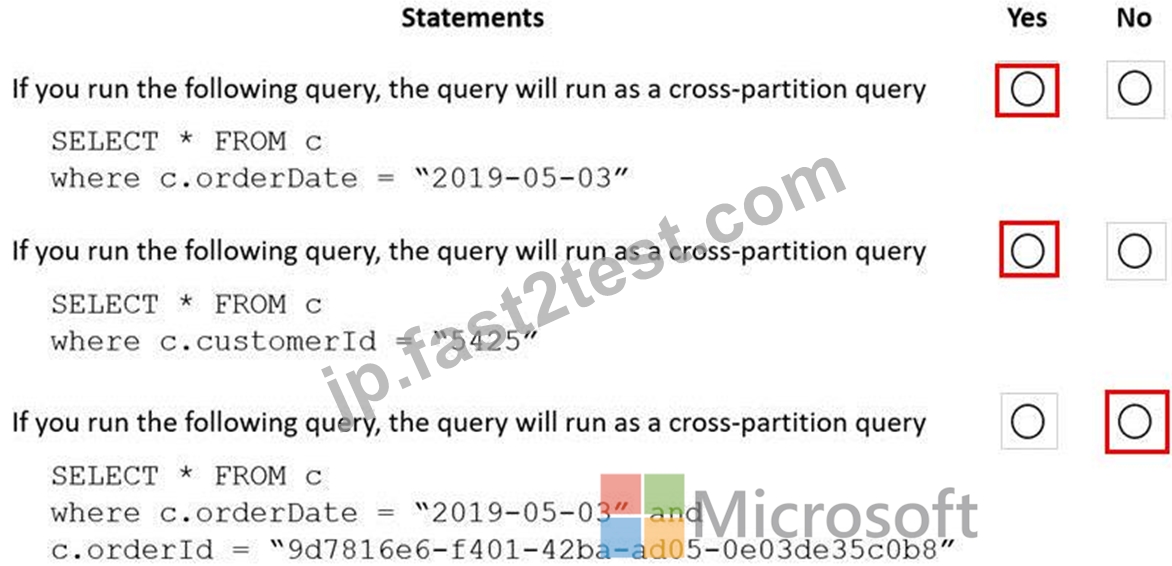
質問 24
You need to implement a trigger in Azure Cosmos DB Core (SQL) API that will run before an item is inserted into a container.
Which two actions should you perform to ensure that the trigger runs? Each correct answer presents part of the solution.
NOTE: Each correct selection is worth one point.
- A. For each create request, set the consistency level to session in RequestOptions.
- B. Append pre to the name of the JavaScript function trigger.
- C. For each create request, set the access condition in RequestOptions.
- D. Register the trigger as a pre-trigger.
- E. For each create request, set the trigger name in RequestOptions.
正解: D
解説:
C: When triggers are registered, you can specify the operations that it can run with.
F: When executing, pre-triggers are passed in the RequestOptions object by specifying PreTriggerInclude and then passing the name of the trigger in a List object.
質問 25
Note: This question is part of a series of questions that present the same scenario. Each question in the series contains a unique solution that might meet the stated goals. Some question sets might have more than one correct solution, while others might not have a correct solution.
After you answer a question in this section, you will NOT be able to return to it. As a result, these questions will not appear in the review screen.
You have an Azure Cosmos DB Core (SQL) API account named account 1 that uses autoscale throughput.
You need to run an Azure function when the normalized request units per second for a container in account1 exceeds a specific value.
Solution: You configure an application to use the change feed processor to read the change feed and you configure the application to trigger the function.
Does this meet the goal?
- A. No
- B. Yes
正解: A
解説:
Instead configure an Azure Monitor alert to trigger the function.
You can set up alerts from the Azure Cosmos DB pane or the Azure Monitor service in the Azure portal.
質問 26
You have an Azure Cosmos DB Core (SQL) API account used by an application named App1.
You open the Insights pane for the account and see the following chart.
Use the drop-down menus to select the answer choice that answers each question based on the information presented in the graphic.
NOTE: Each correct selection is worth one point.
正解:
解説: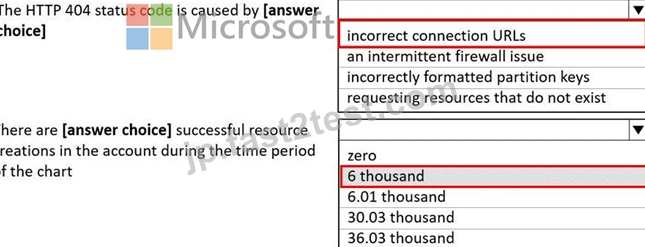
質問 27
......
Microsoft DP-420 認定試験の出題範囲:
| トピック | 出題範囲 |
|---|---|
| トピック 1 |
|
| トピック 2 |
|
| トピック 3 |
|
| トピック 4 |
|
| トピック 5 |
|
| トピック 6 |
|
| トピック 7 |
|
| トピック 8 |
|
| トピック 9 |
|
| トピック 10 |
|
| トピック 11 |
|
2023年最新のFast2test DP-420のPDFで最近更新された問題です:https://jp.fast2test.com/DP-420-premium-file.html
Microsoft DP-420問題集にはリアル試験問題解答:https://drive.google.com/open?id=1ISd9_QKFSlU5dIBrGjdMy3ML1oXPBO7m