

最新の[2023年11月01日]EX294試験問題集で有効で更新された問題集
無料お試しまもなく終了!100%有効なEX294試験問題集には35問があります
EX294試験では、Red Hat Enterprise Linux 8システムの管理と管理に必要な知識とスキルのテストに焦点を当てています。この試験では、システム管理、ネットワーキング、セキュリティ、自動化、ストレージ管理など、さまざまなトピックをカバーしています。候補者は、ネットワークサービスの構成と管理、ストレージボリュームの管理、セキュリティポリシーの構成、仮想マシンの作成と管理、Ansibleを使用したシステム管理タスクの自動化などのタスクを実行する機能を実証する必要があります。 EX294試験を正常に完了すると、候補者が生産環境で複雑なLinuxシステムを管理および構成する能力が示されており、あらゆる組織にとって貴重な資産になります。
Redhat Ex294試験は、スキルを証明し、キャリアを促進しようとしている経験豊富なLinux管理者にとって、挑戦的でありながらやりがいのある認証試験です。 Linuxの専門知識の需要が増え続けているため、RHCE認証は、ITの専門家が雇用市場で自分自身を区別し、潜在的な雇用主に価値を示す優れた方法です。
Red Hat EX294、または Red Hat Enterprise Linux 8 の Red Hat Certified Engineer (RHCE) 試験は、Red Hat Enterprise Linux 8 と一緒に働く IT プロフェッショナルのスキルと知識をテストする認定試験です。この試験は、オープンソースソフトウェアソリューションの主要なプロバイダーである Red Hat によって実施され、経験豊富なシステム管理者、ネットワーク管理者、その他の IT プロフェッショナルを対象としています。
質問 # 17
Create a playbook called timesvnc.yml in /home/sandy/ansible using rhel system role timesync. Set the time to use currently configured nip with the server 0.uk.pool.ntp.org. Enable burst. Do this on all hosts.
正解:
解説:
Solution as: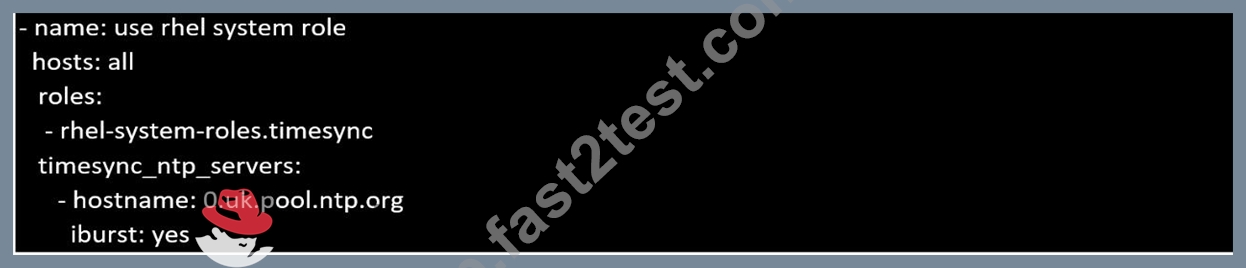
質問 # 18
Install and configure ansible
User sandy has been created on your control node with the appropriate permissions already, do not change or modify ssh keys. Install the necessary packages to run ansible on the control node. Configure ansible.cfg to be in folder /home/sandy/ansible/ansible.cfg and configure to access remote machines via the sandy user. All roles should be in the path /home/sandy/ansible/roles. The inventory path should be in /home/sandy/ansible/invenlory.
You will have access to 5 nodes.
node1.example.com
node2.example.com
node3.example.com
node4.example.com
node5.example.com
Configure these nodes to be in an inventory file where node I is a member of group dev. nodc2 is a member of group test, node3 is a member of group proxy, nodc4 and node 5 are members of group prod. Also, prod is a member of group webservers.
正解:
解説:
In/home/sandy/ansible/ansible.cfg
[defaults]
inventory=/home/sandy/ansible/inventory
roles_path=/home/sandy/ansible/roles
remote_user= sandy
host_key_checking=false
[privilegeescalation]
become=true
become_user=root
become_method=sudo
become_ask_pass=false
In /home/sandy/ansible/inventory
[dev]
node 1 .example.com
[test]
node2.example.com
[proxy]
node3 .example.com
[prod]
node4.example.com
node5 .example.com
[webservers:children]
prod
質問 # 19
In /home/sandy/ansible/ create a playbook called logvol.yml. In the play create a logical volume called Iv0 and make it of size 1500MiB on volume group vgO If there is not enough space in the volume group print a message "Not enough space for logical volume" and then make a 800MiB Iv0 instead. If the volume group still doesn't exist, create a message "Volume group doesn't exist" Create an xfs filesystem on all Iv0 logical volumes. Don't mount the logical volume.
- A. Solution as:

- B. Solution as:
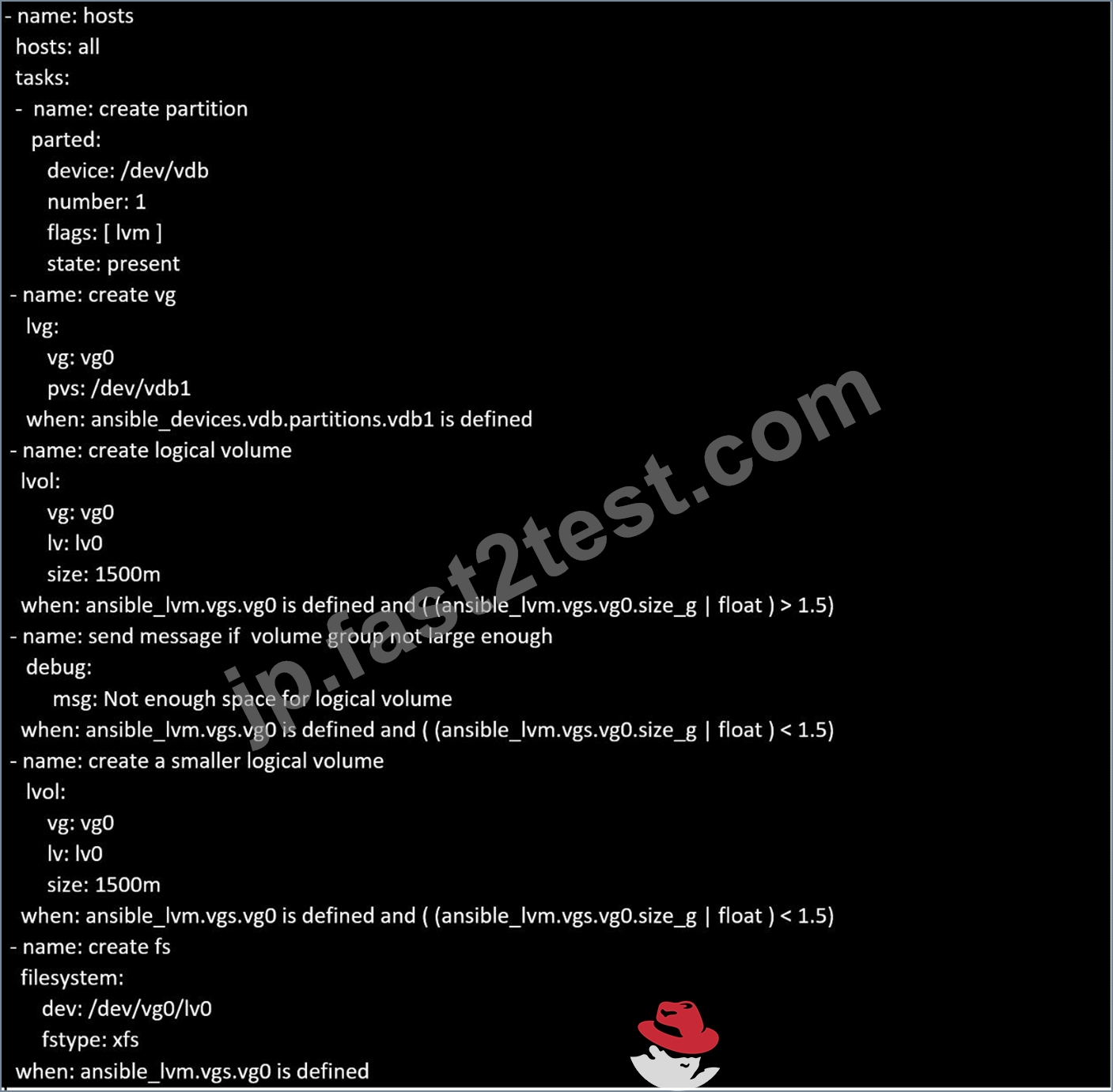
正解:B
質問 # 20
Create a role called sample-apache in /home/sandy/ansible/roles that enables and starts httpd, enables and starts the firewall and allows the webserver service. Create a template called index.html.j2 which creates and serves a message from /var/www/html/index.html Whenever the content of the file changes, restart the webserver service.
Welcome to [FQDN] on [IP]
Replace the FQDN with the fully qualified domain name and IP with the ip address of the node using ansible facts. Lastly, create a playbook in /home/sandy/ansible/ called apache.yml and use the role to serve the index file on webserver hosts.
正解:
解説:
/home/sandy/ansible/apache.yml
/home/sandy/ansible/roles/sample-apache/tasks/main.yml
/home/sandy/ansible/roles/sample-apache/templates/index.html.j2
In /home/sandy/ansible/roles/sample-apache/handlers/main.yml
質問 # 21
Modify file content.
------------------------
Create a playbook called /home/admin/ansible/modify.yml as follows:
* The playbook runs on all inventory hosts
* The playbook replaces the contents of /etc/issue with a single line of text as
follows:
--> On hosts in the dev host group, the line reads: "Development"
--> On hosts in the test host group, the line reads: "Test"
--> On hosts in the prod host group, the line reads: "Production"
正解:
解説:
Solution as:
# pwd
/home/admin/ansible
# vim modify.yml
---
- name:
hosts: all
tasks:
- name:
copy:
content: "Development"
dest: /etc/issue
when: inventory_hostname in groups['dev']
- name:
copy:
content: "Test"
dest: /etc/issue
when: inventory_hostname in groups['test']
- name:
copy:
content: "Production"
dest: /etc/issue
when: inventory_hostname in groups['prod']
:wq
# ansible-playbook modify.yml --syntax-check
# ansible-playbook modify.yml
質問 # 22
Create a playbook called packages.yml that:
----------------------------------------------
--> Installs the php and mariadb packages on hosts in the dev, test, and prod host
groups.
--> Installs the Development Tools package group on hosts in the dev host group.
--> Updates all packages to the latest version on hosts in the dev host group.
正解:
解説:
Solution as:
# pwd
home/admin/ansible/
# vim packages.yml
---
- name: Install the packages
hosts: dev,test,prod
vars:
- php_pkg: php
- mariadb_pkg: mariadb
tasks:
- name: install the packages
yum:
name:
- "{{ php_pkg }}"
- "{{ mariadb_pkg }}"
state: latest
- name: install the devops tool packages
hosts: dev
tasks:
- name: install devepment tools
yum:
name: "@Development Tools"
state: latest
- name: upgrade all the packages
yum:
name: "*"
state: latest
exclude: kernel*
!wq
# ansible-playbook package.yml --syntax-check
# ansible-playbook package.yml
質問 # 23
Create an Ansible vault to store user passwords as follows:
* The name of the vault is valut.yml
* The vault contains two variables as follows:
- dev_pass with value wakennym
- mgr_pass with value rocky
* The password to encrypt and decrypt the vault is atenorth
* The password is stored in the file /home/admin/ansible/password.txt
正解:
解説:
Solution as:
# pwd
/home/admin/ansible
# echo "atenorth" >password.txt
# chmod 0600 password.txt
# ansible-vault create vault.yml --vault-password-file=password.txt
---
- dev_pass: wakennym
- mgr_pass: rocky
:wq
# cat vault.yml
$ANSIBLE_VAULT;1.1;AES256
36383862376164316436353665343765643331393433373564613762666531313034336438353662
3464346331346461306337633632393563643531376139610a343531326130663266613533633562
38623439316631306463623761343939373263333134353264333834353264343934373765643737
3535303630626666370a643663366634383863393338616661666632353139306436316430616334
65386134393363643133363738656130636532346431376265613066326162643437643064313863
6633333537303334333437646163343666666132316639376531
# ansible-vault view vault.yml
password:******
---
- dev_pass: wakennym
- mgr_pass: rocky
質問 # 24
Create a playbook called timesvnc.yml in /home/sandy/ansible using rhel system role timesync. Set the time to use currently configured nip with the server 0.uk.pool.ntp.org. Enable burst. Do this on all hosts.
- A. Solution as:

- B. Solution as:
正解:B
質問 # 25
Create a jinja template in /home/sandy/ansible/ and name it hosts.j2. Edit this file so it looks like the one below. The order of the nodes doesn't matter. Then create a playbook in /home/sandy/ansible called hosts.yml and install the template on dev node at /root/myhosts
正解:
解説:
Solution as:
質問 # 26
Use Ansible Galaxy with a requirements file called /home/admin/ansible/roles/
install.yml to download and install roles to /home/admin/ansible/roles from the
following URLs:
http:// classroom.example.com /role1.tar.gz The name of this role should be balancer
http:// classroom.example.com /role2.tar.gz The name of this role should be phphello
正解:
解説:
Solution as:
# pwd
/home/admin/ansible/roles
# vim install.yml
---
- src: http://classroom.example.com/role1.tar.gz
name: balancer
- src: http://classroom.example.com/role2.tar.gz
name: phphello
:wq!
# pwd
/home/admin/ansible
# ansible-galaxy install -r roles/install.yml -p roles
質問 # 27
Create and run an Ansible ad-hoc command.
--> As a system administrator, you will need to install software on the managed
nodes.
--> Create a shell script called yum-pack.sh that runs an Ansible ad-hoc command to
create yum-repository on each of the managed nodes as follows:
--> repository1
-----------
1. The name of the repository is EX407
2. The description is "Ex407 Description"
3. The base URL is http://content.example.com/rhel8.0/x86_64/dvd/BaseOS/
4. GPG signature checking is enabled
5. The GPG key URL is http://content.example.com/rhel8.0/x86_64/dvd/RPM-GPG-KEYredhat-
release
6. The repository is enabled
--> repository2
-----------
1. The name of the repository is EXX407
2. The description is "Exx407 Description"
3. The base URL is http://content.example.com/rhel8.0/x86_64/dvd/AppStream/
4. GPG signature checking is enabled
5. The GPG key URL is http://content.example.com/rhel8.0/x86_64/dvd/ RPM-GPG-KEYredhat-
release
6. The repository is enabled
正解:
解説:
Solution as:
# pwd
/home/admin/ansible
# vim yum-pack.sh
#!/bin/bash
ansible all -m yum_repository -a 'name=EX407 description="Ex407 Description"
baseurl=http://content.example.com/rhel8.0/x86_64/dvd/BaseOS/ gpgcheck=yes
gpgkey=http://content.example.com/rhel8.0/x86_64/dvd/RPM-GPG-KEY-redhat-release
enabled=yes'
ansible all -m yum_repository -a 'name=EXX407 description="Exx407 Description"
baseurl=http://content.example.com/rhel8.0/x86_64/dvd/AppStream/ gpgcheck=yes
gpgkey=http://content.example.com/rhel8.0/x86_64/dvd/RPM-GPG-KEY-redhat-release
enabled=yes'
:!wq
# chmod +x yum-pack.sh
# bash yum-pack.sh
# ansible all -m command -a 'yum repolist all'
質問 # 28
Create a file called requirements.yml in /home/sandy/ansible/roles to install two roles. The source for the first role is geerlingguy.haproxy and geerlingguy.php. Name the first haproxy-role and the second php-role. The roles should be installed in /home/sandy/ansible/roles.
正解:
解説:
in /home/sandy/ansible/roles
vim requirements.yml
Run the requirements file from the roles directory:
ansible-galaxy install -r requirements.yml -p /home/sandy/ansible/roles
質問 # 29
Create a file called specs.empty in home/bob/ansible on the local machine as follows:
HOST=
MEMORY=
BIOS=
VDA_DISK_SIZE=
VDB_DISK_SIZE=
Create the playbook /home/bob/ansible/specs.yml which copies specs.empty to all remote nodes' path /root/specs.txt. Using the specs.yml playbook then edit specs.txt on the remote machines to reflect the appropriate ansible facts.
正解:
解説:
Solution as:

質問 # 30
Create a file called adhoc.sh in /home/sandy/ansible which will use adhoc commands to set up a new repository. The name of the repo will be 'EPEL' the description 'RHEL8' the baseurl is 'https://dl.fedoraproject.org/pub/epel/epel-release-latest-8.noarch.rmp' there is no gpgcheck, but you should enable the repo.
* You should be able to use an bash script using adhoc commands to enable repos. Depending on your lab setup, you may need to make this repo "state=absent" after you pass this task.
- A. chmod 0117 adhoc.sh
vim adhoc.sh
#I/bin/bash
ansible all -m yum_repository -a 'name=EPEL description=RHEL8
baseurl=https://dl.fedoraproject.org/pub/epel/epel-release-latest-8.noarch.rmp gpgcheck=no enabled=yes' - B. chmod 0777 adhoc.sh
vim adhoc.sh
#I/bin/bash
ansible all -m yum_repository -a 'name=EPEL description=RHEL8
baseurl=https://dl.fedoraproject.org/pub/epel/epel-release-latest-8.noarch.rmp gpgcheck=no enabled=yes'
正解:B
質問 # 31
Create an ansible vault password file called lock.yml with the password reallysafepw in the /home/sandy/ansible directory. In the lock.yml file define two variables. One is pw_dev and the password is 'dev' and the other is pw_mgr and the password is 'mgr' Create a regular file called secret.txt which contains the password for lock.yml.
- A. ansible-vault create lock.yml
New Vault Password: reallysafepw
Confirm: reallysafepw
- B. ansible-vault create lock.yml
New Vault Password: reallysafepw
正解:A
質問 # 32
Create a file called requirements.yml in /home/sandy/ansible/roles a file called role.yml in /home/sandy/ansible/. The haproxy-role should be used on the proxy host. And when you curl http://node3.example.com it should display "Welcome to node4.example.com" and when you curl again "Welcome to node5.example.com" The php-role should be used on the prod host.
- A. Solution as:

Check the proxy host by curl http://node3.example.com - B. Solution as:

Check the proxy host by curl http://node3.example.com
正解:A
質問 # 33
Install and configure ansible
User bob has been created on your control node. Give him the appropriate permissions on the control node. Install the necessary packages to run ansible on the control node.
Create a configuration file /home/bob/ansible/ansible.cfg to meet the following requirements:
* The roles path should include /home/bob/ansible/roles, as well as any other path that may be required for the course of the sample exam.
* The inventory file path is /home/bob/ansible/inventory.
* Ansible should be able to manage 10 hosts at a single time.
* Ansible should connect to all managed nodes using the bob user.
Create an inventory file for the following five nodes:
nodel.example.com
node2.example.com
node3.example.com
node4.example.com
node5.example.com
Configure these nodes to be in an inventory file where node1 is a member of group dev. nodc2 is a member of group test, nodc3 is a member of group proxy, nodc4 and node 5 are members of group prod. Also, prod is a member of group webservers.
正解:
解説:
In/home/sandy/ansible/ansible.cfg
[defaults]
inventory=/home/sandy/ansible/inventory
roles_path=/home/sandy/ansible/roles
remote_user= sandy
host_key_checking=false
[privilegeescalation]
become=true
become_user=root
become_method=sudo
become_ask_pass=false
In /home/sandy/ansible/inventory
[dev]
node 1 .example.com
[test]
node2.example.com
[proxy]
node3 .example.com
[prod]
node4.example.com
node5 .example.com
[webservers:children]
prod
質問 # 34
Create the users in the file usersjist.yml file provided. Do this in a playbook called users.yml located at /home/sandy/ansible. The passwords for these users should be set using the lock.yml file from TASK7. When running the playbook, the lock.yml file should be unlocked with secret.txt file from TASK 7.
All users with the job of 'developer' should be created on the dev hosts, add them to the group devops, their password should be set using the pw_dev variable. Likewise create users with the job of 'manager' on the proxy host and add the users to the group 'managers', their password should be set using the pw_mgr variable.
- A. ansible-playbook users.yml -vault-password-file=secret.txt

- B. ansible-playbook users.yml -vault-password-file=secret.txt

正解:B
質問 # 35
Create a playbook called regulartasks.yml which has the system that append the date to /root/datefile every day at noon. Name is job 'datejob'
- A. Solution as:

- B. Solution as:

正解:B
質問 # 36
Install and configure ansible
User bob has been created on your control node. Give him the appropriate permissions on the control node. Install the necessary packages to run ansible on the control node.
Create a configuration file /home/bob/ansible/ansible.cfg to meet the following requirements:
* The roles path should include /home/bob/ansible/roles, as well as any other path that may be required for the course of the sample exam.
* The inventory file path is /home/bob/ansible/inventory.
* Ansible should be able to manage 10 hosts at a single time.
* Ansible should connect to all managed nodes using the bob user.
Create an inventory file for the following five nodes:
nodel.example.com
node2.example.com
node3.example.com
node4.example.com
node5.example.com
Configure these nodes to be in an inventory file where node1 is a member of group dev. nodc2 is a member of group test, nodc3 is a member of group proxy, nodc4 and node 5 are members of group prod. Also, prod is a member of group webservers.
- A. In/home/sandy/ansible/ansible.cfg
[defaults]
inventory=/home/sandy/ansible/inventory
roles_path=/home/sandy/ansible/roles
remote_user= sandy
host_key_checking=false
[privilegeescalation]
become=true
become_user=root
become_method=sudo
become_ask_pass=false
In /home/sandy/ansible/inventory
[dev]
node 1 .example.com
[test]
node2.example.com
[proxy]
node3 .example.com
[prod]
node4.example.com
node5 .example.com
[webservers:children]
Prod - B. In/home/sandy/ansible/ansible.cfg
[defaults]
inventory=/home/sandy/ansible/inventory
roles_path=/home/sandy/ansible/roles
remote_user= sandy
host_key_checking=false
[privilegeescalation]
become=true
become_user=root
In /home/sandy/ansible/inventory
[dev]
node 1 .example.com
[test]
node2.example.com
[proxy]
node3 .example.com
[prod]
node4.example.com
node5 .example.com
[webservers:children]
prod
正解:A
質問 # 37
Create an empty encrypted file called myvault.yml in /home/sandy/ansible and set the password to notsafepw. Rekey the password to iwejfj2221.
正解:
解説:
ansible-vault create myvault.yml
Create new password: notsafepw Confirm password: notsafepw ansible-vault rekey myvault.yml
Current password: notsafepw New password: iwejfj2221 Confirm password: iwejfj2221
質問 # 38
Create user accounts
------------------------
--> A list of users to be created can be found in the file called user_list.yml
which you should download from http://classroom.example.com/user_list.yml and
save to /home/admin/ansible/
--> Using the password vault created elsewhere in this exam, create a playbook called
create_user.yml
that creates user accounts as follows:
--> Users with a job description of developer should be:
--> created on managed nodes in the "dev" and "test" host groups assigned the
password from the "dev_pass"
variable and these user should be member of supplementary group "devops".
--> Users with a job description of manager should be:
--> created on managed nodes in the "prod" host group assigned the password from
the "mgr_pass" variable
and these user should be member of supplementary group "opsmgr"
--> Passwords should use the "SHA512" hash format. Your playbook should work using
the vault password file
created elsewhere in this exam.
while practising you to create these file hear. But in exam have to download as per
questation.
user_list.yml file consist:
---
user:
- name: user1
job: developer
- name: user2
job: manager
正解:
解説:
Solution as:
# pwd
/home/admin/ansible
# wget http://classroom.example.com/user_list.yml
# cat user_list.yml
# vim create_user.yml
---
- name:
hosts: all
vars_files:
- ./user_list.yml
- ./vault.yml
tasks:
- name: creating groups
group:
name: "{{ item }}"
state: present
loop:
- devops
- opsmgr
- name: creating user
user:
name: "{{ item.name }}"
state: present
groups: devops
password: "{{ dev_pass|password_hash ('sha512') }}"
loop: "{{ user }}"
when: (inventory_hostname in groups['dev'] or inventory_hostname in
groups['test']) and item.job == "developer"
- name: creating user
user:
name: "{{ item.name }}"
state: present
groups: opsmgr
password: "{{ mgr_pass|password_hash ('sha512') }}"
loop: "{{ user }}"
when: inventory_hostname in groups['prod'] and item.job == "manager"
:wq!
# ansible-playbook create_user.yml --vault-password-file=password.txt --syntax-check
# ansible-playbook create_user.yml --vault-password-file=password.txt
質問 # 39
......
EX294試験問題集で100%高得点させるEX294試験解答がこちら:https://jp.fast2test.com/EX294-premium-file.html
検証済みのEX294試験問題成功確定させます:https://drive.google.com/open?id=1HbWzGLmL0OkPab8RDvqCVQ7QSKRFxxPZ