

SC-300問題集でリアル試験問題でテストエンジン問題集でトレーニング
Microsoft SC-300テスト問題集とオンライン試験エンジン
質問 # 167
You create a Log Analytics workspace.
You need to implement the technical requirements for auditing.
What should you configure in Azure AD?
- A. Diagnostics settings
- B. App registrations
- C. Company branding
- D. External Identities
正解:A
解説:
Reference:
https://docs.microsoft.com/en-us/azure/active-directory/reports-monitoring/overview-monitoring
質問 # 168
You have an Azure Active Directory (Azure AD) tenant that has Security defaults disabled.
You are creating a conditional access policy as shown in the following exhibit.
Use the drop-down menus to select the answer choice that completes each statement based on the information presented in the graphic.
NOTE: Each correct selection is worth one point.
正解:
解説:
Explanation: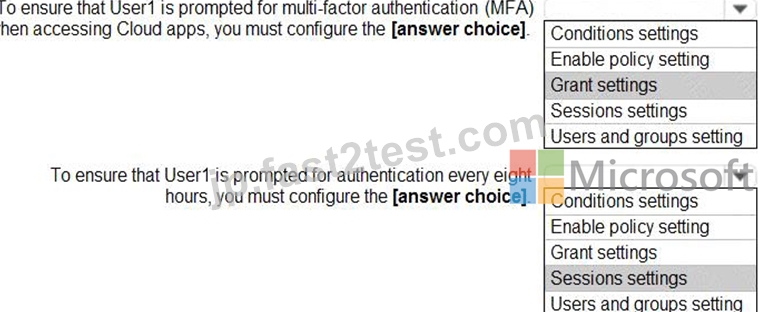
Reference:
https://docs.microsoft.com/en-us/azure/active-directory/conditional-access/howto-conditional-access-policy-all-u
質問 # 169
You have an Azure Active Directory (Azure AD) tenant that contains Azure AD Privileged Identity Management (PIM) role settings for the User administrator role as shown in the following exhibit.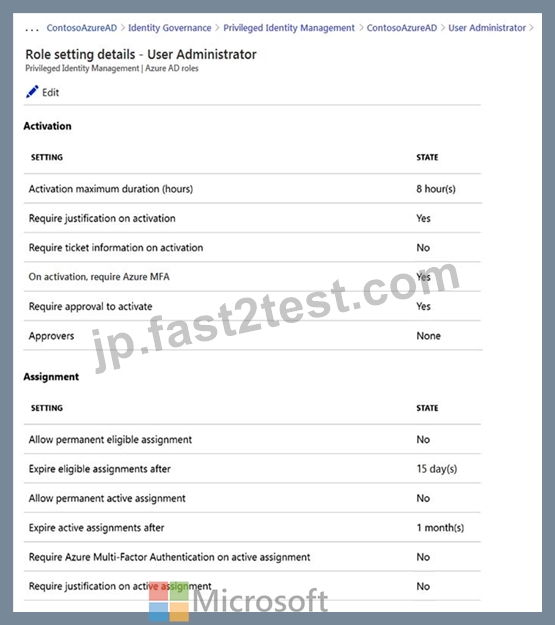
Use the drop-down menus to select the answer choice that completes each statement based on the information presented in the graphic.
NOTE: Each correct selection is worth one point.
正解:
解説: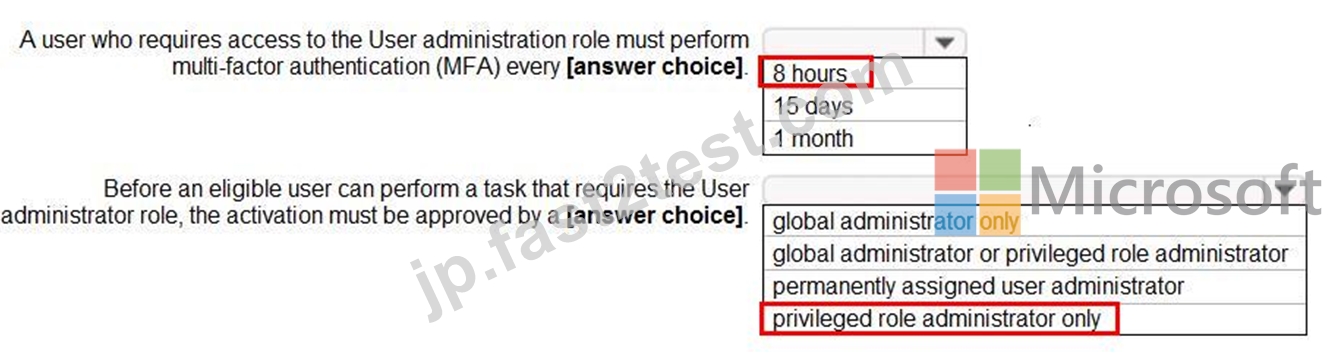
Reference:
https://docs.microsoft.com/en-us/azure/active-directory/privileged-identity-management/pim-configure
https://docs.microsoft.com/en-us/azure/active-directory/privileged-identity-management/pim-deployment-plan
質問 # 170
You have an Azure Active Directory (Azure AD) tenant named contoso.com that contains a user named User1.
User1 has the devices shown in the following table.
On November 5, 2020, you create and enforce terms of use in contoso.com that has the following settings:
Name: Terms1
Display name: Contoso terms of use
Require users to expand the terms of use: On
Require users to consent on every device: On
Expire consents: On
Expire starting on: December 10, 2020
Frequency: Monthly
On November 15, 2020, User1 accepts Terms1 on Device3.
For each of the following statements, select Yes if the statement is true. Otherwise, select No.
NOTE: Each correct selection is worth one point.
正解:
解説: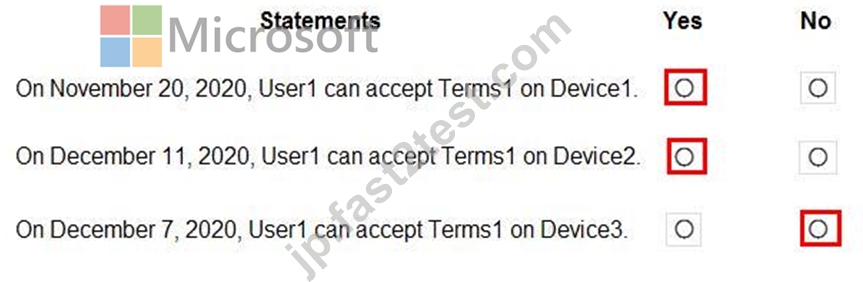
質問 # 171
You need to support the planned changes and meet the technical requirements for MFA.
Which feature should you use, and how long before the users must complete the registration? To answer, select the appropriate options in the answer area.
NOTE: Each correct selection is worth one point.
正解:
解説:
質問 # 172
Your network contains an on-prernises Active Directory Domain Services (AD DS) domain that syncs with Azure AD and contains the users shown in the following table.
In Azure AD Connect. Domain/OU Filtering is configured as shown in the following exhibit.
For each of the following statements, select Yes if the statement is true. Otherwise, select No.
NOTE: Each correct selection is worth one point.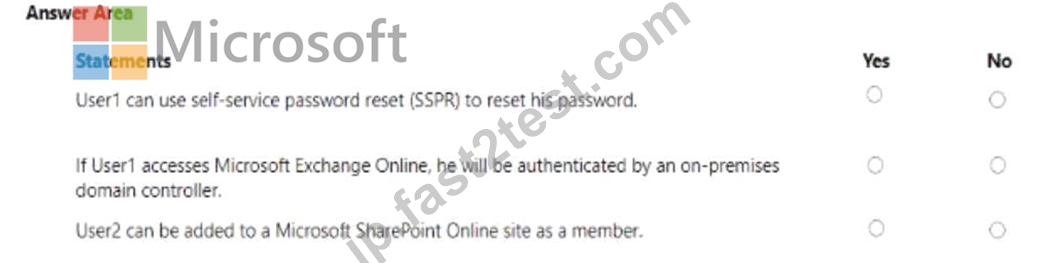
正解:
解説: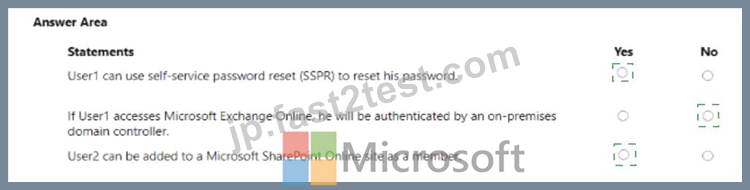
Explanation
質問 # 173
You have an Azure Ad tenant that contains the users show in the following table.
You create a dynamic user group and configure the following rule syntax.
Which users will be added to the group?
- A. User2 only
- B. User1, User2, and User3
- C. User3 only
- D. User1 only
- E. User1 and User2 only
- F. User1 and User3 only
正解:E
質問 # 174
You have a Microsoft 365 E5 subscription.
You need to create a Microsoft Defender for Cloud Apps session policy.
What should you do first?
- A. From the Microsoft Defender for Cloud Apps portal, select User monitoring.
- B. From the Microsoft Defender for Cloud Apps portal, select App onboarding/maintenance
- C. From the Microsoft Defender for Cloud Apps portal, create a continuous report.
- D. From the Azure Active Directory admin center, create a Conditional Access policy.
正解:D
質問 # 175
You have an Azure AD tenant that contains the users shown in the following table.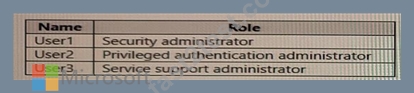
User2 reports that he can only configure multi-factor authenticating (MFA) to use the Microsoft Authenticator app.
You need to ensure that User2 can configure alternate MFA methods.
Which configuration is required, and which user should perform the configuration? To answer, select the appropriate options in the answer area.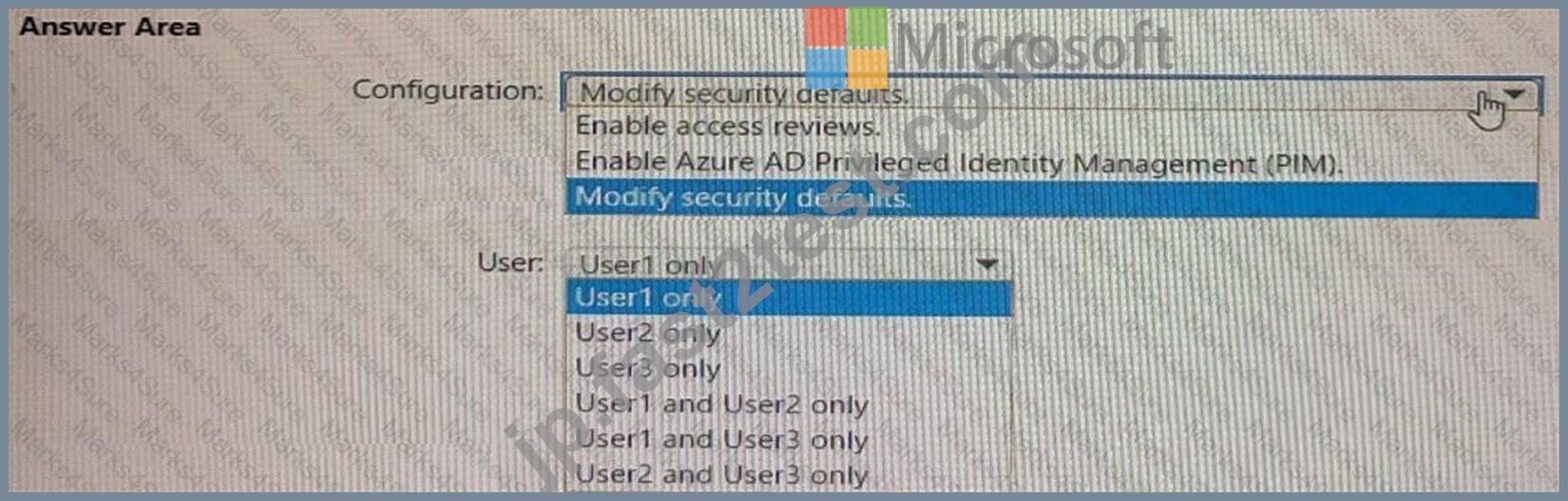
正解:
解説:
Explanation: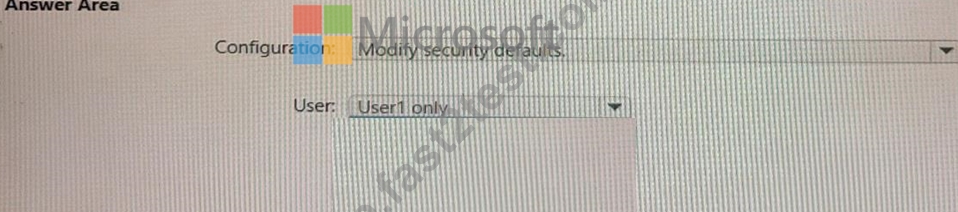
質問 # 176
You have a hybrid Microsoft 365 subscription that contains the users show in the following table.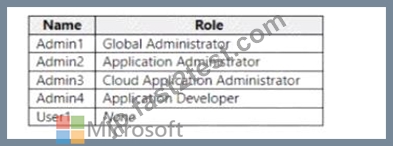
You plan to deploy an on-premises app1. App1 will be registered in Azure AD and will use Azure AD Application Proxy.
You need to delegate the installation of the Application Proxy connector and ensure that User1 can register App1 in Azure AD. The solution must use the principle of least privilege.
Which user should perform the installation, and which role should you assign to Users1? To answer, select the appropriate options in the answer area.
NOTE: Each correct selection is worth one point.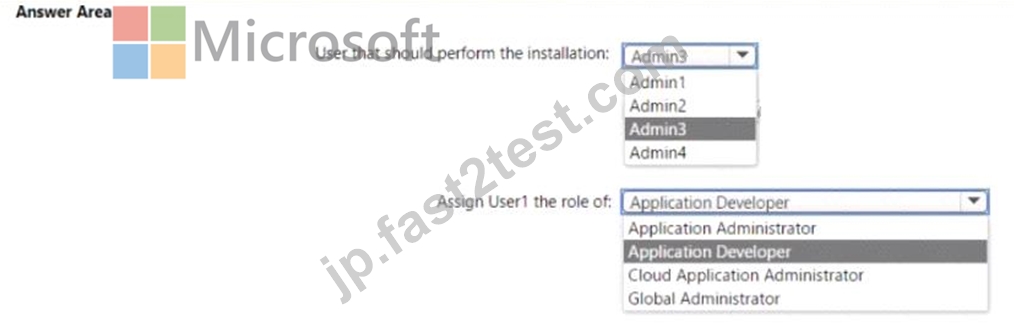
正解:
解説: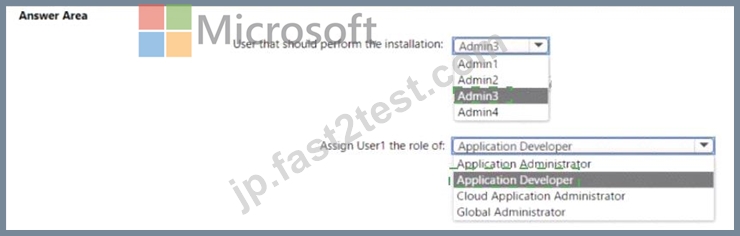
Explanation
質問 # 177
Your company has an Azure Active Directory (Azure AD) tenant named Contoso.com. The company has a business partner named Fabrikam, Inc.
Fabrikam uses Azure AD and has two verified domain names of fabrikam.com and litwarein.com Both domain names are sued for Fabrikam email addresses.
You create a connected organization for Fabrikam.
You need to ensure that the package1 will be accessible only to users who have fabrikam.com email addresses.
What should you do? To answer, select the appropriate options in the answer area.
NOTE: Each correct selection is worth one point.
正解:
解説:
質問 # 178
You implement the planned changes for SSPR.
What occurs when User3 attempts to use SSPR? To answer, select the appropriate options in the answer area.
NOTE: Each correct selection is worth one point.
正解:
解説:
質問 # 179
You have a Microsoft 365 E5 tenant.
You purchase a cloud app named App1.
You need to enable real-time session-level monitoring of App1 by using Microsoft Defender for Cloud Apps.
In which order should you perform the actions? To answer, move the appropriate actions from the list of actions to the answer area and arrange them in the correct order.
正解:
解説:
Explanation:
Register App1 in Microsoft Entra ID.
Create a conditional access policy that has session controls configured.
From Microsoft Defender for Cloud Apps, modify the Connected apps settings for App1.
From Microsoft Defender for Cloud Apps, create a session policy.
Let's break this down step by step based on Microsoft Defender for Cloud Apps (MDCA) and Microsoft Entra ID integration for enabling real-time session-level monitoring, as outlined in Microsoft Identity and Access Administrator documentation.
Understanding the Goal: Real-Time Session-Level Monitoring with Microsoft Defender for Cloud Apps:
Microsoft Defender for Cloud Apps (MDCA) is a Cloud Access Security Broker (CASB) solution that provides visibility, control, and threat protection for cloud applications.
Real-time session-level monitoring allows MDCA to inspect and control user activities within a cloud app (App1 in this case) during active sessions. This requires integration with Microsoft Entra ID and the use of Conditional Access policies to route sessions through MDCA for monitoring.
The Microsoft 365 E5 tenant includes licenses for Microsoft Entra ID P2 and Microsoft Defender for Cloud Apps, which are necessary for this functionality.
Step-by-Step Analysis of the Actions:To enable real-time session-level monitoring, the actions must be performed in a logical order that aligns with Microsoft's recommended workflow for integrating a cloud app with MDCA.
Step 1: Register App1 in Microsoft Entra ID.
Before App1 can be monitored by MDCA, it must be registered as an application in Microsoft Entra ID. This step involves adding App1 to the tenant's enterprise applications, which allows Microsoft Entra ID to manage authentication and authorization for the app.
Registering the app in Microsoft Entra ID enables single sign-on (SSO) and allows the app to be governed by Conditional Access policies, which is a prerequisite for session-level monitoring.
This is the first step because none of the other actions can proceed without App1 being recognized by Microsoft Entra ID.
Step 2: Create a conditional access policy that has session controls configured.
Microsoft Defender for Cloud Apps integrates with Microsoft Entra ID Conditional Access to enforce session- level monitoring. A Conditional Access policy must be created to target App1 and include session controls that route user sessions through MDCA.
In the Conditional Access policy, under "Session" controls, you enable the option "Use Conditional Access App Control," which integrates with MDCA. This allows MDCA to monitor and control the session in real time.
This step must come after registering the app in Microsoft Entra ID because the Conditional Access policy needs to target an existing app. It must also precede the MDCA-specific steps because the session control integration sets up the connection between Microsoft Entra ID and MDCA.
Step 3: From Microsoft Defender for Cloud Apps, modify the Connected apps settings for App1.
After the Conditional Access policy routes sessions to MDCA, you need to configure App1 within MDCA by modifying its Connected apps settings. This step involves ensuring that App1 is properly connected to MDCA, which may include configuring API connectors or verifying that MDCA can monitor the app's activities.
This step is necessary to ensure MDCA has the necessary permissions and configurations to monitor App1. It comes after the Conditional Access policy because the policy enables the integration, and now MDCA needs to be set up to handle the app.
Step 4: From Microsoft Defender for Cloud Apps, create a session policy.
Finally, you create a session policy in MDCA to define the real-time monitoring and control rules for App1. A session policy in MDCA allows you to monitor user activities (e.g., file downloads, data sharing) and apply actions (e.g., block, notify) based on predefined conditions.
This step is the last because it relies on the previous steps: the app must be registered, the Conditional Access policy must route sessions to MDCA, and the Connected apps settings must be configured for MDCA to recognize App1. Only then can you define session policies to enforce real-time monitoring.
Why This Order?
The order ensures a logical flow:
Registering the app in Microsoft Entra ID establishes the app's identity in the tenant.
The Conditional Access policy enables the integration with MDCA by routing sessions through it.
Modifying the Connected apps settings in MDCA ensures the app is properly set up for monitoring.
Creating a session policy in MDCA defines the specific monitoring and control rules for real-time session- level monitoring.
Deviating from this order would result in errors. For example, creating a session policy in MDCA before registering the app in Microsoft Entra ID would fail because MDCA wouldn't recognize the app.
Additional Considerations:
The Microsoft 365 E5 license includes Microsoft Entra ID P2 and Microsoft Defender for Cloud Apps, so no additional licensing is required for this scenario.
If App1 is not a supported app for MDCA's app connectors, additional steps (e.g., using a custom app connector) might be needed, but the question implies App1 can be monitored with the standard process.
Session policies in MDCA can include actions like blocking downloads or requiring step-up authentication, which are applied in real time during the user's session.
Conclusion:The correct order to enable real-time session-level monitoring of App1 using Microsoft Defender for Cloud Apps is:
Register App1 in Microsoft Entra ID.
Create a conditional access policy that has session controls configured.
From Microsoft Defender for Cloud Apps, modify the Connected apps settings for App1.
From Microsoft Defender for Cloud Apps, create a session policy.
References:
Microsoft Defender for Cloud Apps documentation: "Session control with Microsoft Defender for Cloud Apps" (Microsoft Learn:https://learn.microsoft.com/en-us/defender-cloud-apps/session-policy) Microsoft Entra ID Conditional Access documentation: "Session controls in Conditional Access" (Microsoft Learn:https://learn.microsoft.com/en-us/entra/identity/conditional-access/concept-conditional-access-session) Microsoft Identity and Access Administrator (SC-300) exam study guide, which covers integrating Microsoft Defender for Cloud Apps with Microsoft Entra ID for session-level monitoring.
質問 # 180
You need to implement on-premises application and SharePoint Online restrictions to meet the authentication requirements and the access requirements.
What should you do? To answer, select the appropriate options in the answer area.
NOTE: Each correct selection is worth one point.
正解:
解説: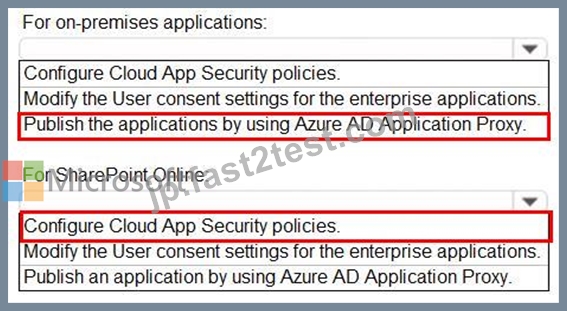
質問 # 181
You have an Azure AD tenant that contains the users shown in the following table.
You have the Azure AD Identity Protection policies shown in the following table.
You review the Risky users report and the Risky sign-ins report and perform actions for each user as shown in the following table.
For each of the following statements, select Yes if the statement is true. Otherwise, select No.
NOTE: Each correct selection is worth one point.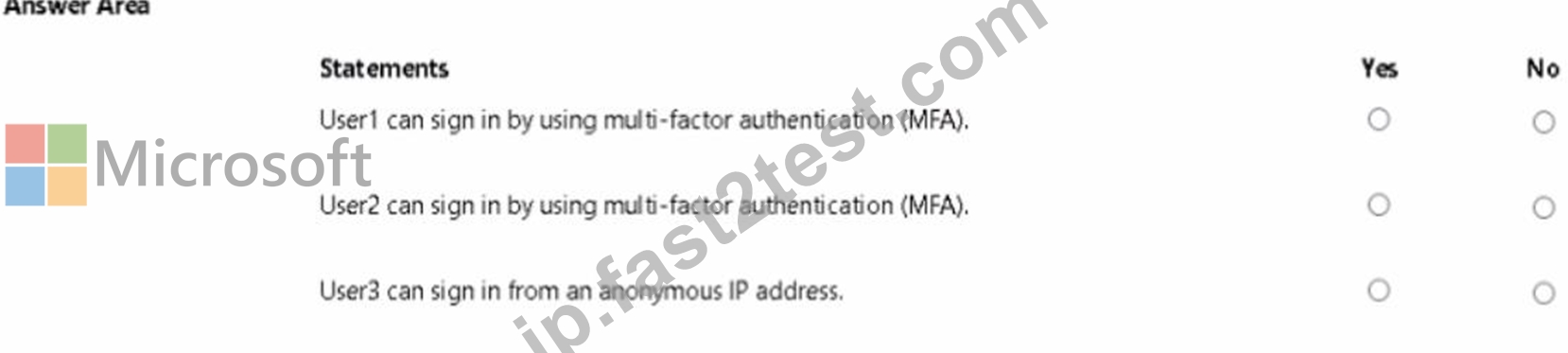
正解:
解説: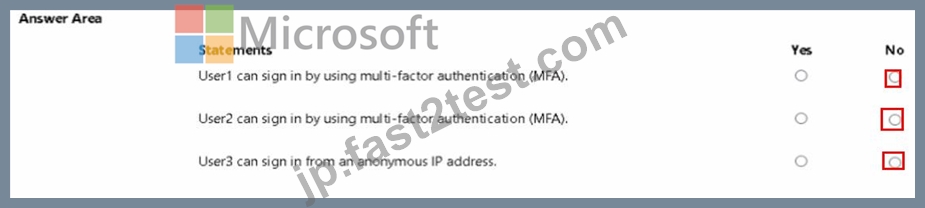
質問 # 182
You have a Microsoft 365 tenant.
You configure a conditional access policy as shown in the Conditional Access policy exhibit. (Click the Conditional Access policy tab.)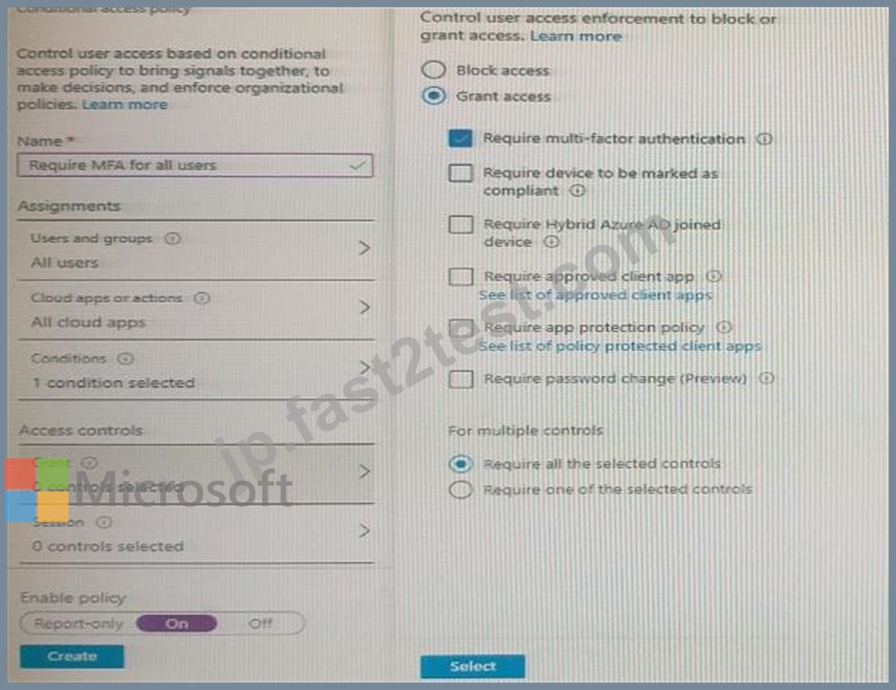
You view the User administrator role settings as shown in the Role setting details exhibit. (Click the Role setting details tab.)
You view the User administrator role assignments as shown in the Role assignments exhibit. (Click the Role assignments lab.)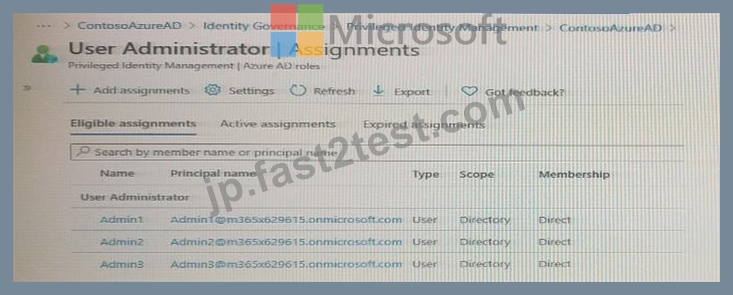
For each of the following statement, select Yes if the statement is true. Otherwise, select No.
NOTE: Each correct selection is worth one point.
正解:
解説:
質問 # 183
......
Microsoft SC-300問題を提供していますMicrosoft Certified: Identity and Access Administrator Associate問題集と完璧な解答付き:https://jp.fast2test.com/SC-300-premium-file.html
信頼され続けるSC-300試験のコツとPDF試験材料:https://drive.google.com/open?id=1Sri4tKBzou104TMBgM5KvQdBBMudv2Rs