

Fast2test CCBAリアル試験問題解答は更新された[2024年05月12日]
お手軽に合格させる 最新IIBA CCBA問題集には522問があります
CCBA認定を達成することは、複雑なビジネス上の問題を分析し、改善の機会を特定し、長期的な成功のための効果的な戦略を生み出すスキルと知識を持っていることを示しています。また、より多くの組織がビジネス分析の価値を認識し、資格のある専門家が目標を達成できるように求めているため、就職活動において競争力を与えることもできます。 CCBA認定により、ビジネスアナリストとしての信頼性を高め、競争から際立たせることができます。
質問 # 60
You need to identify assumptions as part of the assessment of capability gaps. Which of the following is an example of an assumption?
- A. The software must be compatible with the current operating system.
- B. The project manager believes that her project team members can program in COBOL.
- C. The risk in the project must be quantified.
- D. All vendors must have security clearance.
正解:B
解説:
Explanation
Of all the choices, the belief about the project team members is the best example of an assumption. An assumption is something that is believed to be true, but it has not been proven to be true.
Answer B is incorrect. This is an example of a constraint. Answer D is incorrect. This is an example of a requirement.
Answer C is incorrect. This is an enterprise environmental factor, which could also be seen as a requirement.
質問 # 61
A facilities management company has an ambitious growth plan of doubling the revenue of their office waste recycling service over the next 12 months. The business analyst (BA) plans to define the objectives and align them with the enterprise's vision, mission and goals. What element of 'SMART' goals would this objective refer to?
- A. Specialized
- B. Relevant
- C. Measureable
- D. Achievable
正解:B
解説:
There is a well-known test for assessing objectives in terms of how well they have been defined, called SMART. The SMART test works as follows:
Specific: Is your objective specific; does it describe a specific outcome or result? Measurable: Is the outcome or result measurable?
Achievable: Is this objective feasible or achievable?
Relevant: Is this objective aligned and relevant to the organization's vision and goals? Time-bound: What is the timeframe for this objective to be achieved?
質問 # 62
Holly is the business analyst for her organization and she's leading a requirements workshop for a proposed solution. In this workshop, Holly is using a requirements tracing matrix to help prevent against scope creep.
What is scope creep?
- A. It's the addition of the things that aren't needed to consume the project budget.
- B. It's the addition of the deliverables that don't trace back to the original business goals to the project scope.
- C. It's the removal of the things that don't conform to the quality of the requirements.
- D. It's the addition of the things that don't trace back to the original project scope.
正解:D
解説:
Explanation
Scope creep is the uncontrolled expansion of the project scope due to the addition of requirements that are not aligned with the original project scope. A requirements tracing matrix is a tool that helps track the alignment of requirements with the project scope, objectives, and deliverables. It can help prevent scope creep by identifying and rejecting any requirements that are out of scope or do not add value to the project. References:
Capability in Business Analysis™ (CCBA®) Handbook, page 14
A Guide to the Business Analysis Body of Knowledge® (BABOK® Guide), page 40
質問 # 63
You are the business analyst for your organization and you are completing the manage requirements traceability process. You are tracking the requirements to determine how the requirements are interrelated with one another and with the actual delivery of the project scope.
There are actually three reasons why the business analyst should trace requirements. Which one of the following is not one of the three reasons why trace requirements are useful?
- A. Impact analysis
- B. Requirements coverage
- C. Quality control
- D. Requirements allocation
正解:C
解説:
Quality control is a project management process that inspects the project deliverables for quality. Its goal is to identify defects so that corrective actions may be implemented.
Answer A is incorrect. Requirements allocation is the process of assigning stakeholder and solution requirements to solution components and releases.
Answer B is incorrect. Requirements coverage allows business objectives to be traced to business rules, data elements, and use cases to determine how they'll be accomplished in the project.
Answer D is incorrect. Impact analysis allows the business analyst and the project manager to determine how a change in requirements can affect the other requirements in the solution scope.
質問 # 64
A business analyst has just hosted a brainstorming session that has generated 57 ideas for a solution. What should the business analyst do with the ideas now?
- A. Record the ideas as requirements.
- B. Discuss each idea with the project manager.
- C. Rate the ideas.
- D. Research each idea for time and cost.
正解:C
解説:
Once the ideas have been recorded, then the business analyst should rate the ideas and distribute the list to the appropriate stakeholders.
Answer C is incorrect. The business analyst doesn't record the ideas as requirements.
Answer B is incorrect. This isn't a valid statement as time and cost estimates aren't needed for each idea generated in the session.
Answer A is incorrect. The project manager doesn't need, necessarily, to discuss the brainstorming ideas.
質問 # 65
If an organization wants to re-use requirements, where should the defined requirements be kept?
- A. Project management plan
- B. Requirements management plan
- C. Requirements repository
- D. Solution scope
正解:C
解説:
Explanation/Reference:
Explanation:
Requirements that are re-used in an organization are ideally kept in a requirements repository. One person should be identified to manage and control the repository.
A is incorrect. Requirements for the current endeavor are kept in the requirements management
plan, but not the set of requirements that will be reused.
D is incorrect. The project management plan is not a valid answer, as this plan defines how the
project will be planned,
executed, monitored and controlled, and closed.
C is incorrect. The solution scope is not a place where requirements that are reused will be kept
and maintained.
質問 # 66
A business analyst (BA) is proposing design options and a number of opportunities are occurring that need to be understood further. One particular opportunity will prevent different stakeholders from performing the same function in distinctly different ways. What type of opportunity is this?
- A. Additional capabilities
- B. increased efficiency
- C. improved access to information
- D. Reduced barriers to entry
正解:B
解説:
An opportunity is a situation in which it is possible for an organization to perform more effectively or efficiently, or to better meet the needs and desires of its stakeholders1. One type of opportunity is increased efficiency, which means reducing the amount of resources, time, or effort required to produce the same or better results2. In this question, preventing different stakeholders from performing the same function in distinctly different ways can lead to increased efficiency by eliminating duplication, inconsistency, and confusion. References: 1: BABOK Guide v3, Section 3.1 2: Business Efficiency
質問 # 67
Henry is meeting with Janet, the business analyst of the organization. They are discussing an opportunity to create a new service their company can provide, though the startup of the service would take time and an investment. Henry wants Janet to explore the possibility of this new venture. What activity is Henry asking Janet to complete?
- A. Create a data diagram for the service.
- B. Brainstorm the business need.
- C. Define the business need.
- D. Elicit the requirements of the proposal.
正解:C
解説:
Explanation
Defining the business need is the activity that Henry is asking Janet to complete. Defining the business need is the process of identifying and describing the problem or opportunity that the organization faces and how it aligns with the organizational goals and objectives. It helps to set the direction and scope for the rest of the business analysis activities and to justify the initiation of a project or an initiative. Defining the business need is part of the strategy analysis knowledge area in the CCBA certification12 Option A is incorrect because brainstorming the business need is not an activity, but a technique.
Brainstorming is a technique that involves generating and evaluating new and original ideas to address a problem or an opportunity. It can be used as part of defining the business need, but it is not the same as defining the business need34 Option B is incorrect because creating a data diagram for the service is not an activity, but a deliverable. A data diagram is a graphical representation of the data and information that are relevant to the solution. It can be used as an output of defining the business need, but it is not the same as defining the business need.
Option D is incorrect because eliciting the requirements of the proposal is not an activity, but a process.
Eliciting the requirements is the process of identifying and obtaining the information needed from the stakeholders and other sources to define and validate the requirements. It can be used as an input to defining the business need, but it is not the same as defining the business need.
References:
Business Analysis Body of Knowledge (BABOK® Guide), Version 3, Chapter 6: Strategy Analysis, Section 6.1: Define Current State, p. 133-134.
Certification of Capability in Business Analysis (CCBA®) - Simplilearn, Module 7: Requirements Analysis and Design Definition, Lesson 7.1: Define Design Options, p. 6-7.
Business Analysis Techniques - ECBA, CCBA, CBAP Endorsed, Section 7.5: Creative Thinking, p.
83-84.
Certification of Capability in Business Analysis (CCBA®) - Simplilearn, Module 7: Requirements Analysis and Design Definition, Lesson 7.3: Define Design Options, p. 6-7.
[Business Analysis Techniques - ECBA, CCBA, CBAP Endorsed], Section 7.2: Process Modeling, p.
75-76.
[Certification of Capability in Business Analysis (CCBA®) - Simplilearn], Module 7: Requirements Analysis and Design Definition, Lesson 7.2: Analyze Potential Value and Recommend Solution, p. 6-7.
[Business Analysis Techniques - ECBA, CCBA, CBAP Endorsed], Section 7.4: Requirements Elicitation, p. 79-80.
[Certification of Capability in Business Analysis (CCBA®) - Simplilearn], Module 6: Elicitation and Collaboration, Lesson 6.3: Conduct Elicitation, p. 6-7.
質問 # 68
During the analysis, synthesis, and refinement of elicitation results the business analyst (BA) has discovered that some information is missing. Which course of action would resolve the situation?
- A. Conduct elicitation activities
- B. Verify the requirements results
- C. Validate the requirements
- D. Conduct traceability analysis
正解:A
解説:
Explanation
The course of action that would resolve the situation of missing information is to conduct elicitation activities.
Elicitation is the process of obtaining information from stakeholders or other sources to understand the needs, expectations, and context of the project. Elicitation activities can include interviews, workshops, surveys, observation, document analysis, and prototyping. By conducting elicitation activities, the BA can fill in the gaps, clarify the ambiguities, and confirm the accuracy of the information collected during the previous elicitation sessions. Elicitation activities are different from verifying the requirements results, which is the process of checking that the requirements are correctly and completely documented; conducting traceability analysis, which is the process of tracking the relationships and dependencies among the requirements and other project artifacts; and validating the requirements, which is the process of ensuring that the requirements are aligned with the business objectives, stakeholder needs, and solution scope.
References: The answer is verified and explained using the principles found in the CCBA® certification learning documents, specifically the Business Analysis Body of Knowledge (BABOK®) guide, which outlines the knowledge areas and skills required for effective business analysis and the handling of such situations123.
質問 # 69
Karen is the business analyst for her organization and she's reviewing the tasks within her endeavor. Several of the tasks have the characteristic that the activity will be completed with the project stakeholders, consultants, and business analyst, though this hasn't yet been approved. What is this condition of believing some things to be true about an activity without proving the validity of the belief called?
- A. Risk
- B. Boundary
- C. Constraint
- D. Assumption
正解:D
解説:
Explanation
An assumption is something that you believe to be true, but it's not been proven to be true or false. The assumption in this scenario is that the stakeholders will be available to complete activities.
Answer C is incorrect. A constraint is something that limits your options.
Answer D is incorrect. A boundary defines what's in and out of the domain of business analysis, project management, or any other endeavor.
Answer A is incorrect. A risk is an uncertain event or condition that may have a positive or negative effect on the project.
質問 # 70
A business analyst must consider the business value a solution brings in relation to the cost of implementing the desired solution. Suppliers will often be limited in the amount of requirements they can implement based on the allocated resources. If there are not enough resources to implement all of the solutions, what can the business analyst create to justify the additional funds for the implementation?
- A. Business case
- B. Benefits-cost ratio
- C. Risk assessment with positive risk analysis
- D. Cost analysis
正解:A
質問 # 71
When a business analyst performs requirements tracing, he may need to trace the requirements backward through their lineage and may need to trace the requirements forward through their relationship to other requirements. What is the forward tracing activity called in requirements traceability?
- A. Derivation
- B. Lineage tracking
- C. Allocation
- D. Backwards pass
正解:C
解説:
Explanation/Reference:
Allocation is the forward tracking of a requirement to future requirements in the set of requirements.
C is incorrect. Backward tracing of a requirement is called its derivation, as the requirements may
be derived from other older requirements.
A is incorrect. Lineage tracking is not a valid term, so this choice is not valid.
B is incorrect. Backwards pass isn't a valid requirements tracing term; it describes a process in
schedule management.
質問 # 72
You are the business analyst for your organization and you're preparing to elicit requirements from the stakeholders. You've gathered several inputs to help with the elicitation process. Which input(s) will be used to ensure that you understand the type of information that should be elicited from the stakeholders?
- A. Business need
- B. Stakeholder list
- C. Roles and responsibility
- D. Risk assessment
正解:A
質問 # 73
The following chart represents attendance of subject matter experts (SME) and the solution owner for a requirements review and approval meeting held weekly by a business analyst (BA).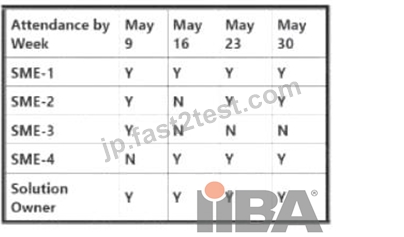
The requirements package was approved by the solution owner during the May 30 meeting. After implementation of the solution, the BA learns that the users in SME-3 s area are not using the system. Which business analysis activity should the BA have monitored more closely to mitigate this situation?
- A. Stakeholder engagement
- B. Solution performance
- C. Requirements scope
- D. Business processes
正解:A
解説:
The BA should have monitored stakeholder engagement more closely to mitigate this situation. This is because stakeholder engagement is the process of ensuring that stakeholders are involved in the business analysis activities and that their needs and expectations are met. The chart shows that SME-3 did not attend any of the requirements review and approval meetings, which means that they were not engaged in the project and did not provide their feedback or approval on the requirements. This could lead to resistance or dissatisfaction with the solution. The BA should have identified and communicated with SME-3 and other key stakeholders throughout the project to ensure their buy-in and support. References:
BABOK Guide, section 2.4: Manage Stakeholder Collaboration
CCBA Practice Test, question 99
質問 # 74
You are the business analyst for your organization and you're working with your team to define the business problem. As part of this analysis, you've identified the adverse impacts of the problem, the benefits from a potential solution, and how quickly the problem could be solved. What other element should you consider?
- A. Dataflow of the problem
- B. Competition and their approach
- C. Vendors input and paid solutions
- D. Underlying source of the problem
正解:D
解説:
Explanation
When examining a business problem, it's always important to define the underlying source of the problem.
This identification can help resolve the matter faster and for less cost. This resolution can also help to prevent the problem from continuing with a new solution that doesn't properly address the problem.
Answer B is incorrect. Competition and their approach may be useful in some instances, but it's not the best
answer considering the question.
Answer A is incorrect. This isn't a valid answer for the question.
Answer C is incorrect. There's no evidence that a dataflow has been created, or even needs to be created.
質問 # 75
The human resources department of an organization needs a new report. The business analyst (BA) assigned to this effort has scheduled a requirements workshop with the users. Users from the legal department have also been invited to the workshop. As the BA sets up the workshop, what can be done in advance to ensure a productive and focused workshop?
- A. Reserve a location
- B. Document the feedback
- C. Facilitate the workshop
- D. Create an agenda
正解:D
解説:
Creating an agenda is a useful activity to ensure a productive and focused workshop, as it helps to define the purpose, scope, objectives, participants, roles, and expected outcomes of the workshop. It also helps to manage time and expectations, and to avoid distractions and conflicts. Documenting feedback, facilitating the workshop, and reserving a location are also important activities, but they are not done in advance of the workshop. References: BABOK Guide v3, page 54; CCBA Mock Test, question 18
質問 # 76
A project is being initiated to enhance an on-line product because sales have declined for over a year. The company leader's ant confident that all of the skills needed to improve the product exist within the company.
By enhancing the product, sales will increase and new customers will emerge. A business analyst (BA) will help the enhancement project by first:
- A. documenting the requirements.
- B. implementing a suitable solution.
- C. evaluating the business need.
- D. identifying the stakeholders.
正解:C
解説:
The BA should resolve the conflict between two stakeholders over which model to use for describing requirements by explaining that the models are complementary to each other. A model is a representation of a concept or system that is used to communicate or analyze it. Different models can be used for different purposes or audiences depending on their strengths and limitations. For example, an activity diagram can show the sequence and conditions of actions performed by actors or objects in a system, while a state diagram can show how an object changes its state in response to events. The BA should demonstrate how both models can be useful and relevant for describing different aspects of the requirements. References: : BABOK Guide v3, Section 4.5 : Activity Diagram vs State Diagram
質問 # 77
A business analyst (BA) is tasked with performing a gap analysis between two existing systems to combine into a single system or run just one system. Which of the following modelling formats will show the requirements for both systems side by side?
- A. Glossary
- B. Bubble Chart
- C. Matrix
- D. Activity Flow
正解:C
質問 # 78
An organization's board of directors has funded a new mobile application to support external customers. The business case was developed with emphasis on objectives to broaden the organization's brand and increase customer engagement. The business analyst (BA) is reviewing a group of user stories with the product owner.
One of these user stories is: "As a customer service representative, I need to enter my time on the mobile application so that I can leave work to pick up my sick daughter from school". The product owner wants to take advantage of this opportunity to provide the staff a way to enter their time away from the office and create an interface to the Payroll application. How must the BA evaluate alignment with the existing scope?
- A. Suggest that the story be included with a change to solution scope or be removed
- B. Review business objectives and determine potential value
- C. Ask product owner to rank this user story against the existing product backlog
- D. Add me functionality to the list of requirements
正解:B
解説:
The BA must review the business objectives and determine the potential value of the user story to evaluate alignment with the existing scope. This is because reviewing the business objectives and determining the potential value are techniques that help to assess how well a requirement or a solution supports the desired outcomes and benefits for the organization and its stakeholders. Reviewing the business objectives and determining the potential value of the user story can help to check if it aligns with the existing scope of the project, which was funded to support external customers and broaden the organization's brand and increase customer engagement. The other options are not as effective or appropriate as reviewing the business objectives and determining the potential value. References:
BABOK Guide, section 10.17: Review Business Objectives
BABOK Guide, section 10.18: Determine Potential Value
CCBA Practice Test, question 110
質問 # 79
Holly is the business analyst for her organization and she's leading a requirements workshop for a proposed solution. In this workshop, Holly is using a requirements tracing matrix to help prevent against scope creep.
What is scope creep?
- A. It's the addition of the things that aren't needed to consume the project budget.
- B. It's the addition of the things that don't trace back to the original project scope.
- C. It's the addition of the deliverables that don't trace back to the original business goals to the project scope.
- D. It's the removal of the things that don't conform to the quality of the requirements.
正解:C
解説:
Explanation
Scope creep is the addition of the deliverables that don't trace back to the original business goals to the project scope.
Answer B is incorrect. The addition of deliverables to the project scope in an attempt to consume the project
budget is called gold
plating.
Answer A is incorrect. The removal of elements that don't contribute to the overall quality is the removal of
non-value added deliverables.
Answer C is incorrect. This answer is tempting but is incorrect, as the project scope doesn't exist yet, as Holly
is only gathering the requirements for a proposed solution.
質問 # 80
......
CCBA試験は、ビジネス分析計画と監視、収集と協力、要件ライフサイクル管理、戦略分析、要件分析と設計定義、ソリューション評価の6つの知識領域に分かれています。試験は130問の多肢選択問題で構成され、受験者には3時間の時間制限があります。試験はコンピュータベースであり、世界中のどのPearson VUEテストセンターでも受験できます。
最新のCCBA学習ガイド2024年最新の- 提供するのはテストエンジンとPDF:https://jp.fast2test.com/CCBA-premium-file.html