

L4M5試験問題でリアルに更新された問題PDF
合格させる無料保証付きクイズ2025年最新の実際に出ると確認されたCIPS
質問 # 91
Which of the following are most likely to be indirect costs of a garment manufacturer? Select THREE that apply.
- A. Utilities
- B. Textile
- C. Packaging material
- D. Depreciation of machinery
- E. Zips pads
- F. Maintenance materials
正解:A、D、F
解説:
:
Indirect costs are those cost that are not directly attributable to production. Examples of indirect costs including the following:
Indirect labour: This covers every person in the factory who does not directly perform a production operation such as managers, supervisors, engineers, store personnel, clerks, maintenance staff, porters, canteen staff, security and cleaners etc.
Expenses: Included in this element is every fixed and variable expenses incurred in operating the factory, such as rent, rates, utilities, insurance, depreciation, maintenance, air conditioning and the various types of energy generation required by a clothing factory.
Indirect materials: Also known as consumables, this element contains all the materials not directly connected to the makeup of a garment. Some of the typical items involved are office materials, spare parts, marker paper, maintenance materials, chalk & pins.
Direct costs are those costs of a product/service directly attributable/traceable to its production. Examples of direct costs including the following:
Direct Materials: Direct materials are all the materials and trimmings which go into the construction and finish of the garment. Typically, these materials would include cloth, lining, fusible, zips pads, tapes, labels, tickets, hangers and packaging materials.
Direct Labour: This cover the cost of all the labor directly involved in producing the garment and could include cutting, fusing, regular sewing, special machine operations, pressing, finishing, inspection and packing. Labor of all types and grade has a direct overhead which include holiday pay, sick pay, fringe benefits etc and the statutory payments made by the employer for each employee. This is usually expressed as a percentage of salary and when this percentage is added to the employee's wage, it becomes the basis for calculating direct labor costs.
質問 # 92
What is the most likely outcome when two organisations with adversarial relationship negotiate with each other?
- A. Win win
- B. Win lose
- C. Deadlocked
- D. Lose lose
正解:B
解説:
:
An adversarial relationship in purchasing and supply arises when identical or equivalent good or services are available from competing suppliers and buyers/sellers are trying to gain an advantage over each other. Low levels of trust are characteristic of adversarial relationships. The outcome when two organisations with adversarial negotiate is most likely to be win-lose.
質問 # 93
Which of the following best describes Leverage quadrant in Kraljic matrix?
- A. High complex, low importance
- B. Low risk, low importance
- C. High value, high complex
- D. Low risk, high importance
正解:D
解説:
In 1983, Peter Kraljic devised a means to segment the supplier base in the article in HBR. In this, he argued that supply items should be mapped against two key dimensions: risk and profitability.
Risk relates to the likelihood for an unexpected event in the supply chains to disrupt operations. For instance, in important areas of spend, such as tire suppliers for an automotive are business critical, and should a disruption occur, the auto company is likely itself to face substantial problems.
Profitability describes the impact of a supply item upon the bottom line. For certain areas of spend, such as stationery, supplies have only a negligible effect on profits. In other categories, a single source of supply can make or break a business.
Putting these two dimensions together yields a classic two-by-two matrix.
Diagram Description automatically generated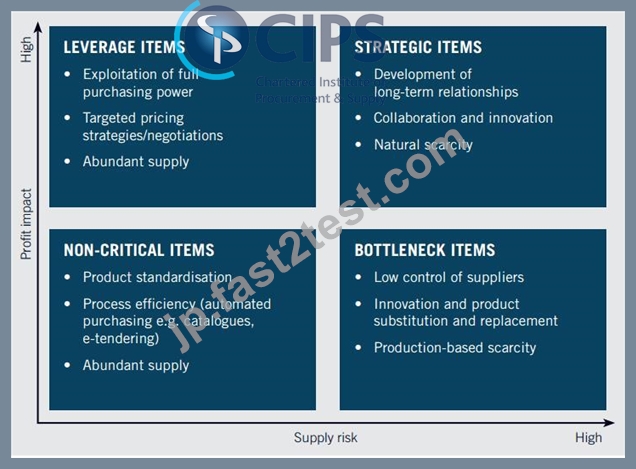
Source: Peter Kraljic, HBR
質問 # 94
Cost and price analysis is very important for buyers when they are preparing for a negotiation with supplier.
Which of the following is a benefit of knowing supplier's fixed costs?
- A. The buyer would be able to get a comprehensive picture of supplier's efficiency
- B. With the sole understanding of supplier's fixed cost, the buyer would be able to know the volume at which supplier maximises their profit in short-run
- C. The buyer would be able to know the right volume to reach break-even point
- D. The buyer would be able to know the point at which the supplier would reject the offer
正解:C
解説:
Knowing supplier's fixed and variable costs is beneficial for the buyer in a negotiation. With these insights, the buyer would know the volume at which the supplier reaches break-even points and then offers significant discount due to economies of scale.
質問 # 95
Which of the following is considered a strength of a 'logical' style negotiator?
- A. Assertive
- B. Friendly and accessible
- C. Methodical
- D. Interrelate issues easily and make quick decisions
正解:C
解説:
:
A useful and simple shorthand for preferred negotiation styles is summarised by four simple descriptor:
'warm', 'tough', 'logical' and 'dealer', which can be applied to describe individuals' dominant preferred style in most circumstances.
Warm - a people person
Tough - a hard-nosed negotiator
Logic - a numbers person
Dealer - a trader who loves bargaining
Strengths, weaknesses of logical style are described below:
Table Description automatically generated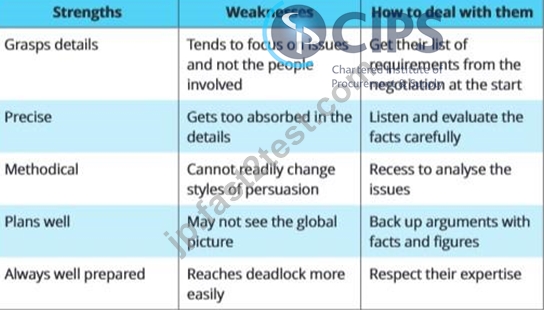
質問 # 96
John Browne, a junior buyer for a corporation, is analyzing the global supply market before undertaking negotiations and is wondering whether foreign exchange rates are important to factor into his research. Should John consider the foreign exchange rates?
- A. Yes, only if the organization can handle foreign currencies in their accounts
- B. Yes, as they can affect profit and turnover
- C. No, as they only affect the bank's interest rates for loans
- D. No, exchange rates only apply to the national economy
正解:B
解説:
Foreign exchange rates impact import costs, profit margins, and overall turnover when transactions are conducted in foreign currencies. Understanding these fluctuations allows buyers to anticipate changes in purchasing costs, supporting informed decision-making, as highlighted in CIPS guidance on global procurement considerations.
質問 # 97
Which of these personal power bases stems from the manager's position in the organisation and the authority that lies in that position?
- A. Reward power
- B. Legitimate power
- C. Coercive power
- D. Expert power
正解:B
解説:
Legitimate power comes from the belief that a person has the formal right to make demands, and to expect others to be compliant and obedient. Legitimate power comes from rules, formal authority, organisation rank, staff grade or official position held. In commercial negotiation, legitimate power can be demonstrated by job title and rank.
LO 1, AC 1.3
質問 # 98
Telephone is most likely to be used for which of the following negotiations?
- A. Contract for purchasing a specialised product
- B. High value contract
- C. Routinetransactions
- D. Complex one-off purchase
正解:C
解説:
Explanation
Many commercial negotiations could be considered routine or just not worth the investment for buyers, and using the phone can make more sense and can be more immediate.
LO 2, AC 2.4
質問 # 99
Which of the following are macroeconomic factors that may have influence to the commercial negotiation?
Select TWO that apply
- A. Bargaining power of supplier
- B. Rising import tariffs
- C. Supply curve
- D. Equilibrium price
- E. Unemployment rate
正解:B、E
解説:
There are many macro economic factors that could influence procurement in general and commercial negotiation in particular. Below are six factors that are agreed to be fairly significant:
* Economy growth rate
* Inflation rates
* Interest rates
* Currency exchange rate
* Unemployment rate
* Protectionism
LO 2, AC 2.2
質問 # 100
Which of the following are signs indicating that the trust between buyer and supplier has improved? Select TWO that apply.
- A. Cost overruns
- B. Decreasing percentage of missed delivery overtime
- C. Transparent decision making process
- D. Less frequent communication on business requests Duplication of effort
正解:B、C
解説:
Signs of trust in business relationships
* Mutually agreed and managed objectives
* Sharing information
* Managing conflict through joint problem solving
* On time delivery of products and services
* High-performance teams that feel empowered to get the job done
* Supplier welcomes opportunity to innovate
* Both parties share ideas and insight
* Clear criteria for decision making
LO 1, AC 1.4
質問 # 101
Mike is a junior buyer who has been working for a manufacturing organisation for two years, specializing in purchasing research. Over this time, he has built good relationships within his team and with other departments. Which of the following sources of power is Mike most likely to possess?
- A. Coercive
- B. Reward
- C. Position
- D. Referent
正解:D
解説:
Referent power is based on personal relationships and the respect or admiration one earns within an organization. Given Mike's positive relationships and his rapport with team members and other departments, he is most likely to have referent power. This power type is influential in negotiation as people are more willing to work with someone they respect, as outlined in CIPS power dynamics in negotiation.
質問 # 102
Which of the following should be done by the procurement team at the closing stage of a negotiation? Select TWO that apply.
- A. Tell TOP that they could have got a better deal
- B. Seek agreement in principle if TOP does not have the final authority
- C. Accept ambiguity or uncertainty
- D. Leave the meeting as soon as possible
- E. Gloat publicly about the deal
正解:B、D
解説:
Explanation
The agreement and closingphase is the phase when it is either clear through explicit language, or strongly suggested through non-verbal signals, that TOP is ready to move to agreement. Judging when to close can be difficult and as with phases of the negotiation, experience, observation, practice and reflection will be the best ways to learn here.
In the closing phase, procurement should:
- Watch for closing/buying signals
- Check to ensure all issues have been resolved
- Consider using visual aids to summarise
- Use 'summary close'
- Make a decision to conclude/close
- Seek agreement in principle if TOP does not have the final authority
- Make your own private notes on the final agreement
- Shake hands on the agreement
- Leave the meeting as soon as possible thereafter.
LO 3, AC 3.1
質問 # 103
One difference between perfect competition and monopolistic competition is that...?
- A. Monopolistic competition has no barriers to entry
- B. Firms in monopolistic competition face a downward-sloping demand curve
- C. In perfect competition, firms produce slightly differentiated products
- D. A perfectly competitive industry has fewer firms.
正解:B
解説:
Monopolistic competition exists in market where there are many competing producers but they will try to use product differentiation. Although their products may be very similar, their ability to differentiate means that they can act as monopolies in short run, irrespective of the actions of their competitors.
In perfect competition, there are no barriers to entry to the market or exit from the market. In monopolistic competition, there tend to be fewer barriers to entry or exit in these markets than in oligopolistic markets, but it doesn't mean that there are absolutely no barriers to entry in monopolistic competition.
In perfect competition, the demand curve is perfectly elastic, which means that it will be horizontal.
Otherwise, in monopolistic competition market, the demand curve will have normal downward slope.
LO 2, AC 2.2
質問 # 104
The trust is built based on the other party's professional qualifications or proven or certified technical capability or experience is known as...?
- A. Contractual trust
- B. Irrevocable Trust
- C. Competence trust
- D. Goodwill trust
正解:C
解説:
:
Trust is the expectation that the other party will behave in a predictable and mutually acceptable way. In inter- firm relationships, the presence and absence of trust can affect the level of cost in a relationship. The existence of trust is taught to lower the transaction cost in a relationship. Dr. Mari Sako identified taxonomy of 3 types of trust in commercial relationship, which is very useful from the perspective of procurement.
Contractual trust: Trust based on the contract with TOP. This is potentially the weakest source of trust if there is nothing else to base the trust on, but it is the quickest to establish.
Competence trust: Trust based on TOP's professional qualifications or proven or certified technical capability or experience.
Goodwill trust: Trust based on knowing TOP has your interest at heart and will not behave opportunistically.
This is potentially the strongest type of trust, but it takes the longest time to build.
質問 # 105
Which of the following are examples of push techniques in commercial negotiations? Select TWO that apply.
- A. Argument based on information, logic and reason
- B. Listening to, involving andsupporting others
- C. Working together to define the problem, the goals and the best solution
- D. Threat of punishment, costs and damage
- E. Using language and imagery to 'paint a picture others can see'
正解:A、D
解説:
There are two major persuasion methods: 'push' and 'pull'.
Persuasion can be defined as encouraging someone to do something that you want them to do for you.
Persuasion is reasoning with someone so that they will believe or do something they might not otherwise do.
Persuasion can be considered as 'pushing' on TOP so that they can accept the change in attitude or behaviour as a result of your actions.
Influence is the ability to affect the manner of thinking of another. Influence can be considered as pulling on TOP so that you achieve the same result, but TOP feels they have changed their attitude or behaviour as a result of their reflection and thinking, and not your direct actions.
There are 5 options in this question:
'Threat of punishment, costs and damage': The influencertries to 'push' the other party to act as he/she wants by using force. This method is effective but short-lived. The influencer also risks to developing reputation for being heavy handed and dictatorial.
'Argument based on information, logic and reason':The influencer uses logic and reasons to persuade the other party. This is also known as 'Persuasive Reasoning' (Push)
'Using language and imagery to 'paint a picture others can see'': The influencer seeks to influence another by understanding the other'semotions, and stimulating that party's imagination to visualise the desired future goal of the influencer. This is also known as 'visionary (pull)'
'Working together to define the problem, the goals and the best solution': In this technique, the person seeking to influence another involves the other party in the decision making process. This is known as 'collaborative (pull)'
'Listening to, involving and supporting others': In this technique, the person seeking to influence another tries to discover the other party's emotion and aims at mutual understanding. This is also a collaborative approach.
質問 # 106
Which of the following are effective approaches when procurement professionals negotiate with monopoly suppliers?
1. Delaying payment with monopoly suppliers as long as possible to increase bargaining power
2. Setting up stronger BATNA
3. Engaging in the negotiation with a distributive approach
4. Eliminating requirements in the specification that prioritises monopoly suppliers
- A. 2 and 3 only
- B. 1 and 4 only
- C. 3 and 4 only
- D. 2 and 4 only
正解:D
解説:
In most commercial negotiations with monopolistic organisations, one can expect that in general they will have far greater bargaining power - you will need them more than they need you. There BATNA isstronger in the short run, but over time their power can be challenged effectively.
Ways of dealing with monopoly suppliers include the following:
Making yourself an attractive buyer
Seeking out alternatives / substitutes in a private or public manner
Designing out the requirement that forces you to go to the monopoly suppliers, or seek to make the product, or threaten to make it yourself if feasible Lobbying government or campaigning, as part of an industry or trade body, for a reduction in barriers to entry that support the monopoly
質問 # 107
According French and Raven's base model, which of the following are sources of personal power that can be used in commercial negotiation? Select THREE that apply.
- A. Expert power
- B. Purchasing spend power
- C. Legitimate power
- D. Trademark power
- E. Coercive power
- F. Competitive power
正解:A、C、E
解説:
:
A useful model of personal power that has survived the test of time and provide a simple way to analyse negotiation in French and Raven's Power Base Model, which describes six bases of power:
Diagram Description automatically generated
質問 # 108
From the principled point of view about negotiation environment, which of the following is a true statement?
- A. There is no ideal negotiation environment in real life
- B. The room layout can be seen as a source of tactical advantage
- C. Advantage gained from uncomfortable negotiation environment is likely to last long after the negotiation
- D. Home advantage should not be exploited to win a temporary advantage
正解:D
解説:
From a principled point of view, the focus of negotiation is on resolving the issue and not on winning temporary advantage over TOP through exploiting home advantage. From the principled point of view, the location and room layout should not be viewed as a source of tactical advantage and should not be used to try to gain advantage over TOP or unfairly influence them in the meeting room.
From a pragmatic point of view, not all of these elements in the ideal negotiation environment may be feasible, so the host may have to make compromises and explain these to TOP.
From a distributive point of view, the host will seek to create an advantage for themselves either explicitly or more subtly. It is arguable that any advantage gained through intentionally creating an uncomfortable environment to put short-term pressure on TOP is likely to be short-lived as TOP will likely reflect on this later and seek means to get even.
LO 2, AC 2.4
質問 # 109
A supplier's mark-up on all products is 25%. Supplier's profit margin is...?
- A. 15%
- B. 30%
- C. 20%
- D. 75%
正解:C
解説:
Table Description automatically generated with medium confidence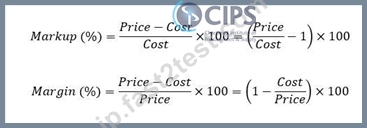
Text Description automatically generated with low confidence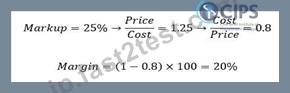
LO 2, AC 2.1
質問 # 110
Commercial negotiation ends at the award of a contract. Is this statement true?
- A. No, because real commercial negotiation begins after the contract is awarded
- B. Yes, because there are no rooms for negotiation after the contract is awarded
- C. Yes, because the supplier will comply with legally binding obligations
- D. No, because improvements can be achieved through post-award negotiation
正解:D
解説:
Negotiation doesn't end after the contract is awarded. The needs for negotiation can arise in any post-award stages. For example, at supplier development and relationship management stage, improvement in supplier capability, capacity, and product/service range can be negotiated. Negotiations with long-term strategic critical suppliers should be carried out in a partnering style, with a win-win starting point assumed.
In some sectors such as transport, utilities and infrastructure, tenderers may 'bid low' or even make a loss to win major contracts with a view to negotiating lucrative changes, variations and 'add-ons' over the life of the contract when the supplier is bedded in and the buyer is in the weaker position to push back or challenge.
Even in less complex contract, it is very likely that there will be a need to negotiate with that supplier again after the awarding of the contract.
LO 1, AC 1.1
質問 # 111
It may be more difficult to buy on a credit from supplier who locates in a country with a hyperinflation? Is this assumption true?
- A. Yes, because thesupplier's currency will lose its value overtime
- B. Yes, because buyer has more advantage if they make payment in their own currency
- C. No, because the higher the inflation rate, the stronger the supplier's currency
- D. No, because supplier's bank will take risks from currency fluctuation
正解:A
解説:
If theinflation rate is running high, then obtaining credit as a buyer is normally more difficult or expensive as money in the future will be worth less than money today.
質問 # 112
Which of the following is considered a strength of a 'logical' style negotiator?
- A. Assertive
- B. Friendly and accessible
- C. Methodical
- D. Interrelate issues easily and make quick decisions
正解:C
質問 # 113
Which of the following are internal factors when a supplier is making its pricing decision?
Price elasticity of demand
Environmental legislation
Risk management
The stage in the product life cycle
- A. 3 and 4 only
- B. 2 and 3 only
- C. 1 and 4 only
- D. 1 and 2 only
正解:A
解説:
Risk management (3) and the stage in the product life cycle (4) are internal factors within the supplier's control and directly influence pricing decisions. These internal factors guide strategic pricing policies. In contrast, price elasticity of demand and environmental legislation are external factors, as per CIPS's guidelines on pricing influences.
質問 # 114
......
CIPS L4M5認定試験は、組織の契約や契約の交渉を担当する個人に最適です。この試験は、調達とサプライチェーン管理のキャリアを前進させようとしている人にも適しています。この認定は、専門家に商業交渉の包括的な理解を提供するように設計されています。これは、さまざまな業界や分野で適用できます。
トップクラスのL4M5練習試験問題:https://jp.fast2test.com/L4M5-premium-file.html
無料CIPS Level 4 Diploma in Procurement and Supply L4M5究極の学習ガイド:https://drive.google.com/open?id=1qwalcaDs2HrYgplsRc_hNwUCdfEl13DS