

CSC2のPDF試験材料2025年最新の実際に出るCSC2問題集
更新されたのはCSI CSC2問題集PDFオンラインエンジン
質問 # 104
Pierre has been plotting the price behaviour of QLT using a 100-day moving average. The 100-day moving average line has been above the daily market price for several weeks. However, the price of QLT broke through the moving average line with heavy trading volume, and the moving average line is moving higher.
What action should Pierre take based on this information?
- A. Sell QLT shares
- B. Sell call option on QLT shares
- C. Buy QLT shares
- D. Buy put option on QLT shares
正解:C
質問 # 105
The principle of retraction in retractable preferred shares is identical to what other security?
- A. Callable preferred shares.
- B. Redeemable preferred shares.
- C. Retractable common shares
- D. Retractable bonds and debentures
正解:D
解説:
The principle of retraction in retractable preferred shares allows the shareholder to force the issuing company to redeem the shares for cash at a predetermined price on or after a specified date. This feature is identical to retractable bonds and debentures, which give the bondholder the option to require the issuer to repay the principal before maturity.
* A. Callable preferred shares: Callability benefits the issuer, not the holder, and is not similar to retraction.
* B. Retractable common shares: Such securities are not common in the market and are not comparable to retractable preferred shares.
* C. Redeemable preferred shares: Redemption is at the issuer's discretion, unlike retraction, which is at the holder's discretion.
Reference:CSC Volume 1, Chapter 8, "Preferred Shares - Retractable Preferred Shares" explains the retraction feature and its similarity to retractable bonds.
質問 # 106
A shareholder receives rights from a company through direct ownership in shares. Not expecting to exercise them, she sells the rights on the relevant exchange. What is her capital gain?
- A. The current share price less the exercise price of the rights.
- B. The current price of the shares less the sale price of the rights.
- C. The sale price of the rights.
- D. The sale price less the exercise price of the rights.
正解:C
質問 # 107
If the manager believes the market is efficient, what investment strategy should they employ for a portfolio?
- A. Sector rotation
- B. Buy-and-hold strategy
- C. Growth investing
- D. Momentum investing
正解:B
質問 # 108
The XYZL mutual fund distributes realized capital gains of $1.50. What is the effect of this distribution?
- A. The mutual fund will have to declare taxable income of $0.75 per share.
- B. The net asset value per share will drop $1.50 as a result of the distribution.
- C. Investors will reduce the adjusted cost base of their holdings in the fund.
- D. Each investor will have to report taxable income of $1.50 per share.
正解:D
質問 # 109
According to the Bank of Canada, approximately how many months does it take for the effect of changes in monetary policy to be felt through the whole economy?
- A. 0
- B. 1
- C. 2
- D. 3
正解:A
解説:
The Bank of Canada estimates that the effects of changes in monetary policy take approximately18 monthsto fully work through the entire economy. This lag exists because monetary policy impacts various sectors, such as consumer spending, business investment, and trade, at different speeds.
* B. 6 months: This is too short a timeframe for the full effects of monetary policy to materialize.
* C. 3 months: Immediate impacts may be seen in financial markets, but the broader economic effects require longer.
* D. 36 months: This is far longer than the typical lag for monetary policy effects.
質問 # 110
What responsibility falls on the buy-side portfolio manager?
- A. To inform the trade about the market conditions and risks.
- B. To provide pertinent market information to the departmentheads of various asset classes.
- C. To maintain constant contact with the investment dealer counterparties.
- D. To busy securities in the market on demand to maintain liquidity in a security.
正解:A
解説:
Thebuy-side portfolio manageris responsible for managing investments on behalf of institutional or retail clients. A critical responsibility is to provide the buy-side trader withpertinent market information and analysis of risksto ensure that trades are executed effectively and aligned with the investment strategy.
* Explanation of Options:
* A. Maintain Liquidity: Incorrect. This is more relevant to market makers or sell-side dealers who provide liquidity in the market.
* B. Contact with Dealers: Incorrect. While buy-side managers interact with dealers, their primary role is to strategize, not to maintain constant contact.
* C. Informing Traders: Correct. Buy-side managers analyze risks and market conditions and pass this information to traders for execution.
* D. Provide Information to Department Heads: Incorrect. This is not a core responsibility of buy- side portfolio managers.
References:
* CSC Volume 2, Chapter 27: Responsibilities of buy-side portfolio managers and their interactions with traders.
質問 # 111
Which macroeconomic factors would have a positive impact on investor expectations and the price of securities?
- A. Low levels of government debt and consumer indebtedness.
- B. Targeting certain sectors of the economy with monetary policy measures and tax breaks.
- C. Increased taxes on corporations with the goal of lower government debt.
- D. A decrease in government spending with corresponding tax outs to individuals.
正解:A
解説:
Low levels of government and consumer indebtedness create a positive macroeconomic environment for investor expectations and securities prices. When debt levels are manageable, governments and consumers have greater financial flexibility, which can lead to increased economic activity and improved investor confidence.
* Why This Impacts Investor Expectations Positively:
* Low government debt allows for expansionary fiscal policies (e.g., increased spending or tax cuts) without significantly increasing borrowing costs.
* Low consumer debt supports higher disposable income, enabling more spending and investment.
* Both factors reduce the risk of higher interest rates, keeping borrowing costs low for businesses and individuals, which supports economic growth and, in turn, securities prices.
* Why Other Options Are Incorrect:
* A: Targeted monetary policies may benefit specific sectors but are not a universally positive factor for all securities.
* B: Increased taxes on corporations can reduce profitability and negatively impact investor expectations.
* D: A decrease in government spending with tax cuts could slow economic growth, negatively impacting securities prices.
:
CSC Volume 2, Chapter 13: Macroeconomic Factors and their impact on securities.
質問 # 112
What type of return is calculated for a security held for 18 months if no adjustments to the return are made?
- A. Holding period return.
- B. Annualized total return.
- C. Effective rate of return.
- D. Nominal rate of return.
正解:A
解説:
The return on a security held for a specific period, such as 18 months, without adjusting for time or compounding, is referred to as theholding period return (HPR). This straightforward calculation assesses total returns over the period of ownership.
1. Definition of Holding Period Return:The HPR is calculated as:
HPR=(Ending Value - Initial Value) + Dividends ReceivedInitial ValueHPR = \frac{{\text{(Ending Value - Initial Value) + Dividends Received}}}{{\text{Initial Value}}}HPR=Initial Value (Ending Value - Initial Value) + Dividends Received This measure evaluates total growth, disregarding compounding or annualization.
2. Other Return Types (Incorrect Answers):
* Effective Rate of Return:Reflects annualized returns considering compounding within a year. It is not applicable to non-annualized periods like 18 months.
* Nominal Rate of Return:The unadjusted rate of return without accounting for inflation. While related, it does not specifically refer to the holding period concept.
* Annualized Total Return:This adjusts returns to reflect an annual basis, assuming constant performance throughout the period. It is unsuitable for raw, unadjusted returns like the HPR.
References from CSC Study Documents:
* Chapter 15, Volume 2: Covers the calculation of different return metrics, with detailed examples of HPR and its application.
* Portfolio Return Analysis inSection 15explains the non-compounded nature of holding period calculations.
Let me know if further details or clarifications are needed!
質問 # 113
Which derivatives transaction has the greatest default risk?
- A. Individual investor buying shares on an exchange during the ex-rights period.
- B. Individual investor entering future contract with an institutional investor.
- C. Exchange-traded equity option contract between an individual investor and a dealer.
- D. Interest rate forward agreement between an investment dealer and a corporation.
正解:D
解説:
Aninterest rate forward agreement (FRA)is anover-the-counter (OTC)derivative contract. Unlike exchange- traded derivatives, OTC contracts are not centrally cleared, meaning there is nointermediary to guarantee performance. This increases counterparty (default) risk, making FRAs inherently riskier than exchange-traded contracts.
* A. Individual investor buying shares on an exchange during the ex-rights period: This is a standard transaction involving equity securities, not derivatives, and carries no default risk.
* C. Exchange-traded equity option contract between an individual investor and a dealer: Exchange- traded derivatives are backed by a clearinghouse, which mitigates default risk.
* D. Individual investor entering a futures contract with an institutional investor: Futures contracts are also exchange-traded and centrally cleared, reducing default risk.
質問 # 114
Which ratio, when showing a decreasing trend, suggests declining operating efficiency?
- A. Price-earnings
- B. Dividend payout
- C. Return on common equity
- D. Debt/equity
正解:C
質問 # 115
How can an analyst use trend analysis to analyze a company's financial statements?
- A. Computer the company's current ratios with its ratios from prior years to determine a trend.
- B. Analyze the ratios against companies in a wide a range of industries to see how the company is trending in the current economic cycle.
- C. Review the company's ratio over the past year, as they provide the best estimate of near-term performance and future trends.
- D. Identity trends by selecting the lowest ratio for the base year, even if a loss is experienced, as it represents a good starting point for analyzing the growth in the ratios.
正解:A
解説:
Trend analysis involves comparing a company's financial ratios or metrics over several periods to identify patterns or changes that may indicate performance trends. This approach is essential for evaluating a company's financial health over time and detecting improvements or declines in critical financial metrics.
By analyzing the current ratios-which measure liquidity and the company's ability to cover short-term obligations-with data from prior years, an analyst can determine trends such as increasing efficiency, solvency, or potential financial stress. This method provides meaningful insights into a company's financial trajectory, supporting better decision-making.
Option B and C are incorrect because they either limit the analysis to a short timeframe or ignore the significance of using a stable and representative base year. Option D deviates from the principle of selecting relevant industry peers.
:
Volume 2, Chapter 14: Company Analysis, Trend Analysis, Canadian Securities Course.
質問 # 116
An emerging Canadian company is exploring the possibility of using hot water springs to produce clear energy for remote rural communities. The company has strong human resource capital and few assets, and raised SI 20,000 through the Capital Pool Company program. Which option is best for this company to continue maximizing public exposure and raising capital?
- A. Crowfunding
- B. Filling disclosure documents with SEDAR+.
- C. Escrowing shares
- D. offering a greenshee option
正解:A
解説:
For an emerging company with limited assets and innovative goals,crowdfundingis an excellent option to maximize public exposure and raise capital. Crowdfunding involves soliciting small investments from a large number of people, typically through online platforms, making it ideal for startups or innovative ventures like the use of hot water springs for clean energy.
Other options:
* Escrowing shares: Typically used to restrict the sale of shares for a certain period, not for raising capital.
* Offering a greenshoe option: Applies to stabilizing stock prices in an IPO or follow-on offering, not raising initial capital.
* Filing disclosure documents with SEDAR+: Necessary for public companies but does not directly raise capital or increase exposure.
References:
* Volume 1, Chapter 12:Financing and Listing Securities, section on "Capital Raising Options" covers crowdfunding as a method for startups to raise funds.
質問 # 117
What happens if a company's dividend payout ratio exceeds 100%?
- A. The share price will increase
- B. Profits will be reduced
- C. The company will be unable to repay its debts
- D. Shareholders' equity will be eroded
正解:D
質問 # 118
Which type of sell side equity revenue is earned when a dealer acts in the capacity of an agent in clients trade?
- A. Commission
- B. Interest
- C. Fees
- D. Spreads
正解:A
解説:
In the context of sell-side equity revenue, when a dealer acts as an agent for a client's trade, the revenue is typically earned as a commission. The dealer facilitates the trade between buyers and sellers without taking ownership of the securities, earning fees for providing this service.
* Commission: Earned when the dealer acts as an agent.
* Spreads: Earned when the dealer acts as a principal, buying securities at one price and selling at a higher price.
* Fees: Charged for additional services, such as research or analytics.
* Interest: Earned from financing activities or margin accounts, not directly tied to trading.
* A. Fees: Incorrect; fees are typically charged for services, not for acting as an agent.
* B. Spreads: Incorrect; spreads are earned when the dealer acts as a principal.
* C. Interest: Incorrect; interest revenue is unrelated to acting as an agent.
* D. Commission: Correct answer. Acting as an agent involves earning commissions for facilitating trades.
:
CSC Volume 2, Chapter 27: The Role of Sell-Side Dealers, which details revenue models in institutional and retail trading.
質問 # 119
An analyst compiles the following information for Theta Inc.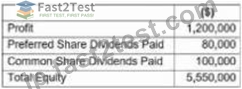
Based on the financial information provided, what will the dividend payout ratio be for Theta Inc.?
- A. 1.80%
- B. 8.33%
- C. 6.66%
- D. 3.24%
正解:B
質問 # 120
Which type of market participant is generally regulated as an alternative trading system?
- A. Venture exchange
- B. Dark pool
- C. Over-the-counter bulletin board.
- D. Pink sheets
正解:B
解説:
Analternative trading system (ATS)is a trading platform that is not a formal stock exchange but allows for the buying and selling of securities. Adark poolis a type of ATS where trade details are not displayed until after execution, providing anonymity to large institutional trades. Other options like venture exchanges, pink sheets, and OTC bulletin boards are not considered ATSs.
References:
* Volume 1, Chapter 9, "Alternative Trading Systems".
質問 # 121
A bond with a duration of five is currently priced at $103. If Interest rates rise by 2%. approximately what win be me bond's price?
- A. $113.30
- B. $92.70
- C. $108.15
- D. $97.85
正解:D
解説:
The approximate price change of a bond due to a change in interest rates can be estimated using the formula:
Price Change (%)=#Duration×#Interest Rate\text{Price Change (\%)} = - \text{Duration} \times \Delta \text
{Interest Rate}Price Change (%)=#Duration×#Interest Rate
Given:
* Duration= 5
* Current Price= $103
* Change in Interest Rate(#\Delta#) = 2% or 0.02
Price Change (%)=#5×0.02=#0.10 (#10%)\text{Price Change (\%)} = -5 \times 0.02 = -0.10 \, (-10\%) Price Change (%)=#5×0.02=#0.10(#10%) The new price is calculated as:
New Price=Current Price×(1+Price Change)=103×(1#0.10)=103×0.90=97.85\text{New Price} = \text
{Current Price} \times (1 + \text{Price Change}) = 103 \times (1 - 0.10) = 103 \times 0.90 = 97.85 New Price=Current Price×(1+Price Change)=103×(1#0.10)=103×0.90=97.85
* A. $108.15andB. $113.30: These represent price increases, which are incorrect for rising interest rates.
* D. $92.70: This reflects a greater-than-actual price drop, which is inconsistent with the duration-based calculation.
質問 # 122
......
CSI CSC2問題集PDFのベストを目指すなら問題集を使おう!高得点目指すならここ:https://jp.fast2test.com/CSC2-premium-file.html
CSC2のPDFで問題解答!PDFサンプル問題は信頼され続ける:https://drive.google.com/open?id=1EYlbNelCPvsE-8-0KWwGkgjRKlUZp8BO