

[2026年10月09日]DY0-001試験問題集、DY0-001練習テスト問題
無料で使えるDY0-001学習ガイド試験問題と解答
質問 # 30
Given matrix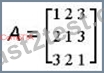
Which of the following is AT?
- A.

- B.

- C.

- D.

正解:C
解説:
Transposing swaps rows and columns, so the (i, j) entry becomes the (j, i) entry.
質問 # 31
A data scientist is creating a responsive model that will update a product's daily pricing based on the previous day's sales volume. Which of the following resource constraints is the data scientist's greatest concern?
- A. Deployment time
- B. Development time
- C. Training time
- D. Data collection time
正解:C
解説:
Because the model must be retrained every day on yesterday's sales data to set today's prices, the time it takes to train the model becomes the critical bottleneck in a responsive, daily‐update workflow.
質問 # 32
A data scientist needs to:
Build a predictive model that gives the likelihood that a car will get a flat tire.
Provide a data set of cars that had flat tires and cars that did not.
All the cars in the data set had sensors taking weekly measurements of tire pressure similar to the sensors that will be installed in the cars consumers drive. Which of the following is the most immediate data concern?
- A. Granularity misalignment
- B. Lagged observations
- C. Insufficient domain expertise
- D. Multivariate outliers
正解:B
解説:
Because tire-pressure sensors report only weekly measurements, you risk missing the critical pressure drop immediately preceding a flat. Those stale ("lagged") readings may not reflect the condition just before failure, undermining your model's ability to learn the true precursors to a flat tire.
質問 # 33
A data scientist is clustering a data set but does not want to specify the number of clusters present. Which of the following algorithms should the data scientist use?
- A. Logistic regression
- B. DBSCAN
- C. k-nearest neighbors
- D. k-means
正解:B
解説:
# DBSCAN (Density-Based Spatial Clustering of Applications with Noise) is a density-based clustering algorithm that does not require specifying the number of clusters in advance. It identifies clusters of arbitrary shape and separates noise/outliers based on density thresholds.
Why other options are incorrect:
* B: k-NN is a supervised classification algorithm, not used for clustering.
* C: k-means requires predefining the number of clusters (k).
* D: Logistic regression is a classification model, not for clustering.
Official References:
* CompTIA DataX (DY0-001) Study Guide - Section 4.2:"DBSCAN detects clusters based on data density without the need for a predefined k value and handles outliers effectively."
-
質問 # 34
Which of the following measures would a data scientist most likely use to calculate the similarity of two text strings?
- A. Edit distance
- B. String indexing
- C. k-nearest neighbors
- D. Word cloud
正解:A
解説:
# Edit distance (also known as Levenshtein distance) measures how many single-character edits (insertions, deletions, or substitutions) are needed to transform one string into another. It's a common metric for assessing string similarity, especially in natural language processing (NLP) tasks.
Why the other options are incorrect:
* A: Word clouds visualize word frequency, not similarity.
* C: String indexing is a method for referencing string positions, not comparison.
* D: k-NN is a classification algorithm, not a string similarity measure.
Official References:
* CompTIA DataX (DY0-001) Study Guide - Section 6.3:"Edit distance is a key similarity metric in text comparison tasks, particularly in cleaning or matching string records."
-
質問 # 35
A data scientist is standardizing a large data set that contains website addresses. A specific string inside some of the web addresses needs to be extracted. Which of the following is the best method for extracting the desired string from the text data?
- A. Named-entity recognition
- B. Large language model
- C. Regular expressions
- D. Find and replace
正解:C
質問 # 36
A data scientist is building a model to predict customer credit scores based on information collected from reporting agencies. The model needs to automatically adjust its parameters to adapt to recent changes in the information collected. Which of the following is the best model to use?
- A. Decision tree
- B. Linear discriminant analysis
- C. Random forest
- D. XGBoost
正解:D
解説:
# XGBoost (Extreme Gradient Boosting) is a high-performance, scalable ensemble algorithm that builds decision trees in sequence and adjusts to errors iteratively. It also supports incremental training, making it adaptive to changing data patterns - ideal for dynamically updated credit information.
Why the other options are incorrect:
* A: Decision trees are static once trained and don't adapt unless retrained.
* B: Random forest is an ensemble of trees but lacks the adaptive boosting component.
* C: LDA is a linear classification technique - not suited for adapting to changing data distributions.
Official References:
* CompTIA DataX (DY0-001) Official Study Guide - Section 4.3:"XGBoost is highly efficient and supports iterative learning, making it well-suited for data environments that evolve over time."
* Applied Machine Learning Guide, Chapter 8:"XGBoost adapts to changes by refining errors across iterations, providing robustness in dynamic systems."
-
質問 # 37
A data analyst wants to save a newly analyzed data set to a local storage option. The data set must meet the following requirements:
* Be minimal in size
* Have the ability to be ingested quickly
* Have the associated schema, including data types, stored with it
Which of the following file types is the best to use?
- A. XML
- B. CSV
- C. Parquet
- D. JSON
正解:C
解説:
Given the requirements:
* Minimized file size
* Fast ingestion
* Schema preservation (including data types)
The most appropriate format is:
# Parquet - It is a columnar storage file format developed for efficient data processing. Parquet files are compressed, support schema embedding, and enable fast columnar reads, making them ideal for analytical workloads and big data environments.
Why the other options are incorrect:
* A. JSON: Text-heavy and lacks native support for data types/schema.
* C. XML: Verbose and has poor performance in storage and ingestion speed.
* D. CSV: Flat structure, doesn't store data types or schema, and can be large in size.
Official References:
* CompTIA DataX (DY0-001) Official Study Guide - Section 6.2 (Data Storage Formats):"Parquet is a preferred format for data analysis as it provides efficient compression and encoding with embedded schema information, making it ideal for minimal storage and fast ingestion."
* Apache Parquet Documentation:"Parquet is designed for efficient data storage and retrieval. It includes schema support and works best for analytics use cases." Parquet is a columnar storage format that automatically includes schema (data types), uses efficient compression to minimize file size, and enables very fast reads for analytic workloads.
質問 # 38
Which of the following is a classic example of a constrained optimization problem?
- A. Calculating gradient descent
- B. Calculating local maximum
- C. The cold start problem
- D. The traveling salesman
正解:D
解説:
# The Traveling Salesman Problem (TSP) is a classic example of a constrained optimization problem. The goal is to find the shortest possible route that visits a set of locations once and returns to the origin point - under constraints such as distance, order, and time.
Why the other options are incorrect:
* A: The cold start problem is related to recommender systems, not optimization.
* C: Calculating a local maximum is part of optimization but not necessarily constrained.
* D: Gradient descent is an optimization method, but not itself a problem with constraints.
Official References:
* CompTIA DataX (DY0-001) Official Study Guide - Section 3.4:"Constrained optimization involves solving problems under defined limitations - e.g., distance or time constraints in routing."
* Optimization Techniques in Data Science, Chapter 6:"TSP is a benchmark in combinatorial optimization, representing a multi-variable problem with strict constraints."
-
質問 # 39
A data scientist observes findings that indicate that as electrical grids in a country become more and more connected over time, the frequency of brownouts and blackouts in total decrease, and the frequency of major brownouts and blackouts increase. Which of the following distribution metrics could best be identified?
- A. Normality
- B. Kurtosis
- C. Skewness
- D. Scale axis magnitudes
正解:B
解説:
Kurtosis quantifies how heavy or light the tails of a distribution are. In this case, fewer overall events but more extreme (major) brownouts/blackouts indicates heavier tails over time. This is exactly what an increasing kurtosis would reveal.
質問 # 40
A data scientist is standardizing a large data set that contains website addresses. A specific string inside some of the web addresses needs to be extracted. Which of the following is the best method for extracting the desired string from the text data?
- A. Named-entity recognition
- B. Large language model
- C. Regular expressions
- D. Find and replace
正解:C
解説:
# Regular expressions (regex) are powerful tools for pattern matching in text. They are ideal for extracting substrings, such as domains, parameters, or specific keywords from URLs or structured text fields.
Why the other options are incorrect:
* B: NER is used to extract named entities (like names, places) - not substrings in structured text.
* C: LLMs are overkill and not efficient for simple string matching tasks.
* D: Find and replace is manual and non-scalable for large data sets.
Official References:
* CompTIA DataX (DY0-001) Official Study Guide - Section 6.3:"Regular expressions provide a flexible method to extract patterns and substrings in structured or semi-structured text."
* Data Cleaning Handbook, Chapter 3:"Regex is the most effective tool for parsing text formats like URLs, emails, or custom tags."
-
質問 # 41
Which of the following environmental changes is most likely to resolve a memory constraint error when running a complex model using distributed computing?
- A. Converting an on-premises deployment to a containerized deployment
- B. Moving model processing to an edge deployment
- C. Migrating to a cloud deployment
- D. Adding nodes to a cluster deployment
正解:D
解説:
Increasing the number of nodes in your cluster directly expands the total available memory across the distributed system, alleviating memory‐constraint errors without changing your code or deployment paradigm. Containerization or edge deployments don't inherently provide more memory, and migrating to the cloud alone doesn't guarantee additional nodes unless you explicitly scale out.
質問 # 42
Given the following:
Which of the following time series models best represents this process?
- A. SARIMA(1, 1, 1) x (1, 1, 1)1
- B. ARIMA(1,1,1)
- C. ARMA(1,1)
- D. AR(1)
正解:D
解説:
The model has a single autoregressive term and only white‐noise errors, matching the definition of an AR(1) process.
質問 # 43
A data scientist would like to model a complex phenomenon using a large data set composed of categorical, discrete, and continuous variables. After completing exploratory data analysis, the data scientist is reasonably certain that no linear relationship exists between the predictors and the target. Although the phenomenon is complex, the data scientist still wants to maintain the highest possible degree of interpretability in the final model. Which of the following algorithms best meets this objective?
- A. Decision tree
- B. Multiple linear regression
- C. Random forest
- D. Artificial neural network
正解:A
解説:
# Decision trees offer excellent interpretability while handling complex, non-linear relationships and multiple variable types (categorical, discrete, continuous). They provide easy-to-understand visualizations and logic- based rules, making them ideal when transparency and insight are priorities.
Why other options are incorrect:
* A: Neural networks are powerful but are considered "black box" models, with low interpretability.
* C: Linear regression assumes a linear relationship, which contradicts the scenario.
* D: Random forests are ensembles of trees - more accurate, but less interpretable.
Official References:
* CompTIA DataX (DY0-001) Study Guide - Section 4.2:"Decision trees are interpretable models that support non-linear, multi-type data with logical branching."
-
質問 # 44
A data scientist is building a model to predict customer credit scores based on information collected from reporting agencies. The model needs to automatically adjust its parameters to adapt to recent changes in the information collected. Which of the following is the best model to use?
- A. Decision tree
- B. Random forest
- C. Linear discrimination analysis
- D. XGBoost
正解:D
解説:
XGBoost supports "warm-start" incremental training, continuing to refine the existing ensemble with new data, so it can automatically update its parameters as new agency information arrives. The other methods require full retraining to incorporate recent changes.
質問 # 45
A data scientist is presenting the recommendations from a monthslong modeling and experiment process to the company's Chief Executive Officer. Which of the following is the best set of artifacts to include in the presentation?
- A. Recommendation charts justifications code reviews and results
- B. Methods, data overview, results, recommendations, and charts
- C. Methodology, code snippets, findings, data tables, and p values
- D. Results, recommendations, justifications, and clear charts
正解:D
解説:
Executive audiences need concise, high-level insights: what you found (results), what you suggest (recommendations), why it matters (justifications), and visual summaries (clear charts). Detailed methods, code, or raw data aren't appropriate at the C-suite level.
質問 # 46
A movie production company would like to find the actors appearing in its top movies using data from the tables below. The resulting data must show all movies in Table 1, enriched with actors listed in Table 2.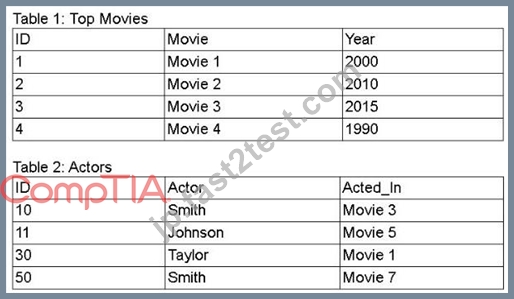
Which of the following query operations achieves the desired data set?
- A. Perform an INNER JOIN between Table 1 using column Movie, and Table 2 using column Acted_In.
- B. Perform a LEFT JOIN on Table 1 using column Movie, with Table 2 using column Acted_In.
- C. Perform an INTERSECT between Table 1 using column Movie, and Table 2 using column Acted_In.
- D. Perform a UNION between Table 1 using column Movie, and Table 2 using column Acted_In.
正解:B
解説:
# A LEFT JOIN ensures all rows from Table 1 (Top Movies) are preserved, even if there's no matching actor data in Table 2. This matches the requirement to show all movies, enriched with actor information when available.
Why the other options are incorrect:
* A: INNER JOIN would exclude movies without matching actor entries.
* B: UNION combines distinct rows - not appropriate for matching columns between two tables.
* C: INTERSECT shows only common movies - excludes unmatched top movies.
Official References:
* CompTIA DataX (DY0-001) Study Guide - Section 5.2:"LEFT JOINs are used when all records from one table (primary) must be retained, even if there are no matching rows in the secondary table."
-
質問 # 47
......
DY0-001試験問題集、DY0-001練習テスト問題:https://jp.fast2test.com/DY0-001-premium-file.html
検証済みDY0-001問題集PDF資料 [2026年更新]:https://drive.google.com/open?id=1iYVPfeu_3EFgtv8i-G_d9vRG0-rLgD-n