

[2025年07月]更新のCTAL-TTA_Syll19_4.0試験問題集、無料サンプル365日更新
まもなく無料セール終了!リアルCTAL-TTA_Syll19_4.0のPDF解答使おう
質問 # 26
Consider the following fault attack:
* Force all possible incoming errors from the software/operating system interfaces to the application.
Which of the following is the kind of failure you are looking for when using this attack?
- A. Application crashes due to a lack of portability.
- B. Application miscalculates total monthly balance due on credit cards.
- C. Application crashes when unsupported characters are pasted into an input field.
- D. Application crashes when the network is unavailable.
正解:C
解説:
The fault attack described involves forcing all possible incoming errors from software/operating system interfaces. The type of failure being sought is one where the application does not handle erroneous or unexpected input correctly, which can lead to crashes or other unintended behavior. Thus, an application crash when unsupported characters are pasted into an input field is a typical failure that this kind of fault attack would aim to uncover.
質問 # 27
Consider the pseudo code provided below: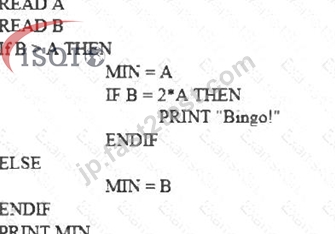
Given the following tests, what additional test(s) (if any) would be needed in order to achieve 100% statement coverage, with the minimum number of tests?
Test 1: A = 7, B = 7, Expected output: 7
Test 2: A = 7, B = 5, Expected output: 5
- A. No additional test cases are needed to achieve 100% statement coverage.
- B. A=6, B=12, Expected output: Bingo!
- C. A=7, B=9, Expected output: 7
- D. A=6, B=12, Expected output: Bingo! and A=7, B=9, Expected output: 7
正解:A
解説:
100% statement coverage means that every line of code is executed at least once during testing. Based on the provided pseudo-code and the test cases given:
Test 1 executes the MIN = B statement when A and B are equal.
Test 2 executes the MIN = A statement and skips the inner IF since B is not equal to 2*A.
All statements within the code have been executed by these two tests, hence no additional test cases are needed to achieve 100% statement coverage.
質問 # 28
Consider the pseudo code provided below:
Which of the following options provides a set of test cases that achieves 100% decision coverage for this code fragment, with the minimum number of test cases?
Assume that in the options, each of the three numbers in parenthesis represent the inputs for a test case, where the first number represents variable "a", the second number represents variable "b", and the third number represents variable "c".
- A. (4,5. 0); {5, 4, 5)
- B. (5. 4, 0); (3, 2, 5); (4, 5, 0)
- C. (5. 3, 2); (6, 4, 2); (5, 4, 0)
- D. (5. 3,2)
正解:C
解説:
To achieve 100% decision coverage with the minimum number of test cases, we need to ensure that every branch of the decision is taken at least once. For the code provided:
The first condition (a>b) is true for the first two test cases and false for the third.
The second condition (b>c) is true for the first test case, false for the second, and does not matter for the third since the first condition is false.
Therefore, with these three test cases, we cover all possible outcomes of the decision, ensuring 100% decision coverage.
質問 # 29
Which of the following statements about performance testing tools is NOT correct?
- A. Performance testing tools generate a load by simulating a large number of virtual users following their designated operational profiles to generate specific volumes of input data.
- B. Significant factors to consider in the implementation of performance testing tools include the flexibility of the tool to allow different operational profiles to be easily implemented, and the hardware and network bandwidth required to generate the load.
- C. Typical metrics and reports provided by performance testing tools include the number of simulated users throughout the test, and the number and type of transactions generated by the simulated users, and the arrival rate of the transactions.
- D. Performance testing tools typically drive the application by simulating user interaction at the graphical user interface level to more accurately measure response times.
正解:D
解説:
The statement about performance testing tools that is NOT correct is that they typically drive the application by simulating user interaction at the graphical user interface (GUI) level to more accurately measure response times. In practice, performance testing tools often simulate user interactions at a protocol or service level rather than the GUI level. This approach allows the tools to generate a high load by simulating many virtual users, which would be challenging to achieve with GUI-level interactions due to the higher resource consumption and slower execution speed associated with GUI automation.
Performance testing tools are designed to assess the performance of a system under a particular load and are not primarily focused on the user interface. They simulate multiple users accessing the system simultaneously, which helps in identifying bottlenecks, understanding the system's behavior under load, and determining how the system scales with increasing load. The tools typically simulate user requests to the server, bypassing the GUI to directly test the backend, APIs, or other service endpoints. This method allows for more efficient and scalable testing, enabling the simulation of thousands of users without the overhead of rendering the GUI.
質問 # 30
Which of the following statements about fault seeding tools is correct?
- A. Fault seeding tools insert defects into the source code to test the input checking capabilities of the software.
- B. Fault seeding tools insert defects into the source code to support the application of specification-based test design techniques.
- C. Fault seeding tools insert defects into the source code to check the level of maintainability of the software.
- D. Fault seeding tools insert defects into the source code to check the effectiveness of testing.
正解:D
解説:
Fault seeding is a method used to evaluate the effectiveness of a testing process. Tools designed for fault seeding intentionally insert known defects into the source code, which are then supposed to be discovered during testing. The main purpose is not to check the input checking capabilities, support specification-based test design techniques, or assess maintainability of the software, but rather to gauge how well the testing process can identify and capture defects. By comparing the number of seeded faults that are found against the total number of faults inserted, test teams can get an insight into the effectiveness of their testing strategies and coverage. This method helps in understanding the detection capabilities of testing efforts and in identifying potential areas for improvement in test processes.
質問 # 31
Consider the code fragment provided below: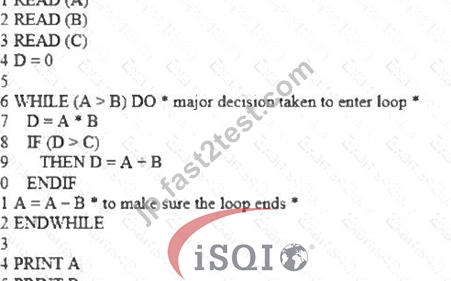
The comment frequency of the code fragment is 13%.
To which non-functional quality characteristic does a good level of comment frequency especially contribute?
- A. Usability
- B. Performance Efficiency
- C. Maintainability
- D. Portability
正解:C
解説:
The comment frequency in a code fragment relates to the number of comments in relation to the code size. A good level of comment frequency can significantly contribute to the maintainability of the software.
Maintainability is a non-functional quality characteristic that refers to the ease with which a software system can be modified to correct defects, update features, improve performance or other attributes, or adapt to a changed environment. Comments in the code help developers understand the logic, purpose, and functionality of the code, which is crucial when modifications are required. This does not directly contribute to portability, usability, or performance efficiency, which are concerned with different aspects of the software's operation and user interaction.
質問 # 32
A product risk assessment has revealed the following product risks:
* lack of usability requirements
* security during on-line transactions
* perceived performance of the system and response time from the user interface
* a required availability of almost 100%
To address the 4th risk, which of the following quality characteristics for technical testing should be part of the test approach?
- A. Compatibility
- B. Portability
- C. Adaptability
- D. Reliability
正解:D
解説:
To address the product risk of requiring an availability of almost 100%, the quality characteristic of reliability should be part of the test approach. Reliability testing focuses on the ability of the system to perform under expected conditions for a specified period of time. It is essential for systems that need to be operational continuously or near-continuously. This characteristic encompasses the system's uptime, fault tolerance, recoverability, and the ability to perform under anticipated conditions, all of which are relevant to maintaining high availability.
質問 # 33
Consider the pseudo code provided below regarding a customer request for cash withdrawal from an ATM.
If the customer has sufficient funds in their account
OR the customer has the credit granted
THEN the ATM machine pays out the requested amount to the customer
Which of the following test cases would be the result of applying multiple condition testing, but would NOT be the result of applying modified condition/decision testing?
- A. TC 1: Customer has sufficient funds. Credit has not been granted.
- B. TC 2: Customer does not have sufficient funds. Credit has been granted.
- C. TC 4: Customer has sufficient funds. Credit has been granted.
- D. TC 3: Customer does not have sufficient funds. Credit has not been granted.
正解:D
解説:
Multiple condition testing requires each possible combination of conditions to be tested, whereas modified condition/decision testing (MC/DC) requires each condition to be shown to independently affect the outcome. In the case of the ATM withdrawal, TC 3 (Customer does not have sufficient funds and credit has not been granted) would not result in the machine paying out, which is a result of applying multiple condition testing. However, for MC/DC, this test case would not be included because it doesn't provide an independent assessment of either condition's effect on the decision since both conditions are negative and the outcome is as expected (no payout).
質問 # 34
A major Caribbean bank typically develops their own banking software using an Agile methodology.
However, for some specific components COTS software is acquired and used. The bank does not want to create a dependency on any external COTS supplier.
As part of the test approach, portability testing will be performed. Which portability sub-characteristic is especially relevant for the Caribbean bank?
- A. Co-existence
- B. In stall ability
- C. Adaptability
- D. Replaceability
正解:D
解説:
Portability testing is concerned with how well software can be transferred from one environment to another.
In the context of a bank using COTS (Commercial Off-The-Shelf) software, the sub-characteristic of replaceability becomes particularly relevant. This is because the bank does not want to create a dependency on any external COTS supplier, meaning it should be able to replace the software with another product without significant effort or operational disruption. Replaceability ensures that if needed, the bank can switch to different software, thereby mitigating the risk of supplier dependency.
質問 # 35
You are working on project where re-use of software is an objective. You are involved in the project as a Technical Test Analyst and have been given the task to develop a checklist for code reviews.
Which question from the list below should you implement as part of the code review checklist?
- A. Are all variables defined with meaningful, consistent and clear names?
- B. Is it possible during acceptance testing to verity whether the item has been satisfied?
- C. Are all modules, data, and interfaces uniquely identified?
- D. Can each item be implemented with the techniques, tools, and resources available?
正解:C
解説:
For a project where the reuse of software components is a key objective, it is essential to ensure that all modules, data, and interfaces are uniquely identified. This facilitates the tracking, maintenance, and reuse of these components in different parts of the software or in other projects. Unique identification helps in preventing confusion and conflicts that may arise due to the reuse of components that have the same name but different functionalities or interfaces.
質問 # 36
There are multiple activities the Technical Test Analyst performs regarding test automation. Which of the following activities is a typical test automation activity that the Technical Test Analyst will perform?
- A. Train the Test Analyst and Business Analyst to use and supply data for the test scripts.
- B. Execute the test cases and analyze any failures that may occur.
- C. Decide regarding a test automation project based on a business case.
- D. Define the business process keywords and related actions.
正解:B
解説:
A Technical Test Analyst is primarily involved in the technical aspects of test preparation and execution. One of their typical activities includes the execution of test cases, particularly those that are automated, and the subsequent analysis of any test failures to identify defects and issues. This activity is more technical than defining business processes or training other analysts, and while making decisions based on a business case may be part of their role, it is not an activity directly related to test automation.
質問 # 37
At which test level would reliability testing most likely be performed?
- A. Component testing
- B. System testing
- C. Functional acceptance testing
- D. Static testing
正解:B
解説:
Reliability testing is aimed at verifying the software's ability to function under expected conditions for a specified period of time. It is typically conducted during system testing, where the software is tested in its entirety to ensure that all components work together as expected in an environment that closely simulates the production environment. Reliability testing is not typically associated with static testing, component testing, or functional acceptance testing, as these levels of testing do not address the overall behavior of the system over time.
質問 # 38
Within the world of consumer electronics, the amount of embedded software is growing rapidly. The amount of software in high-end television sets has increased by a factor of about eight over the last six years. In addition, the market of consumer electronics has been faced with a 5 -10% price erosion per year. The price of a product is, among a number of other things, determined by the microcontroller used. Therefore, the use of ROM and RAM remains under high pressure in consumer electronic products, leading to severe restrictions on code size.
Within a new high-end TV project, it has been decided to apply dynamic analysis.
Which of the quality goals listed below is MOST appropriate to the project context?
- A. Analyse system failures which cannot easily be reproduced.
- B. Improve system performance by providing information on run-time system behaviour.
- C. Prevent failures from occurring by detecting wild pointers and loss of system memory.
- D. Evaluate network behaviour.
正解:B
解説:
In the context of consumer electronics, where there is rapid growth in embedded software and pressure to minimize code size due to cost constraints, dynamic analysis can be particularly useful for improving system performance. Dynamic analysis involves examining the system's behavior during execution, which can provide insights into the efficiency of the code at runtime, memory utilization, and processing speed. In a high-end TV project where the use of ROM and RAM is under severe restrictions, dynamic analysis would be most appropriately applied to improve system performance, ensuring that the software runs efficiently within the available hardware resources. This supports the project context by contributing to the optimization of the software to run within the constraints of the microcontroller used, thereby potentially reducing costs.
質問 # 39
Which of the following statements is TRUE regarding tools that support component testing and the build process?
- A. Component testing tools are the basis for a continuous integration environment.
- B. Build automations tools facilitate manual testing at a low level by allowing the change of variables values during test execution.
- C. Component testing and build automation tools are only used by developers.
- D. Component testing tools are typically specific to the programming language and may be used to automate unit testing.
正解:D
解説:
Component testing tools, which are often specific to a programming language, are used to automate unit tests (answer C). These tools help to validate the functionality of individual components or units of code in isolation from the rest of the application. While build automation tools are indeed used by developers and are related to continuous integration (answers A and D), and they can facilitate testing at various levels (answer B), component testing tools' primary purpose is to support the testing of individual components, often through automated unit tests, which can be specific to the language in which the components are written.
質問 # 40
A new web site has been launched for a testing conference. There are a number of links to other related web sites for information purposes. Participants like the new site but complaints are being made that some (not all) of the links to other sites do not work.
Which type of test tool is most appropriate in helping to identify the causes of these failures?
- A. Dynamic analysis tool
- B. Hyperlink tool
- C. Static analysis tool
- D. Review tool
正解:B
解説:
When users complain about issues with links on a website, the most appropriate test tool to identify the causes of these failures is a hyperlink tool (answer B). Hyperlink tools are specifically designed to check the validity of links on web pages. They can automatically identify broken or dead links, which is essential for maintaining the quality and user experience of a website. Review tools, static analysis tools, and dynamic analysis tools do not primarily focus on hyperlink verification.
質問 # 41
Within an embedded software project, the maintainability of the software is considered to be critical. It has been decided to use static analysis on each delivered software component.
Which of the following metrics is NOT a maintainability metric typically used with static analysis?
- A. Number of Lines of Code (LOG)
- B. Number of Function Calls
- C. Comment Frequency
- D. Mean Time Between Failures
正解:D
解説:
Maintainability metrics typically used with static analysis include measures that reflect the complexity and understandability of the code, such as Number of Lines of Code (LOC), Number of Function Calls, and Comment Frequency. These metrics help in assessing how easily the software can be understood, modified, and maintained. Mean Time Between Failures (MTBF), on the other hand, is a reliability metric. It measures the time elapsed between inherent failures of a system during operation. MTBF is used to predict the system's reliability and is not directly related to the maintainability of the code. Reliability metrics like MTBF would be used in the testing phase to measure the operational reliability of the system rather than during static analysis for maintainability assessment.
質問 # 42
Consider the following specification: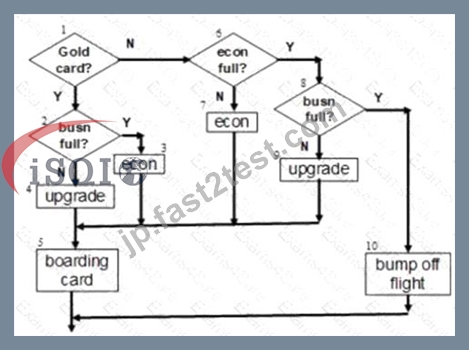
If you are flying with an economy ticket, there is a possibility that you may get upgraded to business class, especially if you hold a gold card in the airline's frequent flier program. If you don't hold a gold card, there is a possibility that you will get 'bumped' off the flight if it is full when you check in late.
This is shown in the control flow graph below. Note that each box (i.e., statement, decision) has been numbered.
Three tests have been run:
Test 1: Gold card holder who gets upgraded to business class
Test 2: Non-gold card holder who stays in economy
Test 3: A person who is bumped from the flight
What is the level of decision coverage achieved by these three tests?
- A. 67%
- B. 60%
- C. 80%
- D. 75%
正解:A
解説:
The control flow graph provided illustrates the decision points for an airline's upgrade and boarding process.
Decision coverage is a measure of the percentage of decision points executed during testing:
Test 1 covers the decision points: Gold card? (Yes) and Business full? (No).
Test 2 covers: Gold card? (No) and Economy full? (No).
Test 3 covers the decision that leads to being bumped from the flight, which is Economy full? (Yes) and Business full? (Yes).
From the given tests, the decision points for Gold card? (No) and Business full? (No) are not tested, leaving us with 4 out of 6 decision points covered, which is approximately 67% decision coverage.
質問 # 43
You have been assigned to perform a review on code provided below: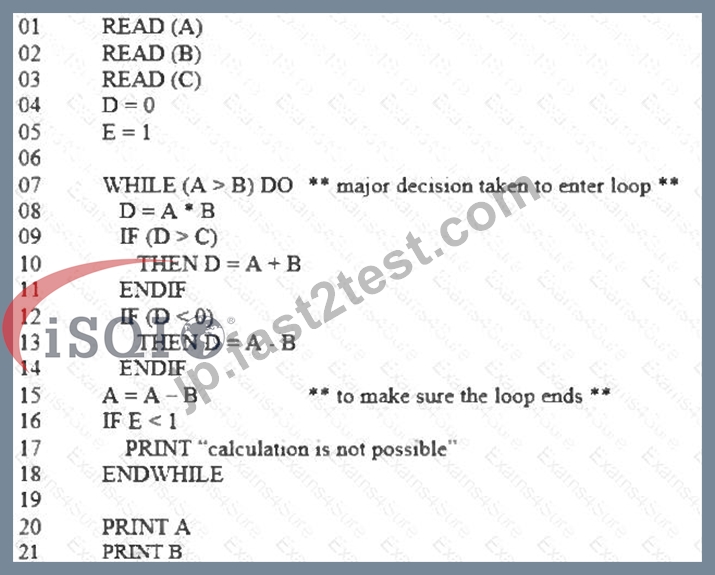
Which type of defect should you report as part of the code review?
- A. Too many nested levels
- B. No defects should be reported, code is correct.
- C. Unreachable code
- D. Endless loop
正解:D
解説:
The code provided contains a potential endless loop. The loop is conditioned on the variable 'E' being less than 1 (IF E < 1), but within the loop, there is no operation that modifies the value of 'E'. Therefore, once the loop is entered, if the condition A > B holds true, the value of 'E' remains unchanged, leading to an endless loop situation. The decrement of 'A' in line 15 does not guarantee an exit condition for the loop, as it does not affect the value of 'E'. This is a control flow defect that could cause the program to hang or crash.
質問 # 44
Which of the following defect types is NOT an example of a defect type typically found with API testing?
- A. High architectural structural complexity
- B. Loss of transactions
- C. Timing problems
- D. Data handling issues
正解:A
解説:
In the context of API testing, the defect types generally found are related to the specific interactions with the API, such as issues with data formatting, handling, validation, and the sequencing or timing of API calls.
Architectural structural complexity is not typically a defect that would be identified at the API testing level.
API tests are concerned with the interface and immediate integration points, not the overarching system architecture, which would be more relevant to design or system-level testing.
質問 # 45
......
CTAL-TTA_Syll19_4.0問題集あなたを合格させる認証試験:https://jp.fast2test.com/CTAL-TTA_Syll19_4.0-premium-file.html