

[2025年02月]更新のN10-009問題集本日限定!無料アクセス可能に!Fast2testで試そう
学習材料は有効N10-009効率的問題集!
CompTIA N10-009 認定試験の出題範囲:
| トピック | 出題範囲 |
|---|---|
| トピック 1 |
|
| トピック 2 |
|
| トピック 3 |
|
| トピック 4 |
|
| トピック 5 |
|
質問 # 55
Which of the following attacks utilizes a network packet that contains multiple network tags?
- A. DNS spoofing
- B. VLAN hopping
- C. MAC flooding
- D. ARP poisoning
正解:B
解説:
VLAN hopping is an attack where an attacker crafts packets with multiple VLAN tags, allowing them to traverse VLAN boundaries improperly. This can result in gaining unauthorized access to network segments that are supposed to be isolated. The other options do not involve the use of multiple network tags. MAC flooding aims to overwhelm a switch's MAC address table, DNS spoofing involves forging DNS responses, and ARP poisoning involves sending fake ARP messages.
質問 # 56
A network administrator is connecting two Layer 2 switches in a network. These switches must transfer data in multiple networks. Which of the following would fulfill this requirement?
- A. Link aggregation
- B. 802.1Q tagging
- C. Native VLAN
- D. Jumbo frames
正解:B
解説:
802.1Q tagging, also known as VLAN tagging, is used to identify VLANs on a trunk link between switches. This allows the switches to transfer data for multiple VLANs (or networks) over a single physical connection. This method ensures that traffic from different VLANs is properly separated and managed across the network.
Reference: CompTIA Network+ study materials.
質問 # 57
A network engineer is now in charge of all SNMP management in the organization. The engineer must use a SNMP version that does not utilize plaintext dat a. Which of the following is the minimum version of SNMP that supports this requirement?
- A. v2u
- B. v1
- C. v2c
- D. v3
正解:D
解説:
SNMPv3 is the version of the Simple Network Management Protocol that introduces security enhancements, including message integrity, authentication, and encryption. Unlike previous versions (v1 and v2c), SNMPv3 supports encrypted communication, ensuring that data is not transmitted in plaintext. This provides confidentiality and protects against eavesdropping and unauthorized access.
Reference: CompTIA Network+ study materials.
質問 # 58
Which of the following is created to illustrate the effectiveness of wireless networking coverage in a building?
- A. Heat map
- B. Logical diagram
- C. Layer 3 network diagram
- D. Service-level agreement
正解:A
解説:
* Definition of Heat Maps:
* A heat map is a graphical representation of data where individual values are represented by colors.
In the context of wireless networking, a heat map shows the wireless signal strength in different areas of a building.
* Purpose of a Heat Map:
* Heat maps are used to illustrate the effectiveness of wireless networking coverage, identify dead zones, and optimize the placement of access points (APs) to ensure adequate coverage and
* performance.
* Comparison with Other Options:
* Logical Diagram: Represents the logical connections and relationships within the network.
* Layer 3 Network Diagram: Focuses on the routing and IP addressing within the network.
* Service-Level Agreement (SLA): A contract that specifies the expected service levels between a service provider and a customer.
* Creation and Use:
* Heat maps are created using specialized software or tools that measure wireless signal strength throughout the building. The data collected is then used to generate a visual map, guiding network administrators in optimizing wireless coverage.
References:
* CompTIA Network+ certification materials and wireless network planning guides.
質問 # 59
Which of the following most likely determines the size of a rack for installation? (Select two).
- A. Server height
- B. Hard drive size
- C. Switch depth
- D. Cooling fan speed
- E. Outlet amperage
- F. KVM size
正解:C
解説:
Understanding Rack Size Determination:
The size of a rack for installation is determined by the dimensions of the equipment to be housed in it, primarily focusing on the depth and height of the devices.
Switch Depth:
Depth of Equipment: The depth of network switches and other rack-mounted devices directly influences the depth of the rack. If the equipment is deeper, a deeper rack is required to accommodate it.
Industry Standards: Most racks come in standard depths, but it is essential to match the depth of the rack to the deepest piece of equipment to ensure proper fit and airflow.
Server Height:
Height of Equipment: The height of servers and other devices is measured in rack units (U), where 1U equals 1.75 inches. The total height of all equipment determines the overall height requirement of the rack.
Rack Units: A rack's height is typically described in terms of the number of rack units it can accommodate, such as 42U, 48U, etc.
Why Other Options are Less Relevant:
KVM Size: While important for management, KVM (Keyboard, Video, Mouse) switches do not typically determine rack size.
Hard Drive Size: Individual hard drives are installed within servers or storage devices, not directly influencing rack dimensions.
Cooling Fan Speed: Fan speed affects cooling but not the physical size of the rack.
Outlet Amperage: Power requirements do not determine rack dimensions but rather the electrical infrastructure supporting the rack.
Reference:
CompTIA Network+ study materials on rack installation and equipment sizing.
質問 # 60
Which of the following panels would be best to facilitate a central termination point for all network cables on the floor of a company building?
- A. UPS
- B. Patch
- C. MDF
- D. Rack
正解:B
質問 # 61
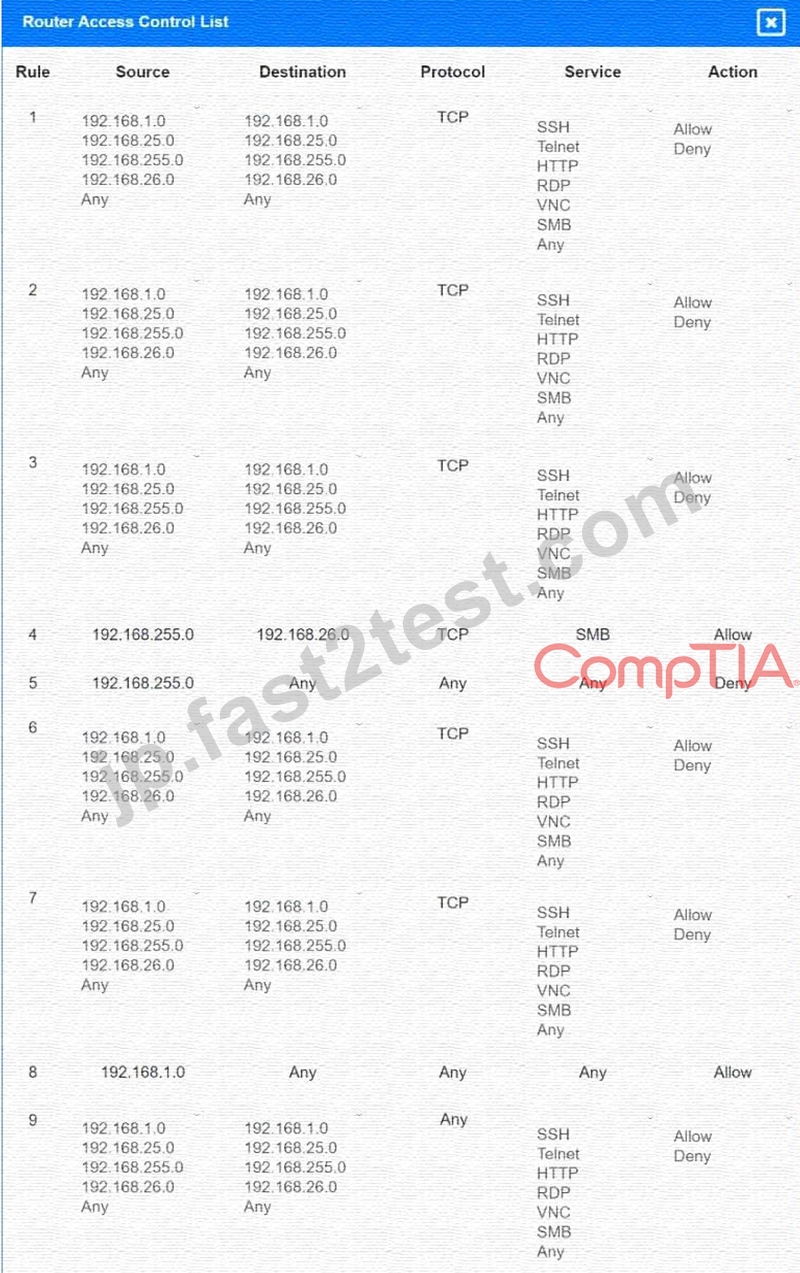
You have been tasked with implementing an ACL on the router that will:
1. Permit the most commonly used secure remote access technologies from the management network to all other local network segments
2. Ensure the user subnet cannot use the most commonly used remote access technologies in the Linux and Windows Server segments.
3. Prohibit any traffic that has not been specifically allowed.
INSTRUCTIONS
Use the drop-downs to complete the ACL
If at any time you would like to bring back the initial state of the simulation, please click the Reset All button.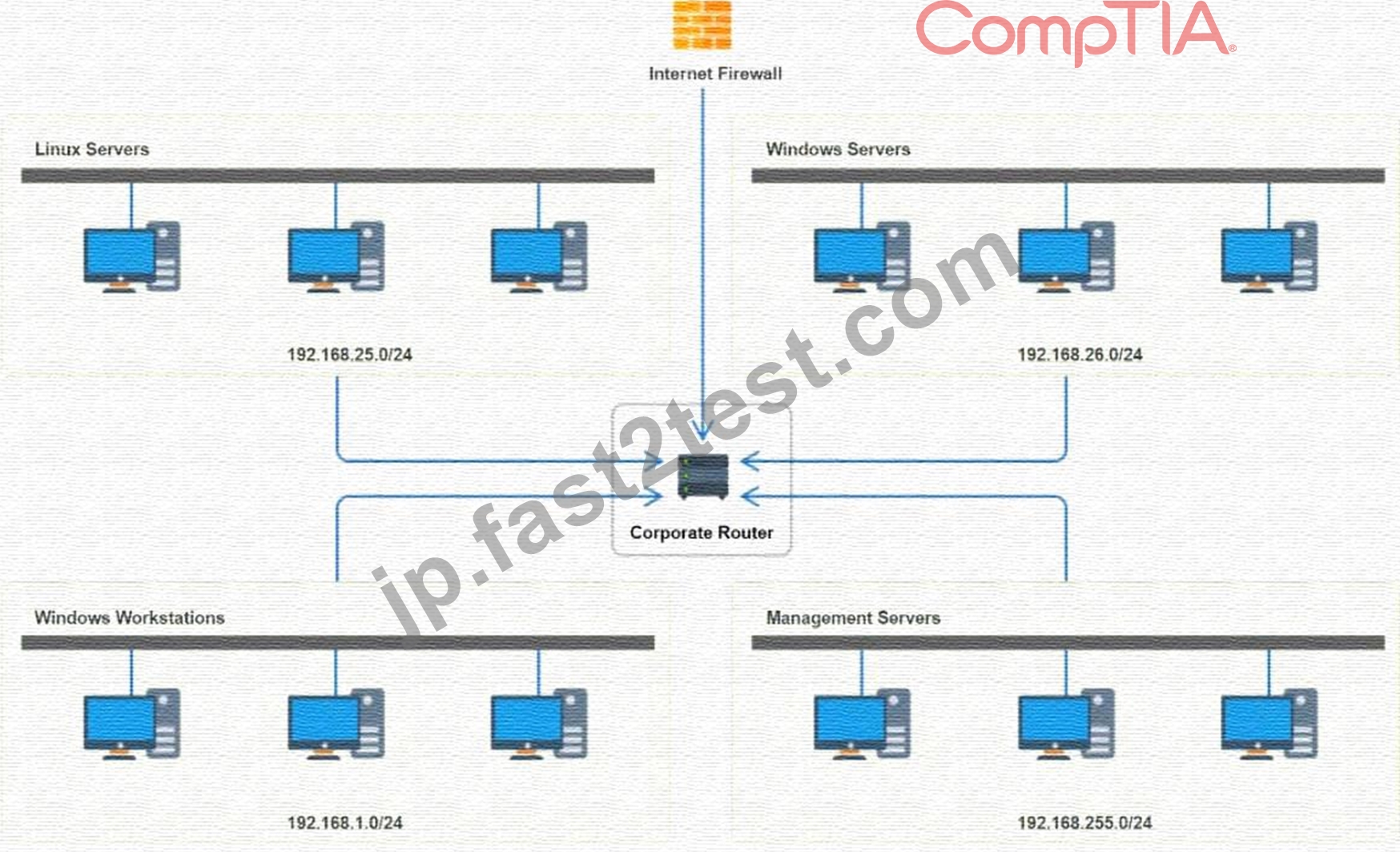
正解:
解説:
See the answer and solution below.
Explanation: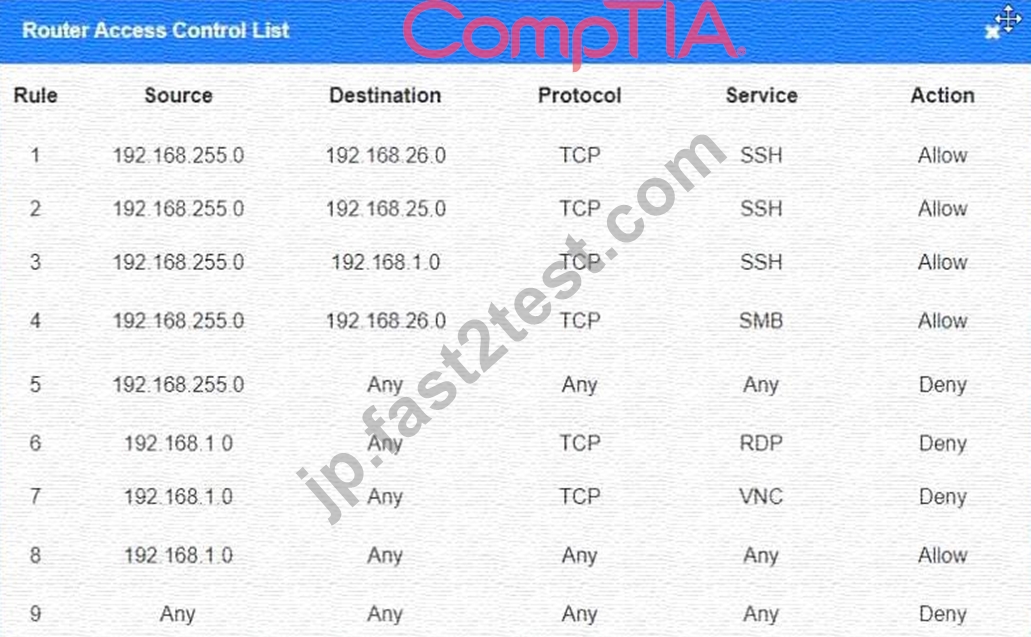
質問 # 62
A network administrator's device is experiencing severe Wi-Fi interference within the corporate headquarters causing the device to constantly drop off the network. Which of the following is most likely the cause of the issue?
- A. Too much wireless absorption
- B. Too many wireless repeaters
- C. Too many client connections
- D. Too much wireless reflection
正解:D
質問 # 63
A company is implementing a wireless solution in a high-density environment. Which of the following 802.11 standards is used when a company is concerned about device saturation and converage?
- A. 802.11ax
- B. 802.11n
- C. 802.11ac
- D. 802.11g
正解:A
解説:
802.11ax, also known as Wi-Fi 6, is designed for high-density environments and improves device saturation and coverage compared to previous standards.
802.11ac: While it offers high throughput, it is not optimized for high-density environments as effectively as 802.11ax.
802.11ax (Wi-Fi 6): Introduces features like OFDMA, MU-MIMO, and BSS Coloring, which enhance performance in crowded environments, reduce latency, and increase the number of devices that can be connected simultaneously.
802.11g and 802.11n: Older standards that do not offer the same level of efficiency or support for high device density as 802.11ax.
Network Reference:
CompTIA Network+ N10-007 Official Certification Guide: Covers the 802.11 standards and their capabilities.
Cisco Networking Academy: Provides training on Wi-Fi technologies and best practices for high-density deployments.
Network+ Certification All-in-One Exam Guide: Discusses the various 802.11 standards and their applications in different environments.
質問 # 64
Which of the following allows a remote user to connect to the network?
- A. Command-line interface
- B. Jump box
- C. Client-to-site VPN
- D. API gateway
正解:C
解説:
Explanation: A Client-to-Site VPN allows a remote user to securely connect to a company's internal network, providing access as if they were physically on-site.
質問 # 65
Before using a guest network, an administrator requires users to accept the terms of use Which of the following is the best way to accomplish this goal?
- A. Autonomous access point
- B. WPA2 encryption
- C. Pre-shared key
- D. Captive portal
正解:D
解説:
A captive portal is a web page that users must view and interact with before being granted access to a network. It is commonly used in guest networks to enforce terms of use agreements. When a user connects to the network, they are redirected to this portal where they must accept the terms of use before proceeding. This method ensures that users are aware of and agree to the network's policies, making it the best choice for this scenario. References: CompTIA Network+ Exam Objectives and official study guides.
質問 # 66
A network administrator needs to set up a multicast network for audio and video broadcasting. Which of the following networks would be the most appropriate for this application?
- A. 192.168.0.0/24
- B. 240.0.0.0/24
- C. 224.0.0.0/24
- D. 172.16.0.0/24
正解:C
質問 # 67
A network administrator wants to configure a backup route in case the primary route fails. A dynamic routing protocol is not installed on the router. Which of the following routing features should the administrator choose to accomplish this task?
- A. Neighbor adjacency
- B. Link state flooding
- C. Hop count
- D. Administrative distance
正解:D
解説:
Introduction to Administrative Distance
Administrative distance (AD) is a value used by routers to rank routes from different routing protocols. AD represents the trustworthiness of the source of the route. Lower AD values are more preferred. If a router has multiple routes to a destination from different sources, it will choose the route with the lowest AD.
Static Routes and Backup Routes
When a dynamic routing protocol is not used, static routes can be employed. Static routes are manually configured routes. To ensure a backup route, multiple static routes to the same destination can be configured with different AD values.
Configuring Static Routes with Administrative Distance
The primary route is configured with a lower AD value, making it the preferred route. The backup route is configured with a higher AD value. In the event of the primary route failure, the router will then use the backup route.
Example Configuration:
plaintext
Copy code
ip route 192.168.1.0 255.255.255.0 10.0.0.1 1
ip route 192.168.1.0 255.255.255.0 10.0.0.2 10
In the above example, 192.168.1.0/24 is the destination network.
10.0.0.1 is the next-hop IP address for the primary route with an AD of 1.
10.0.0.2 is the next-hop IP address for the backup route with an AD of 10.
Verification:
After configuration, use the show ip route command to verify that the primary route is in use and the backup route is listed as a candidate for use if the primary route fails.
Reference:
CompTIA Network+ guide explains the concept of administrative distance and its use in static routing configuration (see page Ref 9†Basic Configuration Commands).
質問 # 68
A client with a 2.4GHz wireless network has stated that the entire office is experiencing intermittent issues with laptops after the WAP was moved. Which of the following is the most likely reason for these issues?
- A. The network has excessive noise.
- B. The signal is reflecting too much.
- C. The network uses a non-overlapping channel.
- D. A microwave is in the office.
正解:D
解説:
Microwaves are known to interfere with the 2.4GHz frequency, which is the same frequency used by many wireless networks. This can cause signal degradation and intermittent connectivity issues, especially if the WAP is placed near such devices.
質問 # 69
A support agent receives a report that a remote user's wired devices are constantly disconnecting and have slow speeds. Upon inspection, the support agent sees that the user's coaxial modern has a signal power of -97 dB.
- A. Switching the devices to wireless
- B. Removing any spliters connecte to the line
- C. Moving the devices closer to the modern
- D. Lowering the network speed
正解:B
解説:
A signal power of -97dB indicates a very weak signal, which can cause connectivity issues and slow speeds.
Splitters on a coaxial line can degrade the signal quality further, so removing them can help improve the signal strength and overall connection quality.
* Signal Quality: Splitters can reduce the signal strength by dividing the signal among multiple lines, which can be detrimental when the signal is already weak.
* Direct Connection: Ensuring a direct connection from the modem to the incoming line can maximize signal quality and reduce potential points of failure.
Network References:
* CompTIA Network+ N10-007 Official Certification Guide: Discusses troubleshooting connectivity issues and the impact of signal strength on network performance.
* Cisco Networking Academy: Provides insights on maintaining optimal signal quality in network setups.
* Network+ Certification All-in-One Exam Guide: Covers common network issues, including those related to signal degradation and ways to mitigate them.
質問 # 70
Which of the following steps of the troubleshooting methodology would most likely include checking through each level of the OSI model after the problem has been identified?
- A. Verify functionality.
- B. Establish a theory.
- C. Implement the solution.
- D. Create a plan of action.
正解:A
解説:
Introduction to Troubleshooting Methodology:
Network troubleshooting involves a systematic approach to identifying and resolving network issues. The CompTIA Network+ certification emphasizes a structured troubleshooting methodology.
Troubleshooting Steps:
Identify the problem: Gather information, identify symptoms, and question users.
Establish a theory of probable cause: Consider possible reasons for the issue.
Test the theory to determine cause: Validate the theory with tests.
Establish a plan of action to resolve the problem and implement the solution: Create and execute a resolution plan.
Verify functionality and implement preventive measures: Ensure the solution works and prevent recurrence.
Verifying Functionality:
After implementing a solution, verifying functionality ensures that the problem is fully resolved. This involves testing the network to confirm that it operates correctly.
Checking through each level of the OSI model helps to ensure that all potential issues at different layers (physical, data link, network, transport, session, presentation, and application) are addressed.
Explanation of the Options:
A . Establish a theory: This step involves hypothesizing possible causes, not verifying functionality.
B . Implement the solution: This step involves executing the resolution plan.
C . Create a plan of action: This step involves planning the resolution, not verification.
D . Verify functionality: This step involves comprehensive checks, including OSI model layers, to ensure the issue is fully resolved.
Conclusion:
Verifying functionality is a critical step in the troubleshooting process, ensuring that the network operates correctly after a solution is implemented. It involves thorough testing across all OSI model layers.
Reference:
CompTIA Network+ guide explaining the troubleshooting methodology and the importance of verifying functionality (see page Ref 9†Basic Configuration Commands).
質問 # 71
Which of the following is an XML-based security concept that works by passing sensitve information about users, such as log-in information and attributes, to providers.
- A. SAML
- B. MFA
- C. RADIUS
- D. IAM
正解:A
解説:
Security Assertion Markup Language (SAML) is an XML-based standard used for exchanging authentication and authorization data between parties, particularly between an identity provider (IdP) and a service provider (SP). SAML is commonly used in Single Sign-On (SSO) solutions to pass sensitive user information, such as login credentials and attributes, securely between the identity provider and the service provider.
* SAML (Security Assertion Markup Language): Facilitates web-based authentication and authorization, allowing users to access multiple services with a single set of credentials.
* XML-based: Uses XML to encode the authentication and authorization data, ensuring secure transmission of user information.
* Identity Federation: Enables secure sharing of identity information across different security domains, making it ideal for enterprise SSO solutions.
Network References:
* CompTIA Network+ N10-007 Official Certification Guide: Covers authentication protocols, including SAML.
* Cisco Networking Academy: Provides training on identity management and federation technologies.
* Network+ Certification All-in-One Exam Guide: Explains SAML and its role in secure identity management and SSO.
質問 # 72
A network administrator wants to implement security zones in the corporate network to control access to only individuals inside of the corporation. Which of the following security zones is the best solution?
- A. Extranet
- B. VPN
- C. Public
- D. Trusted
正解:D
解説:
* Introduction to Security Zones:
* Security zones are logical segments within a network designed to enforce security policies and control access. They help in segregating and securing different parts of the network.
* Types of Security Zones:
* Trusted Zone: This is the most secure zone, typically used for internal corporate networks where only trusted users have access.
* Extranet: This zone allows controlled access to external partners, vendors, or customers.
* VPN (Virtual Private Network): While VPNs are used to create secure connections over the internet, they are not a security zone themselves.
* Public Zone: This zone is the least secure and is typically used for public-facing services accessible by anyone.
* Trusted Zone Implementation:
* The trusted zone is configured to include internal corporate users and resources. Access controls, firewalls, and other security measures ensure that only authorized personnel can access this zone.
* Internal network segments, such as the finance department, HR, and other critical functions, are usually placed in the trusted zone.
* Example Configuration:
* Firewall Rules: Set up rules to allow traffic only from internal IP addresses.
* Access Control Lists (ACLs): Implement ACLs on routers and switches to restrict access based on IP addresses and other criteria.
* Segmentation: Use VLANs and subnetting to segment and isolate the trusted zone from other zones.
* Explanation of the Options:
* A. Extranet: Suitable for external partners, not for internal-only access.
* B. Trusted: The correct answer, as it provides controlled access to internal corporate users.
* C. VPN: A method for secure remote access, not a security zone itself.
* D. Public: Suitable for public access, not for internal corporate users.
* Conclusion:
* Implementing a trusted zone is the best solution for controlling access within a corporate network.
It ensures that only trusted internal users can access sensitive resources, enhancing network security.
References:
* CompTIA Network+ guide detailing security zones and their implementation in a corporate network
* (see page Ref 9fBasic Configuration Commands).
質問 # 73
Which of the following attacks would most likely cause duplicate IP addresses in a network?
- A. Denial-of-service
- B. Social engineering
- C. DNS poisoning
- D. Rogue DHCP server
正解:D
解説:
^p
Explanation:
Definition of a Rogue DHCP Server:
A rogue DHCP server is an unauthorized DHCP server on a network, which can assign IP addresses to devices without proper control, leading to IP address conflicts.
Impact of a Rogue DHCP Server:
IP Address Conflicts: Multiple devices may receive the same IP address from different DHCP servers, causing network connectivity issues.
Network Disruption: Devices may be assigned incorrect network configuration settings, disrupting network services and connectivity.
Comparison with Other Attacks:
DNS poisoning: Alters DNS records to redirect traffic to malicious sites, but does not cause IP address conflicts.
Social engineering: Involves manipulating individuals to gain unauthorized access or information, not directly related to IP address conflicts.
Denial-of-service (DoS): Floods a network or service with excessive traffic to disrupt operations, but does not cause duplicate IP addresses.
Prevention and Detection:
Implement network access control measures to prevent unauthorized devices from acting as DHCP servers.
Use DHCP snooping on switches to allow DHCP responses only from authorized DHCP servers.
Reference:
CompTIA Network+ study materials on network security threats and mitigation techniques.
質問 # 74
A company is implementing a wireless solution in a high-density environment. Which of the following 802.11 standards is used when a company is concerned about device saturation and converage?
- A. 802.11ax
- B. 802.11n
- C. 802.11ac
- D. 802.11g
正解:A
解説:
802.11ax, also known as Wi-Fi 6, is designed for high-density environments and improves device saturation and coverage compared to previous standards.
* 802.11ac: While it offers high throughput, it is not optimized for high-density environments as effectively as 802.11ax.
* 802.11ax (Wi-Fi 6): Introduces features like OFDMA, MU-MIMO, and BSS Coloring, which enhance performance in crowded environments, reduce latency, and increase the number of devices that can be connected simultaneously.
* 802.11g and 802.11n: Older standards that do not offer the same level of efficiency or support for high device density as 802.11ax.
Network References:
* CompTIA Network+ N10-007 Official Certification Guide: Covers the 802.11 standards and their capabilities.
* Cisco Networking Academy: Provides training on Wi-Fi technologies and best practices for high-density deployments.
* Network+ Certification All-in-One Exam Guide: Discusses the various 802.11 standards and their applications in different environments.
質問 # 75
Which of the following is used to estimate the average life span of a device?
- A. MTBF
- B. MTTR
- C. RTO
- D. RPO
正解:A
解説:
Understanding MTBF:
Mean Time Between Failures (MTBF): A reliability metric that estimates the average time between successive failures of a device or system.
Calculation and Importance:
Calculation: MTBF is calculated as the total operational time divided by the number of failures during that period.
Usage: Used by manufacturers and engineers to predict the lifespan and reliability of a device, helping in maintenance planning and lifecycle management.
Comparison with Other Metrics:
RTO (Recovery Time Objective): The maximum acceptable time to restore a system after a failure.
RPO (Recovery Point Objective): The maximum acceptable amount of data loss measured in time.
MTTR (Mean Time to Repair): The average time required to repair a device or system and return it to operational status.
Application:
MTBF is crucial for planning maintenance schedules, spare parts inventory, and improving the overall reliability of systems.
Reference:
CompTIA Network+ study materials on reliability and maintenance metrics.
質問 # 76
While troubleshooting connectivity issues, a junior network administrator is given explicit instructions to test the host's TCP/IP stack first. Which of the following commands should the network administrator run?
- A. ping 172.16.1.1
- B. ping 192.168.1.1
- C. ping 127.0.0.1
- D. ping 169.254.1.1
正解:C
解説:
The loopback address 127.0.0.1 is used to test the TCP/IP stack of the local machine. Pinging this address confirms whether the local system's networking stack is functioning correctly.
=
質問 # 77
A network administrator wants to configure a backup route in case the primary route fails. A dynamic routing protocol is not installed on the router. Which of the following routing features should the administrator choose to accomplish this task?
- A. Neighbor adjacency
- B. Link state flooding
- C. Hop count
- D. Administrative distance
正解:D
解説:
* Introduction to Administrative Distance
* Administrative distance (AD) is a value used by routers to rank routes from different routing protocols. AD represents the trustworthiness of the source of the route. Lower AD values are more preferred. If a router has multiple routes to a destination from different sources, it will choose the route with the lowest AD.
* Static Routes and Backup Routes
* When a dynamic routing protocol is not used, static routes can be employed. Static routes are manually configured routes. To ensure a backup route, multiple static routes to the same destination can be configured with different AD values.
* Configuring Static Routes with Administrative Distance
* The primary route is configured with a lower AD value, making it the preferred route. The backup route is configured with a higher AD value. In the event of the primary route failure, the router will then use the backup route.
* Example Configuration:
plaintext
Copy code
ip route 192.168.1.0 255.255.255.0 10.0.0.1 1
ip route 192.168.1.0 255.255.255.0 10.0.0.2 10
* In the above example, 192.168.1.0/24 is the destination network.
* 10.0.0.1 is the next-hop IP address for the primary route with an AD of 1.
* 10.0.0.2 is the next-hop IP address for the backup route with an AD of 10.
* Verification:
* After configuration, use the show ip route command to verify that the primary route is in use and the backup route is listed as a candidate for use if the primary route fails.
References:
* CompTIA Network+ guide explains the concept of administrative distance and its use in static routing configuration (see page Ref 9fBasic Configuration Commands).
質問 # 78
A network engineer is now in charge of all SNMP management in the organization. The engineer must use a SNMP version that does not utilize plaintext data. Which of the following is the minimum version of SNMP that supports this requirement?
- A. v2u
- B. v1
- C. v2c
- D. v3
正解:D
解説:
SNMPv3 is the version of the Simple Network Management Protocol that introduces security enhancements, including message integrity, authentication, and encryption. Unlike previous versions (v1 and v2c), SNMPv3 supports encrypted communication, ensuring that data is not transmitted in plaintext. This provides confidentiality and protects against eavesdropping and unauthorized access.References:CompTIA Network+ study materials.
質問 # 79
Which of the following describes the best reason for using BGP?
- A. Preventing a loop within a LAN
- B. Improving reconvergence times
- C. Sharing routes with a Layer 3 switch
- D. Exchanging router updates with a different ISP
正解:D
解説:
BGP (Border Gateway Protocol) is used for routing data between different ISPs, making it essential for the functioning of the internet. Its primary use is for exchanging routing information between autonomous systems, especially different ISPs. Preventing loops within a LAN is handled by protocols like Spanning Tree Protocol (STP), while improving reconvergence times and sharing routes with a Layer 3 switch are functions of other protocols or internal mechanisms.
Reference:
The CompTIA Network+ training emphasizes BGP's role in the exchange of routing information across different ISPs and autonomous systems.
質問 # 80
......
最新のN10-009試験エンジンPDFで全部無料問題集保証:https://jp.fast2test.com/N10-009-premium-file.html
最新CompTIA Network+ N10-009実際の無料試験解答:https://drive.google.com/open?id=1gOomrMBloOEED8mq1IrUTJi5Gkhh5t3y