

2025年最新の1Z1-591実際問題集には試験のコツがあるPDF試験材料
心強い1Z1-591のPDF問題集問題
Oracle 1Z1-591認定試験は、Oracle Business Intelligence Foundation Suite 11gの使用に習熟しようとする個人向けに設計されています。この認定試験では、Oracle BIインフラストラクチャのインストール、構成、管理など、ビジネスインテリジェンスのさまざまな側面で候補者の知識とスキルをテストします。認定試験は、ビジネス分析とインテリジェンスの分野でのキャリアを強化しようとしている専門家にとって理想的です。
質問 # 29
Which installation option is used to install into an existing Fusion Middleware Home?
- A. Software Only Install
- B. Cannot install into an existing Fusion Middleware Home
- C. Simple Install
- D. Enterprise Install
正解:A
解説:
Explanation
The Software Only Install type installs the Oracle Business Intelligence software binary files in an Oracle home for later configuration as part of a Fusion Middleware deployment.
質問 # 30
Which two components are required for all OBIEE installations?
- A. Oracle 11g
- B. Admin Server
- C. Managed Server
- D. Node Manager
- E. RCU Schema
正解:A、E
解説:
Explanation/Reference:
B: Before you can run Oracle Business Intelligence 11g Installer, you must first create required Oracle Business Intelligence schemas in an unhardened database. You use a tool called the Repository Creation Utility (RCU) to create these schemas with the appropriate permissions and data.
E: The database 11gR2 is required if you want to run the Oracle Business Intelligence Enterprise Edition Plus Samples
One Oracle Database Preinstalled and not hardened to host the schemas.
質問 # 31
How do Dynamic Repository Variables differ from Static Repository Variables?
- A. Dynamic Repository Variables are not initialized by the Initialization Block.
- B. Dynamic Repository Variables cannot be used in a CASE statement.
- C. Dynamic Repository Variables cannot be used in the Expression Builder.
- D. Dynamic Repository Variables can be changed by data that is returned from queries.
正解:D
解説:
Dynamic Repository Variables:
You initialize dynamic repository variables in the same way as static variables, but the values are refreshed by data returned from queries. When defining a dynamic repository variable, you will create an initialization block or use a pre-existing one that contains a SQL query. You will alsoset up a schedule that the Oracle BI Server will follow to execute the query and periodically refresh the value of the variable.
Note: The value of a static repository value is initialized in the Variable dialog box. This value persists, and does not change until an Oracle BI Administrator decides to change it.
質問 # 32
Which of the following characteristics pertain to a "ragged" hierarchy?
- A. A branch of the hierarchy may have a different number of levels than other branches.
- B. All values can have a maximum of six levels.
- C. It creates multiple levels of hierarchy in the database table.
- D. It can only be stored in an XML structure.
正解:A
解説:
Explanation/Reference:
Ragged Hierarchies are hierarchies where some routes down the hierarchy are longer than others; for example, you may have an organizational hierarchy for salespeople where the overall boss has two assistant managers, one of them works on their own and another has three sales managers under them; some of those sales manager may have sales staff under them, and some sales staff may have trainees under them.
質問 # 33
Which three options apply to FMW Application Roles?
- A. Can be exported / moved between FMW11g environments
- B. Are created and managed by using the WLS Admin Console and FMW Control
- C. Can be created by using BI Administrator Client and "pushed" to WLS Admin Console
- D. Secures RPD permissions but NOT Web Catalog (webcat) permissions
- E. Provide an indirection between LDAP groups and BI roles
正解:B、D、E
解説:
Explanation/Reference:
A: The default Application Roles available after OBIEE 11g installation are BIAdministrator, BISystem, BIConsumer and BIAuthor.
Note: In OBIEE 11g, Application roles provide insulation between permission definitions and corporate LDAP Groups. Permissions are defined at Application Role level and changes to LDAP groups just require a reassignment of the Group to the Application Roles.
See figure below:
C: Application Roles, Policies, association of Policies to application roles and association of users and groups to application roles are managed using Fusion Middleware Enterprise Manager (FMW EM).
E: Object level permission association to Applications Roles resides in the RPD for repository objects.
Permissions and Privilege for web catalog objects resides in the OBIEE Web Catalog. Wherever Groups were used in the web catalog and RPD has been replaced with Application roles in OBIEE 11g.
Note: Application Roles are introduced in OBIEE 11g. An application role is specific to the application. They can be mapped to other application roles defined in the same application scope and also to enterprise users or groups, and they are used in authorization decisions.
質問 # 34
A customer wants to analyze the efficiency of his/her order fulfillment process. If the customer has a dimensional model, which option is the fact table?
- A. Time
- B. Stores
- C. Products
- D. Orders
正解:D
質問 # 35
When adding a new dimension to an existing logical table, what is the significance of the Logical Level setting in the Logical Table Source properties?
- A. It determines the actual value of the dimension.
- B. It defines the granularity of the dimension.
- C. It creates a new session variable.
- D. It creates a foreign key relationship.
正解:B
解説:
Explanation/Reference:
OBIEE - Grain (Level of summarization)
Grain definition in the context of OBIEE.
The following list describes the different grains in navigating a query:
* Aggregation grain. The grain of the aggregate source of from a level based metrics
* Query grain. The grain of the request.
* Time Series grain. The grain at which the time series function aggregation is requested.
* Storage grain. The query in the example can be computed from daily sales or from monthly sales, or from quarterly sales.
Note:
The aggregation grain is defined in the content tab of the logical table source.
When the query grain match the aggregation grain of a logical table source, this one is used to create the physical query.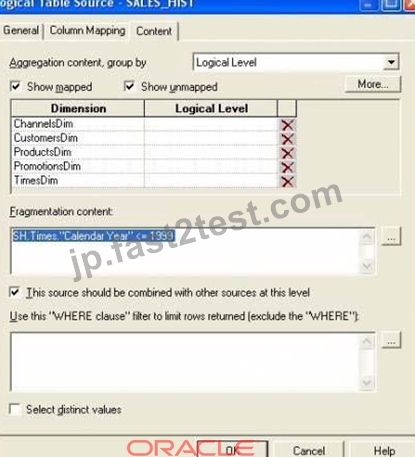
質問 # 36
Identify the two true statements about alias tables.
- A. Alias tables are set up to create a copy of the data with a filter applied to it.
- B. Alias tables are set up to avoid triangular or circular joins.
- C. Alias tables are set up to include best practice naming conventions for physical table names.
- D. Alias tables are set up to create another physical copy of the data.
正解:B、C
解説:
Explanation/Reference:
It is a best practice to create aliases for all tables. Aliases are created in the Physical Layer of the repository.
Some of the benefits of using aliases are given below:
(A) * An alias is used to avoid circular joins and to configure self joins.
* You can create a join relationship which is different than the actual foreign key relationship in the database.
This helps in defining relationships to meet business model criteria.
* Aliases can function in numerous ways to define business model e.g. a table can act both as a dimension and a fact using aliases.
(B) * You can rename aliases to make physical and business model easier to understand.
質問 # 37
A customer needs to create a product share calculation. What are the two ways that they would get the revenue for all products to use in the denominator?
- A. Create a derived measure by using the addition function that adds each product value together.
- B. Create a derived measure based on Revenue that has the Level Total Product selected on the Level Tab of the Logical Column Dialog.
- C. Create a derived measure based on Revenue that has all the levels selected on the Level Tab of the Logical Column Dialog except Total Product.
- D. Create a derived metric by using the Expression Builder.
正解:A、C
解説:
Note: A level-based measure is a column whose values are always calculated to a specific level of aggregation.
The calculation of this measure is independent of the query grain and used always the aggregation grain of the logical column.
Level-based measures allow :
*to return data at multiple levels of aggregation (the query grain and the level-based column grain) with one single query
*to create share measures (percentage), that are calculated by taking some measure and dividing it by a level-based measure. For example, you can divide salesperson revenue by regional revenue to calculate the share of the regional revenue each salesperson generates.

質問 # 38
What are the two ways to use the administration tool?
- A. Administrator can use repository and session variables in a repository to streamline administrative tasks and dynamically modify metadata content to adjust to a changing data environment.
- B. The administration tool uses a set of wizards that support the design of calculations, expressions, dimensions, and so on.
- C. It can be used to manage user password.
- D. It can be used for versioning of the rpd.
正解:A、D
解説:
Explanation/Reference:
Note: The Administration tool is used to manage OBIEE server and have some capabilities to automate some repetitive tasks and principally his embedded tools.
Oracle Business Intelligence Administration Tool is available only for Windows operating systems.
The Administration Tool is a Windows application that allows the BI Server administrator to create and edit repositories.
Repositories can be edited with the administration tool in either online or offline mode.
The Administration Tool also includes a session manager and a cache manager which are available in online mode. The Cache Manager displays what queries have been cached and how frequently they have been accessed. You can also select and delete items
質問 # 39
To add multiple sources to on existing logical table dimension in the Business Model and Mapping layer, the source of the data must first exist in which option?
- A. Web Catalog
- B. Business Aggregate Layer
- C. Presentation Layer
- D. Physical Layer
正解:D
解説:
Explanation
Note:
At the highest level, an OBIEE Metadata Repository includes three layers of information:
1.
First, a Physical layer is defined. The metadata layer identifies the source data.
2.Second, a Business Model and Mapping layer is defined. This metadata layer organizes the physical layer into logical categories and records the appropriate metadata for access to the source data.
3.Finally, the Presentation layer is defined. This metadata layer exposes the business model entities for end-user access.
質問 # 40
Which two Oracle BI Components contain security information regarding permissions and privileges?
- A. The Web Catalog
- B. NQSConfig.ini File
- C. The Repository
- D. InstanceConfig.xml File
- E. NQServer.ini File
正解:B、C
解説:
Explanation/Reference:
B: Oracle Business Intelligence uses a role-based access control model. Security is defined in terms of Application Roles that are mapped to directory server groups and users.
To define a complete security model, you have then to define:
1. A security structure by creating this elements:
* The directory Server User and Group managed by the authentication provider.
* The application roles managed by the policy store provider
2. a security policy (permissions) split across the following components:
*Presentation Catalog
* Repository
* Policy Store to define the Application Policies managed by the policy store provider D: NQSConfig.ini is the main configuration file of Bi Server and contains a lot of parameters.
The file is located in this directory :
11g: ORACLE_INSTANCE/config/OracleBIServerComponent/coreapplication_obisn All changes made to this file require that you restart the Oracle BI Server Service.
Type of Parameters in NQSConfig.ini:
* Security Section Parameters
The security parameters specify default values for the Oracle BI Server security features.
Includes among others:
/DEFAULT_PRIVILEGES
* Repository Section Parameters
* Query Result Cache Section Parameters
* General Section Parameters
The General section contains general server default parameters, including localization and internationalization, temporary space and memory allocation, and other default parameters used to determine how data is returned from the Oracle BI Server to a client.
Incorrect answers:
C: No file NQServer.ini File.
E: On 10g, Instanceconfig.xml is THE parameter file of the BI Presentation server. With the advent of 11g, instanceconfig.xml is also the configuration file of Oracle BI Scheduler The instanceconfig.xml file stores the configuration settings that affect Oracle BI Presentation Services.
Reference: Oracle Fusion Middleware System Administrator's Guide for Oracle Business, A NQSConfig.INI File Configuration Settings
質問 # 41
You run the Consistency Check and receive the warning:
[39003] Missing functional dependency association for column: DIM_Offer_End_Date.CREATE_DT.
What would you check?
- A. Whether there is a logical join between the DIM and FACT tables
- B. Whether there is a physical column mapped to the logical column
- C. Whether the logical table source for this column has been disabled
- D. DIM_Offer_End_Date.CREATE_DT
- E. Whether the columns creating CREATE_DT have been deleted
- F. Whether there is a physical join between the DIM and FACT tables
正解:C
解説:
Explanation
This warning indicates that the given column is only mapped to logical table sources that are disabled. The warning brings this issue to the repository developer's attention in case the default behavior is not desired.
質問 # 42
Point-and-click generation of case statement logic can be accessed via which option?
- A. Column Properties -> Conditional Format tab
- B. Subject Area metrics
- C. Column Formula -> Bins tab
- D. Advanced Tab
- E. Compound Layout
正解:C
解説:
Explanation/Reference:
The "Edit Column Formula" dialog box has a second,
very tiny tab called, "Bins." You can use this tab to have OBIEE
build a CASE statement for you in a formula (you can also create
a CASE statement yourself by using one of the functions that
appears under "Expressions" if you want). A CASE statement is a
lot like an IF-THEN-ELSE statement, except that it's a little easier
to read when you have multiple options. Basically, it puts values
in different buckets that you define.
Note:
Figure:
Incorrect answers:
C: The "Conditional Format" tab lets you set formatting when specific conditions are met.
質問 # 43
A customer has a requirement for rolling period calculations. What two additional steps will need to be done to enable this in the repository?
- A. Clicking the "Time" option in the Logical Table Source Dialog
- B. Designating a chronological key for every level of every dimension hierarchy
- C. Designating a chronological key for every logical column in the Logical Table Source
- D. Specifying a sort order in the Logical Table dialog
- E. Clicking the "Time" option in the Logical Dimension Dialog
正解:B、E
解説:
Creating Logical Time Dimensions Compared to modeling an ordinary dimension, the time dimension requires just two additional steps: selecting the Time option in the Logical Dimension dialog, and designating a chronological key for every level of every dimension hierarchy.
Note: Time dimensions and chronological keys. You can identify a dimension as a time dimension. At least one level of a time dimension must have a chronological key. The following is a list of some guidelines you should use when setting up and using time dimensions:
*At least one level of a time dimension must have a chronological key.
*All time series measures using the AGO, TODATE, and PERIODROLLING functions must be on time levels. AGO, TODATE, and PERIODROLLING aggregates are created as derived logical columns.
Reference: Oracle Fusion Middleware Metadata Repository Builder's Guide for Oracle Business Intelligence Enterprise Edition. Working with Logical Dimensions
質問 # 44
An organization would like to see a Time folder with subfolders for its Fiscal and Julian calendars. How would you accomplish this?
- A. By creating a Presentation Folder called Time<parent> and then two subsequent folders called Fiscal Calendar<child> and Julian Calendar<child>
- B. By creating Presentation Folder called Time and then two subsequent folders called -> Fiscal Calendar and -> Julian Calendar
- C. By creating a Presentation Folder called ->Time called then two subsequent folders called Fiscal Calendar and Julian Calendar
- D. By creating a Presentation Folder called -Time and then two subsequent folders called + Fiscal Calendar and + Julian Calendar
正解:B
解説:
Explanation/Reference:
You can nest presentation folders in two ways.
1) You can enter a hyphen and a greater than sign in the description field of the table to achieve the result.
2) Or, prefix the name of the presentation folder to be nested with a hyphen and a space and place it after the folder in which it nests to achieve the same result as shown below.
Result
質問 # 45
An organization would like to see a Time folder with subfolders for its Fiscal and Julian calendars. How would you accomplish this?
- A. By creating a Presentation Folder called Time<parent> and then two subsequent folders called Fiscal Calendar<child> and Julian Calendar<child>
- B. By creating a Presentation Folder called ->Time called then two subsequent folders called Fiscal Calendar and Julian Calendar
- C. By creating a Presentation Folder called -Time and then two subsequent folders called + Fiscal Calendar and + Julian Calendar
- D. By creating Presentation Folder called Time and then two subsequent folders called -> Fiscal Calendar and
-> Julian Calendar
正解:D
解説:
Explanation/Reference:
You can nest presentation folders in two ways.
1) You can enter a hyphen and a greater than sign in the description field of the table to achieve the result.
2) Or, prefix the name of the presentation folder to be nested with a hyphen and a space and place it after the folder in which it nests to achieve the same result as shown below.
Result
質問 # 46
Which two options are valid Repository Variable names?
- A. Date
- B. CurrentDay
- C. USER
- D. CurrentMonth
正解:B、D
解説:
CurrentDay and CurrentMonth can be calculated by a sql statement.
Note:
REPOSITORY VARIABLE(DYNAMIC)
Initialized when BI server is started
Assigned value dynamically based on the result of a query
Value is dependent of the sql provided in Initialization Block
Create a dynamic variable and provide a Name and Default Initializer.Create a new initialization block by clicking on the New button in the above screen.
Provide Intialization Block variable Name
質問 # 47
Where is Cache in OBIEE located?
- A. In dynamic aggregate
- B. In relational database
- C. It is local disk-based.
- D. In memory cache
正解:C
解説:
Explanation/Reference:
In OBIEE cache will be stored as files on the Hard Disk of the OBIEE Server in the form of files.
質問 # 48
What must be purchased when integrating Oracle map with Oracle BI?
- A. Oracle Business Intelligence Enterprise Edition
- B. Spatial Option with Database
- C. OLAP option
- D. Oracle Mapviewer
正解:D
解説:
Explanation/Reference:
MapViewer is shipped as part of Oracle Fusion Middleware. Its main deliverable is a J2EE application that can be deployed to a J2EE container, such as that for Oracle Fusion Middleware. MapViewer includes the following main components:
* A core rendering engine (Java library) named SDOVIS that performs cartographic rendering. A servlet is provided to expose the rendering functions to Web applications.
* A suite of application programming interfaces (APIs) that allow programmable access to MapViewer features.
These APIs include XML, Java, PL/SQL, and an AJAX-based JavaScript API.
* A graphical Map builder tool that enables you to create map symbols, define spatial data rendering rules, and create and edit MapViewer objects.
* Oracle Map, which includes map cache and FOI (feature of interest) servers that facilitate the development of interactive geospatial Web applications.
Oracle Maps can be configured now in the map viewer as a built in layer.
質問 # 49
What are the two types of Repository Variables?
- A. Dynamic
- B. System
- C. Static
- D. Non System
正解:A、C
解説:
There are static and dynamic repository variables.
Note:
Variables in the Oracle BI Server can be either repository or session variables, and are defined
using the Variable Manager within the Oracle BI Administrator (Manage > Variables).
This brings up the Variable Manager, that divides variables out into repository and session variables, with a further subdivision into static and dynamic repository ones and system and non-system session ones. You can also define variables at the Presentation Server level, these are scoped to individual dashboards and are used amongst other things for setting dashboard prompt values and integrating the dashboard with BI Publisher parameters. Here's a screenshot of a typical Variable Manager screen.
質問 # 50
Which option describes how OBIEE natively integrates with HFM?
- A. Direct relational database access
- B. Through Essbase connectivity
- C. OBIEE does not support HFM integration
- D. Through EPM Analytic Data Model (ADM) connectivity
正解:D
解説:
Explanation/Reference:
BI EE uses the ADM driver to extract the data from HFM.
Note: HFM (Hyperion Financial Management)
Example:
I EE connects to HFM through JavaHost. So, the setup for configuring the connectivity is to basically make the EPM environment variables available for access to BI EE. Before making the changes, there are a couple of things to be aware of
1. Ensure that DCOM is enabled on the BI Server machine. This is needed for HFM client to work/connect properly with HFM Server.
2. Ensure that HFM Client is installed.
The above assumes EPM 11.1.2.x version. If you are on Hyperion 9.3.3, then you need to have the ADM drivers installed manually. All of this is documented clearly. So, rather than re-iterating that i will just point to the link here. Ensure that you follow all the steps mentioned in the docs else you will have issues in the connectivity. Once all the pre-requisite steps are done, we start off with the metadata import process.
質問 # 51
Which two options are valid Repository Variable names?
- A. Date
- B. CurrentDay
- C. USER
- D. CurrentMonth
正解:B、D
解説:
CurrentDay and CurrentMonth can be calculated by a sql statement.
Note:
REPOSITORY VARIABLE(DYNAMIC)
* Initialized when BI server is started
* Assigned value dynamically based on the result of a query * Value is dependent of the sql provided in Initialization Block Create a dynamic variable and provide a Name and Default Initializer.Create a new initialization block by clicking on the New button in the above screen.
http://www.adivaconsulting.com/images/blog/OBIEE_Variable_files/image003.jpg
Provide Intialization Block variable Name
質問 # 52
Which of the following native features of Essbase are not supported in OBIEE 11g?
- A. Parent/Child-based Hierarchies
- B. Dynamic Time Series
- C. Member Alias
- D. Alternate Hierarchies
正解:B
解説:
Explanation
If you want to create a dynamic time-series reference such as the value of a measure as at this time last year, or over the past three months, or year-to-date, you can use one of the OBIEE time-series functions (AGO, PERIODROLLING, TODATE) to provide an offset value for a measure.
Figure:
Sshot 30
Note: OBIEE 11g offered a bunch of improvements that were particularly aimed at Essbase, and other OLAP server, customers; the new hierarchical columns feature brought proper OLAP analysis to OBIEE, and coupled with OLAP-oriented features such as hierarchical prompts and selection steps, made OBIEE 11g a much more conducive environment for Essbase users.
There's much better support for Essbase-native features such as value-based hierarchies, alternate hierarchies, multiple alias tables, UDAs and other Essbase artifacts, and the value-based hierarchy feature in particular is very welcome as it can avoid the need to completely re-import your Essbase database if your outline gains additional hierarchy levels.
So coupled with the new and improved visualization capabilities in OBIEE 11g, including maps, scorecards, improved dashboard controls, the whole new UI, improved BI Publisher and so on, there's a lot to recommend OBIEE 11g to users of the "legacy" Hyperion tools looking for a bit of a refresh of their BI environment.
質問 # 53
Oracle BI Server at a company is connected to Data Warehouse that is refreshed on a daily basis, the majority of users at the company log in to Oracle BI every Monday to generate the previous week's sales report. The BI Administrator schedules cache purge and cache seeding to improve report response times. How is this accomplished?
- A. Every day before Data Warehouse refresh
- B. Every Monday early morning
- C. Every Monday late night
- D. Every day after Data Warehouse refresh
正解:C
解説:
Explanation/Reference:
Purge and reseed once a week after the reports have run to improve report response time.
質問 # 54
......
結果を保証するには2025年10月最新の無料版提供しています:https://jp.fast2test.com/1z1-591-premium-file.html