

最新版無料体験を掴み取れ!Oracle 1Z1-591問題集PDFは更新されたのは2025年
最新リリースの1Z1-591問題集はJava and Middleware認証済みです
質問 # 53
How do you get the BI plug-in for MS Office?
- A. By downloading it from the BI Server
- B. By downloading it from the Database Server
- C. By downloading it from Microsoft Server
- D. By contacting the administrator
正解:A
解説:
Download and installation of the client
The client install executable is available for download from the More Products menu in Oracle BI Interactive Dashboards and Oracle BI Answers.
See picture below.
質問 # 54
Identify the two Object level security functions that are done on the repository by using the BI Admin tool.
- A. Define permissions for Dashboard
- B. Create a web catalog group
- C. Assign users to a web catalog group
- D. Create a new user in the repository
- E. Create a new repository group
正解:D、E
解説:
Explanation/Reference:
The Oracle Business Intelligence (BI) Administration Tool can be used to build, modify, enhance, and manage an Oracle BI repository.
C: To add a new user to a repository
1 Open a repository in the Administration Tool.
2 Display the security manager by selecting Manage > Security.
3 Select Action > New > User to open the User dialog box.
4 Type a name and password for the user.
5 If you want to log queries for this user in the query log, change the query logging level to 1 or 2.
6 Click OK.
This creates a new user with default rights granted to it.
Note: What is Oracle BI Admin Tool/Oracle Business Intelligence Administration Tool?
Oracle Business Intelligence Administration Tool is Used to manage OBIEE server Available only for Windows operating systems.
A Windows application that allows the BI Server administrator to create & edit repositories.
Can edit repositories in either online or offline mode.
Having a session manager and a cache manager in online mode.
質問 # 55
A derived measure is never used to_________.
- A. Calculate share measures
- B. Calculate a variance between two measures
- C. Add two logical columns together
- D. Input data
- E. Calculate the rank dimension values
正解:D
質問 # 56
Which option describes how OBIEE Integrates with Planning?
- A. Planning is not a supported OBIEE source.
- B. OBIEE provides complete access to all Planning data through the Analytic Data Model (ADM) layer.
- C. OBIEE primarily accesses Planning using standard Essbase integration techniques.
- D. OBIEE integrates with Planning directly through relational database access.
正解:B、C
解説:
Explanation/Reference:
A:
* Combining Relational and OLAP Data Sources: Oracle's Common Enterprise Information Model allows users to combine data from a relational system and an OLAP source in a single calculation. For example, a user can compare sales forecasts from an Oracle CRM System with budget data from an Oracle Essbase planning application. To clients of the Common Enterprise Information Model, the forecast and budget data appear to be from the same logical source.
* The Essbase server provides advanced multi-user read and write capabilities, including data update and multi-user recalculation. Business users with front-end tools can write data back to a server and recalculate the data on a server using calculation scripts-key functionality to support sophisticated modeling and planning applications.
* Using aggregate storage, Essbase serves a wide range of analytic needs-financial analysis, planning, budgeting, sales analysis, marketing analysis, supply-chain analysis, and profitability analytics-all from a single analytic infrastructure.
B:
Note: The Analytic Data Model (ADM) is an API used to access OLAP data and metadata. ADM is similar to JDBC, providing a single common API that hides most differences between OLAP data sources.
Note 2: Data model for business intelligence
The most important component of business intelligence is the concept of 'data model'. data model determinde what kind of analysis that end user could do with the data. It is also an independant concept that could span across different vendor 's product.
Unlike data model of the transaction system, the typical analytic data model is often denormalized and store extra data for analytic query and better query performance while transaction data model use is often normalized and optimized for a few data read and write, which is implemented by jointing many tables.
The most common used analytic data model in business intelligence is call the 'Star schema' data model.
With the Oracle business intelligence system, We could define star schema and dimension data model in the
'logical layer' in the admin tools. The data model in OBIEE could span different data source in physical layer, which means OBIEE have the capability of building one logical data model which is actually connect to different database in the backend
質問 # 57
A customer frequently queries multiple dimension tables without a measure. What needs to be defined in the presentation layer?
- A. Logical Column Name
- B. Alias
- C. Logical Key
- D. Implicit Fact Column
- E. Custom Display Name
正解:A
解説:
Explanation
You can define calculations in either of the following ways:- Before the aggregation, in the logical table source. For example:sum(col_A *( col_B))- After the aggregation, in a logical column derived from two other logicalcolumns. For example:sum(col A) * sum(col B)
質問 # 58
What are the two capabilities that users can apply to an Analysis when working within Plug-In for MS Office?
- A. Edit Analysis
- B. Edit Prompts and Levels
- C. Refresh All
- D. Publish
正解:B、C
解説:
B: Click Refresh All from the Oracle BI menu in PowerPoint to refresh all the refreshable objects in the presentation.
C: Right-click Table and select Insert as List from the shortcut menu. The Edit Prompts and Levels dialog box appears. Accept the default options and click Insert.
http://www.oracle.com/webfolder/technetwork/tutorials/obe/fmw/bi/biee/r1013/bi_addin/images/t20 105a.gif
Reference: Using Oracle Business Intelligence Office Add-Ins with Oracle Business Intelligence Enterprise Edition (10.1.3.4) on Windows
質問 # 59
A customer always wants Aggregate Table l to be looked at first to see if it can answer the query. What should be done to make sure this happens?
- A. Set the Priority Group to 0.
- B. Set the Priority Croup to 5.
- C. Make Aggregate Table 1 the first table in the list of Logical Table Sources.
- D. Do not map the logical level in the Content tab.
正解:A
解説:
Priority group
You can set priority group numbers to determine which logical table source should be used for queries for which there is more than one logical table source that can satisfy the requested set of columns.
For example, you might have user queries that can be fulfilled by both a data warehouse and an OLTP source.
Often, access to an operational system is "expensive," while access to a data warehouse is "cheap." In this situation, you can assign a higher priority to the data warehouse to ensure that all queries are fulfilled by the data warehouse if possible.
Note that the priority group of a given logical table source does not always ensure that a particular query will be fulfilled by that source.
Priority Group Designation
0 the highest-priority source (the default)
1 a lowest-priority source
質問 # 60
An organization has its employees' names in an Employees table, and information about their jobs in a Jobs table.
However, an organization's employees can have multiple jobs, and the same job can be performed by multiple employees. This situation would result in a many to-many relationship between the Employees and Jobs tables. How can the many to-many relationship issue be resolved?
- A. By creating a logical table source (LTS) that joins the Employees and Jobs tables
- B. By modeling the many to many relationship in the business model
- C. By creating the many to many join in the physical model
- D. By creating a bridge table that represents one employee doing one job, with several rows for an employee who has several jobs
正解:D
解説:
When you need to model many-to-many relationships between dimension tables and fact tables, you can create a bridge table that resides between the fact and the dimension tables. A bridge table stores multiple records corresponding to that dimension. In the Administration Tool, General tab in the Logical Table dialog box contains a check box that you can select to specify that a table is a bridge table.
A bridge table allows you to resolve many-to-many data relationships.
Reference; OBI Server Administration Server Guide, Version 10.1, Identifying Bridge Tables
質問 # 61
WLS Embedded LDAP Server is managed by the Admin Server Console and supports which three options?
- A. Authentication and Authorization
- B. Creating and Maintaining Users
- C. Subject area and row-level security, connection pool passwords
- D. Basic Directory for storing user details
- E. Application of Session Variables as Data Filters
正解:B、C、D
解説:
Explanation/Reference:
WLS Embedded LDAP Server
*By default, OBIEE 11g users and groups are now held in the WLS LDAP Server (C)
- More robust directory for storing user details
- Recommended for >1000 users
* WLS Admin Server Console now used for
creating and maintaining users (A)
* BI Server "outsources" all authentication,
authorization to FMW11g (not B)
* BI Administration tool now used for
subject area and row-level security,
connection pool passwords only (D)
* WLS LDAP Server can be "swapped out"
for alternative directories (MS AD etc)
質問 # 62
What are the two ways to use the administration tool?
- A. It can be used for versioning of the rpd.
- B. Administrator can use repository and session variables in a repository to streamline administrative tasks and dynamically modify metadata content to adjust to a changing data environment.
- C. The administration tool uses a set of wizards that support the design of calculations, expressions, dimensions, and so on.
- D. It can be used to manage user password.
正解:A、B
解説:
Explanation
Note: The Administration tool is used to manage OBIEE server and have some capabilities to automate some repetitive tasks and principally his embedded tools.
Oracle Business Intelligence Administration Tool is available only for Windows operating systems.
The Administration Tool is a Windows application that allows the BI Server administrator to create and edit repositories.
Repositories can be edited with the administration tool in either online or offline mode.
The Administration Tool also includes a session manager and a cache manager which are available in online mode. The Cache Manager displays what queries have been cached and how frequently they have been accessed. You can also select and delete items
質問 # 63
Where is Cache in OBIEE located?
- A. It is local disk-based.
- B. In memory cache
- C. In dynamic aggregate
- D. In relational database
正解:A
解説:
Explanation
Explanation/Reference:
In OBIEE cache will be stored as files on the Hard Disk of the OBIEE Server in the form of files.
質問 # 64
What are the two methodologies that are followed within an OBIEE implementation?
- A. Start with a big repository and trim it down with the requirements
- B. Use an iterative approach
- C. Do not use prototypes
- D. Start with a small model and then enhance the repository
正解:B、D
質問 # 65
Which task can be performed after the Administrator link has been reached through logging into OBIEE?
- A. Start or Stop BI Managed Servers
- B. Associate map layers to columns
- C. Manage access to Subject Areas
- D. SSO enablement
正解:A、C、D
解説:
B: BI Server Security Manager accessed through the BI Server Administration Tool.
*Set permission to business model, tables, columns and subject areas
*Specify filters to limit data accessible by users
*Set authentication options
C: Enable the SSO through the FMW Control.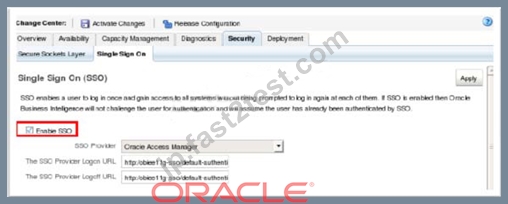
D:You have three methods to start the managed server:
*with the console (recommended)
*with FMW control
*with the command line.
質問 # 66
An organization would like to see a Time folder with subfolders for its Fiscal and Julian calendars. How would you accomplish this?
- A. By creating a Presentation Folder called ->Time called then two subsequent folders called Fiscal Calendar and Julian Calendar
- B. By creating a Presentation Folder called Time<parent> and then two subsequent folders called Fiscal Calendar<child> and Julian Calendar<child>
- C. By creating Presentation Folder called Time and then two subsequent folders called -> Fiscal Calendar and -> Julian Calendar
- D. By creating a Presentation Folder called -Time and then two subsequent folders called + Fiscal Calendar and + Julian Calendar
正解:C
解説:
Explanation
You can nest presentation folders in two ways.
1) You can enter a hyphen and a greater than sign in the description field of the table to achieve the result.
2) Or, prefix the name of the presentation folder to be nested with a hyphen and a space and place it after the folder in which it nests to achieve the same result as shown below.
http://santoshbidw.files.wordpress.com/2011/09/image0011.png?w=500
Result
http://santoshbidw.files.wordpress.com/2011/09/image003.png?w=500
質問 # 67
There is a logical fact table that contains Item number, store, time, and revenue. How would you add Number
of items sold?
- A. By creating a derived measure on the logical column item number and using the count distinct function
- B. By creating a derived measure on the logical column Item number and using the count Function
- C. By creating a derived measure based on the physical column item number and changing the aggregation method to count
- D. By creating a derived metric by using the Expression Builder
正解:C
解説:
Explanation
A measure column is a column unlike the baseline column that has a default aggregation rule defined in the Aggregation tab of the Logical Column dialog in the repository.
Measure columns always calculate the aggregation with which they are defined.
Measures need to be defined in a logical fact. Any column with an aggregation rule is a measure.
http://gerardnico.com/wiki/_media/dat/obiee/bi_server/design/obiee_measure_column.jpg
質問 # 68
The WebLogic Repository Schema generated via RCU can be deployed to which three DBMS?
- A. IBM DB2
- B. Microsoft SQL Server
- C. Teradata
- D. Oracle RDBMS
正解:A、B、D
解説:
Explanation
BIEE 11g Install High level Steps :
Software Required
1. Database (Oracle, IBM DB2 or MS-SQL)
2. Repository Creation Utility (RCU)
3. OBIEE 11g (11.1.1.3 is latest OBIEE as of 30 April 2011)
4. WebLogic 10.3.3 (Optional - Only required for 64 bit machine or IBM AIX)
5. JDK 1.6 64 bit (Optional - Only required for 64 bit machine)
質問 # 69
What are the two methodologies that are followed within an OBIEE implementation?
- A. Start with a big repository and trim it down with the requirements
- B. Use an iterative approach
- C. Do not use prototypes
- D. Start with a small model and then enhance the repository
正解:B、D
解説:
Explanation
質問 # 70
......
最新の1Z1-591試験問題集でOracle試験問題にトレーニング:https://jp.fast2test.com/1z1-591-premium-file.html