

[2024年06月]更新のOGEA-101認定実際の問題を提供します
更新されたのはOGEA-101問題集PDFでOGEA-101リアル有効なブレーン問題集には94問があります!
質問 # 39
Which one of the following classes of information within the Architecture Repository would typically contain a list of the applications in use within the enterprise?
- A. Reference Library
- B. Architecture Landscape
- C. Architecture Metamodel
- D. Governance Log
正解:B
解説:
The Architecture Landscape is a class of information within the Architecture Repository that shows an architectural view of the building blocks that are in use within the organization today (the Baseline Architecture), as well as those that are planned for the future (the Target Architecture). The Architecture Landscape typically contains a list of the applications in use within the enterprise, along with their relationships and dependencies, as well as other relevant architectural information. The Architecture Landscape helps to identify opportunities for re-use, consolidation, or retirement of existing applications, as well as gaps or overlaps in the current or future architecture.Reference: : The TOGAF Standard, Version 9.2, Part IV: Architecture Content Framework, Chapter 34: Architecture Landscape : The TOGAF Standard, Version 9.2, Part VI: Architecture Capability Framework, Chapter 47: Architecture Repository
質問 # 40
What provides context for architecture work, by describing the needs and ways of working employed by the enterprise?
- A. Strategy and vision
- B. Stakeholder needs
- C. Architecture Contracts
- D. Business principles business goals, and business drivers
正解:D
解説:
Business principles business goals, and business drivers provide context for architecture work, by describing the needs and ways of working employed by the enterprise. They define what the enterprise wants to achieve, how it wants to operate, and what factors influence its decisions and actions. Reference: The TOGAF Standard | The Open Group Website, Section 3.2 Preliminary Phase.
質問 # 41
Which section of the TOGAF template for Architecture Principles should describe the relationship to other principles?
- A. Rationale
- B. Implications
- C. Name
- D. Statement
正解:A
解説:
According to the TOGAF template for Architecture Principles, the Rationale section should describe the relationship to other principles, as well as the business benefits and the intentions of adhering to the principle. The Rationale section should use business terminology and point to the similarity of information and technology principles to the principles governing business operations. The Rationale section should also explain how the principle supports the achievement of the business objectives and key architecture drivers. Reference:
* Architecture Principles Template
* The TOGAF Standard, Version 9.2 - Architecture Principles
* The Open Group Exam OGEA-103 Topic 1 Question 4 Discussion
質問 # 42
What is presented as "striking a balance between positive and negative outcomes resulting from the realization of either opportunities or threats?
- A. Risk Management
- B. Transition Management
- C. Agile development
- D. Architecture Security
正解:A
解説:
Risk Management is the process of identifying, assessing, and responding to risks that may affect the achievement of the enterprise's objectives. Risk Management involves balancing positive and negative outcomes resulting from the realization of either opportunities or threats. Reference: The TOGAF Standard | The Open Group Website, Section 3.3.3 Risk Management.
質問 # 43
Consider the following ADM phases objectives.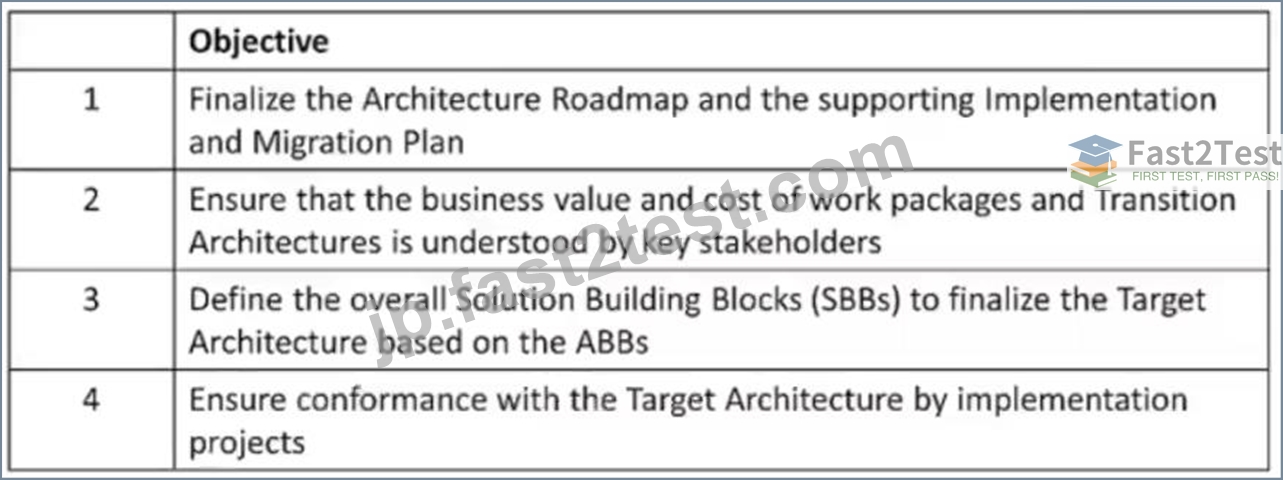
Which phase does each objective match?
- A. 1F-2G-3F-4F
- B. 1E-2F-3E-4G
- C. 1G-2E-3F-4E
- D. 1F-2F-3E-4G
正解:B
解説:
1E: To identify delivery vehicles (projects programs portfolios) that will deliver the Target Architecture 2F: To confirm readiness and ability to undergo change 3E: To determine whether an incremental approach is required and if so identify Transition Architectures that will deliver continuous business value 4G: To perform appropriate governance functions while the solution is being implemented
質問 # 44
What does the TOGAF ADM recommend for use in developing an Architecture Vision document?
- A. Business Scenarios
- B. Gap Analysis
- C. Requirements Management
- D. Architecture Principles
正解:A
解説:
Business scenarios are a technique recommended by the TOGAF ADM for use in developing an Architecture Vision document12. Business scenarios are a means of capturing the business requirements and drivers, the processes and actors involved, and the desired outcomes and measures of success34. Business scenarios help to create a common vision and understanding among the stakeholders, and to identify and validate the architecture requirements . Business scenarios also provide a basis for analyzing the impact and value of the proposed architecture. Reference:
* The TOGAF Standard, Version 9.2 - Phase A: Architecture Vision - The Open Group
* TOGAF Standard - Introduction - Phase A: Architecture Vision
* The TOGAF Standard, Version 9.2 - Definitions - The Open Group
* Business Scenarios - The Open Group
* [The TOGAF Standard, Version 9.2 - Architecture Requirements Specification - The Open Group]
* [The TOGAF Standard, Version 9.2 - Architecture Vision - The Open Group]
* [The TOGAF Standard, Version 9.2 - Business Transformation Readiness Assessment - The Open Group]
質問 # 45
Consider the image showing basic architectural concepts.
What are items A and B?
- A. A-Architecture Viewpoint, B-Architecture View
- B. A-Candidate Architecture, B-Trade-off
- C. A-Requirement. B-Candidate Architecture
- D. A-Architecture Board, B-Architecture Capability
正解:A
解説:
* The image shows a diagram that illustrates the basic concepts of architecture description as defined by the ISO/IEC/IEEE 42010:2011 standard1, which is also adopted by the TOGAF standard2.
* According to the ISO/IEC/IEEE 42010:2011 standard, an architecture description is a work product used to express an architecture, and it consists of one or more architecture views1.
* An architecture view is a representation of a system from the perspective of a related set of concerns, and it conforms to an architecture viewpoint1.
* An architecture viewpoint is a specification of the conventions for constructing and using an architecture view to address specific stakeholder concerns1.
* Therefore, the correct answer is option A, which identifies the items labeled as "A" and "B" in the image as an architecture viewpoint and an architecture view, respectively. Reference:
* 1: ISO/IEC/IEEE 42010:2011 - Systems and software engineering - Architecture description1
* 2: TOGAF Standard, Version 9.2 - Part IV: Architecture Content Framework - 31. Architectural Artifacts2
質問 # 46
Complete the sentence Business Transformation Readiness Assessment is_________________.
- A. widely used to validate an architecture that is being developed
- B. a joint effort between corporate staff lines of business and IT planners
- C. to ensure the active support of powerful stakeholders
- D. a way to put building blocks into context thereby supporting re-usable solutions
正解:B
解説:
Business Transformation Readiness Assessment is a joint effort between corporate staff lines of business and IT planners to evaluate the readiness of the organization to undergo change. It involves assessing factors such as vision, commitment, capacity, capability, culture, and motivation that may influence the success of a business transformation initiative. Reference: The TOGAF Standard | The Open Group Website, Section 3.3.2 Business Transformation Readiness Assessment.
質問 # 47
What is an objective of the ADM Preliminary Phase?
- A. To select and implement tools to support the Architecture Capability
- B. To develop a vision of the business value to be delivered by the proposed enterprise architecture
- C. To obtain approval for the Statement of Architecture Work
- D. To create the initial version of the Architecture Roadmap
正解:A
解説:
The Preliminary Phase is the preparatory phase of the Architecture Development Method (ADM) cycle, which sets the context and direction for the architecture work. One of the objectives of this phase is to select and implement tools to support the Architecture Capability, which is the ability of an organization to perform enterprise architecture effectively and efficiently. Tools can include software applications, methods, techniques, standards, and frameworks that assist the architecture development and governance processes. The selection and implementation of tools should be based on the requirements and constraints of the organization, and the alignment with the Architecture Principles and the Architecture Vision3 Reference: 3: The TOGAF Standard, Version 9.2, Part II: Architecture Development Method (ADM), Chapter 6: Preliminary Phase : The TOGAF Standard, Version 9.2, Part VI: Architecture Capability Framework, Chapter 45: Establishing and Maintaining an Enterprise Architecture Capability : The TOGAF Standard, Version 9.2, Part VI: Architecture Capability Framework, Chapter 46: Tools for Architecture Development
質問 # 48
Which phase of the ADM has the purpose to develop an Enterprise Architecture Capability?
- A. Phase B
- B. Phase G
- C. Phase A
- D. Preliminary Phase
正解:D
解説:
According to the TOGAF Standard, 10th Edition, the Preliminary Phase of the Architecture Development Method (ADM) has the purpose to develop an Enterprise Architecture Capability 1. An Enterprise Architecture Capability is the ability of the organization to perform the activities and tasks related to Enterprise Architecture, such as defining the scope, principles, vision, governance, and stakeholders of the architecture. The Preliminary Phase also establishes the architecture framework, the architecture repository, the architecture tools, and the architecture team 1. The other options are not correct, as they have different purposes in the ADM. Phase G: Implementation Governance has the purpose to ensure that the implementation projects conform to the target architecture 2. Phase A: Architecture Vision has the purpose to define the scope, stakeholders, business drivers, and objectives of the architecture project 3. Phase B: Business Architecture has the purpose to describe the baseline and target business architecture, and to identify the gaps between them . Reference: 1: TOGAF Standard, 10th Edition, Part II: Architecture Development Method, Chapter 6: Preliminary Phase. 2: TOGAF Standard, 10th Edition, Part II: Architecture Development Method, Chapter 18: Phase G: Implementation Governance. 3: TOGAF Standard, 10th Edition, Part II: Architecture Development Method, Chapter 12: Phase A: Architecture Vision. : TOGAF Standard, 10th Edition, Part II: Architecture Development Method, Chapter 13: Phase B: Business Architecture.
質問 # 49
What are the four dimensions used to scope an architecture?
- A. Strategy Segment Capability Budget
- B. Breadth Depth Time Period Architecture Domains
- C. Business Data Application Technology
- D. Strategy Portfolio Project Solution Delivery
正解:B
解説:
* The four dimensions used to scope an architecture are Breadth, Depth, Time Period, and Architecture Domains1, p. 8.
* Breadth refers to the extent of the enterprise covered by the architecture, which can range from a specific business unit to the entire organization1, p. 8.
* Depth refers to the level of detail and completeness of the architecture, which can vary depending on the purpose, scope, and stakeholders of the architecture1, p. 8.
* Time Period refers to the temporal aspects of the architecture, such as the current state, the target state, and the transition plan1, p. 8.
* Architecture Domains refers to the classification of the architecture into four domains: Business, Data, Application, and Technology1, p. 8.
* These four dimensions help define the scope and boundaries of the architecture and ensure that it meets the needs and expectations of the stakeholders.
Reference:
* 1: The Open Group (2018). The TOGAF Standard, Version 9.2. 1
質問 # 50
What are the following activities part of?
* Initial risk assessment
* Risk mitigation and residual risk assessment
* Risk monitoring
- A. Security Architecture
- B. Phase C
- C. Risk Management
- D. Phase A
正解:C
解説:
The following activities are part of Risk Management:
* Initial risk assessment
* Risk mitigation and residual risk assessment
* Risk monitoring
Risk Management is the process of identifying, assessing, and responding to risks that may affect the achievement of the enterprise's objectives. Risk Management involves balancing positive and negative outcomes resulting from the realization of either opportunities or threats. Reference: The TOGA Standard | The Open Group Website, Section 3.3.3 Risk Management.
質問 # 51
Complete the sentence. When considering agile development, Architecture to Support Portfolio will identify what products the Enterprise needs, the boundary of the products, and what constraints a product owner has; this defines the Enterprise's
- A. business continuity
- B. backlog
- C. risk tolerance
- D. operating model
正解:B
解説:
When considering agile development, Architecture to Support Portfolio will identify the necessary products for the enterprise, define their boundaries, and outline the constraints for a product owner. This process directly relates to defining the enterprise's backlog, which in agile methodologies, is a prioritized list of work for the development team that is derived from the roadmap and its requirements.
質問 # 52
Which of the following best describes a purpose of the Gap Analysis technique?
- A. To establish quality metrics for the architecture
- B. To identify missing functions
- C. To determine service levels for the architecture
- D. To validate non-functional requirements
正解:B
解説:
Gap analysis is a technique that is used to validate an architecture by highlighting the shortfall between the Baseline Architecture and the Target Architecture. One of the purposes of gap analysis is to identify missing functions that are either deliberately omitted, accidentally left out, or not yet defined in the Target Architecture. Missing functions are marked as gaps that need to be filled by developing or procuring the building blocks.
質問 # 53
Complete the following sentence:
Presenting different_________and_________to stakeholders helps architects to extract hidden agendas principles and requirements that could impact the final Target Architecture
- A. Solutions Applications
- B. Business Scenarios Business Models
- C. Alternatives Trade-offs
- D. Architecture Views Architecture Viewpoints
正解:D
解説:
According to the TOGAF Standard, an architecture view is a representation of a system from the perspective of a related set of concerns1. An architecture viewpoint is a specification of the conventions for a particular kind of architecture view1. Presenting different architecture views and architecture viewpoints to stakeholders helps architects to extract hidden agendas, principles, and requirements that could impact the final target architecture. This is because different stakeholders may have different concerns and interests in the system, and by showing them how the system addresses their concerns from different perspectives, the architects can elicit more feedback and validation from them2. For example, a business stakeholder may be interested in the business architecture view, which focuses on the business processes, functions, and capabilities of the system3. A security stakeholder may be interested in the enterprise security view, which addresses the security aspects of the system, such as confidentiality, integrity, and availability3. By presenting these views to the respective stakeholders, the architects can ensure that the system meets their expectations and needs, and also identify any potential issues or gaps that may affect the target architecture. Reference: 1: The TOGAF Standard, Version 9.2 - Architectural Artifacts - The Open Group1; 2: Understanding TOGAF Views and Viewpoints in Enterprise Architecture2; 3: Developing Architecture Views - The Open Group4
質問 # 54
Consider the following statement:
According to the TOGAF Standard a governed approach of a particular deliverable will ensure a system of continuous monitoring to check integrity changes decision-making and audit of all architecture-related activities Which deliverable is being referred to?
- A. An Architecture Contract
- B. The Statement of Architecture Work
- C. The Architecture Vision
- D. The Architecture Definition Document
正解:A
解説:
An Architecture Contract is a deliverable that specifies the responsibilities and obligations of the parties involved in the implementation and governance of an architecture. It ensures a system of continuous monitoring to check integrity changes decision-making and audit of all architecture-related activities. Reference: The TOGAF Standard | The Open Group Website, Section 3.3.4 Architecture Contracts.
質問 # 55
Complete the following sentence. In the ADM documents which are under development and have not undergone any formal review and approval process are_______________.
- A. Known as ''Version 0.1''
- B. Called ''draft''
- C. In between phases
- D. Invalid
正解:B
解説:
In the ADM documents which are under development and have not undergone any formal review and approval process are called "draft". This indicates that they are subject to change and refinement as the architecture development progresses. Reference: The TOGAF Standard | The Open Group Website, Section 4.2.5 Architecture Deliverables.
質問 # 56
......
あなたをお手軽にOGEA-101試験合格させるし100%試験合格保証:https://jp.fast2test.com/OGEA-101-premium-file.html
100%無料OGEA-101試験問題集実際問題を使おうEnterprise Architecture問題集:https://drive.google.com/open?id=1ryUxaFpiY0s9EWNpVo4kwal3kORWrr80