

2024年最新の実際に出るAD0-E134問題集には試験のコツがあるPDF試験材料
心強いAD0-E134PDF問題集はAD0-E134問題
Adobe AD0-E134 認定試験の出題範囲:
| トピック | 出題範囲 |
|---|---|
| トピック 1 |
|
| トピック 2 |
|
| トピック 3 |
|
| トピック 4 |
|
| トピック 5 |
|
| トピック 6 |
|
質問 # 29
The OSGi configuration is added to a runmode specific configuration "config.author.staging" in AEM as a Cloud Service. The application fails to read the configuration.
What is a possible cause of this issue?
- A. Only <service> specific OSGi configuration runmodes like "config.author" or "config.publish" are supported in AEM as a Cloud service.
- B. The custom OSGi configuration runmode used (i.e., "config.author.staging") is not supported in AEM as a Cloud service.
- C. OSGi configuration runmodes cannot be installed automatically on AEM as a Cloud Service. We need to install them as a package using the Package manager.
- D. AEM as a Cloud service does not support OSGi configuration runmodes.
正解:A
解説:
Explanation
AEM as a Cloud Service does not support custom OSGi configuration runmodes, such as
"config.author.staging". Only <service> specific OSGi configuration runmodes, such as "config.author" or
"config.publish", are supported. These runmodes are used to apply configurations to specific services, such as author or publish. The <service> specific runmodes can be combined with environment variables to achieve different configurations for different environments. References:
https://experienceleague.adobe.com/docs/experience-manager-cloud-service/implementing/deploying/configurin
質問 # 30
An AEM application wants to set up multi-tenancy using Adobe-recommended best practices and bind multiple configurations to it. Which of the following options is recommended?
- A. @Component(service = ConfigurationFactory.class)
@Designate(ocd = ConfigurationFactorylmpl.Config.class, factory=true) - B. import org.osgi.service.component.annotations.Component; @Component(service = ConfigurationFactory.class)
- C. import org.osgi.service.metatype.annotations.AttributeDefinition;
import org.osgi.service.metatype.annotations.ObjectClassDefinition;
@ObjectClassDefinition(name = "My configuration") - D. import org.apache.felix.scr.annotations.Component; @Component(label = "My configuration", metatype = true, factory= true)
正解:A
解説:
Explanation
The @Component(service = ConfigurationFactory.class) @Designate(ocd =
ConfigurationFactorylmpl.Config.class,factory=true) option is recommended for creating a multi-tenancy configuration and binding multiple configurations to it. This option uses the OSGi R6 annotations to define a component that provides a service of type ConfigurationFactory and designates a class that contains the configuration properties. The factory=true attribute indicates that multiple configurations can be created for this component.
References:https://experienceleague.adobe.com/docs/experience-manager-65/deploying/configuring/osgi-configu
質問 # 31
A developer needs to create a project based on AEM Project Archetype with a specific AEM as a Cloud Service SDK version on the local environment.
Which two properties must be defined when creating this project? (Choose two.)
- A. aemVersion=latest
- B. aemVersion=2022.5.7575.20220530T152407Z-220401
- C. sdkVersion=2022.5.7575.20220530T152407Z-220401
- D. aemVersion=cloud
- E. sdkVersion=latest
正解:C、D
解説:
Explanation
The aemVersion property specifies the target AEM version for the project. To create a project based on AEM as a Cloud Service SDK, the value should be set to cloud. The sdkVersion property specifies the AEM as a Cloud Service SDK version to use for local development. To use a specific SDK version, the value should be set to the exact version number, such as 2022.5.7575.20220530T152407Z-220401. References:
https://experienceleague.adobe.com/docs/experience-manager-core-components/using/developing/archetype/usin
質問 # 32
An AEM application requires LDAP Service integration to synchronize users/groups. Which two OSGi configuration are required for LDAP integration in AEM? (Select Two.)
- A. Apache Jackrabbit Oak Default Sync Handler
- B. Apache Jackrabbit Oak External Login Module
- C. Apache Jackrabbit Oak CUG Configuration
- D. Apache Jackrabbit Oak AuthorizableActionProvider
- E. Apache Jackrabbit Oak Solr server provider
正解:A、B
解説:
Explanation
The Apache Jackrabbit Oak External Login Module and Apache Jackrabbit Oak Default Sync Handler are the two OSGi configurations that are required for LDAP integration in AEM. The External Login Module defines how AEM connects to the LDAP server and authenticates users against it. The Default Sync Handler defines how AEM synchronizes users and groups from the LDAP server to the repository.
References:https://experienceleague.adobe.com/docs/experience-manager-65/administering/security/ldap-config.
質問 # 33
A customer adds third-party client libraries to add some features in an existing AEM application, which will significantly reduce performance.
How should the developer optimize the site?
- A. Embed client libraries to consolidate them into fewer files.
- B. Debug third-party client lib and fix the code.
- C. Rebuild Client libraries.
正解:A
解説:
Explanation
Embedding client libraries is a technique that allows combining code from multiple client libraries into a single file. This reduces the number of network requests and improves performance. Embedding client libraries can be done by using the embed property of the cq:ClientLibraryFolder node and specifying the categories of the client libraries to be embedded. References:
https://experienceleague.adobe.com/docs/experience-manager-cloud-service/content/implementing/developing/fu
質問 # 34
A developer is on an AEM application that is being used to calculate an employee's salary. The calculation is done in an OSGi service called CalculationService. This service class has a dependency on one other service, called the EmployeeService.
How should the developer make sure that the critical code in the CalculationService has a high unit test coverage?
- A. Use a mock framework in the unit test to inject the EmployeeService
- B. Use the feature flag in the unit test to disable the calls to the EmployeeService
- C. Instantiate the EmployeeService in the unit test and pass it to the constructor of the CalculationService
- D. Use a mock framework in the unit test to inject the CalculationService
正解:A
解説:
Explanation
A mock framework is a tool that allows creating mock objects that simulate the behavior of real objects in a controlled way. A mock framework can be used in a unit test to inject the EmployeeService dependency into the CalculationService and verify its interactions. This way, the unit test can focus on testing the logic of the CalculationService without relying on the actual implementation of the EmployeeService. References:
https://sling.apache.org/documentation/development/sling-testing-tools.htmlhttps://wcm.io/testing/aem-mock/usa
質問 # 35
An AEM as a Cloud Service implementation customer wants content to be replicated as soon as the On Time and Off Times are reached.
What must the developer configure?
- A. Enable Auto Replicate via On Off Trigger Configuration
- B. Enable On Time or Off Time via Page Properties
- C. Configure the Publish content tree via Workflow Models
正解:A
解説:
Explanation
The Auto Replicate via On Off Trigger Configuration is a feature that allows content to be replicated as soon as the On Time and Off Times are reached. This feature can be enabled by creating an OSGi configuration for the com.day.cq.wcm.core.impl.servlets.OnOffTimeServlet service. This service listens for changes in the On Time and Off Time properties of pages andtriggers replication accordingly. References:
https://experienceleague.adobe.com/docs/experience-manager-65/deploying/configuring/replication.html?lang=e
質問 # 36
An AEM Developer needs to create a new component to help support a new product launch.
* The client is on AEM 6.5 on-premise with the latest version of WCM Core Components
* The component must include text, image, and a link
* The component must support multiple designs
Which process should the AEM Developer use to support the launch?
- A. 1. Create a new component by extending the Text Component from Core Components
2. Add dialog properties and modify HTL to support images - B. 1. Create a new Image with Text component that exposes the Core Components authoring dialogs for those components
2. Add a policy to define which designs are used - C. 1. Extend the Text Component from Core Components
2. Enable image manipulations for the Text Component via policy - D. 1. Extend the Teaser Component from Core Components
2. Create style variations to be used in the Style System
正解:D
解説:
* Extend the Teaser Component from Core Components
* Create style variations to be used in the Style System** Comprehensive Explanation of Correct Answer Only: The Teaser Component from Core Components is a component that allows authors to display a title, description, image and link for a teaser item. The component supports multiple designs and can be extended to add custom features or logic. The Style System allows authors to define style variations for components without requiring code changes or new templates. References:
https://experienceleague.adobe.com/docs/experience-manager-core-components/using/components/teaser.h
https://experienceleague.adobe.com/docs/experience-manager-core-components/using/components/style-sy
質問 # 37
A customer who is running an AEM application on premise reports that the application is slowing down over time and even crashes The issues seem to start occurring after a new production deployment. The AEM developer knows that the described symptoms could be caused by a memory leak.
Which two steps should be taken after confirming the problem is related to a memory issue? (Choose two.)
- A. Open the error log and look for messages with 'OutOfMemoryError'
- B. Analyze the request log and make sure the number of requests are below the expected threshold
- C. Create a thread dump for analysis
- D. Increase the cache ratio of the application
- E. Create a heap dump for analysis
正解:C、E
解説:
Explanation
Creating a heap dump and a thread dump are two steps that should be taken after confirming the problem is related to a memory issue. A heap dump is a snapshot of the memory usage of the Java Virtual Machine (JVM) at a given point in time. A heap dump can be used to identify memory leaks, memory consumption patterns, and objects that occupy large amounts of memory. A thread dump is a snapshot of the state of all threads that are part of the JVM process. A thread dump can be used to identify deadlocks, blocked threads, and CPU-intensive threads. References:
https://experienceleague.adobe.com/docs/experience-manager-65/deploying/configuring/memory-analysis.html?
質問 # 38
In a non-optimized website, the final HTML generated for a typical page by publish instance includes a relatively large number of <script> elements that refer to other script files loaded from AEM environment. The developer wants to minimize these network calls by combining all required client library code into a single file to reduce the number of back-and-forth requests on page load.
Which step should a developer take to solve this issue?
- A. Embed the required libraries into an app-specific client library using the dependencies property of the cq:Clientl_ibraryFolder node
- B. Embed the required libraries into an app-specific client library using the embed property of the cq:ClientLibraryFolder node
- C. Embed the required libraries into an app-specific client library using the allowProxy property of the cq:Clientl_ibraryFolder node
- D. Add the categories property of the cq:Clientl_ibraryFolder node into an app-specific client library folder
正解:A
解説:
Explanation
The embed property of the cq:ClientLibraryFolder node allows embedding code from a client library into another client library. At runtime, the generated JS and CSS files of the embedding library include the code of the embedded library. This reduces the number of network calls and improves performance. Embedding code is useful for providing access to libraries that arestored in secured areas of the repository. References:
https://experienceleague.adobe.com/docs/experience-manager-cloud-service/content/implementing/developing/fu
質問 # 39
A developer needs to create a runmode-specific OSGi configuration for an AEM as a Cloud Service implementation. In which location should the OSGi configuration be created?
- A. ui.config project, (/config/.../config.<runmode>) folder
- B. core project, (/core/.../config <runmode>) folder
- C. all project, (/all/.../config.<runmode>) folder
- D. ui.apps project (/apps/.../config.<runmode>) folder
正解:A
解説:
Explanation
The ui.config project, (/config/.../config.<runmode>) folder is the location where the OSGi configuration should be created for a runmode-specific configuration for an AEM as a Cloud Service implementation. The ui.config project contains OSGi configurations that are deployed to /apps in the repository. The config.<runmode> folder specifies the runmode for which the configuration is applicable, such as author or publish.
References:https://experienceleague.adobe.com/docs/experience-manager-cloud-service/implementing/deploying
質問 # 40
A snippet throws an exception at runtime:
@Model(adaptables = {Resource.class}) public class MyCustomModel {
(SSIingObject
private Resource resource;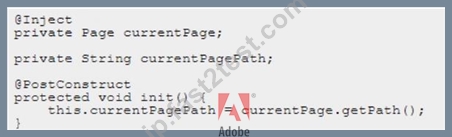
What should the developer add to fix it?
- A. defaultlnjectionStrategy = DefaultlnjectionStrategy property to @Model Class annotation
- B. SlingHttpServletRequest.class to adaptables property of Model Class annotation
- C. throws Exception at the end of the init method declaration
- D. (Optional annotation to page field
正解:A
解説:
Explanation
The developer should add the defaultInjectionStrategy = DefaultInjectionStrategy property to the @Model Class annotation to fix the snippet. The defaultInjectionStrategy property defines how the Sling Model handles missing or null values for the injected fields. By default, the Sling Model uses the REQUIRED injection strategy, which means that all fields must have a non-null value or else an exception is thrown. By setting the defaultInjectionStrategy property to OPTIONAL, the Sling Model allows null values for the injected fields and does not throw an exception. This way, if the page field is null because the resource is not a page, the Sling Model can still work without errors. References:
https://sling.apache.org/documentation/bundles/models.htmlhttps://sling.apache.org/documentation/bundles/mod
質問 # 41
Which AEM as a Cloud Service role can configure or run pipelines?
- A. Deployment Manager
- B. Developer
- C. Program Manager
- D. DevOps
正解:A
解説:
Explanation
The Deployment Manager is a role that can configure or run pipelines in Cloud Manager. The Deployment Manager can create and edit programs and environments, configure pipelines, start and cancel pipeline executions, and approve or reject deployments to production. The Deployment Manager role requires an IMS ID that is associated with the Adobe Experience Cloud product profile. References:
https://experienceleague.adobe.com/docs/experience-manager-cloud-service/implementing/using-cloud-manager
質問 # 42
An AEM development team is working on a new multi-country application using AEM as a Cloud Service. A developer has been assigned the task for building the integration with a third-party web service. A secret key is needed to connect with this web service. The website creators will provide this key. The key is different for each type of environment (dev, stage and production) What is the recommended way to make the secret key available in the AEM application?
- A. Use an environment variable which is then consumed by an OSGi configuration
- B. Read the key value from OSGi configuration stored in run nNdes
- C. Use a context aware configuration
- D. Read the key value from a property file stored in the code base
正解:A
解説:
Explanation
The recommended way to make the secret key available in the AEM application is to use an environment variable which is then consumed by an OSGi configuration. This way, the secret key is not stored in the code base or in the repository, but rather in a secure and encrypted way in the Cloud Manager environment variables. The OSGi configuration can use a placeholder to reference the environment variable and inject its value at runtime. References:
https://experienceleague.adobe.com/docs/experience-manager-cloud-service/implementing/deploying/configurin
質問 # 43
Which tool should a developer use to look up Adobe Identity Management System (IMS) users by email and return their IMS IDs?
- A. IMS Lookup Tool
- B. User Mapping Tool
- C. Developer Console
- D. Cloud Acceleration
正解:A
解説:
Explanation
The IMS Lookup Tool is a tool that allows looking up Adobe Identity Management System (IMS) users by email and returning their IMS IDs. The IMS Lookup Tool is available in the Cloud Manager UI under the Tools menu. The IMS Lookup Tool can be used to find the IMS IDs of users who need to be added to Cloud Manager programs or environments. References:
https://experienceleague.adobe.com/docs/experience-manager-cloud-service/implementing/using-cloud-manager
質問 # 44
The following anchor tag is not resolving:
<a href="item.path" >{item.name}</a>
Upon further inspection the developer notices that the link has no .html appended to the end of the URL What could be a potential fix for the issue?
- A.

- B.

- C.

- D.

正解:C
解説:
Explanation
Option B is a potential fix for the issue. Option B uses the data-sly-attribute block statement to add the href attribute to the anchor tag. The data-sly-attribute statement uses an expression to append ".html" to the item.path value. This way, the link will have the correct extension and will resolve to the corresponding page.
References:https://experienceleague.adobe.com/docs/experience-manager-htl/using-htl/htl-block-statements.htm
質問 # 45
A developer needs to create sling models for two fields name and occupations. The dialog has two fields, name - a single value field, and occupations - a multi value field.
The following code is included in sling models inherited from interface com.adobe.aem.guides.wknd.core.models.Byline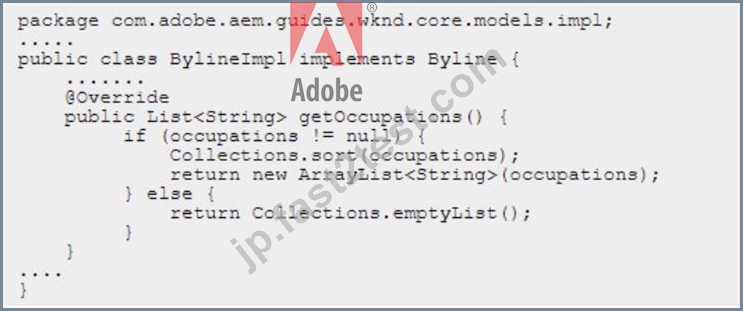
- A.

- B.

- C.

- D.

正解:A
解説:
Explanation
Option C is the correct implementation for the Sling Model. Option C uses the @Model annotation with the adaptables parameter set to Resource.class. This allows the Sling Model to adapt from a resource object and access its properties using the ValueMap interface. Option C also uses the @Inject annotation with the name parameter set to "./name" and "./occupations" to inject the values of the name and occupations properties into the name and occupations fields. Option C also uses the @Named annotation with the value parameter set to
"byline" to specify the name of the Sling Model that can be used in HTL scripts. References:
https://sling.apache.org/documentation/bundles/models.htmlhttps://experienceleague.adobe.com/docs/experience
質問 # 46
Which attribute must be present in all filter rules in AEM dispatcher configuration?
- A. /type
- B. /selectors
- C. /url
- D. /glob
正解:D
解説:
Explanation
The /glob attribute is mandatory for all filter rules in the dispatcher configuration. It specifies a pattern that is matched against the incoming request URL. If the pattern matches, the rule is applied. The /glob attribute can use wildcards (*) and placeholders ($1, $2, etc.) to match parts of the URL.
References:https://experienceleague.adobe.com/docs/experience-manager-dispatcher/using/configuring/dispatche
質問 # 47
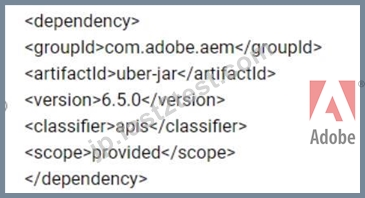
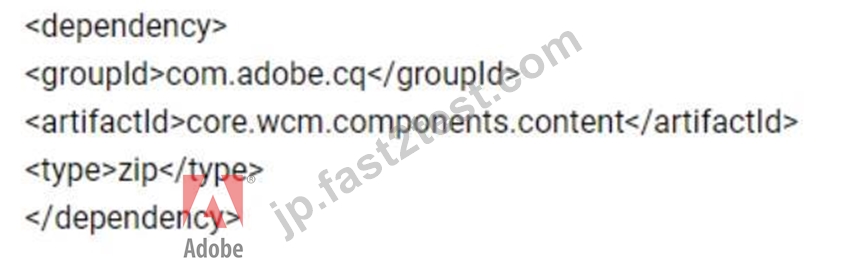
Which AEM dependency provides APIs for all AEM environments?
- A.
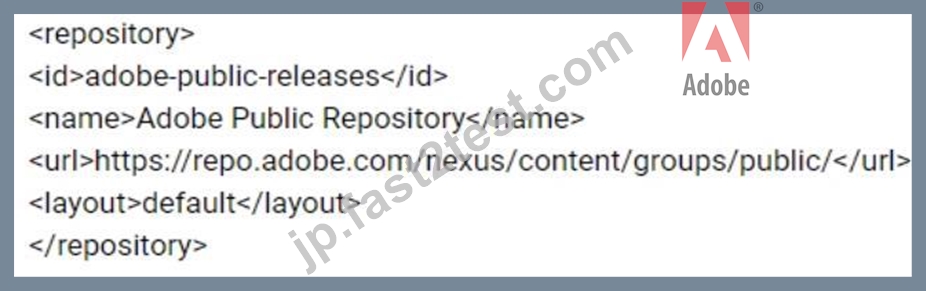
- B.
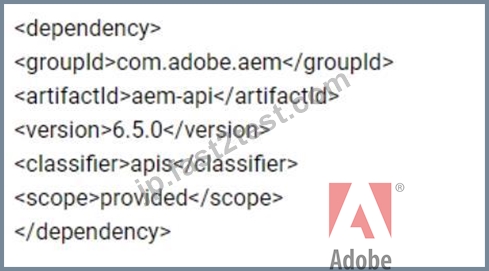
- C.
- D.
正解:A
解説:
Explanation
Option C is the AEM dependency that provides APIs for all AEM environments. Option C uses the uber-jar dependency with the provided scope and the classifier set to apis. The uber-jar dependency contains all the public Java APIs that are available in AEM. The provided scope indicates that the dependency is not required for runtime, as it is already provided by the AEM platform. The apis classifier indicates that only the API classes are included in the dependency, not the implementation classes. References:
https://experienceleague.adobe.com/docs/experience-manager-cloud-service/implementing/developing/aem-proje
質問 # 48
An AEM Developer receives requirements for Sling Models in a human-readable yaml format. A custom application needs to be built. The dependency is as shown: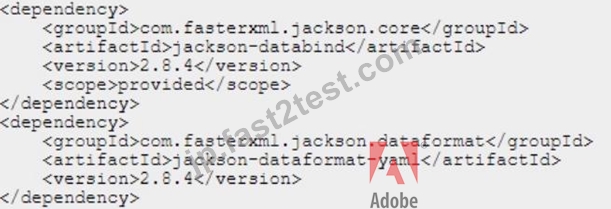
- A. 1. Create OSGI models to export as yaml
2. Configure mime type in Apache Sling Servlet/Script Resolver and Error Handler - B. 1. Create OSGI models to export as yaml
2. Configure mime type in Apache Sling MIME Type Service - C. 1. Create Sling models to export as yaml
2. Configure mime type in Apache Sling MIME Type Service - D. 1. Create Sling models to export as yaml
2. Configure mime type in Apache Sling Referrer Filter
正解:C
解説:
Explanation
To create Sling Models that can export data in a human-readable yaml format, the following steps are required:
* Create Sling models to export as yaml. Sling models are Java classes that can be used to represent resources in AEM. Sling models can use annotations to define how they can be adapted from a resource and how they can export data in different formats. To export data in yaml format, the Sling model class needs to use the @Model annotation with the resourceType parameter set to the resource type of the resource that the model represents. The Sling model class also needs to implement the org.apache.sling.models.annotations.Exporter annotation with the name parameter set to "jackson" and the extensions parameter set to "yaml". The Sling model class also needs to use the @JsonProperty annotation on the fields or methods that need to be exported in yaml format.
* Configure mime type in Apache Sling MIME Type Service. The Apache Sling MIME Type Service is an OSGi service that maps file extensions to MIME types and vice versa. To enable the yaml format for Sling models, the MIME Type Service needs to be configured with a new entry for the yaml extension and its corresponding MIME type, which is "application/x-yaml". This can be done by creating an OSGi configuration for the org.apache.sling.commons.mime.internal.MimeTypeServiceImpl service and adding the entry "yaml=application/x-yaml" to the mime.types property. References:
https://sling.apache.org/documentation/bundles/models.html
https://sling.apache.org/documentation/bundles/mime-type-support-commons-mime.html
質問 # 49
What is the recommended path to override /libs standard functionality?
- A. /Iibs
- B. /conf
- C. /content
- D. /apps
正解:D
解説:
Explanation
The recommended path to override /libs standard functionality is /apps. The /apps folder contains application-specific code and configuration that can extend or override the default functionality provided by
/libs. The /apps folder has precedence over the /libs folder, meaning that if there are two resources with the same path under both folders, the one under /apps will be used. References:
https://experienceleague.adobe.com/docs/experience-manager-cloud-service/implementing/developing/aem-proje
質問 # 50
......
結果を保証するには最新2024年01月無料:https://jp.fast2test.com/AD0-E134-premium-file.html