

100%合格、売れ筋最上位AD0-E720試験材料は2024年最新のAdobe練習試験合格させます
Adobe Commerce問題集でAD0-E720試験完全版問題、試験学習ガイド
Adobe AD0-E720 認定試験の出題範囲:
| トピック | 出題範囲 |
|---|---|
| トピック 1 |
|
| トピック 2 |
|
| トピック 3 |
|
| トピック 4 |
|
| トピック 5 |
|
| トピック 6 |
|
質問 # 19
An Adobe Commerce developer has just installed an extension via composer. When running, bin/magento module: status Vendor_Module, the status is returned as Module is disabled.
Which two CLI commands need to be run to make the extension work properly? (Choose two.)
- A. bin/magento setup:upgrade
- B. composer update vendor/module
- C. composer install
- D. bin/magento module:enable Vendor_Module --clear-static-content
正解:A、D
解説:
Explanation
The developer needs to run these two CLI commands to make the extension work properly:
bin/magento module:enable Vendor_Module --clear-static-content This command enables the extension and clears any outdated static files that might interfere with its functionality.
bin/magento setup:upgrade This command updates the database schema and data according to the extension's requirements. The other two options are incorrect because they are not necessary to make the extension work properly. The composer install command installs all dependencies specified in the composer.json file, but it does not enable or update any extensions. The composer update vendor/module command updates an existing extension to its latest version, but it does not enable or upgrade it.
質問 # 20
An Adobe Commerce Developer is adding a new page layout to the theme directory within a custom theme.
Which file needs to be created to register the new page layout?
- A. app/design/frontend/<VendorName>/<ThemeName>/Magento_Theme/layout/layouts.xml
- B. app/design/frontend/<VendorName>/<ThemeName>/layouts. xml
- C. app/design/frontend/<VendorName>/<ThemeName>/Magento_Theme/layouts.xnil
正解:A
解説:
Explanation
To register a new page layout in a custom theme, the developer needs to create a layouts.xml file in the app/design/frontend/<VendorName>/<ThemeName>/Magento_Theme/layout directory. The layouts.xml file should contain the <layout> element with the id, label, and file attributes. The id attribute is used to reference the layout in other layout files, the label attribute is used to display the layout name in the admin panel, and the file attribute is used to specify the path to the layout file relative to the web directory of the theme. The app/design/frontend/<VendorName>/<ThemeName>/layouts.xml and app/design/frontend/<VendorName>/<ThemeName>/Magento_Theme/layouts.xml files are not valid and will not work. References: [Create a new page layout], [layouts.xml]
質問 # 21
An Adobe Commerce developer wants to determine which template is rendering a specific element on the storefront. Which two methods can they use to turn on template hints? (Choose two.)
- A. In the Admin, navigate to Stores > Configuration > Advanced > Developer > Debug.
Set Enabled Template Path Hints for Storefront to Yes - B. On the command line, run the command; php bin/magento dev:template-hints:enable
- C. On the command line, run the command; php bin/magento setup:enable-template-hints
- D. In the Admin, navigate to system > Advanced > Template > Developer > Debug.
Set Enabled Template Path Hints for Storefront to Yes
正解:A、B
解説:
Explanation
Template hints are a useful tool for frontend developers to determine which template is rendering a specific element on the storefront. Template hints can be turned on using either of these two methods:
In the Admin Panel, navigate to Stores > Configuration > Advanced > Developer > Debug. Set Enabled Template Path Hints for Storefront to Yes On the command line, run the command; php bin/magento dev:template-hints:enable The other two options are incorrect because they do not exist as valid methods to turn on template hints.
References: Adobe Commerce Developer Documentation, Adobe Inc.
質問 # 22
In which mode would the stylesheet customizations display immediately after you reload a page in a browser?
- A. server- side compilation mode
- B. less-side compilation mode
- C. client-side compilation mode
正解:C
解説:
Explanation
In client-side compilation mode, the stylesheet customizations will display immediately after reloading a page in a browser. This is because in this mode, the LESS files are compiled into CSS files by the browser using JavaScript. This mode is useful for development and debugging purposes, as it allows quick changes and previews of the styles. However, this mode is not recommended for production, as it can affect the performance and compatibility of the site. The other modes, server-side compilation and LESS compilation, require running commands or tools to compile the LESS files into CSS files on the server side, which can take some time and delay the display of the customizations. References: [Compilation modes], [Compile LESS]
質問 # 23
An Adobe Commerce developer wants to apply a knockout binding to a <div> to run a function, onClick(), when it's clicked. Which two solutions would the developer use to achieve this? (Choose two.)
- A. <div><!-- ko click: 'onClick' --> <!-- /ko --></div>
- B. <div data-bind="click: onClick()"><x/div>
- C. <div data-bind="click: onClick"></div>
- D. <div click=,,onClick"X/div>
正解:B、C
解説:
Explanation
To apply a knockout binding to a <div> to run a function, onClick(), when it's clicked, the developer can use either of the following solutions:
A: <div data-bind="click: onClick()"></div>: This solution will use the click binding to execute the onClick() function as an expression when the <div> is clicked. The function will be called with the current binding context as the first parameter and the event object as the second parameter.
C: <div data-bind="click: onClick"></div>: This solution will use the click binding to execute the onClick function as a reference when the <div> is clicked. The function will be called with the current binding context as the first parameter and the event object as the second parameter.
The following solutions are not valid and will not work:
B: <div><!-- ko click: 'onClick' --><!-- /ko --></div>: This solution will use the virtual element syntax to apply the click binding, but it will pass a string literal instead of a function expression or reference.
This will cause an error, as the click binding expects a function value.
D: <div click="onClick"></div>: This solution will use a custom attribute instead of a data-bind attribute to apply the click binding. This is not supported by knockout and will not have any effect.
質問 # 24
an Adobe commerce developer wants to override the core Magento Ul library dropdowns in your theme.
Which is the correct way to achieve this?
- A. /web/css/source/lib/.dropdowns.less
- B. lib/web/css/source/.dropdowns.less
- C. /web/css/source/_dropdowns.less
正解:C
解説:
Explanation
To override the core Magento UI library dropdowns in a custom theme, the developer needs to create a file named _dropdowns.less in the /web/css/source directory of the theme. This file will override the default
_dropdowns.less file from the lib/web/css/source/lib directory and apply the custom styles to the dropdown elements. The lib/web/css/source/_dropdowns.less and /web/css/source/lib/_dropdowns.less files are not valid and will not work, as they do not follow the theme structure or the naming convention. References:
[Dropdowns], [Theme structure]
質問 # 25
An Adobe Commerce developer needs to create translations for the Orange/custom theme. Which directory would the developer place the translations?
- A. Orange/custom/il8n
- B. Orange/custom/translations
- C. Orange/custom/etc
正解:A
解説:
Explanation
To create translations for a theme, the developer needs to place the translation files in the il8n directory of the theme. The translation files should have the format <language code>_<country code>.csv, such as en_US.csv or fr_FR.csv. The etc and translations directories are not used for storing translation files. References:
[Translations overview], [Translate theme strings]
質問 # 26
An Adobe Commerce developer needs to add CMS content above products on a specific category page via the Admin Panel. Where would the developer need to put the content in order to use Display Modes functionality and display it on the category?
- A. Widget
- B. CMS Page
- C. CMS Block
正解:C
解説:
Explanation
CMS Blocks are the best option to add CMS content above products on a specific category page via the Admin Panel. CMS Blocks are reusable pieces of content that can be inserted into any page or layout using widgets or layout XML. CMS Blocks can be assigned to specific categories using the Display Settings tab in the category edit page. The developer can choose the Display Mode for the category, which determines how the CMS Block and the products are displayed on the category page. For example, the developer can choose Static block and products to show both the CMS Block and the products, or Static block only to show only the CMS Block and no products. References: Adobe Commerce Developer Documentation, Adobe Inc.
質問 # 27
An Adobe Commerce developer wants to override the following Layout XML file in the theme ExampleCorp/orange.
app/design/frontend/ExampleCorp/blank/Vendor_Module/layout/catalog_product_view.xml What path would the developer use inside the layout directory of the theme to override the file?
- A. /override/ExampleCorp/blank/catalog_product_view.xml
- B. /override/theme/ExampleCorp/blank/catalog_product_view.xml
- C. /catalog_product_view.xml
正解:C
解説:
Explanation
To override a layout XML file from a parent theme, the developer just needs to place the modified file in the same path relative to the layout directory of the child theme. In this case, the file would be app/design/frontend/ExampleCorp/orange/Vendor_Module/layout/catalog_product_view.xml. The override directory is not used for overriding layout files, but for overriding templates and web assets. References:
[Layout instructions], [Override templates and layout files]
質問 # 28
An Adobe Commerce developer was asked to customize a JavaScript component which is written as a function. How would the developer extend the native JavaScript function?
- A.

- B.

- C.

正解:C
解説:
Explanation
To customize a JavaScript component that is written as a function, the developer can use option A. This option will use the prototype property of the function to extend its functionality and add new methods or properties.
For example:
function Component() { // Component logic }
Component.prototype.customMethod = function() { // Custom method logic }; This will create a new method called customMethod on the prototype of the Component function, which can be accessed by any instance of the Component object. The developer can also override existing methods or properties on the prototype by reassigning them with new values.
Option B is not correct because it will not extend the native JavaScript function, but create a new function that wraps the original function. This will not allow the developer to access or modify the properties or methods of the original function. Option C is not correct because it will not extend the native JavaScript function, but create a new object that inherits from the original function. This will not allow the developer to customize the original function itself, but only its instances.
質問 # 29
An Adobe Commerce developer is implementing a sticky sidebar using a jQuery widget. How would the developer initialize the block in a JavaScript file?
- A.

- B.

- C.

正解:C
解説:
Explanation
Option C is the correct way to initialize a jQuery widget in a JavaScript file. The widget name should be prefixed with "mage" and the options should be passed as an object literal. Option A is incorrect because it uses a dot notation instead of a colon to separate the widget name and the options. Option B is incorrect because it uses a string instead of an object literal to pass the options.
https://experienceleague.adobe.com/docs/certification/program/technical-certifications/ac/ac-expert/ac-e-fedevel
https://developer.adobe.com/commerce/docs/
質問 # 30
An Adobe Commerce developer wants to override the template assigned to a block named existing, product, block. This relationship is defined in the catalog_product_view. xml layout in the Magento_Catalog module.
They cannot simply override the file in their theme, as this change is part of a feature that is being released to the marketplace as a module called "Orange_CustomProduct".
The developer has already created the desired template at app/code/Orange/CustomProduct/view/f rontend/templates/custom-product-block.phtml.
What can they add to app/code/Orange/CustomProduct/view/f rontend/layout/catalog_product_view. xml in their module to accomplish this?
- A.

- B.

- C.

- D.

正解:B
解説:
Explanation
To override the template assigned to a block in a module, the developer needs to use the <referenceBlock> layout instruction with the name attribute specifying the name of the block and the template attribute specifying the path to the new template file. In this case, the code would be:
<referenceBlock name="existing.product.block"
template="Orange_CustomProduct::custom-product-block.phtml"/>
Option A is not valid because it uses <block> instead of <referenceBlock>, which would create a new block instead of referencing an existing one. Option C is not valid because it uses <argument> instead of
<template>, which would not change the template of the block. Option D is not valid because it uses an incorrect syntax for the template attribute, which should use two colons instead of a slash. References: [Layout instructions], [Override templates and layout files]
質問 # 31
An Adobe Commerce developer has been asked to move a block called country from the container sidebar to the container content, the block has to be the last child on the content container.
Which layout instruction would be used to move the block?
- A. <move element="country-element"destination="content-element"/>
- B. <moveelement = "country"destination="content" after="-"/>
- C. <move element="country" destination="content" after="last-child"/>
正解:B
解説:
Explanation
To move a block from one container to another, the developer needs to use the <move> layout instruction with the element attribute specifying the name of the block and the destination attribute specifying the name of the container. The after attribute can be used to position the block relative to other blocks in the same container.
The value "-" means that the block will be placed after all other blocks, i.e., as the last child. The value
"last-child" is not valid for the after attribute and will not work. The element and destination attributes should use the names of the blocks and containers, not their aliases or classes. References: [Layout instructions],
[Move an element]
質問 # 32
An Adobe Commerce developer wants to create a sticky widget.
How would the widget be initialized using the data-mage-init attribute?
- A.

- B.

- C.

正解:C
解説:
Explanation
Option B is the correct way to initialize a widget using the data-mage-init attribute. The attribute value should be a JSON object with the widget name as the key and the widget options as the value. Option A is incorrect because it uses a string instead of an object for the attribute value. Option C is incorrect because it uses a colon instead of a comma to separate the widget name and the options.
質問 # 33
Where are the Magento Ul library LESS files located?
- A. Magento_Ui/web/css/source/
- B. Magento_Lib/web/css/source
- C. lib/web/css/source/lib
正解:B
解説:
Explanation
This directory contains various LESS files that define variables, mixins, functions, and styles for common UI elements and components. The Magento_Ui/web/css/source and lib/web/css/source/lib directories are not valid and do not contain the Magento UI library LESS files. References: [Magento UI library], [Magento UI library source files]
質問 # 34
An Adobe Commerce developer has just installed an extension via composer. When running, bin/magento module: status Vendor_Module, the status is returned as Module is disabled.
Which two CLI commands need to be run to make the extension work properly? (Choose two.)
- A. bin/magento setup:upgrade
- B. composer update vendor/module
- C. composer install
- D. bin/magento module:enable Vendor_Module --clear-static-content
正解:A、D
解説:
Explanation
The developer needs to run these two CLI commands to make the extension work properly:
bin/magento module:enable Vendor_Module --clear-static-content This command enables the extension and clears any outdated static files that might interfere with its functionality.
bin
質問 # 35
An Adobe Commerce developer wants to add a custom widget that extends the default Calendar Widget. What would the contents of this file look like?
- A.

- B.

- C.
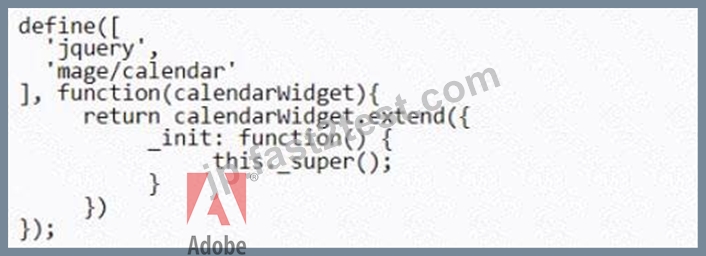
正解:B
解説:
Explanation
To add a custom widget that extends the default Calendar Widget, the contents of the file would look like option B. This is because option B follows the correct syntax and structure for defining a jQuery widget in Magento. The code does the following steps:
Defines a module with the name "Vendor_Module/js/calendar-widget" that depends on the "jquery/ui" and "Magento_Ui/js/lib/knockout/bindings/datepicker" modules.
Returns a function that creates a new widget with the name "vendor.calendarWidget" that extends the base calendar widget class.
Overrides the init function of the base calendar widget class to add custom logic or functionality to the widget.
Option A is not correct because it does not use the correct syntax for defining a jQuery widget. It uses a script tag instead of a define function, which is not valid for creating a module. It also uses an incorrect name for the widget, which should use a dot instead of a slash. Option C is not correct because it does not use the correct syntax for extending a widget. It uses an extend function instead of a widget function, which is not valid for creating a new widget. It also does not return anything from the module, which will cause an error.
References: [jQuery widgets], [Calendar Widget]
質問 # 36
An Adobe Commerce developer wants to remove the default Wishlist and Compare Products blocks on a category page with layered navigation Where would this modification be placed, assuming the developer only wants to make this change?
- A. app/design/frontend/Vendor/Theme/Magento_LayeredNavigation/layout/override/catalog_category_view_
- B. app/design/frontend/Vendor/Theme/Magento_Catalog/layout/catalog_category_view.xml
- C. app/design/frontend/Vendor/Theme/Magento_Layered.Navigation/layout/catalog_category_view_type_lay
正解:C
解説:
Explanation
To remove the default Wishlist and Compare Products blocks on a category page with layered navigation, the developer should place the modification in the app/design/frontend/Vendor/Theme/Magento_LayeredNavigation/layout/catalog_category_view_type_layered.x file. This file is specific to the category pages with layered navigation and will override the default layout file from the Magento_LayeredNavigation module. The modification should use the <referenceBlock> tag with the name attribute specifying the name of the block and the remove attribute set to true. For example:
<referenceBlock name="catalog.compare.sidebar" remove="true"/> <referenceBlock name="wishlist_sidebar" remove="true"/> The app/design/frontend/Vendor/Theme/Magento_LayeredNavigation/layout/override/catalog_category_view_type_ file is not valid and will not work, as it is not a valid override path. The app/design/frontend/Vendor/Theme/Magento_Catalog/layout/catalog_category_view.xml file is not specific to the category pages with layered navigation and will affect all category pages. References: [Layout override],
[Remove an element]
質問 # 37
......
正真正銘のベスト試験材料AD0-E720オンライン練習試験:https://jp.fast2test.com/AD0-E720-premium-file.html