

練習できるSnowPro Advanced Certification ARA-C01問題集オンライン試験練習テスト詳細な解釈付き!ARA-C01合格にストレスなし!
ARA-C01練習テスト2025年最新ので更新されました
質問 # 63
A user can change object parameters using which of the following roles?
- A. SYSADMIN, SECURITYADMIN
- B. SECURITYADMIN, USER with PRIVILEGE
- C. ACCOUNTADMIN, USER with PRIVILEGE
- D. ACCOUNTADMIN, SECURITYADMIN
正解:C
解説:
According to the Snowflake documentation, object parameters are parameters that can be set on individual objects such as databases, schemas, tables, and stages. Object parameters can be set by users with the appropriate privileges on the objects. For example, to set the object parameter AUTO_REFRESH on a table, the user must have the MODIFY privilege on the table. The ACCOUNTADMIN role has the highest level of privileges on all objects in the account, so it can set any object parameter on any object. However, other roles, such as SECURITYADMIN or SYSADMIN, do not have the same level of privileges on all objects, so they cannot set object parameters on objects they do not own or have the required privileges on. Therefore, the correct answer is C. ACCOUNTADMIN, USER with PRIVILEGE.
Reference:
Parameters | Snowflake Documentation
Object Parameters | Snowflake Documentation
Object Privileges | Snowflake Documentation
質問 # 64
An Architect runs the following SQL query: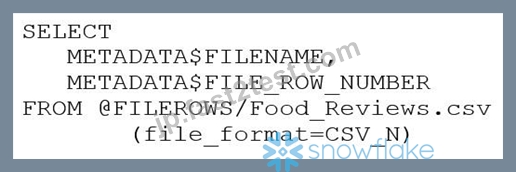
How can this query be interpreted?
- A. FILEROWS is a file. FILE_ROW_NUMBER is the file format location.
- B. FILERONS is the file format location. FILE_ROW_NUMBER is a stage.
- C. FILEROWS is the table. FILE_ROW_NUMBER is the line number in the table.
- D. FILEROWS is a stage. FILE_ROW_NUMBER is line number in file.
正解:D
解説:
* A stage is a named location in Snowflake that can store files for data loading and unloading. A stage can be internal or external, depending on where the files are stored.
* The query in the question uses the LIST function to list the files in a stage named FILEROWS. The
* function returns a table with various columns, including FILE_ROW_NUMBER, which is the line number of the file in the stage.
* Therefore, the query can be interpreted as listing the files in a stage named FILEROWS and showing the line number of each file in the stage.
References:
* : Stages
* : LIST Function
質問 # 65
Files arrive in an external stage every 10 seconds from a proprietary system. The files range in size from 500 K to 3 MB. The data must be accessible by dashboards as soon as it arrives.
How can a Snowflake Architect meet this requirement with the LEAST amount of coding? (Choose two.)
- A. Use a materialized view on an external table.
- B. Use a COPY command with a task.
- C. Use a combination of a task and a stream.
- D. Use the COPY INTO command.
- E. Use Snowpipe with auto-ingest.
正解:A、E
解説:
These two options are the best ways to meet the requirement of loading data from an external stage and making it accessible by dashboards with the least amount of coding.
* Snowpipe with auto-ingest is a feature that enables continuous and automated data loading from an external stage into a Snowflake table. Snowpipe uses event notifications from the cloud storage service to detect new or modified files in the stage and triggers a COPY INTO command to load the data into the table. Snowpipe is efficient, scalable, and serverless, meaning it does not require any infrastructure or maintenance from the user. Snowpipe also supports loading data from files of any size, as long as they are in a supported format1.
* A materialized view on an external table is a feature that enables creating a pre-computed result set from an external table and storing it in Snowflake. A materialized view can improve the performance and efficiency of querying data from an external table, especially for complex queries or dashboards. A materialized view can also support aggregations, joins, and filters on the external table data. A
* materialized view on an external table is automatically refreshed when the underlying data in the external stage changes, as long as the AUTO_REFRESH parameter is set to true2.
References:
* Snowpipe Overview | Snowflake Documentation
* Materialized Views on External Tables | Snowflake Documentation
質問 # 66
The Data Engineering team at a large manufacturing company needs to engineer data coming from many sources to support a wide variety of use cases and data consumer requirements which include:
1) Finance and Vendor Management team members who require reporting and visualization
2) Data Science team members who require access to raw data for ML model development
3) Sales team members who require engineered and protected data for data monetization What Snowflake data modeling approaches will meet these requirements? (Choose two.)
- A. Create a single star schema in a single database to support all consumers' requirements.
- B. Create a Data Vault as the sole data pipeline endpoint and have all consumers directly access the Vault.
- C. Consolidate data in the company's data lake and use EXTERNAL TABLES.
- D. Create a raw database for landing and persisting raw data entering the data pipelines.
- E. Create a set of profile-specific databases that aligns data with usage patterns.
正解:D、E
解説:
Explanation
These two approaches are recommended by Snowflake for data modeling in a data lake scenario. Creating a raw database allows the data engineering team to ingest data from various sources without any transformation or cleansing, preserving the original data quality and format. This enables the data science team to access the raw data for ML model development. Creating a set of profile-specific databases allows the data engineering team to apply different transformations and optimizations for different use cases and data consumer requirements. For example, the finance and vendor management team can access a dimensional database that supports reporting and visualization, while the sales team can access a secure database that supports data monetization.
References:
* Snowflake Data Lake Architecture | Snowflake Documentation
* Snowflake Data Lake Best Practices | Snowflake Documentation
質問 # 67
One of your joins is taking a lot of time. The query profile view looks like this.
What may be the issue?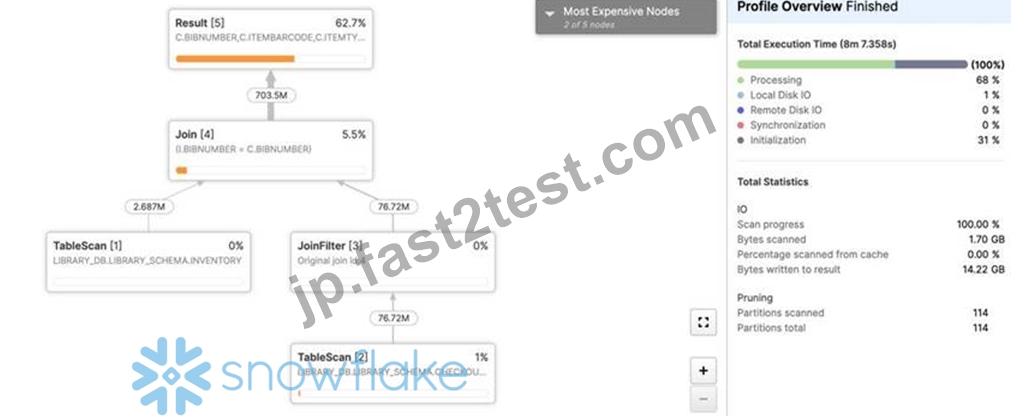
- A. Looks like tablescan is the most expensive operation in the profile.
- B. There is not enough memory to process the join query
- C. This may be an "exploding join" issue. The query has provided a condition where records from one table match multiple records from another table resulting in a cartesian product
正解:C
質問 # 68
A Snowflake Architect is setting up database replication to support a disaster recovery plan. The primary database has external tables.
How should the database be replicated?
- A. Create a clone of the primary database then replicate the database.
- B. Move the external tables to a database that is not replicated, then replicate the primary database.
- C. Share the primary database with an account in the same region that the database will be replicated to.
- D. Replicate the database ensuring the replicated database is in the same region as the external tables.
正解:D
質問 # 69
You are running a large join on snowflake. You ran it on a medium warehouse and it took almost an hour to run. You then tried to run the join on a large warehouse but still the performance did not improve.
What may be the most possible cause of this.
- A. Since you have configured an warehouse with a low auto-suspend value, your warehouse is going down frequently
- B. Your warehouses do not have enough memory
- C. There may be a symptom on skew in your data where one of the value of the column is significantly more than rest of the values in the column
正解:C
質問 # 70
An Architect is integrating an application that needs to read and write data to Snowflake without installing any additional software on the application server.
How can this requirement be met?
- A. Use the Snowflake SQL REST API.
- B. Use the Snowpipe REST API.
- C. Use SnowSQL.
- D. Use the Snowflake ODBC driver.
正解:A
解説:
The Snowflake SQL REST API is a REST API that you can use to access and update data in a Snowflake database. You can use this API to execute standard queries and most DDL and DML statements. This API can be used to develop custom applications and integrations that can read and write data to Snowflake without installing any additional software on the application server. Option A is not correct because SnowSQL is a command-line client that requires installation and configuration on the application server. Option B is not correct because the Snowpipe REST API is used to load data from cloud storage into Snowflake tables, not to read or write data to Snowflake. Option D is not correct because the Snowflake ODBC driver is a software component that enables applications to connect to Snowflake using the ODBC protocol, which also requires installation and configuration on the application server. Reference: The answer can be verified from Snowflake's official documentation on the Snowflake SQL REST API available on their website. Here are some relevant links:
Snowflake SQL REST API | Snowflake Documentation
Introduction to the SQL API | Snowflake Documentation
Submitting a Request to Execute SQL Statements | Snowflake Documentation
質問 # 71
You have a view.
How will you list all the object references of the view?
- A. GET_VIEW_METADATA
- B. GET_OBJECT_REFERENCES
- C. GET_VIEW_REFERENCES
正解:B
質問 # 72
An Architect has chosen to separate their Snowflake Production and QA environments using two separate Snowflake accounts.
The QA account is intended to run and test changes on data and database objects before pushing those changes to the Production account. It is a requirement that all database objects and data in the QA account need to be an exact copy of the database objects, including privileges and data in the Production account on at least a nightly basis.
Which is the LEAST complex approach to use to populate the QA account with the Production account's data and database objects on a nightly basis?
- A. 1) Create a share in the Production account for each database
2) Share access to the QA account as a Consumer
3) The QA account creates a database directly from each share
4) Create clones of those databases on a nightly basis
5) Run tests directly on those cloned databases - B. 1) Create a stage in the Production account
2) Create a stage in the QA account that points to the same external object-storage location
3) Create a task that runs nightly to unload each table in the Production account into the stage
4) Use Snowpipe to populate the QA account - C. 1) In the Production account, create an external function that connects into the QA account and returns all the data for one specific table
2) Run the external function as part of a stored procedure that loops through each table in the Production account and populates each table in the QA account - D. 1) Enable replication for each database in the Production account
2) Create replica databases in the QA account
3) Create clones of the replica databases on a nightly basis
4) Run tests directly on those cloned databases
正解:D
解説:
This approach is the least complex because it uses Snowflake's built-in replication feature to copy the data and database objects from the Production account to the QA account. Replication is a fast and efficient way to synchronize data across accounts, regions, and cloud platforms. It also preserves the privileges and metadata of the replicated objects. By creating clones of the replica databases, the QA account can run tests on the cloned data without affecting the original data. Clones are also zero-copy, meaning they do not consume any additional storage space unless the data is modified. This approach does not require any external stages, tasks, Snowpipe, or external functions, which can add complexity and overhead to the data transfer process.
Reference:
Introduction to Replication and Failover
Replicating Databases Across Multiple Accounts
Cloning Considerations
質問 # 73
How can an Architect enable optimal clustering to enhance performance for different access paths on a given table?
- A. Create super projections that will automatically create clustering.
- B. Create a clustering key that contains all columns used in the access paths.
- C. Create multiple materialized views with different cluster keys.
- D. Create multiple clustering keys for a table.
正解:C
解説:
According to the SnowPro Advanced: Architect documents and learning resources, the best way to enable optimal clustering to enhance performance for different access paths on a given table is to create multiple materialized views with different cluster keys. A materialized view is a pre-computed result set that is derived from a query on one or more base tables. A materialized view can be clustered by specifying a clustering key, which is a subset of columns or expressions that determines how the data in the materialized view is co-located in micro-partitions. By creating multiple materialized views with different cluster keys, an Architect can optimize the performance of queries that use different access paths on the same base table. For example, if a base table has columns A, B, C, and D, and there are queries that filter on A and B, or on C and D, or on A and C, the Architect can create three materialized views, each with a different cluster key: (A, B), (C, D), and (A, C). This way, each query can leverage the optimal clustering of the corresponding materialized view and achieve faster scan efficiency and better compression.
Reference:
Snowflake Documentation: Materialized Views
Snowflake Learning: Materialized Views
https://www.snowflake.com/blog/using-materialized-views-to-solve-multi-clustering-performance-problems/
質問 # 74
Company A would like to share data in Snowflake with Company B. Company B is not on the same cloud platform as Company A.
What is required to allow data sharing between these two companies?
- A. Company A and Company B must agree to use a single cloud platform: Data sharing is only possible if the companies share the same cloud provider.
- B. Setup data replication to the region and cloud platform where the consumer resides.
- C. Create a pipeline to write shared data to a cloud storage location in the target cloud provider.
- D. Ensure that all views are persisted, as views cannot be shared across cloud platforms.
正解:B
解説:
Explanation
According to the SnowPro Advanced: Architect documents and learning resources, the requirement to allow data sharing between two companies that are not on the same cloud platform is to set up data replication to the region and cloud platform where the consumer resides. Data replication is a feature of Snowflake that enables copying databases across accounts in different regions and cloud platforms. Data replication allows data providers to securely share data with data consumers across different regions and cloud platforms by creating a replica database in the consumer's account. The replica database is read-only and automatically synchronized with the primary database in the provider's account. Data replication is useful for scenarios where data sharing is not possible or desirable due to latency, compliance, or security reasons1. The other options are incorrect because they are not required or feasible to allow data sharing between two companies that are not on the same cloud platform. Option A is incorrect because creating a pipeline to write shared data to a cloud storage location in the target cloud provider is not a secure or efficient way of sharing data. It would require additional steps to load the data from the cloud storage to the consumer's account, and it would not leverage the benefits of Snowflake's data sharing features. Option B is incorrect because ensuring that all views are persisted is not relevant for data sharing across cloud platforms. Views can be shared across cloud platforms as long as they reference objects in the same database. Persisting views is an option to improve the performance of querying views, but it is not required for data sharing2. Option D is incorrect because Company A and Company B do not need to agree to use a single cloud platform. Data sharing is possible across different cloud platforms using data replication or other methods, such as listings or auto-fulfillment3. References: ReplicatingDatabases Across Multiple Accounts | Snowflake Documentation, Persisting Views | Snowflake Documentation, Sharing Data Across Regions and Cloud Platforms | Snowflake Documentation
質問 # 75
Which of the following ingestion methods can be used to load near real-time data by using the messaging services provided by a cloud provider?
- A. Spark
- B. Snowflake streams
- C. Snowpipe
- D. Snowflake Connector for Kafka
正解:D
解説:
Snowflake Connector for Kafka and Snowpipe are two ingestion methods that can be used to load near real-time data by using the messaging services provided by a cloud provider. Snowflake Connector for Kafka enables you to stream structured and semi-structured data from Apache Kafka topics into Snowflake tables.
Snowpipe enables you to load data from files that are continuously added to a cloud storage location, such as Amazon S3 or Azure Blob Storage. Both methods leverage Snowflake's micro-partitioning and columnar storage to optimize data ingestion and query performance. Snowflake streams and Spark are not ingestion methods, but rather components of the Snowflake architecture. Snowflake streams provide change data capture (CDC) functionality by tracking data changes in a table. Spark is a distributed computing framework that can be used to process large-scale data and write it to Snowflake using the Snowflake Spark Connector. References:
* Snowflake Connector for Kafka
* Snowpipe
* Snowflake Streams
* Snowflake Spark Connector
質問 # 76
Database DB1 has schema S1 which has one table, T1.
DB1 --> S1 --> T1
The retention period of EG1 is set to 10 days.
The retention period of s: is set to 20 days.
The retention period of t: Is set to 30 days.
The user runs the following command:
Drop Database DB1;
What will the Time Travel retention period be for T1?
- A. 37 days
- B. 20 days
- C. 10 days
- D. 30 days
正解:D
解説:
The Time Travel retention period for T1 will be 30 days, which is the retention period set at the table level.
The Time Travel retention period determines how long the historical data is preserved and accessible for an object after it is modified or dropped. The Time Travel retention period can be set at the account level, the database level, the schema level, or the table level. The retention period set at the lowest level of the hierarchy takes precedence over the higher levels. Therefore, the retention period set at the table level overrides the retention periods set at the schema level, the database level, or the account level. When the user drops the database DB1, the table T1 is also dropped, but the historical data is still preserved for 30 days, which is the retention period set at the table level. The user can use the UNDROP command to restore the table T1 within the 30-day period. The other options are incorrect because:
* 10 days is the retention period set at the database level, which is overridden by the table level.
* 20 days is the retention period set at the schema level, which is also overridden by the table level.
* 37 days is not a valid option, as it is not the retention period set at any level.
References:
* Understanding & Using Time Travel
* AT | BEFORE
* Snowflake Time Travel & Fail-safe
質問 # 77
An Architect is designing a solution that will be used to process changed records in an orders table.
Newly-inserted orders must be loaded into the f_orders fact table, which will aggregate all the orders by multiple dimensions (time, region, channel, etc.). Existing orders can be updated by the sales department within 30 days after the order creation. In case of an order update, the solution must perform two actions:
1. Update the order in the f_0RDERS fact table.
2. Load the changed order data into the special table ORDER _REPAIRS.
This table is used by the Accounting department once a month. If the order has been changed, the Accounting team needs to know the latest details and perform the necessary actions based on the data in the order_repairs table.
What data processing logic design will be the MOST performant?
- A. Useone stream and two tasks.
- B. Usetwo streams and one task.
- C. Useone stream and one task.
- D. Usetwo streams and two tasks.
正解:A
解説:
The most performant design for processing changed records, considering the need to both update records in the f_orders fact table and load changes into the order_repairs table, is to use one stream and two tasks. The stream will monitor changes in the orders table, capturing both inserts and updates. The first task would apply these changes to the f_orders fact table, ensuring all dimensions are accurately represented. The second task would use the same stream to insert relevant changes into the order_repairs table, which is critical for the Accounting department's monthly review. This method ensures efficient processing by minimizing the overhead of managing multiple streams and synchronizing between them, while also allowing specific tasks to optimize for their target operations.References: Snowflake's documentation on streams and tasks for handling data changes efficiently.
質問 # 78
Based on the Snowflake object hierarchy, what securable objects belong directly to a Snowflake account?
(Select THREE).
- A. Database
- B. Warehouse
- C. Stage
- D. Schema
- E. Role
- F. Table
正解:A、B、E
解説:
* A securable object is an entity to which access can be granted in Snowflake. Securable objects include databases, schemas, tables, views, stages, pipes, functions, procedures, sequences, tasks, streams, roles, warehouses, and shares1.
* The Snowflake object hierarchy is a logical structure that organizes the securable objects in a nested manner. The top-most container is the account, which contains all the databases, roles, and warehouses for the customer organization. Each database contains schemas, which in turn contain tables, views, stages, pipes, functions, procedures, sequences, tasks, and streams. Each role can be granted privileges on other roles or securable objects. Each warehouse can be used to execute queries on securable objects2.
* Based on the Snowflake object hierarchy, the securable objects that belong directly to a Snowflake account are databases, roles, and warehouses. These objects are created and managed at the account level, and do not depend on any other securable object. The other options are not correct because:
* Schemas belong to databases, not to accounts. A schema must be created within an existing database3.
* Tables belong to schemas, not to accounts. A table must be created within an existing schema4.
* Stages belong to schemas or tables, not to accounts. A stage must be created within an existing schema or table.
References:
* 1: Overview of Access Control | Snowflake Documentation
* 2: Securable Objects | Snowflake Documentation
* 3: CREATE SCHEMA | Snowflake Documentation
* 4: CREATE TABLE | Snowflake Documentation
* [5]: CREATE STAGE | Snowflake Documentation
質問 # 79
Refer to the exhibit.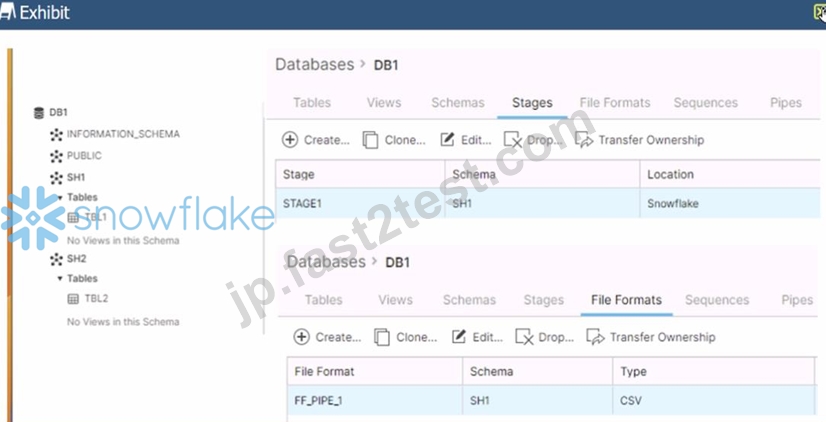
Based on the architecture in the image, how can the data from DB1 be copied into TBL2? (Select TWO).
- A.
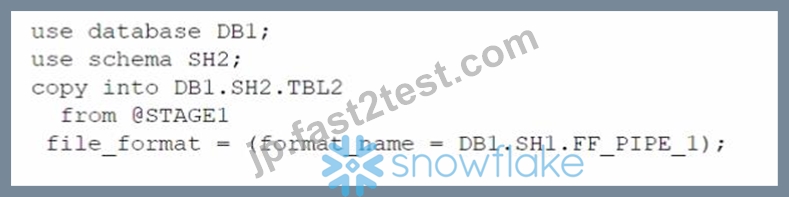
- B.

- C.
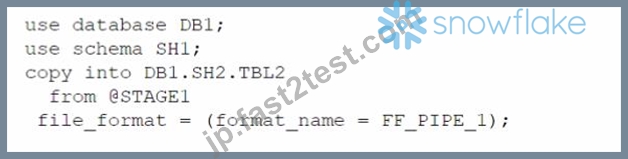
- D.
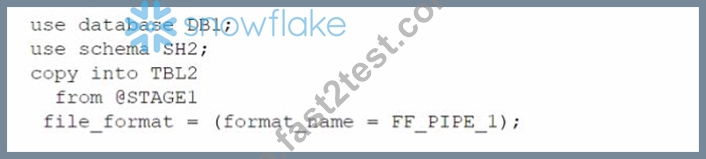
- E.
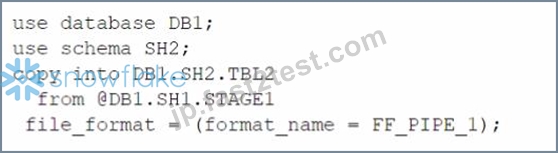
正解:D、E
質問 # 80
Data is being imported and stored as JSON in a VARIANT column. Query performance was fine, but most recently, poor query performance has been reported.
What could be causing this?
- A. The recent data imports contained fewer fields than usual.
- B. There were variations in string lengths for the JSON values in the recent data imports.
- C. There were JSON nulls in the recent data imports.
- D. The order of the keys in the JSON was changed.
正解:B、D
解説:
Data is being imported and stored as JSON in a VARIANT column. Query performance was fine, but most recently, poor query performance has been reported. This could be caused by the following factors:
The order of the keys in the JSON was changed. Snowflake stores semi-structured data internally in a column-like structure for the most common elements, and the remainder in a leftovers-like column. The order of the keys in the JSON affects how Snowflake determines the common elements and how it optimizes the query performance. If the order of the keys in the JSON was changed, Snowflake might have to re-parse the data and re-organize the internal storage, which could result in slower query performance.
There were variations in string lengths for the JSON values in the recent data imports. Non-native values, such as dates and timestamps, are stored as strings when loaded into a VARIANT column. Operations on these values could be slower and also consume more space than when stored in a relational column with the corresponding data type. If there were variations in string lengths for the JSON values in the recent data imports, Snowflake might have to allocate more space and perform more conversions, which could also result in slower query performance.
The other options are not valid causes for poor query performance:
There were JSON nulls in the recent data imports. Snowflake supports two types of null values in semi-structured data: SQL NULL and JSON null. SQL NULL means the value is missing or unknown, while JSON null means the value is explicitly set to null. Snowflake can distinguish between these two types of null values and handle them accordingly. Having JSON nulls in the recent data imports should not affect the query performance significantly.
The recent data imports contained fewer fields than usual. Snowflake can handle semi-structured data with varying schemas and fields. Having fewer fields than usual in the recent data imports should not affect the query performance significantly, as Snowflake can still optimize the data ingestion and query execution based on the existing fields.
Reference:
Considerations for Semi-structured Data Stored in VARIANT
Snowflake Architect Training
Snowflake query performance on unique element in variant column
Snowflake variant performance
質問 # 81
If a multi-cluster warehouse is resized, the new size applies to
- A. Clusters that are currently running
- B. All of the above
- C. Clusters that are started after the warehouse is resized
正解:B
質問 # 82
A user can change object parameters using which of the following roles?
- A. SYSADMIN, SECURITYADMIN
- B. ACCOUNTADMIN, SECURITYADMIN
- C. ACCOUNTADMIN, USER with PRIVILEGE
- D. SECURITYADMIN, USER with PRIVILEGE
正解:B
質問 # 83
......
今すぐ試そうARA-C01練習試験解答:https://drive.google.com/open?id=1tXqxpSFNlvRzVbuDkmK9xZCvavHWOWHR
ベストARA-C01学習材料と試験準備問題はここにある:https://jp.fast2test.com/ARA-C01-premium-file.html