

信頼できるSnowPro Advanced Certification ARA-C01問題集PDF 2026年03月24日最近更新された問題
必ず合格できるSnowflake ARA-C01試験正確な164問題と解答あります
Snowflake ARA-C01認定は、業界のリーダーによって認識されており、クラウドコンピューティングでキャリアを進めたい専門家にとって貴重な資産です。これは、スノーフレークの専門知識を示し、新しいキャリアの機会を開く優れた方法です。この認定は、最新の業界動向と技術を最新の状態に保つというあなたのコミットメントの証でもあります。
Snowflake ARA-C01 認定試験の出題範囲:
| トピック | 出題範囲 |
|---|---|
| トピック 1 |
|
| トピック 2 |
|
| トピック 3 |
|
Snowflake ARA-C01認定試験は、データモデリング、データの読み込み、パフォーマンスチューニング、セキュリティ、アクセス制御、データ処理など、さまざまなドメインの候補者の知識とスキルをテストするために設計された100の複数選択質問で構成されています。試験は時刻形式で実施され、候補者は2時間以内に完了すると予想されます。認定試験は提案されており、世界中のどこからでもオンラインで撮影できます。
質問 # 60
You ran a query and the query
SELECT * FROM inventory WHERE BIBNUMBER = 2805127;
The query profile looks as below. If you would like to further tune the query, what is the best thing to do?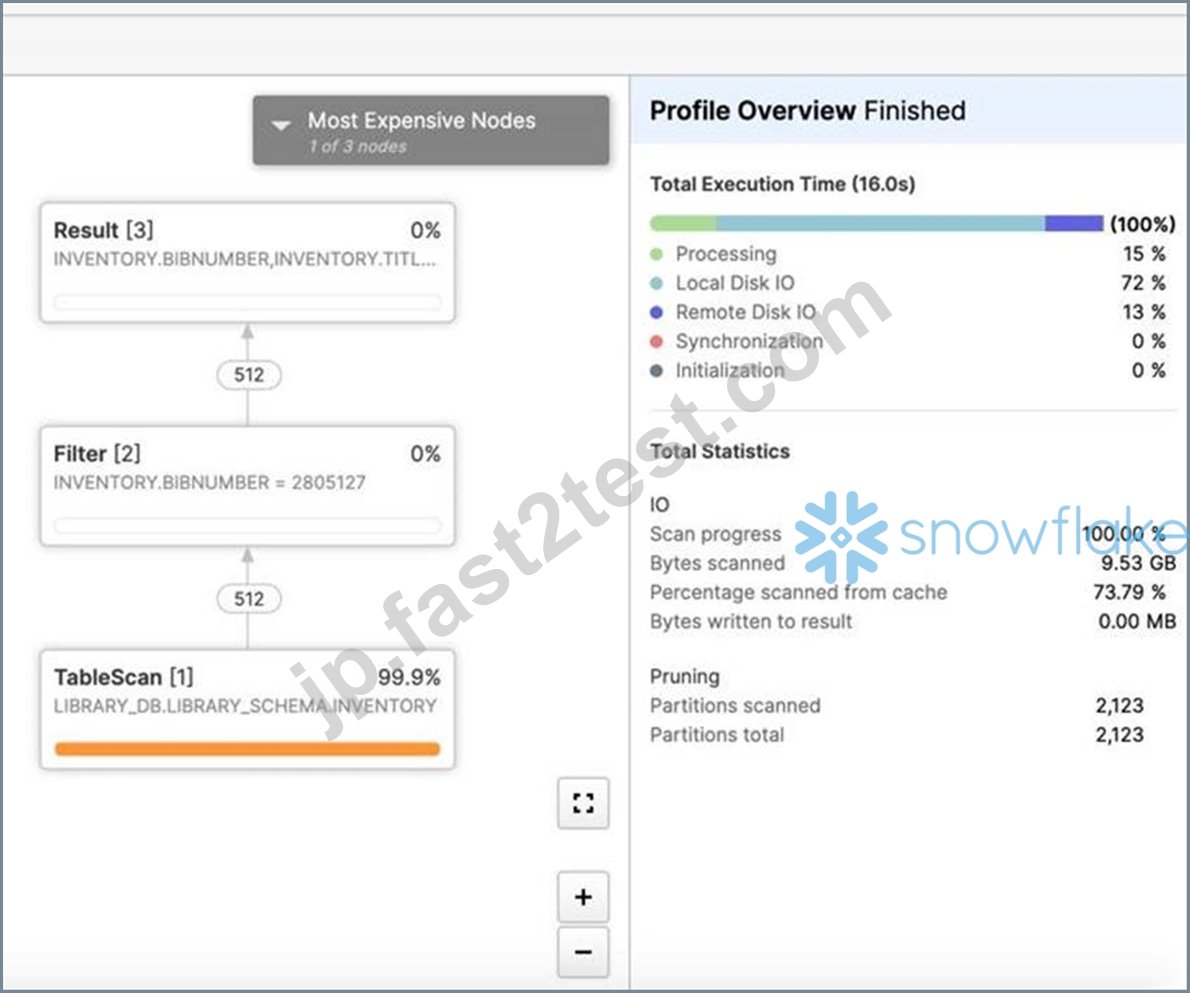
- A. Execute the below query to enable auto clustering
- B. alter table inventory cluster by (BIBNUMBER);
- C. Create an index on column BIBNUMBER
- D. Divide the table into multiple smaller tables
正解:B
質問 # 61
You have created a table as below
CREATE TABLE TEST_01 (NAME STRING(10));
What data type SNOWFLAKE will assign to column NAME?
- A. STRING
- B. LONGCHAR
- C. VARCHAR
正解:C
質問 # 62
When activating Tri-Secret Secure in a hierarchical encryption model in a Snowflake account, at what level is the customer-managed key used?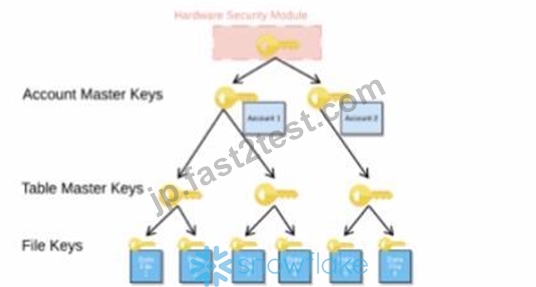
- A. At the account level (AMK)
- B. At the table level (TMK)
- C. At the root level (HSM)
- D. At the micro-partition level
正解:A
解説:
Tri-Secret Secure is a feature that allows customers to use their own key, called the customer-managed key (CMK), in addition to the Snowflake-managed key, to create a composite master key that encrypts the data in Snowflake. The composite master key is also known as the account master key (AMK), as it is unique for each account and encrypts the table master keys (TMKs) that encrypt the file keys that encrypt the data files. The customer-managed key is used at the account level, not at the root level, the table level, or the micro-partition level. The root level is protected by a hardware security module (HSM), the table level is protected by the TMKs, and the micro-partition level is protected by the file keys12. References:
* Understanding Encryption Key Management in Snowflake
* Tri-Secret Secure FAQ for Snowflake on AWS
質問 # 63
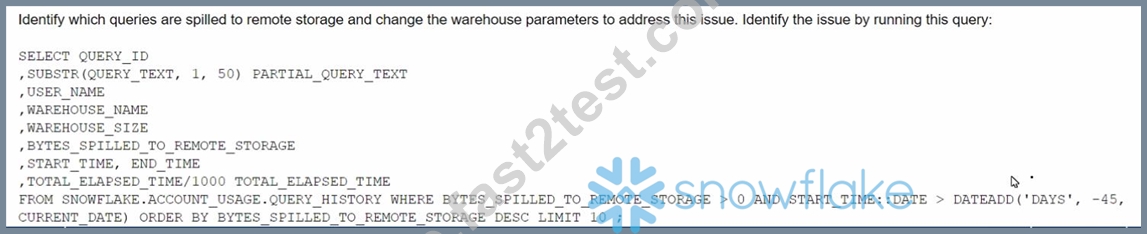
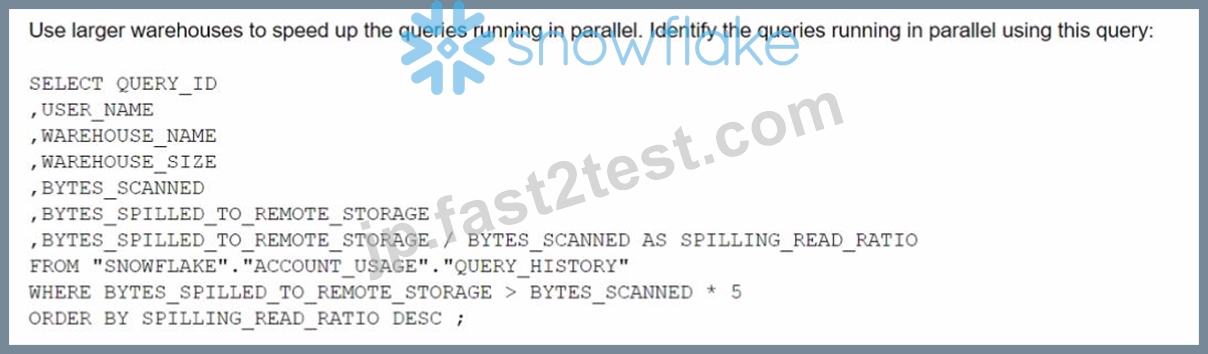
The Business Intelligence team reports that when some team members run queries for their dashboards in parallel with others, the query response time is getting significantly slower What can a Snowflake Architect do to identify what is occurring and troubleshoot this issue?
- A.

- B.
- C.
- D.

正解:C
解説:
The image shows a SQL query that can be used to identify which queries are spilled to remote storage and suggests changing the warehouse parameters to address this issue. Spilling to remote storage occurs when the memory allocated to a warehouse is insufficient to process a query, and Snowflake uses disk or cloud storage as a temporary cache. This can significantly slow down the query performance and increase the cost. To troubleshoot this issue, a Snowflake Architect can run the query shown in the image to find out which queries are spilling, how much data they are spilling, and which warehouses they are using. Then, the architect can adjust the warehouse size, type, or scaling policy to provide enough memory for the queries and avoid spilling12. Reference:
Recognizing Disk Spilling
Managing the Kafka Connector
質問 # 64
A company is storing large numbers of small JSON files (ranging from 1-4 bytes) that are received from IoT devices and sent to a cloud provider. In any given hour, 100,000 files are added to the cloud provider.
What is the MOST cost-effective way to bring this data into a Snowflake table?
- A. A copy command at regular intervals
- B. An external table
- C. A pipe
- D. A stream
正解:C
解説:
Explanation
* A pipe is a Snowflake object that continuously loads data from files in a stage (internal or external) into a table. A pipe can be configured to use auto-ingest, which means that Snowflake automatically detects new or modified files in the stage and loads them into the table without any manual intervention1.
* A pipe is the most cost-effective way to bring large numbers of small JSON files into a Snowflake table, because it minimizes the number of COPY commands executed and the number of micro-partitions created. A pipe can use file aggregation, which means that it can combine multiple small files into a single larger file before loading them into the table. This reduces the load time and the storage cost of the data2.
* An external table is a Snowflake object that references data files stored in an external location, such as Amazon S3, Google Cloud Storage, or Microsoft Azure Blob Storage. An external table does not store the data in Snowflake, but only provides a view of the data for querying. An external table is not a cost-effective way to bring data into a Snowflake table, because it does not support file aggregation, and it requires additional network bandwidth and compute resources to query the external data3.
* A stream is a Snowflake object that records the history of changes (inserts, updates, and deletes) made to a table. A stream can be used to consume the changes from a table and apply them to another table or a task. A stream is not a way to bring data into a Snowflake table, but a way to process the data after it is loaded into a table4.
* A copy command is a Snowflake command that loads data from files in a stage into a table. A copy command can be executed manually or scheduled using a task. A copy command is not a cost-effective way to bring large numbers of small JSON files into a Snowflake table, because it does not support file aggregation, and it may create many micro-partitions that increase the storage cost of the data5.
References: : Pipes : Loading Data Using Snowpipe : External Tables : Streams : COPY INTO <table>
質問 # 65
A user can change object parameters using which of the following roles?
- A. ACCOUNTADMIN, SECURITYADMIN
- B. ACCOUNTADMIN, USER with PRIVILEGE
- C. SECURITYADMIN, USER with PRIVILEGE
- D. SYSADMIN, SECURITYADMIN
正解:B
解説:
According to the Snowflake documentation, object parameters are parameters that can be set on individual objects such as databases, schemas, tables, and stages. Object parameters can be set by users with the appropriate privileges on the objects. For example, to set the object parameter AUTO_REFRESH on a table, the user must have the MODIFY privilege on the table. The ACCOUNTADMIN role has the highest level of privileges on all objects in the account, so it can set any object parameter on any object. However, other roles, such as SECURITYADMIN or SYSADMIN, do not have the same level of privileges on all objects, so they cannot set object parameters on objects they do not own or have the required privileges on. Therefore, the correct answer is C. ACCOUNTADMIN, USER with PRIVILEGE.
Parameters | Snowflake Documentation
Object Parameters | Snowflake Documentation
Object Privileges | Snowflake Documentation
質問 # 66
A company is using Snowflake in Azure in the Netherlands. The company analyst team also has data in JSON format that is stored in an Amazon S3 bucket in the AWS Singapore region that the team wants to analyze.
The Architect has been given the following requirements:
1. Provide access to frequently changing data
2. Keep egress costs to a minimum
3. Maintain low latency
How can these requirements be met with the LEAST amount of operational overhead?
- A. Use a materialized view on top of an external table against the S3 bucket in AWS Singapore.
- B. Use an external table against the S3 bucket in AWS Singapore and copy the data into transient tables.
- C. Copy the data between providers from S3 to Azure Blob storage to collocate, then use Snowpipe for data ingestion.
- D. Use AWS Transfer Family to replicate data between the S3 bucket in AWS Singapore and an Azure Netherlands Blob storage, then use an external table against the Blob storage.
正解:B
質問 # 67
Following objects can be cloned in snowflake
- A. Permanent table
- B. Transient table
- C. External tables
- D. Internal stages
- E. Temporary table
正解:A、B、C
解説:
Snowflake supports cloning of various objects, such as databases, schemas, tables, stages, file formats, sequences, streams, tasks, and roles. Cloning creates a copy of an existing object in the system without copying the data or metadata. Cloning is also known as zero-copy cloning1.
Among the objects listed in the question, the following ones can be cloned in Snowflake:
Permanent table: A permanent table is a type of table that has a Fail-safe period and a Time Travel retention period of up to 90 days. A permanent table can be cloned using the CREATE TABLE ... CLONE command2. Therefore, option A is correct.
Transient table: A transient table is a type of table that does not have a Fail-safe period and can have a Time Travel retention period of either 0 or 1 day. A transient table can also be cloned using the CREATE TABLE ... CLONE command2. Therefore, option B is correct.
External table: An external table is a type of table that references data files stored in an external location, such as Amazon S3, Google Cloud Storage, or Microsoft Azure Blob Storage. An external table can be cloned using the CREATE EXTERNAL TABLE ... CLONE command3. Therefore, option D is correct.
The following objects listed in the question cannot be cloned in Snowflake:
Temporary table: A temporary table is a type of table that is automatically dropped when the session ends or the current user logs out. Temporary tables do not support cloning4. Therefore, option C is incorrect.
Internal stage: An internal stage is a type of stage that is managed by Snowflake and stores files in Snowflake's internal cloud storage. Internal stages do not support cloning5. Therefore, option E is incorrect.
質問 # 68
Which of the following are characteristics of Snowflake's parameter hierarchy?
- A. Schema parameters override account parameters.
- B. Session parameters override virtual warehouse parameters.
- C. Virtual warehouse parameters override user parameters.
- D. Table parameters override virtual warehouse parameters.
正解:B
質問 # 69
A Developer is having a performance issue with a Snowflake query. The query receives up to 10 different values for one parameter and then performs an aggregation over the majority of a fact table. It then joins against a smaller dimension table. This parameter value is selected by the different query users when they execute it during business hours. Both the fact and dimension tables are loaded with new data in an overnight import process.
On a Small or Medium-sized virtual warehouse, the query performs slowly. Performance is acceptable on a size Large or bigger warehouse. However, there is no budget to increase costs. The Developer needs a recommendation that does not increase compute costs to run this query.
What should the Architect recommend?
- A. Create a task that will run the 10 different variations of the query corresponding to the 10 different parameters before the users come in to work. The query results will then be cached and ready to respond quickly when the users re-issue the query.
- B. Create a task that will run the 10 different variations of the query corresponding to the 10 different parameters before the users come in to work. The task will be scheduled to align with the users' working hours in order to allow the warehouse cache to be used.
- C. Enable the search optimization service on the table. When the users execute the query, the search optimization service will automatically adjust the query execution plan based on the frequently-used parameters.
- D. Create a dedicated size Large warehouse for this particular set of queries. Create a new role that has USAGE permission on this warehouse and has the appropriate read permissions over the fact and dimension tables. Have users switch to this role and use this warehouse when they want to access this data.
正解:C
解説:
Enabling the search optimization service on the table can improve the performance of queries that have selective filtering criteria, which seems to be the case here. This service optimizes the execution of queries by creating a persistent data structure called a search access path, which allows some micro-partitions to be skipped during the scanning process. This can significantly speed up query performance without increasing compute costs1.
References
*Snowflake Documentation on Search Optimization Service1.
質問 # 70
Database DB1 has schema S1 which has one table, T1.
DB1 --> S1 --> T1
The retention period of EG1 is set to 10 days.
The retention period of s: is set to 20 days.
The retention period of t: Is set to 30 days.
The user runs the following command:
Drop Database DB1;
What will the Time Travel retention period be for T1?
- A. 30 days
- B. 10 days
- C. 20 days
- D. 37 days
正解:A
解説:
The Time Travel retention period for T1 will be 30 days, which is the retention period set at the table level.
The Time Travel retention period determines how long the historical data is preserved and accessible for an object after it is modified or dropped. The Time Travel retention period can be set at the account level, the database level, the schema level, or the table level. The retention period set at the lowest level of the hierarchy takes precedence over the higher levels. Therefore, the retention period set at the table level overrides the retention periods set at the schema level, the database level, or the account level. When the user drops the database DB1, the table T1 is also dropped, but the historical data is still preserved for 30 days, which is the retention period set at the table level. The user can use the UNDROP command to restore the table T1 within the 30-day period. The other options are incorrect because:
* 10 days is the retention period set at the database level, which is overridden by the table level.
* 20 days is the retention period set at the schema level, which is also overridden by the table level.
* 37 days is not a valid option, as it is not the retention period set at any level.
Understanding & Using Time Travel
AT | BEFORE
Snowflake Time Travel & Fail-safe
質問 # 71
Which command can be run to list all shares that have been created in your account or are available to consume by your account
- A. LIST SHARES
- B. SHOW SHARES
- C. DESCRIBE SHARES
正解:B
質問 # 72
An Architect has a VPN_ACCESS_LOGS table in the SECURITY_LOGS schema containing timestamps of the connection and disconnection, username of the user, and summary statistics.
What should the Architect do to enable the Snowflake search optimization service on this table?
- A. Assume role with ALL PRIVILEGES including ADD SEARCH OPTIMIZATION in the SECURITY LOGS schema.
- B. Assume role with OWNERSHIP on VPN_ACCESS_LOGS and ADD SEARCH OPTIMIZATION in the SECURITY_LOGS schema.
- C. Assume role with OWNERSHIP on future tables and ADD SEARCH OPTIMIZATION on the SECURITY_LOGS schema.
- D. Assume role with ALL PRIVILEGES on VPN_ACCESS_LOGS and ADD SEARCHOPTIMIZATION in the SECURITY_LOGS schema.
正解:B
解説:
According to the SnowPro Advanced: Architect Exam Study Guide, to enable the search optimization service on a table, the user must have the ADD SEARCH OPTIMIZATION privilege on the table and the schema.
The privilege can be granted explicitly or inherited from a higher-level object, such as a database or a role.
The OWNERSHIP privilege on a table implies the ADD SEARCH OPTIMIZATION privilege, so the user who owns the table can enable the search optimization service on it. Therefore, the correct answer is to assume a role with OWNERSHIP on VPN_ACCESS_LOGS and ADD SEARCH OPTIMIZATION in the SECURITY_LOGS schema. This will allow the user to enable the search optimization service on the VPN_ACCESS_LOGS table and any future tables created in the SECURITY_LOGS schema. The other options are incorrect because they either grant excessive privileges or do not grant the required privileges on the table or the schema. References:
* SnowPro Advanced: Architect Exam Study Guide, page 11, section 2.3.1
* Snowflake Documentation: Enabling the Search Optimization Service
質問 # 73
Materialized views are recommended for all of the scenarios except
- A. Query results contain a small number of rows and/or columns relative to the base table
- B. The query is on an external table
- C. The view's base table changes frequently
- D. Query results contain results that require significant processing
正解:C
質問 # 74
An Architect needs to grant a group of ORDER_ADMIN users the ability to clean old data in an ORDERS table (deleting all records older than 5 years), without granting any privileges on the table. The group's manager (ORDER_MANAGER) has full DELETE privileges on the table.
How can the ORDER_ADMIN role be enabled to perform this data cleanup, without needing the DELETE privilege held by the ORDER_MANAGER role?
- A. This scenario would actually not be possible in Snowflake - any user performing a DELETE on a table requires the DELETE privilege to be granted to the role they are using.
- B. Create a stored procedure that can be run using both caller's and owner's rights (allowing the user to specify which rights are used during execution), and grant USAGE on this procedure to ORDER_ADMIN. The ORDER_MANAGER role owns the procedure.
- C. Create a stored procedure that runs with owner's rights, including the appropriate "> 5 years" business logic, and grant USAGE on this procedure to ORDER_ADMIN. The ORDER_MANAGER role owns the procedure.
- D. Create a stored procedure that runs with caller's rights, including the appropriate "> 5 years" business logic, and grant USAGE on this procedure to ORDER_ADMIN. The ORDER_MANAGER role owns the procedure.
正解:A
質問 # 75
A Snowflake Architect is designing an application and tenancy strategy for an organization where strong legal isolation rules as well as multi-tenancy are requirements.
Which approach will meet these requirements if Role-Based Access Policies (RBAC) is a viable option for isolating tenants?
- A. Create an object for each tenant strategy if row level security is viable for isolating tenants.
- B. Create accounts for each tenant in the Snowflake organization.
- C. Create a multi-tenant table strategy if row level security is not viable for isolating tenants.
- D. Create an object for each tenant strategy if row level security is not viable for isolating tenants.
正解:B
解説:
This approach meets the requirements of strong legal isolation and multi-tenancy. By creating separate accounts for each tenant, the application can ensure that each tenant has its own dedicated storage, compute, and metadata resources, as well as its own encryption keys and security policies. This provides the highest level of isolation and data protection among the tenancy models. Furthermore, by creating the accounts within the same Snowflake organization, the application can leverage the features of Snowflake Organizations, such as centralized billing, account management, and cross-account data sharing.
References:
* Snowflake Organizations Overview | Snowflake Documentation
* Design Patterns for Building Multi-Tenant Applications on Snowflake
質問 # 76
Which SQL alter command will MAXIMIZE memory and compute resources for a Snowpark stored procedure when executed on the snowpark_opt_wh warehouse?



- A. Option A
- B. Option C
- C. Option D
- D. Option B
正解:A
解説:
To maximize memory and compute resources for a Snowpark stored procedure, you need to set the MAX_CONCURRENCY_LEVEL parameter for the warehouse that executes the stored procedure. This parameter determines the maximum number of concurrent queries that can run on a single warehouse. By setting it to 16, you ensure that the warehouse can use all the available CPU cores and memory on a single node, which is the optimal configuration for Snowpark-optimized warehouses. This will improve the performance and efficiency of the stored procedure, as it will not have to share resources with other queries or nodes. The other options are incorrect because they either do not change the MAX_CONCURRENCY_LEVEL parameter, or they set it to a lower value than 16, which will reduce the memory and compute resources for the stored procedure. Reference:
[Snowpark-optimized Warehouses] 1
[Training Machine Learning Models with Snowpark Python] 2
[Snowflake Shorts: Snowpark Optimized Warehouses] 3
質問 # 77
Why might a Snowflake Architect use a star schema model rather than a 3NF model when designing a data architecture to run in Snowflake? (Select TWO).
- A. The Architect wants to present a simple flattened single view of the data to a particular group of end users.
- B. The Architect wants to remove data duplication from the data stored in Snowflake.
- C. Snowflake cannot handle the joins implied in a 3NF data model.
- D. The Bl tool needs a data model that allows users to summarize facts across different dimensions, or to drill down from the summaries.
- E. The Architect is designing a landing zone to receive raw data into Snowflake.
正解:A、D
解説:
A star schema model is a type of dimensional data model that consists of a single fact table and multiple dimension tables. A 3NF model is a type of relational data model that follows the third normal form, which eliminates data redundancy and ensures referential integrity. A Snowflake Architect might use a star schema model rather than a 3NF model when designing a data architecture to run in Snowflake for the following reasons:
* A star schema model is more suitable for analytical queries that require aggregating and slicing data across different dimensions, such as those performed by a BI tool. A 3NF model is more suitable for transactional queries that require inserting, updating, and deleting individual records.
* A star schema model is simpler and faster to query than a 3NF model, as it involves fewer joins and less complex SQL statements. A 3NF model is more complex and slower to query, as it involves more joins and more complex SQL statements.
* A star schema model can provide a simple flattened single view of the data to a particular group of end
* users, such as business analysts or data scientists, who need to explore and visualize the data. A 3NF model can provide a more detailed and normalized view of the data to a different group of end users, such as application developers or data engineers, who need to maintain and update the data.
The other options are not valid reasons for choosing a star schema model over a 3NF model in Snowflake:
* Snowflake can handle the joins implied in a 3NF data model, as it supports ANSI SQL and has a powerful query engine that can optimize and execute complex queries efficiently.
* The Architect can use both star schema and 3NF models to remove data duplication from the data stored in Snowflake, as both models can enforce data integrity and avoid data anomalies. However, the trade-off is that a star schema model may have more data redundancy than a 3NF model, as it denormalizes the data for faster query performance, while a 3NF model may have less data redundancy than a star schema model, as it normalizes the data for easier data maintenance.
* The Architect can use both star schema and 3NF models to design a landing zone to receive raw data into Snowflake, as both models can accommodate different types of data sources and formats. However, the choice of the model may depend on the purpose and scope of the landing zone, such as whether it is a temporary or permanent storage, whether it is a staging area or a data lake, and whether it is a single source or a multi-source integration.
References:
* Snowflake Architect Training
* Data Modeling: Understanding the Star and Snowflake Schemas
* Data Vault vs Star Schema vs Third Normal Form: Which Data Model to Use?
* Star Schema vs Snowflake Schema: 5 Key Differences
* Dimensional Data Modeling - Snowflake schema
* Star schema vs Snowflake Schema
質問 # 78
......
2026年最新の実際にある検証済みのARA-C01問題集:https://jp.fast2test.com/ARA-C01-premium-file.html
合格させるARA-C01試験で更新された164問題あります:https://drive.google.com/open?id=1tXqxpSFNlvRzVbuDkmK9xZCvavHWOWHR