

無料提供中のEMT試験問題集で(2026年最新のPDF問題集)信頼度の高いテストエンジン
EMTのPDFで最近更新された問題です集試験点数を伸ばそう
質問 # 89
You have achieved ROSC in a 77-year-old female. She remains unresponsive and her vital signs are BP 94
/58, P 82, and R 18. In what position should she be placed?
- A. Left lateral recumbent
- B. Supine
- C. Head elevated 45°
- D. Trendelenburg
正解:A
解説:
The correct answer is B. Left lateral recumbent.
This patient has return of spontaneous circulation (ROSC) but remains unresponsive. In such cases, airway protection becomes the priority.
According to NREMT and resuscitation guidelines:
Unresponsive patients who are breathing adequately should be placed in the recovery position (lateral recumbent) to maintain a patent airway and reduce the risk of aspiration.
This position allows secretions or vomit to drain out of the mouth instead of entering the airway.
Why B is correct:
"Place unresponsive patients with adequate breathing in the recovery position." The left lateral recumbent position is the standard recovery position used in EMS.
Why the other options are incorrect:
A). Supine: Increases risk of airway obstruction and aspiration in an unresponsive patient.
C). Trendelenburg: Not recommended; can worsen respiratory function and does not improve outcomes.
D). Head elevated 45°: May be used in conscious patients or certain conditions, but not ideal for an unresponsive patient without airway control.
Exact Extracts:
"Unresponsive patients who are breathing adequately should be placed in the recovery position."
"The recovery position helps maintain an open airway and reduces aspiration risk."
"Airway management is the priority after ROSC."
References:
NREMT EMT Education Standards - Cardiology & Resuscitation
NREMT National Continued Competency Program (NCCP) - Post-Resuscitation Care AHA BLS Guidelines - Post-Cardiac Arrest Care
質問 # 90
A patient with emphysema is displaying pursed lip breathing. Which of the following pathological responses is responsible for this type of breathing?
- A. Inadequate diaphragmatic function
- B. Loss of lung elasticity
- C. Increased mucous production
- D. Decreased hemoglobin
正解:B
解説:
Pursed-lip breathing is a classic compensatory mechanism seen in patients with emphysema, a form of chronic obstructive pulmonary disease (COPD). According to NREMT education, emphysema is characterized by destruction of the alveolar walls, which leads to loss of lung elasticity. This loss prevents the small airways from remaining open during exhalation.
Option A is correct because pursed-lip breathing creates positive pressure in the airways during exhalation.
This pressure helps keep collapsed airways open longer, allowing trapped air to escape and improving ventilation. It also reduces the work of breathing and helps alleviate dyspnea.
Option B is incorrect because decreased hemoglobin affects oxygen-carrying capacity, not airway mechanics or breathing patterns.
Option C is more commonly associated with chronic bronchitis, not emphysema.
Option D is incorrect because diaphragmatic dysfunction is not the primary cause of pursed-lip breathing.
NREMT emphasizes recognizing compensatory breathing patterns in chronic lung disease to guide supportive care, including oxygen administration and positioning.
質問 # 91
An EMT has just assisted with the delivery of a newborn. At the five-minute mark, the neonate is completely pink with a pulse of 108/min. The neonate has some flexion of their extremities, but the breathing is still slow.
How should the EMT score the following categories of the APGAR scale? Select the correct value for each sign.
正解:
解説:
Explanation: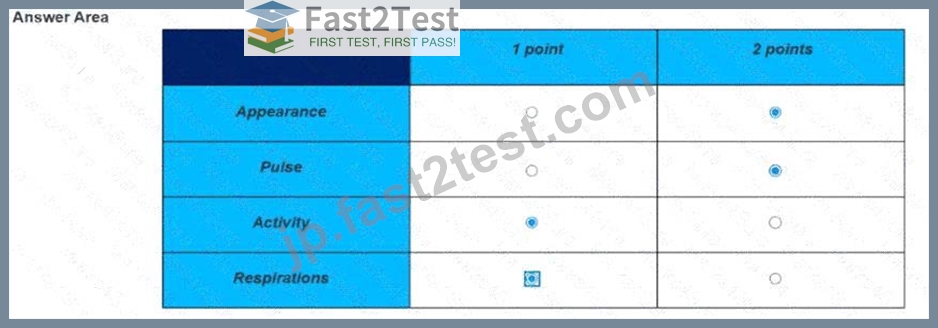
Appearance (Skin Color): # 2 points
* The neonate is completely pink.
* APGAR criteria:
* 0 = blue/pale
* 1 = pink body, blue extremities
* 2 = completely pink
Pulse (Heart Rate): # 2 points
* Heart rate is 108/min.
* APGAR criteria:
* 0 = absent
* 1 = < 100/min
* 2 = # 100/min
Activity (Muscle Tone): # 1 point
* The neonate has some flexion of extremities, but not active motion.
* APGAR criteria:
* 0 = limp
* 1 = some flexion
* 2 = active motion
Respirations: # 1 point
* Breathing is slow, not strong crying.
* APGAR criteria:
* 0 = absent
* 1 = slow or irregular respirations
* 2 = strong cry
Total APGAR Score at 5 Minutes: 6 / 10
Interpretation (NREMT-based):
* A score of 6 indicates the newborn requires continued supportive care, such as warming, positioning, stimulation, and close monitoring.
* No immediate chest compressions are indicated because the heart rate is >100/min.
* Respiratory effort should continue to be assessed closely.
This scoring aligns with NREMT neonatal assessment and APGAR scoring guidelines used for evaluating newborn transition after birth.
質問 # 92
Defusing sessions should do which of the following in order to be successful? Select the two correct options.
- A. Have mental health experts present during the session
- B. Be held immediately following an incident
- C. Force all providers to provide feedback
- D. Allow the open sharing of information
- E. Take place 72 hours or more following an incident
正解:B、D
解説:
Comprehensive and Detailed Explanation From Exact Extract:
Defusingis an informal, short-term intervention after acritical incident. It should:
* Occur within hoursof the event (ideally the same shift)
* Encourage voluntary open discussionin a confidential setting
It isnot a full debriefor counseling session and doesn't requiremental health professionalspresent. Forcing participation or waiting too long (e.g., 72+ hours) can reduce its effectiveness.
References:
NREMT EMS Operations - Critical Incident Stress Management (CISM)
International Critical Incident Stress Foundation (ICISF) Guidelines
National EMS Education Standards - Mental Health and Stress Response
質問 # 93
A 44-year-old patient is unresponsive, and an EMT checks for a pulse prior to applying an AED. Which of the following shockable rhythms, ventricular fibrillation or ventricular tachycardia, if either, may still produce a pulse in this patient?
- A. Ventricular tachycardia only
- B. Ventricular fibrillation only
- C. Neither a shockable rhythm
- D. Both shockable rhythms
正解:A
解説:
The correct answer is B. Ventricular tachycardia only.
There are two primary shockable rhythms in cardiac arrest:
* Ventricular fibrillation (VF)
* Ventricular tachycardia (VT)
However, only one of these may still produce a pulse under certain conditions.
Why B is correct:
* Ventricular tachycardia (VT) can occur with or without a pulse.
* In some cases, VT allows the heart to generate enough cardiac output to produce a palpable pulse (this is called stable or unstable VT with a pulse).
* Therefore, VT is the only shockable rhythm that may still have a pulse.
Why the other options are incorrect:
* A. Ventricular fibrillation only # VF produces no organized cardiac activity, therefore no pulse
* C. Both shockable rhythms # Incorrect because VF never produces a pulse
* D. Neither a shockable rhythm # Incorrect because VT can produce a pulse Exact Extracts:
* "Ventricular fibrillation results in no effective cardiac output and no pulse."
* "Ventricular tachycardia may be present with or without a pulse."
* "Pulseless ventricular tachycardia and ventricular fibrillation are treated with defibrillation." References:
NREMT EMT Education Standards - Cardiology & Resuscitation
National EMS Education Standards - Cardiac Emergencies
NREMT Candidate Handbook - Cardiac Arrest Management
質問 # 94
A program whose efforts are to limit the effects of an injury or illness that you cannot completely prevent is called
- A. Secondary prevention
- B. Proactive prevention
- C. Primary prevention
- D. Reactive prevention
正解:A
解説:
Comprehensive and Detailed Explanation From Exact Extract:
Secondary preventionfocuses onearly detection and interventionto reduce the severity or impact of an illness or injury that has already occurred or is inevitable. Examples in EMS include:
* AED deployment in public
* Stroke recognition training
* Early CPR
Primary preventionaims to stop the injury from occurring at all (e.g., vaccination, seatbelts). "Reactive" and
"proactive" are not recognized formal categories in EMS public health strategy.
References:
NREMT Public Health and EMS Prevention Models
CDC Injury Prevention Framework
EMS Agenda for the Future - Preventive and Community-Based EMS Care
質問 # 95
A 10-year-old patient is unresponsive in a park. What locations should the EMT use to assess for the presence of a pulse? Select the two answer options that are correct.
- A. Femoral
- B. Popliteal
- C. Radial
- D. Brachial
- E. Carotid
正解:A、E
解説:
Comprehensive and Detailed Explanation (Based on NREMT standards):
For unresponsive children, NREMT guidelines recommend checking central pulses to determine circulation.
Option B (Carotid) is correct and is the preferred pulse site for children over 1 year old.
Option C (Femoral) is also acceptable as a central pulse, especially if the carotid pulse is difficult to locate.
Option A is a peripheral pulse and unreliable in shock.
Option D is used for infants under 1 year.
Option E is not used for pulse assessment.
Accurate pulse assessment guides CPR decisions and must be completed within 10 seconds.
質問 # 96
Reassessment of a patient begins with repeating the
- A. Vital signs
- B. Primary survey
- C. Scene size-up
- D. Secondary assessment
正解:B
解説:
Comprehensive and Detailed Explanation From Exact Extract:
Thereassessment phasein the EMT patient assessment model starts with repeating theprimary survey(also called the primary assessment), which includes:
* Airway
* Breathing
* Circulation
* Disability (mental status)
* Exposure/environment
The purpose is to identify any changes or deterioration in the patient'slife-threatening conditions, especially in dynamic or unstable patients. Only after this do EMTs check vitals and reevaluate secondary complaints.
References:
NREMT Assessment Guidelines - Patient Reassessment
Brady Emergency Care (13th ed.), Chapter: Assessment in EMS
National EMS Education Standards - Patient Assessment
質問 # 97
Which of the following is an example of secondary prevention?
- A. Controlling access to addictive substances
- B. Administering vaccinations
- C. Performing equipment maintenance
- D. Educating the public on naloxone usage
正解:D
解説:
Comprehensive and Detailed Explanation (Based on NREMT standards):
NREMT defines secondary prevention as actions taken to reduce the impact of a disease or injury after it has occurred, focusing on early intervention and harm reduction.
Option D is correct because educating the public on naloxone use does not prevent opioid addiction but reduces morbidity and mortality by reversing overdoses when they occur.
Option A and C are examples of primary prevention, which aim to prevent disease before it happens.
Option B is an operational task, not prevention.
NREMT emphasizes prevention roles as part of community paramedicine and public health integration.
質問 # 98
A 23-year-old female has a tear in her perineum following delivery. This is best treated by:
- A. packing her vagina with gauze.
- B. having her keep her legs flexed.
- C. elevating her pelvis.
- D. applying direct pressure.
正解:D
解説:
The correct answer is D. applying direct pressure.
A perineal tear after childbirth is a form of external soft-tissue bleeding. The primary prehospital treatment for any external bleeding, including obstetric perineal tears, is direct pressure with sterile dressings.
According to NREMT EMT-level obstetrics care guidelines, bleeding control in the postpartum patient should follow standard hemorrhage control principles, with emphasis on direct pressure as the first-line intervention.
Why D is correct:
* Direct pressure is the most effective and immediate method to control bleeding from a perineal tear.
* It helps reduce blood loss and prevents further complications such as shock.
Why the other options are incorrect:
* A. Packing her vagina with gauze # This is not appropriate in the prehospital setting and may cause further injury or infection.
* B. Elevating her pelvis # Not a recognized or effective method for controlling perineal bleeding.
* C. Having her keep her legs flexed # This does not control bleeding and has no role in treatment.
Exact Extracts:
* "Control external bleeding with direct pressure using sterile dressings."
* "Postpartum bleeding should be managed with standard hemorrhage control techniques."
* "Direct pressure is the first step in controlling soft-tissue hemorrhage." References:
NREMT EMT Education Standards - Obstetrics and Gynecology
National EMS Education Standards - Childbirth and Postpartum Care
NREMT Candidate Handbook - Patient Management (Bleeding Control)
質問 # 99
A 3-year-old patient has drooling and stridor. The vital signs are BP 82/40, P 132, R 34, SpO# 94%, and T
102.4°F (39.1°C). Which of the following interventions should the EMT perform?
- A. Suction the patient's posterior pharynx.
- B. Insert an oropharyngeal airway.
- C. Apply humidified oxygen.
- D. Visualize the airway for any obstruction.
正解:C
解説:
The correct answer is D. Apply humidified oxygen.
This pediatric patient presents with:
Drooling
Stridor
Fever (102.4°F)
These are classic signs of epiglottitis, a life-threatening upper airway infection.
Critical Concept: DO NOT agitate or manipulate the airway
In suspected epiglottitis:
The airway is severely inflamed and unstable
Any attempt to visualize, suction, or insert an airway adjunct can cause:
Sudden airway closure
Complete obstruction
NREMT-aligned guidance states:
"Avoid examining the airway in patients with suspected epiglottitis."
"Do not insert airway adjuncts or suction unless absolutely necessary." Why D is correct:
Humidified oxygen helps improve oxygenation without irritating the airway It is the safest and most appropriate intervention Keep the child calm and in a position of comfort Why the other options are incorrect:
A). Visualize the airway # Dangerous; may cause airway collapse
B). Suction posterior pharynx # Can trigger complete obstruction
C). Insert an oropharyngeal airway # Contraindicated in this condition
Exact Extracts (NREMT-aligned EMT educational references):
"Drooling, stridor, and fever suggest epiglottitis."
"Do not place anything in the mouth."
"Provide oxygen and avoid agitating the child."
Clinical Priority Summary:
In suspected epiglottitis, the priority is to maintain a calm environment and provide oxygen without airway manipulation, making D the correct answer.
References:
NREMT EMT Education Standards - Airway, Respiration & Ventilation (Pediatrics) NREMT National Continued Competency Program (NCCP) AAOS Emergency Care and Transportation of the Sick and Injured (NREMT-aligned)
質問 # 100
A choking patient becomes unresponsive. What should the EMT perform next? Select the two correct options.
- A. Do not ventilate until the foreign body is removed
- B. Check for a pulse
- C. Position the patient in recovery and administer back blows
- D. Open mouth
- E. Begin chest compressions
正解:B、E
解説:
Comprehensive and Detailed Explanation From Exact Extract:
If a choking patient becomes unresponsive, EMTs should:
* Check for a pulse
* Begin chest compressions if no pulse is foundChest compressions can help dislodge the object. After compressions, the airway should be opened and inspected. Back blows are not appropriate for unconscious patients.
Ventilation is attempted after clearing the airway or if no object is seen. Do not withhold compressions waiting for object removal.
References:
AHA BLS Provider Manual (2020) - Foreign Body Airway Obstruction Algorithm NREMT Airway Skills Sheet - Obstructed Airway National EMS Education Standards - Respiratory and Airway Management
質問 # 101
A 38-year-old patient is dyspneic and has facial swelling after eating at a restaurant. What should the EMT do first?
- A. Administer epinephrine
- B. Initiate rapid transport
- C. Provide oxygen
- D. Obtain a set of vital signs
正解:A
解説:
The correct answer is C. Administer epinephrine.
This patient is presenting with classic signs of anaphylaxis, a life-threatening allergic reaction:
* Dyspnea (respiratory distress)
* Facial swelling (angioedema)
* Recent exposure to a likely allergen (food)
Why C is correct (Epinephrine):
Epinephrine is the first-line, life-saving treatment for anaphylaxis. It works by:
* Dilating bronchioles (improving breathing)
* Constricting blood vessels (improving blood pressure)
* Reducing airway swelling
NREMT-aligned guidelines state:
* "Administer epinephrine immediately in patients with signs of anaphylaxis."
* "Do not delay epinephrine administration in life-threatening allergic reactions." Why the other options are incorrect:
* A. Provide oxygen: Important, but not the priority over epinephrine in anaphylaxis.
* B. Initiate rapid transport: Necessary, but after immediate life-saving intervention.
* D. Obtain vital signs: Should not delay treatment in a critical patient.
Key Concept:
* In anaphylaxis, epinephrine is the first and most critical intervention.
* Delays in administration significantly increase mortality risk.
Exact Extracts:
* "Epinephrine is the drug of choice for anaphylaxis."
* "Immediate administration is critical in respiratory distress with allergic reactions."
* "Airway swelling and bronchoconstriction must be rapidly treated."
References:
NREMT EMT Education Standards - Medical Emergencies (Allergic Reactions) NREMT National Continued Competency Program (NCCP) - Medical Emergencies Prehospital Emergency Care (EMT) - Allergic Reactions and Anaphylaxis
質問 # 102
Your partner has performed an improper treatment. He wrote a statement that you directed him to perform this treatment. His written statement is an example of
- A. Malice
- B. Libel
- C. Battery
- D. Slander
正解:B
解説:
NREMT legal education differentiates between slander and libel, both forms of defamation.
Option D (Libel) is correct because libel involves false written statements that harm a person's reputation.
In this scenario, the partner's written claim falsely attributes improper treatment to you.
Option A (Slander) refers to spoken false statements.
Option B (Malice) describes intent, not a legal category of defamation.
Option C (Battery) is unlawful physical contact with a patient.
Understanding legal terminology helps EMTs protect themselves professionally and legally.
質問 # 103
When treating a patient suspected of having tuberculosis, you should
- A. Wear a surgical mask before treating the patient
- B. Place a surgical mask on the patient
- C. Place a HEPA respirator on the patient
- D. Notify the Centers for Disease Control
正解:B
解説:
Comprehensive and Detailed Explanation From Exact Extract:
Forsuspected or confirmed tuberculosis (TB), the EMT should place asurgical mask on the patient, not a HEPA respirator. Surgical masks are used tocontain droplets from the patientand reduce airborne transmission.
The EMTshould wear aN95 or HEPA respiratorto protect against inhaling airborne particles. Notification to the CDC is not the EMT's responsibility - that falls to public health officials.
References:
CDC Guidelines for TB Exposure in Prehospital Settings
NREMT Infectious Disease Control Protocols
National EMS Education Standards - Airborne Pathogens and PPE Use
質問 # 104
A 3-year-old female choked while eating a hot dog and then became unresponsive. You should first
- A. Check her carotid pulse
- B. Deliver two rescue breaths
- C. Perform a head tilt-chin lift maneuver
- D. Begin chest compressions
正解:D
解説:
According to Pediatric Basic Life Support (PBLS) guidelines by the American Heart Association (AHA), when a child becomes unresponsive due to foreign body airway obstruction (FBAO), the immediate next step is to begin chest compressions. This is done before checking the airway or giving breaths because the airway is presumed obstructed. The compressions may dislodge the object.
After 30 compressions, open the airway and check for visible objects. If none are seen, attempt rescue breaths.
This protocol reflects the high risk of complete airway blockage in children with sudden collapse following a choking episode.
References:
AHA PALS and BLS Provider Manual (2020), Pediatric FBAO Algorithm
NREMT Cognitive Exam Blueprint - Pediatric Airway Obstruction
National EMS Education Standards (2011) - Pediatric Emergencies
質問 # 105
An EMT is responding to a motor vehicle collision on a busy highway at nighttime. Which of the following tactics should the EMT employ to keep themselves safe from moving traffic? Select the three answer options that are correct.
- A. Wear a safety vest to increase visibility.
- B. Place flares 10 feet in front and behind crash site.
- C. Limit scene time to reduce exposure to vehicles.
- D. Keep back turned to vehicles to avoid headlights.
- E. Park with wheels turned towards the emergency scene to provide protection from impact.
- F. Reduce unnecessary scene lighting to improve visibility for oncoming drivers.
正解:A、C、E
解説:
The correct answers are A. Wear a safety vest, B. Limit scene time, and F. Park with wheels turned toward the scene.
Why A is correct (High-visibility vest):
EMS providers must wear ANSI-compliant reflective vests when operating on roadways This significantly improves visibility, especially at night NREMT-aligned guidance states:
"Wear high-visibility apparel when operating near traffic."
Why B is correct (Limit scene time):
Reducing time on the roadway minimizes exposure risk
Rapid assessment, treatment, and transport are key safety strategies
"Minimize time spent in hazardous environments."
Why F is correct (Wheel positioning):
Turning wheels toward the scene helps:
Prevent the ambulance from being pushed into responders if struck
Provide a protective barrier
"Position vehicles to protect the scene and personnel."
Why the other options are incorrect:
C). Keep back turned to vehicles# Dangerous - EMTs should face traffic when possible D). Place flares 10 feet away# Incorrect distance - flares should be placed much farther away for advance warning E). Reduce scene lighting# Incorrect - proper lighting is essential for scene safety and visibility Exact Extracts (NREMT-aligned EMT educational references):
"Use reflective safety vests when working on roadways."
"Limit exposure time in hazardous scenes."
"Position emergency vehicles to create a safe work zone."
Clinical Priority Summary:
Key roadway safety measures include visibility, minimizing exposure, and proper vehicle positioning, making A, B, and F the correct answers.
References:
NREMT EMT Education Standards - EMS Operations (Scene Safety)
NREMT National Continued Competency Program (NCCP)
FHWA Traffic Incident Management Guidelines (aligned with NREMT)
質問 # 106
A 19-year-old patient has received multiple stab wounds. The patient is unresponsive. The vital signs are BP
82/60, P 116, R 28, and SpO2 86%. Which substance would the EMT expect to increase in the patient's body?
- A. Carbon dioxide
- B. Lactic acid
- C. Sodium bicarbonate
- D. Water
正解:B
解説:
Comprehensive and Detailed Explanation From Exact Extract:
The patient is in hypoperfusion (shock) from blood loss. In shock states, tissues are deprived of oxygen, leading to anaerobic metabolism, which produces lactic acid as a byproduct. This causes metabolic acidosis, which is a critical sign of systemic oxygen debt.
Carbon dioxide rises with respiratory failure, but lactic acid is a more specific indicator of cellular hypoxia.
References:
NREMT Medical Emergencies: Shock
Brady Emergency Care, Chapter: Shock and Resuscitation
Advanced EMT Curriculum - Pathophysiology of Shock
質問 # 107
A 56-year-old female with diabetes reports dizziness, shortness of breath, and weakness that began an hour ago. The EMT should suspect
- A. anemia.
- B. a myocardial infarction.
- C. an allergic reaction.
- D. vertigo.
正解:B
解説:
This is the kind of patient where EMTs should think beyond the absence of chest pain. In women, a myocardial infarction can present with less classic symptoms such as shortness of breath, dizziness
/lightheadedness, and unusual weakness or fatigue . The American Heart Association specifically notes that women may have heart attack symptoms including shortness of breath and unusual tiredness and weakness , and the American Diabetes Association also lists shortness of breath and dizziness or lightheadedness among symptoms of heart disease that people with diabetes should recognize. ( www.heart.
org )
So from an NREMT-style assessment standpoint, a 56-year-old woman with diabetes and a sudden onset of these symptoms should be treated with a high index of suspicion for acute myocardial infarction until proven otherwise. ( www.heart.org )
質問 # 108
What sign is the best indication that an 8-year-old is in hypovolemic shock?
- A. Cyanotic skin
- B. Pale skin
- C. BP of 90/60
- D. Tachypnea
正解:D
解説:
In pediatric patients, NREMT emphasizes that hypotension is a late and ominous sign of shock. Children compensate well and may maintain blood pressure until shock is severe.
Option C (Tachypnea) is the earliest and most reliable indicator of hypovolemic shock in children.
Increased respiratory rate reflects metabolic acidosis and compensatory mechanisms for poor perfusion.
Option A may be present but is less specific.
Option B is a very late finding.
Option D indicates decompensated shock and impending cardiovascular collapse.
NREMT stresses early recognition of shock through subtle signs such as tachypnea and tachycardia.
質問 # 109
......
EMT完全版問題集には無料PDF問題で合格させる:https://jp.fast2test.com/EMT-premium-file.html
無料Medical Technicians EMT公式認定ガイドPDFダウンロード:https://drive.google.com/open?id=1wsHJMoa5zJSo9_d1jWPnZsJomp_LzUN4