

検証済みFCP_WCS_AD-7.4問題集と解答100%合格はここにFast2test
合格させるFCP_WCS_AD-7.4試験一発合格保証2024問題集!
Fortinet FCP_WCS_AD-7.4 認定試験の出題範囲:
| トピック | 出題範囲 |
|---|---|
| トピック 1 |
|
| トピック 2 |
|
| トピック 3 |
|
| トピック 4 |
|
| トピック 5 |
|
質問 # 14
Your company deployed a FortiSandbox for AWS.
Which statement is correct about FortiSandbox for AWS?
- A. FortiSandbox deploys new EC2 instances with the custom Windows and Linux VMs, then it sends malware, runs it, and captures the results for analysis.
- B. FortiSandbox for AWS comes as a hybrid solution. The FortiSandbox manager is installed on-premises and analyzes the results of the sandboxing process received from AWS EC2 instances.
- C. The FortiSandbox manager is installed on the AWS platform and analyzes the results of the sandboxing process received from on-premises Windows instances.
- D. FortiSandbox for AWS does not need more resources because it performs only management and analysis tasks.
正解:A
解説:
FortiSandbox Deployment:
FortiSandbox for AWS deploys new EC2 instances to create isolated environments where it can safely execute and analyze suspicious files. These instances run custom Windows and Linux virtual machines specifically configured for sandboxing (Option D).
Sandboxing Process:
The process involves sending potential malware to these isolated VMs, executing it, and monitoring its behavior to detect malicious activities. The results are then captured and analyzed to provide detailed threat intelligence.
Other Options Analysis:
Option A is incorrect because FortiSandbox for AWS operates entirely within the AWS environment and does not require an on-premises manager.
Option B is incorrect as the FortiSandbox manager is not installed on the AWS platform for managing on-premises instances.
Option C is incorrect because FortiSandbox requires sufficient resources to perform the actual sandboxing and analysis tasks.
Reference:
FortiSandbox for AWS Documentation: FortiSandbox
Sandboxing Concepts: Sandboxing
質問 # 15
An AWS administrator is designing internet connectivity for an organization's virtual public cloud (VPC). The organization has web servers with private addresses that must be reachable from the internet. The web servers must be highly available.
Which two configurations can you use to ensure the web servers are highly available and reachable from the internet? (Choose two.)
- A. Deploy a network load balancer.
- B. Configure a network address translation (NAT) Gateway in your VPC. Place web servers behind the NAT Gateway.
- C. Deploy web servers in multiple availability zones.
- D. Add a route to the default virtual public cloud (VPC) route table forwarding all traffic to the internet gateway.
正解:A、C
解説:
Network Load Balancer:
Deploying a network load balancer ensures that incoming traffic is distributed across multiple web servers, providing high availability and redundancy. This setup helps in managing traffic efficiently and maintaining service uptime even if some servers fail (Option A).
Multiple Availability Zones:
Deploying web servers in multiple availability zones (AZs) enhances fault tolerance and availability. If one AZ goes down, servers in other AZs can continue to handle the traffic, ensuring the web application remains accessible (Option D).
Other Options Analysis:
Option B is incorrect because NAT Gateways are used to provide internet access to instances in private subnets, not to make private addresses reachable from the internet.
Option C is not sufficient on its own for high availability. Adding a route to the default VPC route table forwarding traffic to the internet gateway makes the VPC internet-accessible but does not ensure high availability.
Reference:
AWS High Availability and Fault Tolerance: AWS High Availability
AWS Network Load Balancer: Network Load Balancer
質問 # 16
Your organization is deciding between deploying an active-active (A-A) or active-passive (A-P) FortiGate high availability (HA) cluster in AWS cloud.
Which two statements are true about A-A clusters compared to A-P clusters? (Choose two.)
- A. For A-A clusters, FortiGate must perform SNAT inbound to ensure symmetric traffic flow.
- B. A-A clusters can use a software-defined network (SDN) to perform a failover.
- C. A-A clusters rely on API calls for sfailovers.
- D. A-A clusters always require a load balancer.
正解:A、D
質問 # 17
AWS native network services offer vast functionality and inter-connectivity between the cloud and on-premises networks.
Which three additional functions can FortiGate for AWS offer to complement the native services offered by AWS? (Choose three.)
- A. Web filtering
- B. Advanced dynamic routing
- C. Secure SD-WAN with application visibility
- D. Higher VPN throughput
- E. OSPF over IPSec
正解:A、C、E
解説:
Web Filtering:
FortiGate for AWS offers advanced web filtering capabilities, which allow organizations to control and monitor web access. This feature complements AWS's native security services by providing granular control over web traffic (Option B).
OSPF over IPSec:
FortiGate for AWS can establish dynamic routing protocols such as OSPF (Open Shortest Path First) over IPSec tunnels. This capability enhances network routing flexibility and security, which is not natively provided by AWS (Option C).
Secure SD-WAN with Application Visibility:
FortiGate for AWS provides Secure SD-WAN functionality, offering enhanced application visibility and traffic management. This is a significant addition to AWS's networking services, optimizing application performance and security (Option E).
Comparison with Other Options:
Option A (Higher VPN throughput) is not specifically enhanced by FortiGate as compared to AWS native services.
Option D (Advanced dynamic routing) is partially covered under OSPF over IPSec but is not as specific as the other chosen options.
Reference:
FortiGate for AWS Documentation: FortiGate on AWS
AWS Networking and Content Delivery: AWS Networking
質問 # 18
Refer to the exhibit.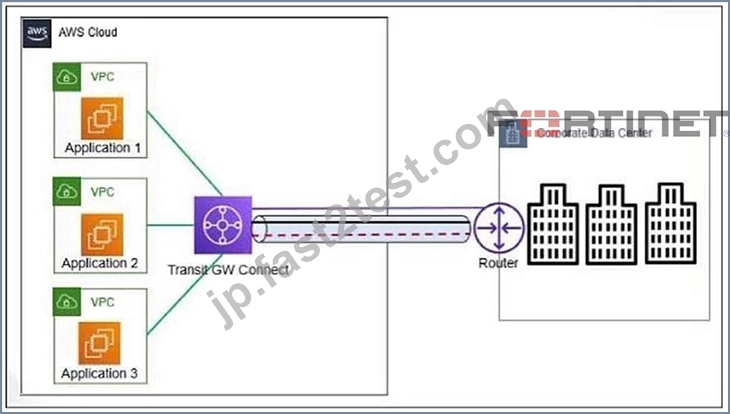
An organization deployed the application servers in the AWS VPC that connects to the corporate data center using Transit Gateway Connect. Demand for the applications has grown and the connection requires more bandwidth.
What is required to achieve higher bandwidth?
- A. Use routable public IP addresses instead of private IP addresses for connectivity.
- B. You add a Transit VPC between the organization's VPCs.
- C. You cannot increase bandwidth the connection has a fixed limit.
- D. No configuration change is required because GRE tunnels are scaled to provide higher bandwidth.
正解:D
解説:
Understanding Transit Gateway Connect:
Transit Gateway Connect is a feature of AWS Transit Gateway that simplifies the integration of SD-WAN networks with AWS. It uses Generic Routing Encapsulation (GRE) tunnels to facilitate this connection.
GRE Tunnels and Bandwidth:
GRE tunnels can dynamically scale to meet increasing bandwidth demands. They allow multiple tunnels between the same endpoints, which can aggregate bandwidth without requiring additional configuration.
Scaling Bandwidth with GRE:
The GRE protocol used by Transit Gateway Connect can support high bandwidth requirements by spreading traffic across multiple tunnels. As demand grows, additional tunnels can be automatically used to handle the increased traffic load.
Comparison with Other Options:
Option A suggests using public IP addresses, which is not relevant to bandwidth scaling.
Option B is incorrect because bandwidth can be increased through GRE scaling.
Option D suggests adding a Transit VPC, which is unnecessary for increasing bandwidth when using Transit Gateway Connect.
Reference:
AWS Transit Gateway Documentation: AWS Transit Gateway
GRE Tunnels and AWS: AWS GRE Tunnels
質問 # 19
Refer to the exhibit.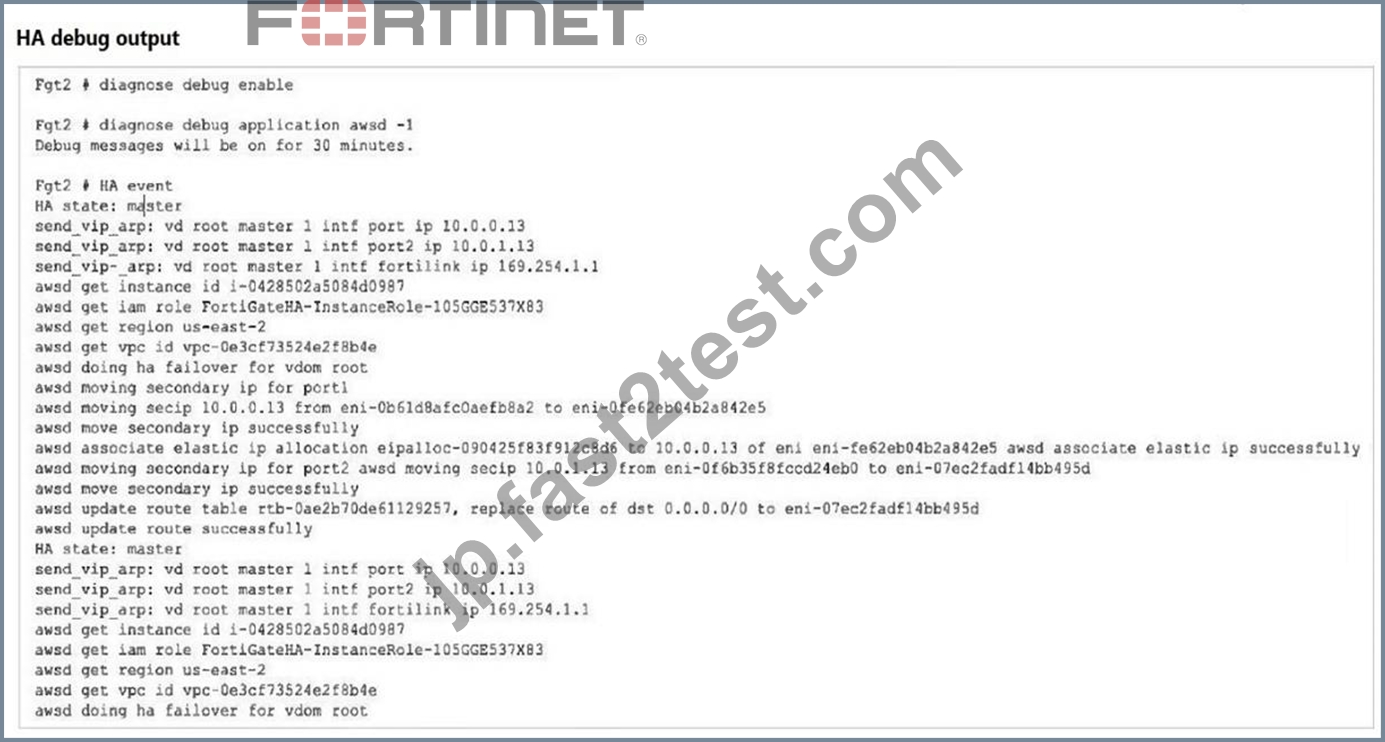
You deployed an active-passive FortiGate HA cluster using a CloudFormation template on an existing VPC. Now you want to test active-passive FortiGate HA failover by running a debug so you can see the API calls to change the Elastic and secondary IP addresses.
Which statement is correct about the output of the debug?
- A. The routing table for Fgt2 updated successfully, and port2 will provide internet access to Fgt2.
- B. The Elastic IP is associated with port2 of Fgt2, and the secondary IP address for port1 and port2 was updated successfully.
- C. IP address 10.0.0.13 is now associated with eni-0b61d8afc0aefb8a2.
- D. The Elastic IP is associated with port1 of Fgt2.
正解:D
解説:
HA Event and Failover:
The debug output indicates that a failover event occurred and the secondary instance (Fgt2) is now taking over as the master.
Elastic IP Association:
The debug output shows the process of moving the Elastic IP (eipalloc-090425f83f912c8d6) to the new master instance. This involves associating the Elastic IP with the appropriate network interface (eni) of the new master.
Specific IP Address Association:
The Elastic IP is specifically associated with port1 of Fgt2. The message "associate elastic ip eipalloc-090425f83f912c8d6 to 10.0.0.13 of eni eni-0f6b35f8fccd24eb0" indicates that the Elastic IP is now linked to the primary IP address (10.0.0.13) on port1 of the new master.
Other Options Analysis:
Option A is incorrect because the routing table update details are not explicitly stated.
Option C is incorrect because the IP address association mentioned relates to an Elastic IP, not eni-0b61d8afc0aefb8a2.
Option D is incorrect because it specifically mentions port2 for the Elastic IP association, which is not indicated in the debug output.
Reference:
FortiGate HA Configuration Guide: FortiGate HA
AWS Elastic IP Documentation: Elastic IP
質問 # 20
An administrator needs to attach an Elastic Network Interface (ENI) to an application instance in a VPC with multiple availability zones. An instance runs in availability zone 1.
Which ENI property must the administrator consider when implementing this requirement?
- A. An ENI cannot attach to an instance in availability zone 2.
- B. You can detach the primary ENI from an AWS instance.
- C. After the ENI detaches from one instance, it can reattach only to the same instance.
- D. When you move an ENI, network traffic remains directed to the old instance until you terminate that instance.
正解:A
解説:
ENI Attachment Across Availability Zones:
Elastic Network Interfaces (ENIs) are associated with a specific Availability Zone. They cannot be attached to instances that are in a different Availability Zone than where the ENI was created. Therefore, an ENI created in Availability Zone 1 cannot be attached to an instance in Availability Zone 2 (Option A).
ENI Reattachment:
ENIs can be detached from one instance and reattached to another instance within the same Availability Zone. This flexibility allows for network interface configuration to be preserved across instance changes within the same AZ.
Other Options Analysis:
Option B is incorrect because an ENI can be reattached to any instance in the same AZ.
Option C is incorrect as the primary ENI (eth0) cannot be detached from an instance.
Option D is incorrect because when an ENI is moved, the traffic is directed to the new instance, and there is no redirection to the old instance.
Reference:
AWS ENI Documentation: Elastic Network Interfaces
AWS Networking Best Practices: AWS Networking
質問 # 21
Refer to the exhibit.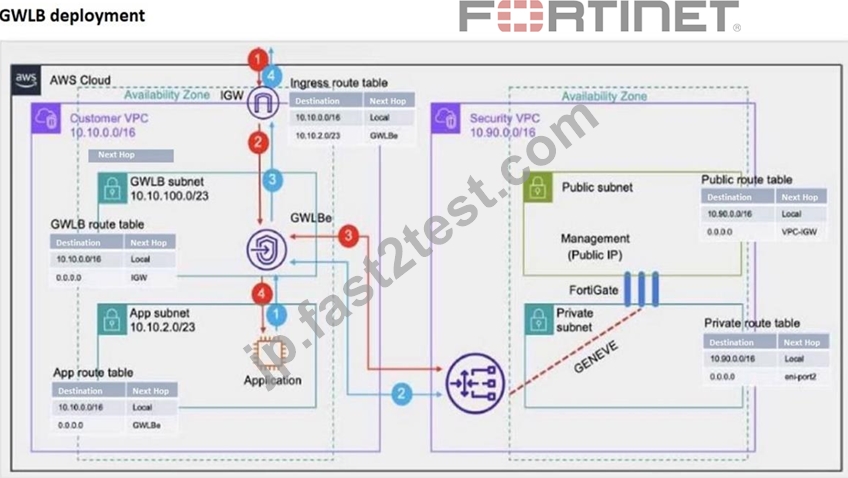
Which two statements are true about inbound traffic based on the IGW ingress route table and GWLB deployment shown in the exhibit? (Choose two.)
- A. Inbound traffic is directed to the application subnet through a GWLB endpoint.
- B. Inbound traffic is directed to the GWLB through a GWLB endpoint.
- C. GWLB forwards traffic to FortiGate without encapsulation in its dedicated subnet.
- D. GWLB encapsulates traffic with the GENEVE protocol and sends it to FortiGate.
正解:B、D
解説:
Traffic Direction through GWLB Endpoint:
The ingress route table directs inbound traffic to the GWLB through a GWLB endpoint (GWLBe). This endpoint is responsible for directing traffic to the Gateway Load Balancer for further processing (Option B).
GENEVE Encapsulation:
The GWLB encapsulates the inbound traffic using the GENEVE protocol. This encapsulated traffic is then sent to FortiGate instances for security inspection. The use of GENEVE ensures that the original traffic context is preserved and can be analyzed by FortiGate (Option D).
Other Options Analysis:
Option A is incorrect because GWLB does not forward traffic without encapsulation in its dedicated subnet.
Option C is incorrect as the inbound traffic is directed to the GWLB endpoint first, not directly to the application subnet.
Reference:
AWS Gateway Load Balancer Documentation: AWS GWLB
GENEVE Protocol Overview: GENEVE Protocol
質問 # 22
Your organization is deciding between deploying an active-active (A-A) or active-passive (A-P) FortiGate high availability (HA) cluster in AWS cloud.
Which two statements are true about A-A clusters compared to A-P clusters? (Choose two.)
- A. For A-A clusters, FortiGate must perform SNAT inbound to ensure symmetric traffic flow.
- B. A-A clusters can use a software-defined network (SDN) to perform a failover.
- C. A-A clusters rely on API calls for sfailovers.
- D. A-A clusters always require a load balancer.
正解:A、D
解説:
Symmetric Traffic Flow with SNAT:
In active-active (A-A) clusters, symmetric traffic flow is essential for maintaining session integrity across multiple instances. Source Network Address Translation (SNAT) is performed inbound to ensure that return traffic is routed correctly (Option A).
Load Balancer Requirement:
A-A clusters require a load balancer to distribute incoming traffic evenly across the active instances. This is crucial for balancing the load and providing high availability (Option C).
API Calls and Failovers:
Option B is incorrect because failovers in A-A clusters do not typically rely on API calls but are managed by the load balancer and the clustering mechanism itself.
Software-Defined Network (SDN) Failover:
Option D is incorrect as SDN is not specifically required for performing failovers in A-A clusters. The failover mechanism is typically managed by the load balancer and FortiGate's clustering technology.
Reference:
FortiGate High Availability on AWS: FortiGate HA
AWS Elastic Load Balancing: AWS ELB
質問 # 23
An administrator must deploy a web application firewall (WAF) solution to protect the web applications of their organization.
Why would the administrator choose FortiWeb Cloud over AWS WAF with Fortinet managed rules?
- A. The solution must meet PCI 6.6 compliance.
- B. Traffic must be inspected for malware.
- C. SSL inspection is a requirement.
- D. WAF signatures must be manually updated by FortiGuard.
正解:C
解説:
SSL Inspection Requirement:
FortiWeb Cloud provides comprehensive SSL inspection capabilities, allowing it to decrypt and inspect HTTPS traffic for threats. This is a crucial feature for many organizations that need to ensure all traffic, including encrypted traffic, is thoroughly inspected (Option C).
Comparison with AWS WAF:
While AWS WAF with Fortinet managed rules provides robust protection, it might not offer the same level of SSL inspection capabilities as FortiWeb Cloud.
Other Considerations:
Option A (Manual WAF signature updates) is incorrect because FortiWeb Cloud updates signatures automatically.
Option B (PCI 6.6 compliance) is a general requirement for any WAF solution, not specific to choosing FortiWeb Cloud over AWS WAF.
Option D (Traffic inspection for malware) is a feature provided by both FortiWeb Cloud and AWS WAF with Fortinet managed rules.
Reference:
FortiWeb Cloud Overview: FortiWeb Cloud
AWS WAF Documentation: AWS WAF
質問 # 24
An administrator wants to deploy a solution to automatically create firewall rules on FortiGate to accelerate time-to-protection for threats.
Which AWS service can be integrated with FortiGate to accomplish this?
- A. SDN Connector for AWS
- B. AWS Firewall Manager
- C. AWS network access control list
- D. AWS GuardDuty
正解:D
解説:
AWS GuardDuty Integration:
AWS GuardDuty is a threat detection service that continuously monitors for malicious activity and unauthorized behavior to protect AWS accounts and workloads. It can generate findings that can be used to create or update firewall rules automatically in FortiGate to enhance security and provide timely protection (Option D).
Integration with FortiGate:
GuardDuty findings can be integrated with FortiGate using automation tools and scripts to create firewall rules dynamically, thereby accelerating the time-to-protection against emerging threats.
Other Options Analysis:
Option A (AWS Firewall Manager) is more suited for managing rules across multiple accounts but not for dynamic threat response.
Option B (AWS Network ACL) provides stateless filtering but does not offer automated rule creation.
Option C (SDN Connector for AWS) helps in integrating SDN capabilities but is not specifically focused on threat-based rule automation.
Reference:
AWS GuardDuty: AWS GuardDuty
FortiGate Integration: Fortinet Integration
質問 # 25
Your customers have been reporting slow response times when accessing your web application.
What are two possible ways to increase response times from web servers protected by FortiWeb Cloud? (Choose two.) Your customers have been reporting slow response times when accessing your web application.
What are two possible ways to increase response times from web servers protected by FortiWeb Cloud? (Choose two.)
- A. Disable WAF functionality.
- B. Modify DNS entries to directly point to your web server.
- C. Enable a content delivery network
- D. Deploy FortiWeb Cloud in the same region where your web application is being hosted.
正解:C、D
解説:
Same Region Deployment:
Deploying FortiWeb Cloud in the same AWS region as your web application minimizes latency and ensures faster response times by reducing the distance data needs to travel (Option A).
Content Delivery Network (CDN):
Enabling a CDN can significantly improve response times by caching content closer to the end-users, reducing the load on the origin server, and speeding up content delivery (Option B).
Other Options Analysis:
Option C is incorrect because modifying DNS entries to directly point to your web server bypasses the WAF protection, which is not advisable for security reasons.
Option D is incorrect because disabling WAF functionality would expose your web application to vulnerabilities and threats, compromising security.
Reference:
AWS Regions and Availability Zones: AWS Regions
Content Delivery Network Overview: AWS CloudFront
質問 # 26
You are troubleshooting network connectivity issues between two VMs deployed in AWS.
One VM is a FortiGate located on subnet "LAN" that is part of the VPC "Encryption". The other VM is a Windows server located on the subnet "servers" which is also in the "Encryption" VPC. You are unable to ping the Windows server from FortiGate.
What are two reasons for this? (Choose two.)
- A. Add an inbound allow ICMP rule in the security group attached to the windows server.
- B. The default AWS Network Access Control List (NACL) does not allow this traffic.
- C. By default, AWS does not allow ICMP traffic between subnets.
- D. The firewall in the Windows VM is blocking the traffic.
正解:A、D
解説:
Windows Firewall Blocking Traffic:
The firewall on the Windows VM might be configured to block incoming ICMP traffic (ping requests). By default, Windows Firewall is set to block ICMP traffic, which could be a reason for the connectivity issue (Option A).
Security Group Configuration:
AWS Security Groups act as virtual firewalls for instances. If there is no rule allowing ICMP traffic in the security group attached to the Windows server, the ping requests from FortiGate will be blocked. An inbound allow ICMP rule must be added to the security group to permit this traffic (Option D).
Other Options Analysis:
Option B is incorrect because the default AWS Network Access Control List (NACL) allows all inbound and outbound traffic.
Option C is incorrect as AWS does allow ICMP traffic between subnets if properly configured with Security Groups and NACLs.
Reference:
AWS Security Groups: AWS Security Groups
Windows Firewall Configuration: Windows Firewall
質問 # 27
Which two statements about the FortiCloud portal are true? (Choose two.)
- A. To assign permissions in the identity and access management (JAM) portal, you must write a JSON script.
- B. You can access the FortiFlex portal only after you purchase a FortiFlex license and register it on FortiCare.
- C. You can gain remote access to your FortiGate VM directly from the portal.
- D. You can access only cloud services that you have subscribed to on AWS marketplace.
正解:B、C
解説:
Remote Access to FortiGate VM:
The FortiCloud portal allows users to remotely access their FortiGate VM instances. This is particularly useful for managing and configuring instances without needing direct network access (Option A).
FortiFlex Portal Access:
The FortiFlex portal is a feature that becomes available only after purchasing a FortiFlex license and registering it on FortiCare. This portal provides additional functionalities and services related to FortiFlex (Option C).
IAM Permissions:
Option B is incorrect because the Identity and Access Management (IAM) permissions in the FortiCloud portal do not require writing JSON scripts; they can be managed through the portal interface.
Subscription to Cloud Services:
Option D is incorrect because FortiCloud provides access to services beyond those subscribed through the AWS marketplace, including services directly offered by Fortinet.
Reference:
FortiCloud Documentation: FortiCloud
FortiFlex Portal: FortiFlex Licensing
質問 # 28
Refer to the exhibit.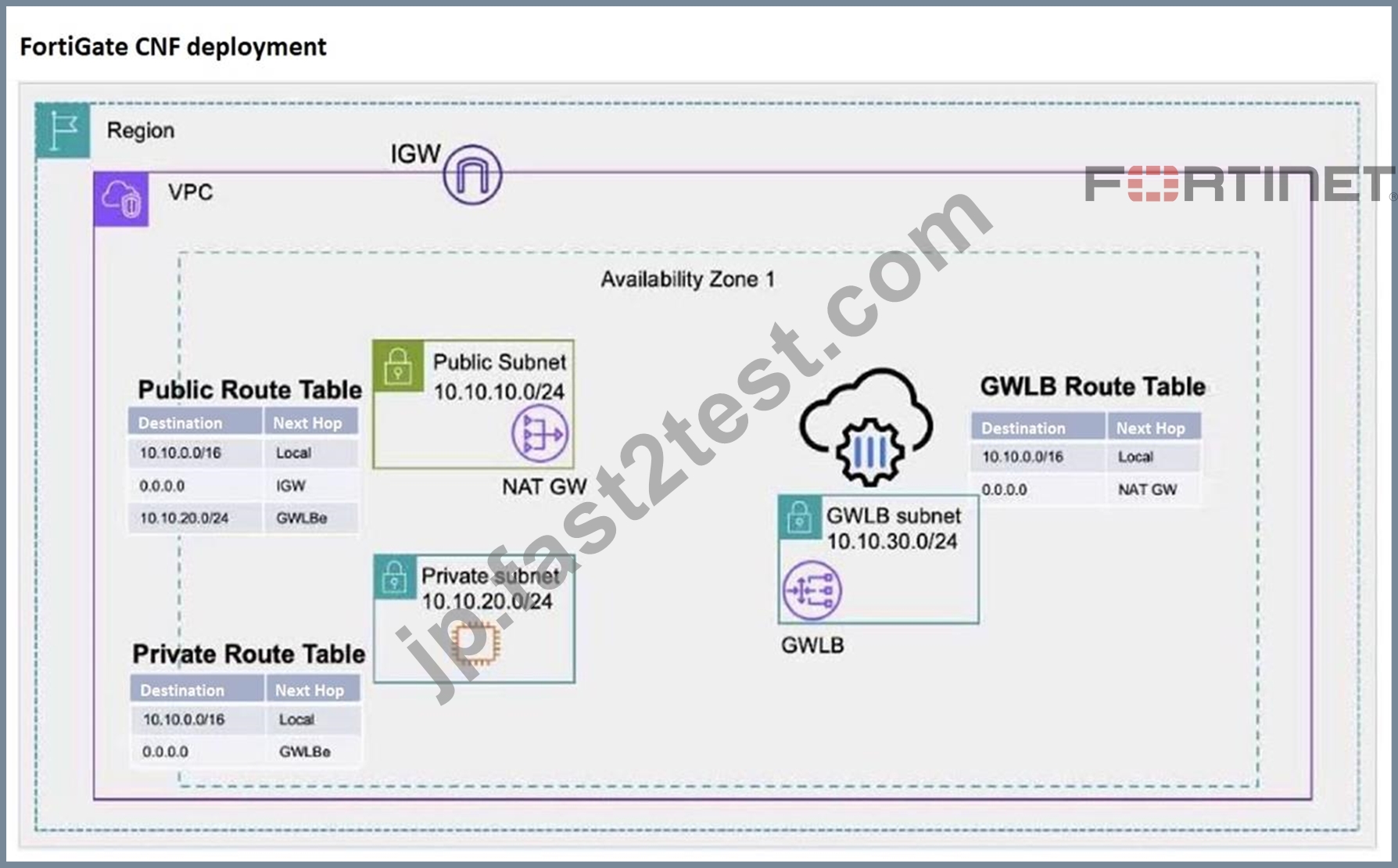
Traffic is initiated from the EC2 instance and is destined for the internet.
Which traffic flow is correct?
- A. EC2 instance > GWLBe > internet
- B. EC2 instance > NAT GW > IGW > internet
- C. There is no route to the internet in the Private Route Table. The traffic does not reach the internet.
- D. EC2 instance > GWLBe > NAT GW > IGW > internet
正解:D
解説:
Understanding the Architecture:
The architecture includes an EC2 instance in a private subnet, a Gateway Load Balancer Endpoint (GWLBe), a NAT Gateway (NAT GW), and an Internet Gateway (IGW).
Route Tables and Routing:
The private route table for the subnet containing the EC2 instance has a route pointing to the GWLBe for internet-bound traffic.
The public route table for the subnet containing the NAT Gateway has routes to the IGW.
Traffic Flow Analysis:
Traffic initiated from the EC2 instance destined for the internet will first be routed to the GWLBe as per the private route table.
The GWLBe will forward the traffic to the NAT Gateway.
The NAT Gateway will then route the traffic to the IGW, which finally sends the traffic to the internet.
Comparison with Other Options:
Option A suggests direct routing to the NAT GW from the EC2 instance, which is incorrect.
Option B incorrectly states there is no route to the internet in the private route table.
Option D suggests direct routing from GWLBe to the internet, which is not the case.
Reference:
AWS Documentation on Route Tables: AWS Route Tables
Gateway Load Balancer Overview: AWS Gateway Load Balancer
質問 # 29
......
FCP_WCS_AD-7.4問題集完全版解答試験学習ガイド:https://jp.fast2test.com/FCP_WCS_AD-7.4-premium-file.html