

合格させるDatabricks Databricks-Generative-AI-Engineer-Associate試験には保証が付きます。更新されたのは47問があります
最新のDatabricks-Generative-AI-Engineer-Associate合格保証付き試験問題集の認定サンプル問題
Databricks Databricks-Generative-AI-Engineer-Associate 認定試験の出題範囲:
| トピック | 出題範囲 |
|---|---|
| トピック 1 |
|
| トピック 2 |
|
| トピック 3 |
|
質問 # 15
A Generative Al Engineer is tasked with developing an application that is based on an open source large language model (LLM). They need a foundation LLM with a large context window.
Which model fits this need?
- A. MPT-30B
- B. Llama2-70B
- C. DistilBERT
- D. DBRX
正解:B
解説:
* Problem Context: The engineer needs an open-source LLM with a large context window to develop an application.
* Explanation of Options:
* Option A: DistilBERT: While an efficient and smaller version of BERT, DistilBERT does not provide a particularly large context window.
* Option B: MPT-30B: This model, while large, is not specified as being particularly notable for its context window capabilities.
* Option C: Llama2-70B: Known for its large model size and extensive capabilities, including a large context window. It is also available as an open-source model, making it ideal for applications requiring extensive contextual understanding.
* Option D: DBRX: This is not a recognized standard model in the context of large language models with extensive context windows.
Thus,Option C(Llama2-70B) is the best fit as it meets the criteria of having a large context window and being available for open-source use, suitable for developing robust language understanding applications.
質問 # 16
A Generative AI Engineer has been asked to build an LLM-based question-answering application. The application should take into account new documents that are frequently published. The engineer wants to build this application with the least cost and least development effort and have it operate at the lowest cost possible.
Which combination of chaining components and configuration meets these requirements?
- A. For the application a prompt, a retriever, and an LLM are required. The retriever output is inserted into the prompt which is given to the LLM to generate answers.
- B. The LLM needs to be frequently with the new documents in order to provide most up-to-date answers.
- C. For the application a prompt, an agent and a fine-tuned LLM are required. The agent is used by the LLM to retrieve relevant content that is inserted into the prompt which is given to the LLM to generate answers.
- D. For the question-answering application, prompt engineering and an LLM are required to generate answers.
正解:A
解説:
Problem Context: The task is to build an LLM-based question-answering application that integrates new documents frequently with minimal costs and development efforts.
Explanation of Options:
* Option A: Utilizes a prompt and a retriever, with the retriever output being fed into the LLM. This setup is efficient because it dynamically updates the data pool via the retriever, allowing the LLM to provide up-to-date answers based on the latest documents without needing tofrequently retrain the model. This method offers a balance of cost-effectiveness and functionality.
* Option B: Requires frequent retraining of the LLM, which is costly and labor-intensive.
* Option C: Only involves prompt engineering and an LLM, which may not adequately handle the requirement for incorporating new documents unless it's part of an ongoing retraining or updating mechanism, which would increase costs.
* Option D: Involves an agent and a fine-tuned LLM, which could be overkill and lead to higher development and operational costs.
Option Ais the most suitable as it provides a cost-effective, minimal development approach while ensuring the application remains up-to-date with new information.
質問 # 17
A Generative AI Engineer is designing an LLM-powered live sports commentary platform. The platform provides real-time updates and LLM-generated analyses for any users who would like to have live summaries, rather than reading a series of potentially outdated news articles.
Which tool below will give the platform access to real-time data for generating game analyses based on the latest game scores?
- A. AutoML
- B. Feature Serving
- C. Foundation Model APIs
- D. DatabrickslQ
正解:B
解説:
* Problem Context: The engineer is developing an LLM-powered live sports commentary platform that needs to provide real-time updates and analyses based on the latest game scores. The critical requirement here is the capability to access and integrate real-time data efficiently with the platform for immediate analysis and reporting.
* Explanation of Options:
* Option A: DatabricksIQ: While DatabricksIQ offers integration and data processing capabilities, it is more aligned with data analytics rather than real-time feature serving, which is crucial for immediate updates necessary in a live sports commentary context.
* Option B: Foundation Model APIs: These APIs facilitate interactions with pre-trained models and could be part of the solution, but on their own, they do not provide mechanisms to access real- time game scores.
* Option C: Feature Serving: This is the correct answer as feature serving specifically refers to the real-time provision of data (features) to models for prediction. This would be essential for an LLM that generates analyses based on live game data, ensuring that the commentary is current and based on the latest events in the sport.
* Option D: AutoML: This tool automates the process of applying machine learning models to real-world problems, but it does not directly provide real-time data access, which is a critical requirement for the platform.
Thus,Option C(Feature Serving) is the most suitable tool for the platform as it directly supports the real-time data needs of an LLM-powered sports commentary system, ensuring that the analyses and updates are based on the latest available information.
質問 # 18
A Generative Al Engineer is tasked with developing a RAG application that will help a small internal group of experts at their company answer specific questions, augmented by an internal knowledge base. They want the best possible quality in the answers, and neither latency nor throughput is a huge concern given that the user group is small and they're willing to wait for the best answer. The topics are sensitive in nature and the data is highly confidential and so, due to regulatory requirements, none of the information is allowed to be transmitted to third parties.
Which model meets all the Generative Al Engineer's needs in this situation?
- A. Dolly 1.5B
- B. OpenAI GPT-4
- C. Llama2-70B
- D. BGE-large
正解:D
解説:
Problem Context: The Generative AI Engineer needs a model for a Retrieval-Augmented Generation (RAG) application that provides high-quality answers, where latency and throughput are not major concerns. The key factors areconfidentialityandsensitivityof the data, as well as the requirement for all processing to be confined to internal resources without external data transmission.
Explanation of Options:
* Option A: Dolly 1.5B: This model does not typically support RAG applications as it's more focused on image generation tasks.
* Option B: OpenAI GPT-4: While GPT-4 is powerful for generating responses, its standard deployment involves cloud-based processing, which could violate the confidentiality requirements due to external data transmission.
* Option C: BGE-large: The BGE (Big Green Engine) large model is a suitable choice if it is configured to operate on-premises or within a secure internal environment that meets regulatory requirements.
Assuming this setup, BGE-large can provide high-quality answers while ensuring that data is not transmitted to third parties, thus aligning with the project's sensitivity and confidentiality needs.
* Option D: Llama2-70B: Similar to GPT-4, unless specifically set up for on-premises use, it generally relies on cloud-based services, which might risk confidential data exposure.
Given the sensitivity and confidentiality concerns,BGE-largeis assumed to be configurable for secure internal use, making it the optimal choice for this scenario.
質問 # 19
A Generative AI Engineer is building a Generative AI system that suggests the best matched employee team member to newly scoped projects. The team member is selected from a very large team. Thematch should be based upon project date availability and how well their employee profile matches the project scope. Both the employee profile and project scope are unstructured text.
How should the Generative Al Engineer architect their system?
- A. Create a tool for finding available team members given project dates. Embed team profiles into a vector store and use the project scope and filtering to perform retrieval to find the available best matched team members.
- B. Create a tool for finding team member availability given project dates, and another tool that uses an LLM to extract keywords from project scopes. Iterate through available team members' profiles and perform keyword matching to find the best available team member.
- C. Create a tool to find available team members given project dates. Create a second tool that can calculate a similarity score for a combination of team member profile and the project scope. Iterate through the team members and rank by best score to select a team member.
- D. Create a tool for finding available team members given project dates. Embed all project scopes into a vector store, perform a retrieval using team member profiles to find the best team member.
正解:A
解説:
* Problem Context: The problem involves matching team members to new projects based on two main factors:
* Availability: Ensure the team members are available during the project dates.
* Profile-Project Match: Use the employee profiles (unstructured text) to find the best match for a project's scope (also unstructured text).
The two main inputs are theemployee profilesandproject scopes, both of which are unstructured. This means traditional rule-based systems (e.g., simple keyword matching) would be inefficient, especially when working with large datasets.
* Explanation of Options: Let's break down the provided options to understand why D is the most optimal answer.
* Option Asuggests embedding project scopes into a vector store and then performing retrieval using team member profiles. While embedding project scopes into a vector store is a valid technique, it skips an important detail: the focus should primarily be on embedding employee profiles because we're matching the profiles to a new project, not the other way around.
* Option Binvolves using a large language model (LLM) to extract keywords from the project scope and perform keyword matching on employee profiles. While LLMs can help with keyword extraction, this approach is too simplistic and doesn't leverage advanced retrieval techniques like vector embeddings, which can handle the nuanced and rich semantics of unstructured data. This approach may miss out on subtle but important similarities.
* Option Csuggests calculating a similarity score between each team member's profile and project scope. While this is a good idea, it doesn't specify how to handle the unstructured nature of data efficiently. Iterating through each member's profile individually could be computationally expensive in large teams. It also lacks the mention of using a vector store or an efficient retrieval mechanism.
* Option Dis the correct approach. Here's why:
* Embedding team profiles into a vector store: Using a vector store allows for efficient similarity searches on unstructured data. Embedding the team member profiles into vectors captures their semantics in a way that is far more flexible than keyword-based matching.
* Using project scope for retrieval: Instead of matching keywords, this approach suggests using vector embeddings and similarity search algorithms (e.g., cosine similarity) to find the team members whose profiles most closely align with the project scope.
* Filtering based on availability: Once the best-matched candidates are retrieved based on profile similarity, filtering them by availability ensures that the system provides a practically useful result.
This method efficiently handles large-scale datasets by leveragingvector embeddingsandsimilarity search techniques, both of which are fundamental tools inGenerative AI engineeringfor handling unstructured text.
* Technical References:
* Vector embeddings: In this approach, the unstructured text (employee profiles and project scopes) is converted into high-dimensional vectors using pretrained models (e.g., BERT, Sentence-BERT, or custom embeddings). These embeddings capture the semantic meaning of the text, making it easier to perform similarity-based retrieval.
* Vector stores: Solutions likeFAISSorMilvusallow storing and retrieving large numbers of vector embeddings quickly. This is critical when working with large teams where querying through individual profiles sequentially would be inefficient.
* LLM Integration: Large language models can assist in generating embeddings for both employee profiles and project scopes. They can also assist in fine-tuning similarity measures, ensuring that the retrieval system captures the nuances of the text data.
* Filtering: After retrieving the most similar profiles based on the project scope, filtering based on availability ensures that only team members who are free for the project are considered.
This system is scalable, efficient, and makes use of the latest techniques inGenerative AI, such as vector embeddings and semantic search.
質問 # 20
A Generative Al Engineer has created a RAG application to look up answers to questions about a series of fantasy novels that are being asked on the author's web forum. The fantasy novel texts are chunked and embedded into a vector store with metadata (page number, chapter number, book title), retrieved with the user' s query, and provided to an LLM for response generation. The Generative AI Engineer used their intuition to pick the chunking strategy and associated configurations but now wants to more methodically choose the best values.
Which TWO strategies should the Generative AI Engineer take to optimize their chunking strategy and parameters? (Choose two.)
- A. Pass known questions and best answers to an LLM and instruct the LLM to provide the best token count. Use a summary statistic (mean, median, etc.) of the best token counts to choose chunk size.
- B. Create an LLM-as-a-judge metric to evaluate how well previous questions are answered by the most appropriate chunk. Optimize the chunking parameters based upon the values of the metric.
- C. Add a classifier for user queries that predicts which book will best contain the answer. Use this to filter retrieval.
- D. Choose an appropriate evaluation metric (such as recall or NDCG) and experiment with changes in the chunking strategy, such as splitting chunks by paragraphs or chapters.
Choose the strategy that gives the best performance metric. - E. Change embedding models and compare performance.
正解:B、D
解説:
To optimize a chunking strategy for a Retrieval-Augmented Generation (RAG) application, the Generative AI Engineer needs a structured approach to evaluating the chunking strategy, ensuring that the chosen configuration retrieves the most relevant information and leads to accurate and coherent LLM responses.
Here's whyCandEare the correct strategies:
Strategy C: Evaluation Metrics (Recall, NDCG)
* Define an evaluation metric: Common evaluation metrics such as recall, precision, or NDCG (Normalized Discounted Cumulative Gain) measure how well the retrieved chunks match the user's query and the expected response.
* Recallmeasures the proportion of relevant information retrieved.
* NDCGis often used when you want to account for both the relevance of retrieved chunks and the ranking or order in which they are retrieved.
* Experiment with chunking strategies: Adjusting chunking strategies based on text structure (e.g., splitting by paragraph, chapter, or a fixed number of tokens) allows the engineer to experiment with various ways of slicing the text. Some chunks may better align with the user's query than others.
* Evaluate performance: By using recall or NDCG, the engineer can methodically test various chunking strategies to identify which one yields the highest performance. This ensures that the chunking method provides the most relevant information when embedding and retrieving data from the vector store.
Strategy E: LLM-as-a-Judge Metric
* Use the LLM as an evaluator: After retrieving chunks, the LLM can be used to evaluate the quality of answers based on the chunks provided. This could be framed as a "judge" function, where the LLM compares how well a given chunk answers previous user queries.
* Optimize based on the LLM's judgment: By having the LLM assess previous answers and rate their relevance and accuracy, the engineer can collect feedback on how well different chunking configurations perform in real-world scenarios.
* This metric could be a qualitative judgment on how closely the retrieved information matches the user's intent.
* Tune chunking parameters: Based on the LLM's judgment, the engineer can adjust the chunk size or structure to better align with the LLM's responses, optimizing retrieval for future queries.
By combining these two approaches, the engineer ensures that the chunking strategy is systematically evaluated using both quantitative (recall/NDCG) and qualitative (LLM judgment) methods. This balanced optimization process results in improved retrieval relevance and, consequently, better response generation by the LLM.
質問 # 21
A team wants to serve a code generation model as an assistant for their software developers. It should support multiple programming languages. Quality is the primary objective.
Which of the Databricks Foundation Model APIs, or models available in the Marketplace, would be the best fit?
- A. MPT-7b
- B. CodeLlama-34B
- C. Llama2-70b
- D. BGE-large
正解:B
解説:
For a code generation model that supports multiple programming languages and where quality is the primary objective,CodeLlama-34Bis the most suitable choice. Here's the reasoning:
* Specialization in Code Generation:CodeLlama-34B is specifically designed for code generation tasks.
This model has been trained with a focus on understanding and generating code, which makes it particularly adept at handling various programming languages and coding contexts.
* Capacity and Performance:The "34B" indicates a model size of 34 billion parameters, suggesting a high capacity for handling complex tasks and generating high-quality outputs. The large model size typically correlates with better understanding and generation capabilities in diverse scenarios.
* Suitability for Development Teams:Given that the model is optimized for code, it will be able to assist software developers more effectively than general-purpose models. It understands coding syntax, semantics, and the nuances of different programming languages.
* Why Other Options Are Less Suitable:
* A (Llama2-70b): While also a large model, it's more general-purpose and may not be as fine- tuned for code generation as CodeLlama.
* B (BGE-large): This model may not specifically focus on code generation.
* C (MPT-7b): Smaller than CodeLlama-34B and likely less capable in handling complex code generation tasks at high quality.
Therefore, for a high-quality, multi-language code generation application,CodeLlama-34B(option D) is the best fit.
質問 # 22
A Generative AI Engineer is developing a patient-facing healthcare-focused chatbot. If the patient's question is not a medical emergency, the chatbot should solicit more information from the patient to pass to the doctor' s office and suggest a few relevant pre-approved medical articles for reading. If the patient's question is urgent, direct the patient to calling their local emergency services.
Given the following user input:
"I have been experiencing severe headaches and dizziness for the past two days." Which response is most appropriate for the chatbot to generate?
- A. Here are a few relevant articles for your browsing. Let me know if you have questions after reading them.
- B. Please call your local emergency services.
- C. Headaches can be tough. Hope you feel better soon!
- D. Please provide your age, recent activities, and any other symptoms you have noticed along with your headaches and dizziness.
正解:B
解説:
* Problem Context: The task is to design responses for a healthcare-focused chatbot that appropriately addresses the urgency of a patient's symptoms.
* Explanation of Options:
* Option A: Suggesting articles might be suitable for less urgent inquiries but is inappropriate for symptoms that could indicate a serious condition.
* Option B: Given the description of severe symptoms like headaches and dizziness, directing the patient to emergency services is prudent. This aligns with medical guidelines that recommend immediate professional attention for such severe symptoms.
* Option C: Offering well-wishes does not address the potential seriousness of the symptoms and lacks appropriate action.
* Option D: While gathering more information is part of a detailed assessment, the immediate need here suggests a more urgent response.
Given the potential severity of the described symptoms,Option Bis the most appropriate, ensuring the chatbot directs patients to seek urgent care when needed, potentially saving lives.
質問 # 23
A Generative AI Engineer is designing a chatbot for a gaming company that aims to engage users on its platform while its users play online video games.
Which metric would help them increase user engagement and retention for their platform?
- A. Repetition of responses
- B. Randomness
- C. Lack of relevance
- D. Diversity of responses
正解:D
解説:
In the context of designing a chatbot to engage users on a gaming platform,diversity of responses(option B) is a key metric to increase user engagement and retention. Here's why:
* Diverse and Engaging Interactions:A chatbot that provides varied and interesting responses will keep users engaged, especially in an interactive environment like a gaming platform. Gamers typically enjoy dynamic and evolving conversations, anddiversity of responseshelps prevent monotony, encouraging users to interact more frequently with the bot.
* Increasing Retention:By offering different types of responses to similar queries, the chatbot can create a sense of novelty and excitement, which enhances the user's experience and makes them more likely to return to the platform.
* Why Other Options Are Less Effective:
* A (Randomness): Random responses can be confusing or irrelevant, leading to frustration and reducing engagement.
* C (Lack of Relevance): If responses are not relevant to the user's queries, this will degrade the user experience and lead to disengagement.
* D (Repetition of Responses): Repetitive responses can quickly bore users, making the chatbot feel uninteresting and reducing the likelihood of continued interaction.
Thus,diversity of responses(option B) is the most effective way to keep users engaged and retain them on the platform.
質問 # 24
A Generative AI Engineer has created a RAG application which can help employees retrieve answers from an internal knowledge base, such as Confluence pages or Google Drive. The prototype application is now working with some positive feedback from internal company testers. Now the Generative Al Engineer wants to formally evaluate the system's performance and understand where to focus their efforts to further improve the system.
How should the Generative AI Engineer evaluate the system?
- A. Benchmark multiple LLMs with the same data and pick the best LLM for the job.
- B. Curate a dataset that can test the retrieval and generation components of the system separately. Use MLflow's built in evaluation metrics to perform the evaluation on the retrieval and generation components.
- C. Use cosine similarity score to comprehensively evaluate the quality of the final generated answers.
- D. Use an LLM-as-a-judge to evaluate the quality of the final answers generated.
正解:B
解説:
* Problem Context: After receiving positive feedback for the RAG application prototype, the next step is to formally evaluate the system to pinpoint areas for improvement.
* Explanation of Options:
* Option A: While cosine similarity scores are useful, they primarily measure similarity rather than the overall performance of an RAG system.
* Option B: This option provides a systematic approach to evaluation by testing both retrieval and generation components separately. This allows for targeted improvements and a clear understanding of each component's performance, using MLflow's metrics for a structured and standardized assessment.
* Option C: Benchmarking multiple LLMs does not focus on evaluating the existing system's components but rather on comparing different models.
* Option D: Using an LLM as a judge is subjective and less reliable for systematic performance evaluation.
OptionBis the most comprehensive and structured approach, facilitating precise evaluations and improvements on specific components of the RAG system.
質問 # 25
A Generative Al Engineer is responsible for developing a chatbot to enable their company's internal HelpDesk Call Center team to more quickly find related tickets and provide resolution. While creating the GenAI application work breakdown tasks for this project, they realize they need to start planning which data sources (either Unity Catalog volume or Delta table) they could choose for this application. They have collected several candidate data sources for consideration:
call_rep_history: a Delta table with primary keys representative_id, call_id. This table is maintained to calculate representatives' call resolution from fields call_duration and call start_time.
transcript Volume: a Unity Catalog Volume of all recordings as a *.wav files, but also a text transcript as *.txt files.
call_cust_history: a Delta table with primary keys customer_id, cal1_id. This table is maintained to calculate how much internal customers use the HelpDesk to make sure that the charge back model is consistent with actual service use.
call_detail: a Delta table that includes a snapshot of all call details updated hourly. It includes root_cause and resolution fields, but those fields may be empty for calls that are still active.
maintenance_schedule - a Delta table that includes a listing of both HelpDesk application outages as well as planned upcoming maintenance downtimes.
They need sources that could add context to best identify ticket root cause and resolution.
Which TWO sources do that? (Choose two.)
- A. transcript Volume
- B. maintenance_schedule
- C. call_detail
- D. call_rep_history
- E. call_cust_history
正解:A、C
解説:
In the context of developing a chatbot for a company's internal HelpDesk Call Center, the key is to select data sources that provide the most contextual and detailed information about the issues being addressed. This includes identifying the root cause and suggesting resolutions. The two most appropriate sources from the list are:
* Call Detail (Option D):
* Contents: This Delta table includes a snapshot of all call details updated hourly, featuring essential fields like root_cause and resolution.
* Relevance: The inclusion of root_cause and resolution fields makes this source particularly valuable, as it directly contains the information necessary to understand and resolve the issues discussed in the calls. Even if some records are incomplete, the data provided is crucial for a chatbot aimed at speeding up resolution identification.
* Transcript Volume (Option E):
* Contents: This Unity Catalog Volume contains recordings in .wav format and text transcripts in .txt files.
* Relevance: The text transcripts of call recordings can provide in-depth context that the chatbot can analyze to understand the nuances of each issue. The chatbot can use natural language processing techniques to extract themes, identify problems, and suggest resolutions based on previous similar interactions documented in the transcripts.
Why Other Options Are Less Suitable:
* A (Call Cust History): While it provides insights into customer interactions with the HelpDesk, it focuses more on the usage metrics rather than the content of the calls or the issues discussed.
* B (Maintenance Schedule): This data is useful for understanding when services may not be available but does not contribute directly to resolving user issues or identifying root causes.
* C (Call Rep History): Though it offers data on call durations and start times, which could help in assessing performance, it lacks direct information on the issues being resolved.
Therefore, Call Detail and Transcript Volume are the most relevant data sources for a chatbot designed to assist with identifying and resolving issues in a HelpDesk Call Center setting, as they provide direct and contextual information related to customer issues.
質問 # 26
A Generative AI Engineer is designing an LLM-powered live sports commentary platform. The platform provides real-time updates and LLM-generated analyses for any users who would like to have live summaries, rather than reading a series of potentially outdated news articles.
Which tool below will give the platform access to real-time data for generating game analyses based on the latest game scores?
- A. AutoML
- B. Feature Serving
- C. Foundation Model APIs
- D. DatabrickslQ
正解:B
解説:
* Problem Context: The engineer is developing an LLM-powered live sports commentary platform that needs to provide real-time updates and analyses based on the latest game scores. The critical requirement here is the capability to access and integrate real-time data efficiently with the platform for immediate analysis and reporting.
* Explanation of Options:
* Option A: DatabricksIQ: While DatabricksIQ offers integration and data processing capabilities, it is more aligned with data analytics rather than real-time feature serving, which is crucial for immediate updates necessary in a live sports commentary context.
* Option B: Foundation Model APIs: These APIs facilitate interactions with pre-trained models and could be part of the solution, but on their own, they do not provide mechanisms to access real- time game scores.
* Option C: Feature Serving: This is the correct answer as feature serving specifically refers to the real-time provision of data (features) to models for prediction. This would be essential for an LLM that generates analyses based on live game data, ensuring that the commentary is current and based on the latest events in the sport.
* Option D: AutoML: This tool automates the process of applying machine learning models to real-world problems, but it does not directly provide real-time data access, which is a critical requirement for the platform.
Thus,Option C(Feature Serving) is the most suitable tool for the platform as it directly supports the real-time data needs of an LLM-powered sports commentary system, ensuring that the analyses and updates are based on the latest available information.
質問 # 27
A Generative AI Engineer just deployed an LLM application at a digital marketing company that assists with answering customer service inquiries.
Which metric should they monitor for their customer service LLM application in production?
- A. Energy usage per query
- B. HuggingFace Leaderboard values for the base LLM
- C. Number of customer inquiries processed per unit of time
- D. Final perplexity scores for the training of the model
正解:C
解説:
When deploying an LLM application for customer service inquiries, the primary focus is on measuring the operational efficiency and quality of the responses. Here's whyAis the correct metric:
* Number of customer inquiries processed per unit of time: This metric tracks the throughput of the customer service system, reflecting how many customer inquiries the LLM application can handle in a given time period (e.g., per minute or hour). High throughput is crucial in customer service applications where quick response times are essential to user satisfaction and business efficiency.
* Real-time performance monitoring: Monitoring the number of queries processed is an important part of ensuring that the model is performing well under load, especially during peak traffic times. It also helps ensure the system scales properly to meet demand.
Why other options are not ideal:
* B. Energy usage per query: While energy efficiency is a consideration, it is not the primary concern for a customer-facing application where user experience (i.e., fast and accurate responses) is critical.
* C. Final perplexity scores for the training of the model: Perplexity is a metric for model training, but it doesn't reflect the real-time operational performance of an LLM in production.
* D. HuggingFace Leaderboard values for the base LLM: The HuggingFace Leaderboard is more relevant during model selection and benchmarking. However, it is not a direct measure of the model's performance in a specific customer service application in production.
Focusing on throughput (inquiries processed per unit time) ensures that the LLM application is meeting business needs for fast and efficient customer service responses.
質問 # 28
A Generative AI Engineer received the following business requirements for an external chatbot.
The chatbot needs to know what types of questions the user asks and routes to appropriate models to answer the questions. For example, the user might ask about upcoming event details. Another user might ask about purchasing tickets for a particular event.
What is an ideal workflow for such a chatbot?
- A. There should be two different chatbots handling different types of user queries.
- B. The chatbot should only process payments
- C. The chatbot should only look at previous event information
- D. The chatbot should be implemented as a multi-step LLM workflow. First, identify the type of question asked, then route the question to the appropriate model. If it's an upcoming event question, send the query to a text-to-SQL model. If it's about ticket purchasing, the customer should be redirected to a payment platform.
正解:D
解説:
* Problem Context: The chatbot must handle various types of queries and intelligently route them to the appropriate responses or systems.
* Explanation of Options:
* Option A: Limiting the chatbot to only previous event information restricts its utility and does not meet the broader business requirements.
* Option B: Having two separate chatbots could unnecessarily complicate user interaction and increase maintenance overhead.
* Option C: Implementing a multi-step workflow where the chatbot first identifies the type of question and then routes it accordingly is the most efficient and scalable solution. This approach allows the chatbot to handle a variety of queries dynamically, improving user experience and operational efficiency.
* Option D: Focusing solely on payments would not satisfy all the specified user interaction needs, such as inquiring about event details.
Option Coffers a comprehensive workflow that maximizes the chatbot's utility and responsiveness to different user needs, aligning perfectly with the business requirements.
質問 # 29
A Generative Al Engineer would like an LLM to generate formatted JSON from emails. This will require parsing and extracting the following information: order ID, date, and sender email. Here's a sample email: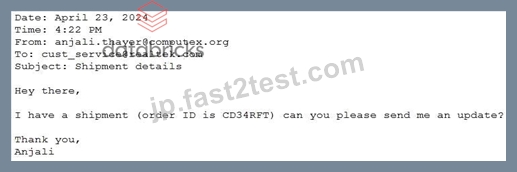
They will need to write a prompt that will extract the relevant information in JSON format with the highest level of output accuracy.
Which prompt will do that?
- A. You will receive customer emails and need to extract date, sender email, and order ID. Return the extracted information in a human-readable format.
- B. You will receive customer emails and need to extract date, sender email, and order ID. Return the extracted information in JSON format.
Here's an example: {"date": "April 16, 2024", "sender_email": "[email protected]", "order_id":
"RE987D"} - C. You will receive customer emails and need to extract date, sender email, and order ID. Return the extracted information in JSON format.
- D. You will receive customer emails and need to extract date, sender email, and order ID. You should return the date, sender email, and order ID information in JSON format.
正解:B
解説:
Problem Context: The goal is to parse emails to extract certain pieces of information and output this in a structured JSON format. Clarity and specificity in the prompt design will ensure higher accuracy in the LLM' s responses.
Explanation of Options:
* Option A: Provides a general guideline but lacks an example, which helps an LLM understand the exact format expected.
* Option B: Includes a clear instruction and a specific example of the output format. Providing an example is crucial as it helps set the pattern and format in which the information should be structured, leading to more accurate results.
* Option C: Does not specify that the output should be in JSON format, thus not meeting the requirement.
* Option D: While it correctly asks for JSON format, it lacks an example that would guide the LLM on how to structure the JSON correctly.
Therefore,Option Bis optimal as it not only specifies the required format but also illustrates it with an example, enhancing the likelihood of accurate extraction and formatting by the LLM.
質問 # 30
A Generative Al Engineer has successfully ingested unstructured documents and chunked them by document sections. They would like to store the chunks in a Vector Search index. The current format of the dataframe has two columns: (i) original document file name (ii) an array of text chunks for each document.
What is the most performant way to store this dataframe?
- A. Store each chunk as an independent JSON file in Unity Catalog Volume. For each JSON file, the key is the document section name and the value is the array of text chunks for that section
- B. Split the data into train and test set, create a unique identifier for each document, then save to a Delta table
- C. Flatten the dataframe to one chunk per row, create a unique identifier for each row, and save to a Delta table
- D. First create a unique identifier for each document, then save to a Delta table
正解:C
解説:
* Problem Context: The engineer needs an efficient way to store chunks of unstructured documents to facilitate easy retrieval and search. The current dataframe consists of document filenames and associated text chunks.
* Explanation of Options:
* Option A: Splitting into train and test sets is more relevant for model training scenarios and not directly applicable to storage for retrieval in a Vector Search index.
* Option B: Flattening the dataframe such that each row contains a single chunk with a unique identifier is the most performant for storage and retrieval. This structure aligns well with how data is indexed and queried in vector search applications, making it easier to retrieve specific chunks efficiently.
* Option C: Creating a unique identifier for each document only does not address the need to access individual chunks efficiently, which is critical in a Vector Search application.
* Option D: Storing each chunk as an independent JSON file creates unnecessary overhead and complexity in managing and querying large volumes of files.
OptionBis the most efficient and practical approach, allowing for streamlined indexing and retrieval processes in a Delta table environment, fitting the requirements of a Vector Search index.
質問 # 31
......
最新Databricks-Generative-AI-Engineer-Associateテスト材料には有効なDatabricks-Generative-AI-Engineer-Associateテストエンジン:https://jp.fast2test.com/Databricks-Generative-AI-Engineer-Associate-premium-file.html
Databricks-Generative-AI-Engineer-Associate更新された試験問題集で[2025年最新] 練習には有効な試験問題集:https://drive.google.com/open?id=1aZKNRlevyh2AAurg-OW0xl45mYQzZ8gh