

あなたを合格させる試験には100%確認済みDatabricks-Generative-AI-Engineer-Associate試験問題
Databricks-Generative-AI-Engineer-Associate問題集PDFでDatabricks-Generative-AI-Engineer-Associateリアル試験問題解答
Databricks Databricks-Generative-AI-Engineer-Associate 認定試験の出題範囲:
| トピック | 出題範囲 |
|---|---|
| トピック 1 |
|
| トピック 2 |
|
| トピック 3 |
|
| トピック 4 |
|
質問 # 41
A Generative AI Engineer wants to build an LLM-based solution to help a restaurant improve its online customer experience with bookings by automatically handling common customer inquiries. The goal of the solution is to minimize escalations to human intervention and phone calls while maintaining a personalized interaction. To design the solution, the Generative AI Engineer needs to define the input data to the LLM and the task it should perform.
Which input/output pair will support their goal?
- A. Input: Online chat logs; Output: Group the chat logs by users, followed by summarizing each user's interactions
- B. Input: Customer reviews; Output: Classify review sentiment
- C. Input: Online chat logs; Output: Buttons that represent choices for booking details
- D. Input: Online chat logs; Output: Cancellation options
正解:C
解説:
Context: The goal is to improve the online customer experience in a restaurant by handling common inquiries about bookings, minimizing escalations, and maintaining personalized interactions.
Explanation of Options:
* Option A: Grouping and summarizing chat logs by user could provide insights into customer interactions but does not directly address the task of handling booking inquiries or minimizing escalations.
* Option B: Using chat logs to generate interactive buttons for booking details directly supports the goal of facilitating online bookings, minimizing the need for human intervention by providing clear, interactive options for customers to self-serve.
* Option C: Classifying sentiment of customer reviews does not directly help with booking inquiries, although it might provide valuable feedback insights.
* Option D: Providing cancellation options is helpful but narrowly focuses on one aspect of the booking process and doesn't support the broader goal of handling common inquiries about bookings.
Option Bbest supports the goal of improving online interactions by using chat logs to generate actionable items for customers, helping them complete booking tasks efficiently and reducing the need for human intervention.
質問 # 42
A Generative AI Engineer has a provisioned throughput model serving endpoint as part of a RAG application and would like to monitor the serving endpoint's incoming requests and outgoing responses. The current approach is to include a micro-service in between the endpoint and the user interface to write logs to a remote server.
Which Databricks feature should they use instead which will perform the same task?
- A. Lakeview
- B. Vector Search
- C. Inference Tables
- D. DBSQL
正解:C
解説:
Problem Context: The goal is to monitor theserving endpointfor incoming requests and outgoing responses in aprovisioned throughput model serving endpointwithin aRetrieval-Augmented Generation (RAG) application. The current approach involves using a microservice to log requests and responses to a remote server, but the Generative AI Engineer is looking for a more streamlined solution within Databricks.
Explanation of Options:
* Option A: Vector Search: This feature is used to perform similarity searches within vector databases.
It doesn't provide functionality for logging or monitoring requests and responses in a serving endpoint, so it's not applicable here.
* Option B: Lakeview: Lakeview is not a feature relevant to monitoring or logging request-response cycles for serving endpoints. It might be more related to viewing data in Databricks Lakehouse but doesn't fulfill the specific monitoring requirement.
* Option C: DBSQL: Databricks SQL (DBSQL) is used for running SQL queries on data stored in Databricks, primarily for analytics purposes. It doesn't provide the direct functionality needed to monitor requests and responses in real-time for an inference endpoint.
* Option D: Inference Tables: This is the correct answer.Inference Tablesin Databricks are designed to store the results and metadata of inference runs. This allows the system to logincoming requests and outgoing responsesdirectly within Databricks, making it an ideal choice for monitoring the behavior of a provisioned serving endpoint. Inference Tables can be queried and analyzed, enabling easier monitoring and debugging compared to a custom microservice.
Thus,Inference Tablesare the optimal feature for monitoring request and response logs within the Databricks infrastructure for a model serving endpoint.
質問 # 43
A Generative AI Engineer is building a Generative AI system that suggests the best matched employee team member to newly scoped projects. The team member is selected from a very large team. The match should be based upon project date availability and how well their employee profile matches the project scope. Both the employee profile and project scope are unstructured text.
How should the Generative Al Engineer architect their system?
- A. Create a tool to find available team members given project dates. Create a second tool that can calculate a similarity score for a combination of team member profile and the project scope. Iterate through the team members and rank by best score to select a team member.
- B. Create a tool for finding team member availability given project dates, and another tool that uses an LLM to extract keywords from project scopes. Iterate through available team members' profiles and perform keyword matching to find the best available team member.
- C. Create a tool for finding available team members given project dates. Embed team profiles into a vector store and use the project scope and filtering to perform retrieval to find the available best matched team members.
- D. Create a tool for finding available team members given project dates. Embed all project scopes into a vector store, perform a retrieval using team member profiles to find the best team member.
正解:C
解説:
Problem Context: The problem involves matching team members to new projects based on two main factors:
Availability: Ensure the team members are available during the project dates.
Profile-Project Match: Use the employee profiles (unstructured text) to find the best match for a project's scope (also unstructured text).
The two main inputs are the employee profiles and project scopes, both of which are unstructured. This means traditional rule-based systems (e.g., simple keyword matching) would be inefficient, especially when working with large datasets.
Explanation of Options: Let's break down the provided options to understand why D is the most optimal answer.
Option A suggests embedding project scopes into a vector store and then performing retrieval using team member profiles. While embedding project scopes into a vector store is a valid technique, it skips an important detail: the focus should primarily be on embedding employee profiles because we're matching the profiles to a new project, not the other way around.
Option B involves using a large language model (LLM) to extract keywords from the project scope and perform keyword matching on employee profiles. While LLMs can help with keyword extraction, this approach is too simplistic and doesn't leverage advanced retrieval techniques like vector embeddings, which can handle the nuanced and rich semantics of unstructured data. This approach may miss out on subtle but important similarities.
Option C suggests calculating a similarity score between each team member's profile and project scope. While this is a good idea, it doesn't specify how to handle the unstructured nature of data efficiently. Iterating through each member's profile individually could be computationally expensive in large teams. It also lacks the mention of using a vector store or an efficient retrieval mechanism.
Option D is the correct approach. Here's why:
Embedding team profiles into a vector store: Using a vector store allows for efficient similarity searches on unstructured data. Embedding the team member profiles into vectors captures their semantics in a way that is far more flexible than keyword-based matching.
Using project scope for retrieval: Instead of matching keywords, this approach suggests using vector embeddings and similarity search algorithms (e.g., cosine similarity) to find the team members whose profiles most closely align with the project scope.
Filtering based on availability: Once the best-matched candidates are retrieved based on profile similarity, filtering them by availability ensures that the system provides a practically useful result.
This method efficiently handles large-scale datasets by leveraging vector embeddings and similarity search techniques, both of which are fundamental tools in Generative AI engineering for handling unstructured text.
Technical Reference:
Vector embeddings: In this approach, the unstructured text (employee profiles and project scopes) is converted into high-dimensional vectors using pretrained models (e.g., BERT, Sentence-BERT, or custom embeddings). These embeddings capture the semantic meaning of the text, making it easier to perform similarity-based retrieval.
Vector stores: Solutions like FAISS or Milvus allow storing and retrieving large numbers of vector embeddings quickly. This is critical when working with large teams where querying through individual profiles sequentially would be inefficient.
LLM Integration: Large language models can assist in generating embeddings for both employee profiles and project scopes. They can also assist in fine-tuning similarity measures, ensuring that the retrieval system captures the nuances of the text data.
Filtering: After retrieving the most similar profiles based on the project scope, filtering based on availability ensures that only team members who are free for the project are considered.
This system is scalable, efficient, and makes use of the latest techniques in Generative AI, such as vector embeddings and semantic search.
質問 # 44
A Generative Al Engineer has developed an LLM application to answer questions about internal company policies. The Generative AI Engineer must ensure that the application doesn't hallucinate or leak confidential data.
Which approach should NOT be used to mitigate hallucination or confidential data leakage?
- A. Add guardrails to filter outputs from the LLM before it is shown to the user
- B. Limit the data available based on the user's access level
- C. Fine-tune the model on your data, hoping it will learn what is appropriate and not
- D. Use a strong system prompt to ensure the model aligns with your needs.
正解:C
解説:
When addressing concerns of hallucination and data leakage in an LLM application for internal company policies, fine-tuning the model on internal data with the hope it learns data boundaries can be problematic:
* Risk of Data Leakage: Fine-tuning on sensitive or confidential data does not guarantee that the model will not inadvertently include or reference this data in its outputs. There's a risk of overfitting to the specific data details, which might lead to unintended leakage.
* Hallucination: Fine-tuning does not necessarily mitigate the model's tendency to hallucinate; in fact, it might exacerbate it if the training data is not comprehensive or representative of all potential queries.
Better Approaches:
* A,C, andDinvolve setting up operational safeguards and constraints that directly address data leakage and ensure responses are aligned with specific user needs and security levels.
Fine-tuning lacks the targeted control needed for such sensitive applications and can introduce new risks, making it an unsuitable approach in this context.
質問 # 45
A Generative Al Engineer is creating an LLM-based application. The documents for its retriever have been chunked to a maximum of 512 tokens each. The Generative Al Engineer knows that cost and latency are more important than quality for this application. They have several context length levels to choose from.
Which will fulfill their need?
- A. context length 2048: smallest model is 11GB and embedding dimension 2560
- B. context length 32768: smallest model is 14GB and embedding dimension 4096
- C. context length 514; smallest model is 0.44GB and embedding dimension 768
- D. context length 512: smallest model is 0.13GB and embedding dimension 384
正解:D
解説:
When prioritizing cost and latency over quality in a Large Language Model (LLM)-based application, it is crucial to select a configuration that minimizes both computational resources and latency while still providing reasonable performance. Here's whyDis the best choice:
* Context length: The context length of 512 tokens aligns with the chunk size used for the documents (maximum of 512 tokens per chunk). This is sufficient for capturing the needed information and generating responses without unnecessary overhead.
* Smallest model size: The model with a size of 0.13GB is significantly smaller than the other options.
This small footprint ensures faster inference times and lower memory usage, which directly reduces both latency and cost.
* Embedding dimension: While the embedding dimension of 384 is smaller than the other options, it is still adequate for tasks where cost and speed are more important than precision and depth of understanding.
This setup achieves the desired balance between cost-efficiency and reasonable performance in a latency- sensitive, cost-conscious application.
質問 # 46
A small and cost-conscious startup in the cancer research field wants to build a RAG application using Foundation Model APIs.
Which strategy would allow the startup to build a good-quality RAG application while being cost-conscious and able to cater to customer needs?
- A. Use the largest LLM possible because that gives the best performance for any general queries
- B. Pick a smaller LLM that is domain-specific
- C. Limit the number of queries a customer can send per day
- D. Limit the number of relevant documents available for the RAG application to retrieve from
正解:B
解説:
For a small, cost-conscious startup in the cancer research field, choosing a domain-specific and smaller LLM is the most effective strategy. Here's whyBis the best choice:
* Domain-specific performance: A smaller LLM that has been fine-tuned for the domain of cancer research will outperform a general-purpose LLM for specialized queries. This ensures high-quality responses without needing to rely on a large, expensive LLM.
* Cost-efficiency: Smaller models are cheaper to run, both in terms of compute resources and API usage costs. A domain-specific smaller LLM can deliver good quality responses without the need for the extensive computational power required by larger models.
* Focused knowledge: In a specialized field like cancer research, having an LLM tailored to the subject matter provides better relevance and accuracy for queries, while keeping costs low.Large, general- purpose LLMs may provide irrelevant information, leading to inefficiency and higher costs.
This approach allows the startup to balance quality, cost, and customer satisfaction effectively, making it the most suitable strategy.
質問 # 47
A Generative AI Engineer is tasked with deploying an application that takes advantage of a custom MLflow Pyfunc model to return some interim results.
How should they configure the endpoint to pass the secrets and credentials?
- A. Pass variables using the Databricks Feature Store API
- B. Use spark.conf.set ()
- C. Add credentials using environment variables
- D. Pass the secrets in plain text
正解:C
解説:
Context: Deploying an application that uses an MLflow Pyfunc model involves managing sensitive information such as secrets and credentials securely.
Explanation of Options:
* Option A: Use spark.conf.set(): While this method can pass configurations within Spark jobs, using it for secrets is not recommended because it may expose them in logs or Spark UI.
* Option B: Pass variables using the Databricks Feature Store API: The Feature Store API is designed for managing features for machine learning, not for handling secrets or credentials.
* Option C: Add credentials using environment variables: This is a common practice for managing credentials in a secure manner, as environment variables can be accessed securely by applications without exposing them in the codebase.
* Option D: Pass the secrets in plain text: This is highly insecure and not recommended, as it exposes sensitive information directly in the code.
Therefore,Option Cis the best method for securely passing secrets and credentials to an application, protecting them from exposure.
質問 # 48
A Generative AI Engineer is designing a RAG application for answering user questions on technical regulations as they learn a new sport.
What are the steps needed to build this RAG application and deploy it?
- A. Ingest documents from a source -> Index the documents and save to Vector Search -> Evaluate model -> Deploy it using Model Serving
- B. Ingest documents from a source -> Index the documents and saves to Vector Search -> User submits queries against an LLM -> LLM retrieves relevant documents -> Evaluate model -> LLM generates a response -> Deploy it using Model Serving
- C. User submits queries against an LLM -> Ingest documents from a source -> Index the documents and save to Vector Search -> LLM retrieves relevant documents -> LLM generates a response -> Evaluate model -> Deploy it using Model Serving
- D. Ingest documents from a source -> Index the documents and save to Vector Search -> User submits queries against an LLM -> LLM retrieves relevant documents -> LLM generates a response -> Evaluate model -> Deploy it using Model Serving
正解:D
解説:
The Generative AI Engineer needs to follow a methodical pipeline to build and deploy a Retrieval-Augmented Generation (RAG) application. The steps outlined in option B accurately reflect this process:
Ingest documents from a source: This is the first step, where the engineer collects documents (e.g., technical regulations) that will be used for retrieval when the application answers user questions.
Index the documents and save to Vector Search: Once the documents are ingested, they need to be embedded using a technique like embeddings (e.g., with a pre-trained model like BERT) and stored in a vector database (such as Pinecone or FAISS). This enables fast retrieval based on user queries.
User submits queries against an LLM: Users interact with the application by submitting their queries. These queries will be passed to the LLM.
LLM retrieves relevant documents: The LLM works with the vector store to retrieve the most relevant documents based on their vector representations.
LLM generates a response: Using the retrieved documents, the LLM generates a response that is tailored to the user's question.
Evaluate model: After generating responses, the system must be evaluated to ensure the retrieved documents are relevant and the generated response is accurate. Metrics such as accuracy, relevance, and user satisfaction can be used for evaluation.
Deploy it using Model Serving: Once the RAG pipeline is ready and evaluated, it is deployed using a model-serving platform such as Databricks Model Serving. This enables real-time inference and response generation for users.
By following these steps, the Generative AI Engineer ensures that the RAG application is both efficient and effective for the task of answering technical regulation questions.
質問 # 49
A Generative Al Engineer is working with a retail company that wants to enhance its customer experience by automatically handling common customer inquiries. They are working on an LLM-powered Al solution that should improve response times while maintaining a personalized interaction. They want to define the appropriate input and LLM task to do this.
Which input/output pair will do this?
- A. Input: Customer reviews; Output Group the reviews by users and aggregate per-user average rating, then respond
- B. Input: Customer service chat logs; Output Group the chat logs by users, followed by summarizing each user's interactions, then respond
- C. Input: Customer reviews: Output Classify review sentiment
- D. Input: Customer service chat logs; Output: Find the answers to similar questions and respond with a summary
正解:D
解説:
The task described in the question involves enhancing customer experience by automatically handling common customer inquiries using an LLM-powered AI solution. This requires the system to process input data (customer inquiries) and generate personalized, relevant responses efficiently. Let's evaluate the options step-by-step in the context of Databricks Generative AI Engineer principles, which emphasize leveraging LLMs for tasks like question answering, summarization, and retrieval-augmented generation (RAG).
Option A: Input: Customer reviews; Output: Group the reviews by users and aggregate per-user average rating, then respond This option focuses on analyzing customer reviews to compute average ratings per user. While this might be useful for sentiment analysis or user profiling, it does not directly address the goal of handling common customer inquiries or improving response times for personalized interactions. Customer reviews are typically feedback data, not real-time inquiries requiring immediate responses.
Databricks Reference: Databricks documentation on LLMs (e.g., "Building LLM Applications with Databricks") emphasizes that LLMs excel at tasks like question answering and conversational responses, not just aggregation or statistical analysis of reviews.
Option B: Input: Customer service chat logs; Output: Group the chat logs by users, followed by summarizing each user's interactions, then respond This option uses chat logs as input, which aligns with customer service scenarios. However, the output-grouping by users and summarizing interactions-focuses on user-specific summaries rather than directly addressing inquiries. While summarization is an LLM capability, this approach lacks the specificity of finding answers to common questions, which is central to the problem.
Databricks Reference: Per Databricks' "Generative AI Cookbook," LLMs can summarize text, but for customer service, the emphasis is on retrieval and response generation (e.g., RAG workflows) rather than user interaction summaries alone.
Option C: Input: Customer service chat logs; Output: Find the answers to similar questions and respond with a summary This option uses chat logs (real customer inquiries) as input and tasks the LLM with identifying answers to similar questions, then providing a summarized response. This directly aligns with the goal of handling common inquiries efficiently while maintaining personalization (by referencing past interactions or similar cases). It leverages LLM capabilities like semantic search, retrieval, and response generation, which are core to Databricks' LLM workflows.
Databricks Reference: From Databricks documentation ("Building LLM-Powered Applications," 2023), an exact extract states: "For customer support use cases, LLMs can be used to retrieve relevant answers from historical data like chat logs and generate concise, contextually appropriate responses." This matches Option C's approach of finding answers and summarizing them.
Option D: Input: Customer reviews; Output: Classify review sentiment
This option focuses on sentiment classification of reviews, which is a valid LLM task but unrelated to handling customer inquiries or improving response times in a conversational context. It's more suited for feedback analysis than real-time customer service.
Databricks Reference: Databricks' "Generative AI Engineer Guide" notes that sentiment analysis is a common LLM task, but it's not highlighted for real-time conversational applications like customer support.
Conclusion: Option C is the best fit because it uses relevant input (chat logs) and defines an LLM task (finding answers and summarizing) that meets the requirements of improving response times and maintaining personalized interaction. This aligns with Databricks' recommended practices for LLM-powered customer service solutions, such as retrieval-augmented generation (RAG) workflows.
質問 # 50
A company has a typical RAG-enabled, customer-facing chatbot on its website.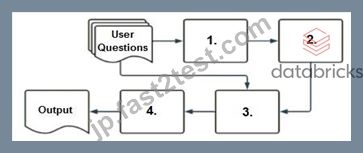
Select the correct sequence of components a user's questions will go through before the final output is returned. Use the diagram above for reference.
- A. 1.response-generating LLM, 2.context-augmented prompt, 3.vector search, 4.embedding model
- B. 1.response-generating LLM, 2.vector search, 3.context-augmented prompt, 4.embedding model
- C. 1.context-augmented prompt, 2.vector search, 3.embedding model, 4.response-generating LLM
- D. 1.embedding model, 2.vector search, 3.context-augmented prompt, 4.response-generating LLM
正解:D
解説:
To understand how a typical RAG-enabled customer-facing chatbot processes a user's question, let's go through the correct sequence as depicted in the diagram and explained in option A:
Embedding Model (1):
The first step involves the user's question being processed through an embedding model. This model converts the text into a vector format that numerically represents the text. This step is essential for allowing the subsequent vector search to operate effectively.
Vector Search (2):
The vectors generated by the embedding model are then used in a vector search mechanism. This search identifies the most relevant documents or previously answered questions that are stored in a vector format in a database.
Context-Augmented Prompt (3):
The information retrieved from the vector search is used to create a context-augmented prompt. This step involves enhancing the basic user query with additional relevant information gathered to ensure the generated response is as accurate and informative as possible.
Response-Generating LLM (4):
Finally, the context-augmented prompt is fed into a response-generating large language model (LLM). This LLM uses the prompt to generate a coherent and contextually appropriate answer, which is then delivered as the final output to the user.
Why Other Options Are Less Suitable:
B, C, D: These options suggest incorrect sequences that do not align with how a RAG system typically processes queries. They misplace the role of embedding models, vector search, and response generation in an order that would not facilitate effective information retrieval and response generation.
Thus, the correct sequence is embedding model, vector search, context-augmented prompt, response-generating LLM, which is option A.
質問 # 51
A Generative Al Engineer is responsible for developing a chatbot to enable their company's internal HelpDesk Call Center team to more quickly find related tickets and provide resolution. While creating the GenAI application work breakdown tasks for this project, they realize they need to start planning which data sources (either Unity Catalog volume or Delta table) they could choose for this application. They have collected several candidate data sources for consideration:
call_rep_history: a Delta table with primary keys representative_id, call_id. This table is maintained to calculate representatives' call resolution from fields call_duration and call start_time.
transcript Volume: a Unity Catalog Volume of all recordings as a *.wav files, but also a text transcript as *.txt files.
call_cust_history: a Delta table with primary keys customer_id, cal1_id. This table is maintained to calculate how much internal customers use the HelpDesk to make sure that the charge back model is consistent with actual service use.
call_detail: a Delta table that includes a snapshot of all call details updated hourly. It includes root_cause and resolution fields, but those fields may be empty for calls that are still active.
maintenance_schedule - a Delta table that includes a listing of both HelpDesk application outages as well as planned upcoming maintenance downtimes.
They need sources that could add context to best identify ticket root cause and resolution.
Which TWO sources do that? (Choose two.)
- A. call_detail
- B. transcript Volume
- C. call_cust_history
- D. maintenance_schedule
- E. call_rep_history
正解:A、B
解説:
In the context of developing a chatbot for a company's internal HelpDesk Call Center, the key is to select data sources that provide the most contextual and detailed information about the issues being addressed. This includes identifying the root cause and suggesting resolutions. The two most appropriate sources from the list are:
* Call Detail (Option D):
* Contents: This Delta table includes a snapshot of all call details updated hourly, featuring essential fields like root_cause and resolution.
* Relevance: The inclusion of root_cause and resolution fields makes this source particularly valuable, as it directly contains the information necessary to understand and resolve the issues discussed in the calls. Even if some records are incomplete, the data provided is crucial for a chatbot aimed at speeding up resolution identification.
* Transcript Volume (Option E):
* Contents: This Unity Catalog Volume contains recordings in .wav format and text transcripts in .txt files.
* Relevance: The text transcripts of call recordings can provide in-depth context that the chatbot can analyze to understand the nuances of each issue. The chatbot can use natural language processing techniques to extract themes, identify problems, and suggest resolutions based on previous similar interactions documented in the transcripts.
Why Other Options Are Less Suitable:
* A (Call Cust History): While it provides insights into customer interactions with the HelpDesk, it focuses more on the usage metrics rather than the content of the calls or the issues discussed.
* B (Maintenance Schedule): This data is useful for understanding when services may not be available but does not contribute directly to resolving user issues or identifying root causes.
* C (Call Rep History): Though it offers data on call durations and start times, which could help in assessing performance, it lacks direct information on the issues being resolved.
Therefore, Call Detail and Transcript Volume are the most relevant data sources for a chatbot designed to assist with identifying and resolving issues in a HelpDesk Call Center setting, as they provide direct and contextual information related to customer issues.
質問 # 52
A Generative AI Engineer is creating an LLM-powered application that will need access to up-to-date news articles and stock prices.
The design requires the use of stock prices which are stored in Delta tables and finding the latest relevant news articles by searching the internet.
How should the Generative AI Engineer architect their LLM system?
- A. Use an LLM to summarize the latest news articles and lookup stock tickers from the summaries to find stock prices.
- B. Download and store news articles and stock price information in a vector store. Use a RAG architecture to retrieve and generate at runtime.
- C. Query the Delta table for volatile stock prices and use an LLM to generate a search query to investigate potential causes of the stock volatility.
- D. Create an agent with tools for SQL querying of Delta tables and web searching, provide retrieved values to an LLM for generation of response.
正解:D
解説:
To build an LLM-powered system that accesses up-to-date news articles and stock prices, the best approach is to create an agent that has access to specific tools (option D).
Agent with SQL and Web Search Capabilities:
By using an agent-based architecture, the LLM can interact with external tools. The agent can query Delta tables (for up-to-date stock prices) via SQL and perform web searches to retrieve the latest news articles. This modular approach ensures the system can access both structured (stock prices) and unstructured (news) data sources dynamically.
Why This Approach Works:
SQL Queries for Stock Prices: Delta tables store stock prices, which the agent can query directly for the latest data.
Web Search for News: For news articles, the agent can generate search queries and retrieve the most relevant and recent articles, then pass them to the LLM for processing.
Why Other Options Are Less Suitable:
A (Summarizing News for Stock Prices): This convoluted approach would not ensure accuracy when retrieving stock prices, which are already structured and stored in Delta tables.
B (Stock Price Volatility Queries): While this could retrieve relevant information, it doesn't address how to obtain the most up-to-date news articles.
C (Vector Store): Storing news articles and stock prices in a vector store might not capture the real-time nature of stock data and news updates, as it relies on pre-existing data rather than dynamic querying.
Thus, using an agent with access to both SQL for querying stock prices and web search for retrieving news articles is the best approach for ensuring up-to-date and accurate responses.
質問 # 53
What is an effective method to preprocess prompts using custom code before sending them to an LLM?
- A. Write a MLflow PyFunc model that has a separate function to process the prompts
- B. It is better not to introduce custom code to preprocess prompts as the LLM has not been trained with examples of the preprocessed prompts
- C. Rather than preprocessing prompts, it's more effective to postprocess the LLM outputs to align the outputs to desired outcomes
- D. Directly modify the LLM's internal architecture to include preprocessing steps
正解:A
解説:
The most effective way to preprocess prompts using custom code is to write a custom model, such as an MLflow PyFunc model. Here's a breakdown of why this is the correct approach:
* MLflow PyFunc Models:MLflow is a widely used platform for managing the machine learning lifecycle, including experimentation, reproducibility, and deployment. APyFuncmodel is a generic Python function model that can implement custom logic, which includes preprocessing prompts.
* Preprocessing Prompts:Preprocessing could include various tasks like cleaning up the user input, formatting it according to specific rules, or augmenting it with additional context before passing it to the LLM. Writing this preprocessing as part of a PyFunc model allows the custom code to be managed, tested, and deployed easily.
* Modular and Reusable:By separating the preprocessing logic into a PyFunc model, the system becomes modular, making it easier to maintain and update without needing to modify the core LLM or retrain it.
* Why Other Options Are Less Suitable:
* A (Modify LLM's Internal Architecture): Directly modifying the LLM's architecture is highly impractical and can disrupt the model's performance. LLMs are typically treated as black-box models for tasks like prompt processing.
* B (Avoid Custom Code): While it's true that LLMs haven't been explicitly trained with preprocessed prompts, preprocessing can still improve clarity and alignment with desired input formats without confusing the model.
* C (Postprocessing Outputs): While postprocessing the output can be useful, it doesn't address the need for clean and well-formatted inputs, which directly affect the quality of the model's responses.
Thus, using an MLflow PyFunc model allows for flexible and controlled preprocessing of prompts in a scalable way, making it the most effective method.
質問 # 54
A Generative AI Engineer I using the code below to test setting up a vector store: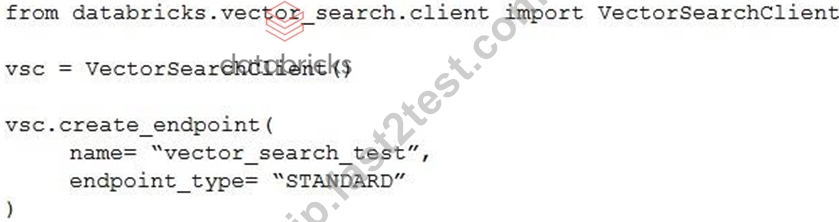
Assuming they intend to use Databricks managed embeddings with the default embedding model, what should be the next logical function call?
- A. vsc.create_delta_sync_index()
- B. vsc.similarity_search()
- C. vsc.create_direct_access_index()
- D. vsc.get_index()
正解:A
解説:
* Context: The Generative AI Engineer is setting up a vector store using Databricks' VectorSearchClient. This is typically done to enable fast and efficient retrieval of vectorized data for tasks like similarity searches.
* Explanation of Options:
Option A: vsc.get_index(): This function would be used to retrieve an existing index, not create one, so it would not be the logical next step immediately after creating an endpoint.
Option B: vsc.create_delta_sync_index(): After setting up a vector store endpoint, creating an index is necessary to start populating and organizing the data. The create_delta_sync_index() function specifically creates an index that synchronizes with a Delta table, allowing automatic updates as the data changes. This is likely the most appropriate choice if the engineer plans to use dynamic data that is updated over time.
Option C: vsc.create_direct_access_index(): This function would create an index that directly accesses the data without synchronization. While also a valid approach, it's less likely to be the next logical step if the default setup (typically accommodating changes) is intended.
Option D: vsc.similarity_search(): This function would be used to perform searches on an existing index; however, an index needs to be created and populated with data before any search can be conducted.
Given the typical workflow in setting up a vector store, the next step after creating an endpoint is to establish an index, particularly one that synchronizes with ongoing data updates, hence Option B.
質問 # 55
A Generative AI Engineer is developing an LLM application that users can use to generate personalized birthday poems based on their names.
Which technique would be most effective in safeguarding the application, given the potential for malicious user inputs?
- A. Increase the amount of compute that powers the LLM to process input faster
- B. Reduce the time that the users can interact with the LLM
- C. Ask the LLM to remind the user that the input is malicious but continue the conversation with the user
- D. Implement a safety filter that detects any harmful inputs and ask the LLM to respond that it is unable to assist
正解:D
解説:
In this case, the Generative AI Engineer is developing an application to generate personalized birthday poems, but there's a need to safeguard against malicious user inputs. The best solution is to implement a safety filter (option A) to detect harmful or inappropriate inputs.
Safety Filter Implementation:
Safety filters are essential for screening user input and preventing inappropriate content from being processed by the LLM. These filters can scan inputs for harmful language, offensive terms, or malicious content and intervene before the prompt is passed to the LLM.
Graceful Handling of Harmful Inputs:
Once the safety filter detects harmful content, the system can provide a message to the user, such as "I'm unable to assist with this request," instead of processing or responding to malicious input. This protects the system from generating harmful content and ensures a controlled interaction environment.
Why Other Options Are Less Suitable:
B (Reduce Interaction Time): Reducing the interaction time won't prevent malicious inputs from being entered.
C (Continue the Conversation): While it's possible to acknowledge malicious input, it is not safe to continue the conversation with harmful content. This could lead to legal or reputational risks.
D (Increase Compute Power): Adding more compute doesn't address the issue of harmful content and would only speed up processing without resolving safety concerns.
Therefore, implementing a safety filter that blocks harmful inputs is the most effective technique for safeguarding the application.
質問 # 56
A Generative Al Engineer is ready to deploy an LLM application written using Foundation Model APIs. They want to follow security best practices for production scenarios Which authentication method should they choose?
- A. Use OAuth machine-to-machine authentication
- B. Use an access token belonging to any workspace user
- C. Use a frequently rotated access token belonging to either a workspace user or a service principal
- D. Use an access token belonging to service principals
正解:D
解説:
The task is to deploy an LLM application using Foundation Model APIs in a production environment while adhering to security best practices. Authentication is critical for securing access to Databricks resources, such as the Foundation Model API. Let's evaluate the options based on Databricks' security guidelines for production scenarios.
* Option A: Use an access token belonging to service principals
* Service principals are non-human identities designed for automated workflows and applications in Databricks. Using an access token tied to a service principal ensures that the authentication is scoped to the application, follows least-privilege principles (via role-based access control), and avoids reliance on individual user credentials. This is a security best practice for production deployments.
* Databricks Reference:"For production applications, use service principals with access tokens to authenticate securely, avoiding user-specific credentials"("Databricks Security Best Practices,"
2023). Additionally, the "Foundation Model API Documentation" states:"Service principal tokens are recommended for programmatic access to Foundation Model APIs."
* Option B: Use a frequently rotated access token belonging to either a workspace user or a service principal
* Frequent rotation enhances security by limiting token exposure, but tying the token to a workspace user introduces risks (e.g., user account changes, broader permissions). Including both user and service principal options dilutes the focus on application-specific security, making this less ideal than a service-principal-only approach. It also adds operational overhead without clear benefits over Option A.
* Databricks Reference:"While token rotation is a good practice, service principals are preferred over user accounts for application authentication"("Managing Tokens in Databricks," 2023).
* Option C: Use OAuth machine-to-machine authentication
* OAuth M2M (e.g., client credentials flow) is a secure method for application-to-service communication, often using service principals under the hood. However, Databricks' Foundation Model API primarily supports personal access tokens (PATs) or service principal tokens over full OAuth flows for simplicity in production setups. OAuth M2M adds complexity (e.g., managing refresh tokens) without a clear advantage in this context.
* Databricks Reference:"OAuth is supported in Databricks, but service principal tokens are simpler and sufficient for most API-based workloads"("Databricks Authentication Guide," 2023).
* Option D: Use an access token belonging to any workspace user
* Using a user's access token ties the application to an individual's identity, violating security best practices. It risks exposure if the user leaves, changes roles, or has overly broad permissions, and it's not scalable or auditable for production.
* Databricks Reference:"Avoid using personal user tokens for production applications due to security and governance concerns"("Databricks Security Best Practices," 2023).
Conclusion: Option A is the best choice, as it uses a service principal's access token, aligning with Databricks' security best practices for production LLM applications. It ensures secure, application-specific authentication with minimal complexity, as explicitly recommended for Foundation Model API deployments.
質問 # 57
......
Databricks-Generative-AI-Engineer-Associate問題集100合保証には最新のサンプル:https://jp.fast2test.com/Databricks-Generative-AI-Engineer-Associate-premium-file.html
準備Databricks-Generative-AI-Engineer-Associate問題解答無料更新には100%試験合格保証 [2026年更新]:https://drive.google.com/open?id=1aZKNRlevyh2AAurg-OW0xl45mYQzZ8gh