

初心者向けのCKAD試験 [2024] 問題集でLinux FoundationのPDF問題
CKADプレミアム試験エンジンPDFをダウンロード
質問 # 16
Exhibit:
Context
You have been tasked with scaling an existing deployment for availability, and creating a service to expose the deployment within your infrastructure.
Task
Start with the deployment named kdsn00101-deployment which has already been deployed to the namespace kdsn00101 . Edit it to:
* Add the func=webFrontEnd key/value label to the pod template metadata to identify the pod for the service definition
* Have 4 replicas
Next, create ana deploy in namespace kdsn00l01 a service that accomplishes the following:
* Exposes the service on TCP port 8080
* is mapped to me pods defined by the specification of kdsn00l01-deployment
* Is of type NodePort
* Has a name of cherry
- A. Solution:


- B. Solution:
正解:A
質問 # 17
Refer to Exhibit.
Task:
1) First update the Deployment cka00017-deployment in the ckad00017 namespace:
*To run 2 replicas of the pod
*Add the following label on the pod:
Role userUI
2) Next, Create a NodePort Service named cherry in the ckad00017 nmespace exposing the ckad00017-deployment Deployment on TCP port 8888
正解:
解説:
Solution:


質問 # 18 
Task
You are required to create a pod that requests a certain amount of CPU and memory, so it gets scheduled to-a node that has those resources available.
* Create a pod named nginx-resources in the pod-resources namespace that requests a minimum of 200m CPU and 1Gi memory for its container
* The pod should use the nginx image
* The pod-resources namespace has already been created
正解:
解説:
See the solution below.
Explanation
Solution:


質問 # 19
Context
Task
Create a new deployment for running.nginx with the following parameters;
* Run the deployment in the kdpd00201 namespace. The namespace has already been created
* Name the deployment frontend and configure with 4 replicas
* Configure the pod with a container image of lfccncf/nginx:1.13.7
* Set an environment variable of NGINX__PORT=8080 and also expose that port for the container above
正解:
解説:
Solution:


質問 # 20
Refer to Exhibit.
Set Configuration Context:
[student@node-1] $ | kubectl
Config use-context k8s
Context
A container within the poller pod is hard-coded to connect the nginxsvc service on port 90 . As this port changes to 5050 an additional container needs to be added to the poller pod which adapts the container to connect to this new port. This should be realized as an ambassador container within the pod.
Task
* Update the nginxsvc service to serve on port 5050.
* Add an HAproxy container named haproxy bound to port 90 to the poller pod and deploy the enhanced pod. Use the image haproxy and inject the configuration located at /opt/KDMC00101/haproxy.cfg, with a ConfigMap named haproxy-config, mounted into the container so that haproxy.cfg is available at /usr/local/etc/haproxy/haproxy.cfg. Ensure that you update the args of the poller container to connect to localhost instead of nginxsvc so that the connection is correctly proxied to the new service endpoint. You must not modify the port of the endpoint in poller's args . The spec file used to create the initial poller pod is available in /opt/KDMC00101/poller.yaml
正解:
解説:
Solution:
To update the nginxsvc service to serve on port 5050, you will need to edit the service's definition yaml file. You can use the kubectl edit command to edit the service in place.
kubectl edit svc nginxsvc
This will open the service definition yaml file in your default editor. Change the targetPort of the service to 5050 and save the file.
To add an HAproxy container named haproxy bound to port 90 to the poller pod, you will need to edit the pod's definition yaml file located at /opt/KDMC00101/poller.yaml.
You can add a new container to the pod's definition yaml file, with the following configuration:
containers:
- name: haproxy
image: haproxy
ports:
- containerPort: 90
volumeMounts:
- name: haproxy-config
mountPath: /usr/local/etc/haproxy/haproxy.cfg
subPath: haproxy.cfg
args: ["haproxy", "-f", "/usr/local/etc/haproxy/haproxy.cfg"]
This will add the HAproxy container to the pod and configure it to listen on port 90. It will also mount the ConfigMap haproxy-config to the container, so that haproxy.cfg is available at /usr/local/etc/haproxy/haproxy.cfg.
To inject the configuration located at /opt/KDMC00101/haproxy.cfg to the container, you will need to create a ConfigMap using the following command:
kubectl create configmap haproxy-config --from-file=/opt/KDMC00101/haproxy.cfg You will also need to update the args of the poller container so that it connects to localhost instead of nginxsvc. You can do this by editing the pod's definition yaml file and changing the args field to args: ["poller","--host=localhost"].
Once you have made these changes, you can deploy the updated pod to the cluster by running the following command:
kubectl apply -f /opt/KDMC00101/poller.yaml
This will deploy the enhanced pod with the HAproxy container to the cluster. The HAproxy container will listen on port 90 and proxy connections to the nginxsvc service on port 5050. The poller container will connect to localhost instead of nginxsvc, so that the connection is correctly proxied to the new service endpoint.
Please note that, this is a basic example and you may need to tweak the haproxy.cfg file and the args based on your use case.
質問 # 21 
Context
You are tasked to create a secret and consume the secret in a pod using environment variables as follow:
Task
* Create a secret named another-secret with a key/value pair; key1/value4
* Start an nginx pod named nginx-secret using container image nginx, and add an environment variable exposing the value of the secret key key 1, using COOL_VARIABLE as the name for the environment variable inside the pod See the solution below.
正解:
解説:
Explanation
Solution:


質問 # 22 
Context
Your application's namespace requires a specific service account to be used.
Task
Update the app-a deployment in the production namespace to run as the restrictedservice service account. The service account has already been created.
正解:
解説:
See the solution below.
Explanation
Solution:
質問 # 23 
Task:
Modify the existing Deployment named broker-deployment running in namespace quetzal so that its containers.
1) Run with user ID 30000 and
2) Privilege escalation is forbidden
The broker-deployment is manifest file can be found at:
正解:
解説:
See the solution below.
Explanation
Solution:
Text Description automatically generated

質問 # 24
Refer to Exhibit.
Context
It is always useful to look at the resources your applications are consuming in a cluster.
Task
* From the pods running in namespace cpu-stress , write the name only of the pod that is consuming the most CPU to file /opt/KDOBG030l/pod.txt, which has already been created.
正解:
解説:
Solution:
質問 # 25
Exhibit:
Context
A web application requires a specific version of redis to be used as a cache.
Task
Create a pod with the following characteristics, and leave it running when complete:
* The pod must run in the web namespace.
The namespace has already been created
* The name of the pod should be cache
* Use the Ifccncf/redis image with the 3.2 tag
* Expose port 6379
- A. Solution:

- B. Solution:

正解:A
質問 # 26
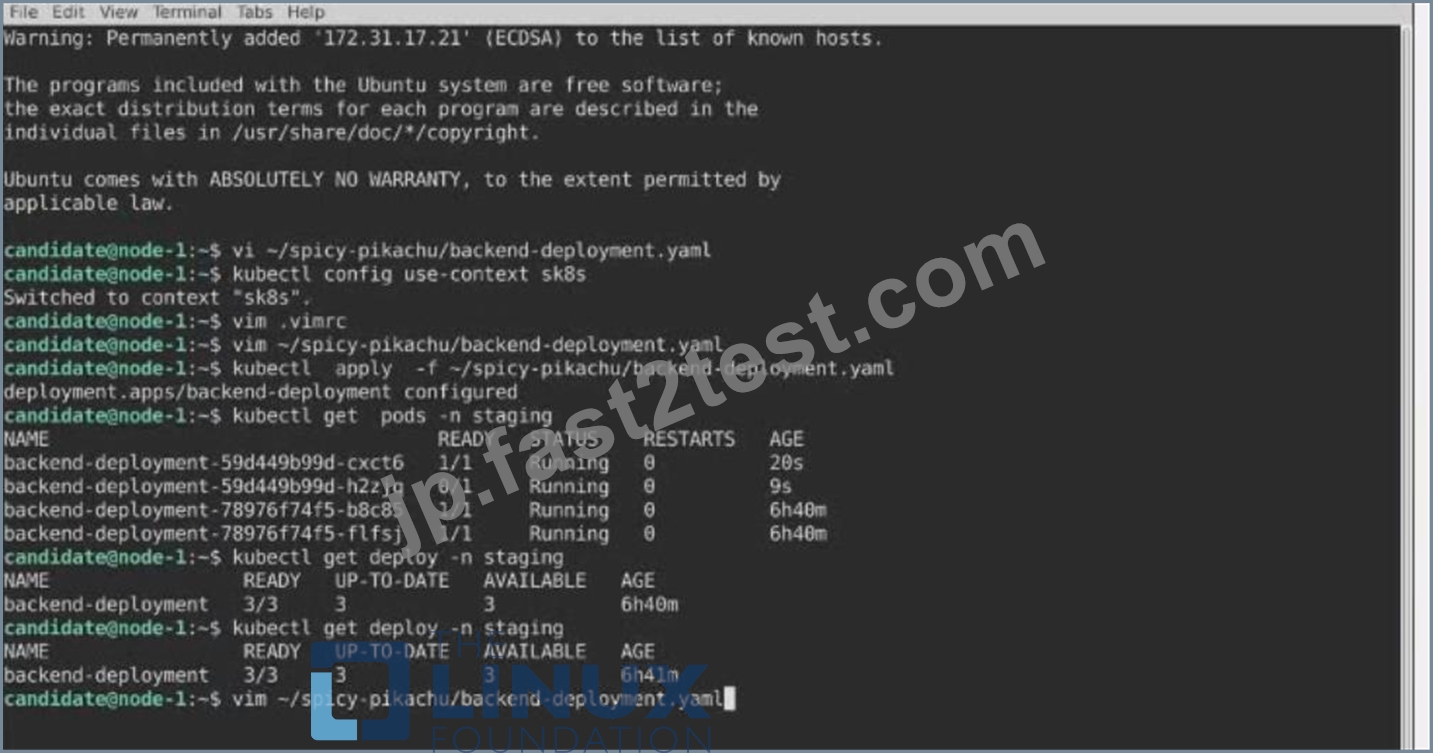
Task
A Deployment named backend-deployment in namespace staging runs a web application on port 8081.
正解:
解説:
See the solution below.
Explanation
Solution:
Text Description automatically generated
質問 # 27
Refer to Exhibit.
Task:
1) Fix any API depreciation issues in the manifest file -/credible-mite/www.yaml so that this application can be deployed on cluster K8s.
2) Deploy the application specified in the updated manifest file -/credible-mite/www.yaml in namespace cobra
正解:
解説:
Solution:


質問 # 28
Context
Task
A deployment is falling on the cluster due to an incorrect image being specified. Locate the deployment, and fix the problem.
正解:
解説:
create deploy hello-deploy --image=nginx --dry-run=client -o yaml > hello-deploy.yaml Update deployment image to nginx:1.17.4: kubectl set image deploy/hello-deploy nginx=nginx:1.17.4
質問 # 29
Context
Task:
Create a Deployment named expose in the existing ckad00014 namespace running 6 replicas of a Pod. Specify a single container using the ifccncf/nginx: 1.13.7 image Add an environment variable named NGINX_PORT with the value 8001 to the container then expose port 8001
正解:
解説:
Solution:


質問 # 30
Exhibit:
Context
Your application's namespace requires a specific service account to be used.
Task
Update the app-a deployment in the production namespace to run as the restrictedservice service account. The service account has already been created.
- A. Solution:

- B. Solution:

正解:A
質問 # 31
Exhibit:
Context
A project that you are working on has a requirement for persistent data to be available.
Task
To facilitate this, perform the following tasks:
* Create a file on node sk8s-node-0 at /opt/KDSP00101/data/index.html with the content Acct=Finance
* Create a PersistentVolume named task-pv-volume using hostPath and allocate 1Gi to it, specifying that the volume is at /opt/KDSP00101/data on the cluster's node. The configuration should specify the access mode of ReadWriteOnce . It should define the StorageClass name exam for the PersistentVolume , which will be used to bind PersistentVolumeClaim requests to this PersistenetVolume.
* Create a PefsissentVolumeClaim named task-pv-claim that requests a volume of at least 100Mi and specifies an access mode of ReadWriteOnce
* Create a pod that uses the PersistentVolmeClaim as a volume with a label app: my-storage-app mounting the resulting volume to a mountPath /usr/share/nginx/html inside the pod

- A. Solution:


- B. Solution:

正解:B
質問 # 32
Context
Task
You have rolled out a new pod to your infrastructure and now you need to allow it to communicate with the web and storage pods but nothing else. Given the running pod kdsn00201 -newpod edit it to use a network policy that will allow it to send and receive traffic only to and from the web and storage pods.

正解:
解説:
apiVersion: networking.k8s.io/v1
kind: NetworkPolicy
metadata:
name: internal-policy
namespace: default
spec:
podSelector:
matchLabels:
name: internal
policyTypes:
- Egress
- Ingress
ingress:
- {}
egress:
- to:
- podSelector:
matchLabels:
name: mysql
ports:
- protocol: TCP
port: 3306
- to:
- podSelector:
matchLabels:
name: payroll
ports:
- protocol: TCP
port: 8080
- ports:
- port: 53
protocol: UDP
- port: 53
protocol: TCP
質問 # 33
Context
Context
Your application's namespace requires a specific service account to be used.
Task
Update the app-a deployment in the production namespace to run as the restrictedservice service account. The service account has already been created.
正解:
解説:
Solution:
質問 # 34
Context
Context
As a Kubernetes application developer you will often find yourself needing to update a running application.
Task
Please complete the following:
* Update the app deployment in the kdpd00202 namespace with a maxSurge of 5% and a maxUnavailable of 2%
* Perform a rolling update of the web1 deployment, changing the Ifccncf/ngmx image version to 1.13
* Roll back the app deployment to the previous version
正解:
解説:
Solution:


質問 # 35
Exhibit:
Context
Developers occasionally need to submit pods that run periodically.
Task
Follow the steps below to create a pod that will start at a predetermined time and]which runs to completion only once each time it is started:
* Create a YAML formatted Kubernetes manifest /opt/KDPD00301/periodic.yaml that runs the following shell command: date in a single busybox container. The command should run every minute and must complete within 22 seconds or be terminated oy Kubernetes. The Cronjob namp and container name should both be hello
* Create the resource in the above manifest and verify that the job executes successfully at least once
- A. Solution:


- B. Solution:

正解:B
質問 # 36
Refer to Exhibit.
Task:
Modify the existing Deployment named broker-deployment running in namespace quetzal so that its containers.
1) Run with user ID 30000 and
2) Privilege escalation is forbidden
The broker-deployment is manifest file can be found at:
正解:
解説:
Solution:


質問 # 37
Context
Task:
1- Update the Propertunel scaling configuration of the Deployment web1 in the ckad00015 namespace setting maxSurge to 2 and maxUnavailable to 59
2- Update the web1 Deployment to use version tag 1.13.7 for the Ifconf/nginx container image.
3- Perform a rollback of the web1 Deployment to its previous version
正解:
解説:
Solution:


質問 # 38 
Task:
A Dockerfile has been prepared at -/human-stork/build/Dockerfile
1) Using the prepared Dockerfile, build a container image with the name macque and lag 3.0. You may install and use the tool of your choice.
2) Using the tool of your choice export the built container image in OC-format and store it at -/human stork/macque 3.0 tar See the solution below.
正解:
解説:
Explanation
Solution:


質問 # 39
......
あなたを合格させるLinux Foundation試験にはCKAD試験問題集:https://jp.fast2test.com/CKAD-premium-file.html
検証済みCKAD豪華お試しセットリアル試験問題集PDF:https://drive.google.com/open?id=1YHGdZkd7WuWAlMl6oRk5eRZxcJ0_vo_K