

リアルな1Z0-821は100%カバー試験問題をゲット [2023年07月]
問題集まとめ概要は1Z0-821試験問題集はここ
質問 # 73
A user on the system has started a process,but it needs to be terminated.
The process ID was determined as follows:
pgrep userprogram
l5317
The user attempted to terminate the program as follows:
pkill 15317
This command runs without an error message,and the process continues to run.
What is the issue?
- A. You need to run the pkill command with the process name.
- B. You need to run the ps command to get more information.
- C. You need to run the prstat command to get more information.
- D. You need to switch to super user to kill the process.
正解:D
解説:
You can use the pgrep and pkill commands to identify and stop command processes that you no longer want to run. These commands are useful when you mistakenly start a process that takes a long time to run.
To terminate a process:
Type pgrep to find out the PID(s) for the process(es).
Type pkill followed by the PID(s).
You can kill any process that you own. Superuser can kill any process in the system except for those processes with process IDs of 0,1,2,3,and 4. Killing these processes most likely will crash the system.
質問 # 74
User jack logs in to host solar in and issues the following command:
jack@solaris:-$ ls .ssh id_dsa id_dsa.pub id_rsa id_rsa.pub known_hosts authorized_keys Which two are true?
- A. The id_rsa.pub file contains the Rivest Shamir Adelman public key for the host solaris.
- B. The id_rsa file contains the private key for rhosts-based host authentication.
- C. The id_dsa.pub file contains the Digital Signature Algorithm public key for the user jack.
- D. The authorized_keys file contains the private keys of remote users authorized to access jack's account on solaris.
- E. The known_hosts file contains the verified public keys of remote hosts known to be trusted.
正解:B、E
解説:
A: You will see two files starting with id_rsa. id_rsa is the private key and id_rsa.pub is public key.
E: The .ssh/known_hosts file
In order to use public-key secure connection with other hosts (ssh,scp,sftp) there is a special directory,~/.ssh/,where passphrases and public keys are stored. Normally you wouldn't need to know the gory details,but from time to time a host will change its public key and then you have difficulty using ssh or scp with that host,and have to edit a file named known_hosts. If you try to ssh to another computer,but get an error message that warns about a changed or incorrect public key,then it is probably just a case of that host changing its public key. (It is possible,though usually not the case,that malicious hacking is involved.) Unless you actually suspect hacker involvement,you can edit the file ~/.ssh/known_hosts using your usual text editor (vi,emacs,nedit,or pico) and delete any line with the name of that host.
Then when you try to ssh that host again,it will be like the first time ever; ssh will ask you if you want to accept a new public key,you type the whole word yes,and everything will proceed normally from there.
Here is what a typical ~/.ssh/known_hosts file might contain. Note that newton is represented on two different lines:
newton 1024 35 153438062610297067329638677441205712613292203533062535600064224677647442 245028855505387934431717435134842994423656065076260604296084868001730665 553662299156116414854701274715680961503198280525759778667306417179500370 189017139564144825610347509023078143132936185076849630461827976942220442 313116255293297021841 ucsub 1024 37 132170811640421742212085598383135714069016332111955003414250071326834884 018721183646445780180633494496866895830879394309011412231102757022090299 732775466435482517698989962531081214859205054227533597152962802400251809 883548442498002326460312850336779152617243800769119880843882425555806081 435017335194477605333 simpson 1024 41 840896920592494584403453622735282634536002054701576247765078766974814128 393752943151071629834843909016027026612791643752972116459602750267266908 365259665072736159491719667576217171370458928680504368847255632477925660 234893185547218857655484574619075125368470792976275806263534208879722192 77539015703446529603 newton,128.138.249.8 ssh-rsa AAAAB3NzaC1yc2EAAAABIwAAAIEA0d7Aoure0toNJ+YMYi61QP2ka8m5x5ZQlT7obP8C K3eropfqsMPPY6uiyIh9vpiFX2r1LHcbx139+vG6HOtVvuS8+IfMDtawm3WQvRuOopz3vVy 5GtMwtaOgehsXoT930Ryev1bH5myPtWKlipITsOd2sX9k3tvjrmme4KCGGss=
質問 # 75
You are installing the Oracle Solaris 11 Operating System by using the Text Installer.
Which two options describe the features associated with the Text Installer?
- A. You can do both automatic and manual configuration of the network.
- B. It installs gnome as the default user environment on a system capable of displaying a graphical environment.
- C. You can select how to configure the remaining network interfaces.
- D. It can be used to install only SPARC systems.
- E. You can choose whether root is a role or user account.
正解:A、E
質問 # 76
You have been asked to troubleshoot the initial configuration of a virtual network connecting two local zones with the outside world.
View the exhibit.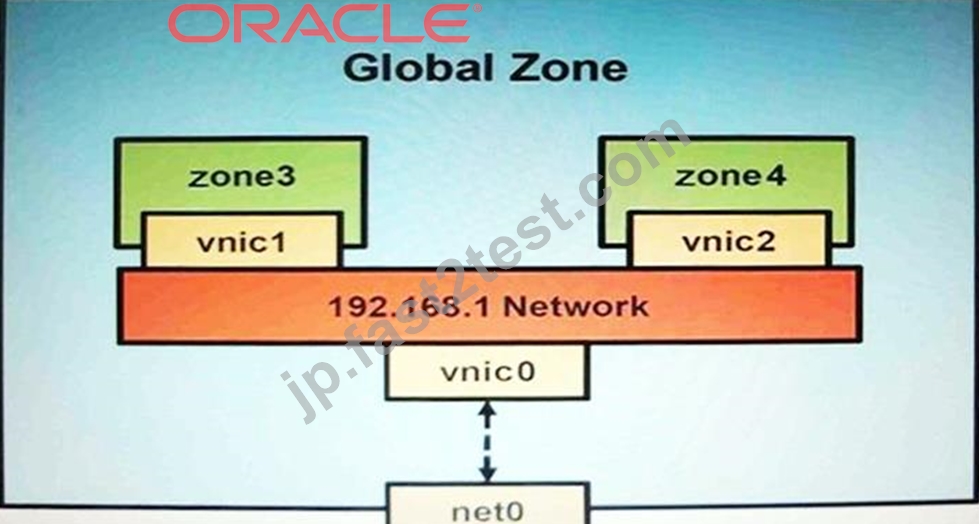
The command
dladm create-vnic -1 vswitch192.168.1 vnic1
fails with the error
dladm: invalid link name 'vswitch192.168.1'
What is the reason for this error?
- A. The zone must be specified withdladm create-vnic -z zone3 vnic1.
- B. The name vswitch192.168.1 is not legal.
- C. The virtual interface must be created withipadm create-vnic -1 switch192.168.1.
- D. The virtual interface must be specified withdladm create-vnic -z zone3 vnic1.
- E. The virtual switch must be created first withdladm create -etherstub vswitch192.168.1.
正解:E
解説:
There is no data-link named vswitch192.168.
We need to create an etherstub first.
See Note and example below for details.
Note: Create a VNIC in the system's global zone.
# dladm create-vnic -l data-link vnic-name
data-link is the name of the interface where the VNIC is to be configured.
-l link, --link=link
link can be a physical link or an etherstub.
vnic-name is the name that you want to give the VNIC.
For example, to create a VNIC named vnic0 on interface e1000g0, you would type the following:
# dladm create-vnic -l e1000g0 vnic0
Example: Creating a Virtual Network Without a Physical NIC
First, create an etherstub with name stub1:
# dladm create-etherstub stub1
Create two VNICs with names hello0 and test1 on the etherstub. This operation implicitly creates a virtual switch connecting hello0 and test1.
# dladm create-vnic -l stub1 hello0
# dladm create-vnic -l stub1 test1
質問 # 77
You are currently working in both your home directory and the system directory /tmp. You are switch back and forth with full path names. Which pair of cd commands will provide you with a shortcut to switch between these two locations?
- A. cd * and cd ..
- B. cd ~and cd
- C. cd and cd .
- D. cd~and cd-
正解:D
解説:
In the Bourne Again, C, Korn, TC, and Z shells, the tilde (~) is used as a shortcut for
specifying your home directory.
cd -
It's the command-line equivalent of the back button (takes you to the previous directory you were
in).
Note:
To make certain that you are in your home directory, type the cd (change directory) command.
This command moves you to your home (default) directory.
Reference: Changing the Working Directory (cd)
質問 # 78
After installing the OS, the following network configuration information is displayed from the system:
Which option describes the state of this server?
- A. The manual network configuration option was chosen during the installation of the OS.
- B. The network was not configured during the installation of the OS.
- C. The network interface is configured with a static IP address.
- D. The automatic network configuration option was chosen during the installation of the OS.
正解:B
解説:
Explanation/Reference:
Explanation:
Only the loopback addresses are configured. No IP address is configured.
質問 # 79
Select the two statements that correctly describe the operation of NWAM.
- A. NWAM stores profile information in /etc/ipadm/ipadm.conf and /etc/dladm/datalink.conf.
- B. Multiple locations may be automatically activated in systems with multiple network interface cards.
- C. If a location is explicitly enabled, it remains active until explicitly changed.
- D. If the DefaultFixed NCP is enabled, persistent configuration, stored in /etc/ipadm.conf and /etc/dladm/datalink.conf is used.
- E. Wireless security keys can be configured by using the nwammgr command.
- F. Interface NCU Properties "float" and are automatically attached to the highest priority Link NCU Property.
正解:B、C
解説:
A: Conditional and system locations can be manually activated, which means that the location remains active until explicitly disabled.
D: A location comprises certain elements of a network configuration, for example a name service and firewall settings, that are applied together, when required. You can create multiple locations for various uses. For example, one location can be used when you are connected at the office by using the company intranet. Another location can be used at home when you are connected to the public Internet by using a wireless access point. Locations can be activated manually or automatically, according to environmental conditions, such as the IP address that is obtained by a network connection.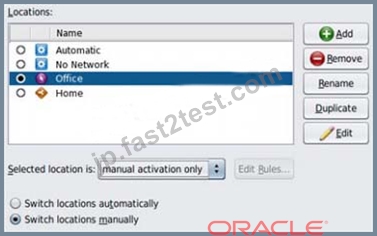
Reference: Oracle Solaris Administration: Network Interfaces and NetworkVirtualization, Activating and Deactivating Profiles
Reference: Oracle Solaris Administration: Network Interfaces and NetworkVirtualization,Creating and Managing Locations
質問 # 80
You need to install the gzip software package on your system. Which command would you use to find the software package in the configured repository?
- A. yumlistgzip
- B. pkginfogzip
- C. pkgsearchgzip
- D. pkginfogzip
- E. pkgcontentsgzip
正解:C
解説:
Use the pkg search command to search for packages whose data matches the
specified pattern.
Like the pkg contents command, the pkg search command examines the contents of packages.
While the pkg contents command returns the contents, the pkg search command returns the
names of packages that match the query.
Reference: Oracle Solaris 11 Information Library, Searching for Packages
質問 # 81
A user account must be a member of a primary group, and may also be a member of one or more secondary groups. What is the maximum total number of groups that one user can concurrently belong to?
- A. 0
- B. 1
- C. 2
- D. 3
- E. The number of groups one user can concurrently belong to is unlimited in Solaris 11.
- F. 4
- G. 5
正解:C
解説:
Each user belongs to a group that is referred to as the user's primary group. The GID number, located in the user's account entry within the /etc/passwd file, specifies the user's primary group.
Each user can also belong to up to 15 additional groups, known as secondary groups. In the /etc/group file, you can add users to group entries, thus establishing the user's secondary group affiliations.
Note (4 PSARC/2009/542):
his project proposes changing the maximum value for NGROUPS_MAX from 32 to 1024 by changing the definition of NGROUPS_UMAX from 32 to 1024.
The use for a larger number of groups is described in CR 4088757, particular in the case of Samba servers and ADS clients; the Samba servers map every SID to a Unix group. Users with more than 32 groups SIDs are common. We've seen reports varying from "64 is enough", "128 is absolutely enough" and "we've users with more 190 group SIDS).
NGROUPS_MAX as defined by different Unix versions are as follows
(http://www.j3e.de/ngroups.html):
Linux Kernel >= 2.6.3 65536
Linux Kernel < 2.6.3 32
Tru64 / OSF/1 32
IBM AIX 5.2 64
IBM AIX 5.3 ... 6.1 128
OpenBSD, NetBSD, FreeBSD, Darwin (Mac OS X) 16
Sun Solaris 7, 8, 9, 10 16 (can vary from 0-32)
HP-UX 20
IRIX 16 (can vary from 0-32)
Plan 9 from Bell Labs 32
Minix 3 0 (Minix-vmd: 16)
QNX 6.4 8
質問 # 82
_________ serves as the interface between the SMF repository and the user to ensure that a consistent, picture of the repository is presented to the user.
- A. svc.startd
- B. svc.configd
- C. repository.db
- D. service manifest
正解:B
解説:
SVC.CONFIGD is the repository daemon responsible for maintaining /etc/svc/repository.db.
The repository.db must come clean during this integrity check otherwise it is a "no go" for usual boot sequence to run level 3. The repository may get corrupted due to various hardware issues, software bugs, disk write failures, etc.
Note: When svc.configd(1M), the Solaris Repository Daemon, is started, it does an integrity check of the smf(5) repository, stored in /etc/svc/repository.db. This integrity check can fail due to a disk failure, the database file being corrupted either due to a hardware bug, a software bug, or an accidental overwrite. If the integrity check fails, svc.configd will write a message to the console.
質問 # 83
The default publisher on your system is:
You want to update the Oracle Solaris 11 environment on your system, but you are not able to connect this system to the Internet to access the default Oracle repository. A repository has been created on your local network and is named
http://server1.example.com.
Which command would you choose to connect your system to the local repository?
- A. pkg set-publisher to set the origin for the publisher
- B. pkg add-publisher to add the new publisher
- C. pkg publisher to specify the new publisher
- D. pkg set-publisher to set the stickiness on the http://server1.example.com publisher and unset stickiness for http://pkg.oracle.com/solaris/release
正解:A
解説:
Solaris 11 Express makes it pretty easy to set up a local copy of the repository.
A common reason folks need access to a local repository is because their system is not connected to the Internet.
Tthe pkg set-publisher command can be used to for example add a publisher or to enable or disable a publisher.
Note: Example Adding a Publisher
Use the -g option to specify the publisher origin URI.
# pkg set-publisher -g http://pkg.example.com/release example.com
Example Specifying the Preferred Publisher
Use the -P option to specify a publisher as the preferred publisher. The specified publisher moves to the top of the search order. You can specify the -P option when you add a publisher or you can modify an existing publisher.
# pkg set-publisher -P example.com
Example Enabling or Disabling a Publisher
Use the -d option to disable a publisher. The preferred publisher cannot be disabled. A disabled publisher is not used in package operations such as list and install. You can modify the properties of a disabled publishers.
Use the -e option to enable a publisher.
# pkg set-publisher -d example2.com
質問 # 84
United States of America export laws include restrictions on cryptography.
Identify the two methods with which these restrictions are accommodated in the Oracle Solaris 11 Cryptographic Framework.
- A. A third-party provider object must be signed with a certificate issued by Oracle.
- B. Corporations must utilize signed X.509 v3 certificates.
- C. Systems destined for embargoed countries utilize loadable kernel software modules that restrict encryption to 64 bit keys.
- D. Third-party providers must utilize X.509 v3 certificates signed by trusted Root Certification Authorities.
- E. Loadable kernel software modules must register using the Cryptographic Framework SPI.
正解:A、E
解説:
Explanation/Reference:
Explanation:
B: Binary Signatures for Third-Party Software
The elfsign command provides a means to sign providers to be used with the Oracle Solaris Cryptographic Framework. Typically, this command is run by the developer of a provider.
The elfsign command has subcommands to request a certificate from Sun and to sign binaries. Another subcommand verifies the signature. Unsigned binaries cannot be used by the Oracle Solaris Cryptographic Framework. To sign one or more providers requires the certificate from Sun and the private key that was used to request the certificate.
C: Export law in the United States requires that the use of open cryptographic interfaces be restricted. The Oracle Solaris Cryptographic Framework satisfies the current law by requiring that kernel cryptographic providers and PKCS #11 cryptographic providers be signed.
質問 # 85
Given:
file1 and file2 are text files.
dir1 and dir2 are directories.
Which two commands will be successful?
- A. cp file. dir1
- B. cp dir1 file1
- C. cp file? dir1
- D. cp file1 file2 dir1
- E. cp dir1 dir1
- F. cp file% dir2
正解:C、D
解説:
C: Here the wildcard character ? is used (Matches any single character).
file1 and file2 will be copied into dir1
F: the two files file1 and file2 are copied into directoy dir1.
Note: cp - copy files and directories
Copy SOURCE to DEST,or multiple SOURCE(s) to DIRECTORY.
Cp has three principal modes of operation. These modes are inferred from the type and count of arguments presented to the program upon invocation.
*When the program has two arguments of path names to files,the program copies the contents of the first file to the second file,creating the second file if necessary.
*When the program has one or more arguments of path names of files and following those an argument of a path to a directory,then the program copies each source file to the destination directory,creating any files not already existing.
*When the program's arguments are the path names to two directories,cp copies all files in the source directory to the destination directory,creating any files or directories needed. This mode of operation requires an additional option flag,typically r,to indicate the recursive copying of directories. If the destination directory already exists,the source is copied into the destination,while a new directory is created if the destination does not exist.
質問 # 86
zone1 is a non-global zone that has been configured and installed.
zone1 was taken down for maintenance,and the following command was run:
zoneadm -z zone1 mark incomplete
The following information is displayed when listing the zones on your system:
Which task needs to be performed before you can boot zone1?
- A. The zone needs to be uninstalled and reinstalled.
- B. The zone needs to be installed.
- C. The zone needs to be brought to the ready state.
- D. The zone needs to be brought to the complete state.
正解:A
解説:
If administrative changes on the system have rendered a zone unusable or inconsistent,it is
possible to change the state of an installed zone to incomplete.
Marking a zone incomplete is irreversible. The only action that can be taken on a zone
marked incomplete is to uninstall the zone and return it to the configured state.
質問 # 87
The interface net3 should be operating, but is not.
Command:
ipadm show-addr | grep net3
Response:
net3/v4 static down 192.168.0.200/24
Which command should you enter next?
- A. ipadmcreate-ip
- B. ipadmenable-if
- C. ipadm up-addr
- D. ipadmshow-if
正解:B
解説:
enable-if -t interface
Enables the given interface by reading the configuration from the persistent store. All the
persistent interface properties, if any, are applied and all the persistent addresses, if any, on the
given interface will be enabled.
-t, --temporary
Specifies that the enable is temporary and changes apply only to the active configuration.
質問 # 88
In an effort to reduce storage space on your server, you would like to eliminate duplicate copies of data in your server's ZFS file systems.
How do you specify that pool1/data should not contain duplicate data blocks (redundant data) on write operations?
- A. zpool create -o deduplication =on pool1; zfs create pool1/data
- B. zfs create - o dedup=on pool1/data
- C. zfs create - o deduplication=on pool1; zfs create pool1/data
- D. zfs create - o compression=on pool1/data
- E. zfs create - o dedupratio=2 pool1/data
正解:B
解説:
Explanation/Reference:
Explanation:
ZFS Deduplication Property
Solaris Express Community Edition, build 129: In this Solaris release, you can use the deduplication property to remove redundant data from your ZFS file systems. If a file system has the dedup property enabled, duplicate data blocks are removed synchronously. The result is that only unique data is stored and common components are shared between files.
You can enable this property as follows:
# zfs set dedup=on tank/home
質問 # 89
Which files must be edited in order to set up logging of all failed login attempts?
- A. /etc/default/login, /var/adm/loginlog, /etc/syslog.conf
- B. /etc/default/login, /var/adm/authlog, /var/adm/loginlog
- C. /etc/default/login, /var/adm/authlog, /etc/syslog.conf
- D. /var/adm/loginlog, /var/adm/authlog, /etc/syslog.conf
正解:C
解説:
Explanation/Reference:
Explanation:
This procedure captures in a syslog file all failed login attempts.
1. Set up the /etc/default/login file with the desired values for SYSLOG and SYSLOG_FAILED_LOGINS Edit the /etc/default/login file to change the entry. Make sure that SYSLOG=YES is uncommented.
2. Create a file with the correct permissions to hold the logging information.
Create the authlog file in the /var/adm directory.
3. Edit the syslog.conf file to log failed password attempts.
Send the failures to the authlog file.
質問 # 90
Which three statements are true concerning Image Packaging System (IPS) incorporation package?
- A. They are a content management tool and not a version management tool.
- B. Their dependencies are always of TYPE-REQUIRE.
- C. They are defined by their manifest
- D. Installing an incorporation package does not install any other packages.
- E. Every feature or tool has a separate IPS incorporation.
- F. They constrain the versions of packages they incorporate.
正解:B、D、F
質問 # 91
A local repository is available on this system and you need to enable clients to access this repository via HTTP. The repository information is:
PUBLISHERTYPESTATUSURI
solarisoriginonlinehttp://sysA.example.com
Identify two of the steps that are required to make the local repository on this server available to the client via HTTP.
- A. On the server: set the sharefs property on the ZFS file system containing the IPS repository.
- B. On the client: start the pkg.depotd process.
- C. On the client: reset the origin for the solaris publisher.
- D. On the client: set the pkg/inst_root and pkg/readonly properties for the svc:/application/server:default service enable the service.
- E. On the server: set the pkg/inst_root and pkg/readonly properties for the svc:/application/pkg/server:default service and enabled the service
正解:B、E
解説:
A: Configure the Repository Server Service To enable clients to access the local repository via HTTP,enable the application/pkg/server Service Management Facility (SMF) service. # svccfg -s application/pkg/server setprop pkg/inst_root=/export/repoSolaris11 # svccfg -s application/pkg/server setprop pkg/readonly=true
E: Use pkg.depotd to serve the repository to clients. Start the Repository Service Restart the pkg.depotd repository service. # svcadm refresh application/pkg/server # svcadm enable application/pkg/server To check whether the repository server is working,open a browser window on the localhost location.
質問 # 92
A change in your company's security policy now requires an audit trial of all administrators assuming the sysadm role, capturing:
There are two command necessary to accomplish this change. One is a rolemod command. What is the other?
- A. auditconfig set flags=lo, ex sysadm
- B. auditconfig -setflags lo, ex sysadm
- C. auditconfig set policy=argv
- D. auditconfig -setpolicy +argv
正解:D
解説:
Audit Significant Events in Addition to Login/Logout (see step 2 below) Use this procedure to audit administrative commands, attempts to invade the system, and other significant events as specified by your site security policy.
For all users and roles, add the AUE_PFEXEC audit event to their preselection mask.
# usermod -K audit_flags=lo, ps:no username
# rolemod -K audit_flags=lo, ps:no rolename
# auditconfig -setpolicy +argv
3 - Record the environment in which audited commands are executed.
# auditconfig -setpolicy +arge
Note: [-t] -setpolicy [+|-]policy_flag[, policy_flag ...]
Set the kernel audit policy. A policy policy_flag is literal strings that denotes an audit policy.
A prefix of + adds the policies specified to the current audit policies. A prefix of - removes the policies specified from the current audit policies. No policies can be set from a local zone unless the perzone policy is first set from the global zone.
質問 # 93
Review the boot environments displayed on your system:
Which option describes the solaris-1 BE?
- A. It is inactive.
- B. It is active on the next reboot.
- C. It has been removed and will no longer be available after the next reboot.
- D. It is unbootable.
- E. It is active now.
- F. It is active now and on reboot.
正解:F
解説:
In the below output, NR (now running) means the BE is active now and will be the active BE on reboot.
Example:
Display your existing BE information.
# beadm list
BE Active Mountpoint Space Policy Created
-- ------ ---------- ----- ------ -------
solaris NR / 12.24G static 2011-10-04 09:42
質問 # 94
Review the information taken from your server: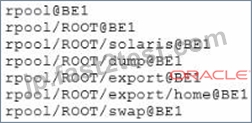
Which option describes the command used to create these snapshots of the root file system?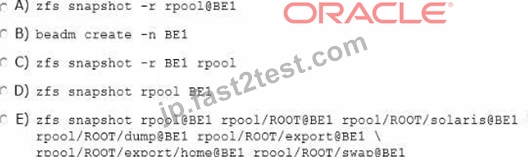
- A. Option D
- B. Option A
- C. Option B
- D. Option C
正解:B
解説:
Explanation/Reference:
Explanation:
zfs snapshot [-r] [-o property=value] ... filesystem@snapname|volume@snapname Creates a snapshot with the given name. All previous modifications by successful system calls to the file system are part of the snapshot. See the "Snapshots" section for details.
-r
Recursively create snapshots of all descendent datasets. Snapshots are taken atomically, so that all recursive snapshots correspond to the same moment in time.
質問 # 95
You are executing this command in the default shell:
sleep 5000 &
The system displays a number. This value is______.
- A. the process group ID that includes the /usr/bin/sleep process
- B. the priority of the /usr/bin/sleep process
- C. the current number of instances of the /usr/bin/sleep process
- D. the process ID of the /usr/bin/sleep process
- E. the process ID of the shell spawned to execute /usr/bin/sleep
- F. the amount of memory allocated to the /usr/bin/sleep process
正解:E
解説:
Explanation/Reference:
Explanation:
If a command is terminated by the control operator '&', the shell executes the command asynchronously in a subshell. This is known as executing the command in the background. The shell does not wait for the command to finish, and the return status is 0 (true).
質問 # 96
......
認定トレーニングは1Z0-821試験問題集テストエンジン:https://jp.fast2test.com/1Z0-821-premium-file.html
1Z0-821トレーニングと認定最新のOracle Solaris問題をゲットせよ:https://drive.google.com/open?id=116A15wWA1p8KLHlLQL57f5NEGoxM5MIY