

100% 高得点合格保証312-50v12日本語無制限573解答で[2024]
312-50v12日本語問題集でPDF、312-50v12日本語最速合格したいならここ
質問 # 64
コンテナのセキュリティが仮想マシンよりも低いのはなぜですか?
- A. コンテナが侵害されると、ホストの CPU 枯渇が発生する可能性があります。
- B. コンテナ上のホスト OS では、表面攻撃が大きくなります。
- C. コンテナがホストのディスク領域をいっぱいにする可能性があります。
- D. コンテナーは同じ仮想ネットワークに接続されます。
正解:B
質問 # 65
次のどれがエクスプロイト フレームワークと見なされ、コンピュータ システムのサービス、ポート、アプリケーション、およびパッチが適用されていないセキュリティ上の欠陥に対して自動攻撃を実行する機能を備えていますか?
- A. マルテゴ
- B. ワイヤーシャーク
- C. メタスプロイト
- D. ネッスス
正解:C
解説:
https://en.wikipedia.org/wiki/Metasploit_Project
The Metasploit Project is a computer security project that provides information about security vulnerabilities and aids in penetration testing and IDS signature development. It is owned by Boston, Massachusetts-based security company Rapid7.
Its best-known sub-project is the open-source Metasploit Framework, a tool for developing and executing exploit code against a remote target machine. Other important sub-projects include the Opcode Database, shellcode archive and related research.
The Metasploit Project includes anti-forensic and evasion tools, some of which are built into the Metasploit Framework. Metasploit is pre-installed in the Kali Linux operating system.
The basic steps for exploiting a system using the Framework include.
1. Optionally checking whether the intended target system is vulnerable to an exploit.
2. Choosing and configuring an exploit (code that enters a target system by taking advantage of one of its bugs; about 900 different exploits for Windows, Unix/Linux and macOS systems are included).
3. Choosing and configuring a payload (code that will be executed on the target system upon successful entry; for instance, a remote shell or a VNC server). Metasploit often recommends a payload that should work.
4. Choosing the encoding technique so that hexadecimal opcodes known as "bad characters" are removed from the payload, these characters will cause the exploit to fail.
5. Executing the exploit.
This modular approach - allowing the combination of any exploit with any payload - is the major advantage of the Framework. It facilitates the tasks of attackers, exploit writers and payload writers.
質問 # 66
フェイスブックの投稿を見ていると、マットは友人の一人が「友達についてもっと知ろう!」というキャプションとともに投稿した写真と、いくつかの個人的な質問を見つけました。疑わしいと思ったマットは友人にテキストメッセージを送り、友人は確かに投稿したことを確認しました。投稿は本物であると確信しました。数日後、マットは投稿の質問に返信しました。友人の銀行口座がアクセスされ、パスワードが変更されていました。
おそらく何が起こったのでしょうか?
- A. Matt は投稿に返信する際に誤ってパスワードを提供してしまいました。
- B. マットのコンピュータがキーロガーに感染しました。
- C. マットの銀行口座のログイン情報がブルートフォース攻撃を受けました。
- D. Matt は投稿に返信する際に、誤ってセキュリティの質問に対する回答を提供してしまいました。
正解:D
質問 # 67
セキュリティ専門家の Abel は、セキュリティの抜け穴がないか確認するために、クライアント組織で侵入テストを実施しています。彼は、偽造された DHCP 要求をブロードキャストして DHCP サーバーに攻撃を仕掛け、DHCP スコープで使用可能なすべての DHCP アドレスを、サーバーが IP アドレスを発行できなくなるまでリースしました。これにより DoS 攻撃が発生し、結果として、正当な従業員がクライアント ネットワークにアクセスできなくなりました。上記のシナリオで Abel が実行した攻撃は次のうちどれですか。
- A. 不正なDHCPサーバー攻撃
- B. VLANホッピング
- C. STP攻撃
- D. DHCP 不足
正解:D
解説:
A DHCP starvation assault is a pernicious computerized assault that objectives DHCP workers. During a DHCP assault, an unfriendly entertainer floods a DHCP worker with false DISCOVER bundles until the DHCP worker debilitates its stock of IP addresses. When that occurs, the aggressor can deny genuine organization clients administration, or even stock an other DHCP association that prompts a Man-in-the-Middle (MITM) assault.
In a DHCP Starvation assault, a threatening entertainer sends a huge load of false DISCOVER parcels until the DHCP worker thinks they've used their accessible pool. Customers searching for IP tends to find that there are no IP addresses for them, and they're refused assistance. Furthermore, they may search for an alternate DHCP worker, one which the unfriendly entertainer may give. What's more, utilizing a threatening or sham IP address, that unfriendly entertainer would now be able to peruse all the traffic that customer sends and gets.
In an unfriendly climate, where we have a malevolent machine running some sort of an instrument like Yersinia, there could be a machine that sends DHCP DISCOVER bundles. This malevolent customer doesn't send a modest bunch - it sends a great many vindictive DISCOVER bundles utilizing sham, made-up MAC addresses as the source MAC address for each solicitation.
In the event that the DHCP worker reacts to every one of these false DHCP DISCOVER parcels, the whole IP address pool could be exhausted, and that DHCP worker could trust it has no more IP delivers to bring to the table to legitimate DHCP demands.
When a DHCP worker has no more IP delivers to bring to the table, ordinarily the following thing to happen would be for the aggressor to get their own DHCP worker. This maverick DHCP worker at that point starts giving out IP addresses.
The advantage of that to the assailant is that if a false DHCP worker is distributing IP addresses, including default DNS and door data, customers who utilize those IP delivers and begin to utilize that default passage would now be able to be directed through the aggressor's machine. That is all that an unfriendly entertainer requires to play out a man-in-the-center (MITM) assault.
質問 # 68
簡易メール転送プロトコル (SMTP) 列挙が成功すると、どのような有用な情報が収集されますか?
- A. 内部コマンド RCPT は、メッセージ トラフィックに対して開いているポートのリストを提供します。
- B. メールボックスがロックされる前の毎日の送信メッセージ制限を表示します
- C. 2 つの内部コマンド VRFY と EXPN は、有効なユーザー、電子メール アドレス、エイリアス、およびメーリング リストの確認を提供します。
- D. 対象ホストが使用するすべてのメールプロキシサーバアドレスのリスト
正解:C
質問 # 69
次のどれがよく知られているパスワードクラッキングプログラムですか?
- A. 切り裂きジャック
- B. NetCat
- C. ネットバス
- D. ロープクラック
- E. ジョン・ザ・リッパー
正解:D、E
質問 # 70
ある組織が、脅威を軽減するために脆弱性評価を行っています。侵入テスターの James は、組織のマシンで見つかったプロトコルのインベントリを作成して組織をスキャンし、電子メール サーバー、Web サーバー、データベース サーバーなどのサービスに接続されているポートを検出しました。サービスを特定した後、各マシンの脆弱性を選択し、関連するテストのみの実行を開始しました。上記のシナリオで James が採用した脆弱性評価ソリューションのタイプは何ですか?
- A. 推論に基づく評価
- B. ツリーベースの評価
- C. サービスベースのソリューション
- D. 製品ベースのソリューション
正解:A
解説:
In an inference-based assessment, scanning starts by building an inventory of the protocols found on the machine. After finding a protocol, the scanning process starts to detect which ports are attached to services, such as an email server, web server, or database server. After finding services, it selects vulnerabilities on each machine and starts to execute only those relevant tests.
質問 # 71
攻撃者ロニーは、組織の境界内に不正なアクセス ポイントを設置し、内部ネットワークへの侵入を試みました。セキュリティ監査人のジョンソンは、認証メカニズムをクラッキングしようとする異常なトラフィックを内部ネットワークで特定しました。彼はすぐに標的のネットワークをオフにし、攻撃を受けやすい脆弱で古いセキュリティ メカニズムがないかどうかをテストしました。上記のシナリオでジョンソンが実行した脆弱性評価の種類は何ですか。
- A. ホストベースの評価
- B. 分散評価
- C. ワイヤレスネットワークの評価
- D. アプリケーションの評価
正解:C
解説:
Wireless network assessment determines the vulnerabilities in an organization's wireless networks. In the past, wireless networks used weak and defective data encryption mechanisms. Now, wireless network standards have evolved, but many networks still use weak and outdated security mechanisms and are open to attack.
Wireless network assessments try to attack wireless authentication mechanisms and gain unauthorized access.
This type of assessment tests wireless networks and identifies rogue networks that may exist within an organization's perimeter. These assessments audit client-specified sites with a wireless network. They sniff wireless network traffic and try to crack encryption keys. Auditors test other network access if they gain access to the wireless network.
Expanding your network capabilities are often done well using wireless networks, but it also can be a source of harm to your data system . Deficiencies in its implementations or configurations can allow tip to be accessed in an unauthorized manner.This makes it imperative to closely monitor your wireless network while also conducting periodic Wireless Network assessment.It identifies flaws and provides an unadulterated view of exactly how vulnerable your systems are to malicious and unauthorized accesses.Identifying misconfigurations and inconsistencies in wireless implementations and rogue access points can improve your security posture and achieve compliance with regulatory frameworks.
質問 # 72
ネットワーク セキュリティ アナリストは、侵入テストを実施しながら、Kerberos 認証プロトコルを使用してサービス アカウントのパスワードを識別しようとしています。アナリストは有効なユーザー認証チケット (TGT) を持っており、Kerberoasting 攻撃を実行することにしました。説明されているシナリオでは、アナリストは次にどの手順を実行する必要がありますか。
- A. インターネットパケットスニファーを使用して受動的なワイヤスニッフィング操作を実行する
- B. PROBABILITY INFINITE CHAINED ELEMES (PRINCE) 攻撃を実行する
- C. Mimikatz などのツールを使用して、プレーンテキストのパスワード、ハッシュ、PIN コード、Kerberos チケットを抽出します。
- D. 対象サービス アカウントのサービス プリンシパル名のサービス チケットを要求します。
正解:D
解説:
A Kerberoasting attack is a technique that exploits the weak encryption of Kerberos service tickets to obtain the password hashes of service accounts that have a Service Principal Name (SPN) associated with them. The attacker can then crack the hashes offline and use the plaintext passwords to impersonate the service accounts and access network resources.
A Kerberoasting attack follows these steps1:
* The attacker impersonates a legitimate Active Directory user and authenticates to the Key Distribution Center (KDC) in the Active Directory environment. They then request a Ticket Granting Ticket (TGT) from the KDC to access network resources. The KDC complies because the attacker is impersonating a legitimate user.
* The attacker enumerates the service accounts that have an SPN using tools like GetUserSPNs.py or PowerView. They then request a service ticket for each SPN from the KDC using their TGT. The KDC grants the service tickets, which are encrypted with the password hashes of the service accounts.
* The attacker captures the service tickets and takes them offline. They then attempt to crack the password hashes using tools like Hashcat or John the Ripper. They can use various methods, such as brute force, dictionary, or hybrid attacks, to guess the passwords. Alternatively, they can use a PRINCE attack, which is a probabilistic password generation technique that combines common words, patterns, and transformations to generate likely passwords2.
* Once the attacker obtains the plaintext passwords of the service accounts, they can use them to authenticate as the service accounts and access the network resources that they are authorized to.
Therefore, the next step that the analyst should take after obtaining a valid TGT is to request a service ticket for the SPN of the target service account. This will allow them to capture the service ticket and extract the password hash of the service account.
References:
* How to Perform Kerberoasting Attacks: The Ultimate Guide - StationX
* PRINCE: PRobability INfinite Chained Elements
質問 # 73
ある組織では、重要なインフラストラクチャの運用を遠隔地から自動化しています。このため、すべての産業用制御システムはインターネットに接続されています。製造プロセスを強化し、産業用ネットワークの信頼性を確保し、ダウンタイムとサービスの中断を減らすために、組織はサイバースパイ、ゼロデイ攻撃、マルウェアなどのセキュリティインシデントからさらに保護する OT セキュリティツールをインストールすることにしました。組織が重要なインフラストラクチャを保護するために採用する必要があるツールは次のうちどれですか。
- A. フロウモン
- B. インテントファザー
- C. バレナクラウド
- D. ロボティウム
正解:A
解説:
Source: https://www.flowmon.com
Flowmon empowers manufacturers and utility companies to ensure the reliability of their industrial networks confidently to avoid downtime and disruption of service continuity. This can be achieved by continuous monitoring and anomaly detection so that malfunctioning devices or security incidents, such as cyber espionage, zero-days, or malware, can be reported and remedied as quickly as possible.
質問 # 74
プロのハッカーであるハリーは、組織の IT インフラストラクチャをターゲットにしています。攻撃の準備を整えた後、彼はスピアフィッシング メールの送信や公開されているサーバーの脆弱性の悪用などの手法を使用して、ターゲット ネットワークへの侵入を試みます。これらの手法を使用して、彼はターゲット システムにマルウェアを展開し、アウトバウンド接続を確立することに成功しました。ハリーが現在実行している APT ライフサイクル フェーズは何ですか。
- A. 永続性
- B. クリーンアップ
- C. 最初の侵入
- D. 準備
正解:D
解説:
After the attacker completes preparations, subsequent step is an effort to realize an edge within the target's environment. a particularly common entry tactic is that the use of spearphishing emails containing an internet link or attachment. Email links usually cause sites where the target's browser and related software are subjected to varied exploit techniques or where the APT actors plan to social engineer information from the victim which will be used later. If a successful exploit takes place, it installs an initial malware payload on the victim's computer. Figure 2 illustrates an example of a spearphishing email that contains an attachment.
Attachments are usually executable malware, a zipper or other archive containing malware, or a malicious Office or Adobe PDF (Portable Document Format) document that exploits vulnerabilities within the victim's applications to ultimately execute malware on the victim's computer. Once the user has opened a malicious file using vulnerable software, malware is executing on the target system. These phishing emails are often very convincing and difficult to differentiate from legitimate email messages. Tactics to extend their believability include modifying legitimate documents from or associated with the organization. Documents are sometimes stolen from the organization or their collaborators during previous exploitation operations. Actors modify the documents by adding exploits and malicious code then send them to the victims. Phishing emails are commonly sent through previously compromised email servers, email accounts at organizations associated with the target or public email services. Emails also can be sent through mail relays with modified email headers to form the messages appear to possess originated from legitimate sources. Exploitation of vulnerabilities on public-facing servers is another favorite technique of some APT groups. Though this will be accomplished using exploits for known vulnerabilities, 0-days are often developed or purchased to be used in intrusions as required .
Gaining an edge within the target environment is that the primary goal of the initial intrusion. Once a system is exploited, the attacker usually places malware on the compromised system and uses it as a jump point or proxy for further actions. Malware placed during the initial intrusion phase is usually an easy downloader, basic Remote Access Trojan or an easy shell. Figure 3 illustrates a newly infected system initiating an outbound connection to notify the APT actor that the initial intrusion attempt was successful which it's able to accept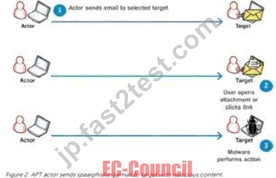
commands.
質問 # 75
あなたは、クラウドベースのサービスを提供する CloudTech Inc. のサイバーセキュリティ専門家です。機密データをパブリック クラウド サービスに移行したいクライアントのプロジェクトを管理しています。規制要件に準拠するために、クライアントは、データがクラウド上に保存されている場合でも、暗号化キーを完全に制御することを要求しています。この要件を満たすには、次のどのプラクティスを実装する必要がありますか。
- A. クラウド サービス プロバイダーの暗号化サービスを使用しますが、キーはオンプレミスに保存します。
- B. クラウドにアップロードする前にクライアント側でデータを暗号化し、暗号化キーの制御を保持します。
- C. クラウド サービス プロバイダーのデフォルトの暗号化およびキー管理サービスを使用します。
- D. 保存データには Secure Sockets Layer (SSL) 暗号化を使用します。
正解:B
解説:
The best practice to meet the client's requirement is to encrypt data client-side before uploading to the cloud and retain control of the encryption keys. This practice is also known as client-side encryption or end-to-end encryption, and it involves encrypting the data on the client's device using a software or hardware tool that generates and manages the encryption keys. The encrypted data is then uploaded to the cloud service, where it remains encrypted at rest. The encryption keys are never shared with the cloud service provider or any third party, and they are only used by the client to decrypt the data when needed. This way, the client can maintain full control over the encryption keys and the security of the data, even when the data is stored on a public cloud service12.
The other options are not as optimal as option D for the following reasons:
* A. Use the cloud service provider's encryption services but store keys on-premises: This option is not feasible because it contradicts the client's requirement of maintaining full control over the encryption keys. Using the cloud service provider's encryption services means that the client has to rely on the
* cloud service provider to generate and manage the encryption keys, even if the keys are stored on-premises. The cloud service provider may have access to the keys or the ability to decrypt the data, which may compromise the security and privacy of the data. Moreover, storing the keys on-premises may introduce additional challenges, such as key distribution, synchronization, backup, and recovery3.
* B. Use the cloud service provider's default encryption and key management services: This option is not desirable because it violates the client's requirement of maintaining full control over the encryption keys. Using the cloud service provider's default encryption and key management services means that the client has to trust the cloud service provider to encrypt and decrypt the data on the server-side, using the cloud service provider's own encryption keys and mechanisms. The cloud service provider may have access to the keys or the ability to decrypt the data, which may compromise the security and privacy of the data. Furthermore, the cloud service provider's default encryption and key management services may not meet the regulatory requirements or the security standards of the client4.
* C. Rely on Secure Sockets Layer (SSL) encryption for data at rest: This option is not sufficient because SSL encryption is not designed for data at rest, but for data in transit. SSL encryption is a protocol that encrypts the data as it travels over the internet between the client and the server, using certificates and keys that are exchanged and verified by both parties. SSL encryption can protect the data from being intercepted or modified by unauthorized parties, but it does not protect the data from being accessed or decrypted by the cloud service provider or any third party who has access to the server. Moreover, SSL encryption does not provide the client with any control over the encryption keys or the security of the data.
References:
* 1: Client-side encryption - Wikipedia
* 2: What is Client-Side Encryption? | Definition, Benefits & Best Practices | Kaspersky
* 3: Cloud Encryption Key Management: What You Need to Know | Thales
* 4: Cloud Encryption: How It Works and How to Use It | Comparitech
* : What is SSL Encryption and How Does it Work? | Norton
質問 # 76
サーバーを侵害し、ルート アクセスを取得しました。ネットワーク上でトラフィックを検知されずに通過させ、侵入検知システムを回避したいと考えています。最適なアプローチは何でしょうか。
- A. Telnet をインストールして使用し、このサーバーからのすべての送信トラフィックを暗号化します。
- B. Cryptcat をインストールし、このサーバーからの送信パケットを暗号化します。
- C. 代替データ ストリームを使用して、このサーバーからの送信パケットを非表示にします。
- D. HTTP を使用してすべてのトラフィックをブラウザ経由でルーティングし、内部の侵入検知システムを回避します。
正解:B
解説:
https://linuxsecurityblog.com/2018/12/23/create-a-backdoor-with-cryptcat/ Cryptcat enables us to communicate between two systems and encrypts the communication between them with twofish, one of many excellent encryption algorithms from Bruce Schneier et al. Twofish's encryption is on par with AES encryption, making it nearly bulletproof. In this way, the IDS can't detect the malicious behavior taking place even when its traveling across normal HTTP ports like 80 and 443.
質問 # 77
フレッドは会社のネットワーク管理者です。フレッドは内部スイッチをテストしています。
Fred は、外部 IP アドレスから、このスイッチが自分のコンピュータとのセッションをすでに確立していると思わせようとします。Fred はどのようにしてこれを実現できるでしょうか?
- A. SYN ビットと自分のコンピューターの送信元アドレスを含む IP パケットを送信できます。
- B. Fred は、ACK ビットをゼロに設定し、スイッチの送信元アドレスを含む IP パケットを送信できます。
- C. Fred は、ACK ビットと自分のマシンの送信元アドレスを含む IP パケットをスイッチに送信できます。
- D. Fred は、RST/SIN ビットと自分のコンピューターの送信元アドレスを含む IP パケットを送信することでこれを実現できます。
正解:C
質問 # 78
次のアンテナのうち、10 MHz から VHF および UHF までの周波数帯域の通信で一般的に使用されるものはどれですか。
- A. ダイポールアンテナ
- B. 全方向性アンテナ
- C. 八木アンテナ
- D. パラボラグリッドアンテナ
正解:C
質問 # 79
最近、大手企業の IT システムの脆弱性評価を行った際、セキュリティ チームはいくつかの潜在的なリスクを特定しました。脆弱性スコアリング システムを使用して、これらの脆弱性を定量化し、優先順位を付けることにしました。そこで、共通脆弱性スコアリング システム (CVSS) を使用することにしました。特定された脆弱性の特性を考慮すると、CVSS がこれらの脆弱性を測定するために使用するメトリック タイプに関して、次の記述のうち最も正確なものはどれですか。
- A. 環境メトリックは、脆弱性の存続期間中に変化する機能を含みます。
- B. 時間的指標は脆弱性の固有の性質を表す
- C. 基本メトリックは脆弱性の固有の性質を表します
- D. 時間的指標は、特定の環境または実装に基づいて脆弱性を測定することを含む
正解:C
解説:
The base metric represents the inherent qualities of a vulnerability, according to the Common Vulnerability Scoring System (CVSS). CVSS is a framework that numerically characterizes the severity of software vulnerabilities between the range of 0-10. CVSS consists of three metric groups: Base, Temporal, and Environmental. The base metric group captures the characteristics of a vulnerability that are constant over time and across user environments. The base metric group consists of six sub-metrics: Attack Vector, Attack Complexity, Privileges Required, User Interaction, Scope, and Impact. The impact sub-metric further consists of three sub-metrics: Confidentiality, Integrity, and Availability. The base metric group produces a score ranging from 0 to 10, which reflects the intrinsic and fundamental properties of a vulnerability12.
The other options are not correct for the following reasons:
* A. Temporal metric represents the inherent qualities of a vulnerability: This option is incorrect because the temporal metric group captures the characteristics of a vulnerability that change over time due to events external to the vulnerability. The temporal metric group consists of three sub-metrics: Exploit Code Maturity, Remediation Level, and Report Confidence. The temporal metric group modifies the
* base score to reflect the current state of the vulnerability, such as the availability of exploit code, the existence of patches or workarounds, and the degree of verification of the vulnerability report12.
* C. Environmental metric involves the features that change during the lifetime of the vulnerability: This option is incorrect because the environmental metric group captures the characteristics of a vulnerability that are relevant and unique to a user's environment. The environmental metric group consists of three sub-metrics: Modified Attack Vector, Modified Attack Complexity, and Modified Privileges Required.
The environmental metric group also allows the user to assign importance values to the impact sub-metrics: Confidentiality Requirement, Integrity Requirement, and Availability Requirement. The environmental metric group modifies the base and temporal scores to reflect the impact of the vulnerability on the user's specific environment, such as the network configuration, the security objectives, and the asset value12.
* D. Temporal metric involves measuring vulnerabilities based on a specific environment or implementation: This option is incorrect because the temporal metric group does not involve measuring vulnerabilities based on a specific environment or implementation, but rather on the factors that change over time due to events external to the vulnerability. The environmental metric group, not the temporal metric group, involves measuring vulnerabilities based on a specific environment or implementation, as explained in option C.
References:
* 1: What is CVSS - Common Vulnerability Scoring System - SANS Institute
* 2: Common Vulnerability Scoring System - Wikipedia
質問 # 80
攻撃者の Jason は、ファイアウォールで保護されているバックエンド サーバーにアクセスする目的で、ある組織を標的にして、インターネットに接続された Web サーバーを攻撃しました。このプロセスでは、URL https://xyz.com/feed.php?url:externaIsile.com/feed/to を使用してリモート フィードを取得し、ローカル ホストへの URL 入力を変更して、ターゲット サーバーのすべてのローカル リソースを表示しました。上記のシナリオで Jason が実行した攻撃の種類は何ですか。
- A. ウェブサイトの改ざん
- B. サーバー側リクエストフォージェリ(SSRF)攻撃
- C. ウェブキャッシュポイズニング攻撃
- D. Web サーバーの設定ミス
正解:B
解説:
Server-side request forgery (also called SSRF) is a net security vulnerability that allows an assaulter to induce the server-side application to make http requests to associate arbitrary domain of the attacker's choosing.
In typical SSRF examples, the attacker might cause the server to make a connection back to itself, or to other web-based services among the organization's infrastructure, or to external third-party systems.
Another type of trust relationship that often arises with server-side request forgery is where the application server is able to interact with different back-end systems that aren't directly reachable by users. These systems typically have non-routable private informatics addresses. Since the back-end systems normally ordinarily protected by the topology, they typically have a weaker security posture. In several cases, internal back-end systems contain sensitive functionality that may be accessed while not authentication by anyone who is able to act with the systems.
In the preceding example, suppose there's an body interface at the back-end url https://192.168.0.68/admin.
Here, an attacker will exploit the SSRF vulnerability to access the executive interface by submitting the following request:
POST /product/stock HTTP/1.0
Content-Type: application/x-www-form-urlencoded
Content-Length: 118
stockApi=http://192.168.0.68/admin
質問 # 81
デジタル署名はどのような 2 つの条件を満たす必要がありますか?
- A. 読みやすく、整然としている必要があります。
- B. 物理的な署名と同じ文字数で、一意である必要があります。
- C. 一意であり、特殊文字が含まれている必要があります。
- D. 偽造不可能で、本物である必要があります。
正解:D
質問 # 82
IoT デバイスが侵害された疑いがある場合に最初にブロックするポートは何ですか?
- A. 0
- B. 1
- C. 2
- D. 3
正解:B
解説:
TCP port 48101 uses the Transmission management Protocol. transmission control protocol is one in all the most protocols in TCP/IP networks. transmission control protocol could be a connection-oriented protocol, it needs acknowledgement to line up end-to-end communications. only a association is about up user's knowledge may be sent bi-directionally over the association.
Attention! transmission control protocol guarantees delivery of knowledge packets on port 48101 within the same order during which they were sent. bonded communication over transmission control protocol port
48101 is that the main distinction between transmission control protocol and UDP. UDP port 48101 wouldn't have bonded communication as transmission control protocol.
UDP on port 48101 provides Associate in Nursing unreliable service and datagrams might arrive duplicated, out of order, or missing unexpectedly. UDP on port 48101 thinks that error checking and correction isn't necessary or performed within the application, avoiding the overhead of such process at the network interface level.
UDP (User Datagram Protocol) could be a borderline message-oriented Transport Layer protocol (protocol is documented in IETF RFC 768).
Application examples that always use UDP: vocalisation IP (VoIP), streaming media and period multiplayer games. several internet applications use UDP, e.g. the name System (DNS), the Routing info Protocol (RIP), the Dynamic Host Configuration Protocol (DHCP), the straightforward Network Management Protocol (SNMP).
質問 # 83
テクノロジー企業のネットワーク脆弱性評価戦略を実装する過程で、セキュリティ アナリストは次のシナリオに直面します。
1) ネットワーク上で、ベンダーから更新を受信しなくなったレガシー アプリケーションが検出されます。
2) ネットワーク内のいくつかのシステムでは、分散攻撃を受けやすい古いバージョンの Web ブラウザが実行されていることが判明しました。
3) ネットワーク ファイアウォールは、デフォルトの設定とパスワードを使用して構成されています。
4) 組織で使用されている特定の TCP/IP プロトコルは本質的に安全ではありません。
セキュリティ アナリストは、脆弱性スキャン ソフトウェアを使用することを決定しました。この場合、アナリストが最も注意すべき脆弱性評価の制限は次のどれですか。
- A. 脆弱性スキャンソフトウェアでは、特定された脆弱性がさまざまな業務に与える影響を定義できません。
- B. 脆弱性スキャンソフトウェアは、ソフトウェアエンジニアリングの欠陥から免れることはできず、重大な脆弱性を見逃してしまう可能性があります。
- C. 脆弱性スキャンソフトウェアは、Webアプリケーション上でライブテストを実行してエラーや予期しない動作を検出する能力が限られています。
- D. 脆弱性スキャンソフトウェアは、特定の時点で脆弱性を検出する能力に限界があります。
正解:B
解説:
Vulnerability scanning software is a tool that can help security analysts identify and prioritize known vulnerabilities in their systems and applications. However, it is not a perfect solution and has some limitations that need to be considered. One of the most critical limitations is that vulnerability scanning software is not immune to software engineering flaws that might lead to serious vulnerabilities being missed. This means that the software itself might have bugs, errors, or oversights that could affect its accuracy, reliability, or performance. For example, the software might:
* Fail to detect some vulnerabilities due to incomplete or outdated databases, incorrect signatures, or insufficient coverage of the target system or application.
* Produce false positives or false negatives due to misinterpretation of the scan results, incorrect configuration, or lack of context or validation.
* Cause unintended consequences or damage to the target system or application due to intrusive or aggressive scanning techniques, such as exploiting vulnerabilities, modifying data, or crashing services.
* Be vulnerable to attacks or compromise by malicious actors who could exploit its weaknesses, tamper with its functionality, or steal its data.
Therefore, the security analyst should be most cautious about this limitation of vulnerability scanning software, as it could lead to a false sense of security, missed opportunities for remediation, or increased exposure to threats. The security analyst should always verify the scan results, use multiple tools and methods, and update and patch the software regularly to mitigate this risk.
References:
* [CEHv12 Module 03: Vulnerability Analysis]
* 7 limitations of vulnerability scanners
* The pros and cons of vulnerability scanning tools
質問 # 84
セキュリティ アナリストが、ネットワーク レベルのセッション ハイジャック インシデントの可能性を調査しています。調査中に、アナリストは、攻撃者が偽装した送信元 IP アドレスと推測された確認応答番号を使用して本物に見えるリセット パケットを挿入する手法を使用していることを発見しました。その結果、被害者の接続がリセットされました。次のハイジャック手法のうち、攻撃者が使用した可能性が最も高いのはどれですか。
- A. TCP/IPハイジャック
- B. UDPハイジャック
- C. RSTハイジャック
- D. 盲目的ハイジャック
正解:C
解説:
The attacker has most likely used RST hijacking, which is a type of network-level session hijacking technique that exploits the TCP reset (RST) mechanism. TCP reset is a way of terminating an established TCP connection by sending a packet with the RST flag set, indicating that the sender does not want to continue the communication. RST hijacking involves sending a forged RST packet to one or both ends of a TCP connection, using a spoofed source IP address and a guessed acknowledgment number, to trick them into believing that the other end has closed the connection. As a result, the victim's connection is reset and the attacker can take over the session or launch a denial-of-service attack12.
The other options are not correct for the following reasons:
* A. TCP/IP hijacking: This option is a general term that refers to any type of network-level session hijacking technique that targets TCP/IP connections. RST hijacking is a specific type of TCP/IP hijacking, but not the only one. Other types of TCP/IP hijacking include SYN hijacking, source routing, and sequence prediction3.
* B. UDP hijacking: This option is not applicable because UDP is a connectionless protocol that does not use TCP reset mechanism. UDP hijacking is a type of network-level session hijacking technique that targets UDP connections, such as DNS or VoIP. UDP hijacking involves intercepting and modifying UDP packets to redirect or manipulate the communication between the sender and the receiver4.
* D. Blind hijacking: This option is not accurate because blind hijacking is a type of network-level session hijacking technique that does not require injecting RST packets. Blind hijacking involves guessing the sequence and acknowledgment numbers of a TCP connection without being able to see the responses from the target. Blind hijacking can be used to inject malicious data or commands into an active TCP session, but not to reset the connection5.
References:
* 1: RST Hijacking - an overview | ScienceDirect Topics
* 2: TCP Reset Attack - an overview | ScienceDirect Topics
* 3: TCP/IP Hijacking - an overview | ScienceDirect Topics
* 4: UDP Hijacking - an overview | ScienceDirect Topics
* 5: Blind Hijacking - an overview | ScienceDirect Topics
質問 # 85
一般的に MiTM 攻撃と呼ばれるスニッフィング手法の種類は何ですか?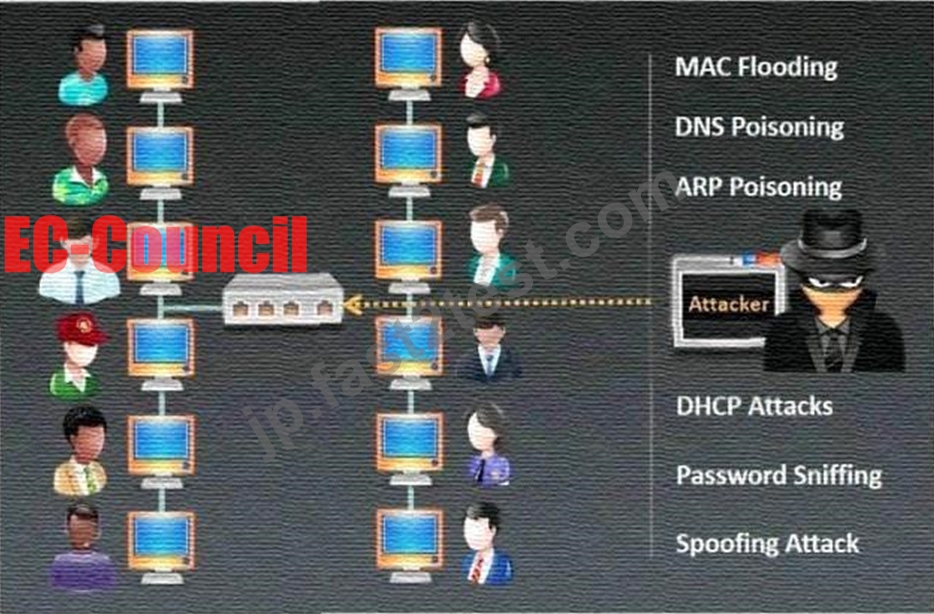
- A. DHCPスニッフィング
- B. パスワードスニッフィング
- C. ARP ポイズニング
- D. Mac フラッディング
正解:C
質問 # 86
......
最新の検証済み312-50v12日本語問題と解答合格保証:https://jp.fast2test.com/312-50v12-JPN-premium-file.html