

Adobe AD0-E213認証された練習解答、必ずあなたを試験合格させる![2023]
有効な合格方法Adobe AnalyticsのAD0-E213試験問題集
Adobe Ad0-E213試験では、データの収集と処理、分析ツールの実装と構成、分析ソリューションのトラブルシューティング、カスタムレポートとダッシュボードの作成など、Adobe分析に関連する幅広いトピックをカバーしています。この試験は、候補者の分析的、技術的、および問題解決スキルをテストするように設計されています。 Adobe Analyticsプラットフォームとその機能を深く理解する必要があるのは、やりがいのある試験です。
Adobe AD0-E213試験は、Adobe Analytics Developer Professionalになりたいと考えている専門家のスキルと知識をテストするために設計されています。この認定は、Adobe Analyticsとその機能に深い理解を持ち、Adobe Analyticsソリューションの開発と実装に特化した個人を対象としています。
質問 # 26
If useBeacon variable is enabled, which technique is being used to send data over HTTP to a web server?
- A. Web browser's navigator.sendBeacon() method
- B. A synchronous AppMeasure function
- C. A standard GET image request
正解:A
解説:
This technique is used to send data over HTTP to a web server when the useBeacon variable is enabled. According to the Adobe Analytics Developer Professional study guide (page 8-9), the navigator.sendBeacon() method is a modern way of sending data to a web server in the background that is asynchronous and does not interfere with the user's experience. For more detailed information, please refer to the study guide
質問 # 27
An analyst has to alter a request in report Builder in order to illustrate the number of order by month and by purchase country. Currently it displays only the total values by month. What are two ways the analyst can address this change? (Choose two.) Select all that apply.
- A. Edit the existing request and select the dimension "Month" in the first step of the request wizard and Country" in the second step of the request wizard
- B. Right-click on the request and add Matching request breakdown.
- C. Right-click on the request cell, and added depended Request > Breakdown.
- D. Edit the existing request and select the Dimension "Country" in the first step of the request wizard and "Month" in the second step of the request wizard
正解:C、D
解説:
The two ways to address this change are as follows: A. Right-click on the request cell, and added depended Request > Breakdown. This option allows you to add a breakdown to the existing request and view the results by the chosen dimension. B. Edit the existing request and select the Dimension "Country" in the first step of the request wizard and "Month" in the second step of the request wizard. This option allows you to edit the existing request and specify the dimensions that you want to use. For more information, please refer to the Adobe Analytics Developer Professional study guide.
質問 # 28
Product owner is looking to capture outbound links user is clicking, automatically from the website without
actually having to add custom code on the website. As a developer what steps would you take?
- A. On every page, after the s.t() call make sure to execute the code s.trackExternalLinks = true;
- B. On every page, make sure the config variables s.trackExternalLinks, s.linklnternalFilters and
s.linkExternalFilters are set before s.tO call. - C. On every page, make sure the config variable s.trackExternalLinks is set before s.tQ call.
正解:A
質問 # 29
Which feature of Adobe Experience Cloud enables developers to control the what, when, where, and how of all the analytics tags on the website?
- A. Data elements
- B. Extensions
- C. Rules
正解:C
解説:
Rules in Adobe Experience Cloud enable developers to control the what, when, where and how of all the analytics tags on the website. Rules allow you to easily create and manage analytics tags using point-and-click interfaces. Rules also allow you to create conditions so that certain tags will only fire when certain criteria are met, giving you more control over the data that is collected. Rules are a powerful tool for developers, allowing them to customize the analytics tags for a website quickly and accurately.
質問 # 30
Deployment of libraries and implementation of code on a website follow creation and configuration of a tag
property. Which is correct regarding an Adobe Analytics tag property?
- A. Properties are overarching containers used to manage tags.
- B. Properties map data elements to Analytics variable values.
- C. Properties are references to specific parts of a website to collect variable values.
正解:C
質問 # 31
Which of below parameter is report suite determines where data will be kept and reported?
- A. S_account
- B. scRemove
- C. s_code
- D. scView
正解:A
解説:
The Saccount parameter is a report suite identifier that tells Adobe Analytics where to store data and how to report on it. This parameter must be included in any tracking call sent to Adobe Analytics. For more information, please refer to the Adobe Analytics Developer Guide [1], which provides detailed instructions and code examples for tracking with Adobe Analytics. Additionally, you can find more information on the Saccount parameter in the Adobe Experience Platform Web SDK documentation [2], which provides detailed information on tracking with the Web SDK.
[1] https://marketing.adobe.com/resources/help/en_US/sc/implement/developer_guide.html [2] https://aep-sdks.gitbook.io/docs/resources/web-sdk/web-sdk-reference/parameters-reference/s_account
質問 # 32
When may a report in Adobe Analytics show "Unspecified" in the output?
- A. An event fires without a conversion variable.
- B. Using segments where components are not accessible.
- C. Pages fire outside internal URL filters.
正解:B
質問 # 33
Identify the characteristics which is correct in Comparison of Global Report Suite and Rollup Report Features?
- A. Rollups are only processed at midnight each night, while global report suites report data with standard latency.
- B. Rollups provide data on all dimensions, Global report suites provide aggregate data on only high-level reports.
- C. Global report suites can aggregate historical data. Rollups while only report data from the point they were implemented.
正解:C
解説:
Global report suites can aggregate data from multiple report suites into one high-level report. This allows you to view data from multiple report suites at once, enabling you to quickly compare performance across sites, countries, or other groupings. Additionally, global report suites can aggregate historical data, allowing you to see the overall performance of a site over a period of time.
Rollups, on the other hand, are used to aggregate data from multiple report suites into one report suite. This allows you to view data from multiple report suites at once, but it only reports data from the point they were implemented. As a result, rollups cannot be used to view historical data, as they will only report data from the point they were implemented. Additionally, rollups are only processed at midnight each night, while global report suites report data with standard latency.
質問 # 34
Which phase of the Adobe Analytics Implementation using tags in Adobe Experience Platform involves
creating data elements and rules?
- A. Deploy to a development environment
- B. Validate and publish to production
- C. Create a tag property
- D. Gain access to tags
正解:C
解説:
Explanation
Create a tag propertyIn this lesson, you will create your first tag property.
A property is basically a container that you fill with extensions, rules, data elements, and libraries as you
deploy tags to your site.
PrerequisitesIn order to complete the next few lessons, you must have permission to Develop, Approve,
Publish, Manage Extensions, and Manage Environments in tags. If you are unable to complete any of these
steps because the user interface options are not available to you, reach out to your Experience Cloud
Administrator to request access. For more information on tag user permissions, see the documentation.
NOTE
Adobe Experience Platform Launch is being integrated into Adobe Experience Platform as a suite of data
collection technologies. Several terminology changes have rolled out in the interface which you should be
aware of while using this content:
* Platform Launch (Client Side) is now
* Platform Launch Server Side is now event forwarding
* Edge configurations are now datastreams
Learning ObjectivesAt the end of this lesson, you will be able to:
* Log into the Data Collection user interface
* Create a new tag property
* Configure a tag property
Go to the Data Collection interfaceTo get to Data Collection
* Log into the Adobe Experience Cloud
* Click the Solution Switcher Iconicon to open the app switcher
* Select Launch/Data Collection from the menu Open the solution switcher using the icon and click
* Launch/Data Collection
You should now see the Tags Properties screen (if no properties have ever been created in the account, this
screen might be empty):
Properties Screen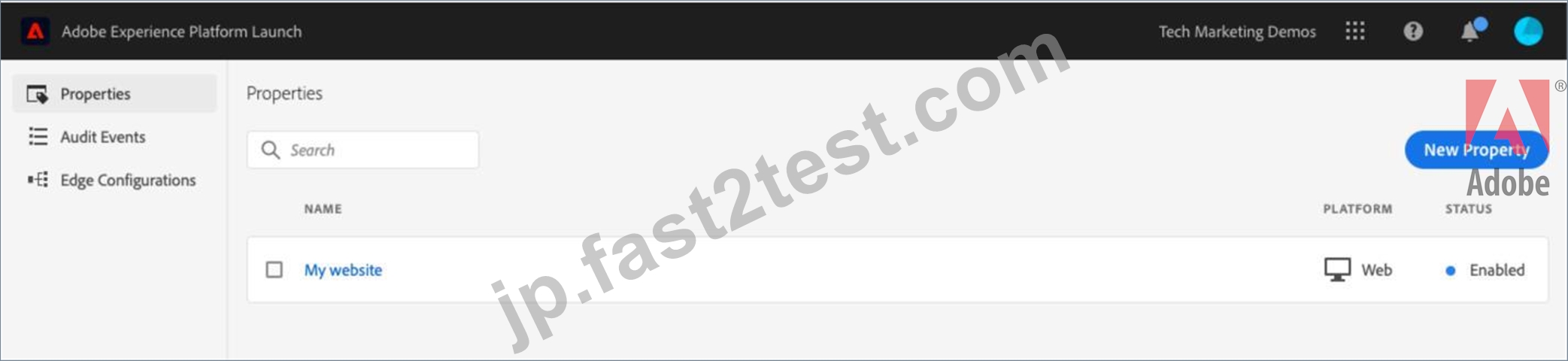
Create a PropertyA property is basically a container that you fill with extensions, rules, data elements, and
libraries as you deploy tags to your site. A property can be any grouping of one or more domains and
subdomains. You can manage and track these assets similarly. For example, suppose that you have multiple
websites based on one template, and you want to track the same assets on all of them. You can apply one
property to multiple domains. For more information on creating properties, see "Companies and Properties" in
the product documentation.
To Create a Property
* Click the New Property button:
Click New Property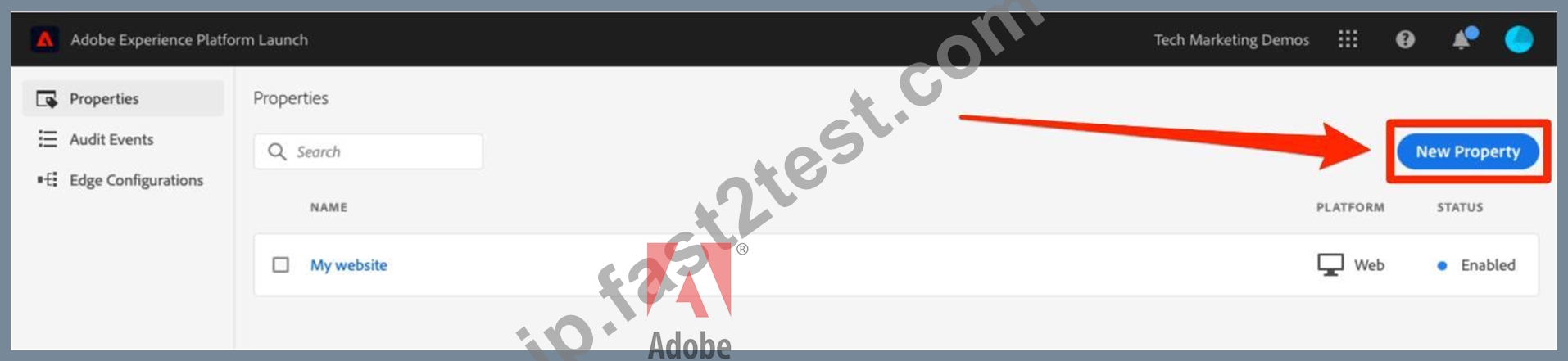
* Name your property (e.g. Luma Tutorial or Luma Tutorial - Daniel)
* As the domain, enter enablementadobe.com since this is the domain where the Luma demo site is
hosted. Although the "Domain" field is required, the tag property will work on any domain where it's
implemented. The main purpose of this field is to pre-populate menu options in the Rule builder.
* Expand the Advanced Options Run rule components in sequence
* Click the Save button
Create a new Property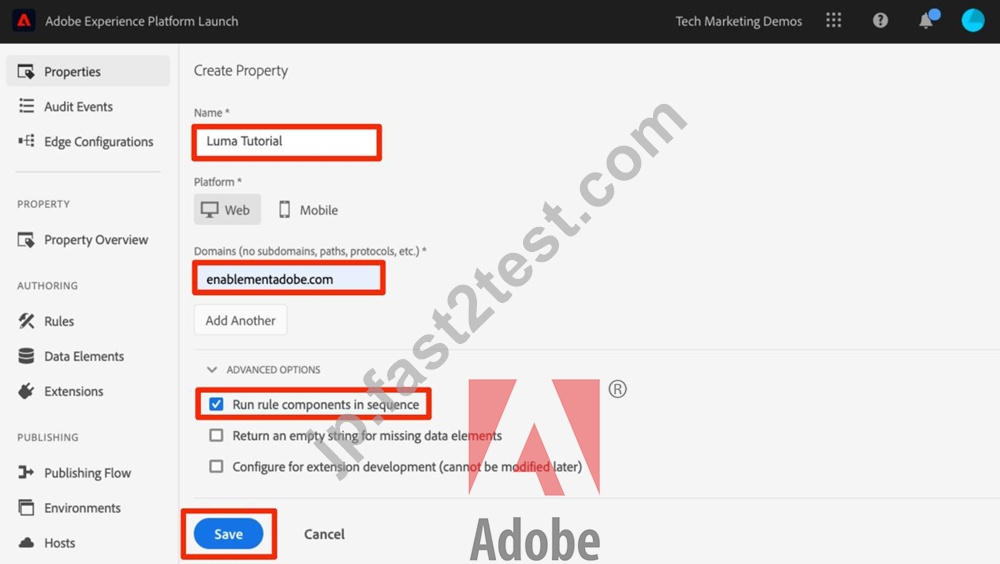
Your new property should display on the Properties page. Note that if you check the box next to the property
name, options to Configure or Delete the property appear above the property list. Click on the name of your
property (e.g. Luma Tutorial) to open the Overview screen.Click the name of the property to open it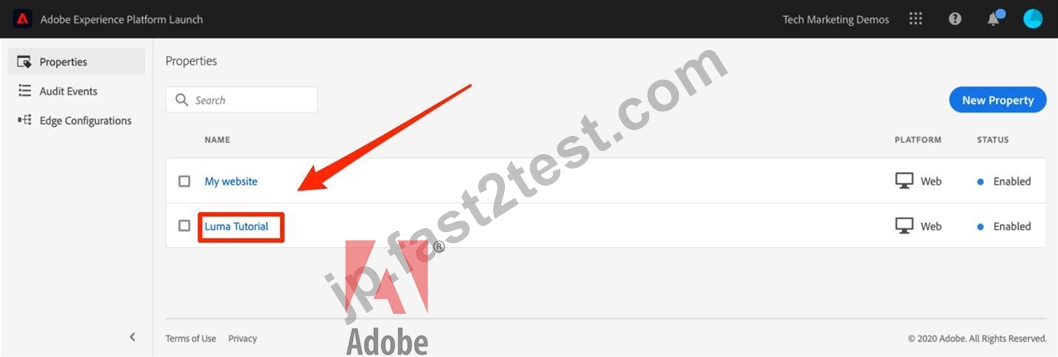
Next "Add the Embed Code" >
質問 # 35
Which code throws a "RangeError: radix must be an integer" exception in JavaScript?
- A. (42).toString(2);
- B. (0x42).toString(10);
- C. (42).toString(37);
正解:B
質問 # 36
A developer wants to use extensions to add core functionality to tags. What is the first step to add a new
extension?
- A. Select an extension from the extensions catalog.
- B. Mouse over an extension to configure it.
- C. From a property's overview page, open the Extensions tab.
正解:A
質問 # 37
An analyst intended to prevent the next tracking call from being sent to Adobe; however, after reviewing the
reports, she found that the tracking call was still sent to Adobe. Which code should the analyst have added to
the doPlugins() function?
- A. s.abort = true;
- B. s.track = true;
- C. s.track = false;
- D. s.abort = false;
正解:C
質問 # 38
A developer has installed large numbers of extensions.
What can be done to help manage the performance of the application without uninstalling extensions?
- A. Sort installed extensions by clicking a column heading.
- B. Selectively enable and disable the extensions.
- C. Remove an extension by selecting an application from the Products list.
正解:B
解説:
According to the Adobe Analytics Developer Professional study guide, one way to help manage the performance of an application with a large number of extensions installed is to selectively enable and disable the extensions depending on the page or functionality being used. This allows you to control which extensions are active and running on the page, which can help to improve performance and reduce the amount of resources being used.
質問 # 39
When a segment is created from within a report by dragging a component on the segment area, how is it
possible to re-use It in another report?
- A. It is automatically available is the segment list.
- B. Done by editing the segment and checking "Make this an Experience Cloud audience"
- C. Done by editing the segment and checking 'Make this segment public'.
正解:C
質問 # 40
An analyst has been asked to deploy analytics for the regional domain for xyz company https://xyz.co.region. What would be the right "fpCookieDomainPeriods" value so that cookies are set appropriately?
- A. 0
- B. 1
- C. 2
正解:C
解説:
The fpCookieDomainPeriods value determines the cookie domain on which the Analytics cookie will be set. For the domain https://xyz.co.region, the fpCookieDomainPeriods value should be set to 2. This will set the cookie domain to be ".co.region". Setting the value to 1 would set the cookie domain to be ".region", which would not be appropriate for this domain. Setting the value to 3 would set the cookie domain to be "xyz.co.region", which would also not be appropriate.
質問 # 41
A developer wants to use extensions to add core functionality to tags. What is the first step to add a new extension?
- A. Select an extension from the extensions catalog.
- B. Mouse over an extension to configure it.
- C. From a property's overview page, open the Extensions tab.
正解:A
解説:
The first step to add a new extension is to select an extension from the extensions catalog. To do this, from a property's overview page, open the Extensions tab and select an extension from the list. You can then mouse over an extension to configure it.
質問 # 42
What is correct order when building a rule in launch by Adobe? Select a correct answer.
- A. Conditions, exceptions, actions. Event
- B. Event, exceptions, actions, conditions
- C. Event, conditions, exceptions, actions
正解:C
解説:
When building a rule in Launch by Adobe, the correct order to follow is Event, conditions, exceptions, and then actions. This order ensures that the conditions and exceptions will be evaluated before any of the actions in the rule are triggered. This is referenced in the Adobe Analytics Developer Professional study guide section on the Tag Management System.
質問 # 43
An analytics developer is implementing tracking products variable and other eCommerce metrics on an
eCommerce website. Which of the following would you suggest to be the correct way of initialising products
variable.?
- A. s.products = "Example category;Example product;1;event1=4.99|event2=5.99;3.50;eVart=Example
merchandising value 1 |eVar2=Example merchandising value 2"; - B. s.products = "Example category;Example product;! ;eVar1 =Example merchandising value 1
|eVar2=Example merchandising value 2*;event1 =4.99|event2=5.99;3.50 - C. s.products = "Example category;Example product;l ;3.50;event1 =4.99|event2=5.99;eVar1 =Example
merchandising value 1 |eVar2=Example merchandising value 2";
正解:B
質問 # 44
Which option shows a correct set of steps in a tags workflow?
- A. Create data elements are rules.
- B. Define different levels of user permissions.
- C. Republish the appropriate libraries.
正解:C
質問 # 45
What is a key feature of tags in Adobe Analytics?
- A. Developers can build, manage, and update integrations using a virtually self-service interface.
- B. Multiple libraries are built sequentially by different teams.
- C. Only Adobe certified software vendors can build and maintain marketing/advertising tools.
正解:A
解説:
Tags in Adobe Analytics provide developers with the ability to build, manage, and update integrations using a virtually self-service interface. This allows for quickly and easily creating customizations and integrations with minimal coding. This is referenced in the Adobe Analytics Developer Professional study guide section on the Tag Management System.
質問 # 46
......
Adobe AD0-E213事前試験練習テストはFast2test:https://jp.fast2test.com/AD0-E213-premium-file.html
AD0-E213練習テスト問題、解答、解釈:https://drive.google.com/open?id=1DmfE0RiIBGPk7fUYZKn-NZHYvStvavK1