

Palo Alto Networks PCCET認定ガイドPDFは100%カバー率でリアル試験問題
合格させるPCCET試験にはリアル問題解答
Palo Alto Networks PCCET(Palo Alto Networks認定サイバーセキュリティ初級技術者)認定試験は、サイバーセキュリティの分野における個人の知識とスキルを検証する認定プログラムです。この試験は、サイバーセキュリティ業界に新しく参入し、この分野でキャリアを開始したいと考えている個人を対象としています。認定試験は、ネットワークセキュリティ、エンドポイント保護、クラウドセキュリティ、サイバーセキュリティの基礎など、幅広いトピックをカバーしています。
PCCET認定試験は、エントリーレベルのサイバーセキュリティの専門家が知識とスキルを検証する絶好の機会です。認定は世界的に認識されており、サイバーセキュリティの専門職へのコミットメントを実証しています。この試験は、サイバーセキュリティの基本的な知識をカバーしており、他の高度なサイバーセキュリティ認証の足がかりです。サイバーセキュリティでのキャリアを開始または強化したい場合は、PCCET認定試験を検討する価値があります。
質問 # 84
Match the Identity and Access Management (IAM) security control with the appropriate definition.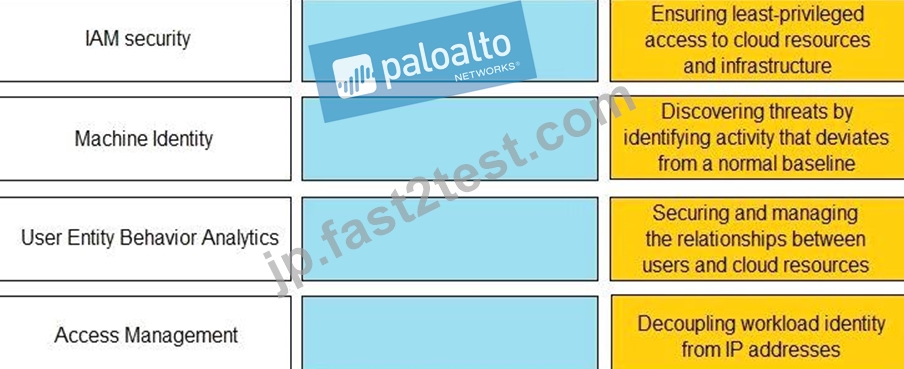
正解:
解説:
質問 # 85
Which Palo Alto subscription service identifies unknown malware, zero-day exploits, and advanced persistent threats (APTs) through static and dynamic analysis in a scalable, virtual environment?
- A. URL Filtering
- B. DNS Security
- C. WildFire
- D. Threat Prevention
正解:C
解説:
Explanation
"The WildFire cloud-based malware analysis environment is a cyber threat prevention service that identifies unknown malware, zero-day exploits, and advanced persistent threats (APTs) through static and dynamic analysis in a scalable, virtual environment. WildFire automatically disseminates updated protections in near-real time to immediately prevent threats from spreading; this occurs without manual intervention"
質問 # 86
Which three services are part of Prisma SaaS? (Choose three.)
- A. Data Exposure Control
- B. Denial of Service
- C. DevOps
- D. Threat Prevention
- E. Data Loss Prevention
正解:A、D、E
質問 # 87
Which technique changes protocols at random during a session?
- A. port hopping
- B. hiding within SSL encryption
- C. tunneling within commonly used services
- D. use of non-standard ports
正解:A
解説:
Port hopping is a technique that changes protocols at random during a session to evade detection and analysis by security devices. Port hopping can be used by malware or attackers to communicate with command and control servers or to exfiltrate data. Port hopping makes it difficult to identify and block malicious traffic based on port numbers or signatures. Reference: Port Hopping, Ports Used for Management Functions, Adding a Custom Application/Ports to Security Policy
質問 # 88
Which of the following is a service that allows you to control permissions assigned to users in order for them to access and utilize cloud resources?
- A. User and Entity Behavior Analytics (UEBA)
- B. Lightweight Directory Access Protocol (LDAP)
- C. User-ID
- D. Identity and Access Management (IAM)
正解:D
解説:
Identity and access management (IAM) is a software service or framework that allows organizations to define user or group identities within software environments, then associate permissions with them. The identities and permissions are usually spelled out in a text file, which is referred to as an IAM policy.
質問 # 89
Which characteristic of serverless computing enables developers to quickly deploy application code?
- A. Uploading the application code itself, without having to provision a full container image or any OS virtual machine components
- B. Using cloud service spot pricing to reduce the cost of using virtual machines to run their application code
- C. Uploading cloud service autoscaling services to deploy more virtual machines to run their application code based on user demand
- D. Using Container as a Service (CaaS) to deploy application containers to run their code.
正解:A
解説:
Explanation
"In serverless apps, the developer uploads only the app package itself, without a full container image or any OS components. The platform dynamically packages it into an image, runs the image in a container, and (if needed) instantiates the underlying host OS and VM and the hardware required to run them."
質問 # 90
The customer is responsible only for which type of security when using a SaaS application?
- A. infrastructure
- B. physical
- C. data
- D. platform
正解:C
解説:
Data security is the only type of security that the customer is fully responsible for when using a SaaS application. Data security refers to the protection of data from unauthorized access, use, modification, deletion, or disclosure. Data security includes aspects such as encryption, backup, recovery, access control, and compliance12. The customer is responsible for ensuring that their data is secure in transit and at rest, and that they comply with any applicable regulations or policies regarding their data.
The other types of security - physical, platform, and infrastructure - are the responsibility of the SaaS provider. Physical security refers to the protection of the hardware and facilities that host the SaaS application. Platform security refers to the protection of the software and services that run the SaaS application. Infrastructure security refers to the protection of the network and systems that support the SaaS application. The SaaS provider is responsible for ensuring that these layers of security are maintained and updated, and that they meet the required standards and certifications34. Reference:
SaaS and the Shared Security Model
A Guide to SaaS Shared Responsibility Model
The Shared Responsibility Model for Security in The Cloud (IaaS, PaaS & SaaS) Shared responsibility in the cloud
質問 # 91
What differentiates Docker from a bare metal hypervisor?
- A. Docker uses more resources than a bare metal hypervisor
- B. Docker lets the user boot up one or more instances of an operating system on the same host whereas hypervisors do not
- C. Docker uses OS-level virtualization, whereas a bare metal hypervisor runs independently from the OS
- D. Docker is more efficient at allocating resources for legacy systems
正解:C
解説:
Docker and bare metal hypervisor are two different types of virtualization technologies that have different functioning mechanisms, architectures, and use cases. Docker is a containerization technology that allows users to create, deploy, and run applications using containers. Containers are isolated environments that share the same host operating system kernel, but have their own libraries, dependencies, and resources. Docker can run multiple containers on the same host, without requiring a separate operating system for each container12. Bare metal hypervisor, also known as type 1 hypervisor, is a software that runs directly on the hardware and creates virtual machines. Virtual machines are complete operating systems that have their own kernel, drivers, and resources. Bare metal hypervisor can run multiple virtual machines on the same host, each with a different operating system and dedicated resources3 .
The main difference between Docker and bare metal hypervisor is the level of abstraction they provide. Docker uses OS-level virtualization, which means it creates containers on top of the host operating system. Bare metal hypervisor uses hardware virtualization, which means it runs independently from the host operating system and creates virtual machines on the hardware layer. This difference has implications for the performance, efficiency, and portability of the virtualized environments. Docker containers are generally faster, lighter, and more scalable than virtual machines, as they do not have the overhead of running a separate operating system for each container. However, Docker containers are more limited and can run only on Linux, certain Windows servers and IBM mainframes if hosted on bare metal. Virtual machines, on the other hand, are more flexible and secure, as they can run any operating system and isolate the guest operating system from the host operating system. However, virtual machines are more resource-intensive and slower than containers, as they have to emulate the hardware and run a full operating system for each virtual machine12.
Reference:
Docker vs VMWare: How Do They Stack Up? | UpGuard
Hypervisor vs. Docker: Complete Comparison of the Two - HitechNectar
Beginners Track - Docker On Bare Metal | dockerlabs
[Getting Started: Layer 3 Subinterfaces - Palo Alto Networks Knowledge Base]
質問 # 92
Which technique uses file sharing or an instant messenger client such as Meebo running over Hypertext Transfer Protocol (HTTP)?
- A. Hiding within SSL encryption
- B. Use of non-standard ports
- C. Port hopping
- D. Tunneling within commonly used services
正解:D
解説:
Tunneling is a method of transporting data across a network using protocols that are not supported by that network. Tunneling works by encapsulating packets: wrapping packets inside of other packets. Tunneling within commonly used services is a technique that uses file sharing or an instant messenger client such as Meebo running over HTTP to bypass firewalls or other network restrictions. The data packets are encapsulated within HTTP packets and sent as normal web traffic. This way, the data packets can reach their destination without being blocked or detected by the network. Reference: What is tunneling? | Tunneling in networking | Cloudflare, What Is Network Tunneling & How Is It Used? | Traefik Labs, networking - What is HTTP tunneling? - Stack Overflow
質問 # 93
If an endpoint does not know how to reach its destination, what path will it take to get there?
- A. The endpoint will broadcast to all connected network devices.
- B. The endpoint will forward data to another endpoint to send instead.
- C. The endpoint will not send the traffic until a path is clarified.
- D. The endpoint will send data to the specified default gateway.
正解:D
質問 # 94
Which endpoint product from Palo Alto Networks can help with SOC visibility?
- A. STIX
- B. Cortex XDR
- C. AutoFocus
- D. WildFire
正解:B
解説:
XDR solutions bring a proactive approach to threat detection and response. It delivers visibility across all data, including endpoint, network, and cloud data, while applying analytics and automation to address today's increasingly sophisticated threats. With XDR, cybersecurity teams can:
* Identify hidden, stealthy, and sophisticated threats proactively and quickly
* Track threats across any source or location within the organization
* Increase the productivity of the people operating the technology
* Get more out of their security investments
* Conclude investigations more efficiently
質問 # 95
What does SOAR technology use to automate and coordinate workflows?
- A. algorithms
- B. playbooks
- C. Security Incident and Event Management
- D. Cloud Access Security Broker
正解:B
解説:
Explanation
SOAR tools ingest aggregated alerts from detection sources (such as SIEMs, network security tools, and mailboxes) before executing automatable, process-driven playbooks to enrich and respond to these alerts.
質問 # 96
Which Palo Alto Networks tools enable a proactive, prevention-based approach to network automation that accelerates security analysis?
- A. AutoFocus
- B. MineMeld
- C. WildFire
- D. Cortex XDR
正解:A
解説:
"Palo Alto Networks AutoFocus enables a proactive, prevention-based approach to network security that puts automation to work for security professionals. Threat intelligence from the service is made directly accessible in the Palo Alto Networks platform, including PAN-OS software and Panorama. AutoFocus speeds the security team's existing workflows, which allows for in-depth investigation into suspicious activity, without additional specialized resources."
質問 # 97
On an endpoint, which method should you use to secure applications against exploits?
- A. strong user passwords
- B. endpoint-based firewall
- C. full-disk encryption
- D. software patches
正解:D
解説:
New software vulnerabilities and exploits are discovered all the time and thus diligent software patch management is required by system and security administrators in every organization.
質問 # 98
In addition to integrating the network and endpoint components, what other component does Cortex integrate to speed up IoC investigations?
- A. Infrastructure
- B. Cloud
- C. Computer
- D. Switch
正解:B
解説:
Explanation
Cortex XDR breaks the silos of traditional detection and response by natively integrating network, endpoint, and cloud data to stop sophisticated attacks
質問 # 99
......
100%無料PCCET日常練習試験には160問があります:https://jp.fast2test.com/PCCET-premium-file.html
合格させるPCCETレビューガイド、信頼され続けるPCCETテストエンジン:https://drive.google.com/open?id=1ixY0jr0qmxvJdWBoU5auZhPthfVcWJwf