

Fortinet NSE7_ADA-6.3認定ガイドPDFは100%カバー率でリアル試験問題
合格させるNSE7_ADA-6.3試験にはリアル問題解答
質問 # 14
Refer to the exhibit.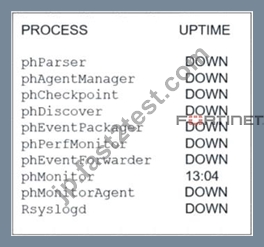
An administrator deploys a new collector for the first time, and notices that all the processes except the phMonitor are down.
How can the administrator bring the processes up?
- A. The administrator needs to run the command phtools --start all on the collector.
- B. The collector was not deployed properly and must be redeployed.
- C. Rebooting the collector will bring up the processes.
- D. The processes will come up after the collector is registered to the supervisor.
正解:D
解説:
Explanation
The collector processes are dependent on the registration with the supervisor. The phMonitor process is responsible for registering the collector to the supervisor and monitoring the health of other processes. After the registration is successful, the phMonitor will start the other processes on the collector.
質問 # 15
What are the modes of Data Ingestion on FortiSOAR? (Choose three.)
- A. Notification based
- B. App Push
- C. Policy based
- D. Schedule based
- E. Rule based
正解:A、B、D
解説:
Explanation
The modes of Data Ingestion on FortiSOAR are notification based, app push, and schedule based. Notification based mode allows FortiSOAR to receive data from external sources via webhooks or email notifications. App push mode allows FortiSOAR to receive data from external sources via API calls or scripts. Schedule based mode allows FortiSOAR to pull data from external sources at regular intervals using connectors.
References: Fortinet NSE 7 - Advanced Analytics 6.3 Exam Description, page 17
質問 # 16
From where does the rule engine load the baseline data values?
- A. The profile database
- B. The memory
- C. The daily database
- D. The profile report
正解:A
解説:
Explanation
The rule engine loads the baseline data values from the profile database. The profile database contains historical data that is used for baselining calculations, such as minimum, maximum, average, standard deviation, and percentile values for various metrics.
質問 # 17
In the event of a WAN link failure between the collector and the supervisor, by default, what is the maximum number of event files stored on the collector?
- A. 20.000
- B. 40.000
- C. 10.000
- D. 30.000
正解:C
解説:
Explanation
By default, the maximum number of event files stored on the collector in the event of a WAN link failure between the collector and the supervisor is 10.000. This value can be changed in the collector.properties file by modifying the parameter max_event_files_to_store. References: Fortinet NSE 7 - Advanced Analytics 6.3 Exam Description, page 13
質問 # 18
Which three processes are collector processes? (Choose three.)
- A. phParser
- B. phRuleMaster
- C. phReportM aster
- D. phMonitorAgent
- E. phAgentManaqer
正解:A、B、D
解説:
Explanation
The collector processes are responsible for receiving, parsing, normalizing, correlating, and monitoring events from various sources. The collector processes are phParser, phRuleMaster, and phMonitorAgent.
質問 # 19
Refer to the exhibit.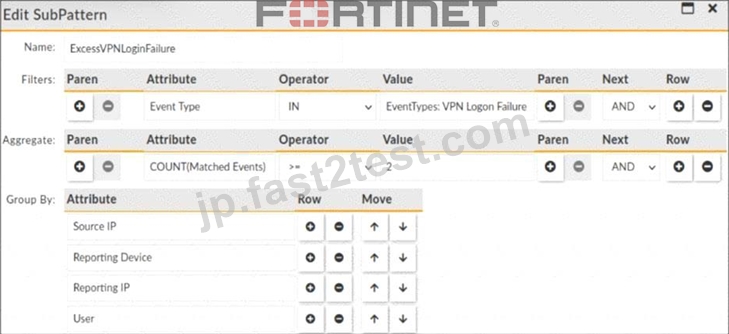
The rule evaluates multiple VPN logon failures within a ten-minute window. Consider the following VPN failure events received within a ten-minute window: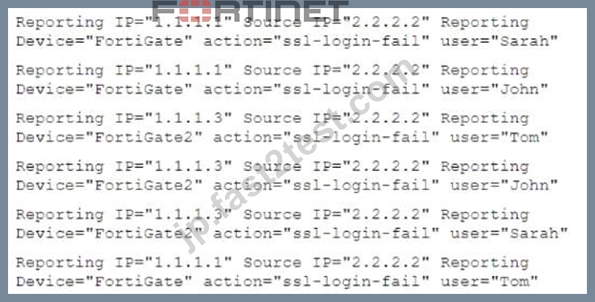
How many incidents are generated?
- A. 0
- B. 1
- C. 2
- D. 3
正解:B
解説:
Explanation
The rule evaluates multiple VPN logon failures within a ten-minute window. The rule will generate an incident if there are more than three VPN logon failures from the same source IP address within a ten-minute window.
Based on the VPN failure events received within a ten-minute window, there are two incidents generated:
* One incident for source IP address 10.10.10.10, which has four VPN logon failures at 09:01, 09:02,
09:03, and 09:04.
* One incident for source IP address 10.10.10.11, which has four VPN logon failures at 09:06, 09:07,
09:08, and 09:09.
質問 # 20
Which three processes are collector processes? (Choose three.)
- A. phParser
- B. phRuleMaster
- C. phReportM aster
- D. phMonitorAgent
- E. phAgentManaqer
正解:A、B、D
解説:
Explanation
The collector processes are responsible for receiving, parsing, normalizing, correlating, and monitoring events from various sources. The collector processes are phParser, phRuleMaster, and phMonitorAgent.
質問 # 21
Which syntax will register a collector to the supervisor?
- A. phProvisionCollector --add
- B. phProvisionCollector --add
- C. phProvisionCollector --add
- D. phProvisionCollector --add
正解:D
解説:
Explanation
The syntax that will register a collector to the supervisor is phProvisionCollector --add <supervisor IP>. This command will initiate the registration process between the collector and the supervisor, and exchange certificates and configuration information. The <supervisor IP> parameter is the IP address of the supervisor node.
質問 # 22
Refer to the exhibit.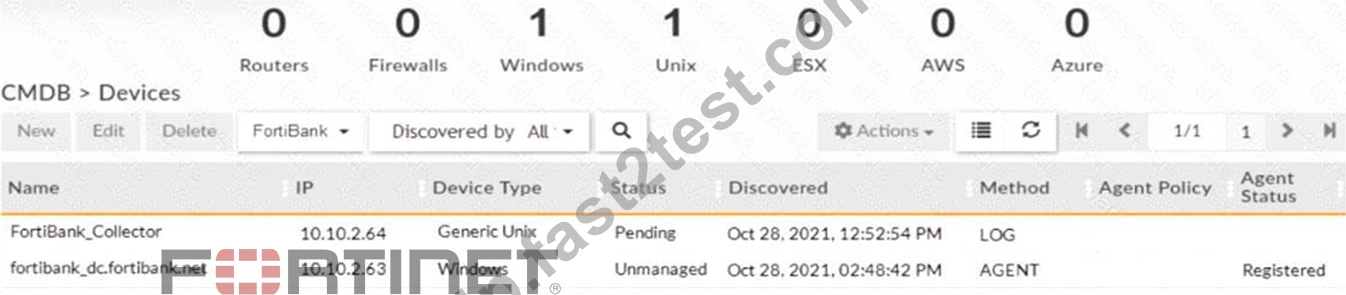
Is the Windows agent delivering event logs correctly?
- A. Because the agent is unmanaged. the logs are dropped silently by the supervisor.
- B. The agent is registered and it is sending logs correctly.
- C. The logs are buffered by the agent and will be sent once the status changes to managed.
- D. The agent is not sending logs because it did not receive a monitoring template.
正解:A
解説:
Explanation
The windows agent is not delivering event logs correctly because the agent is unmanaged, meaning it is not assigned to any organization or customer. The supervisor will drop the logs silently from unmanaged agents, as they are not associated with any valid license or CMDB.
質問 # 23
Refer to the exhibit.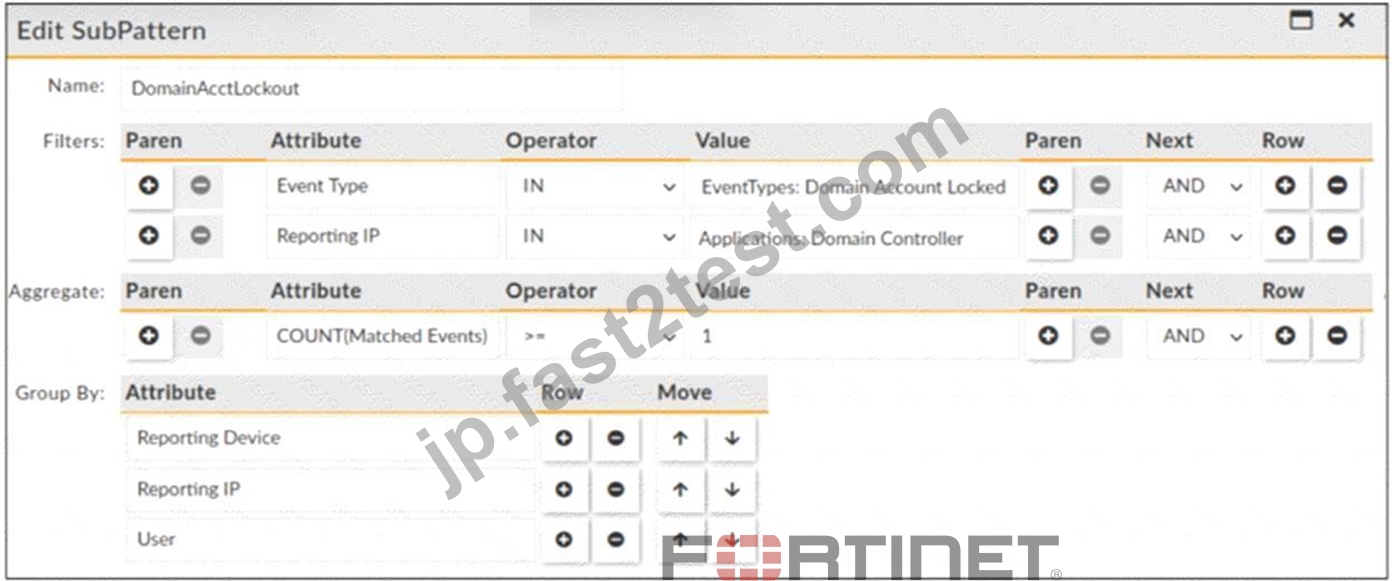
Which statement about the rule filters events shown in the exhibit is true?
- A. The rule filters events with an event type that belong to the Domain Account Locked CMDB group or a reporting IP that belong to the Domain Controller applications group.
- B. The rule filters events with an event type that belong to the Domain Account Locked CMDB group and a reporting |P that belong to the Domain Controller applications group.
- C. The rule filters events with an event type that belong to the Domain Account Locked CMDB group and a user that belongs to the Domain Controller applications group.
- D. The rule filters events with an event type that equals Domain Account Locked and a reporting IP that equals Domain Controller applications.
正解:B
解説:
Explanation
The rule filters events with an event type that belong to the Domain Account Locked CMDB group and a reporting IP that belong to the Domain Controller applications group. This means that only events that have both criteria met will be processed by this rule. The event type and reporting IP are joined by an AND operator, which requires both conditions to be true.
質問 # 24
Which statement about EPS bursting is true?
- A. FortiSIEM will let you burst up to five times the licensed EPS at any given time, regardless of unused of EPS.
- B. FortiSIEM will let you burst up to five times the licensed EPS once during a 24-hour period.
- C. FortiSIEM must be provisioned with ten percent the licensed EPS to handle potential event surges.
- D. FortiSIEM will let you burst up to five times the licensed EPS at any given time, provided it has accumulated enough unused EPS.
正解:D
解説:
Explanation
FortiSIEM allows EPS bursting to handle event spikes without dropping events or violating the license agreement. EPS bursting means that FortiSIEM will let you burst up to five times the licensed EPS at any given time, provided it has accumulated enough unused EPS from previous time intervals.
質問 # 25
From where does the rule engine load the baseline data values?
- A. The profile database
- B. The memory
- C. The daily database
- D. The profile report
正解:A
解説:
Explanation
The rule engine loads the baseline data values from the profile database. The profile database contains historical data that is used for baselining calculations, such as minimum, maximum, average, standard deviation, and percentile values for various metrics.
質問 # 26
How do customers connect to a shared multi-tenant instance on FortiSOAR?
- A. The MSSP must install a Secure Message Exchange node to connect to the customer's shared multi-tenant instance.
- B. The customer must install a tenant node to connect to the MSSP shared multi-tenant instance.
- C. The MSSP must install an agent node on the customer's network to connect to the customer's shared multi-tenant instance.
- D. The MSSP must provide secure network connectivity between the FortiSOAR manager node and the customer devices.
正解:C
解説:
Explanation
To connect to a shared multi-tenant instance on FortiSOAR, the MSSP must install an agent node on the customer's network. The agent node acts as a proxy between the customer's devices and the FortiSOAR manager node. The agent node also performs data collection, enrichment, and normalization for the customer's data sources. References: Fortinet NSE 7 - Advanced Analytics 6.3 Exam Description, page 11
質問 # 27
Refer to the exhibit. Click on the calculator button.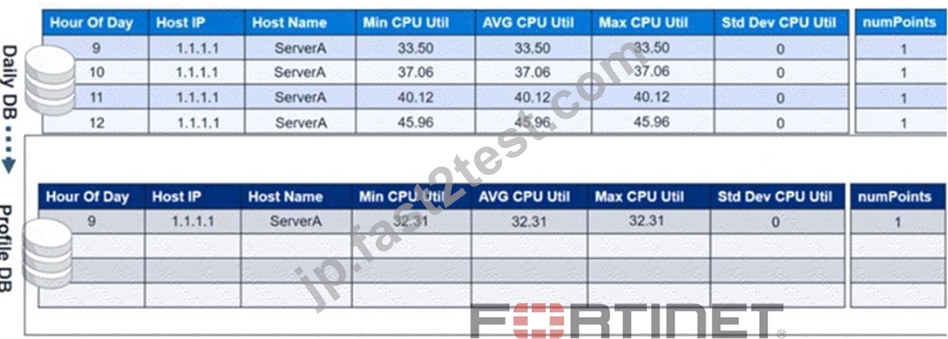
The profile database contains CPU utilization values from day one. At midnight on the second day, the CPU utilization values from the daily database will be merged with the profile database.
In the profile database, in the Hour of Day column where 9 is the value, what will be the updated minimum, maximum, and average CPU utilization values?
- A. Min CPU Util=32.31, Max CPU Ucil=33.50 and AVG CPU Util=32.67
- B. Min CPU Util=32.31, Max CPU Ucil=33.50 and AVG CPU Util=33.50
- C. Min CPU Util=33.50, Max CPU Ucil=33.50 and AVG CPU Util=33.50
- D. Min CPU Util=32.31, Max CPU Ucil=32.31 and AVG CPU Util=32.31
正解:A
解説:
Explanation
The profile database contains CPU utilization values from day one. At midnight on the second day, the CPU utilization values from the daily database will be merged with the profile database using a weighted average formula:
New value = (Old value x Old weight) + (New value x New weight) / (Old weight + New weight) The weight is determined by the number of days in each database. In this case, the profile database has one day of data and the daily database has one day of data, so the weight is equal for both databases. Therefore, the formula simplifies to:
New value = (Old value + New value) / 2
In the profile database, in the Hour of Day column where 9 is the value, the updated minimum, maximum, and average CPU utilization values are:
Min CPU Util = (32.31 + 32.31) / 2 = 32.31 Max CPU Util = (33.50 + 33.50) / 2 = 33.50 AVG CPU Util = (32.67 + 32.67) / 2 = 32.67
質問 # 28
......
100%無料NSE7_ADA-6.3日常練習試験には36問があります:https://jp.fast2test.com/NSE7_ADA-6.3-premium-file.html