

Fortinet Certified Solution Specialist FCSS_SASE_AD-24練習テストエンジン: 今すぐ試そう56試験問題
試験合格保証付きのFortinet Certified Solution Specialist FCSS_SASE_AD-24試験問題集
質問 # 21
Your organization is currently using FortiSASE for its cybersecurity. They have recently hired a contractor who will work from the HQ office and who needs temporary internet access in order to set up a web-based point of sale (POS) system.
What is the recommended way to provide internet access to the contractor?
- A. Use FortiClient on the endpoint to manage internet access.
- B. Configure a VPN policy on FortiSASE to provide access to the internet.
- C. Use zero trust network access (ZTNA) and tag the client as an unmanaged endpoint.
- D. Use a proxy auto-configuration (PAC) file and provide secure web gateway (SWG) service as an explicit web proxy.
正解:C
解説:
The recommended way to provide temporary internet access to the contractor is to use Zero Trust Network Access (ZTNA) and tag the client as an unmanaged endpoint . ZTNA ensures that only authorized users and devices can access specific resources, while treating all endpoints as untrusted by default. By tagging the contractor's device as an unmanaged endpoint, you can apply strict access controls and ensure that the contractor has limited access to only the necessary resources (e.g., the web-based POS system) without exposing the internal network to unnecessary risks.
Here's why the other options are less suitable:
A . Use FortiClient on the endpoint to manage internet access: While FortiClient provides endpoint security and management, it requires installation and configuration on the contractor's device. This may not be feasible for temporary contractors or unmanaged devices.
B . Use a proxy auto-configuration (PAC) file and provide secure web gateway (SWG) service as an explicit web proxy: While this approach can control web traffic, it does not provide the granular access control and security posture validation offered by ZTNA. Additionally, managing PAC files can be cumbersome and less secure compared to ZTNA.
D . Configure a VPN policy on FortiSASE to provide access to the internet: Using a VPN policy would grant broader access to the network, which is not ideal for a temporary contractor. It increases the risk of unauthorized access to internal resources and does not align with the principle of least privilege.
Reference:
Fortinet FCSS FortiSASE Documentation - Zero Trust Network Access (ZTNA) Use Cases FortiSASE Administration Guide - Managing Unmanaged Endpoints
質問 # 22
Refer to the exhibits. A FortiSASE administrator has configured an antivirus profile in the security profile group and applied it to the internet access policy. Remote users are still able to download the eicar.com-zip file from https://eicar.org. Traffic logs show traffic is allowed by the policy.
Which configuration on FortiSASE is allowing users to perform the download?


- A. IPS is disabled in the security profile group.
- B. Force certificate inspection is enabled in the policy.
- C. Web filter is allowing the traffic.
- D. The HTTPS protocol is not enabled in the antivirus profile.
正解:B
解説:
https://community.fortinet.com/t5/FortiSASE/Technical-Tip-Force-Certificate-Inspection-option-in- FortiSASE/ta-p/302617
質問 # 23
Which FortiOS command is used to verify the connectivity between FortiSASE components and remote users?
Response:
- A. diagnose debug application forticloud
- B. execute internet-lookup
- C. get system status
- D. ping
正解:A
質問 # 24
Refer to the exhibits.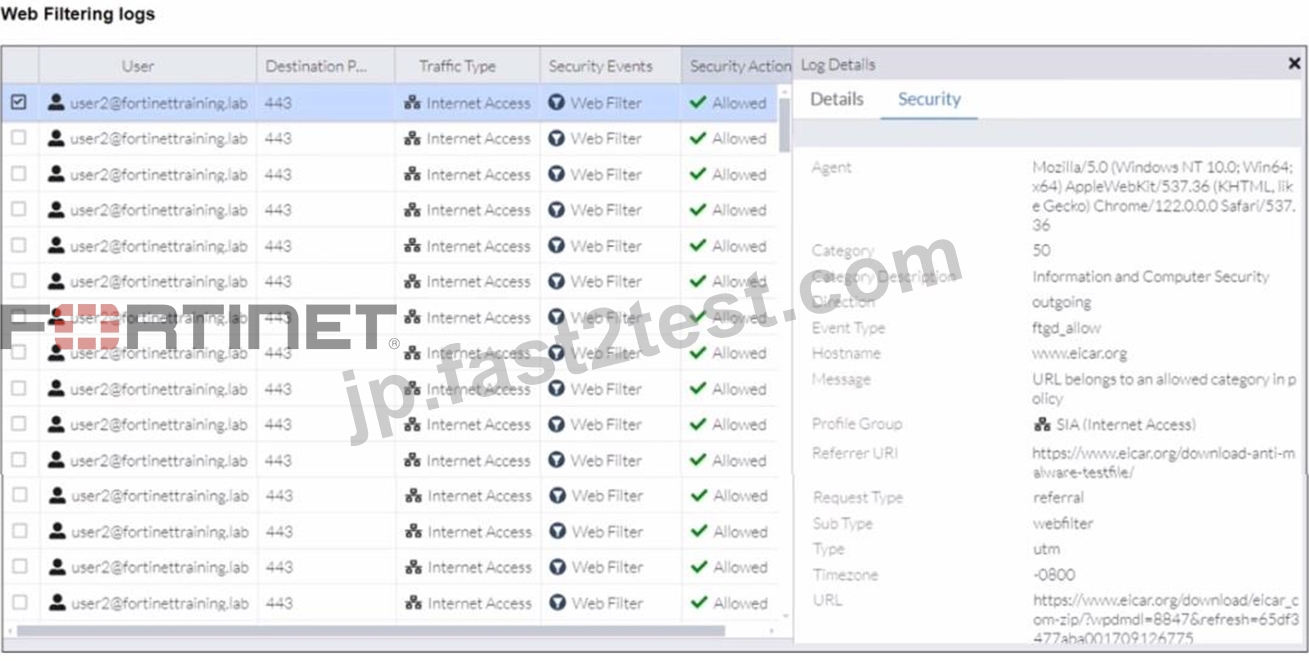

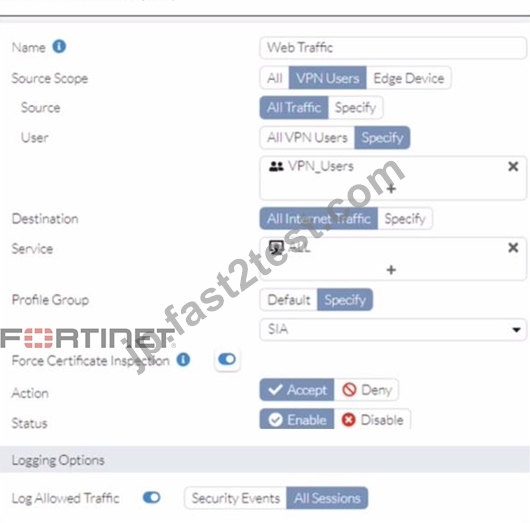
A FortiSASE administrator has configured an antivirus profile in the security profile group and applied it to the internet access policy. Remote users are still able to download the eicar.com-zip file from https://eicar.org. Traffic logs show traffic is allowed by the policy.
Which configuration on FortiSASE is allowing users to perform the download?
- A. IPS is disabled in the security profile group.
- B. Force certificate inspection is enabled in the policy.
- C. Web filter is allowing the traffic.
- D. The HTTPS protocol is not enabled in the antivirus profile.
正解:B
解説:
https://community.fortinet.com/t5/FortiSASE/Technical-Tip-Force-Certificate-Inspection-option-in-FortiSASE/ta-p/302617
質問 # 25
Refer to the exhibits.


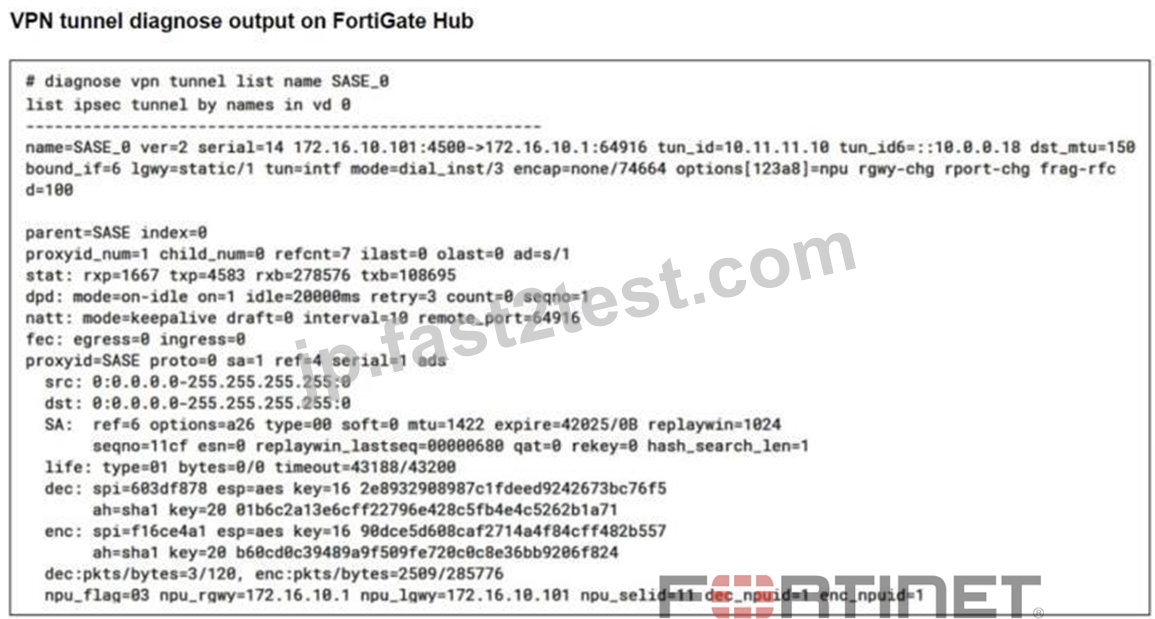
A FortiSASE administrator is trying to configure FortiSASE as a spoke to a FortiGate hub. The tunnel is up to the FortiGale hub. However, the administrator is not able to ping the webserver hosted behind the FortiGate hub.
Based on the output, what is the reason for the ping failures?
- A. Quick mode selectors are restricting the subnet.
- B. Network address translation (NAT) is not enabled on the spoke-to-hub policy.
- C. The BGP route is not received.
- D. The Secure Private Access (SPA) policy needs to allow PING service.
正解:C
質問 # 26
A customer wants to upgrade their legacy on-premises proxy to a could-based proxy for a hybrid network.
Which FortiSASE features would help the customer to achieve this outcome?
- A. secure web gateway (SWG) and inline-CASB
- B. SD-WAN and NGFW
- C. SD-WAN and inline-CASB
- D. zero trust network access (ZTNA) and next generation firewall (NGFW)
正解:A
解説:
For a customer looking to upgrade their legacy on-premises proxy to a cloud-based proxy for a hybrid network, the combination of Secure Web Gateway (SWG) and Inline Cloud Access Security Broker (CASB) features in FortiSASE will provide the necessary capabilities.
* Secure Web Gateway (SWG):
* SWG provides comprehensive web security by inspecting and filtering web traffic to protect against web-based threats.
* It ensures that all web traffic, whether originating from on-premises or remote locations, is inspected and secured by the cloud-based proxy.
* Inline Cloud Access Security Broker (CASB):
* CASB enhances security by providing visibility and control over cloud applications and services.
* Inline CASB integrates with SWG to enforce security policies for cloud application usage, preventing unauthorized access and data leakage.
References:
FortiOS 7.2 Administration Guide: Details on SWG and CASB features.
FortiSASE 23.2 Documentation: Explains how SWG and inline-CASB are used in cloud-based proxy solutions.
質問 # 27
Bulk user registration through automated scripts is less secure than individual user registration in FortiSASE.
Response:
- A. False
- B. True
正解:A
質問 # 28
A FortiSASE administrator is configuring a Secure Private Access (SPA) solution to share endpoint information with a corporate FortiGate.
Which three configuration actions will achieve this solution? (Choose three.)
- A. Apply the FortiSASE zero trust network access (ZTNA) license on the corporate FortiGate.
- B. Use the FortiClient EMS cloud connector on the corporate FortiGate to connect to FortiSASE
- C. Authorize the corporate FortiGate on FortiSASE as a ZTNA access proxy.
- D. Register FortiGate and FortiSASE under the same FortiCloud account.
- E. Add the FortiGate IP address in the secure private access configuration on FortiSASE.
正解:B、C、D
解説:
Reference:
FortiOS 7.2 Administration Guide: Provides details on configuring Secure Private Access and integrating with FortiGate.
FortiSASE 23.2 Documentation: Explains how to set up and manage connections between FortiSASE and corporate FortiGate.
質問 # 29
Which method is most effective for onboarding a large number of remote users into a SASE framework?
Response:
- A. Individual user registration via email invitations
- B. Open registration allowing user self-enrollment
- C. Temporary guest accounts with limited access
- D. Bulk user registration through automated scripts
正解:D
質問 # 30
What are the primary goals of deploying ZTNA in a modern enterprise network?
(Choose Three)
Response:
- A. To minimize the attack surface
- B. To simplify user authentication
- C. To ensure secure remote access
- D. To monitor outbound communications only
正解:A、B、C
質問 # 31
Which statement best describes the Digital Experience Monitor (DEM) feature on FortiSASE?
- A. It can be used to request a detailed analysis of the endpoint from the FortiGuard team.
- B. It can help IT and security teams ensure consistent security monitoring for remote users.
- C. It provides end-to-end network visibility from all the FortiSASE security PoPs to a specific SaaS application.
- D. It requires a separate DEM agent to be downloaded from the FortiSASE portal and installed on the endpoint.
正解:C
解説:
The Digital Experience Monitor (DEM) feature in FortiSASE is designed to provide end-to-end network visibility by monitoring the performance and health of connections between FortiSASE security Points of Presence (PoPs) and specific SaaS applications. This ensures that administrators can identify and troubleshoot issues related to latency, jitter, packet loss, and other network performance metrics that could impact user experience when accessing cloud-based services.
Here's why the other options are incorrect:
B . It can be used to request a detailed analysis of the endpoint from the FortiGuard team: This is incorrect because DEM focuses on network performance monitoring, not endpoint analysis. Endpoint analysis would typically involve tools like FortiClient or FortiEDR, not DEM.
C . It requires a separate DEM agent to be downloaded from the FortiSASE portal and installed on the endpoint: This is incorrect because DEM operates at the network level and does not require an additional agent to be installed on endpoints.
D . It can help IT and security teams ensure consistent security monitoring for remote users: While DEM indirectly supports security by ensuring optimal network performance, its primary purpose is to monitor and improve the digital experience rather than enforce security policies.
Reference:
Fortinet FCSS FortiSASE Documentation - Digital Experience Monitoring Overview FortiSASE Administration Guide - Configuring DEM
質問 # 32
Which statement describes the FortiGuard forensics analysis feature on FortiSASE?
- A. It can monitor endpoint resources in real-time.
- B. It can help customers identify and mitigate potential risks to their network.
- C. It can help troubleshoot user-to-application performance issues.
- D. It is a 24x7x365 monitoring service of your FortiSASE environment.
正解:B
解説:
TheFortiGuard forensics analysis featureon FortiSASE is designed to help customersidentify and mitigate potential risks to their network. This feature provides detailed insights into suspicious activities, threats, and anomalies detected by FortiSASE. By analyzing logs, traffic patterns, and threat intelligence, FortiGuard forensics enables administrators to investigate incidents, understand their root causes, and take proactive measures to secure the network.
Here's why the other options are incorrect:
* A. It can help troubleshoot user-to-application performance issues:Performance troubleshooting is typically handled by features like Digital Experience Monitoring (DEM) or application performance monitoring tools, not forensics analysis.
* C. It can monitor endpoint resources in real-time:Real-time endpoint monitoring is a function of endpoint security solutions like FortiClient or FortiEDR, not FortiGuard forensics analysis.
* D. It is a 24x7x365 monitoring service of your FortiSASE environment:While Fortinet offers managed services for continuous monitoring, FortiGuard forensics analysis is not a dedicated monitoring service. Instead, it focuses on post-incident investigation and risk mitigation.
References:
Fortinet FCSS FortiSASE Documentation - FortiGuard Forensics Analysis
FortiSASE Administration Guide - Threat Detection and Response
質問 # 33
What are two advantages of using zero-trust tags? (Choose two.)
- A. Zero-trust tags can determine the security posture of an endpoint.
- B. Zero-trust tags can be used to allow or deny access to network resources
- C. Zero-trust tags can be used to create multiple endpoint profiles which can be applied to different endpoints
- D. Zero-trust tags can be used to allow secure web gateway (SWG) access
正解:A、B
解説:
Zero-trust tags are critical in implementing zero-trust network access (ZTNA) policies. Here are the two key advantages of using zero-trust tags:
Access Control (Allow or Deny):
Zero-trust tags can be used to define policies that either allow or deny access to specific network resources based on the tag associated with the user or device. This granular control ensures that only authorized users or devices with the appropriate tags can access sensitive resources, thereby enhancing security.
Determining Security Posture:
Zero-trust tags can be utilized to assess and determine the security posture of an endpoint.
Based on the assigned tags, FortiSASE can evaluate the device's compliance with security policies, such as antivirus status, patch levels, and configuration settings. Devices that do not meet the required security posture can be restricted from accessing the network or given limited access.
質問 # 34
In constructing FortiSASE deployment cases, which factor is crucial for optimizing performance in a hybrid network?
Response:
- A. Placement of physical appliances
- B. Location of cloud data centers
- C. Total number of users
- D. Type of encryption used
正解:B
質問 # 35
Which FortiOS command is used to view the log settings configured in FortiSASE?
Response:
- A. config log settings view
- B. diagnose debug log
- C. get log settings
- D. get system log settings
正解:D
質問 # 36
How does FortiSASE hide user information when viewing and analyzing logs?
- A. By encrypting data using advanced encryption standard (AES)
- B. By hashing data using Blowfish
- C. By encrypting data using Secure Hash Algorithm 256-bit (SHA-256)
- D. By hashing data using salt
正解:D
解説:
FortiSASE hides user information when viewing and analyzing logs by hashing data using salt. This approach ensures that sensitive user information is obfuscated, enhancing privacy and security.
* Hashing Data with Salt:
* Hashing data involves converting it into a fixed-size string of characters, which is typically a hash value.
* Salting adds random data to the input of the hash function, ensuring that even identical inputs produce different hash values.
* This method provides enhanced security by making it more difficult to reverse-engineer the original data from the hash value.
* Security and Privacy:
* Using salted hashes ensures that user information remains secure and private when stored or analyzed in logs.
* This technique is widely used in security systems to protect sensitive data from unauthorized access.
References:
FortiOS 7.2 Administration Guide: Provides information on log management and data protection techniques.
FortiSASE 23.2 Documentation: Details on how FortiSASE implements data hashing and salting to secure user information in logs.
質問 # 37
What are two advantages of using zero-trust tags? (Choose two.)
- A. Zero-trust tags can determine the security posture of an endpoint.
- B. Zero-trust tags can be used to allow or deny access to network resources
- C. Zero-trust tags can be used to create multiple endpoint profiles which can be applied to different endpoints
- D. Zero-trust tags can be used to allow secure web gateway (SWG) access
正解:A、B
解説:
Zero-trust tags are critical in implementing zero-trust network access (ZTNA) policies. Here are the two key advantages of using zero-trust tags:
* Access Control (Allow or Deny):
* Zero-trust tags can be used to define policies that either allow or deny access to specific network resources based on the tag associated with the user or device.
* This granular control ensures that only authorized users or devices with the appropriate tags can access sensitive resources, thereby enhancing security.
* Determining Security Posture:
* Zero-trust tags can be utilized to assess and determine the security posture of an endpoint.
* Based on the assigned tags, FortiSASE can evaluate the device's compliance with security policies, such as antivirus status, patch levels, and configuration settings.
* Devices that do not meet the required security posture can be restricted from accessing the network or given limited access.
References:
FortiOS 7.2 Administration Guide: Provides detailed information on configuring and using zero-trust tags for access control and security posture assessment.
FortiSASE 23.2 Documentation: Explains how zero-trust tags are implemented and used within the FortiSASE environment for enhancing security and compliance.
質問 # 38
How can FortiView in FortiSASE be utilized to enhance network security?
Response:
- A. By disabling non-compliant devices
- B. By providing detailed insights into network traffic
- C. By displaying user activity in real-time
- D. By broadcasting security updates
正解:B
質問 # 39
Refer to the exhibits. A FortiSASE administrator is trying to configure FortiSASE as a spoke to a FortiGate hub. The tunnel is up to the FortiGate hub. However, the administrator is not able to ping the Webserver hosted behind the FortiGate hub.
Based on the output, what is the reason for the ping failures?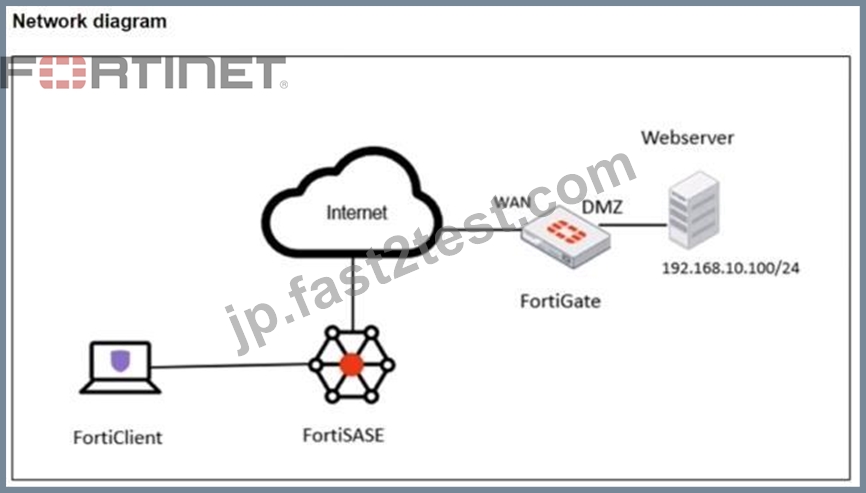
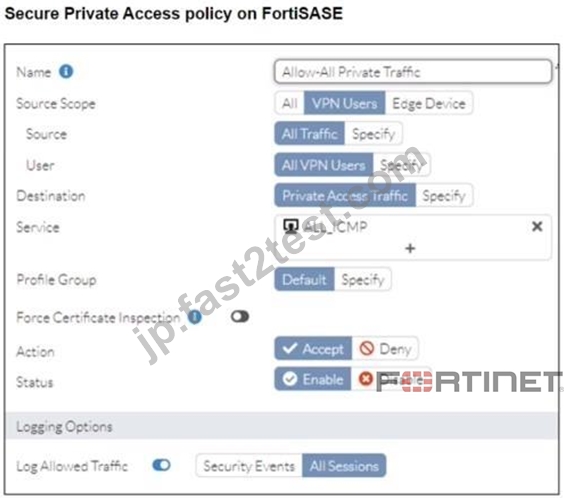

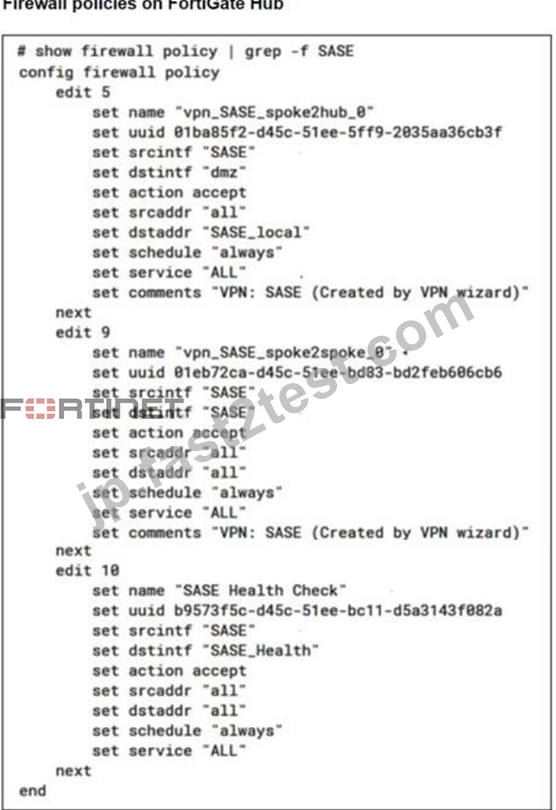
- A. Quick mode selectors are restricting the subnet.
- B. Network address translation (NAT) is not enabled on the spoke-to-hub policy.
- C. The BGP route is not received.
- D. The Secure Private Access (SPA) policy needs to allow PING service.
正解:C
質問 # 40
Which actions enhance compliance in FortiSASE deployments?
(Select all that apply)
Response:
- A. Implementing data encryption
- B. Disabling user activity logs
- C. Regular updates of compliance rules
- D. Allowing unregulated file sharing
正解:A、C
質問 # 41
Which FortiSASE feature is essential for real-time threat detection?
Response:
- A. Scheduled security updates
- B. Dashboard configuration
- C. Device management
- D. Real-time log analysis
正解:D
質問 # 42
Which command is used to verify the status of compliance checks for user devices in FortiSASE?
Response:
- A. diagnose compliance check
- B. diagnose debug compliance
- C. get system compliance status
- D. execute compliance verify
正解:C
質問 # 43
When using Secure Private Access (SPA) and SD-WAN, which protocol is used for spoke-to-spoke connectivity?
Response:
- A. GRE
- B. SSL
- C. IPSEC
- D. eBGP
正解:C
質問 # 44
How do security posture checks enhance SASE deployment in an enterprise environment?
Response:
- A. By ensuring all devices meet predefined security standards before accessing the network
- B. By simplifying user management
- C. By enabling faster data transfers
- D. By decreasing the network's operational costs
正解:A
質問 # 45
Customizing FortiSASE dashboards allows security analysts to focus on the most critical data relevant to their role.
Response:
- A. True
- B. False
正解:A
質問 # 46
......
Fortinet FCSS_SASE_AD-24 認定試験の出題範囲:
| トピック | 出題範囲 |
|---|---|
| トピック 1 |
|
| トピック 2 |
|
| トピック 3 |
|
| トピック 4 |
|
テストエンジン練習FCSS_SASE_AD-24テスト問題:https://jp.fast2test.com/FCSS_SASE_AD-24-premium-file.html
Fortinet FCSS_SASE_AD-24日常練習試験は2026年最新のに更新された56問あります:https://drive.google.com/open?id=10eiytoa9li70za09dFqZ-Lt4sTtdaGp6