

Fast2test HPE6-A86問題集PDFで100%合格保証付き
HPE6-A86ブレーン問題集でリアル試験最新問題2026年07月22日には132問題
質問 # 74
Which type of routing protocol dynamically adapts to changes in network topology and link status?
- A. Static routing
- B. Link-state routing
- C. Distance-vector routing
- D. Dynamic routing
正解:D
質問 # 75
The configuration below is an example of which security concept?
Switch(config)# user-group external-auditors
Switch(config-ur-grp-external-auditors)# 10 permit cli command " show version " Switch(config-ur-grp-external-auditors)# 20 permit cli command " show run "
- A. Authentication
- B. Role-based Access Control
- C. Zero Trust
- D. Accounting
正解:B
解説:
The correct answer is D. Role-based Access Control. The configuration creates a user-defined local user group named external-auditors and then permits only specific CLI commands for that group. HPE Aruba Networking AOS-CX hardening documentation explains that user-defined local groups are used for local authorization and that local authorization uses role-based access control, or RBAC, to provide role-based privilege levels and optional command execution rules. The CLI command documentation also states that permit or deny cli command rules define which CLI commands can be executed by members of a user- defined group, with an implicit deny rule at the end. This matches RBAC because access is granted according to the user's assigned role or group. Option A is incorrect because authentication verifies identity, such as username and password. Option B is incorrect because accounting records user activity. Option C is broader security architecture terminology, but the specific configuration shown is command authorization through RBAC.
質問 # 76
A Network Operator is reviewing the Spanning Tree status on an access switch. One port, 1/1/48, which is an uplink to a distribution switch, is showing a "Blocking" state.
show spanning-tree
Spanning Tree Information
STP Enabled : Yes
Mode : RSTP
Root Bridge ID : 00:00:00:00:01:00
This Bridge ID : 00:00:00:00:02:00
Port Role State Cost Priority
- - -- - --
1/1/1 Designated Forwarding 20000 128
...
1/1/48 Alternate Blocking 20000 128
What does the "Alternate" role for port 1/1/48 in an RSTP environment signify?
- A. The port has detected a BPDU guard violation and is in a shutdown state.
- B. The port is disabled and cannot be used.
- C. The port provides a redundant, backup path towards the Root Bridge.
- D. The port is actively forwarding traffic but is not the primary uplink.
正解:C
質問 # 77
What does DSCP stand for and at which layer of the OSI model does it operate?
- A. Differentiated Service Code Point, Layer 3
- B. Data Service Control Point, Layer 2
- C. Data Segment Control Protocol, Layer 3
- D. Differentiated Service Code Point, Layer 2
正解:A
質問 # 78
A Network Operator is troubleshooting a connectivity issue where a host (10.10.10.50) cannot communicate with its default gateway (10.10.10.1). When the operator checks the ARP table on the gateway, the entry for 10.10.10.50 is "Incomplete".
What is the function of the Address Resolution Protocol (ARP) in this scenario?
- A. To assign a dynamic IP address to the host.
- B. To determine the Layer 3 route the host should use to reach the gateway.
- C. To translate the private IP address of the host to a public IP address.
- D. To discover the MAC address of the host associated with the IP address 10.10.10.50.
正解:D
質問 # 79
Drag and Drop Question
Match the HPE Aruba Networking CX switch features with a given product line.
正解:
解説:
質問 # 80
A router's IP routing table has an entry with a next-hop IP address of 10.30.233.1.
What does this number represent?
- A. The cached ARP entry for the destination MAC address.
- B. The packet destination.
- C. The next Layer 2 switch that should receive the packet.
- D. The next Layer 3 device that should receive the packet.
- E. The router's own egress interface for routing.
正解:A
質問 # 81
A Junior Network Engineer is tasked with the initial setup of a new HPE Aruba Networking CX
6100 switch. The switch needs to be configured with a hostname, a secure local administrator password, and a management IP address so it can be accessed on the network.
Initial State:
* The switch is in its factory default state.
* The engineer is connected to the switch via the console port.
Required Configuration:
* Hostname: `ALS-01`
* Admin Password: `Aruba!CX!2023`
* Management Interface: `vlan 1`
* Management IP Address: `192.168.5.10/24`
Which of the following configuration sets correctly implements all the specified initial settings?
- A. switch(config)# set hostname ALS-01
switch(config)# password administrator Aruba!CX!2023
switch(config)# vlan 1 ip address 192.168.5.10/24 - B. switch# configure terminal
switch(config)# hostname ALS-01
ALS-01(config)# password administrator plaintext Aruba!CX!2023 ALS-01(config)# interface vlan 1 ALS-01(config-if-vlan)# ip address 192.168.5.10/24 - C. switch# configure
switch(config)# hostname ALS-01
ALS-01(config)# password administrator
Enter password: Aruba!CX!2023
Retype password: Aruba!CX!2023
ALS-01(config)# interface default
ALS-01(config-if)# ip address 192.168.5.10 255.255.255.0 - D. switch# configure terminal
switch(config)# hostname ALS-01
ALS-01(config)# password administrator
Enter password: Aruba!CX!2023
Retype password: Aruba!CX!2023
ALS-01(config)# interface vlan 1
ALS-01(config-if-vlan)# ip address 192.168.5.10/24
正解:D
質問 # 82
Which item is at the Physical Layer of the OSI model?
- A. TCP port
- B. Switch port
- C. IP address
- D. URL
正解:B
解説:
The correct answer is B. Switch port. The Physical Layer of the OSI model is concerned with the physical transmission of signals across network media, including electrical or optical signaling, cabling, connectors, transceivers, and physical interfaces. HPE Aruba Networking hardware and transceiver documentation describes switch ports, transceiver slots, copper cabling, fiber-optic cabling, and link LEDs as physical connection components. A switch port is therefore the only option listed that belongs directly to the Physical Layer. Option A, URL, is associated with application-level access to web resources and is not a Physical Layer item. Option C, IP address, belongs to Layer 3 because it is used for logical addressing and routing.
Option D, TCP port, belongs to Layer 4 because TCP ports identify transport-layer application sessions.
Although a switch port may participate in Layer 2 switching after a link is established, the physical connector
/interface itself is part of the Layer 1 network infrastructure. This makes "switch port" the correct answer from the listed options.
質問 # 83
How does dynamic Link Aggregation Group (LAG) differ from a static LAG?
- A. Dynamic LAGs automatically negotiate and manage link aggregation.
- B. Static LAGs utilize protocols like LACP for automatic link aggregation.
- C. Static LAGs provide load-balancing capabilities without additional configuration.
- D. Dynamic LAGs require manual configuration by network administrators.
正解:A
質問 # 84
What are two primary concerns regarding layer two loops in a redundant topology? (Choose two.)
- A. broadcast storms
- B. routing loops
- C. security issues with a redundant loop indicating to hackers that a back-door exists
- D. multiple frame copies leading to instability of the MAC address table
- E. costs associated with upgrading from copper to fiber
正解:A、D
解説:
Layer 2 loops cause Broadcast Storms and MAC table instabilities.
質問 # 85
Based on the given output:
router ospf 1
redistribute connected route-map ospf-redist
area 0.0.0.0
Which HPE Aruba Networking CX switch can be used to create this configuration?
- A. CX 6100
- B. CX 6300
- C. CX 4100i
- D. CX 6000
正解:B
解説:
The correct answer is A. CX 6300. The configuration shown uses OSPFv2 with a process ID, redistribution of connected routes, and a route map. HPE Aruba Networking AOS-CX IP Routing documentation for the CX
6300 and related higher CX platforms includes OSPFv2 routing commands such as router ospf and redistribute connected route-map. The same command documentation shows redistribution into OSPF with a route map as a supported configuration. By contrast, the AOS-CX IP Routing Guide for lower platforms such as the 4100i, 6000, and 6100 includes OSPF command information showing platform support for OSPF on
5420 and 6200, not on the 4100i, 6000, or 6100. Therefore, from the choices provided, the CX 6300 is the switch family that supports creating this OSPF redistribution configuration. The CX 6000 and CX 6100 are access-layer switches and are not the correct choice for this OSPF route redistribution example.
質問 # 86
A switch port is up, but no traffic is being forwarded. What could be a possible reason?
- A. The IP address is incorrect
- B. The switch does not support VLANs
- C. The switch is running in LACP passive mode
- D. The port is in a blocking state due to STP
正解:D
解説:
The Spanning Tree Protocol (STP) is used to prevent loops in a network by designating one active path and blocking redundant paths. If a switch port is up but no traffic is being forwarded, it's likely that the port is in a blocking state due to STP. This means that STP has determined that the port is part of a redundant path and has blocked it to avoid network loops.
質問 # 87
A Security Analyst is troubleshooting an application issue where data is being corrupted during transmission. The analyst suspects there is no mechanism in place to ensure all data segments are received and reassembled correctly.
Which layer of the OSI model is responsible for providing reliable, connection-oriented data transmission, including error checking and recovery?
- A. Layer 2 (Data Link)
- B. Layer 3 (Network)
- C. Layer 4 (Transport)
- D. Layer 7 (Application)
正解:C
質問 # 88
What is a characteristic of a static route?
- A. Responsive to network changes
- B. Automatically learned
- C. Must be manually configured
- D. High processing overhead
正解:C
解説:
The correct answer is A. Must be manually configured. HPE Aruba Networking AOS-CX documentation states that static routes are manually configured in the routing table. A static route defines a destination network and the next-hop address or exit interface that the switch should use to forward traffic. Static routes are useful in small, simple, or predictable networks because they are straightforward and do not require a dynamic routing protocol to exchange route information. Option B is incorrect because automatically learned routes are associated with dynamic routing protocols, such as OSPF or BGP, not static routing. Option C is incorrect because static routes usually have low processing overhead compared to dynamic routing protocols, since the switch does not need to run neighbor discovery, exchange routing updates, or calculate topology changes. Option D is incorrect because static routes do not automatically respond to network topology changes unless supported by an additional tracking mechanism or manually changed by an administrator.
Therefore, the defining characteristic of a static route is manual configuration.
質問 # 89
What are the benefits of creating VLANs? (Select two)
- A. MAC address tables are smaller
- B. Simplify the network deployment
- C. Smaller broadcast domains can improve performance
- D. Minimize the need for routing
- E. Separate VLANs mitigate risk
正解:C、E
質問 # 90
Drag and Drop Question
You are troubleshooting a connectivity issue and are reviewing your notes after talking to your team. Classify each piece of information as either a symptom or a possible cause. (Matches may be used more than once.)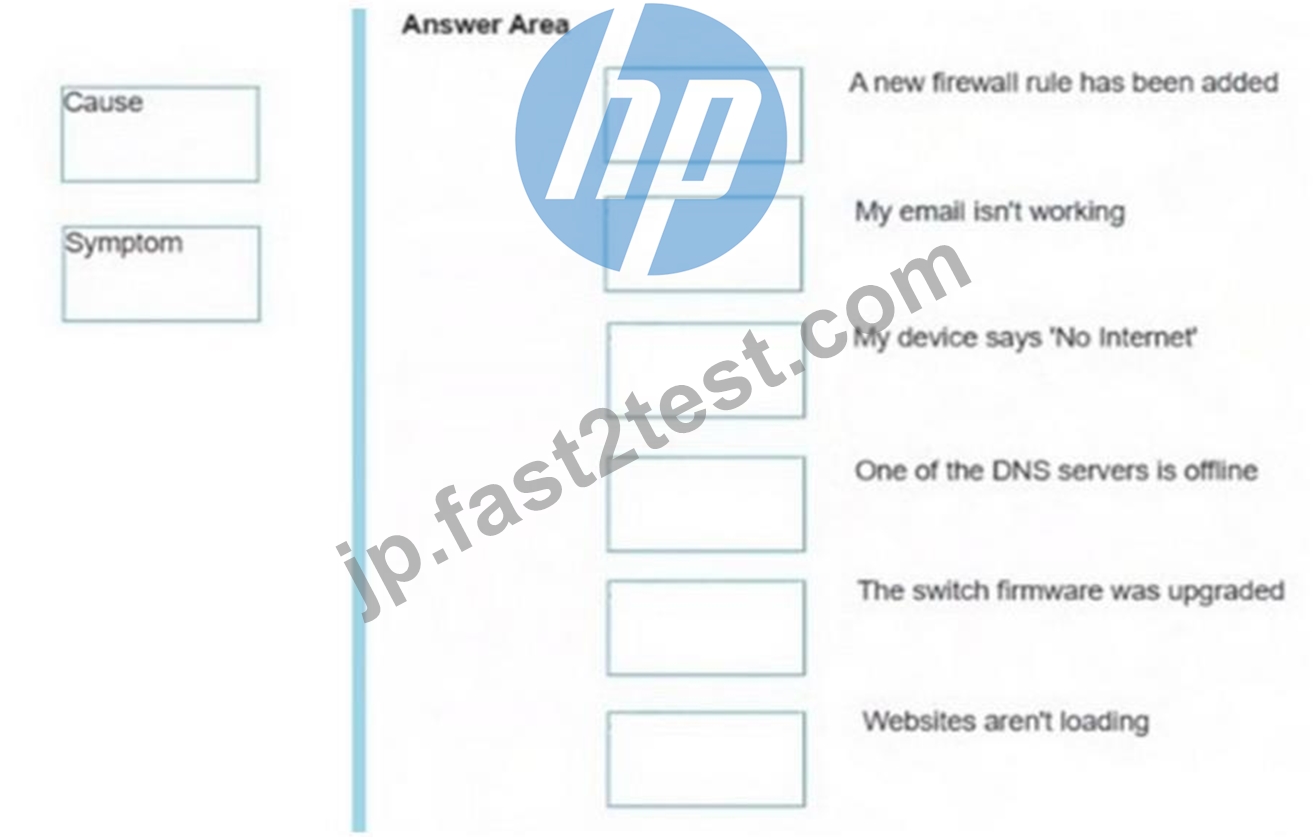
正解:
解説:
Explanation:
A symptom is an observed problem experienced by users or systems. A cause is a change, condition, or failure that could plausibly explain those observed problems.
質問 # 91
How do you configure an IP address for the management interface on an HPE Aruba Networking CX 6300?
- A. vrf mgmt
!
interface mgmt
no shutdown
ip static 10.250.136.52/29
default-gateway 10.250.136.49
vrf attach mgmt - B. interface mgmt
no shutdown
ip address 10.250.136.52/29
default-gateway 10.250.136.49 - C. interface mgmt
no shutdown
ip address 10.250.136.52/29
default-gateway 10.250.136.49
vrf attach mgmt - D. interface mgmt
no shutdown
ip static 10.250.136.52/29
default-gateway 10.250.136.49
正解:D
解説:
The correct answer is A. On HPE Aruba Networking AOS-CX switches, the out-of-band management interface is configured under interface mgmt. For a static IPv4 address on the management interface, the correct command is ip static, not ip address. HPE Aruba Networking documentation shows the management interface configuration using interface mgmt, then ip static < address/prefix > , followed by default-gateway < gateway-address > when a gateway is required. The default-gateway command assigns the IPv4 or IPv6 default gateway to the management interface, and HPE documentation notes that an IPv4 default gateway can only be configured if a static IPv4 address has been assigned to the management interface. Option B is incorrect because ip address is used on routed interfaces or VLAN interfaces, not the CX management interface command syntax. Option C is incorrect for the same reason and because vrf attach mgmt is not required here. Option D includes unnecessary VRF configuration and the invalid vrf attach mgmt
質問 # 92
......
HPE6-A86問題集には100%厳密検証された問題と解答で合格保証付きもしくは全額返金:https://jp.fast2test.com/HPE6-A86-premium-file.html
最新HPE6-A86PDF問題集リアル無料テスト本日更新です:https://drive.google.com/open?id=1dUVAOQ3UXoR5KgpRAofyJSbSRP0VnAov