

Fast2test GES-C01リアル試験問題GES-C01練習問題集
厳密検証されたGES-C01試験問題集と解答で無料提供のGES-C01問題と正解付き
質問 # 42
A data application developer is building a Streamlit chat application within Snowflake. This application uses a RAG pattern to answer user questions about a knowledge base, leveraging a Cortex Search Service for retrieval and an LLM for generating responses. The developer wants to ensure responses are relevant, concise, and structured. Which of the following practices are crucial when integrating Cortex Search with Snowflake Cortex LLM functions like AI_COMPLETE for this RAG chatbot?
- A. For performance and cost optimization, it is always recommended to query Cortex Search and the LLM function within a single
- B. Using the
- C. To maintain conversational context in a multi-turn chat, the developer should pass all previous user prompts and model responses in the
- D. The retrieved context from Cortex Search should be directly concatenated with the user's prompt as input to the
- E. The

正解:B、C
解説:
質問 # 43
An enterprise is deploying a new RAG application using Snowflake Cortex Search on a large dataset of customer support tickets. The operations team is concerned about managing compute costs and ensuring efficient index refreshes for the Cortex Search Service, which needs to be updated hourly. Which of the following considerations and configurations are relevant for optimizing cost and performance of the Cortex Search Service in this scenario?
- A. For embedding text, selecting a model like

- B. The
- C. CHANGE_TRACKING
- D. For optimal performance and cost efficiency, Snowflake recommends using a dedicated warehouse of size no larger than MEDIUM for each Cortex Search Service.
- E. The primary cost driver for Cortex Search is the number of search queries executed against the service, with the volume of indexed data (GBImonth) having a minimal impact on overall billing.
正解:A、B、C、D
解説:
Option A is correct because a Cortex Search Service requires a virtual warehouse to refresh the service, which runs queries against base objects when they are initialized and refreshed, incurring compute costs. Option B is correct because the cost of embedding models varies. For example, 'snowflake-arctic-embed-m-v1.5 costs 0.03 credits per million tokens, while 'voyage-multilingual-2 costs 0.07 credits per million tokens. Choosing a more cost-effective model like 'snowflake-arctic-embed-m-v1.5 for English-only data can reduce token costs. Option C is correct because Snowflake recommends using a dedicated warehouse of size no larger than MEDIUM for each Cortex Search Service to achieve optimal performance. Option D is correct because change tracking is required for the Cortex Search Service to be able to detect and process updates to the base table, enabling incremental refreshes that are more efficient than full re-indexing. Option E is incorrect because Cortex Search Services incur costs based on virtual warehouse compute for refreshes, cost per input token, and a charge of 6.3 Credits per GB/mo of indexed data. The volume of indexed data has a significant impact, not minimal.
質問 # 44 
- A.

- B.

- C.

- D.

- E.

正解:A、D、E
解説:
To prepare a Document AI model build, the role must be granted the database role. In addition, it requires 'USAGE' on the database, 'USAGE on the schema, 'USAGE on the warehouse, and 'OPERATE on the warehouse. Options A, B, and D correctly grant the necessary 'USAGE privileges. Option C grants 'OPERATE on the warehouse, which is also a necessary privilege but is not a 'USAGE' privilege as specifically asked in the question. Option E grants 'CREATE STAGES, which is required for creating processing pipelines but not strictly for initiating a new model build itself.
質問 # 45
A data scientist is implementing a Retrieval Augmented Generation (RAG) system in Snowflake for a legal document repository. They need to convert legal document chunks into vector embeddings and efficiently find the most relevant document chunks based on a user's query. Which of the following statements accurately describe the process and best practices for creating and using these vector embeddings with Snowflake Cortex LLM functions?
- A. Option D
- B. Option A
- C. Option B
- D. Option C
- E. Option E
正解:B、D
解説:
質問 # 46
A financial analytics team is developing an application to extract specific, structured financial data (e.g., company name, revenue, profit margin) from various news articles using Snowflake Cortex LLM functions. They require the output to strictly conform to a predefined JSON schema and want to ensure robust error handling. Which of the following statements are crucial considerations for achieving this goal?
- A. The AI_COMPLETE function should be used with the response_format argument, supplying a JSON schema object that defines the required structure, data types, and constraints for the output.
- B. To guarantee that critical fields like 'company name' and 'revenue' are always extracted, these properties must be explicitly listed within the ' required' array of the JSON schema provided to AI_COMPLETE.
- C. Setting the temperature option to 0 in the AI_COMPLETE call is essential for obtaining the most consistent and accurate structured JSON outputs, regardless of task complexity or model used.
- D. For enhanced reliability in production pipelines, the team should wrap their AI_COMPLETE calls within TRY_COMPLETE, as it returns a structured error object if the model fails to adhere to the schema, allowing for detailed debugging.
- E. The complexity of the JSON schema provided to AI_COMPLETE has no impact on compute costs, as only the input text and generated content tokens are billed.
正解:A、B、C
解説:
Option A is correct. AI_COMPLETE Structured Outputs allows specifying a JSON schema via the argument to ensure response _ format responses follow a defined structure, data types, and constraints. Option B is correct. Using the field in the JSON schema ensures that required specified properties are extracted, or an error is raised by making extraction of critical information reliable. Option C is incorrect. COMPLETE, performs the same operation as COMPLETE (or AI_COMPLETE) but returns instead of raising an error when the operation cannot be TRY COMPLETE NULL performed. It does not return a structured error object for detailed debugging, but rather handles the error by returning allowing a pipeline to NULL, continue. Option D is correct. For the most consistent results and to optimize JSON adherence accuracy, it is recommended to set the temperature option to 0 when calling COMPLETE (or AI_COMPLETE). Option E is incorrect. The number of tokens processed (and billed) increases with schema complexity. A larger and more complex supplied schema generally consumes more input and output tokens, leading to higher compute costs.
質問 # 47
A security engineer is developing an application that uses the Snowflake Cortex REST API to interact with LLMs, specifically to obtain structured outputs for text classification and to ensure secure communication. They are focusing on the /api/v2/cortex/ inference : complete endpoint. Which of the following statements correctly describe aspects of this interaction?
- A. For models like OpenAI (GPT) used via the Cortex REST API with structured output, the JSON schema in the response_format field must include "additionalProperties": false and a "required" field listing all properties at every node.
- B. Authentication for Cortex REST API requests is primarily handled through an Authorization: Bearer header, where the token can be a JSON Web Token (JWT), OAuth token, or programmatic access token.
- C. The Cortex REST API for LLM inference always returns the complete LLM response as a single, fully-formed JSON object once generation is finished, regardless of any streaming options.
- D. To ensure the most consistent and deterministic structured output from the LLM, it is recommended to set the temperature option to a higher value, such as 0.7 or 1.0, in the request payload.
- E. To strictly enforce a JSON schema for the LLM's response, the response_format parameter must be included in the request body, supplied as a JSON schema object, which helps reduce post-processing efforts.
正解:A、B、E
解説:
質問 # 48
A Gen AI developer has a Document AI pipeline that uses a query with 'GET PRESIGNED URL' to process multi-page PDF documents. Despite the internal stage being correctly set up with 'SNOWFLAKE SSE' encryption and the model build being published, they observe inconsistent results. Some documents result in a Received HTTP 403 response for presigned URL. URL may be expired.
error, while other documents (containing complex diagrams and dense text in an unsupported language like Korean) are processed, but the extracted information is often incomplete or inaccurate.
Which two factors are most likely contributing to these observed issues?
- A. The role lacks the 'EXECUTE TASK' privilege, preventing the scheduled pipeline tasks from running.
- B. The '!PREDICT method is being called with an outdated model build version instead of the latest one, leading to performance degradation.
- C. The documents are in an unsupported language or exceed the maximum page length of 125 pages, causing extraction failures or inaccuracies.
- D. The Document AI model is returning answers longer than its limit of 512 tokens for entity extraction or 2048 tokens for table extraction.
- E. The default expiration time for the 'GET PRESIGNED URL' function is causing some URLs to expire before the Document AI model can process them.
正解:C、E
解説:
The error 'Received HTTP 403 response for presigned URL. URL may be expired.' directly indicates that the function's default expiration time is causing some documents to be inaccessible by the Document AI model. This is a common issue when processing pipelines encounter delays. Additionally, the observation of incomplete or inaccurate extraction for documents with 'dense text in an unsupported language like Korean' directly points to language limitations. Document AI explicitly lists supported languages (English, Spanish, French, German, Portuguese, Italian, and Polish) and states that results for other languages might not be satisfactory. While the question mentions 'multi-page PDF documents' without explicitly stating they exceed page limits, the mention of 'complex diagrams and dense text' can also imply potential issues if page length (max 125 pages) is exceeded or other document requirements are not met. Thus, option D comprehensively covers these content- related issues. Option A (outdated model version) is unlikely to cause these specific errors, as the latest model is used by default if not specified. Option C (missing 'EXECUTE TASK privilege) would prevent task execution entirely, not cause intermittent URL issues or content- specific extraction problems. Option E (answers exceeding token limits) would be reflected in truncated output, not necessarily 'incomplete or inaccurate' extraction in the sense of failing to identify information in the first place.
質問 # 49
A data scientist is preparing to log a custom PyCaret classification model into the Snowflake Model Registry. The goal is to deploy this model on Snowpark Container Services (SPCS) for scalable inference. The PyCaret model relies on the 'pycaret' and 'scipy' Python libraries, and the data scientist has local 'sample data.csv' for inferring the model's signature. Which statements are crucial for successfully logging this custom model for eventual SPCS deployment?
- A. Option D
- B. Option A
- C. Option C
- D. Option E
- E. Option B
正解:C、E
解説:
Option B is correct because for models deployed to Snowpark Container Services, dependencies are typically obtained from 'conda- forge' or PyPl. Therefore, 'pip_requirements' is the appropriate way to specify PyPl packages, and explicitly setting ['SNOWPARK_CONTAINER_SERVICEST guides the deployment target. Option C is correct because either (a Pandas or Snowpark DataFrame) or a model 'signature' must be provided to the method for input validation and to infer the model's input signature. Option A is incorrect because 'conda_dependencieS in 'log_model' assumes the Snowflake channel for warehouse deployment, whereas for SPCS, it's 'conda-forge' or PyPl. Mixing channels or assuming Snowflake channel for SPCS is incorrect. Option D is incorrect. The 'use_gpu" option is used when 'loading' a model version Cmv.load(options={'use_gpu': to enable GPU-specific loading logic, not when logging the model. GPU requests for inference are specified when creating the service. Option E is incorrect. Snowflake recommends using only 'conda_dependencieS or 'pip_requirements' , not both, to avoid potential compatibility issues during the container image build.
質問 # 50
An administrator has configured the 'CORTEX_MODELS_ALLOWLIST parameter to only permit the 'mistral-large? model at the account level. A user with the 'PUBLIC' role, which has been granted 'SNOWFLAKE.CORTEX USER and 'SNOWFLAKE."CORTEX- MODEL-ROLE-LLAMA3.1-70B"' , attempts to execute several 'AI COMPLETE queries. Which of the following queries will successfully execute?
- A.

- B.

- C.

- D.

- E.

正解:B、C
解説:
Option A is correct. The query directly references 'MISTRAL-LARGE2', which is explicitly in the account-level , so it will succeed. Option B is correct. When a model name is provided as a string argument, Cortex first treats it as an identifier for a schema-level model object. If found, RBAC is applied. The user's role has 'SNOWFLAKE."CORTEX-MODEL-ROLE-LLAMA3.1-70B"' granted, which provides access to the 'LLAMA3.1-70B' model object in 'SNOWFLAKE.MODELS' , regardless of the 'CORTEX MODELS_ALLOWLIST setting for plain model names. Option C is incorrect because 'llama3.1-70b' as a plain model name is not in the 'CORTEX_MODELS_ALLOWLIST. Although the user has access to the model object, a plain string like 'llama3.1-70b' will be looked up in the allowlist after failing to match a model object by that plain name, and the allowlist only has 'MISTRAL-LARGE2'. Option D is incorrect. 'snowflake-arctic' is neither in the 'CORTEX MODELS ALLOWLIST nor does the user have a specific application role granting access to a 'snowflake-arctic' model object. Option E is incorrect because 'ALTER ACCOUNT operations can only be performed by the 'ACCOUNTADMIN' role, not by a SPUBLIC' user role.
質問 # 51
A Snowflake developer, 'AI _ ENGINEER , is creating a Streamlit in Snowflake (SiS) application that will utilize a range of Snowflake Cortex LLM functions, including SNOWFLAKE. CORTEX. COMPLETE, SNOWFLAKE .CORTEX.CLASSIFY TEXT, and SNOWFLAKE. CORTEX. EMBED TEXT 768. The application also needs to access data from tables within a specific database and schem a. 'AI _ ENGINEER has created a custom role, for the application to operate under. Which of the following privileges or roles are absolutely necessary to grant to for the successful execution of these Cortex LLM functions and interaction with the specified database objects? (Select all that apply.)
- A.

- B. The ACCOUNTADMIN role to ensure unrestricted access to all Snowflake Cortex features.
- C. The USAGE privilege on the specific database and schema where the Streamlit application and its underlying data tables are located.
- D. The CREATE COMPUTE POOL privilege to provision resources for the Streamlit application.
- E.

正解:C、E
解説:
To execute Snowflake Cortex AI functions such as 'SNOWFLAKE.CORTEX.COMPLETE , 'SNOWFLAKE.CORTEX.CLASSIFY_TEXT , and (or their 'AL' prefixed counterparts), the role used by the application in this case) must be granted the 'SNOWFLAKE.CORTEX USER database role. Additionally, for the application to access any database or schema objects (like tables for data input/output or storing the Streamlit app itself), the 'USAGE privilege must be granted on those specific database and schema objects. option B, 'CREATE SNOWFLAKE.ML.DOCUMENT_INTELLIGENCE , is a privilege specific to creating Document AI model builds and is not required for general Cortex LLM functions. Option D, 'ACCOUNTADMIN', grants excessive privileges and is not a best practice for application roles. Option E, 'CREATE COMPUTE POOL' , is a privilege related to Snowpark Container Services for creating compute pools, which is not directly required for running a Streamlit in Snowflake application that consumes Cortex LLM functions.
質問 # 52
A data scientist, 'Dl DEV', has been granted the

Despite these grants, 'DI_DEV' still receives a 'permission denied' error when attempting to ''prepare'' the Document AI model build in Snowsight. Which 'single missing privilege' is the most likely direct cause of this specific error for Document AI model build preparation?
- A.

- B.

- C.

- D.

- E.

正解:D
解説:
質問 # 53
A team is developing a critical business intelligence application that leverages Snowflake Cortex Analyst to provide natural language querying capabilities over complex structured dat a. To minimize operational costs while maintaining high accuracy, which of the following strategies are most effective for optimizing the cost efficiency of the Cortex Analyst service?
- A. Using a smaller, less capable LLM as the underlying summarization agent for multi-turn conversations to reduce token processing costs, even if it slightly degrades conversational context.
- B. Implementing a comprehensive Verified Query Repository (VQR) to guide Cortex Analyst towards pre-validated SQL queries for common questions, which ensures predictable execution and reduces LLM inference iterations.
- C. Optimizing the semantic model YAML file by reducing the number of logical tables and columns to decrease the metadata processed by Cortex Analyst's LLMs per message.
- D. Leveraging Cortex Search Services integration within the semantic model to improve literal value matching, thereby reducing the need for Cortex Analyst to perform expensive fuzzy string matching or re-prompt the user.
- E. Configuring a custom instruction with a short, precise task description to reduce the input token count for the LLMs orchestrating SQL generation.
正解:B、D
解説:
Option B is correct because a Verified Query Repository (VQR) helps Cortex Analyst leverage pre-validated SQL for similar questions, improving accuracy and potentially reducing the number of LLM inference calls or complex reasoning steps required for SQL generation, thus making usage more efficient and reducing cost associated with less optimal LLM calls. Option D is correct because integrating Cortex Search Services improves literal search, helping Cortex Analyst find exact literal values needed for SQL queries more accurately and efficiently, which can reduce ambiguity and the need for multiple LLM iterations or incorrect queries, ultimately leading to more cost-effective message processing. Option A is incorrect: While using a smaller LLM might seem to save cost, Llama 3.1 70B was specifically chosen as the summarization agent for multi-turn conversations in Cortex Analyst due to its higher accuracy in rephrasing questions and avoiding errors, implying that a less capable model would degrade performance and potentially lead to more (and thus more expensive) overall messages to achieve a correct answer. The cost for Cortex Analyst is per message, not per token for this component. Option C is incorrect. While a well- scoped semantic model is recommended for accuracy, the sources do not explicitly state that reducing the number of logical tables and columns 'directly' reduces the per-message cost of Cortex Analyst, which is fixed per message. The impact would be indirect through improved accuracy or reduced processing complexity, but not a direct cost reduction based on metadata size for the fixed per-message billing. Option E is incorrect. Cortex Analyst cost is based on the number of messages, not the token count of prompts. While good prompt engineering (like concise custom instructions) is generally good practice, it does not directly reduce the per-message cost of Cortex Analyst as it would for token- based LLM calls.
質問 # 54
A new Gen AI team member attempts to use Document AI to process a batch of 1 ,500 scanned image files (JPG) that are 70 MB each, stored in an internal stage that was created without specifying an encryption type. Their '!PREDICT' queries consistently fail with various errors. Which of the following are valid reasons for the '!PREDICT' queries to fail in this scenario?
- A. The individual JPG files exceed the maximum supported file size for Document AI.
- B. The internal stage was not created with 'ENCRYPTION = (TYPE = 'SNOWFLAKE SSE'V, which is a requirement for Document AI.
- C. Processing 1 ,500 documents in one query exceeds the maximum limit for Document AI.
- D. JPG is an unsupported file format for Document AI.
- E. The team member's role lacks the database role, which is essential for using Document AI functions.
正解:A、B、C、E
解説:
Option A is correct because internal stages used with Document AI must specify 'ENCRYPTION = (TYPE = 'SNOWFLAKE_SSE')' when created. Option B is correct as the database role is required for the account role to use Document AI functions to extract information. Option C is correct because Document AI supports processing a maximum of 1 ,000 documents in one query, so 1 ,500 documents would exceed this limit. Option D is correct because documents processed by Document AI must be 50 MB or less in size, and the 70 MB files exceed this limit. Option E is incorrect because JPG is listed as a supported file format for Document AI.
質問 # 55
A data engineering manager needs to audit Cortex LLM function costs to identify specific SQL queries that are unexpectedly high in token consumption for the 'llama3.1-8b' model. They require granular analysis of prompt, completion, and guardrail token usage for these queries. Which of the following Snowflake methods or views would provide the necessary insights?
- A. Option D
- B. Option C
- C. Option A
- D. Option E
- E. Option B
正解:A、E
解説:
質問 # 56
A data science team is using SNOWFLAKE. CORTEX. CLASSIFY_TEXT to categorize product reviews into detailed segments like 'Bug Report - Critical', 'Feature Request - UI/UX', 'General Praise', or 'Query - Billing Issue'. For highly nuanced reviews, they find the initial classifications lack precision, and they are also concerned about the associated compute costs for processing large volumes of dat a. Which strategies should they employ to optimize classification accuracy and manage costs effectively with this function?
- A. If classifying thousands of reviews, they can significantly reduce overall compute costs by setting the temperature option to 0.0 within CLASSIFY_TEXT to ensure deterministic and cheaper inference.
- B. For complex scenarios where the relationship between review text and categories is not straightforward, including a concise task_description (e.g., 'Classify the product review focusing on technical support relevance') in the options argument is recommended to guide the model.

- C. To reduce input token costs for classifications, the input text should be pre-processed to remove common stop words and punctuation, as these characters are counted as billable tokens without contributing to classification accuracy.
- D. CLASSIFY_TEXT labels, descriptions, and examples are counted as input tokens only once per function call, regardless of the number of records processed in a batch, to optimize cost efficiency.
- E. To improve accuracy for ambiguous classifications, they should augment the list_of_categories with explicit description and examples for each category, understanding that these additions will increase input token costs for each record processed.

正解:B、E
解説:
Option A is correct because adding label descriptions and examples can improve classification accuracy, especially when category definitions are ambiguous. The source explicitly states that each label, description, and example counts as input tokens for each record processed by a 'CLASSIFY _ TEXT function call, incurring costs accordingly. Option B is correct because adding a clear 'task_description' can improve accuracy when the relationship between the input text and categories is ambiguous or nuanced. Option C is incorrect; while token counts contribute to cost, the sources do not recommend removing stop words and punctuation for cost reduction or as a general best practice for SCLASSIFY TEXT. The focus is on using plain English input. Option D is incorrect because the 'temperature' option is available for 'COMPLETE and functions to control output randomness, but it is not listed as an option for 'CLASSIFY _ TEXT in its syntax. Furthermore, while a lower temperature can make results more deterministic, the source does not link it to 'cheaper' inference cost for these task-specific functions, but rather to consistency for 'COMPLETE. Option E is incorrect because 'AI_CLASSIFY labels, descriptions, and examples are indeed counted as input tokens for 'each record processed' , not just once per call, as clearly stated in the cost considerations.
質問 # 57
A data analytics team aims to enhance their understanding of customer feedback stored in a Snowflake table called CUSTOMER_FEEDBACK. This table has a REVIEW_TEXT column containing raw customer comments and a CUSTOMER_SEGMENT column. The team wants to classify each review into predefined categories and then generate a concise summary of all reviews for each customer segment. Which of the following Snowflake Cortex AI functions and approaches should they use?
- A. Option D
- B. Option A
- C. Option E
- D. Option B
- E. Option C
正解:B、C、E
解説:
質問 # 58
A data application developer is tasked with building a multi-turn conversational AI application using Streamlit in Snowflake (SiS) that leverages the COMPLETE (SNOWFLAKE. CORTEX) LLM function. To ensure the conversation flows naturally and the LLM maintains context from previous interactions, which of the following is the most appropriate method for handling and passing the conversation history?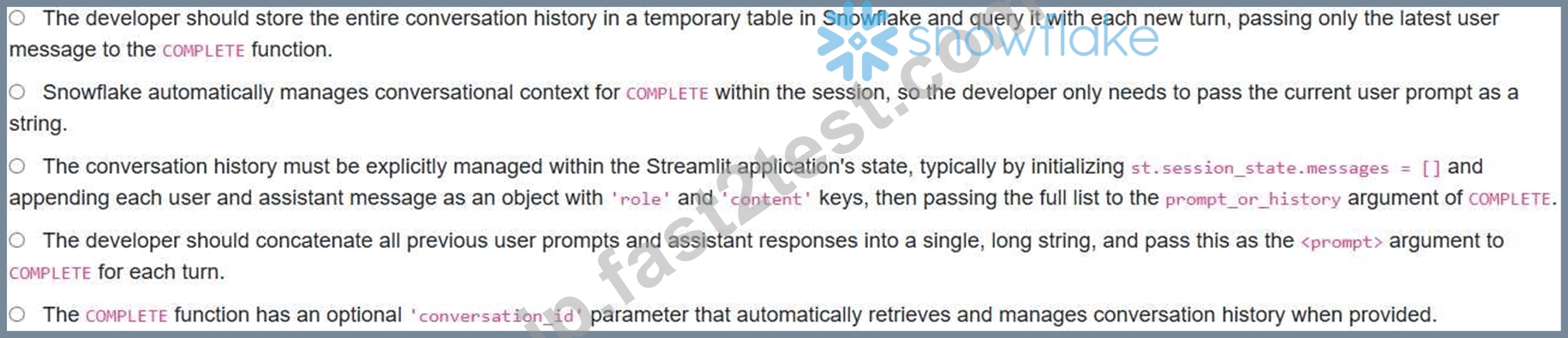
- A. Option D
- B. Option A
- C. Option B
- D. Option C
- E. Option E
正解:D
質問 # 59
A data engineer is reviewing the purpose of AI Observability's tracing feature within Snowflake Cortex. Which of the following statements accurately describe the benefits or functionality of tracing in this context?
- A. Tracing records only the final output of an LLM inference call, not the intermediate steps.
- B. Tracing primarily focuses on aggregating performance metrics like accuracy and latency across multiple application runs for comparison, rather than step-by-step execution details.
- C. It enables refinement of the application for improved accuracy, latency, and cost.
- D. Tracing requires manual logging of each application step through custom SQL INSERT statements into an event table.
- E. It allows debugging individual records by showing every step of application executions, including input prompts, retrieved context, and tool use.
正解:C、E
解説:
Tracing, as a feature of AI Observability, is designed to 'trace every step of application executions across input prompts, retrieved context, tool use, and LLM inference'. This detailed visibility is used to 'debug individual records and refine the app for accuracy, latency, and cost'. Option A is incorrect because tracing captures all steps, not just the final output. Option C describes 'Evaluations' and 'Comparison', which are separate features of AI Observability, though related to performance measurement. Option E is incorrect because the TruLens SDK is used for instrumentation to generate traces, and Cortex Analyst logs requests to an event table automatically.
質問 # 60
A Gen AI specialist is preparing to upload a large volume of diverse documents to an internal stage for Document AI processing. The objective is to extract detailed information, including lists of items and potentially classifying document types, and then automate this process. Which of the following statements represent 'best practices or important considerations/limitations' when preparing documents and setting up the Document AI workflow in Snowflake? (Select ALL that apply.)
- A. When defining data values for extraction, especially for nonstandard formats or combinations of values, fine-tuning the model with annotations is generally more effective than relying solely on complex prompt engineering.
- B. To improve model training, documents uploaded should represent a real use case, and the dataset should consist of diverse documents in terms of both layout and data.
- C. Documents with a page count exceeding 125 pages or a file size greater than 50 MB will be processed, but with a potential reduction in extraction accuracy.
- D. If the Document AI model does not find an answer for a specific field, the '!PREDICT method will omit the 'value' key but will still return a 'score' key to indicate confidence that the answer is not present.
- E. For continuous processing of new documents, it is best practice to create a stream on the internal stage and a task to automate the '!PREDICT method execution.
正解:A、B、D、E
解説:
質問 # 61
A multi-national corporation uses Snowflake across several AWS regions. Their primary operational Snowflake account is in AWS US East (Ohio), but they need to leverage a specific AI_COMPLETE model, llama4-maverick, which is natively available in AWS US East 1 (N. Virginia) but not in US East (Ohio). To address this, the Snowflake administrator enables cross-region inference for their US East (Ohio) account.
- A. Option D
- B. Option A
- C. Option C
- D. Option B
- E. Option E
正解:A、B
解説:
Option A is correct because the account parameter is used to enable cross-region inference. Setting it CORTEX_ENABLED_CROSS_REGION to 'Aws us' would permit inference requests to be processed in any AWS US region, such as N. Virginia, from a local AWS US region like Ohio. Option B is incorrect because user inputs, service generated prompts, and outputs are explicitly not stored or cached during cross-region inference. Option C is incorrect as cross-region inference is not supported in U.S. SnowGov regions for either inbound or outbound inference requests. Option D is correct because the sources indicate that is natively available in AWS US East 1 (N. Virginia) and is supported AI_COMPLETE (llama4-maverick) for cross-region inference within AWS US regions, making it a valid target for the account in US East (Ohio). Option E is incorrect because latency between regions depends on the cloud provider infrastructure and network status, and Snowflake recommends testing specific use cases with cross-region inference enabled.
質問 # 62
An administrator has configured the 'CORTEX MODELS ALLOWLIST parameter to only permit the 'mistral-large? model at the account level. A user with the role, which has been granted 'SNOWFLAKE.CORTEX USER and 'SNOWFLAKE."CORTEX- MODEL-ROLE-LLAMA3.1-70B"', attempts to execute several queries. Which of the following queries will successfully execute?
- A.

- B.

- C.

- D.

- E.

正解:A、D
解説:
Option A is correct because the 'MISTRAL-LARGE2' model is explicitly included in the account-level , allowing the 'AI_COMPLETE' function to be used with it. Option B is correct because the user's 'PUBLIC' role has been granted the application role , which provides access to the 'LLAMA3.1- 70B' model object in 'SNOWFLAKE.MODELS'. When a model name is provided as a string argument, Cortex first checks if it's an identifier for a schema-level model object and applies RBAC, overriding the allowlist for that specific object. Option C is incorrect because 'llama3.1-70b' as a plain model name is not in the 'CORTEX MODELS ALLOWLIST' , and while the user has RBAC access to the model 'object' , a plain string name will be matched against the allowlist if it fails to match a model object by that plain name. Option D is incorrect as 'snowflake-arctic' is neither in the 'CORTEX MODELS ALLOWLIST nor does the user have a specific application role for it, causing the query to fail. Option E is incorrect because 'ALTER ACCOUNT operations, such as modifying , require the 'ACCOUNTADMIN' role, not the SPUBLIC' role.
質問 # 63
A financial analytics team is using to extract specific financial metrics (e.g., revenue, profit margin) from quarterly reports and requires the output in a strict JSON format for automated ingestion into a data warehouse. They've encountered issues where the LLM sometimes generates malformed JSON or includes extraneous text. Which of the following approaches will help ensure deterministic, schema-compliant JSON outputs and mitigate these 'hallucinations' related to format?
- A. Option D
- B. Option A
- C. Option C
- D. Option E
- E. Option B
正解:A、B、C、E
解説:
Option A is correct because 'AI_COMPLETE Structured Outputs allows supplying a JSON schema via the 'response_format' argument, which defines the structure, data types, and constraints, ensuring responses conform to the schema and reducing post-processing. Option B is correct as it specifically states requirements for OpenAI (GPT) models when using 'response_format' , including 'additionalProperties: false' and explicitly listing all properties in the 'required' field. Option C is correct because, for medium-to-complex tasks, adding 'Respond in JSON' to the prompt can further improve JSON adherence accuracy, even when 'response_format' is specified. Option D is correct as setting 'temperature' to 0 is recommended for the most consistent results, which is crucial for deterministic JSON outputs, regardless of task or model. Option E is incorrect because 'CLASSIFY_TEXT is for categorizing text, not for validating JSON structure, making it an inappropriate tool for this task.
質問 # 64
An AI developer is building a Snowflake data pipeline to prepare unstructured data for a RAG application. The pipeline involves extracting text, splitting it into chunks, generating embeddings, and then indexing for Cortex Search. Considering the role of helper functions like SNOWFLAKE.CORTEX.SPLIT_TEXT_RECURSIVE_CHARACTER
, which of the following statements accurately describes its typical operational placement and interaction within this Gen AI pipeline?
- A. It is typically applied after an embedding function (e.g.,
- B. The function's recursive nature enables it to automatically detect and correct factual inconsistencies or 'hallucinations' present in the original large text documents before they are embedded.
- C. It is a post-processing step for LLM-generated responses, used to break down long answers into digestible paragraphs for user display in chat interfaces.
- D. Its output, consisting of smaller text chunks, serves as the direct input for text embedding functions that then convert these chunks into vector representations for semantic indexing.
- E. It replaces the need for
正解:D
解説:
Option B is correct.
is a helper function used to divide large text documents into smaller chunks. These smaller text chunks are then processed by embedding functions, such as
, to create vector embeddings that are subsequently used for indexing and semantic search in RAG applications. Option A is incorrect because text splitting (chunking) happens *before* embedding generation, not after, as it prepares the raw text for vectorization. Option C is incorrect; COUNT_TOKENS is a separate helper function specifically designed to return the token count of input text. SPLIT_TEXT_RECURSIVE_CHARACTER does not implicitly provide token counts for its output chunks. Option D is incorrect; the function's purpose is text splitting, not hallucination detection or correction, which pertains to LLM output quality. Option E is incorrect; while LLM responses might be formatted, the primary role of SPLIT_TEXT_RECURSIVE_CHARACTER is in preparing input documents for RAG, not post-processing LLM outputs for display.
質問 # 65
......
無料でゲット!高評価Snowflake GES-C01試験問題集を今すぐダウンロード!:https://jp.fast2test.com/GES-C01-premium-file.html
あなたを合格させるGES-C01無料最新問題集でSnowflake練習テスト:https://drive.google.com/open?id=1iRhstozuyCMWDK9OaX9SQBs9Rq8R75vj