

Databricks-Machine-Learning-Professional練習問題集で検証済みで更新された193問題あります
更新されたDatabricks-Machine-Learning-Professional試験問題集でPDF問題とテストエンジン
質問 # 39
A data scientist is utilizing MLflow to track their machine learning experiments. After completing a series of runs for the experiment with experiment ID exp_id, the data scientist wants to programmatically work with the experiment run data in a Spark DataFrame. They have an active MLflow Client client and an active Spark session spark. Which of the following lines of code can be used to obtain run-level results for exp_id in a Spark DataFrame?
- A. mlflow.search_runs(exp_id)
- B. spark.read.format("delta").load(exp_id)
- C. spark.read.format("mlflow-experiment").load(exp_id)
- D. There is no way to programmatically return row-level results from an MLflow Experiment.
- E. client.list_run_infos(exp_id)
正解:B
質問 # 40
Feature drift occurs when there is a change in which element?
- A. The distribution of a target variable
- B. The relationship between input variables and target variables
- C. The distribution of an input variable
- D. The distribution of the predicted target given by the model
正解:C
解説:
Feature drift refers to a change in the distribution of one or more input features over time, even if the target variable and model relationship remain stable. This can degrade model performance because the model was trained on a different feature distribution than it encounters during inference.
質問 # 41
Why is Delta Lake time travel useful in ML pipelines?
- A. Model tuning
- B. Faster model inference
- C. Reproducible training datasets
- D. Smaller datasets
正解:C
解説:
Time travel allows training on exact historical datasets.
質問 # 42
A Machine Learning Engineer is setting up a cluster for a deep learning training run, but has a number of settings options to choose from. Their cluster will be reused by other engineers on their team and their datasets vary in size from hundreds of MBs to hundreds of GBs. They need to choose a configuration that allows for performant, stable deep learning training without excessive costs. Which configuration will do this?
- A. Using ML Runtime, use a moderately sized CPU VM for the driver and a variable number of GPU enabled VMs for the workers with autoscale enabled
- B. Using ML Runtime, use a large single node, GPU-enabled VM with auto termination set to 20 minutes to reduce costs
- C. Using ML Runtime, use a moderate sized GPU VM for the driver and a variable number of memory optimized CPU VMs for the workers with autoscale enabled
- D. Using Databricks Runtime, use a moderately sized CPU VM for the driver and a variable number of GPU enabled VMs for the workers with autoscale enabled
正解:A
解説:
Using the ML Runtime ensures deep learning frameworks and GPU drivers are preconfigured and optimized. A moderately sized CPU driver is sufficient for coordination, while GPU-enabled worker nodes handle the computationally intensive training workload. Enabling autoscaling allows the cluster to efficiently adapt to datasets ranging from hundreds of megabytes to hundreds of gigabytes, providing strong performance without overprovisioning and controlling costs in a shared team environment.
質問 # 43
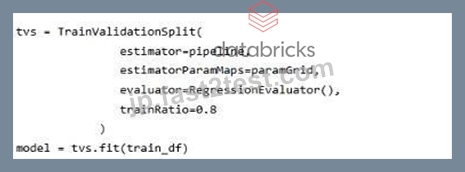
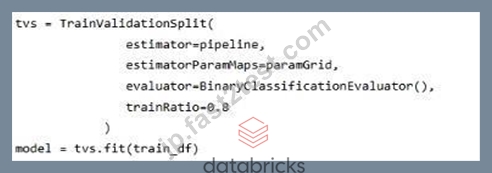
A Data Scientist is using Spark ML to train a model for detecting fraudulent transactions (1:
fraudulent, 0: non-fraudulent). To maximize the model's overall AUC (ROC) score, the Data Scientist wants to perform hyperparameter tuning on a Random Forest classifier. Due to budget constraints, the tuning process must be completed efficiently to avoid excessive compute costs.
Which approach will fulfill their needs?
- A.
- B.
- C.
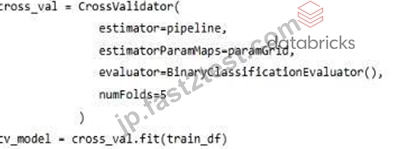
- D.
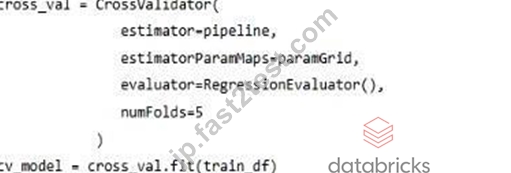
正解:B
解説:
TrainValidationSplit evaluates each hyperparameter combination using a single train/validation split, which is significantly more compute-efficient than k-fold cross-validation. Using a BinaryClassificationEvaluator aligns directly with optimizing AUC (ROC) for a binary fraud detection task, making this approach well suited for maximizing model performance under budget and compute constraints.
質問 # 44
A Data Scientist is training a complex gradient-boosted model for fraud detection. The model uses dynamic threshold tuning during training and generates custom visualizations of feature drift. To ensure reproducibility and collaboration, they need to programmatically track:
- Custom metrics (e g., adjusted_f1 for threshold variations)
- Hyperparameters from nested configuration files
- Drift visualization plots as PDFs
Which approach implements this tracking in MLflow?
- A. Enable mlflow.autolog() at the beginning of the code and rely on it to automatically detect and log custom metrics, parameters, and visualization files.
- B. Use mlflow.log_metric("adjusted_f1", value),mlflow.log_params(nested_config), and mlflow.log_artifact("drift_plot.pdf") within an active MLflow run context, while enabling mlflow.autolog() to capture model-specific metadata automatically.
- C. Write all custom metrics and parameters to stdout during training and configure MLflow's tracking server to scrape these outputs.
- D. Store hyperparameters in a YAML file, save metrics to a CSV, and use mlflow.log_artifact() to upload both to the tracking server as artifacts.
正解:B
解説:
Explicitly using mlflow.log_metric, mlflow.log_params, and mlflow.log_artifact within an active MLflow run provides precise, programmatic control over tracking custom metrics, complex hyperparameter configurations, and generated artifacts such as PDF visualizations. Enabling mlflow.autolog alongside this captures standard model metadata automatically while still allowing full flexibility for advanced, custom tracking needs.
質問 # 45
A Machine Learning Engineer needs to develop a custom anomaly detection model that monitors the internal IT infrastructure of their company. The model takes in compute metrics, logs, and user data and generates a binary prediction. The engineer plans to deploy it as a Databricks Model Serving endpoint. In production there will only be one client calling the endpoint once every
15 seconds. Leadership sees the model as an important part of their operational improvement strategy so maintaining consistent, stable, low latency inference is a requirement while minimizing infrastructure costs. The engineer plans to deploy the endpoint via the MLflow Deployment SDK.
Which endpoint config for the MLflow Deployment SDK should the engineer select?
- A.
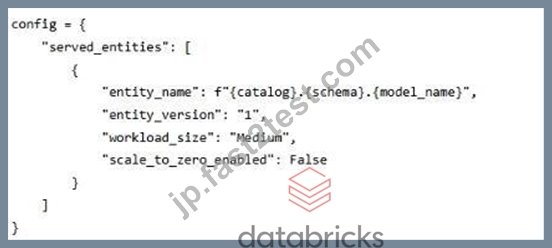
- B.
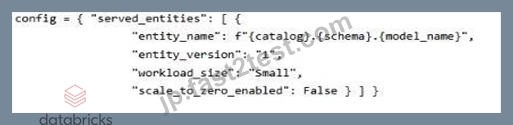
- C.
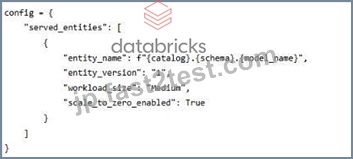
- D.
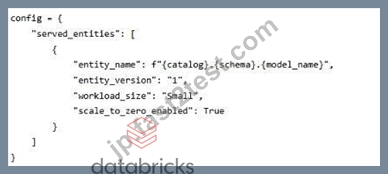
正解:B
解説:
With a single client making requests every 15 seconds, the traffic is steady and predictable, and low-latency inference is a strict requirement. Disabling scale-to-zero avoids cold start latency, ensuring consistent response times. Selecting a Small workload size minimizes infrastructure costs while still providing sufficient resources for a lightweight binary classification model, making this configuration the best balance between performance, stability, and cost.
質問 # 46
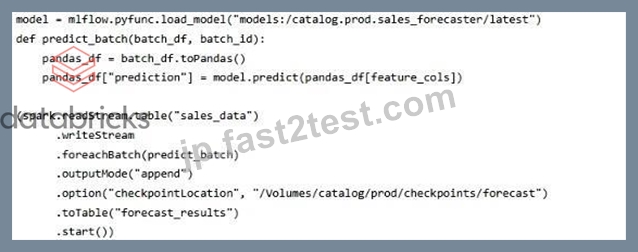
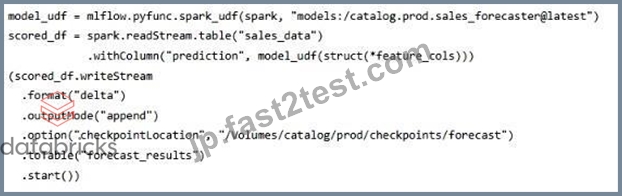
A Data Scientist needs to perform inference on a continuously updated Delta table called sales_data using an MLflow-registered Spark ML pipeline model (catalog.prod.sales_forecaster).
Predictions must be written to a Delta table forecast_results, which must be updated with low latency leveraging a cluster with three executors. They want to maximize the efficient use of their cluster when doing this. Which approach will suit their needs?
- A.

- B.
- C.

- D.
正解:D
解説:
This approach uses a Spark Structured Streaming read from the continuously updated Delta table and applies an MLflow-registered Spark UDF for inference. The model execution is distributed across the three executors, enabling parallel, low-latency scoring as new data arrives. Writing the results with writeStream efficiently updates the forecast_results Delta table incrementally, maximizing cluster utilization and aligning with best practices for continuous, scalable batch- stream inference in Databricks.
質問 # 47
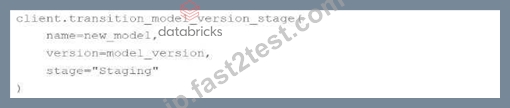
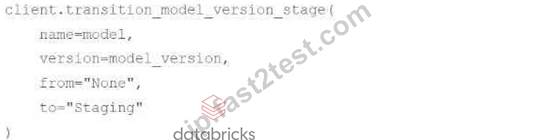
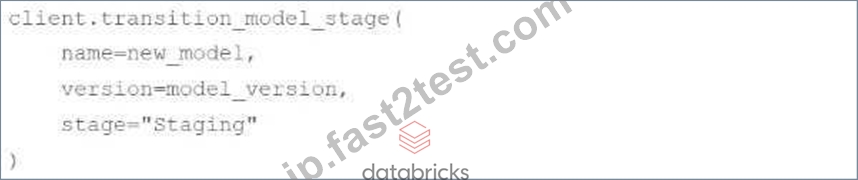
A machine learning engineer has created a webhook with the following code block: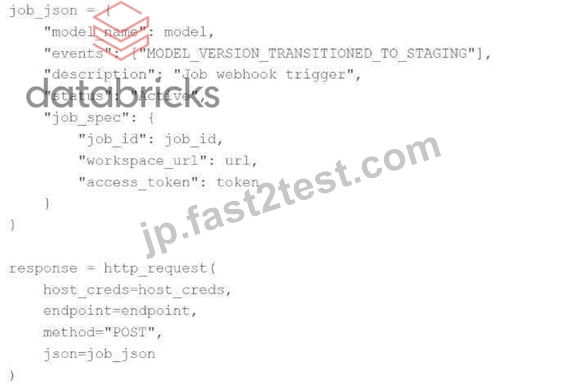
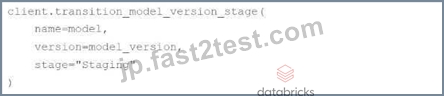
Which of the following code blocks will trigger this webhook to run the associate job?
- A.
- B.
- C.
- D.
- E.
正解:D
質問 # 48
A Machine Learning Engineer is implementing integration tests for an ML pipeline in Databricks.
The current integration test runs the complete workflow but takes four hours to execute due to large dataset processing and extensive model training. They need to select an approach that will be the most effective for optimizing integration test execution while maintaining test reliability. The approach should also be based on MLOps best practices. Which approach will do this?
- A. Skip the model training phase entirely and only test data transformations and API endpoints using mock model predictions.
- B. Use small subsets of production-like data and reduce training iterations while maintaining the same pipeline structure and validation checkpoints in a staging environment that closely matches production.
- C. Run integration tests only in the production environment using full datasets to ensure complete accuracy of the testing process.
- D. Replace integration tests with unit tests for each pipeline component to reduce execution time and focus on individual component validation in a staging environment that closely matches production.
正解:B
解説:
Using smaller, production-like datasets and reduced training iterations preserves the full pipeline structure while significantly reducing execution time. This aligns with MLOps best practices by maintaining high-fidelity integration testing in a staging environment that mirrors production behavior, without the cost and delay of running full-scale training workloads.
質問 # 49
A machine learning engineer needs to deliver predictions of a machine learning model in real- time. However, the feature values needed for computing the predictions are available one week before the query time. Which feature is a benefit of using a batch serving deployment in this scenario rather than a real-time serving deployment where predictions are computed at query time?
- A. There is no advantage to using batch serving deployments over real-time serving deployments
- B. Querying stored predictions can be faster than computing predictions in real-time
- C. Batch serving has built-in capabilities in Databricks Machine Learning
- D. Computing predictions in real-time provides more up-to-date results
- E. Testing is not possible in real-time serving deployments
正解:C
質問 # 50
A Machine Learning Engineer wants to monitor the quality and stability of their machine learning model's predictions over time. They have a Delta table, retail_inference_log, which records each model prediction along with input features, a timestamp, and (when available) the true label. They need to detect data drift and monitor model performance trends using Databricks Lakehouse Monitoring, ensuring that alerts are triggered if the distribution of predictions or input features changes significantly. Which approach will set up monitoring for this use case?
- A. Create a monitor with the Inference profile on the retail_inference_log table, and specify a recent batch of production data as the baseline table for drift detection. Use this recent production data to compare against new data for drift and performance monitoring.
- B. Create a monitor with the Inference profile on the retail_inference_log table, specifying the timestamp column and the columns for model inputs, predictions, and labels. Configure the monitor to compute drift and performance metrics over time windows.
- C. Create a monitor with the Time Series profile on the retail_inference_log table, specifying the timestamp column and including model input, prediction columns and the true label column. This will track drift in features and predictions over time, and model performance could also be tracked using a custom metric.
- D. Create a monitor with the Snapshot profile on the retail_inference_log table, so that metrics are calculated over the entire table each time the monitor runs and therefore is able to compare new values with previous ones to compute data drift.
正解:B
解説:
The Inference profile is specifically designed for monitoring production inference logs. By configuring it on the inference table with the timestamp, input feature columns, prediction column, and label column, Databricks Lakehouse Monitoring can automatically compute prediction drift, input feature drift, and model performance metrics over rolling time windows, and trigger alerts when significant distribution changes or performance degradation are detected.
質問 # 51
A machine learning engineer is monitoring categorical input variables for a production machine learning application. The engineer believes that missing values are becoming more prevalent in more recent data for a particular value in one of the categorical input variables. Which of the following tools can the machine learning engineer use to assess their theory?
- A. Kolmogorov-Smirnov (KS) test
- B. Two-way Chi-squared Test
- C. Jenson-Shannon distance
- D. None of these
- E. One-way Chi-squared Test
正解:E
質問 # 52
Which of the following is an obstacle related to streaming machine learning applications?
- A. All of these
- B. Out-of-order data
- C. End-to-end fault tolerance
- D. None of these
正解:A
解説:
Streaming machine learning applications face multiple challenges, including end-to-end fault tolerance (ensuring recovery from failures without data loss) and out-of-order data (handling events that arrive late or out of sequence). Both are common obstacles in building reliable real- time ML systems.
質問 # 53
A machine learning engineer has deployed a model recommender using MLflow Model Serving.
They now want to query the version of that model that is in the Production stage of the MLflow Model Registry. Which of the following model URIs can be used to query the described model version?
- A. The version number of the model version in Production is necessary to complete this task.
- B. https://<databricks-instance>/model-serving/recommender/stage-production/invocations
- C. https://<databricks-instance>/model/recommender/stage-production/invocations
- D. https://<databricks-instance>/model/recommender/Production/invocations
- E. https://<databricks-instance>/model-serving/recommender/Production/invocations
正解:A
質問 # 54
How can you save a trained Spark ML PipelineModel?
- A. pipeline.persist()
- B. pipeline.save()
- C. pipeline.store()
- D. pipelineModel.write().save()
正解:D
解説:
Example:
pipelineModel.write().overwrite().save("/model")
質問 # 55
A machine learning engineer wants to delete an active MLflow Model Registry Webhook with webhook ID webhook_id for a specific model.
They are using the following code block: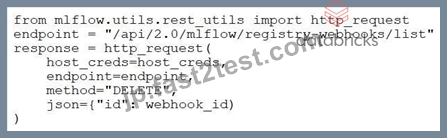
Which change does the machine learning engineer need to make to this code block so it will successfully accomplish the task?
- A. Replace list with delete in the endpoint URL
- B. Replace list with webhooks in the endpoint URL
- C. There are no necessary changes
- D. Replace DELETE with POST in the call to http_request
正解:A
解説:
To delete a webhook using the MLflow REST API, the correct endpoint is:
/api/2.0/mlflow/registry-webhooks/delete
In the provided code, the endpoint incorrectly uses "list", which retrieves webhooks rather than deleting them. The HTTP method "DELETE" is correct, so the only necessary change is to replace list with delete in the endpoint URL.
質問 # 56
A Data Scientist is tasked with developing models to forecast product demand. The company offers 5000 different product types, and the Data Scientist must generate weekly forecasts for each type. They have access to two years of historical purchase data and are given ample project budget.
For their next project, they want to build 5000 separate Random Forest models, one for each product type. They aim to train all the models as quickly as possible with minimal setup.
Which approach meets these requirements?
- A. Use the RandomForest method from MLlib. This will leverage Spark's parallel processing capability to train 5000 different models.
- B. Create a Databricks Workflow with 5000 tasks. Each task is configured to accept a product ID as a parameter which will then train a model based on the specified product ID.
- C. Leverage the pandas function API (Grouped map) to group the data by product type and apply a custom model training function to each group.
- D. Use the DeepSpeed library to distribute the data by product across different nodes to enable the parallel training of multiple models.
正解:C
解説:
The pandas function API with grouped map allows data to be grouped by product type and applies a custom training function independently to each group. This approach enables massive parallelism across the cluster with minimal orchestration or setup, making it well suited for rapidly training thousands of independent models in parallel.
質問 # 57
Which of the following is a drawback associated with using Jensen-Shannon (JS) distance for numeric feature drift detection?
- A. JS is not robust when working with large datasets
- B. JS requires a manual threshold or cutoff determinations
- C. All of these reasons
- D. None of these reasons
正解:B
解説:
A key drawback of using Jensen-Shannon (JS) distance for numeric feature drift detection is that it requires manual threshold tuning to determine what level of divergence indicates significant drift. This makes automation and consistent interpretation challenging, especially across features or datasets with differing distributions.
質問 # 58
A Machine Learning Engineer is building a fraud detection model that needs to use both pre- computed features from a feature table and real-time calculated features based on user location data sent with each inference request. The engineer has created a Python UDF called calculate_distance in Unity Catalog at main.fraud_detection.calculate_distance that computes the distance between a transaction location and the user's current location. The feature table main.fraud_detection.user_features contains historical user spending patterns with primary key user_id.
The engineer has written the following code to implement this scenario: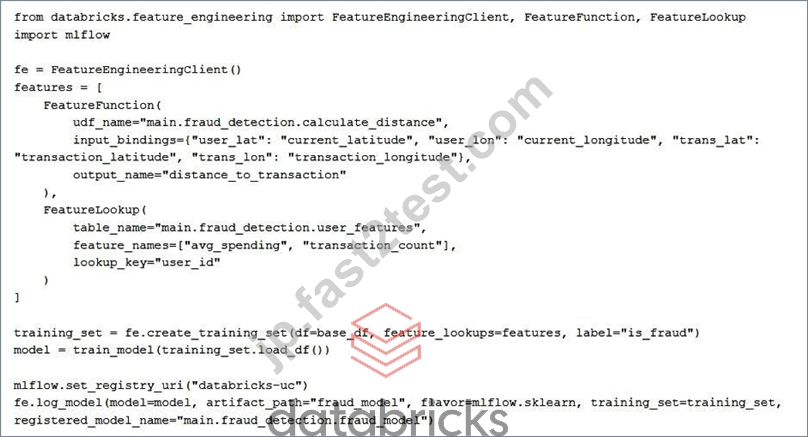
Which benefit of this implementation approach makes it suited to the real-time fraud detection use case?
- A. The FeatureFunction caches computed distance values in the online store to improve inference latency for location pairs.
- B. The FeatureLookup function avoids the need for joining the full table main.fraud_detection.user_features with training_set increasing efficiency.
- C. The Unity Catalog registry automatically creates REST API endpoints for UDF functions used in feature computation.
- D. The model automatically performs feature lookup and computation during inference without additional serving code.
正解:D
解説:
By defining both FeatureLookup and FeatureFunction objects in the training set and logging the model with the FeatureEngineeringClient, the feature logic is packaged with the model. During inference, Databricks automatically performs feature lookups from the feature table and computes the on-demand distance feature using request-time inputs, without requiring any additional custom serving or feature-joining code. This makes the approach well suited for real-time fraud detection.
質問 # 59
A data scientist is building a model to predict which communication channel (Phone, SMS, Email, or Post) is most likely to be effective for a given customer. Which model type is suited to this task?
- A. Logistic Regression
- B. Linear Regression
- C. Softmax Classifier
- D. ARIMA
正解:C
解説:
This task requires predicting one class from multiple mutually exclusive categories. A softmax classifier is designed for multiclass classification problems and outputs a probability distribution across all possible communication channels, allowing selection of the most likely effective channel.
質問 # 60
......
最新(2026)Databricks Databricks-Machine-Learning-Professional試験問題集:https://jp.fast2test.com/Databricks-Machine-Learning-Professional-premium-file.html
最適な練習法にはDatabricks Databricks-Machine-Learning-Professional試験の素晴らしいDatabricks-Machine-Learning-Professional試験問題PDF:https://drive.google.com/open?id=1gkU-4mkDVHZizfPEboQYMdg7qYozE3bA