

CISI IFC試験情報と無料練習テスト問題で合格せよ
2025年最新のの問題IFC問題集で更新されたCISI試験問題集を試そう
質問 # 112
A dealing representative explains the past performance of a mutual fund to a potential client, discussing the annual simple returns and compound returns that the fund had earned. She concluded by indicating she expects the fund's NAVPU was likely to rise at similar rates in the future, given the economic outlook. What unacceptable selling practice has occurred?
- A. Representatives cannot discuss a fund's past performance
- B. Representatives cannot promise NAVPU will increase by any amount
- C. Representatives cannot quote a future purchase price
- D. Representatives cannot comment upon the economic outlook
正解:B
解説:
Promising that a mutual fund's NAVPU will increase by a certain amount is an illegal and unacceptable selling practice, as it implies guaranteed future performance. The feedback from the document states:
"There are a number of sales practices that are clearly illegal or otherwise unacceptable to securities regulators. A dealing representative may not make promises that the NAVPS or NAVPU of a fund will achieve a certain level or increase by any amount." Reference: Chapter 17 - Mutual Fund Dealer RegulationLearning Domain: Ethics, Compliance and Mutual Fund Regulations
質問 # 113
Tony, the investment manager of True North Canadian Equity Fund is deciding on some new investments. He has done an economic analysis of the various provinces and sectors of the Canadian economy and has determined that Nova Scotia and Alberta present the best prospects. He has also identified potential in the oil and gas sector. He narrows down his selection to an oil supply firm in Medicine Hat and a drilling company in Halifax.
What investment approach is Tony employing?
- A. value investing
- B. growth at a reasonable price (GARP)
- C. bottom-up
- D. top-down
正解:D
解説:
Tony is employing a top-down investment approach, which is a method of selecting securities based on macroeconomic factors, such as the state of the economy, the industry trends, and the market conditions. A top-down investor starts by analyzing the big picture and then drills down to the specific sectors, regions, and companies that are expected to perform well in that environment. Tony has done an economic analysis of the various provinces and sectors of the Canadian economy and has determined that Nova Scotia and Alberta present the best prospects. He has also identified potential in the oil and gas sector. He then narrows down his selection to an oil supply firm in Medicine Hat and a drilling company in Halifax. This shows that he is using a top-down approach to choose his investments.
Canadian Investment Funds Course, Chapter 3: Risk and Return1
質問 # 114
What party is responsible for ensuring that a public corporation's total number of outstanding common shares does not exceed its total number of authorized shares?
- A. Distributor
- B. Trustee
- C. Registrar
- D. Portfolio manager
正解:C
解説:
A corporation's charter specifies the maximum number of authorized shares it may issue. The Registrar (provincial securities administrator) ensures compliance so that a public corporation does not issue more shares than authorized.
Trustees oversee debt obligations.
Portfolio managers manage investments.
Distributors sell securities but do not regulate share issuance.
Thus, the responsible party is the Registrar.
質問 # 115
What type of fee does a mutual fund sponsor often reduce the longer an investor holds a back-end load fund?
- A. Redemption fee
- B. Sales fee
- C. Acquisition fee
- D. Trailer fee
正解:A
解説:
Back-end load funds often have a decreasing redemption fee (deferred sales charge) schedule, which reduces the longer the investor holds the fund. The feedback from the document states:
"Fund sponsors use a decreasing redemption fee (deferred sales charges) schedule to recover their costs from investors who opt out of the fund early. In most cases, redemption fees on a back-end load fund decrease the longer the investor holds the fund." Reference: Chapter 16 - Mutual Fund Fees and ServicesLearning Domain: Evaluating and Selecting Mutual Funds
質問 # 116
What role do investment dealers play in the Canadian and global financial markets?
- A. They are contributors to a company's profits.
- B. By underwriting financial instruments, they raise capital for investors.
- C. They assist with the exchange of capital for a financial instrument.
- D. They are contributors to an investor's earnings.
正解:C
解説:
Investment dealers are people or firms who buy and sell securities for their own account, whether through a broker or otherwise. They play an important role in the Canadian and global financial markets because they are market makers, create liquidity, and help promote long-term growth in the market. They also provide investment services to investors, such as underwriting securities, raising capital, and offering advice. By assisting with the exchange of capital for a financial instrument, they facilitate the flow of funds between savers and borrowers, and between different sectors and countries. The other options are not accurate descriptions of the role of investment dealers. References: Dealers: Definition in Trading, Meaning and Comparison to Brokers, Investment Dealers Definition
質問 # 117
Loretta is looking for a well diversified equity fund. Her ideal mutual fund would hold investments within and outside Canada. Although she is seeking growth, Loretta also wants a mutual fund that invests in quality companies.
Which of the following mutual funds would be the best choice for Loretta?
- A. Dominion International Growth Fund - this international equity fund invests in small and medium sized companies in countries all around the world.
- B. Lennox Energy Fund - this sector fund invests primarily in Canadian oil and gas companies that sell both to domestic and foreign markets.
- C. Auric Precious Metals Fund - this sector fund invests in Canadian companies that participate in the precious metals sector such as owning mines in foreign countries.
- D. Polar Global Blue Chip Equity Fund - this global equity fund invests in large, established companies in mostly stable and mature foreign markets.
正解:D
解説:
Loretta is looking for a well diversified equity fund that invests both within and outside Canada. She also wants a fund that invests in quality companies, which implies that she prefers lower risk and higher stability.
A global equity fund would meet her criteria, as it can invest in any country, including Canada, and diversify across different regions and markets. A global equity fund that focuses on large, established companies, also known as blue chip stocks, would also suit her preference for quality and stability, as these companies tend to have strong financial performance, competitive advantages, and consistent dividends. Therefore, the Polar Global Blue Chip Equity Fund would be the best choice for Loretta among the given options.
1: Canadian Investment Funds Course, Unit 6, Section 6.2
質問 # 118
Which of the following statements describes a feature of the Home Buyers' Plan (HBP)?
- A. A qualifying home must be purchased by December 31 of the year of withdrawal.
- B. Once you are required to repay the amounts back to your RRSP. any missed or incomplete payments are subject to tax.
- C. To qualify- as a first-time home buyer you or your spouse must never have previously owned a home
- D. If you have a spouse or common-law partner, each of you can withdraw up to JE50.000 from your registered retirement savings plans (RRSPs).
正解:B
解説:
The Home Buyers' Plan (HBP) is a program that allows eligible first-time home buyers to withdraw up to
$35,000 from their registered retirement savings plans (RRSPs) to buy or build a qualifying home without paying any tax on the withdrawal. The withdrawn amount must be repaid to the RRSP over a period of up to
15 years, starting from the second year after the withdrawal. If the required repayment for a year is not made, it is added to the taxpayer's income and subject to tax. Therefore, option B describes a feature of the HBP.
The other options are not correct descriptions of the HBP. Option A is false because to qualify as a first-time home buyer, you or your spouse must not have owned and lived in another home as your principal place of residence during the four-year period before the date of withdrawal. Option C is false because a qualifying home must be purchased or built before October 1 of the year following the year of withdrawal. Option D is false because if you have a spouse or common-law partner, each of you can withdraw up to $35,000 from your RRSPs, not $50,000. References: [Home Buyers' Plan (HBP)], [Home Buyers' Plan (HBP) - Canada.ca],
[Home Buyers' Plan (HBP) | GetSmarterAboutMoney.ca]
質問 # 119
On which of the following does the Personal Information Protection and Electronic Documents Act (PIPEDA) impose requirements?
- A. organizations in the private sector subject to federal regulation
- B. consumers
- C. departments and agencies of provincial governments
- D. departments and agencies of the Government of Canada
正解:A
解説:
The Personal Information Protection and Electronic Documents Act (PIPEDA) is a federal law that imposes requirements on the collection, use, and disclosure of personal information by organizations in the private sector that are subject to federal regulation, such as banks, telecommunications, transportation, and broadcasting. PIPEDA also applies to organizations that operate in provinces or territories that do not have substantially similar privacy legislation, such as Alberta, British Columbia, and Quebec. PIPEDA does not apply to consumers, departments and agencies of the Government of Canada, or departments and agencies of provincial governments, as they are governed by other privacy laws or regulations12 References = Canadian Investment Funds Course, Unit 7: The Regulatory Environment, Lesson 3: Privacy Legislation, Section 7.3.1: Personal Information Protection and Electronic Documents Act (PIPEDA) 1; Office of the Privacy Commissioner of Canada website
質問 # 120
Which among the following BEST describes a company's income statement?
- A. It shows the amount of capital contributed to the company by its shareholders or owners.
- B. It shows the earnings and expenses of a business over a period of time.
- C. It provides a snapshot of a company's financial position at a specific point in time
- D. It shows the amount of profit that is reinvested in the company in the form of retained earnings.
正解:B
解説:
An income statement is a financial report that shows the earnings and expenses of a business over a period of time, such as a month, a quarter, or a year. It also shows the net income or net loss of the business, which is the difference between the total revenues and the total expenses. An income statement helps investors and creditors evaluate the profitability, performance, and risk of a business. The other options are not accurate descriptions of an income statement. Option A describes retained earnings, which are part of the equity section of the balance sheet. Option B describes contributed capital, which is also part of the equity section of the balance sheet. Option D describes the balance sheet, which is another financial statement that shows the assets, liabilities, and equity of a business at a specific point in time. References: Income Statement - Definition, Explanation and Examples, Income Statement: How to Read and Use It - Investopedia, How to Prepare an Income Statement | HBS Online
質問 # 121
What is the time period during which an individual must complete a training program once she starts acting as a dealing representative?
- A. 3 months
- B. 30 days
- C. 6 months
- D. 90 days
正解:D
解説:
A mutual fund dealing representative must complete a training program within 90 days of starting to act in that role and be closely supervised for six months. The feedback from the document states:
"All mutual fund dealing representatives are required to complete a training program within 90 days from the day that they first start acting as a dealing representative and must be closely supervised for six months." Reference: Chapter 17 - Mutual Fund Dealer RegulationLearning Domain: Ethics, Compliance and Mutual Fund Regulations
質問 # 122
What type of benefit plan has a final benefit that is dependent on the investment returns within the plan?
- A. Final average plan
- B. Defined contribution plan
- C. Career average plan
- D. Flat benefit plan
正解:B
解説:
In a defined contribution plan, the retirement benefit depends on the performance of the investments within the plan, also known as a money-purchase plan. The feedback from the document states:
"In a defined contribution plan, also known as a money-purchase plan, the eventual benefits at retirement will be based on how the contributions were invested within the plan." Reference: Chapter 6 - Tax and Retirement PlanningLearning Domain: The Know Your Client Communication Process
質問 # 123
Which of the following best describes implied needs of your clients?
- A. They are statements made by you showing readiness to solve a client's problem.
- B. They are statements made by clients expressing the desire for lower commissions.
- C. They are needs reflected by statements made by clients regarding problems and dissatisfactions.
- D. They are statements of wants and needs made by clients.
正解:C
解説:
Implied needs of your clients are needs reflected by statements made by clients regarding problems and dissatisfactions1. For example, a client may say "I'm worried about outliving my savings" or "I don't understand how this investment works". These statements imply that the client has a need for retirement planning or financial education, respectively. Implied needs are different from explicit needs, which are statements of wants and needs made by clients1. For example, a client may say "I want to save for my child's education" or "I need a low-risk investment". These statements express the client's goals and preferences clearly. Statements made by you showing readiness to solve a client's problem are not implied needs, but rather responses to implied needs1. For example, you may say "I can help you create a retirement plan that suits your lifestyle" or "I can explain how this investment works and what are the benefits and risks". Statements made by clients expressing the desire for lower commissions are not implied needs, but rather objections or concerns that may arise during the sales process2. For example, a client may say "Your fees are too high" or "I can get a better deal elsewhere". These statements may indicate that the client is not convinced of the value of your service or product, or that they are trying to negotiate a lower price.
References: Unit 2: Know Your Client, Unit 10: Sales Process
質問 # 124
Seth's brother Keith manages a successful private equity fund. Seth is an investment advisor and has thoroughly evaluated Keith's fund. He believes it would be an excellent investment for some of his clients. If Seth does not disclose his relation to Keith prior to recommending this investment, what value does he stand to breach with his client?
- A. Confidentiality
- B. Integrity
- C. Duty of care
- D. Compliance
正解:B
解説:
According to CSC ethical guidelines, integrity requires an advisor to act honestly and avoid conflicts of interest.
By recommending his brother's private equity fund without disclosing the relationship, Seth risks a conflict of interest and breaches the principle of integrity.
Duty of care relates to suitability and due diligence.
Compliance refers to following regulations.
Confidentiality refers to safeguarding client information.
Thus, the violated value is Integrity.
質問 # 125
You are collecting know your client (KYC) information for your new client, Yael. She has recently accepted an early retirement package from her employer and has $100,000 to invest. She is looking for an investment that will provide income to help pay her ongoing monthly expenses. Without this extra income, she would have trouble paying her bills. From your discussions, Yael understands that markets fluctuate and says she is comfortable with high risk. Which of the following would be a suitable investment?
- A. Canadian equity index fund
- B. money market fund
- C. global equity fund
- D. mortgage fund
正解:D
解説:
A mortgage fund is a type of income fund that invests in mortgages and other debt instruments secured by real estate. It provides a steady stream of income to investors and has a low correlation with other asset classes. A mortgage fund is suitable for Yael because she needs income to pay her monthly expenses and is comfortable with high risk. A global equity fund, a money market fund, and a Canadian equity index fund are not suitable for Yael because they do not meet her income objective and risk tolerance.
質問 # 126
Kerry's total income this past year was $100,000 and she claimed a tax deduction of $2,000. When the tax return is filed, what would be the federal tax payable when applying the following federal tax rates?
(Round to the closest whole dollar for the final answer.)
- A. $24,000
- B. $17,472
- C. $18,754
- D. $25,480
正解:C
解説:
Kerry's taxable income would be $98,000 ($100,000 - $2,000). Using the federal tax rates provided in the image, the first $48,535 of her income would be taxed at 15%, the next $48,534 at 20.5%, and the remaining
$931 at 26%. This would result in a total federal tax payable of $18,754. You can see the calculation in detail below:
Taxable Income
Marginal Tax Rate
Federal Tax Payable
$0 - $48,535
15%
$7,280.25
$48,536 - $97,069
20.5%
$9,934.47
$97,070 - $98,000
26%
$539.80
Total
$18,754.52
Note: The final answer is rounded to the closest whole dollar.
Canadian Investment Funds Course, Unit 8, Section 8.2; [4]
質問 # 127
As it pertains to fixed-income securities, which yield metric factors in cash flows relative to ongoing bond prices rather than the initial amount invested?
- A. Effective
- B. Current
- C. Earnings
- D. Dividend
正解:B
解説: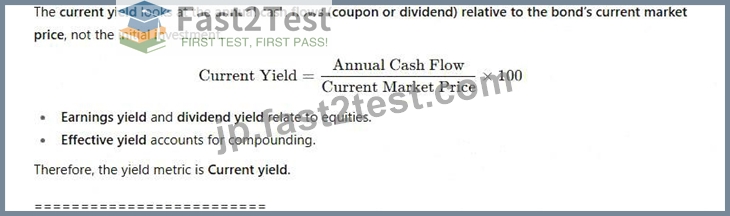
質問 # 128
Rashad is a Dealing Representative with Investors Network Corp., a mutual fund dealer. Investors Network is registered in all provinces and territories of Canada and Rashad is registered in the Edmonton, Alberta branch. Rashad is told to provide his Branch Manager with a number of client files. The client files will be part of a compliance review by the applicable self-regulatory organization (SRO). Which regulator will review Rashad's client files?
- A. Mutual Fund Dealers Association of Canada (MFDA)
- B. Canadian Securities Administrators (CSA)
- C. Chambre de la securite financiere (CSF)
- D. Autorite de marches financiers (AMF)
正解:A
解説:
The Mutual Fund Dealers Association of Canada (MFDA) is the self-regulatory organization (SRO) that regulates mutual fund dealers in Canada, except in Quebec. The MFDA is responsible for setting and enforcing rules and standards of conduct for its members and their representatives, as well as conducting compliance reviews and investigations. Rashad works for a mutual fund dealer that is registered in all provinces and territories of Canada, including Alberta, where he is based. Therefore, his client files will be part of a compliance review by the MFDA, which is the applicable SRO for his firm and jurisdiction.
References = Canadian Investment Funds Course, Unit 7: The Regulatory Environment, Lesson 1: The Regulatory Framework, Section 7.1.2: Self-Regulatory Organizations (SROs) 1; MFDA website 2
質問 # 129
Beatrice is looking for comprehensive information regarding the analysis of financial statements and fund management expenses as it relates to her current mutual fund investment.
Which document would provide the information she is looking for?
- A. Fund Facts
- B. Annual Information Form
- C. Management Reports of Fund Performance
- D. Simplified Prospectus
正解:C
解説:
The Management Reports of Fund Performance (MRFP) are documents that provide information about a mutual fund's financial performance, portfolio composition, risk profile, and management expenses. The MRFP are prepared by the fund manager and filed with the securities regulators twice a year, for the semi- annual and annual periods. The MRFP are also made available to the investors on the fund manager's website or upon request. The MRFP include the following sections:
* Financial Highlights: This section summarizes the key financial data of the fund, such as net assets, net asset value per unit, total return, ratios and supplemental data.
* Past Performance: This section shows the historical returns of the fund over different time periods and compares them with a benchmark index or category average.
* Summary of Investment Portfolio: This section provides a breakdown of the fund's portfolio by asset class, sector, geographic region, and top holdings. It also shows how the portfolio has changed over the reporting period.
* Management Discussion of Fund Performance: This section explains the fund's investment objectives, strategies, and risks, and analyzes the factors that affected the fund's performance during the reporting period. It also discloses the fund's management expense ratio (MER), trading expense ratio (TER), and turnover rate.
* Financial Statements: This section presents the fund's statement of financial position, statement of comprehensive income, statement of changes in net assets attributable to holders of redeemable units, and statement of cash flows. It also includes notes to the financial statements that provide additional information and disclosures.
The MRFP would provide Beatrice with comprehensive information regarding the analysis of financial statements and fund management expenses as it relates to her current mutual fund investment.
Canadian Investment Funds Course, Chapter 6: Fund Operations and Regulations1
質問 # 130
......
最新のIFC試験問題集でCISI試験が合格できます:https://jp.fast2test.com/IFC-premium-file.html
合格できるCISI IFCのPDF問題集で最近更新された451問あります:https://drive.google.com/open?id=1VrwdaBW9ffohFCI6logyQltLjKiEAwSi