

CIS-DF日本語更新された試験問題集で[2026年最新] 練習有効な試験問題集
CIS-DF日本語サンプルには正確で更新された問題
質問 # 56
CMDB 管理者は、メンバー CI のグループ調整をより適切に維持するために、動的 CI グループに基づく多数のテクノロジー管理サービス オファリング (テクニカル サービス オファリング) を構築しました。
動的 CI グループと関係のあるオファリングから CI に同期されるグループはどれですか?
(2つのオプションを選択)
- A. グループ所有
- B. サポートグループ
- C. グループによって管理
- D. 承認グループ
正解:B、C
解説:
In ServiceNow, Dynamic CI Groups are a core Data Foundations capability used to automatically manage CI membership based on rules rather than manual maintenance. When Technology Management Service Offerings (Technical Service Offerings) are related to Dynamic CI Groups, ServiceNow uses those relationships to synchronize operational support attributes to the member CIs.
The two CI attributes that are intentionally designed to sync in this model are the Managed by Group and the Support Group. These groups directly influence operational ownership and support routing, which is why they are automatically aligned when Dynamic CI Groups are used.
This ensures that incidents, changes, problems, and operational tasks are routed consistently as CI membership changes over time.
The Support Group defines who provides day-to-day operational support and is critical for Incident and Request Management workflows. The Managed by Group represents the team responsible for the technical lifecycle and operational health of the CI. Synchronizing these attributes eliminates manual updates and reduces misrouted tickets, which is a key goal of Configuration Management maturity.
質問 # 57
CMDB 管理者は、統合マップとサービス マッピング マップを比較しています。
統合マップの追加機能は何ですか? (2 つ選択してください)
- A. マップを拡大・縮小できます
- B. アプリケーションとそれがインストールされているホストへの可視性
- C. マップ上に表示されるレベルの数を変更できます
- D. マップノードはユーザーの好みに基づいてフィルタリングできます
正解:A、D
解説:
The Unified Map is designed to provide enhanced visual insight and analysis across the CMDB by consolidating configuration item (CI) relationships from multiple sources--such as Discovery, Service Mapping, and manual relationships--into a single, interactive view. While traditional Service Mapping maps are optimized for modeling and understanding application-to-infrastructure dependencies, the Unified Map extends this capability with more flexible visualization and exploration features.
Option B is correct because the Unified Map allows users to zoom in and out, enabling both high- level overviews and detailed inspections of complex CI relationships. This capability is particularly valuable in large enterprise environments where services may span hundreds or thousands of infrastructure components. Zoom functionality supports impact analysis, troubleshooting, and architectural reviews without overwhelming the user with unnecessary detail.
Option C is also correct because the Unified Map supports filtering of map nodes based on user preferences. Administrators and analysts can filter by CI class, relationship type, lifecycle state, or other attributes, allowing them to focus on what is most relevant to their task--such as identifying only production CIs, security-relevant components, or a specific technology stack. This aligns strongly with Data Foundations principles by improving usability and decision-making without altering underlying data.
質問 # 58
CMDB 360 / マルチソースCMDBでは、動的照合ルールが有効になっています。管理要件に基づき、CMDB管理者は複数の動的照合ルールを設定する必要があります。
調整ルールの作成ウィザード内で使用できる動的ルール タイプはどれですか? (2 つのオプションを選択)
- A. 最終作成日
- B. 最も報告されたもの
- C. 最小値
- D. 最終更新日
正解:B、D
解説:
CMDB 360 / Multisource CMDB extends the standard IRE by enabling Dynamic Reconciliation Rules, which determine attribute values dynamically based on incoming data patterns rather than fixed source priority.
Within the Create Reconciliation Rule wizard, two supported dynamic rule types are:
Most Reported (Option B): selects the attribute value that is reported most frequently across all sources. This is useful when multiple sources contribute data and consensus is a strong indicator of correctness.
Last Updated (Option C): selects the most recently updated value, which is useful for rapidly changing attributes such as IP address or operational state.
質問 # 59
CMDB で管理されている新しいアプリケーションを反映するには、新しいカスタム クラスが必要です。
このカスタム CI クラスを追加するために最低限必要なロールは何ですか?
- A. sn_cmdb_admin と personalize_dictionary
- B. sn_cmdb_admin と personalize_dictionary
- C. sn_cmdb_admin と personalize_form
- D. itil_admin と personalize_form
正解:B
解説:
CMDB でカスタム CI クラスを作成することは、辞書レベルの構成アクティビティであり、ServiceNow でのガバナンスとアップグレードの安全性を確保するために、適切な最小限の権限で実行する必要があります。
sn_cmdb_admin ロールは、CI クラス階層管理を含む CMDB 構造への管理アクセスを付与するため必須です。このロールにより、変更が CMDB ガバナンス制御とデータ基盤プラクティスに準拠していることが保証されます。
新しいCIクラスを追加するには、辞書エントリ(テーブル、属性、継承)の作成または拡張が必要となるため、personalize_dictionaryロールも必要です。辞書レベルのアクセス権がないと、ユーザーはCMDBスキーマに新しいクラスや属性を定義できません。
オプションAは不正解です。sn_cmdb_adminだけでは辞書権限なしでは不十分です。オプションBとDはフォームのパーソナライゼーションに重点を置いており、UIレイアウトのみに影響し、新しいCIクラスの作成は許可されません。また、itil_adminはスキーマレベルのCMDB変更には適切なロールではありません。
したがって、最小限かつ正しいロールの組み合わせは sn_cmdb_admin と personalize_dictionary であり、オプション C が検証済みの回答になります。
質問 # 60
ドラッグアンドドロップの質問
プラットフォーム内のサービス タイプのリストが表示されたら、適切なサービスをその定義にドラッグします。
正解:
解説:
Explanation:
Within the Common Service Data Model (CSDM), service types are clearly defined to separate business-facing value, application logic, and technical enablement. Correct classification is foundational to impact analysis, ownership, reporting, and service visibility.
An Application Service is a logical representation of a deployed application or system stack. It models how an application runs, including servers, databases, middleware, and integrations.
Application Services are typically created and maintained through Service Mapping and are primarily consumed by IT operations, DevOps, and support teams.
A Technology Management Service (also called a Technical Service) represents shared technical capabilities such as databases, authentication platforms, messaging systems, or cloud infrastructure. These services are published to Service Owners, not business users, and underpin one or more Application Services or Business Services. They are critical for understanding technical dependencies and risk but are not business-facing.
A Business Service is published to Business Users and directly supports business capabilities and outcomes. It represents what the business consumes, such as "Online Banking," "Order Fulfillment," or "Employee Onboarding." Business Services sit at the top of the CSDM hierarchy and are the anchor point for SLAs, experience, and value measurement.
Correctly distinguishing these service types ensures alignment with CSDM best practices, enables accurate impact analysis, and prevents common CMDB anti-patterns such as exposing technical services to business users or misrepresenting application stacks as business value.
質問 # 61
CMDB管理者は、重複CI修復ツールを使用して重複排除タスクに対処しています。ウィザードの最初のタブでは、メインCIが選択されています。
メイン CI を識別するために使用される属性はどれですか? (2 つ選択してください)
- A. 最も関連性の低いアイテム
- B. 最も古い作成
- C. 最新作成
- D. 最も関連性の高いアイテム
正解:B、D
解説:
ServiceNow の重複 CI 修復ツールは、最も価値が高く権威のある記録を保持しながら、重複する構成アイテムを安全に解決するために設計された、管理されたツールです。修復ウィザードの最初のステップは、修復後も保持されるメイン CI を特定することです。
ServiceNow は、メイン CI に最適な候補を決定するために、次の 2 つの主な属性を使用します。
最も古い作成(オプションA)
最も古いCIは、運用履歴が長く、過去のインシデント、変更、問題、監査などで参照される可能性があり、下流のプロセスやレポートに組み込まれる可能性が高いため、好まれることが多いです。最も古いCIを保持することで、過去の参照が失われるのを防ぐことができます。
最も関連性の高いアイテム(オプションB)
最も多くの関係性(例えば、アプリケーション、サービス、インシデント、その他のCIへのリンク)を持つCIは、一般的に、ビジネスおよび運用上のコンテキストの観点から最も価値があります。これらの関係性を維持することは、影響分析、変更管理、そしてCSDMに準拠したサービスモデリングにとって非常に重要です。
オプション C (最新作成) および D (最も関連性の低いアイテム) は選択基準として使用されません。これは、新しい CI や関連性の低い CI には通常、履歴値や関係値が少なく、削除またはマージする方が適しているためです。
最も古く作成されたアイテムと最も関連性の高いアイテムを優先することで、重複 CI 修復機能は CMDB データ基盤のベスト プラクティスに準拠し、データ損失を最小限に抑え、ビジネス コンテキストを維持し、重複排除の結果をより安全に実現します。
したがって正解はAとBです。
質問 # 62
CMDB構成管理チームは、健全で信頼性の高いCMDBの開発に成功しました。検出されたインフラストラクチャデータを統合し、検出不可能なデータ(変更やサポートグループ情報など)を正確に参照し、サービスマッピングを使用してCMDBをサービス対応にしました。
適切なサポート グループを参照する CI を選択した後、インシデント フォームのどのフィールドが自動的に入力されますか?
- A. グループの変更
- B. サポートグループ
- C. グループによって管理
- D. 承認グループ
- E. 割り当てグループ
正解:E
解説:
ServiceNow における成熟した CMDB 実装では、CI の運用属性を活用して ITSM ワークフローを自動化します。正確な構成管理によって得られる最も重要な成果の一つは、インシデントルーティングの自動化です。
インシデントレコードでCIが選択されると、ServiceNowはそのCIのサポートグループ属性を評価します。正しく入力されている場合、プラットフォームはこの値をインシデントの「担当グループ」フィールドに自動的にコピーします。これにより、インシデントは手動でトリアージすることなく適切な解決グループにルーティングされ、平均解決時間(MTTR)が短縮されます。
サポートグループはCI属性であり、ワークフローを直接制御するインシデントフィールドではありません。割り当てグループは、インシデント管理で所有権を割り当てるために使用する運用フィールドです。管理グループ、承認グループ、変更グループは、他のガバナンスおよびライフサイクルコンテキストで使用されるため、インシデント作成時には自動入力されません。
この動作は、データ基盤のベスト プラクティス、つまり ITSM プロセス全体の自動化と一貫性を実現するために CI とサポート グループ間の正確な関係を維持するという直接的な結果です。
したがって、正解は C - 割り当てグループです。
質問 # 63
CMDB 所有者は CSDM の取り組みを開始し、CSDM ドメインに精通する必要があります。
CMDB オブジェクトを正しい CSDM ドメインにドラッグします。
正解:
解説: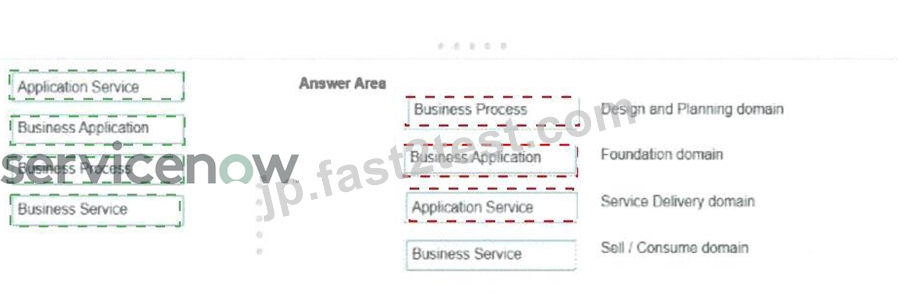
Explanation:
共通サービスデータモデル(CSDM)は、CMDBデータをサービスの計画、提供、利用方法を反映したドメインに整理します。オブジェクトの正しい配置は、レポート、所有権、そして下流のITSM、ITOM、IRMユースケースにとって不可欠です。
設計と計画ドメイン # ビジネスプロセス
ビジネスプロセスは、ビジネスの運営方法と必要な機能を記述します。これらは、サービスやアプリケーションを構築または提供する前に設計するために使用される計画構造です。
基盤ドメイン # ビジネスアプリケーション
ビジネスアプリケーションは、どのようなアプリケーションが存在し、誰が所有しているかを表す基礎的な参照オブジェクトです。所有権、ライフサイクル、ガバナンスを規定しますが、直接運用されるものではありません。
サービス配信ドメイン # アプリケーションサービス
アプリケーション サービスは、実行中の運用技術サービス (多くの場合、サービス マッピングによって作成される) を表します。
これらは、インシデント、変更、およびイベント管理の中心であり、サービス提供の一部となります。
ドメインの販売/消費 # ビジネスサービス
ビジネスサービスは、顧客または消費者に提供されるものを表します。価値の提供、SLA、そして消費コンテキストを定義するため、販売/消費ドメインに属します。
このマッピングは CSDM v5 ガイダンスに準拠しており、計画構造、基本レコード、運用サービス、および消費者向けサービス間の明確な分離を保証します。これは、スケーラブルで管理された CMDB の重要な原則です。
質問 # 64
組織は、ハードウェアCIの保証有効期限など、検出不可能な属性を管理する必要があります。これらの属性は、自動検出ツールでは更新されません。
すべての CI に対してこれらの属性が正確に維持されることを保証する方法は何ですか?
- A. 検出できない属性専用の新しいCIクラスを作成します。
- B. スケジュールされたデータインポートを使用して外部ソースから属性を更新します
- C. CMDB調整エンジンを使用して属性を更新します
正解:B
解説:
In Data Foundations, "Ingest" is not limited to Discovery. It includes establishing reliable sources and mechanisms to populate and maintain CMDB attributes--especially those that Discovery cannot provide. Warranty expiration dates are a classic example of non-discoverable data: they typically come from procurement systems, asset repositories, vendors, or contract tools rather than from device interrogation.
The correct approach is to maintain these attributes via a scheduled data import from an authoritative external source. This ensures ongoing accuracy and consistency at scale. A scheduled import allows you to define a repeatable integration pattern, apply data quality checks, and keep warranty data current as vendors and procurement records change--without relying on manual updates that inevitably drift over time.
質問 # 65
CMDBの価値は何ですか?(2つのオプションを選択)
- A. インシデント管理と変更管理の合理化
- B. 運用の回復力強化
- C. 財務データの収集と管理
- D. CI関係のメンテナンスの自動化
正解:A、B
解説:
The CMDB is a foundational capability that enables organizations to operate IT services with confidence, resilience, and efficiency. Its value lies not in automation for its own sake or financial data management, but in how it supports service-aware operations and decision-making.
Strengthening operational resiliency (Option A) is a core value of the CMDB. By maintaining accurate configuration data and relationships, organizations can better understand dependencies, assess risk, and recover more quickly from incidents or outages. A trusted CMDB enables proactive problem management and informed change planning, directly contributing to resiliency.
Streamlining Incident and Change Management (Option B) is another primary value. Accurate CI data allows incidents to be routed automatically to the correct support groups, enables faster root- cause analysis, and supports risk-based change assessments. This reduces manual effort, improves response times, and lowers operational risk.
質問 # 66
構成マネージャーは CMDB の実装を計画しています。
規定の CSDM 展開順序はどれですか?
- A. 初期、開発中、定義済み、管理済み
- B. 開始、計画、実行、提供、終了
- C. アーキテクチャ、ビジネス、技術、ガバナンス
- D. 這う、歩く、走る、飛ぶ
正解:D
解説:
The Common Service Data Model (CSDM) prescribes an incremental, maturity-based rollout approach to reduce risk and ensure sustainable adoption. The recommended order is Crawl, Walk, Run, Fly, which aligns implementation effort with increasing organizational capability and value realization.
Crawl focuses on foundational data hygiene: core CI classes, identification rules, reconciliation, basic Discovery ingestion, and CMDB Health basics.
Walk introduces service context, including Business Services, Application Services, and relationships that enable impact analysis for Incident and Change.
Run expands into operational excellence with Service Mapping, service offerings, advanced governance, and process automation.
Fly represents optimization and scale, leveraging analytics, AI/ML, proactive operations, and cross- domain integration (e.g., SecOps, APM, CSM).
This progression ensures teams do not over-model early or introduce complexity before data quality and governance are established. The other options describe generic project lifecycles or organizational categorizations, not the CSDM-recommended adoption path.
質問 # 67
複数の検出ソース(ServiceNow Discovery とサードパーティ製ツール)によって重複したサーバー CI が作成されています。今後重複を防ぐには、どのような設定が必要ですか?
- A. データ認証
- B. 変換マップの結合
- C. 識別ルール
- D. ビジネスルール
正解:C
解説:
The Identification Rule determines how CIs are uniquely identified. Proper identification criteria (e.g., serial number + hostname) prevents duplicate CI creation across sources via the IRE.
質問 # 68
ユーザーのエンドポイントデバイスはCMDBにインポートされ、コンピュータCI [cmdb_ci_computer] の「割り当て先 [assigned_to]」フィールドに入力されます。資産チームは、構成アナリストに対し、関連する資産の「割り当て先」フィールドに入力するよう依頼します。
これを自動的に実現するために、構成アナリストはどのようなアクションを実行しますか?
- A. 資産レコードの「割り当て先」フィールドを非表示にし、関連するCIにドットウォークして「割り当て先」の値を取得する新しいフィールドを作成します。
- B. アセット CI フィールド マッピング モジュールを使用して、アセットと関連付けられた CI 間で「割り当て先」の値を複製する新しいルールを作成します。
- C. コンピュータクラスの「割り当て先」フィールドへの挿入または更新に基づいて、資産の「割り当て先」フィールドにデータを入力するスクリプトを使用するように、コンピュータテーブルにビジネスルールを設定します。
正解:B
解説:
Data Foundations strongly encourages using out-of-box synchronization mechanisms rather than custom scripting whenever possible, to reduce technical debt and improve upgrade safety. In this scenario, endpoint data is being ingested into the CI record, and the Asset team needs the corresponding Asset record kept in sync automatically for their asset management processes.
The recommended approach is to use Asset CI Field Mapping, which is designed specifically to map and synchronize fields between an Asset and its related CI. Creating or updating a mapping rule for "Assigned to" allows the platform to replicate the value in a controlled, supportable way without writing scripts. This approach aligns with best practices: standard configuration, clear governance, and minimal custom code.
質問 # 69
CMDB 管理者は、サービスの所有者が特定されたプレイブックを実行して、CMDB データ基盤ダッシュボードに表示される問題を修正したいと考えています。
どのような修復策が使用されますか? (2 つ選択してください。)
- A. データを修正
- B. レポートデータ
- C. データの管理
- D. データを分析する
正解:A、D
解説:
CMDBおよびCSDMのデータ基盤では、ダッシュボードのインジケーター(「サービスの所有者が特定されています」など)がデータ品質の状態(この場合は、サービスに必要な所有者情報が不足している)をハイライト表示します。プレイブック主導の改善モデルは、通常、実用的な手順に従います。まず、問題の範囲を特定して検証し、次に、指標が改善され、持続可能な状態を維持できるように、基盤となるレコードを修正します。
データ分析プレイは、ダッシュボードのレポート内容を実用的な詳細に分解するために使用されます。これは、どのサービスレコードが所有権要件を満たしていないか、どの所有権フィールドが不足しているか(構成に応じてサービスオーナー、ビジネスオーナー、テクニカルオーナーなど)、そしてギャップが集中している場所(ビジネスユニット、環境、ライフサイクルステージ、またはサービスポートフォリオセグメント別)を特定するのに役立ちます。これにより、修復作業で適切なレコードが対象となり、不正確な割り当てを回避できます。
修正データプレイは、実際の修復作業、つまりサービスレコードの所有者属性の入力または修正を行うために使用されます。これにより、説明責任が明確になり、運用プロセスにおいて承認、エスカレーション、サービスに関する意思決定が適切にルーティングされます。CSDMの観点から見ると、所有者が明確に割り当てられることで、サービスポートフォリオとサービスオファリングの適切な管理が可能になり、インシデント割り当ての精度、変更影響分析、レポートの信頼性といった下流工程の成果が向上します。
Govern Data は再発防止 (ポリシー、制御、所有権モデル、および管理ルーチン) をサポートし、Report Data は進捗状況を伝達しますが、ダッシュボードの問題を直接修復するために使用される 2 つのプレイは Analyze Data と Fix Data です。
質問 # 70
ServiceNow 管理者は、Sen/ice Graph コネクタを実装して、会社が CMDB に統合したい多数のサードパーティ ソリューションとの統合を実現したいと考えています。管理者が使用できるコネクタのカテゴリは何ですか?
- A. DevOps
- B. 可観測性
- C. クラウド
- D. ワークフロー自動化
正解:B、C
解説:
Service Graph Connectors are a key Data Foundations ingestion capability in ServiceNow. They provide out-of-the-box, upgrade-safe integrations that ingest data into the CMDB using the Identification and Reconciliation Engine (IRE), ensuring data quality and source governance.
Two primary categories of Service Graph Connectors are:
Cloud (Option A): These connectors integrate with major cloud providers and platforms (such as AWS, Azure, and GCP) to ingest infrastructure, platform, and service data into the CMDB. They are essential for managing hybrid and multi-cloud environments and maintaining accurate cloud CI relationships.
Observability (Option B): These connectors integrate with monitoring and observability tools (such as APM, infrastructure monitoring, and telemetry platforms). They provide near-real-time operational data that enriches CI records and supports incident correlation, impact analysis, and service health insights.
質問 # 71
CMDB 構成マネージャは、CI クラス マネージャを使用して CI クラスのグループ所有権を定義し、CI クラス マネージャで指定された所有権の値を活用する必要があります。
CMDB データ マネージャ ポリシーを作成するときに、どのグループ参照フィールドを設定する必要がありますか?
- A. グループの変更
- B. サポートグループ
- C. グループによって管理
- D. 承認グループ
正解:C
解説:
In ServiceNow CMDB governance, the CI Class Manager allows administrators to assign ownership and accountability at the class level. This ownership is used by governance tools-- especially CMDB Data Manager--to automatically determine who receives tasks and actions related to data lifecycle management.
The group reference field that aligns with class ownership and is consumed by CMDB Data Manager policies is the Managed By Group. This field represents the team responsible for the technical stewardship and lifecycle management of CIs within that class.
When CMDB Data Manager executes policies such as retention, archival, or cleanup, it uses the Managed By Group to assign tasks to the appropriate data owners. This ensures governance actions are routed to the correct accountable team without manual intervention.
Approval Group, Support Group, and Change Group serve different purposes. Approval Group is used for workflow approvals, Support Group is used for operational ticket routing, and Change Group supports Change Management governance. None of these reflect data ownership at the class level.
質問 # 72
顧客の CMDB は CSDM Walk ステージに合わせて調整されます。
CMDB によってどのような利点が得られますか?
- A. OLAとコミットメントに沿って技術チームのサポート構造をさらに階層化できます。
- B. 将来のビジネスアプリケーションの合理化のために、APM Foundation の実装速度を向上させます。
- C. ビジネスサービスにおけるインシデント、問題、変更の影響評価を可能にします
正解:C
質問 # 73
CMDB 管理者は脆弱性対応またはセキュリティ インシデント対応を実装しており、リスクを推定し、タスクの優先順位を設定するために十分なコンテキストを顧客が持っていることを確認する必要があります。
CSDM データ基盤ダッシュボードのどの Get Well Playbook がこれに役立ちますか?
- A. CIライフサイクルステージのカスタムステータス値の割合
- B. ビジネスアプリケーション関係を持つアプリケーションサービス
- C. 親ロケーションのないロケーション
- D. プロダクトオーナーのいない名前付きプロダクトモデル
正解:B
解説:
In ServiceNow, Vulnerability Response and Security Incident Response rely heavily on business context to accurately assess risk, prioritize remediation tasks, and communicate impact to stakeholders. From a CSDM (Common Service Data Model) perspective, this context is primarily delivered through properly modeled relationships between Application Services and Business Applications.
The "Application Services with Business Application Relationships" Get Well Playbook directly addresses this requirement. In CSDM, Application Services represent the technical, deployable services that run in the environment, while Business Applications represent the logical applications that support business capabilities. When these two are correctly related, security teams can clearly understand which business processes, customers, and revenue streams are affected by a vulnerability or security incident.
Without this relationship, vulnerabilities may still be detected, but they lack meaningful prioritization. For example, a critical vulnerability on an application service supporting a revenue- generating or customer-facing business application should be addressed far more urgently than one tied to a low-impact internal tool. This relationship is what enables risk-based prioritization, rather than purely technical severity-based prioritization.
質問 # 74
構成管理プロセスオーナーは、カスタムCIをCMDBに取り込むためのソリューションオプションを技術ガバナンス委員会に提示する準備をしています。このソリューションは、ベストプラクティスに準拠し、将来の作業コスト(技術的負債)を最小限に抑え、将来のアップグレードへのコンプライアンスを確保する必要があります。
これを実現するソリューションはどれですか? (2 つ選択してください。)
- A. 既存の CI クラステーブルを拡張して、カスタム CI クラス属性に対応する
- B. CMDB CIクラスモデルストアアプリケーションをインストールまたはアップグレードして、新しい属性に対応する適切な既存のCIクラスを見つけます。
- C. 必要に応じて、基本CIクラスの再利用と属性名の変更
- D. 既存の資産クラステーブルを拡張して、カスタム CI クラス属性に対応する
正解:A、B
解説:
Data Foundations emphasizes that "ingest" must produce CMDB data that is standardized, supportable, and upgrade-safe. When introducing custom CIs, the best practice is to reuse the most appropriate existing CI class (or an approved industry-aligned model) and only add what is necessary--this keeps the data model aligned with platform expectations and reduces downstream rework.
Option B supports this directly: the CMDB CI Class Models application is intended to help teams select a suitable existing class rather than inventing new classes unnecessarily. Reusing existing classes improves consistency across integrations, Discovery/Service Mapping patterns, reporting, and CMDB Health rules--reducing technical debt and making future platform upgrades smoother.
Option A is also aligned with best practice when used correctly: once you have the right CI class, extending that class to add additional attributes (new fields) is a standard, upgrade-safe customization approach. It preserves the underlying platform data structures and avoids breaking out-of-box behaviors, identification/reconciliation practices, and CMDB Health evaluations.
質問 # 75
CMDB 管理者は、CSDM に関連するデータ品質を向上したいと考えています。
この目標を達成するために管理者はどのようなアクションを取る必要がありますか?
- A. CSDMデータ基盤ダッシュボードを使用する
- B. ServiceNowヘルススキャンを開始する
- C. デフォルトで設定されたCMDBヘルスダッシュボードを使用する
正解:A
解説:
To specifically improve data quality related to CSDM, the most effective and prescribed action is to use the CSDM Data Foundations Dashboard. In ServiceNow, this dashboard is purpose-built to assess and improve CSDM alignment, not just general CMDB hygiene.
The CSDM Data Foundations Dashboard focuses on service modeling readiness, highlighting gaps such as missing service ownership, incomplete relationships between Business Applications and Application Services, unmanaged services, and misaligned lifecycle states. It provides Get Well Playbooks that guide administrators through structured remediation using Analyze Data, Fix Data, and Govern Data plays--directly tied to CSDM outcomes.
質問 # 76
CMDB管理者は、重複CI修復ツールを使用して重複排除タスクに対処しています。ウィザードの最初のタブでは、メインCIが選択されています。
メイン CI を識別するために使用される属性はどれですか? (2 つ選択してください)
- A. 最も関連性の低いアイテム
- B. 最も古い作成
- C. 最新作成
- D. 最も関連性の高いアイテム
正解:B、D
解説:
In ServiceNow, the Duplicate CI Remediator is a governed tool designed to safely resolve duplicate Configuration Items while preserving the most valuable and authoritative record. The first step in the remediation wizard is identifying the Main CI, which will be retained after remediation.
ServiceNow uses two primary attributes to help determine the best candidate for the Main CI:
The oldest CI is often preferred because it typically has a longer operational history, may be referenced by historical incidents, changes, problems, or audits, and is more likely to be embedded in downstream processes and reports. Retaining the oldest CI helps avoid breaking historical references.
A CI with the most relationships (for example, links to applications, services, incidents, or other CIs) is generally the most valuable from a business and operational context perspective.
Preserving these relationships is critical for impact analysis, Change Management, and CSDM- aligned service modeling.
質問 # 77
自動的な関係を構築する ServiceNow ソリューションはどれですか? (2 つのオプションを選択)
- A. インテグレーションハブ ETL
- B. サービスマッピング
- C. ワークフロースタジオ
- D. 発見
正解:B、D
解説:
Automatic relationship creation is fundamental to maintaining a service-aware and trustworthy CMDB. In ServiceNow, this capability is primarily delivered by Discovery and Service Mapping.
Discovery (Option C) automatically identifies infrastructure components--such as servers, network devices, and storage--and creates technical relationships between them (for example, "runs on,"
"connected to," or "depends on"). These relationships form the backbone of infrastructure dependency mapping.
Service Mapping (Option B) builds on Discovery by creating application- and service-level relationships. It maps how application components interact across servers, databases, and middleware, resulting in accurate Application Service models aligned with CSDM. These relationships are created and maintained automatically as the environment changes.
質問 # 78
構成管理ガバナンス チームは、従来の CMDB ステータス フィールドの利用から CSDM ライフサイクル ステータス フィールドへの移行を行っています。
どのテーブルを変更できますか?
- A. ライフサイクルステージ
- B. ライフサイクルコントロール
- C. ライフサイクルステージのステータス
- D. ライフサイクルマッピング
正解:D
解説:
When organizations transition from legacy CMDB status fields (such as custom install status or operational status values) to CSDM-aligned lifecycle status fields, the goal is to map old values to standardized lifecycle stages without disrupting existing processes. In ServiceNow, this is achieved through the Life Cycle Mapping table.
The Life Cycle Mapping table is specifically designed to translate legacy or custom status values into CSDM lifecycle stages and statuses. This allows organizations to preserve historical data and integrations while progressively adopting CSDM standards. By modifying this table, administrators can define how existing status values correspond to CSDM lifecycle stages such as Plan, Build, Deploy, Operate, and Retire.
質問 # 79
データセンターマネージャーは、CMDB CIクラスマネージャーと連携して、アプリケーションサーバーとそれらがホストするアプリケーションとの関係を定義しています。企業には、1つ以上のアプリケーションをホストする複数のアプリケーションサーバーがあります。
アプリケーション サーバー テーブルとアプリケーション テーブルの関係を説明するものはどれですか。
- A. 多対一
- B. 1対多
- C. 多対多
- D. 1対1
正解:C
解説:
CMDBモデリングにおいて、関係性を正確に定義することは、影響分析、サービスマッピング、変更管理において非常に重要です。このシナリオでは、アプリケーションサーバーは複数のアプリケーションをホストでき、アプリケーションは複数のアプリケーションサーバーにまたがって実行できます(例えば、クラスター化、負荷分散、分散アーキテクチャなど)。
このアーキテクチャの現実は、アプリケーション サーバー テーブルとアプリケーション テーブル間の多対多の関係を定義します。
ServiceNowでは、特に水平スケーリング、冗長性、コンテナ化されたワークロードを使用する最新の環境では、アプリケーションホスティングモデルにおいて多対多の関係が一般的です。これを適切にモデル化することで、単一のサーバーに影響を与えるインシデント、変更、および障害を、影響を受けるすべてのアプリケーションに正確に追跡できるようになります。また、その逆も同様です。
1対多または多対1の関係では、一方向の排他性を誤って想定してしまい、実際のアプリケーションのデプロイメントパターンを反映しません。1対1の関係では、さらに制限が多くなり、不正確になります。
したがって、正しい関係タイプは A - 多対多であり、これは CMDB のベスト プラクティスと CSDM サービス モデリングの原則と一致しています。
質問 # 80
構成マネージャーは、ポリシー タイプを活用して、CI の存在を検証するためのタスクの作成と割り当てを自動化する必要があります。
この目標を達成するにはどのポリシー タイプを使用する必要がありますか?
- A. 引退
- B. 証明書
- C. 認定
- D. 削除
正解:B
解説:
In ServiceNow, validating whether Configuration Items (CIs) still exist is a core CMDB governance activity. Over time, environments change rapidly--servers are decommissioned, cloud resources are torn down, and applications are replaced. If existence validation is not enforced, the CMDB quickly fills with obsolete or "ghost" CIs.
Attestation policies are specifically designed to address this need. An attestation policy automatically generates and assigns tasks to responsible users or groups, asking them to confirm that a CI still exists and is still relevant. This process focuses on acknowledgment rather than deep data validation, making it lightweight and scalable across large CMDBs.
質問 # 81
......
合格させるServiceNow CIS-DF日本語プレミアムお試しセットテストエンジンPDFで無料問題集セット:https://jp.fast2test.com/CIS-DF-JPN-premium-file.html