

BCS TM3認定試験問題集には53練習テスト問題があります
最新TM3試験問題集には高得点で一発合格
質問 # 12
You have been contracted to manage the user acceptance testing of a new reservation system for a travel agency. The reservation system is being developed by a third party. Detailed specifications are available, and an estimate of the total development effort exists. The system will be delivered in four agreed increments.
Which of the following estimation techniques would be most appropriate to use in this context?
- A. Wide-band Delphi
- B. Estimation based on ratios
- C. Extrapolation
- D. Planning poker
正解:B
解説:
Comprehensive and Detailed Explanation From Exact Extract of ISTQB Certified Tester Advanced Level - Test Manager v3.0 syllabus:
The syllabus describesratio-based estimation(e.g., estimating test effort as a proportion of known or estimated development effort) as appropriate when reliable development-effort data or estimates and clear scope are available. Here, detailed specifications exist, overall development effort is estimated, and increments are defined-conditions well-suited to ratio-based estimation.
Extrapolationrequires comparable historical test data for this context.
Wide-band Delphiis useful when data is scarce and expert consensus is needed.
Planning pokeris typically used by Agile development teams to size user stories, not for contracting UAT with a third party.
質問 # 13
Factors that are important to take into account when performing test estimation include:
i. The quality of the test basis
ii. The availability of test automation
iii. The amount of rework required
iv. The distribution of testing across several locations
The various factors can be grouped by characteristic. Examples of characteristics include:
- A. A = i, B = ii, C = iii, D = iv
- B. Product
- C. A = iv, B = iii, C = i, D = ii
- D. A = ii, B = iii, C = iv, D = i
- E. Test context
- F. Test results
- G. Development processWhich factor is related to which characteristic?
- H. A = iv, B = iii, C = ii, D = i
正解:F
解説:
Comprehensive and Detailed Explanation From Exact Extract of ISTQB Certified Tester Advanced Level - Test Manager v3.0 syllabus:
Product characteristic # quality of the test basis (C = i):The syllabus lists the quality and stability of the requirements/specifications (test basis) as a product-related estimation driver.
Test results characteristic # amount of rework (B = iii):Expected rework/defect-fix cycles and their impact on retesting and confirmation testing are identified through past results/defect patterns and directly affect estimates.
Test context characteristic # distribution across locations (A = iv):Organizational and logistical context (multiple sites, time zones, communication overhead) influences test effort.
Development process characteristic # availability of test automation (D = ii):Process/tooling capability (e.g., presence of automation frameworks) is treated as a development/process factor affecting test efficiency and thus estimation.The syllabus groups estimation drivers into characteristics such as product, development process, test results/history, and test/organizational context, and recommends mapping specific factors to these groups to structure estimation.
質問 # 14
You are a test consultant involved in setting up and implementing retrospectives in an organisation that is developing software based on an Agile lifecycle. The Agile teams are experiencing problems on product quality, so the retrospectives will be specifically focused on the testing practices and processes.
Which of the following is an example of a good practice for a test retrospective?
- A. An action plan for the improvements identified is too much documentation in an Agile context; the team members are already motivated to implement the improvements based on the retrospective
- B. Because an Agile team is empowered, all improvement actions should reside within the team
- C. Brainstorming sessions can be used to generate ideas on how to resolve the root causes of testing issues identified
- D. Only testers should be involved in the retrospectives since they perform testing and will know what should be improved
正解:C
解説:
Comprehensive and Detailed Explanation From Exact Extract of ISTQB Certified Tester Advanced Level - Test Manager v3.0 syllabus:
The syllabus highlightscontinuous improvementpractices, includingretrospectivesin Agile lifecycles, encouragingcollaborative techniquessuch asbrainstormingto generateconcrete improvement ideas, often followingroot cause analysisof issues.
Effective retrospectives should involve thewhole team and relevant stakeholders, generatespecific actions (anaction plan), and recognize that some actions may requiresupport beyond the team.
Therefore,Cis a good practice.Ais incorrect (retrospectives should be cross-functional),Bis too narrow (some actions require organizational support), andDis incorrect (capturing concrete actions is recommended even in Agile contexts).
(References: CTAL-TM v3.0 Syllabus - Chapter 1 "Testing Process" - lessons learned and process improvement; Agile lifecycle considerations for retrospectives and collaborative improvement techniques; emphasis on actionable outcomes.)
質問 # 15
Test control uses the information from test monitoring to provide guidance and take corrective action when required.
Which of the following is not a possible test control action?
- A. Re-prioritisation of test cases
- B. Adjusting the test schedule
- C. Adding new resources
- D. Checking the fulfilment of the exit criteria
正解:D
解説:
Comprehensive and Detailed Explanation From Exact Extract of ISTQB Certified Tester Advanced Level - Test Manager v3.0 syllabus:
The syllabus distinguishestest monitoring(collecting/assessing status information, e.g., progress vs plan, exit criteria status) fromtest control(takingcorrective actionsbased on monitoring).Control actionsincludere- prioritising tests,adjusting schedules, andadding resourcesto address variances and risks.Checking the fulfilment of exit criteriaismonitoringactivity (status assessment), not a control action.
(Reference: CTAL-TM v3.0 -Test Planning, Monitoring, and Control: differences between monitoring (status, metrics, exit criteria checks) and control (reprioritisation, rescheduling, resource adjustments, scope changes).)
質問 # 16
Following up on the situation, the team lacks drive and is performing tasks too slowly. You have been asked to recruit an extra person into the team. Which of the following team roles would be most appropriate to enhance the team?
- A. A test process improvement consultant
- B. A person who brings new ideas to the team
- C. A person with the ability to complete tasks
- D. A person with in-depth technical skills
正解:C
解説:
Comprehensive and Detailed Explanation From Exact Extract of ISTQB Certified Tester Advanced Level - Test Manager v3.0 syllabus:
According to theISTQB Certified Tester Advanced Level - Test Manager v3.0 Syllabus (Chapter 7: People Skills - Team Composition), theBelbin team role modelis referenced to describe how a balanced team benefits from diverse behavioral roles.
"A team should consist of people who complement each other's strengths and weaknesses. When the team lacks drive or the ability to meet deadlines, a role such as the Implementer or Completer-Finisher may be needed to ensure that work is completed efficiently and on time." (ISTQB CTAL-TM v3.0 Syllabus, Chapter 7 - People Skills, Section: Building and Leading Test Teams) When a test teamlacks driveand isslow in completing tasks, this indicates the absence oftask-oriented rolesthat emphasize execution and delivery. The Belbin roles that suit this gap include:
Implementer (Practical Organizer)- disciplined, reliable, and efficient in turning ideas into actions.
Completer-Finisher (Detail-Oriented Finisher)- conscientious and ensures that work is completed to the required standard.
Recruiting a person with astrong ability to complete tasksbest addresses this deficiency and directly improves the team's delivery performance.
Why the Other Options Are Incorrect:
B). A test process improvement consultant- Focuses on optimizing processes, not motivating daily execution or speeding up delivery.
C). A person with in-depth technical skills- Adds expertise but does not necessarily address the lack of drive or task completion discipline.
D). A person who brings new ideas to the team- Reflects a creative or "Plant" role, valuable for innovation but not for improving execution speed or focus.
References (from ISTQB Certified Tester Advanced Level - Test Manager v3.0 Syllabus):
Chapter 7:People Skills - Team Composition
Section:Test Team Dynamics and the Belbin Team Roles
States that"the Test Manager should identify and balance behavioral roles within the team to ensure effectiveness, for example, introducing task-oriented members when delivery speed is lacking."
質問 # 17
Which of the following test stakeholders are most likely not involved in defining requirements?
- A. Development Leads
- B. Users
- C. Product Owners
- D. Operations Team
正解:D
解説:
Comprehensive and Detailed Explanation From Exact Extract of ISTQB Certified Tester Advanced Level - Test Manager v3.0 syllabus:
The syllabus (Chapter:People Skills - Team Composition) discusses stakeholder roles and collaboration.
Product OwnersandUsersare primary sources forrequirements and acceptance criteria.Development Leadstypically collaborate on clarifying requirements and translating them into technical solutions and testability. By contrast, theOperations Teamis primarily focused ondeployment, support, and operational concerns(e.g., environments, monitoring, reliability in production). While operations may influencenon- functional constraintsor service levels, they arenot typically the primary participants in defining functional requirements, makingOperations Teamthe most likely answer here.
(Reference: CTAL-TM v3.0 Syllabus - Chapter "People Skills - Team Composition", stakeholder roles and collaboration; contrasts in responsibilities across PO/Users/Dev vs. Operations.)
質問 # 18
Which of the following factors influences the risk impact?
- A. Complexity of technology being used
- B. Frequency of use of the affected feature
- C. Maturity of the development organisation
- D. Geographically distributed teams
正解:B
解説:
Comprehensive and Detailed Explanation From Exact Extract of ISTQB Certified Tester Advanced Level - Test Manager v3.0 syllabus:
In the syllabus,risk impactconcerns thepotential damage or lossif a failure occurs (business, user, financial, legal, or reputational).Frequency of use of the affected featureincreases theexposureand thus theimpactwhen defects occur, making optionBcorrect. By contrast,complexity of technology,organizational maturity, anddistributed teamsprimarily influencelikelihood(the chance of defects entering/escaping), not the impact dimension (CTAL-TM v3.0 Syllabus, Risk-Based Testing section explaining factors oflikelihood vs.
impactand examples of each).
質問 # 19
You are a test manager in charge of integration, system, and user acceptance testing for a bank. You are working on a project to upgrade an existing ATM to allow customers to obtain cash advances from supported credit cards.
The system should allow cash advances from €20 to €500 (both inclusive) for all supported credit cards. The supported credit cards are American Express, VISA, Eurocard, and Mastercard. The system should be easy to use for all users, including new users. The organisation is currently in a transition to Agile and already well on its way.
In the test plan, the following items are listed under the heading"Items and features to be tested":
All supported credit cards
Language localisation
Valid and invalid advance
Usability
Response time
Which of the following topics would be most important for you to address in detail in the test plan?
- A. An approach to regression testing
- B. Detailed entry and exit criteria per test level
- C. A list of acceptance criteria for each of the user stories
- D. A set of logical test cases
正解:B
解説:
Comprehensive and Detailed Explanation From Exact Extract of ISTQB Certified Tester Advanced Level - Test Manager v3.0 syllabus:
According to theISTQB CTAL-TM v3.0 Syllabus, Chapter 3 - Test Planning, Monitoring, and Control, one of the main tasks oftest planningis todefine and document test completion criteria and test level entry criteriaas part of the test plan.
"The test plan shall include the entry and exit criteria for each test level, including the conditions that must be met to start and finish testing activities at that level." (ISTQB CTAL-TM v3.0 Syllabus, Chapter 3: Test Planning activities) Thetest planprovides the structure for managing multiple test levels such as integration, system, and user acceptance tests. Since this question context explicitly mentions severaltest levels, the most critical aspect to document in detail isthe entry and exit criteria per test level, ensuring clarity on when each test level starts and completes, and what constitutes sufficient testing for release or transition.
Why the other options are incorrect:
A). An approach to regression testing- While important, regression strategy typically belongs to thetest approachsection, not the detailed planning of multi-level testing criteria.
B). A list of acceptance criteria for each of the user stories- This belongs toAgile acceptance testdocumentation, not the formaltest planfor multiple test levels (integration, system, UAT).
D). A set of logical test cases- Test cases are outputs oftest design, not part of thetest plandocument.
References:
ISTQB Certified Tester Advanced Level - Test Manager Syllabus v3.0
Chapter 3: Test Planning, Monitoring, and Control
Section:Test Planning Tasks
Subsection:Define test completion criteria (exit criteria) and entry criteria for each test level Table of contents and body text referring to"items and features to be tested","entry and exit criteria", and
"content of the test plan".
質問 # 20
Management is sceptical regarding the budget request (€25,000) for the next testing project. You are asked for a cost-benefit calculation. Based on historical data from several projects, you have come up with the following numbers:
Average prevention cost per defect: €200
Average cost of detection per defect: €400
Average cost of internal failure: €150
Average cost of external failure: €2,500
Expected number of defects to be found in this project during testing: 50 What is the result for the expected cost-benefit calculation for the upcoming project?
- A. €92,500
- B. €62,500
- C. €72,500
- D. €87,500
正解:D
解説:
Comprehensive and Detailed Explanation From Exact Extract of ISTQB Certified Tester Advanced Level - Test Manager v3.0 syllabus:
Per the syllabus, when building abusiness caseusing thecost of qualitymodel, compare theavoided external failure costswith thesum of relevant pre-release costs(prevention, detection/appraisal, and internal failure). For
50 expected defects found in testing:
Avoided external failure cost= 50 × €2,500 =€125,000
Pre-release costsper defect = €200 (prevention) + €400 (detection) + €150 (internal failure) =€750 Total pre-release costs= 50 × €750 =€37,500 Net benefit (cost-benefit)= €125,000 # €37,500 =€87,500 This computation follows the syllabus' guidance to quantify bothcosts(prevention, detection, internal failure) andbenefits(external failures avoided) to demonstrate the economic value of testing.
質問 # 21
A project has been running for a few months and the team does not seem to be making progress in their test approach. The team also lacks drive and enthusiasm and is sometimes seen to be performing their tasks too slowly. You have been asked to recruit an extra person into the team. In addition to introducing the new team member, you have decided to raise motivation.
Which of the actions listed below would most likely result in the opposite, a de-motivation of the team?
- A. Criticising testers only in private when they made a mistake during their test activities.
- B. Providing adequate rewards to the testers when they have done an outstanding job.
- C. Constantly prescribing overtime to the testers so that they will be accustomed to perform extra hours when necessary.
- D. Organising a meeting with senior management in which senior management addresses the importance of good testing for this project.
正解:C
解説:
Comprehensive and Detailed Explanation From Exact Extract of ISTQB Certified Tester Advanced Level - Test Manager v3.0 syllabus:
The syllabus addressesmotivators and de-motivatorsin test teams. Sustainedmandatory overtimeis explicitly highlighted as ade-motivator, leading to burnout, reduced morale, and lower quality over time. In contrast, private, constructive feedback,recognition/reward, andvisible management supportare listed as practices that canimprove motivation. Hence,constantly prescribing overtime (B)is the option most likely tode-motivatethe team.
(ISTQB CTAL-TM v3.0 - Chapter "People Skills - Team Composition": motivation and de-motivation factors; effects of overwork, recognition, supportive leadership, and constructive feedback.)
質問 # 22
Assume that you are using traceability to manage test case coverage against test conditions. During test analysis, three test conditions were identified. Test design for system testing has been completed and 10 test cases (TC1 to TC10) have been designed, as described by the following traceability matrix ("C" indicates a critical test case, while "NC" indicates a non-critical test case):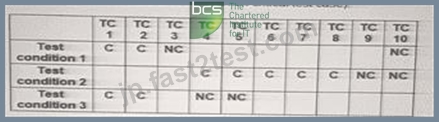
[traceability matrix not visible in the prompt]
The exit criterion for system testing states that each test condition must have all the associated critical test cases successfully executed (passed) AND all associated non-critical test cases at least executed.
The following is the situation after three days of system testing:
TC1, TC2, TC4, TC5, TC7, TC9: passed
TC3, TC10: failed (with an associated open defect report)
TC6, TC8: not run
Management wants to decide whether to release the system. You advise them that the system does not yet meet the defined exit criteria.
Based only on the given information, which test condition does not yet meet the stated exit criterion?
- A. Test condition 2
- B. Test condition 1
- C. None, all meet the stated exit criteria
- D. Test condition 3
正解:A
解説:
The syllabus explicitly states thatexit criteriamust be met before considering completion of a test level:
"Exit criteria are the conditions that must be achieved to declare completion of a given test level... including coverage criteria and status of required tests (e.g., passed)."
- ISTQB CTAL-TM v3.0 Syllabus, Chapter 5Test Monitoring and Test Control And test control must act when exit criteria are not met:
"If the exit criteria are not satisfied, appropriate actions must be taken to address the situation."
- ISTQB CTAL-TM v3.0 Syllabus, Chapter 5
Sincetest condition 2 still has critical tests not yet executed, thedefined exit criteria are not fulfilled, and therefore a release decision should not be approved.
質問 # 23
Which one of the following metrics is primarily used to measure the achievement of a test objective and reported in a test completion report?
- A. Number of automated test cases versus planned automated test cases
- B. Actual versus planned estimation (in hours) for testing activities
- C. Code coverage
- D. Accumulated number of resolved defects versus accumulated number of defects
正解:A
解説:
Comprehensive and Detailed Explanation From Exact Extract of ISTQB Certified Tester Advanced Level - Test Manager v3.0 syllabus:
The syllabus explains thattest objectivesare agreed during planning andachievement against these objectivesis assessed and reported intest completion. A common objective is toautomate a defined proportion of tests; the metric "number of automated test cases versus planned automated test cases" directly measures the degree to which thatobjectivewas achieved and is reported in completion.
A (code coverage)andC (defect trends)are valuable but are not inherently tied to a specificstated objectiveunless such a target was set (e.g., 80% branch coverage).
Bis amonitoringmetric (variance to plan) rather than a direct measure ofobjective achievement.(Reference:
CTAL-TM v3.0 -Test Planning, Monitoring, and ControlandTesting Process (Test Completion): defining measurable test objectives; reporting objective achievement in the test summary/completion report.)
質問 # 24
A company that sells an established capture-replay execution tool is adding a test management tool. Same team, same technology, incremental development (V-model per increment), known first-year features; later features driven by customer demand.
Which two of the following factors are most likely to influence the estimation technique that would be selected in this scenario?
- A. Estimation error
- B. Data availability
- C. Time constraints
- D. Expert availability
- E. Knowledge in modelling
正解:B、D
解説:
According to theISTQB Certified Tester Advanced Level - Test Manager v3.0 Syllabus (Chapter 3: Test Planning, Monitoring, and Control), the choice oftest estimation techniquedepends on several influencing factors, including data availability, expert availability, and knowledge of historical information or models.
"The selection of a suitable estimation approach (metrics-based or expert-based) depends on factors such as the availability of relevant historical data, the availability of experts with appropriate experience, the time available to perform estimation, and the knowledge of applicable models." (ISTQB CTAL-TM v3.0 Syllabus, Chapter 3 - Test Planning, Section: Test Estimation) Analysis for this scenario:
* The organization isadding a test management toolto anexisting productusing thesame team and technology- implyingavailability of previous project datafrom similar development work.#Data availability(B) is a significant factor, enabling the use ofmetrics-based estimation.
* Thesame experienced teamis working on the project, meaningdomain and technical expertsare available.#Expert availability(C) also influences estimation and may support anexpert-based estimationapproach for new, customer-driven increments.
Therefore, the combination ofdata availability (B)andexpert availability (C)most strongly influences the estimation technique to be applied in this scenario.
Why the Other Options Are Incorrect:
* A. Estimation error- This is a result of estimation, not a factor influencing the choice of estimation technique.
* D. Knowledge in modelling- While useful, modelling is not central to this specific context because data and experts are readily available.
* E. Time constraints- Not highlighted as a limiting factor in this scenario; estimation can be planned adequately given the context.
References (from ISTQB Certified Tester Advanced Level - Test Manager v3.0 Syllabus):
* Chapter 3: Test Planning, Monitoring, and Control
* Section:Test Estimation
* Lists influencing factors for selecting estimation techniques:availability of historical data, expert knowledge, applicable models, and time available for estimation.
質問 # 25
Which status would typically be assigned to a false-positive defect report during defect management?
- A. Resolved
- B. Accepted
- C. Rejected
- D. Deferred
正解:C
解説:
Comprehensive and Detailed Explanation From Exact Extract of ISTQB Certified Tester Advanced Level - Test Manager v3.0 syllabus:
Afalse-positivedefect is one where the reported behavior isnot actually a defect(e.g., intended behavior, misuse, environment/setup issue). In defect management, the appropriate disposition for "not a defect" is torejectthe report rather than accept, resolve, or defer it.
Rejected: used when the item is not a defect (e.g., "as designed," duplicate, or cannot be reproduced).
Accepted/Resolved: used when confirmed and fixed.
Deferred: used when confirmed, but the fix is postponed to a later release.This aligns with the syllabus content ondefect lifecycle states and dispositionswithin defect management governance and reporting (CTAL- TM v3.0, Chapter 5: Test Monitoring, Test Control, and Test Reporting - defect management process, defect states, and reporting).
質問 # 26
Which of the following is not something you should do when performing a Belbin assessment with an Agile team?
- A. Feedback is provided to the individual team members by another team member using the observer assessment questionnaire.
- B. The team should not align the team's roles with the team's goals and expectations. These should be kept independent.
- C. Team members use a self-assessment questionnaire to identify their own strengths and weaknesses in relation to nine Belbin roles.
- D. The team member roles should be balanced with the Belbin team roles model to identify any missing or overrepresented roles and adjust accordingly.
正解:B
解説:
Comprehensive and Detailed Explanation From Exact Extract of ISTQB Certified Tester Advanced Level - Test Manager v3.0 syllabus:
The syllabus introducesBelbin team rolesas a tool tobalance rolesin a team and improve collaboration. It notes the use ofself-assessmentandobserver feedbackand stresses aligning team composition and role usage withthe team's goals and context. Therefore, statementDis incorrect: teamsshouldalign roles withteam goals and expectations; keeping them "independent" runs counter to the intended use of Belbin roles in Agile teams.
(ISTQB CTAL-TM v3.0 - Chapter "People Skills - Team Composition": Belbin roles, use of self/observer assessments, and aligning role mix with team goals.)
質問 # 27
Analytical test improvement approaches identify problems based on data from the project or team.
Appropriate improvements can be derived from an analysis of the identified set of problems.
Which of the following is not an example of an analytical-based test process improvement approach?
- A. Root cause analysis
- B. The Goal Question Metric (GQM) approach
- C. Quantitative TPI NEXT assessment
- D. Analysis using measures, metrics and indicators
正解:C
質問 # 28
You are a tester working in an Agile team in the finance domain. The team consists of 6 members, and you are the only tester. The team is responsible for the development and maintenance of a mobile front-end application. The application is considered to be critical with respect to customer impact and market branding.
You have been asked to identify which test management activity needs to be performed within the team to enhance test maturity and achieve a higher level of product quality.
Which test management activity would you recommend the team should adopt?
- A. Perform product risk identification and analysis
- B. Provide detailed estimations early for each test level
- C. Increase coverage by automating more tests
- D. Define quality criteria for user stories and acceptance criteria
正解:A
解説:
Comprehensive and Detailed Explanation From Exact Extract of ISTQB Certified Tester Advanced Level - Test Manager v3.0 syllabus:
The syllabus positionsproduct risk analysisas a core activity for test managers toprioritize testing and allocate effort. Performingproduct risk identification and analysisdrives the selection of features, levels, and test types to focus on, informs coverage depth, and guides where to automate for maximum value. While defining acceptance criteria (A) is important and often handled during backlog refinement, and automation (D) is valuable, withoutrisk analysisthe team cannot ensure efforts target the most critical quality risks-especially forhigh-impact, customer-facing mobile applications(CTAL-TM v3.0 Syllabus, chapter on Risk-Based Testing: risk identification, analysis, and applying risk to test prioritization and coverage).
質問 # 29
When reading books and watching recorded videos are used as a way to acquire skills and knowledge, which approach to competence development is typically being used?
- A. Peer learning
- B. Self-study
- C. Training on-the-job
- D. Training and education
正解:B
解説:
Comprehensive and Detailed Explanation From Exact Extract of ISTQB Certified Tester Advanced Level - Test Manager v3.0 syllabus:
The syllabus lists multiple competence development approaches (training/education, coaching/mentoring, on- the-job learning, peer learning, andself-study) and explicitly characterizesself-studyas learning through materials such as books and recorded content. This aligns directly with the scenario of "reading books and watching recorded videos," which isself-study(CTAL-TM v3.0, People Skills - competence development options).
質問 # 30
......
無料提供中TM3ブレーン問題集とTM3リアル試験問題を試そう:https://jp.fast2test.com/TM3-premium-file.html
BCS TM3実際の問題とブレーン問題集:https://drive.google.com/open?id=1kKWnb_6iAXXyhXjMze-4yrxaAkZ3BumB