

237試験解答はSalesforce-MuleSoft-Developer-I最新版 テストエンジン
合格確定Salesforce-MuleSoft-Developer-I試験問最新のSalesforce-MuleSoft-Developer-I試験問題集PDF2026年更新
質問 # 77
What path setting is required for an HTTP Listener endpoint to route all requests to an APIkit router?
- A. "/*"
- B. /
- C. /(*)
- D. /()
正解:A
解説:
Option1 is correct syntax to configure HTTP Listener endpoint
質問 # 78
Refer to the exhibits.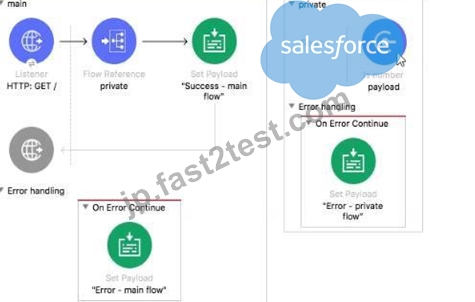
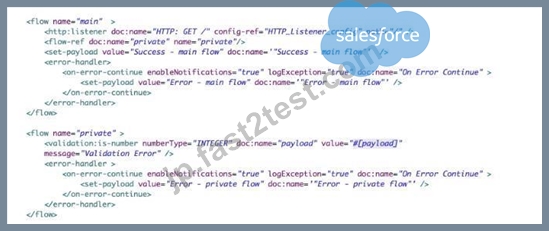
The Validation component in the private flow throws an error. What response message is returnedto a client request to the main flow's HTTP Listener?
- A. Validation Error
- B. Error - main flow
- C. Error - private flow
- D. Success - main flow
正解:B
解説:
Error in validation component will get processed by Processer level On Error Propagate block and thenerror will be rethrown which will get processed by flow level error handler which will set payload to "Error- main flow". Hence correct answer is Error - main flow
1) Request is received by HTTP listener
2) Try scope gets executed
3) The validator component in the Try scope creates an Error Object because the payload is not null.
4) The On Error Propagate handles the error. The payload is set to "Error - Try scope"
6) "Error - Try scope" is returned to the 'On Error Continue' block. Main flow execution stops. Payload is set to "Error - main flow"
7) "Error - main flow" is returned to the requestor in the body of the HTTP request. HTTP Status Code: 200
---------------------------------------------------------------------------------------------------------------------------------------- Reference Diagram though not exactly same, conditions are similar. They will help you answer any new question on error handling in real exam:
Timeline Description automatically generated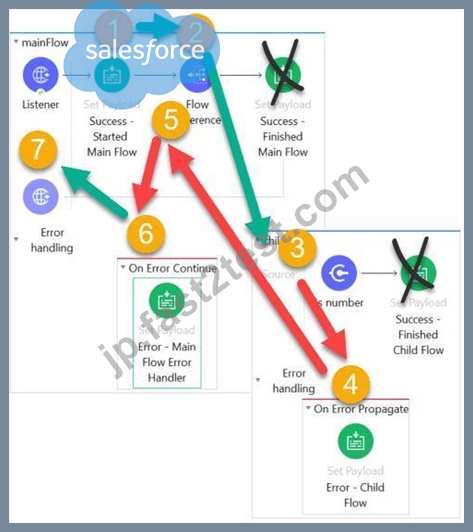
https://docs.mulesoft.com/mule-runtime/4.3/on-error-scope-concept#on-error-continue
質問 # 79
Refer to the below exhibit.
A Mule application configures a property placeholder file named config.yaml to set some property placeholders for an HTTP connector.
What is the valid properties placeholder file to set these values?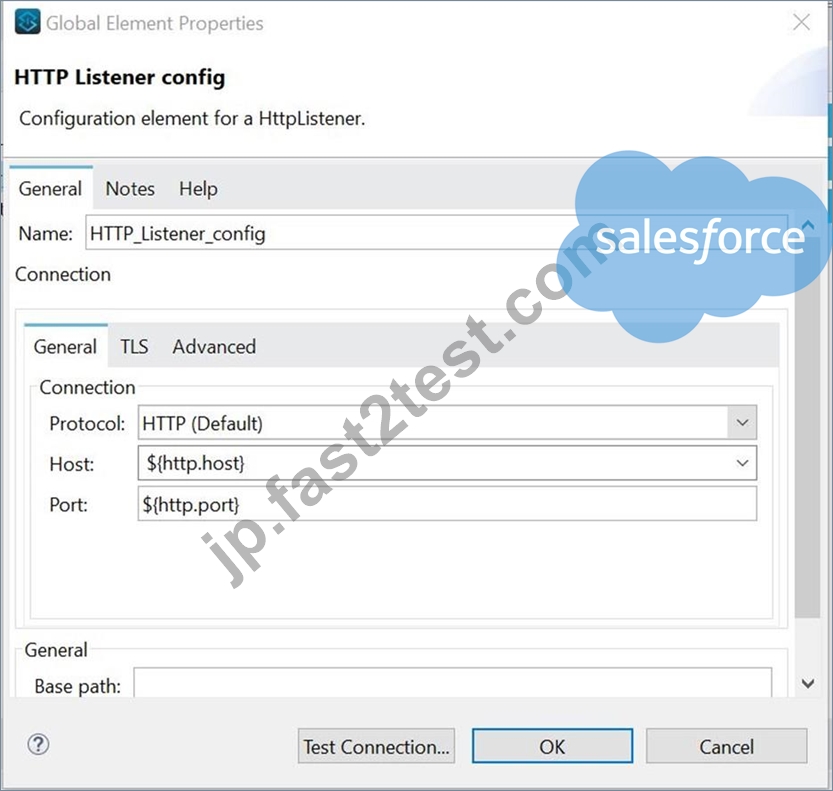
- A. 1. http:
2. host = "localhost"
3. port = "8081" - B. 1. {
2. http:
3. basePath: "api",
4. port: "8081", - C. 1. http:
2. basepath: "api"
3. host : "localhost"
4. port : "8081" - D. 1. http.host = localhost
2. http.port = 8081
正解:C
解説:
5. host: " localhost"
Explanation:
Correct answer is as below as it follows the correct syntax.
http:
basepath: "api"
host : "localhost"
port : "8081"
Mule Doc Reference : https://docs.mulesoft.com/mule-runtime/4.3/mule-app-properties-to-configure
質問 # 80
In the Database On Table Row operation, what does the Watermark column enable the On Table Row operation to do?
- A. To delete the most recent records retrieved from a database to enable database caching
- B. To enable duplicate processing of records in a database
- C. To save the most recent records retrieved from a database to enable database caching
- D. To avoid duplicate processing of records in a database.
正解:D
解説:
The correct answer is To avoid duplicate processing of records in a database.
If a watermark column is provided, the values taken from that column are used to filter the contents of the next poll, so that only rows with a greater watermark value are returned. If an ID column is provided, this component automatically verifies that the same row is not picked twice by concurrent polls.
Mule doc reference : https://docs.mulesoft.com/db-connector/1.8/database-documentation#listener
質問 # 81
How does APIkit determine the number of flows to generate from a RAML specification?
- A. Creates a separate flow for each resource that contains child resources
- B. Creates a separate flow for each HTTP method
- C. Creates a separate flow for each response status code
- D. Creates a separate flow for each resource
正解:B
解説:
APIKIt Creates a separate flow for each HTTP method
質問 # 82
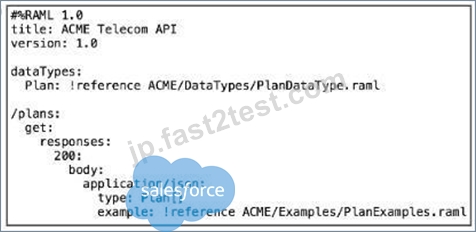
Refer to the exhibit.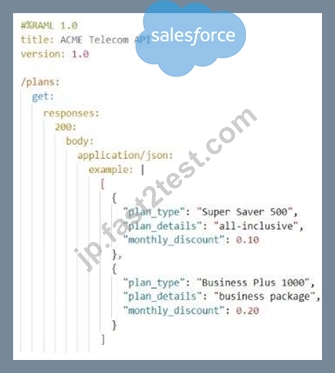
The API needs to beupdated using the company-wide standard for the Plan data type. The Object data type has already been published in Anypoint Exchange with the global reference . ACME/DataTypes
/PlanDataType.raml.
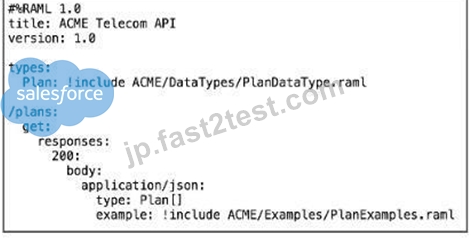
What is a valid RAML specification that reuses the Plan data type?
- A.
- B.
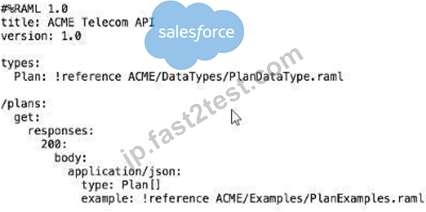
- C.
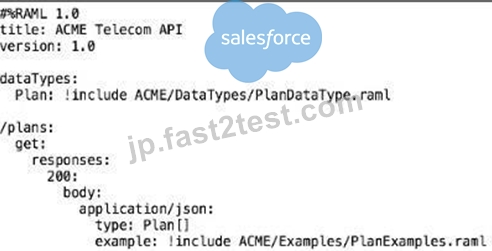
- D.
正解:A
解説:
As can be seen in RAML, POST expects input in application/json format which eliminates two of the options as two options are in xml format.
Now out of the two remainingoptions, one has id field in request which is only mentioned for get response and not for POST request. Hence id field is not expected in POST request.
Hence correct answer is
{
"name": "GoerdiLa Forge",
"address": "1 Westland CA",
"customer_since":"2014-01-04",
"balance": "4829.29",
"bank_agend_id": "12556"
}
質問 # 83
Why would a Mule application use the ${http.port} property placeholder for its HTTP Listener port when it is deployed to CloudHub?
- A. AllowsCloudHub to automatically change the HTTP port to allow external clients to connect to the HTTP Listener
- B. Allows clients to VPN directly to the application at the Mule application's configured HTTP port
- C. Allows MuleSoft Support to troubleshoot the application by connectingdirectly to the HTTP Listener
- D. Allows CloudHub to automatically register the application with API Manager
正解:A
解説:
This helps CloudHub to dynamically allocates a port at deployment time.
MuleSoft Doc Ref : https://docs.mulesoft.com/mule-runtime/4.3/deploy-to-cloudhub#prerequisites Reference:https://docs.mulesoft.com/runtime-manager/developing-applications-for-cloudhub
質問 # 84
Where are values of query parameters stored in the Mule event by the HTTP Listener?
- A. Payload
- B. Attributes
- C. Variables
- D. Inbound Properties
正解:B
解説:
Correct answer is Attributes.
Query parameters , URI parameters and headers are some of examples which are part of attributes.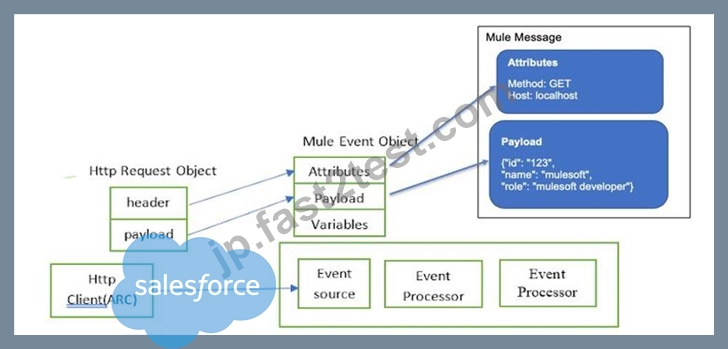
Bottom of Form
Top of Form
質問 # 85
An On Table Row Database listener retrieves data from a table that contains record_id, an increasing numerical column.
How should the listener be configured so it retrieves new rows at most one time?
- A. Set the ObjectStore to store the last retrieved record_id value
- B. Set the watermark column to the record id column
- C. Set the target to the record_id column
- D. Set the target to store the last retrieved record_id value
正解:B
質問 # 86
Pick the component with which DataWeave is tightly integrated.
- A. Exchange
- B. All APIs
- C. Flow Designer
- D. Mule runtime
正解:D
解説:
Correct answer is Mule runtime
DataWeave is the MuleSoft expression language for accessing and transforming data that travels through a Mule app. DataWeave is tightly integrated with the Mule runtime engine, which runs the scripts and expressions in your Mule app.
Mule Doc Reference : https://docs.mulesoft.com/mule-runtime/4.3/dataweave
質問 # 87
What should this endpoint return considering the API is build using standard practices?
http://dev.acme.com/api/patients?year=2021
- A. Patients from year 2021
- B. Patient with id 2021
- C. All patients
- D. No patients
正解:A
解説:
Correct answer is Patients from year 2021.
The thing to note here is that year is not a query parameter and not the uri parameter. Hence it will filter all the patients and return the ones for whom year is 2021
質問 # 88
Refer to the exhibits. The main flow contains an HTTP Request in the middle of the flow. The HTTP Listeners and HTTP Requestuse default configurations.
A web client submits a request to the main flow's HTTP Listener that includes query parameters for the pedigree of the piano.
What values are accessible to the Logger component at the end of the main flow?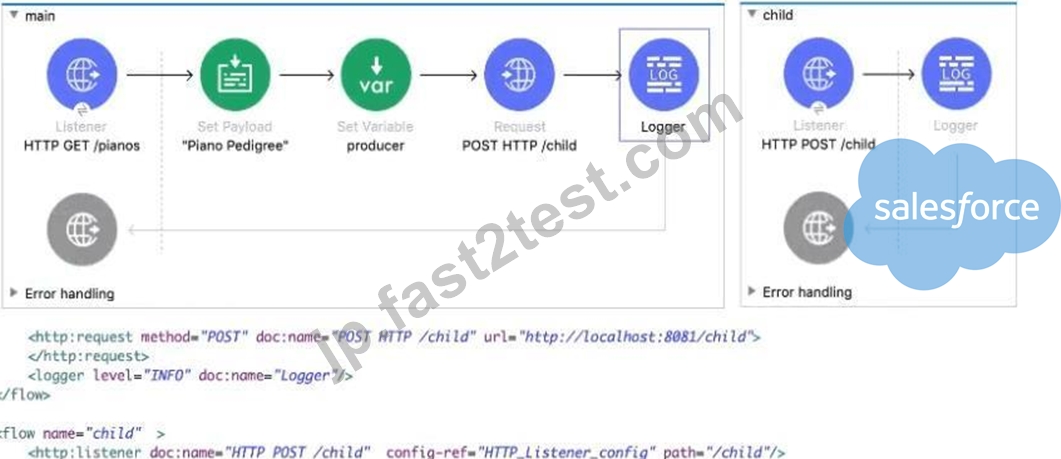
- A. payload
- B. payloadpedigree query params producer var
- C. payloadpedigree query params
- D. payloadproducer var
正解:D
解説:
In this case as outbound call is made using HTTP: POST /child , all attributes will be replaced by this invocation. Hence query parameter will not be accessible at logger. Hence correct answer is option 2
質問 # 89
Refer to the exhibits.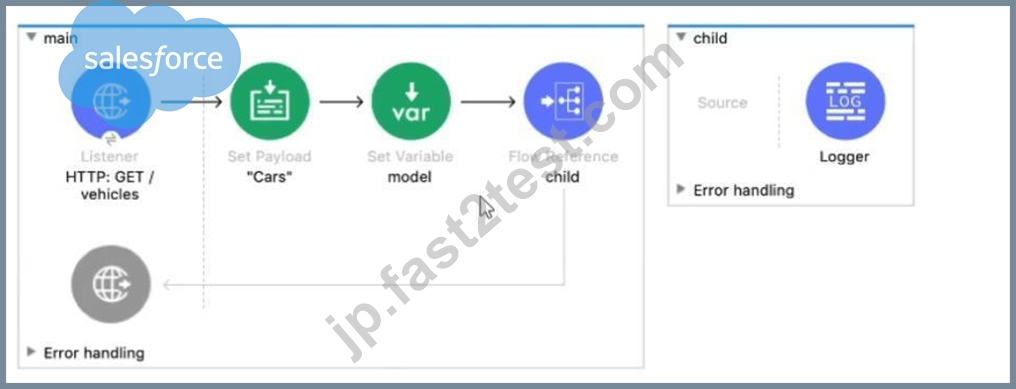
The main flow contains a Flow Reference to the child flow.
A web client sends a GET request to the main flow's HTTP Listener that includes a make query parameter.
What values are accessible in the child flow?
- A. payload
- B. payload
make query param model var - C. payload
make query param - D. payload
model var
正解:B
質問 # 90
What MuleSoft API-led connectivity layer is intended to expose part of a backend database without business logic?
- A. Experience layer
- B. Data layer
- C. System layer
- D. Process layer
正解:C
解説:
Correct answer is System layer
System APIs provide a means for insulating the data consumers from the complexity or changes to the underlying backend systems.
MuleSoft recommends three-layered approach to API-led connectivity, highlighting the three layers:
* System APIs
* Process APIs
* Experience APIs
System APIs are the core systems of record underlying core systems of record (e.g. ERPs, key customer and billing systems, databases, etc.). Process APIs allow you to define a common process which the organization can share, and these APIs perform specific functions, provide access to non-central data, and may be built by either Central IT or Line of Business IT. And finally, the Experience APIs are the means by which data can be reconfigured so that it is most easily consumed by its intended audience, all from a common data source.
The three-layered structure allows for a seamless flow of data from systems of record to new experiences, and allows for reusability of assets rather than point to point connections. This approach provides a distributed and tailored approach to architecture, greater flexibility through loose coupling, and deeper operational visibility into what is being built.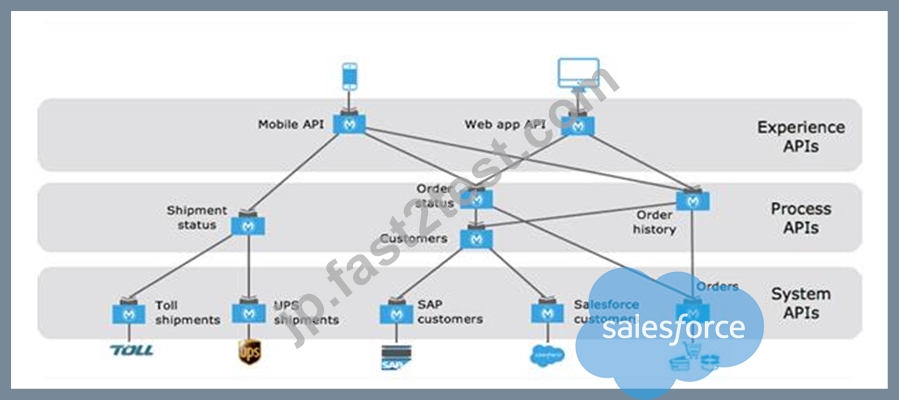
質問 # 91
Refer to the exhibits.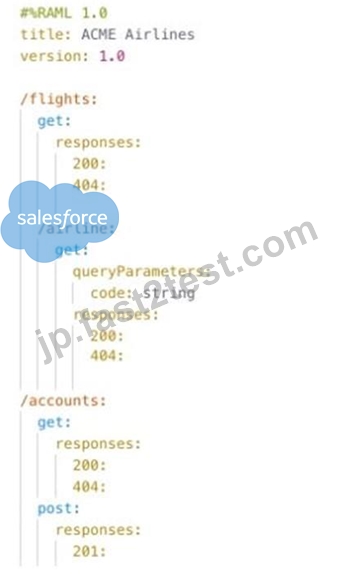
How many private flows does APIKIt generate from RAML specification?
- A. 0
- B. 1
- C. 2
- D. 3
正解:B
解説:
APIKIt Creates a separate flow for each HTTP method. Hence 4 private flows would be generated.
MuleSoft Documentation Referrence :https://docs.mulesoft.com/mule-runtime/4.3/build-application-from-api
質問 # 92
Refer to the exhibits.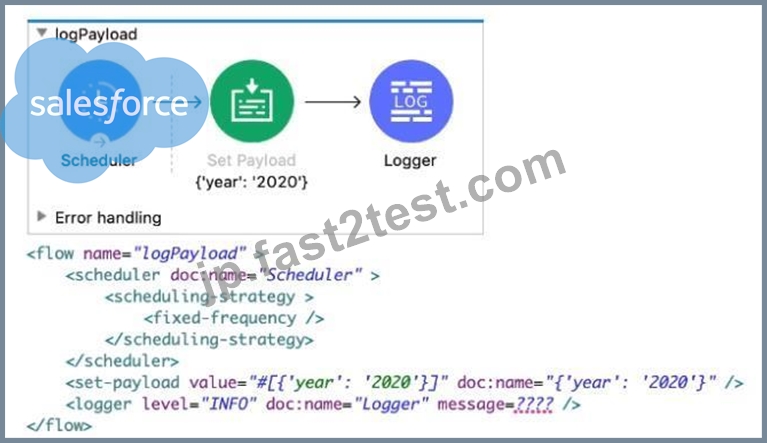
The Set Payload transformer's value is set to {'year': '2020'}.
What message value should be added to the Logger component to output the message 'The year is 2020', withouthardcoding 2020?
- A. '#[The year is " + paytoad.year]'
- B. '#[The year is $(pay load .year)]*
- C. #["The year is "++ payload.year].
- D. The year is #[payload.year]'
正解:C
質問 # 93
What is the minimum Cloudhub worker size that can be specified while deploying muleapplication?
- A. 0.1 vCores
- B. 0.2 vCores
- C. 0.5 vCores
- D. 1.0 vCores
正解:A
解説:
Correct answer is 0.1 vCores
MuleSoft Doc Ref :https://docs.mulesoft.com/runtime-manager/cloudhub-architecture#cloudhub-workers CloudHub Workers Workers are dedicated instances of Mule runtime engine that run your integration applications on CloudHub.
The memory capacity and processing power of a worker depends on how you configure it at the application level.
Worker sizes have different compute, memory, and storage capacities. You can scale workers vertically by selecting one of the available worker sizes:
Table Description automatically generated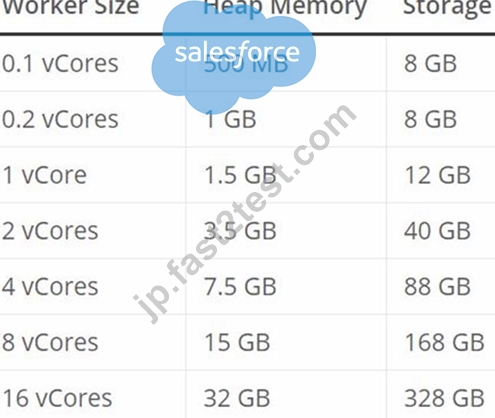
質問 # 94
What is minimal requirement in a flow for a Mule application to compile?
- A. Event Processors
- B. Error handlers
- C. Source and processors both
- D. Event Source
正解:A
解説:
Process section is must to get compiles. Process section must have one or more processors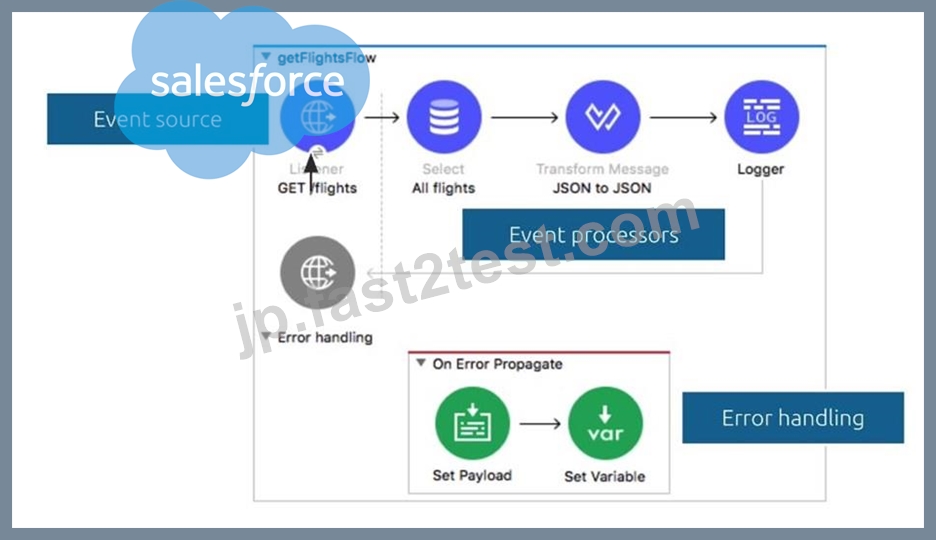
質問 # 95
- A. Option A
- B.

- C.

- D. Option C
- E.

- F. Option D
- G. Option B
- H.

正解:B、G
質問 # 96
Refer to the exhibits.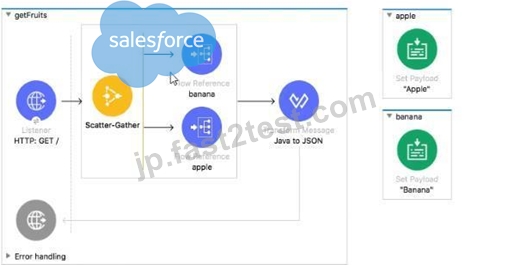
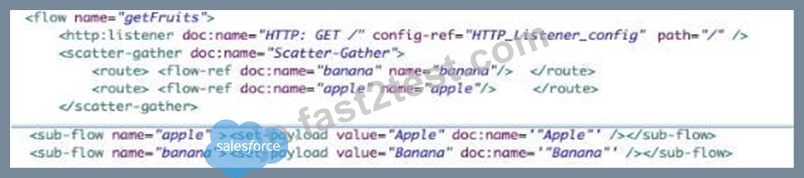
A
web client submits a request to http://localhQst:8081. What is the structure of the payload at the end of the flow?
- A.
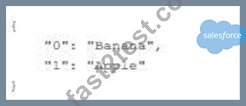
- B.
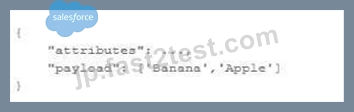
- C.
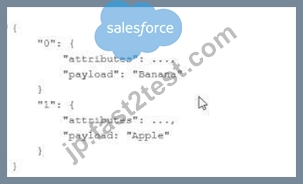
- D.

正解:C
解説:
Scatter-Gather Router
The Scatter-Gather component is arouting event processor that processes a Mule event through different parallel processing routes that contain different event processors. Each route receives a reference to the Mule event and executes a sequence of one or more event processors. Each of these routes uses a separate thread to execute the event processors, and the resulting Mule event can be either the same Mule event without modifications or a new Mule event with its own payload, attributes, and variables. The Scatter-Gather component then combines the Mule events returned by each processing route into a new Mule event that is passed to the next event processor only after every route completes successfully.
The Scatter-Gather component executes each route in parallel, not sequentially. Parallel execution of routes can greatly increase the efficiency of your Mule application and may provide more information than sequential processing.
Mule Ref Doc : https://docs.mulesoft.com/mule-runtime/4.3/scatter-gather-concept
質問 # 97
......
Salesforce Salesforce-MuleSoft-Developer-I 認定試験の出題範囲:
| トピック | 出題範囲 |
|---|---|
| トピック 1 |
|
| トピック 2 |
|
| トピック 3 |
|
| トピック 4 |
|
| トピック 5 |
|
| トピック 6 |
|
| トピック 7 |
|
| トピック 8 |
|
Salesforce-MuleSoft-Developer-I試験問題集無料サンプル365日更新:https://jp.fast2test.com/Salesforce-MuleSoft-Developer-I-premium-file.html
まもなく無料セール終了!- リアルSalesforce-MuleSoft-Developer-IのPDF解答を試そう:https://drive.google.com/open?id=18OV0fjU6mzUIKM7LJdsXS9Mbix2HZf0w