

[2026年09月]更新のHP HPE7-A01試験練習テスト問題
更新された認定試験HPE7-A01問題集で練習テスト問題
Aruba Certified Campus Access Professional認定を取得することは、ITプロフェッショナルにとって重要なマイルストーンです。それは、彼らがArubaの製品や技術を扱う専門家であることを証明し、混雑した就職市場で差別化するのに役立ちます。また、多くの組織がArubaのネットワークソリューションに認定を持つITプロフェッショナルを求めているため、新しいキャリアの機会を開くこともできます。
質問 # 51
Drag and Drop Question
Match the solution components of NetConductor (Options may be used more than once or not at all.)
正解:
解説:
質問 # 52
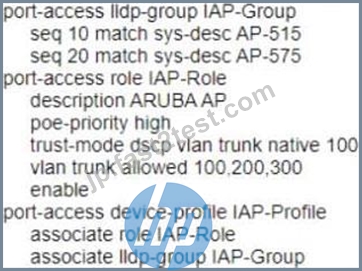
A system engineer needs to preconfigure several Aruba CX 6300 switches that will be sent to a remote office.
An untrained local field technician will do the rollout of the switches and the mounting of several AP-515s and AP-575S.
Cables running to the APs are not labeled. The VLANs are already preconfigured to VLAN 100 (mgmt), VLAN 200 (clients), and VLAN 300 (guests).
What is the correct configuration to ensure that APs will work properly?
- A.

- B.
- C.

正解:A
解説:
Option C is the correct configuration to ensure that APs will work properly. It uses the ap command to configure a port profile for APs with VLAN 100 as the native VLAN and VLAN 200 and 300 as tagged VLANs. It also enables LLDP on the ports to discover the APs and assign them to the port profile automatically. The other options are incorrect because they either do not use the ap command, do not enable LLDP, or do not configure the VLANs correctly.
質問 # 53
You are proposing new CX 8360 VSX switches to replace a customer's existing core switches.
The customer is concerned about the possibility of a split-brain scenario between the VSX pair.
How is the VSX pair affected when the ISL is down and keepalive is up?
- A. The VSX pair is out-of-sync.
- B. The VSX pair nodes are still forwarding traffic.
- C. The VSX LAGs are in a degraded state.
- D. The VSX pair is not at risk.
正解:B
解説:
When the Inter-Switch Link (ISL) is down but the keepalive link is still operational, both VSX switches detect each other as active and continue to forward traffic independently. This prevents a split-brain scenario because the keepalive link ensures both nodes are aware of each other's status.
質問 # 54
Your Director of Security asks you to assign AOS-CX switch management roles to new employees based on their specific job requirements. After the configuration was complete, it was noted that a user assigned with the administrators role did not have the appropriate level of access on the switch. The user was not limited to viewing nonsensitive configuration information and a level of 1 was not assigned to their role.
Which default management role should have been assigned for the user?
- A. helpdesk
- B. sysadmin
- C. config
- D. operators
正解:D
解説:
The operators user role is a predefined role that allows users to view nonsensitive configuration information on the switch, such as interfaces, VLANs, routing protocols, statistics, and more. The operators user role has a privilege level of 1, which is the lowest level of access on the switch.
The administrators user role is a predefined role that has full access to all switch configuration information and all REST API methods. This role is more than what the Director of Security requires.
質問 # 55
A network engineer recently identified that a wired device connected to a CX Switch is misbehaving on the network To address this issue, a new ClearPass policy has been put in place to prevent this device from connecting to the network again.
Which steps need to be implemented to allow ClearPass to perform a CoA and change the access for this wired device? (Select two.)
- A. Configure dynamic authorization on the switchport
- B. Bounce the switchport
- C. Configure dynamic authorization on the switch.
- D. Confirm that NTP is configured on the switch and ClearPass
- E. Use Dynamic Segmentation.
正解:C、D
解説:
To allow ClearPass to perform a CoA and change the access for a wired device, the following steps need to be implemented:
* Confirm that NTP is configured on the switch and ClearPass. NTP is required to synchronize the time between the switch and ClearPass, which is essential for CoA messages to be processed correctly.
* Configure dynamic authorization on the switch. Dynamic authorization is a feature that enables the switch to accept CoA messages from a RADIUS server and apply them to existing sessions.
Dynamic authorization can be enabled globally or per port on the switch.
* Optionally, configure dynamic authorization on the switchport. This step is not required, but it can provide more granular control over which ports can accept CoA messages from a RADIUS server. Bouncing the switchport or using Dynamic Segmentation are not necessary steps for allowing ClearPass to perform a CoA and change the access for a wired device.
質問 # 56
Your Aruba CX 6300 VSF stack has OSPF adjacency over SVI 10 with LAG 1 to a neighboring device The following configuration was created on the switch:
- A.

- B.

- C.

- D.

正解:D
解説:
OSPF (Open Shortest Path First) is a routing protocol that uses link-state information to calculate the best path to each destination in the network. OSPF establishes adjacencies with neighboring routers to exchange routing information and maintain a consistent view of the network topology1.
To establish an OSPF adjacency, the routers need to have some common parameters, such as the area ID, the network type, the hello interval, the dead interval, and the authentication method2. The routers also need to have a matching subnet mask on the interface that connects them3.
In this case, the Aruba CX 6300 VSF stack has an SVI (Switched Virtual Interface) on VLAN 10 with an IP address of 10.1.1.1/24 and a LAG (Link Aggregation Group) on port 1/1/1 and port 2/1/1 that connects to a neighboring device. The SVI is configured with OSPF area 0 and network type broadcast. The LAG is configured with OSPF passive mode, which means that it will not send or receive OSPF hello packets.
The neighboring device has an interface with an IP address of 10.1.1.2/24 and a LAG on port 1/0/1 and port
2/0/1 that connects to the Aruba CX 6300 VSF stack. The interface is configured with OSPF area 0 and network type broadcast.
Since the Aruba CX 6300 VSF stack and the neighboring device have the same area ID, network type, subnet mask, and default hello and dead intervals on their interfaces, they will be able to establish an OSPF adjacency over SVI 10 with LAG 1. The OSPF passivemode on the LAG will not affect the adjacency, because it only applies to the LAG interface, not the SVI interface.
質問 # 57
For the Aruba CX 6400 switch, what does virtual output queueing (VOQ) implement that is different from most typical campus switches?
- A. large egress packet buffers
- B. per port ASICs
- C. large ingress packet buffers
- D. VSX
正解:A
質問 # 58
Refer to the exhibit.
A company has deployed 200 AP-635 access points. To but is not working as expected What would be the correct action to fix the issue?
- A. Change the SSID to WPA3-Enhanced Open
- B. Change the SSID to WPA3-Personal
- C. Change the SSID to WPA3-Enterpnse (CNSA).
- D. Change the SSID to WPA3-Enterprise (CCM).
正解:A
解説:
Explanation
This is the correct action to fix the issue where the SSID is not working as expected. WPA3-Enhanced Open is a new security standard for public networks that uses Opportunistic Wireless Encryption (OWE) to provide encryption and privacy on open, non-password-protected networks. WPA3-Enhanced Open can be configured on an Aruba Access Point by changing the SSID security mode to WPA3-Enhanced Open in Aruba Central or Aruba Instant. The other options are incorrect because they either do not use WPA3-Enhanced Open or do not exist as valid security modes. References:
https://www.arubanetworks.com/assets/wp/WP_WPA3-Enhanced-Open.pdf
https://www.arubanetworks.com/techdocs/Instant_86_WebHelp/Content/instant-ug/wpa3-enhanced-open.htm
質問 # 59
Review the exhibit. You are troubleshooting an issue with a 10.102.39 0/24 subnet which is also VLAN 1000 used Tor wireless clients on a pair of Aruba CX 8360 switches The subnet SVI is configured on the 8360 pair, and the DHCP server is a Microsoft Windows Server 2022 Standard with an IP address of 10.200.1.100. The 10.102.250.0/24 subnet is used for switch management.
A large number of DHCP requests are failing You are observing sporadic DHCP behavior across clients attached to the CX 6100 switch.
Which action may help fix the issue?
- A.


- B.

- C.

- D.

正解:C
解説:
Option C is the only action that configures the DHCP relay on the SVI of VLAN 1000 on the CX
8360 switches. DHCP relay is a feature that allows a switch to forward DHCP requests from clients in one subnet to a DHCP server in another subnet. DHCP relay is required when the DHCP server and the clients are not in the same broadcast domain.
Option C uses the following commands:
interface vlan 1000: This command enters the interface configuration mode for the SVI of VLAN
1000, which has an IP address of 10.102.39.1/24 and is used for wireless clients. ip helper- address vrf default 10.200.1.100: This command configures the IP address of the DHCP server as a helper address for the SVI, which means that the switch will forward DHCP requests from clients on VLAN 1000 to this address. The vrf default parameter indicates that the SVI and the DHCP server are in the same VRF.
質問 # 60
A customer is using a legacy application that communicates at layer-2. The customer would like to keep this application working across the campus which is connected via layer-3. The legacy devices are connected to Aruba CX 6300 switches throughout the campus. Which technology minimizes flooding so the legacy application can work efficiently?
- A. Ethernet over IP (EolP)
- B. Static VXLAN
- C. EVPN-VXLAN
- D. Generic Routing Encapsulation (GRE)
正解:C
解説:
EVPN-VXLAN is a technology that allows layer-2 communication across layer-3 networks by using Ethernet VPN (EVPN) as a control plane and Virtual Extensible LAN (VXLAN) as a data plane. EVPN-VXLAN can be used to support legacy applications that communicate at layer-2 across different campuses or data centers that are connected via layer-3. EVPN-VXLAN minimizes flooding by using BGP to distribute MAC addresses and IP addresses of hosts across different VXLAN segments. EVPN-VXLAN also provides benefits such as loop prevention, load balancing, mobility, and scalability.
質問 # 61
Which Aruba AP mode is sending captured RF data to Aruba Central for waterfall plot?
- A. Hybrid Mode
- B. Dual Mode
- C. Air Monitor
- D. Spectrum Monitor
正解:D
解説:
Spectrum Monitor is an Aruba AP mode that is sending captured RF data to Aruba Central for waterfall plot.
Spectrum Monitor is a mode that allows an AP to scan all channels in both 2.4 GHz and 5 GHz bands and collect information about the RF environment, such as interference sources, noise floor, channel utilization, etc. The AP then sends this data to Aruba Central, which is a cloud-based network management platform that can display the data in various formats, including waterfall plot. Waterfall plot is a graphical representation of the RF spectrum over time, showing the frequency, amplitude, and duration of RF signals. The other options are incorrect because they are either not AP modes or not sending RF data to Aruba Central. References:
https://www.arubanetworks.com/techdocs/ArubaOS_86_Web_Help/Content/arubaos-solutions/1-overview
/spectrum_monitor.htm https://www.arubanetworks.com/techdocs/ArubaOS_86_Web_Help/Content/arubaos- solutions/1-overview/waterfall_plot.htm https://www.arubanetworks.com/products/network-management- operations/aruba-central/
質問 # 62
In AOS 10. which session-based ACL below will only allow ping from any wired station to wireless clients but will not allow ping from wireless clients to wired stations"? The wired host ingress traffic arrives on a trusted port.
- A. ip access-list session pingFromWired user any svc-icmp deny any any svc-icmp permit
- B. ip access-list session pingFromWired any any svc-icmp deny any user svc-icmp permit
- C. ip access-list session pingFromWired any user any permit
- D. ip access-list session pingFromWired any any svc-icmp permit user any svc-icmp deny
正解:B
解説:
A). ip access-list session pingFromWired any user any permit
This will allow all traffic from any source to wireless clients (user). Not what we want.
B). ip access-list session pingFromWired user any svc-icmp deny any any svc-icmp permit
The first rule denies ICMP (ping) from wireless clients (user) to any destination.
The second rule permits ICMP from any source to any destination. However, since the deny rule is processed first, pings from wireless clients will be blocked.
This option looks correct based on the rules provided.
C). ip access-list session pingFromWired any any svc-icmp permit user any svc-icmp deny The first rule permits ICMP from any source to any destination. This includes wireless clients pinging wired stations.
The second rule denies ICMP from wireless clients to any destination. However, since it comes after the permit rule, it will never be processed.
This doesn't match the desired behavior.
D). ip access-list session pingFromWired any any svc-icmp deny any user svc-icmp permit The first rule denies ICMP from any source to any destination. Since this is the first rule, it will block all ICMP traffic.
This option will not allow the desired behavior.
Given the explanations above, the correct answer is:
B). ip access-list session pingFromWired user any svc-icmp deny any any svc-icmp permit
質問 # 63
A customer wants to provide wired security as close to the source as possible The wired security must meet the following requirements:
-allow ping from the IT management VLAN to the user VLAN
-deny ping sourcing from the user VLAN to the IT management VLAN
The customer is using Aruba CX 6300s
What is the correct way to implement these requirements?
- A. Apply an inbound ACL on the user VLAN allowing icmp echo-reply traffic toward the IT management VLAN
- B. Apply an inbound ACL on the user VLAN denying icmp echo traffic toward the IT management VLAN
- C. Apply an outbound ACL on the user VLAN allowing temp echo-reply traffic toward the IT management VLAN
- D. Apply an outbound ACL on the user VLAN denying icmp echo traffic toward the IT management VLAN
正解:B
解説:
An inbound ACL is applied to traffic entering a port or VLAN. An outbound ACL is applied to traffic leaving a port or VLAN4. To deny ping sourcing from the user VLAN to the IT management VLAN, an inbound ACL on the user VLAN should be used to filter icmp echo traffic toward the IT management VLAN. Icmp echo-reply traffic is not needed to be allowed because it is already permitted by default5. References:
4 https://techhub.hpe.com/eginfolib/Aruba/OS-CX_10.04/5200-6692/GUID-9B8F6E8F-9C7A-4F0D-AE7B-9D8E6C5B6A7F.html
5 https://techhub.hpe.com/eginfolib/Aruba/OS-CX_10.04/5200-6692/GUID-0C3A9D0F-6E5B-4E1A-AF3C-8D8B2F9C1A7B.html
質問 # 64
A client is connecting to 802.1X SSID that has been configured in tunnel mode with the default AP- group settings.
After receiving Access-Accept from the RADIUS server, the Aruba Gateway will send Access-Accept to the AP through which tunnel?
- A. Split tunnel
- B. GRE tunnel
- C. IPsec tunnel
- D. PAR tunnel
正解:B
解説:
According to the Aruba Documentation Portal1, 802.1X is a standard for port-based network access control that uses a RADIUS server to authenticate and authorize wireless clients. 802.1X can be configured in different modes, such as bridge mode, tunnel mode, or split tunnel mode. Option C: GRE tunnel This is because option C shows how to configure an SSID in tunnel mode with the default AP-group settings on an Aruba switch. In tunnel mode, all client traffic from the access points is tunneled back to the controller and the controller would in turn put the client traffic onto the network2. The GRE protocol is used to encapsulate and decapsulate the traffic between the access points and the controller3.
Therefore, option C is correct.
1: https://www.arubanetworks.com/techdocs/AOS-CX/10.06/HTML/5200-7696/GUID-581D2976-694B-
46C7-849
https://community.arubanetworks.com/discussion/bridge-and-tunnel-mode 3:
https://www.twingate.com/blog/ipsec-tunnel-mode
質問 # 65
A customer has a site with 200 AP-515 access points 75AP-565 access points installed. The customer is rolling out new mobile phones with Wi-Fi-calling. 802.1X is in use for authentication What should be enabled to ensure the best roaming experience?
- A. 802 .11h
- B. 802.1X
- C. 802. 11r
- D. 802.11W
正解:B
解説:
Explanation
https://www.howtogeek.com/794724/what-is-wi-fi-calling/ 2:
https://www.networkcomputing.com/networking/your-network-optimized-wifi-calling 3:
https://www.arubanetworks.com/techdocs/AOS-CX/10.10/HTML/monitoring_6300-6400/Content/Chp_LEDs/fr Wi-Fi calling is a feature that allows you to make or receive voice calls over Wi-Fi instead of cellular network.
Wi-Fi calling can provide better voice quality and reliability in areas with poor or no cellular coverage.
質問 # 66
......
更新された検証済みのHPE7-A01問題集と解答で合格保証もしくは全額返金:https://jp.fast2test.com/HPE7-A01-premium-file.html
HPE7-A01のPDF問題とテストエンジンには172問があります:https://drive.google.com/open?id=15fchp_tU2bqLtWnRg8owkJCpmMvGwGZf