

[2026年09月] 実際問題を使ってAI-103無料問題集サンプルと問題と練習テストエンジン
合格させるMicrosoft AI-103試験問題でテスト復刻エンジンとPDF
質問 # 89
You have a Microsoft Foundry project named Project1 that contains an agent. The agent uses an OpenAPI 3.0 specification to call an external weather service.
The weather service requires a key to be passed in an HTTP header. The key value is stored as a connection in Project1.
You need to ensure that the key value from the connection is included automatically whenever the OpenAPI tool is invoked.
What should you configure in the OpenAPI specification?
- A. a Bearer token security scheme
- B. an Azure Key Vault connection
- C. a header parameter defined for each operation
- D. an API key security scheme
正解:D
解説:
The correct configuration is an API key security scheme . For Microsoft Foundry Agent Service OpenAPI tools, the OpenAPI specification must declare authentication through the components.securitySchemes section and use a scheme of type apiKey when the external service expects a key in a header. Microsoft's OpenAPI tool guidance states that API key authentication requires updating the OpenAPI spec security schemes with one scheme of type apiKey, and the tool then uses the associated project connection to supply the key value at runtime. This allows the key stored in Project1's connection to be injected automatically when the tool is invoked.
A header parameter defined separately for each operation is not the correct approach because credentials should not be modeled as ordinary operation parameters. The Foundry guidance explicitly indicates that parameters requiring the API key should be removed from the OpenAPI spec because the API key is stored and passed through a connection. A Bearer token security scheme is used for bearer-token-style authorization, not a generic weather API key passed in a custom HTTP header. Azure Key Vault is a secret store, but the scenario already stores the key in a Foundry project connection. Reference topics: Microsoft Foundry Agent Service, OpenAPI tools, project connections, API key authentication, and OpenAPI security schemes.
質問 # 90
You have a Microsoft Foundry project that contains an agent. The agent has a Model Context Protocol (MCP) tool that queries a knowledge base stored in Azure AI Search.
Some agent runs return answers from the base model without invoking the knowledge base, which results in responses without grounded citations.
You are provided with the following code snippet that runs the agent.
You need to add the correct tool _choiceparameter to the code to deterministically force the agent to invoke the MCP tool on each run.
What should you add?
- A. tool_choice ={"type":"mcp"}
- B. tool_choice={"auto"}
- C. tool_choice={"required"}
- D. tool_choice={"type":"knowledge_base"}
正解:C
解説:
To deterministically force the agent to invoke your Model Context Protocol (MCP) tool on every run, you must pass tool_choice="required" into the run_create_and_process method.
The 'required' tool choice: Setting this parameter to 'required' forces the underlying Azure OpenAI model to invoke one of your available tools on every response, ensuring the agent doesn't guess answers from the base model.
Reference:
https://learn.microsoft.com/en-us/azure/foundry/agents/concepts/tool-best-practice
質問 # 91
You are developing an app that will perform a sentiment analysis of social media posts by using the Azure AI Language service.
You perform a test on a sample post.
You need to quantify the results of the test.
Which JSON property should you review?
- A. sentiment
- B. relations
- C. confidenceThreshold
- D. confidenceScores
正解:D
解説:
Sentiment analysis
The sentiment analysis feature assigns sentiment labels, such as "negative," "neutral," and
"positive." The service determines these labels using the highest confidence score. Sentiment is evaluated at both the sentence level and the document level. This feature also returns confidence scores between 0 and 1 for each document & sentences within it for positive, neutral, and negative sentiment.
In Azure AI Language's sentiment analysis, confidenceScores are numerical values between 0 and 1 that represent the probability that the text belongs to a specific sentiment (positive, neutral, or negative). A score closer to 1 indicates a higher confidence from the service that the text exhibits that sentiment, while a lower score signifies less confidence in that particular label. The service calculates these scores for both individual sentences and the entire document, providing a granular understanding of sentiment.
How to interpret confidenceScores:
High Score (close to 1): The model is very sure about the assigned sentiment. For example, a positive score of 0.95 means the model is 95% confident the text is positive.
Low Score (close to 0): The model is not very sure about the assigned sentiment.
Scores for each sentiment: For any given piece of text, the service returns a score for positive, neutral, and negative sentiment. The sentiment label that receives the highest score is assigned as the overall sentiment for that text.
Reference:
https://learn.microsoft.com/en-us/azure/ai-services/language-service/sentiment-opinion-mining/overview
質問 # 92
You need to add an automated grounding check to a RAG application's continuous evaluation.
The check must return a simple pass or fail result and must not require you to deploy a separate judge model. Which evaluator should you use?
- A. Fluency
- B. Relevance
- C. Groundedness, which returns a 1 to 5 score
- D. Groundedness Pro
正解:D
解説:
Groundedness Pro returns a binary pass or fail result and runs on the Azure AI Content Safety service, so it does not require you to deploy a model to act as a judge. That matches both requirements in the scenario.
質問 # 93
Hotspot Question
You have a Python application collects customer comments before posting them to a public forum.
You need to send a text comment to Azure AI Content Safety and return the self-harm severity from the response.
How should you complete the code? To answer, select the appropriate options in the answer area.
NOTE: Each correct selection is worth one point.
正解:
解説: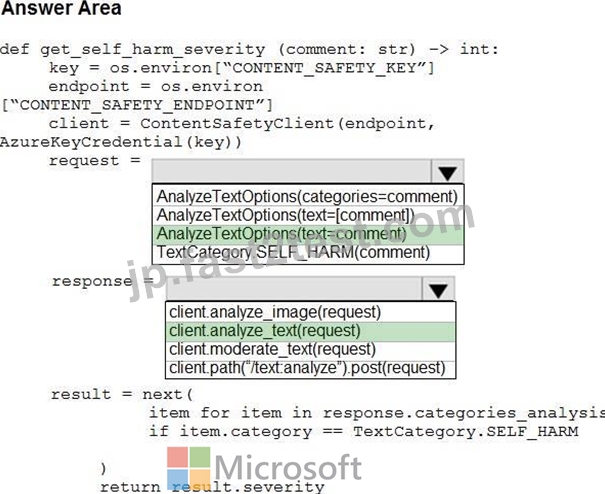
Explanation:
Box 1: AnalyzeTextOptions(text=comment)
To set up the request in your Python script, you must use AnalyzeTextOptions(text=comment), passing the text as a single string rather than a list.
Example:
Build the request options focusing on Text analysis
# You can optionally restrict analysis to specific categories
request_options = AnalyzeTextOptions(
text=user_comment,
categories=[TextCategory.SELF_HARM]
Box 2: client.analyze_text(request)
You must use client.analyze_text(request)
1. Send the request: Call client.analyze_text(request) to retrieve the multi-severity results.
2. Extract the self-harm result: Locate the self-harm categories from the response list.
3. Return the severity: Access the .severity attribute
Reference:
https://learn.microsoft.com/en-us/python/api/overview/azure/ai-contentsafety-readme
質問 # 94
You have a Microsoft Foundry project that contains an agent. The agent has a Model Context Protocol (MCP) tool that queries a knowledge base stored in Azure AI Search.
Some agent runs return answers from the base model without invoking the knowledge base, which results in responses without grounded citations.
You are provided with the following code snippet that runs the agent.
run = project_client.agents.runs.create_and_process(
thread_id=thread.id,
agent_id=agent.id,
)
You need to add the correct tool_choice parameter to the code to deterministically force the agent to invoke the MCP tool on each run.
What should you add?
- A. tool_choice ={ " type " : " mcp " }
- B. tool_choice={ " auto " }
- C. tool_choice={ " required " }
- D. tool_choice={ " type " : " knowledge_base " }
正解:C
解説:
The correct selection is D . In Microsoft Foundry Agent Service, tool_choice is the runtime control used to influence whether the model may answer directly or must invoke a tool. Microsoft's tool best-practice guidance states that auto lets the model decide whether to call tools, none prevents tool calls, and required means the model must call one or more tools. This directly addresses the issue where some runs answer from the base model and skip the knowledge base.
For an agentic retrieval solution backed by Azure AI Search through an MCP tool, Microsoft's tutorial states that setting tool_choice= " required " ensures the agent always uses the knowledge base tool when processing queries. This produces grounded answers because the run is forced into tool invocation before responding.
auto is incorrect because it preserves the nondeterministic behavior already causing missing citations. { " type
" : " knowledge_base " } is not a valid Foundry tool-choice type. { " type " : " mcp " } describes an MCP tool type in some Responses API schemas, but the deterministic guarantee for this agent run scenario is the required tool-call mode. Reference topics: Microsoft Foundry Agent Service, MCP tools, Azure AI Search agentic retrieval, tool_choice, and grounded citations.
質問 # 95
You have a product support manual.
You need to build a product support chatbot based on the manual. The solution must minimize development effort and costs.
What should you use?
- A. Azure AI Phi-3-medium with fine-tuning
- B. Azure OpenAI GPT-4 with grounding data that uses Azure AI Search
- C. Azure AI Language Custom question answering
- D. Azure AI Document intelligence
正解:B
解説:
Azure OpenAI On Your Data makes it easier for developers to connect, ingest and ground their enterprise data to create personalized copilots (preview) rapidly. It enhances user comprehension, expedites task completion, improves operational efficiency, and aids decision- making.
Azure OpenAI On Your Data enables you to run advanced AI models such as GPT-35-Turbo and GPT-4 on your own enterprise data without needing to train or fine-tune models. You can chat on top of and analyze your data with greater accuracy. You can specify sources to support the responses based on the latest information available in your designated data sources.
Reference:
https://learn.microsoft.com/en-us/azure/ai-services/openai/concepts/use-your-data
質問 # 96
You need to configure Agent1 to answer customer questions about only the Contoso products. The solution must meet the business requirements.
What should you do?
- A. Increase the value of the temperature parameter.
- B. Modify the system message instructions.
- C. Apply top-p sampling.
- D. Add few-shot examples.
正解:B
解説:
The correct answer is B. Modify the system message instructions . The case study states that Agent1 answers general questions about Contoso products and that a business requirement is for Agent1 to answer questions only about products sold by Contoso. This requirement defines the agent's allowed domain and refusal boundary, so it must be expressed in the agent's system-level instructions. Microsoft Foundry guidance states that system messages steer Azure OpenAI chat model behavior and are used to define the assistant's role, boundaries, output format, and safety or quality constraints.
The system message should instruct Agent1 to answer only Contoso-product questions, use Contoso product documentation when available, and decline questions about non-Contoso products. This directly enforces the intended business scope at the highest instruction level. Few-shot examples can reinforce desired behavior but are not the primary control for defining mandatory operating boundaries. Top-p sampling and temperature are decoding controls; they influence randomness and diversity, not whether the agent restricts answers to a specific product domain. Increasing temperature would likely reduce consistency. Reference topics: Microsoft Foundry agent instructions, system message design, prompt engineering, response boundaries, and grounded generative AI behavior.
質問 # 97
You have an Azure Speech in Foundry Tools resource that hosts a custom speech to text model deployed to a custom endpoint. An agent uses the endpoint to perform real-time speech recognition.
You are approaching the expiration date of the custom speech to text model.
What is the expected behavior when the model expires?
- A. Speech recognition requests will return a 4xx error until a new custom model is deployed.
- B. Speech recognition requests will fall back to the most recent base model for the same locale.
- C. The custom model will be deleted automatically when the model expires.
- D. Speech recognition requests will continue to use the expired custom model until the model is removed manually.
正解:B
解説:
When the custom speech-to-text model expires, the real-time endpoint will automatically fall back to using the most recent base model for that locale.
Because of this automated fallback design, your agent's real-time speech recognition streams will not fail or throw a connection error. However, you will likely experience a drop in transcription accuracy, as the fallback base model lacks the domain-specific vocabulary, acronyms, or unique audio adaptations built into your custom model.
Immediate Impact Summary
Real-Time Endpoints: Continue to process requests. The endpoint swaps the expired custom model for the newest standard base model behind the scenes.
Batch Transcriptions (If used): Any batch transcription jobs explicitly targeting the expired custom model ID will fail with a 4xx error code.
Customization Loss: Specific jargon, formatting rules, or accents trained into your model will temporarily stop applying to incoming agent audio.
Reference:
https://learn.microsoft.com/en-us/azure/ai-services/speech-service/how-to-custom-speech-model-and-endpoint-lifecycle
質問 # 98
Hotspot Question
You are building a model to detect objects in images.
The performance of the model based on training data is shown in the following exhibit.
Use the drop-down menus to select the answer choice that completes each statement based on the information presented in the graphic.
NOTE: Each correct selection is worth one point.
正解:
解説:
Explanation:
Box 1: 0
The percentage of false positives is 0%.
Because the model made zero incorrect positive predictions, the count and percentage of false positives must be exactly zero.
Box 2: 25
The value for the number of true positives divided by the total number of true positives and false negatives is 25% (or 0.25).
High Precision (100%): Every single object your model detects is correct; it generates zero false alarms.
Low Recall (25%): Your model misses 75% of the actual objects it was supposed to find.
'
Reference:
https://medium.com/grabngoinfo/how-to-evaluate-the-performance-of-a-binary-classification-model-6e7193dcbbf9
質問 # 99
You have a Microsoft Foundry project that generates product marketing images from text prompts.
After publishing several images, the legal team at your company identifies a competitor's logo on a sign in the background of an image.
You need to remove only the logo, while preserving the rest of the image.
What should you do?
- A. Apply a mask-based inpainting edit to the part of the image that contains the logo.
- B. Increase the prompt guidance strength.
- C. Modify the original prompt to exclude brand names.
- D. Rerun the prompt by using a different random seed.
正解:A
解説:
To remove a logo from a generated image while preserving the rest of the content, you should use AI-powered inpainting tools or standard object removal features in professional image editing software.
Microsoft Designer or Azure AI (In-Engine Fixes)
If your Foundry project is built on top of Azure OpenAI Service or Dall-E, you can often handle this programmatically or through related first-party tools.
Generative Erase / Inpainting: Use Microsoft Designer's "Erase" tool. Brush over the logo, and the AI will replace it by seamlessly blending the background.
API Inpainting: If you have access to the underlying image generation API (like DALL-E 3 or Stable Diffusion), use the Inpainting API. Pass the original image along with a black-and-white mask highlighting the logo, and prompt it to "fill the background naturally." Reference:
https://starryai.com/en/blog/mai-image-1
質問 # 100
Hotspot Question
You have a Microsoft Foundry project that contains an agent.
The agent accepts user-uploaded screenshots and uses a multimodal chat model.
Some screenshots contain potentially malicious embedded text.
You need to prevent a prompt injection attack and ensure that third-party content is treated as lower trust.
How should you configure prompt shields for document attacks? To answer, select the appropriate options in the answer area.
NOTE: Each correct selection is worth one point.
正解:
解説:
質問 # 101
Note: This section contains one or more sets of questions with the same scenario and problem. Each question presents a unique solution to the problem. You must determine whether the solution meets the stated goals. More than one solution in the set might solve the problem. It is also possible that none of the solutions in the set solve the problem.
After you answer a question in this section, you will NOT be able to return. As a result, these questions do not appear on the Review Screen.
You have a multimodal AI generative model that accepts image uploads and uses extracted image text to generate responses.
You discover that users can upload unsafe images and embed hidden instructions into images to manipulate the model.
You need to implement controls to mitigate the risk.
Solution: You configure protected material detection.
Does this meet the goal?
- A. Yes
- B. No
正解:B
解説:
Correct:
* You configure a prompt shield for documents.
Prompt Shield for Documents: Highly Effective (Critical Defense)
How it helps: This shield specifically scans untrusted, third-party data inputs (like external documents or text extracted from uploaded images).
Mechanism: It evaluates the extracted image text before it is sent to the LLM to identify hidden jail
* You configure a prompt shield for user prompts.
Prompt Shield for User Prompts: Partially Effective (Defense in Depth)
How it helps: This shield targets direct jailbreak attempts written manually by the user in the text prompt field accompanying the upload.
Mechanism: It prevents the user from typing supporting instructions that prime the model to execute the hidden instructions found within the image.
* You configure image moderation to block unsafe content before processing the images.
Implementing rigorous image moderation is one of the most effective ways to secure multimodal AI systems against these threats. Moderation acts as a necessary gatekeeper, preventing malicious inputs from ever reaching the generative model.
Incorrect:
* You configure protected material detection.
Protected Material Detection: Ineffective for this Threat
Why it does not help: This feature is designed to scan model outputs to prevent the generation of copyrighted text, proprietary source code, or licensed imagery.
Limitation: It does not scan inputs for adversarial instructions and will not prevent a user from manipulating the model's logic.
Reference:
https://www.upgrad.com/blog/what-is-multimodal-ai/
https://learn.microsoft.com/en-us/azure/ai-services/content-safety/concepts/jailbreak-detection
質問 # 102
You need to recommend a solution to support the planned changes and technical requirements for Agent1 to use the product information stored in storage1.
What should you include in the recommendation?
- A. Azure Al Search
- B. Azure Translator in Foundry Tools
- C. Grounding with Bing Search
- D. Azure Document Intelligence in Foundry Tools
正解:A
解説:
The correct recommendation is Azure AI Search. The case study states that the product detail sheets are stored as PDFs in storage1, and that Agent1 must be enabled to retrieve and use detailed product information from those sheets. It also specifies that the indexing pipeline must enable semantic and vector search, and that Agent1 must answer natural language questions about product details by using the product sheet information.
Azure AI Search is the Azure service designed to ingest content from sources such as Azure Blob Storage, create searchable indexes, and support keyword, semantic, hybrid, and vector retrieval for Retrieval Augmented Generation (RAG) solutions.
Microsoft's Azure AI Search guidance states that integrated vectorization can chunk content and generate embeddings during indexing, enabling vector search over source documents. It also states that Azure AI Search supports text and vector queries and can improve raw content for search-related scenarios through enrichment pipelines. Azure Translator is unrelated to retrieval. Document Intelligence can extract document structure, but it is not the retrieval index for Agent1. Grounding with Bing Search retrieves public web content, not Contoso's private PDFs in storage1. Reference topics: Azure AI Search, RAG, semantic search, vector search, Azure Blob Storage indexing, and agent grounding.
質問 # 103
You have a Microsoft Foundry project that contains an agent. The agent generates summaries from retrieved policy documents.
You need to improve response completeness. The solution must be implemented in the logic of the application code before responses are returned.
What should you do?
- A. Decrease the value of the temperature parameter.
- B. Switch to Retrieval Augmented Generation (RAG).
- C. Add a reflection pass before the responses are returned.
- D. Enable response streaming.
正解:C
解説:
The correct answer is B. Add a reflection pass before the responses are returned . A reflection pass is an application-orchestration step in which the generated summary is reviewed before final delivery, typically by asking the model or an evaluator step to check whether the answer covers the retrieved policy evidence and to revise the response when important details are missing. This directly addresses response completeness in application logic before the response is returned. The Microsoft Learn study guide explicitly includes Implement model reflection and Apply prompt engineering techniques to improve responses under optimization and operationalization of generative AI solutions.
This is also consistent with Microsoft Foundry agentic-loop guidance, which identifies reflection and planning cycles as patterns for multi-step reasoning in production agent systems. Completeness is a response-quality property: Azure AI evaluation defines completeness as whether a response contains all necessary and relevant information with respect to ground truth.
Option C is not correct because the scenario already says the agent generates summaries from retrieved policy documents, which is already a grounded retrieval pattern. Option A mainly reduces randomness, not missing content. Option D improves delivery experience, not answer completeness. Reference topics: model reflection, prompt engineering, agentic loops, response evaluation, and grounded generative AI solutions.
質問 # 104
Drag and Drop Question
You are developing an application that will detect faulty components produced on a factory production line. The components are specific to your business.
You need to use the Azure Custom Vision API to help detect common faults.
Which three actions should you perform in sequence? To answer, move the appropriate actions from the list of actions to the answer area and arrange them in the correct order.
正解:
解説:
Explanation:
Step 1: Create a project
You must first set up a new project in the Custom Vision portal or via the SDK to store your data and configuration.
Step 2: Upload and tag images
Next, you need to upload photos of your specific factory components and draw bounding boxes around the faults to tag them.
Step 3: Train the object detection model
Because you need to identify and locate specific, localizable faults on a component, you must train an object detection model rather than a general classifier model.
Reference:
https://thegroundtruth.blog/tag/computervision/
質問 # 105
Note: This section contains one or more sets of questions with the same scenario and problem. Each question presents a unique solution to the problem. You must determine whether the solution meets the stated goals. More than one solution in the set might solve the problem. It is also possible that none of the solutions in the set solve the problem.
After you answer a question in this section, you will NOT be able to return. As a result, these questions do not appear on the Review Screen.
You have a Microsoft Foundry project that contains an agent. The agent generates summaries from retrieved policy documents.
Users report that some responses omit required regulatory clauses, even when the clauses are present in the retrieved content.
You need to improve response completeness.
Solution: You run an evaluation flow that scores responses for completeness and blocks responses that fall below a defined threshold.
Does this meet the goal?
- A. Yes
- B. No
正解:B
解説:
Correct:
* You add a reflection pass that regenerates the response if the required clauses are missing.
This is Self-Correction Strategy: A reflection pass allows an agent to evaluate its own initial output against specified constraints (e.g., checking for the presence of mandatory regulatory clauses). If the required text is missing, the agent triggers a programmatic self-correction or regeneration loop to include them before final delivery.
Incorrect:
* You increase the value of the max_tokens parameter.
Increasing the max_tokens parameter prevents the response from being cut off mid-sentence due to length constraints. However, it does not force the model's logic to explicitly include missing information that it chose to leave out earlier in the text.
* You increase the value of the temperature parameter.
Raising the temperature parameter increases randomness and creativity. For rigid compliance tasks like summarizing regulatory documents, higher temperature actually increases the risk of hallucination and omission.
* You run an evaluation flow that scores responses for completeness and blocks responses that fall below a defined threshold.
Evaluation Flow Block: Running an evaluation flow to score completeness and blocking bad responses identifies and stops low-quality outputs, but it does not fix or actively improve the response completeness. It simply filters failures out of the system.
Reference:
https://pub.towardsai.net/reflection-with-llm-how-to-make-ai-review-its-own-work-2db122fca1d8
質問 # 106
Hotspot Question
You need to create a new resource that will be used to perform sentiment analysis and optical character recognition (OCR). The solution must meet the following requirements:
- Use a single key and endpoint to access multiple services.
- Consolidate billing for future services that you might use.
- Support the use of Azure Vision in Foundry Tools in the future.
How should you complete the HTTP request to create the new resource? To answer, select the appropriate options in the answer area.
NOTE: Each correct selection is worth one point.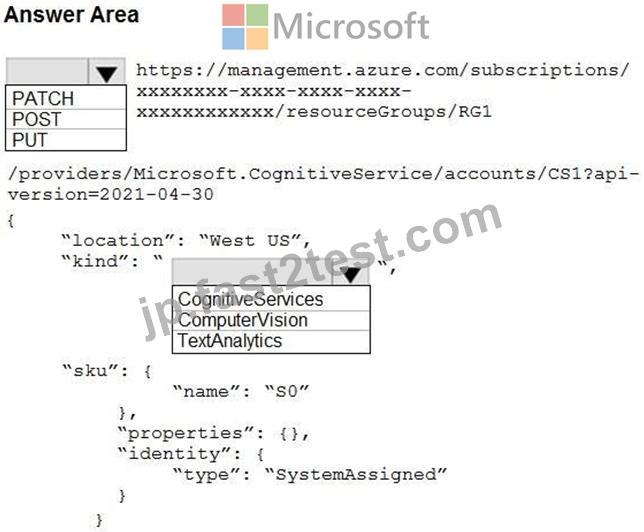
正解:
解説: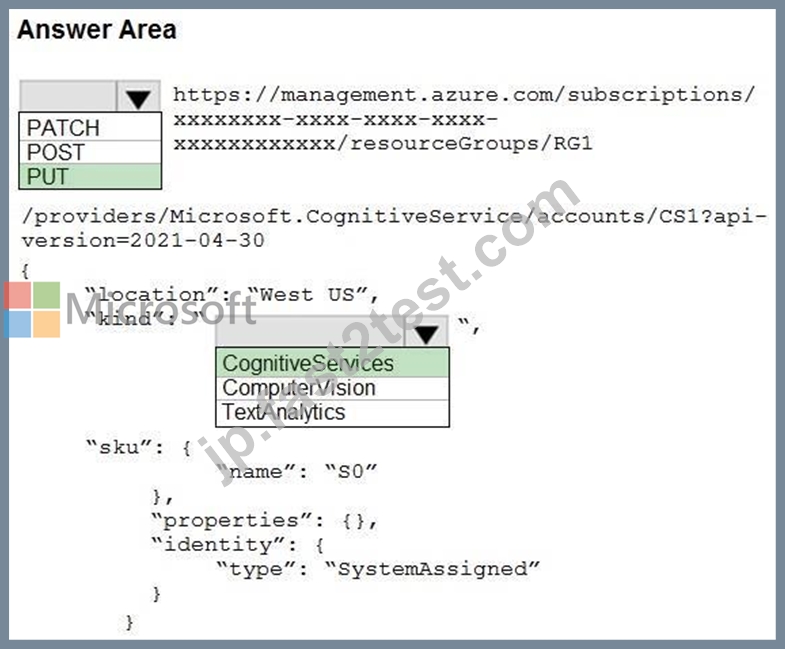
Explanation:
Box 1: PUT
Need to create a Cognitive Services Multi-Service resource using the PUT method. This specific resource type provides a single endpoint and key for multiple AI services, consolidates billing, and supports Azure Vision.
Box 2: CognitiveServices
Using the CognitiveServices kind creates a multi-service resource. This fulfills all the requirements by providing a single key and endpoint for multiple services, consolidating billing, and enabling access to features like Azure AI Vision and Text Analytics under one roof.
Reference:
https://learn.microsoft.com/en-us/azure/foundry/how-to/develop/sdk-overview
質問 # 107
You have a Microsoft Foundry project.
You need to deploy a model from the model catalog to support real-time inference. The solution must meet the following requirements:
- Use key-based authentication.
- Support real-time REST API access.
- NOT consume the vCPU quota of the virtual machines in the Azure
subscription.
Which type of deployment should you use?
- A. serverless API
- B. batch
- C. standard
- D. self-hosted container
正解:C
解説:
The most appropriate type of deployment is a serverless API deployment (also referred to as a standard deployment or Models-as-a-Service / MaaS).
Key-Based Authentication: Serverless API deployments natively provision an endpoint URL alongside primary and secondary API keys to secure your client applications.
Real-Time REST API Access: When the model is successfully deployed, it exposes a scalable, real-time HTTP/REST endpoint matching the standardized Azure AI Model Inference API.
No Virtual Machine vCPU Quota Consumption: Unlike managed compute deployments-which provision dedicated virtual machines in your subscription and require VM vCPU quota- serverless API deployments are completely hosted and managed by Microsoft. They operate on a pay-as-you-go, token-based billing structure and do not consume any VM vCPU quota from your Azure subscription.
Reference:
https://learn.microsoft.com/en-us/azure/foundry/concepts/deployments-overview
質問 # 108
Case Study 1 - Contoso, Ltd
Overview
Company Information
Contoso, Ltd is a multinational retail company that builds, deploys, and manages generative AI and agent-based solutions by using Microsoft Foundry.
Existing Environment
Identity Environment
Contoso uses Microsoft Entra ID for identity management, authentication, and authorization capabilities that enable agents to access organizational resources and services.
Contoso recently formed a new AI engineering team named Agent1Dev Team to optimize and maintain existing AI solutions.
The team collaborates with solution architects, DevOps engineers, and security engineers to design, implement. monitor, and secure AI applications.
Contoso also has a team named Agent1Test Team that is responsible for validating AI solutions before the solution deployments.
Generative Environment
Contoso has a Microsoft Foundry deployment that contains two projects named Project1 and Project2.
Project1
Project1 contains a customer support agent named Agent1 that assists customers with product inquiries and troubleshooting requests.
Agent1 has the following configurations:
- Agent1 uses a base model deployment.
- A safety evaluation pipeline is NOT enabled.
- Tool invocation approval workflows are NOT enabled.
- Conversation memory constraints are NOT configured.
Agent1 interacts with customers by using digital support channels and answers general questions about Contoso products.
Project1 is deployed to an Azure region located in the European Union (EU).
Agent1Dev Team will use Project1 to optimize and maintain Agent1.
Project2
Project2 contains a deployed video generation model. The marketing department at Contoso has access to Project2 and plans to use the model to develop a video creation solution.
Development of the solution is incomplete.
Data Environment
Contoso stores product-related information in Azure resources that support AI applications.
The Azure environment contains an Azure Blob Storage account named storage1 that stores product detail sheets for all the Contoso products.
The product sheets include specifications, feature descriptions, and product support information that Agent1 can use to answer customer questions. The product sheets are stored in the PDF format.
Problem Statements
Contoso identifies the following issues:
- Agent1 has only general knowledge of the Contoso products.
- A recent chat interaction with Agent1 was analyzed for sentiment. The results of the analysis have NOT been processed yet.
- Agent1 does NOT use the detailed product information in the product sheets stored in storage1 when responding to customer questions.
- The finance department at Contoso reports that vendor invoices must be reviewed manually to ensure that the invoices match the terms defined in the vendor contracts. The invoices contain tables, logos, and varied layouts that make the documents difficult to process consistently.
Requirements
Planned Changes
Contoso plans to implement the following changes:
- Implement a solution for Project1 that analyzes the vendor invoices by evaluating both the visual layout and the textual content of the invoices, so that the invoice details can be verified against the vendor contract terms.
- Update the base model deployment used by Agent1 and standardize the model version to ensure continuity and consistent responses.
- Enable Agent1 to retrieve and use the detailed product information from the product sheets stored in storage1.
- Implement an indexing solution for the product sheets that Agent1 can use to answer customer questions.
- Complete the development of the video creation solution.
Technical Requirements
Contoso identifies the following technical requirements:
- The model deployment used by Agent1 must support scalable, high-throughput generative AI workloads and dynamically scale to handle variable customer support traffic, without requiring reserved throughput capacity.
- The product sheets must be processed by using an indexing pipeline that enables semantic and vector search, so that Agent1 can retrieve the relevant product information.
- Responses generated by using the product sheet information must be relevant, complete, and accurate.
- Agent1 must be able to use the product sheets to answer natural language questions about product details.
- The model version used by Agent1 must remain consistent to ensure stable responses.
- The data processed by the model must remain within the EU.
Security and Compliance Requirements
Contoso identifies the following security and compliance requirements:
- API keys must NOT be used to access Foundry-deployed models.
- Access to the Azure resources must follow the principle of least privilege.
- The developers at Contoso must authenticate to Microsoft Foundry resources by using Microsoft Entra authentication.
- Access to Project1 must be assigned to the members of Agent1Dev Team by using a security group named SC_Agent1_Dev.
- Access to Project1 must be assigned to the members of Agent1Test Team by using a security group named SC_Agent1_Test.
- Agent1 must never reveal customer information, even if a document that contains customer data is added erroneously to the product sheet repository in storage1.
- The product sheets might contain images that include embedded text. Agent1 must be protected from malicious instructions potentially hidden within the images.
Business Requirements
Contoso identifies the following business requirements:
- Users that interact with Agent1 must have a personalized experience in future interactions, including the ability for Agent1 to retain conversation context and recall relevant information from previous interactions.
- Agent1 must answer questions only about the products sold by Contoso.
You need to configure an indexing pipeline for Agent1 to retrieve the relevant product information in storage1. The solution must meet the technical requirement.
Which two built-in skills should you use? Each correct answer presents part of the solution.
NOTE: Each correct selection is worth one point.
- A. Text Split
- B. Merge
- C. Entity Recognition
- D. key phrase extraction
- E. Azure OpenAI Embedding
- F. Language Detection
正解:A、E
解説:
The most essential skills for this scenario are Azure OpenAI Embedding and Text Split.
Azure OpenAI Embedding: This skill is critical for generating the vector representations (embeddings) of your text, which directly enables the required vector search capability.
Text Split: This skill is essential because LLMs and embedding models have strict token limits.
Breaking large product detail sheets into smaller chunks ensures the text fits into the embedding model and improves the accuracy of semantic search.
Incorrect:
[Not B]
Entity Recognition: This extracts specific entities like names, dates, or locations. While helpful for advanced filtering, it is not a foundational requirement to enable basic semantic or vector search.
[Not D]
Merge: This skill combines text from multiple fields into a single string. Since product sheets are already unified documents, splitting and chunking them is the priority rather than merging separate fields.
[Not E]
Language Detection: This identifies the language of the input text. Unless your product sheets are completely multilingual and require conditional routing to different language models, this skill is secondary.
[Not F]
Key Phrase Extraction: This pulls out main talking points or keywords. This is primary used for traditional keyword tagging or basic search indexing, whereas your requirement specifically dictates vector and semantic-based retrieval.
Scenario:
Technical Requirements;
*-> The product sheets must be processed by using an indexing pipeline that enables semantic and vector search, so that Agent1 can retrieve the relevant product information.
Data environment: The Azure environment contains an Azure Blob Storage account named storage1 that stores product detail sheets for all the Contoso products.
Planned changes: Enable Agent1 to retrieve and use the detailed product information from the product sheets stored in storage1.
Reference:
https://www.rheininsights.com/blog/en/Retrieval+Augmented+Generation+with+Azure+AI+Search
+and+Atlassian+Confluence.php
質問 # 109
Drag and Drop Question
You have a Microsoft Foundry project that uses Azure Content Understanding in Foundry Tools to analyze marketing videos.
Video segmentation is enabled.
You need to configure an analyzer to output a generated JSON field that describes the color scheme of each video segment.
How should you configure the analyzer? To answer, drag the appropriate values to the correct targets. Each value may be used once, more than once, or not at all. You may need to drag the split bar between panes or scroll to view content.
NOTE: Each correct selection is worth one point.
正解:
解説:
Explanation:
Box 1: string
The Type (string): While you want the output schema to contain a description of the color palette or style, Azure Content Understanding schemas map the underlying data types using fundamental types like string, number, or array. The field will output the final result in the JSON response under a key like "valueString" Box 2: generate The Method (generate): The extract method is only used for pulling literal text exactly as it appears in content (such as speech-to-text transcripts or OCR). Because analyzing visual aesthetics and synthesizing descriptive text about a "color scheme" requires multimodal AI reasoning, you must use the generate method. This instructs the underlying model to analyze the segment and synthesize a completely new descriptive insight.
References:
https://learn.microsoft.com/en-us/azure/ai-services/content-understanding/video/elements
質問 # 110
Hotspot Question
Your company is piloting a customer support agent in a Microsoft Foundry project name Project1.
Project1 is connected to an existing Application Insights resource, and the company's support team reviews runs in the Traces tab.
The Foundry Agent Service is configured to perform the following actions:
- Retrieve the Application Insights connection string by calling
project_client.telemetry.get_application_insights_connection_string().
- Call configure_azure_monitor(connection_string=...) to enable
telemetry.
A separate LangChain service is configured to use OpenTelemetry and has the following configurations:
- Uses AzureAIOpenTelemetryTracer(connection_string=...,
enable_content_recording=False)
- Passes the tracer by using config={"callbacks":[azure_tracer]}
Company policy has the following requirements:
- Telemetry from LangChain and OpenTelemetry must be distinguishable
within the same Application Insights resource.
- Secrets and credentials must NOT be stored in prompts, tool
arguments, or span attributes.
For each of the following statements, select Yes if the statement is true. Otherwise, select No.
NOTE: Each correct selection is worth one point.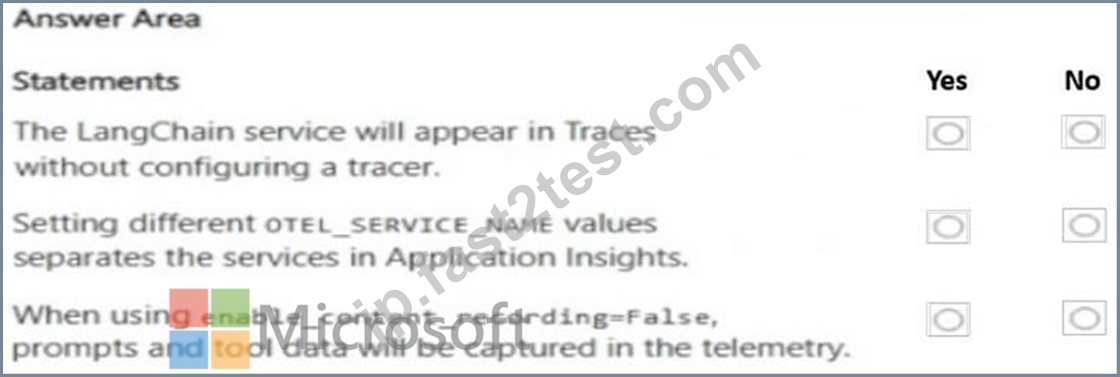
正解:
解説:
質問 # 111
Drag and Drop Question
You have a web app that uses Azure AI Search.
When reviewing activity you see greater than expected search query volumes. You suspect that the query key is compromised.
You need to prevent unauthorized access to the search endpoint and ensure that users only have read only access to the documents collection. The solution must minimize app downtime.
Which three actions should you perform in sequence? To answer, move the appropriate actions from the list of actions to the answer area and arrange them in the correct order.
正解:
解説:
Explanation:
Enforces Read-Only Permissions: Query keys are specifically designed to provide read-only access to the documents collection of an index. Admin keys provide full read-write administrative privileges and should never be distributed to consumer-facing applications.
Zero Downtime: Azure AI Search lets you generate up to 50 individual query keys. Creating a new one allows the app to stay online throughout the entire key rotation process Reference:
https://learn.microsoft.com/en-us/azure/search/search-security-api-keys
質問 # 112
Hotspot Question
You have a Microsoft Foundry project that contains an agent.
The agent uses tools to retrieve internal content and call external APIs. The agent is configured to let the model decide when to call the tools.
You need to publish the agent for a compliance workflow. The solution must meet the following requirements:
- Each workflow run must include a retrieval step before generating a
response.
- Tool calls must authenticate by using the published agent's own
identity.
- Tool access must use an identity isolated from other project
resources.
- Tool access must use support audit tracing.
What should you do? To answer, select the appropriate options in the answer area.
NOTE: Each correct selection is worth one point.
正解:
解説:
質問 # 113
......
あなたを合格させるAI-103お手軽に試験合格リアルAI-103練習問題集で更新されたのは2026年09月27日:https://jp.fast2test.com/AI-103-premium-file.html