

[2026年02月] 無料CIS-Discovery試験問題集試験点数を伸ばそう
2026年最新のCIS-Discovery実際問題集には試験のコツがあるPDF試験材料
ServiceNow CIS-Discovery(認定実装スペシャリスト - Discovery)認定試験は、ServiceNow DiscoveryおよびService Mappingアプリケーションの専門知識を示したいプロフェッショナル向けに設計されています。この認定試験は、ServiceNow DiscoveryおよびService Mappingアプリケーションの実装における知識とスキル、Discoveryアプリケーションの設定と管理、問題のトラブルシューティング、アプリケーションの最適化などを検証するために設計されています。
質問 # 64
In order to use Debug from the Pattern Designer, you must have what?
- A. a discoverable CI
- B. the admin role
- C. Service Mapping installed
- D. a proxy server
正解:B
解説:
Debug mode is a feature of the Pattern Designer that allows you to test and troubleshoot your patterns in real time. To activate Debug mode, you need to have the admin role or a role that includes the pattern_designer_debug permission. Debug mode is not available for users who only have the pattern_designer_read permission1.
1: Activate pattern Debug mode - Product Documentation: San Diego - ServiceNow
質問 # 65
If the Allow fallback to parent's rules checkbox is unchecked on the CI Identifier entry of a Child class, what is the expected behavior.
Response:
- A. An attempt is made to match a CI on the Child Class, if no match found an attempt is made to match
- B. a CI on the parent class, finally if no match found a new CI is created in the Child Class
- C. An attempt is made to match a CI on the Child Class, if no match found a new CI is created in the Child Class.
正解:A、B
質問 # 66
On the ECC Queue, sensor records have a Queue value of ___________ and probe records have a Queue value of ___________.
- A. started, ready
- B. output, input
- C. input, output
- D. ready, started
正解:B
解説:
On the ECC Queue, sensor records have a Queue value of output and probe records have a Queue value of input. The ECC Queue is the connection point between the instance and the MID Server, and it displays the input and output messages from and to the MID Server1. A probe is a message that the instance sends to the MID Server to request information from a device or application2. A sensor is a script that the MID Server runs to process the results returned by the probe3. When a probe is created, it is inserted into the ECC Queue with a Queue value of input, which means that it is waiting to be picked up by the MID Server4. When a sensor is created, it is inserted into the ECC Queue with a Queue value of output, which means that it is waiting to be processed by the instance.
References: 1: ECC Queue - ServiceNow 2: Probes - ServiceNow 3: Sensors - ServiceNow 4: How the ECC Queue table records get processed: from output ready to input processed - Support and Troubleshooting - Now Support Portal : [ECC Queue Processing and Debugging, with "Discovery - Sensors" used as an example - Support and Troubleshooting - Now Support Portal]
質問 # 67 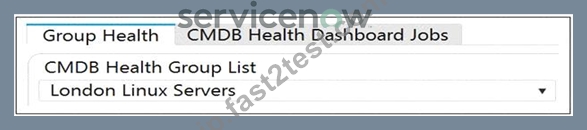
Based on the following image, which of the following choices is also true about London Linux Servers?
- A. It is a CMDB Group with Default Group type.
- B. It is a Datacenter Group in London.
- C. It is a CMDB Group with Dashboard Group type.
- D. It is a CMDB Group with Health Group type.
正解:D
解説:
London Linux Servers is a CMDB Group with Health Group type. A CMDB Group is a collection of configuration items (CIs) that share common characteristics or are related in some way1. A Health Group is a type of CMDB Group that is used to monitor and measure the health of a specific set of CIs based on predefined rules and metrics2. The image shows that London Linux Servers is selected from the CMDB Health Group List, which is a dropdown menu that displays all the Health Groups defined in the system3. The image also shows the Group Health tab, which displays the health scores and indicators for the selected Health Group.
References: 1: Create a CMDB group - ServiceNow 2: CMDB health groups - ServiceNow 3: CMDB health dashboard - ServiceNow : [View CMDB health scores - ServiceNow]
質問 # 68
What network protocol is needed to discover network devices like routers, switches etc?
Response:
- A. 1) WMI Protocol with username/password
2) Domain Administrator permission - B. 1) SNMP Protocol with community string
- C. 1)SSH Protocol with username/password, or private key
2) Root or Sudo privileges must be granted
正解:B
質問 # 69
A Discovery Schedule contains a /24 subnet IP Range and a Shazzam batch size of 5000. How many times will a Shazzam probe be launched during discovery?
- A. 0
- B. 1
- C. 2
- D. 3
正解:B
解説:
A /24 subnet IP Range means that there are 256 possible IP addresses in the range, from 0 to 255. A Shazzam batch size of 5000 means that Discovery will send 5000 ICMP packets at a time to scan the IP addresses.
Therefore, Discovery will launch the Shazzam probe once for every 5000 IP addresses in the range, or 256 /
5000 = 0.0512 times. Since the number of times must be an integer, Discovery will round up to 1 and launch the Shazzam probe once. However, since the Shazzam probe is launched for each MID Server that is assigned to the Discovery Schedule, the actual number of times will depend on how many MID Servers are available.
If there are N MID Servers, then the Shazzam probe will be launched N times, each sending 5000 ICMP packets to the same IP range. Therefore, the total number of times that the Shazzam probe will be launched during discovery is N * 1 = N.
:
Discovery Schedule form
Shazzam Probe
Discovery IP range
質問 # 70
SNMP Credentials require which of the following?
- A. read community strings
- B. write community strings
- C. usernames
- D. port 135 access
正解:A
解説:
SNMP credentials are used by Discovery to communicate with devices that support the Simple Network Management Protocol (SNMP). SNMP credentials do not include a user name, just a password, called the community string. The default read-only community string for many SNMP devices is public, and Discovery will try that automatically. Enter the appropriate SNMP credentials if they differ from the public community string1.
References: 1: SNMP credentials - Product Documentation: Utah - Now Support Portal
質問 # 71
How is a discovery pattern utilized by the Discovery Engine.
Response:
- A. By Associating the pattern to the Discovery Schedule
- B. By Associating the aiscovery pattern to a CI Classifier
正解:B
質問 # 72
Which choice best describes what happens when, by default, duplicate CIs are detected during identification and reconciliation?
- A. The next discovery is stopped for the CI that is duplicated.
- B. A notification is sent to the CI owner.
- C. Each set of duplicate CIs is added to a de-duplication task.
- D. An association identification rule is created automatically.
正解:C
質問 # 73
What pattern operation allows the transfer of a file from the MID Server to a target?
- A. Create Connection
- B. Parse file
- C. Put file
- D. Manage Attachments
正解:C
解説:
The Put file operation allows the transfer of a file from the MID Server to a target1. This operation can be used to copy files from the MID Server to a target device, such as configuration files, scripts, or binaries2. The Put file operation requires the file path on the MID Server and the file path on the target as inputs2.
:
1: Put file
2: Define discovery steps
質問 # 74
What is the recommended method of consolidating duplicate CIs?
- A. Duplicate CI Remediator
- B. Event CI Remediation
- C. Ignore Duplicate CI
- D. Manual CI Remediation
正解:A
質問 # 75
Which of the following choices explain differences between Service Mapping and Discovery? (Choose two.)
- A. Discovery addresses inventory-related use-cases, while Service Mapping allows for the creation of accurate maps of application service topologies.
- B. Discovery requires agent installation to find hardware devices, Service Mapping requires agents for software.
- C. Discovery finds applications and devices on your network, Service Mapping monitors those devices.
- D. Discovery utilizes IP address ranges for initial discovery, Service Mapping uses entry points.
正解:A、D
解説:
Discovery and Service Mapping are both products that help to identify and map the IT infrastructure and services in an organization. However, they have different approaches and objectives. Discovery uses IP address ranges as the starting point for finding devices and applications on the network, and then runs probes and sensors to collect information and classify them. Discovery focuses on inventory-related use-cases, such as asset management, configuration management, and compliance. Service Mapping uses entry points, such as URLs or host names, as the starting point for mapping business services and their dependencies. Service Mapping runs patterns, which are sequences of operations that follow the traffic connections between devices and applications, and then creates a service map that shows the logical and semantic relationships. Service Mapping focuses on service-related use-cases, such as service availability, impact analysis, and root cause analysis12.
References:
* 1: ServiceNow Discovery Overview, page 9
* 2: ServiceNow Discovery Documentation, Service Mapping section
質問 # 76 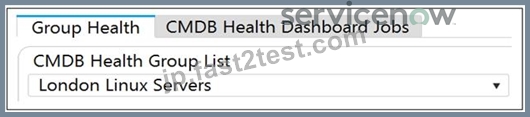
Based on the following image, which of the following choices is also true about London Linux Servers?
- A. It is a CMDB Group with Default Group type.
- B. It is a Datacenter Group in London.
- C. It is a CMDB Group with Dashboard Group type.
- D. It is a CMDB Group with Health Group type.
正解:D
解説:
London Linux Servers is a CMDB Group with Health Group type. A CMDB Group is a collection of configuration items (CIs) that share common characteristics or are related in some way1. A Health Group is a type of CMDB Group that is used to monitor and measure the health of a specific set of CIs based on predefined rules and metrics2. The image shows that London Linux Servers is selected from the CMDB Health Group List, which is a dropdown menu that displays all the Health Groups defined in the system3. The image also shows the Group Health tab, which displays the health scores and indicators for the selected Health Group.
1: Create a CMDB group - ServiceNow 2: CMDB health groups - ServiceNow 3: CMDB health dashboard - ServiceNow : [View CMDB health scores - ServiceNow]
質問 # 77
When designing steps with operations requiring variables, it is best practice to do what?
- A. always use scalar variables
- B. hard core variables
- C. design for a static environment
- D. query targets for variables
正解:D
解説:
When designing steps with operations requiring variables, it is best practice to query targets for variables1.
This allows you to dynamically obtain the values of the variables from the target devices, rather than hard coding them or using scalar variables that may not reflect the current state of the target. Querying targets for variables also enables you to design for a dynamic environment, where the target configuration may change over time.
References:
* 1: Define discovery steps
質問 # 78
Which choice represents the three best ways of extending Discovery?
- A. Orchestration, Classifiers, Probes & Sensors
- B. Classifiers, Probes & Sensors, Discovery Patterns
- C. Fingerprinting, Classifiers, Discovery Patterns
- D. Orchestration, Classifiers, Discovery Patterns
- E. Classifiers, Fingerprinting, Probes & Sensors
正解:B
解説:
ServiceNow Discovery can be extended in three main ways: Classifiers, Probes & Sensors, and Discovery Patterns. Classifiers are used to identify the type of device or application that is being discovered, based on the information returned by a probe. Probes are commands or scripts that are executed on the target device or application to collect data. Sensors are scripts that process the data collected by probes and create or update configuration items (CIs) in the CMDB. Discovery Patterns are graphical representations of the discovery process that can be customized or created to discover specific types of devices or applications, using classifiers, probes, and sensors as building blocks.
:
Discovery overview - Product Documentation: Vancouver - Now Support Portal Create a Discovery CI classification - Product Documentation: Vancouver - Now Support Portal Discovery probes and sensors - Product Documentation: Vancouver - Now Support Portal Discovery patterns - Product Documentation: Vancouver - Now Support Portal
質問 # 79
A discovery runs against a Windows Server returning the following attribute values for the first time:
name = WindowsSN1 serial_number = 12321
A subsequent discovery is ran against a different Windows Server returning the following attribute values:
name = WindowsSN2
serial_number = 12321
With only base system CI Identifiers configured, which of the following is true?
- A. A Windows Server CI is created, then updated with WindowsSN1 as the name.
- B. Two Windows Sewer CIs are created, with WindowsSN1 AND WindowsSN2 for names.
- C. A Windows Server CI is created, then updated with WindowsSN2 as the name.
- D. Two Windows Server CIs are created, without serial_number values.
正解:B
解説:
According to the ServiceNow Discovery documentation, the base system CI Identifiers for Windows Server class are name and serial_number. These are the attributes that Discovery uses to uniquely identify a Windows Server CI. If both attributes match an existing CI, Discovery updates that CI. If only one attribute matches, Discovery creates a new CI. If neither attribute matches, Discovery also creates a new CI. In this scenario, the serial_number is the same for both Windows Servers, but the name is different. Therefore, Discovery will create two separate CIs, one with WindowsSN1 as the name and one with WindowsSN2 as the name.
References:
* Create a Discovery CI classification - Product Documentation: Tokyo - Now Support Portal
* Identification rules - Product Documentation: Tokyo - Now Support Portal
* ServiceNow IRE: Identification Rules Explained - Cookdown
質問 # 80
For CMDB Health, relationships can be which of the following choices? (Choose three.)
- A. Duplicate
- B. Stale
- C. Recommended
- D. Required
- E. Orphan
正解:A、B、E
解説:
CMDB Health measures the quality of the data in the CMDB by testing it against predefined rules and metrics. One of the categories of these rules is Correctness, which tests the data against data integrity rules such as identification rules, orphan CI rules, and stale CI rules1. These rules help identify and flag the existing CMDB relationships that are not compliant with the suggested relationships2.
* Duplicate relationships are those that have more than one relationship of the same type between the same two CIs3. For example, if a server CI has two relationships of type "Depends on" with the same network CI, it is a duplicate relationship.
* Stale relationships are those that have not been updated for a specified period of time3. For example, if a server CI has a relationship of type "Runs on" with a virtual machine CI that has not been discovered for more than 60 days, it is a stale relationship.
* Orphan relationships are those that are missing a defined relationship within the CMDB3. For example, if a server CI has no relationship of type "Depends on" with any network CI, it is an orphan relationship.
1: CMDB Health - Customer Success - ServiceNow 2: CMDB health Dashboard: "Relationships not compliant with suggested relationships" calculation -Support and Troubleshooting - Now Support Portal 3: Maintain a healthy CMDB - ServiceNow
質問 # 81
Is a failover Midserver cluster load balanced?
Response:
- A. No, the next available midserver in a failover cluster takes over
- B. Yes
正解:A
質問 # 82
What is the purpose of the Discovery Configuration Console?
Response:
- A. Enable/Disable the discovery of Devices(Windows,Unix) , Applications & Include/Exclude the discovery of installed Software (Correct) based on filters
- B. Configuration of Discovery debug logs and other properties
正解:A
質問 # 83
Which choice best represents how to modify the functionality shown in this image?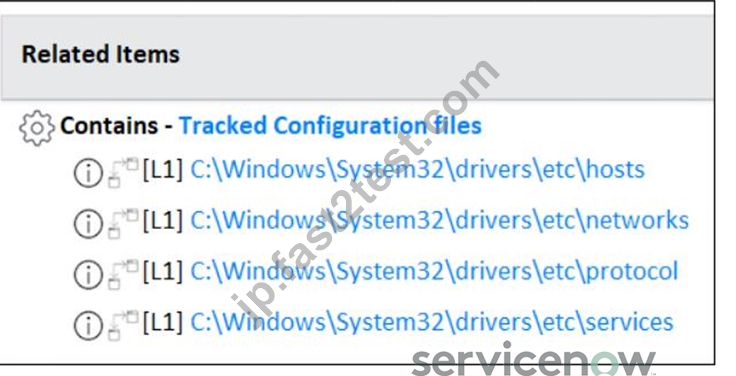
- A. From a Probe
- B. From a Classifier
- C. From the MID Server
- D. From a Discovery Pattern
正解:A
質問 # 84
How to easily identify Duplicate Cls in the System.
Response:
- A. Running a custom scheduled job
- B. Using the CMDB View Dashboard
- C. Running background scripts
正解:B
質問 # 85
......
心強いCIS-DiscoveryのPDF問題集はCIS-Discovery問題:https://jp.fast2test.com/CIS-Discovery-premium-file.html
正真正銘のCIS-Discovery問題集で無料PDF問題で合格させる:https://drive.google.com/open?id=1rqxWracQiDzKXsD3vXKXSdXf8CBnADgj