

2026年最新のTerraform-Associate-003問題集にはTerraform Associate認証済み試験問題と解答
実際に出ると確認されたTerraform-Associate-003試験問題集と解答でTerraform-Associate-003無料更新
質問 # 129
A provider configuration block is required in every Terraform configuration.
Example: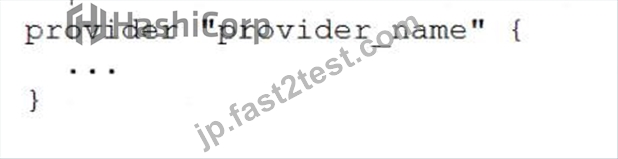
- A. True
- B. False
正解:B
解説:
A provider configuration block is not required in every Terraform configuration. A provider configuration block can be omitted if its contents would otherwise be empty. Terraform assumes an empty default configuration for any provider that is not explicitly configured. However, some providers may require some configuration arguments (such as endpoint URLs or cloud regions) before they can be used. A provider's documentation should list which configuration arguments it expects. For providers distributed on the Terraform Registry, versioned documentation is available on each provider's page, via the "Documentation" link in the provider's header1. References = [Provider Configuration]1
質問 # 130
Which of the following commands would you use to access all of the attributes and details of a resource managed by Terraform?
- A. terraform get 'provider_type.name'
- B. terraform state list 'provider_type.name'
- C. terraform state list
- D. terraform state show 'provider_type.name'
正解:D
解説:
Explanation
The terraform state show command allows you to access all of the attributes and details of a resource managed by Terraform. You can use the resource address (e.g. provider_type.name) as an argument to show the information about a specific resource. The terraform state list command only shows the list of resources in the state, not their attributes. The terraform get command downloads and installs modules needed for the configuration. It does not show any information about resources. References = [Command: state show] and
[Command: state list]
質問 # 131
If a DevOps team adopts AWS CloudFormation as their standardized method for provisioning public cloud resoruces, which of the following scenarios poses a challenge for this team?
- A. The team is asked to build a reusable code based that can deploy resources into any AWS region
- B. The DevOps team is tasked with automating a manual, web console-based provisioning.
- C. The organization decides to expand into Azure wishes to deploy new infrastructure
- D. The team is asked to manage a new application stack built on AWS-native services
正解:C
解説:
Explanation
This is the scenario that poses a challenge for this team, if they adopt AWS CloudFormation as their standardized method for provisioning public cloud resources, as CloudFormation only supports AWS services and resources, and cannot be used to provision infrastructure on other cloud platforms such as Azure.
質問 # 132
Select the command that doesn't cause Terraform to refresh its state.
- A. Terraform apply
- B. Terraform destroy
- C. Terraform plan
- D. Terraform state list
正解:D
質問 # 133
The public Terraform Module Registry is free to use.
- A. False
- B. True
正解:B
解説:
Explanation
The public Terraform Module Registry is free to use, as it is a public service that hosts thousands of self-contained packages called modules that are used to provision infrastructure. You can browse, use, and publish modules to the registry without any cost.
質問 # 134
You created infrastructure outside the Terraform workflow that you now want to manage using Terraform.
Which command brings the infrastructure into Terraform state?
- A. terraform get
- B. terraform import
- C. terraform init
- D. terraform refresh
正解:B
解説:
The terraform import command allows Terraform to takeexistinginfrastructure andbring it under Terraform's management.
* A (terraform get)is incorrect because it is used to fetch modules.
* B (terraform refresh)is incorrect because it only updates Terraform's state to match the infrastructure but does not import resources.
* D (terraform init)is incorrect because it only initializes the Terraform working directory.
Official Terraform Documentation Reference:
terraform import - HashiCorp Documentation
質問 # 135
Your DevOps team is currently using the local backend for your Terraform configuration. You would like to move to a remote backend to store the state file in a central location. Which of the following backends would not work?
- A. Artifactory
- B. Amazon S3
- C. Git
- D. Terraform Cloud
正解:C
解説:
Explanation
This is not a valid backend for Terraform, as it does not support locking or versioning of state files4. The other options are valid backends that can store state files in a central location.
質問 # 136
If a DevOps team adopts AWS CloudFormation as their standardized method for provisioning public cloud resoruces, which of the following scenarios poses a challenge for this team?
- A. The team is asked to build a reusable code based that can deploy resources into any AWS region
- B. The DevOps team is tasked with automating a manual, web console-based provisioning.
- C. The organization decides to expand into Azure wishes to deploy new infrastructure
- D. The team is asked to manage a new application stack built on AWS-native services
正解:C
解説:
This is the scenario that poses a challenge for this team, if they adopt AWS CloudFormation as their standardized method for provisioning public cloud resources, as CloudFormation only supports AWS services and resources, and cannot be used to provision infrastructure on other cloud platforms such as Azure.
質問 # 137
What is the provider for this resource?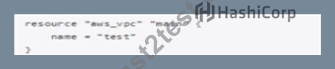
- A. Vpc
- B. aws
- C. Test
- D. Main
正解:B
解説:
In the given Terraform configuration snippet:
resource "aws_vpc" "main" {
name = "test"
}
The provider for the resource aws_vpc is aws. The provider is specified by the prefix of the resource type. In this case, aws_vpc indicates that the resource type vpc is provided by the aws provider.
Reference:
Terraform documentation on providers: Terraform Providers
質問 # 138
Which of the following is not a valid Terraform collection type?
- A. set
- B. List
- C. Tree
- D. Map
正解:C
解説:
Explanation
This is not a valid Terraform collection type, as Terraform only supports three collection types: list, map, and set. A tree is a data structure that consists of nodes with parent-child relationships, which is not supported by Terraform.
質問 # 139
In a Terraform Cloud workspace linked to a version control repository, speculative plan runs start automatically when you merge or commit changes to version control.
- A. True
- B. False
正解:B
解説:
In Terraform Cloud, speculative plan runs are not automatically started when changes are merged or committed to the version control repository linked to a workspace. Instead, speculative plans are typically triggered as part of proposed changes in merge requests or pull requests to give an indication of what would happen if the changes were applied, without making any real changes to the infrastructure. Actual plan and apply operations in Terraform Cloud workspaces are usually triggered by specific events or configurations defined within the Terraform Cloud workspace settings.
Reference = This behavior is part of how Terraform Cloud integrates with version control systems and is documented in Terraform Cloud's usage guidelines and best practices, especially in the context of VCS-driven workflows.
質問 # 140
Which of the following is not a valid source path for specifying a module?
- A. source - "hashicorp/consul/aws"
- B. source - "github.com/hashicorp/examplePref-ul.0.8M
- C. source - "./module"
- D. source = "./module?version=vl.6.0"
正解:D
解説:
Terraform modules are referenced by specifying a source location. This location can be a URL or a file path. However, specifying query parameters such as ?version=vl.6.0 directly within the source path is not a valid or supported method for specifying a module version in Terraform. Instead, version constraints are specified using the version argument within the module block, not as part of the source string.
References = This clarification is based on Terraform's official documentation regarding module usage, which outlines the correct methods for specifying module sources and versions.
質問 # 141
How could you reference an attribute from the vsphere_datacenter data source for use with the datacenter_id argument within the vsphere_folder resource in the following configuration?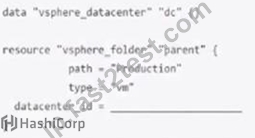
- A. Data,dc,id
- B. Data.vsphere_datacenter.DC.id
- C. Vsphere_datacenter.dc.id
- D. Data.vsphere_datacenter,dc
正解:B
解説:
The correct way to reference an attribute from the vsphere_datacenter data source for use with the datacenter_id argument within the vsphere_folder resource in the following configuration is data.vsphere_datacenter.dc.id. This follows the syntax for accessing data source attributes, which is data.TYPE.NAME.ATTRIBUTE. In this case, the data source type is vsphere_datacenter, the data source name is dc, and the attribute we want to access is id. The other options are incorrect because they either use the wrong syntax, the wrong punctuation, or the wrong case.
References = [Data Source: vsphere_datacenter], [Data Source: vsphere_folder], [Expressions: Data Source References]
質問 # 142
When does Terraform create the .terraform.lock.hc1 file?
- A. After your first terraform plan
- B. After your first terraform apply
- C. After your first terraform init
- D. When you enable state locking
正解:C
解説:
Terraform creates the .terraform.lock.hcl file after the first terraform init command. This lock file ensures that the dependencies for your project are consistent across different runs by locking the versions of the providers and modules used.
質問 # 143
Multiple team members are collaborating on infrastructure using Terraform and want to format the* Terraform code following standard Terraform-style convention.
How should they ensure the code satisfies conventions?
- A. Run terraform validate prior to executing terraform plan or terraform apply
- B. Use terraform fmt
- C. Replace all tabs with spaces
- D. Terraform automatically formats configuration on terraform apply
正解:B
解説:
The terraform fmt command is used to format Terraform configuration files to a canonical format and style. This ensures that all team members are using a consistent style, making the code easier to read and maintain. It automatically applies Terraform's standard formatting conventions to your configuration files, helping maintain consistency across the team's codebase.
Reference:
Terraform documentation on terraform fmt: Terraform Fmt
質問 # 144
terraform validate confirms that your infrastructure matches the Terraform state file.
- A. True
- B. False
正解:B
解説:
terraform validate does not confirm that your infrastructure matches the Terraform state file. It only checks whether the configuration files in a directory are syntactically valid and internally consistent3. To confirm that your infrastructure matches the Terraform state file, you need to use terraform plan or terraform apply with the -refresh-only option.
質問 # 145
Which of the following isnotan advantage of using Infrastructure as Code (IaC) operations?
- A. Troubleshoot via a Linux diff command.
- B. API-driven workflows.
- C. Modify a count parameter to scale resources.
- D. Public cloud console configuration workflows.
- E. Self-service infrastructure deployment.
正解:D
解説:
* E (#Correct)-IaC aims to eliminate manual cloud console workflowsby using code-based automation.
* A, B, C (#Advantages of IaC)- IaC enablesself-service deployment, API-driven workflows, and dynamic resource scaling.
* D (diff command)- While useful, troubleshooting via diff is not acore advantageof IaC.
Official Terraform Documentation Reference:
What is Infrastructure as Code?
質問 # 146
You can reference a resource created with for_each using a Splat ( *) expression.
- A. True
- B. False
正解:B
解説:
You cannot reference a resource created with for_each using a splat (*) expression, as it will not work with resources that have non-numeric keys. You need to use a for expression instead to iterate over the resource instances.
質問 # 147
Which of the following can you do with terraform plan? (Pick 2 correct responses)
- A. Save a generated execution plan to apply later.
- B. View the execution plan and check if the changes match your expectations.
- C. Schedule Terraform to run at a planned time in the future.
- D. Execute a plan in a different workspace.
正解:A、B
解説:
Detailed Explanation:
* Rationale for Correct Answers:
* B. View the execution plan: Correct - terraform plan shows what Terraform intends to do (create, update, or destroy).
* C. Save a generated execution plan: Correct - using terraform plan -out=planfile lets you save the plan to apply later with terraform apply planfile.
* Analysis of Incorrect Options:
* A. Schedule runs in the future: Incorrect, Terraform does not provide scheduling; external tools (like cron, CI/CD) are required.
* D. Execute a plan in a different workspace: Incorrect, execution happens in the current workspace; switching workspaces must be done before running the plan.
* Key Concept:terraform plan is used for previewing and optionally saving an execution plan for controlled and predictable infrastructure changes.
Reference:Terraform Exam Objective - Understand Terraform Basics and CLI.
質問 # 148
Which Terraform command checks that your configuration syntax is correct?
- A. terraform fmt
- B. terraform show
- C. terraform validate
- D. terraform init
正解:C
解説:
The terraform validate command is used to check that your Terraform configuration files are syntactically valid and internally consistent. It is a useful command for ensuring your Terraform code is error-free before applying any changes to your infrastructure.
質問 # 149
terraform apply is failing with the following error. What next step should you take to determine the root cause of the problem?
Error:
yaml
CopyEdit
Error loading state: AccessDenied: Access Denied
status code: 403, request id: 288766CE5CCA24A0, host id: web.example.com
- A. Run terraform login to reauthenticate with the provider.
- B. Review syslog for Terraform error messages.
- C. Set TF_LOG=DEBUG.
- D. Review /var/log/terraform.log for error messages.
正解:C
解説:
The error messageindicates an authentication issue (403 - Access Denied), which requiresdebugging Terraform logs.
* Setting TF_LOG=DEBUG enablesdetailed logs, providing insights into API requests, state loading, and authentication errors.
* Terraformdoes not log errors in /var/log/terraform.log or syslog, making optionsC and D incorrect.
* A (terraform login)is only relevant forTerraform Cloud, but this error appears to be related toprovider authentication.
Official Terraform Documentation Reference:
Debugging Terraform
質問 # 150
What is the provider for this resource?
- A. Vpc
- B. aws
- C. Test
- D. Main
正解:B
解説:
In the given Terraform configuration snippet:
resource "aws_vpc" "main" {
name = "test"
}
The provider for the resource aws_vpc is aws. The provider is specified by the prefix of the resource type. In this case, aws_vpc indicates that the resource type vpc is provided by the aws provider.
References:
Terraform documentation on providers: Terraform Providers
質問 # 151
In a Terraform Cloud workpace linked to a version control repository speculative plan rum start automatically commit changes to version control.
- A. False
- B. True
正解:B
解説:
When you use a remote backend that needs authentication, HashiCorp recommends that you:
質問 # 152
Which of the following statements about Terraform modules is not true?
- A. A module is a container for one or more resources
- B. Modules must be publicly accessible
- C. You can call the same module multiple times
- D. Modules can call other modules
正解:B
解説:
This is not true, as modules can be either public or private, depending on your needs and preferences. You can use the Terraform Registry to publish and consume public modules, or use Terraform Cloud or Terraform Enterprise to host and manage private modules.
質問 # 153
A provider configuration block is required in every Terraform configuration.
Example: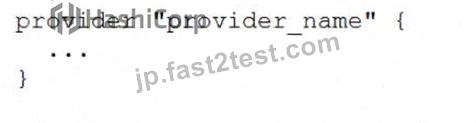
- A. True
- B. False
正解:B
解説:
A provider configuration block is not required in every Terraform configuration. A provider configuration block can be omitted if its contents would otherwise be empty. Terraform assumes an empty default configuration for any provider that is not explicitly configured. However, some providers may require some configuration arguments (such as endpoint URLs or cloud regions) before they can be used. A provider's documentation should list which configuration arguments it expects. For providers distributed on the Terraform Registry, versioned documentation is available on each provider's page, via the "Documentation" link in the provider's header1. References = [Provider Configuration]1
質問 # 154
......
実際問題を使ってTerraform-Associate-003問題集で100%無料Terraform-Associate-003試験問題集:https://jp.fast2test.com/Terraform-Associate-003-premium-file.html
Terraform-Associate-003試験問題集、テストエンジン練習テスト問題:https://drive.google.com/open?id=1GAFtQcMGQZV6Y457W5Nz35Qk9S-7lNXg