

2026年最新のSecOps-Generalist試験資料SecOps-Generalist学習ガイド
お手軽に合格させるSecOps-Generalist試験にはこちらが提供する問題集PDFテストエンジン
質問 # 104
How does Cortex XSIAM enhance proactive security operations?
Response:
- A. By focusing only on known attack signatures
- B. By enabling AI-powered threat hunting and anomaly detection
- C. By automatically blocking all external network traffic
- D. By eliminating the need for EDR solutions
正解:B
質問 # 105
A user's endpoint is infected with malware that attempts to contact its command-and-control (C2) server using a newly generated domain name (Domain Generation Algorithm - DGA). The user's traffic passes through a Palo Alto Networks NGFW with the Advanced DNS Security subscription enabled. The DNS query for the malicious domain is sent to an external DNS server via the firewall. How does Advanced DNS Security MOST likely contribute to detecting and preventing this C2 communication attempt? (Select all that apply)
- A. The firewall intercepts the DNS query and sends it to the Advanced DNS Security cloud service for analysis.
- B. The firewall relies on the external DNS server to block the query based on its own threat intelligence.
- C. The firewall detects the C2 activity by deep packet inspection of the encrypted communication flow after the DNS resolution is complete.
- D. The Advanced DNS Security cloud service analyzes the domain name requested using machine learning models trained to detect DGA patterns and other malicious characteristics.
- E. Based on the analysis, if the domain is classified as malicious, the Advanced DNS Security cloud service instructs the firewall to block the DNS response or the subsequent connection attempt to the resolved IP address.
正解:A、D、E
解説:
Advanced DNS Security intercepts and analyzes DNS queries to block access to malicious domains before the connection to the malicious IP is even attempted. - Option A (Correct): When enabled, the firewall intercepts DNS queries passing through it and forwards them (or metadata about them) to the Advanced DNS Security cloud service for analysis. - Option B (Correct): The cloud service performs sophisticated analysis on the domain name and associated context (querying source, history, etc.), leveraging machine learning models (specifically trained to detect DGAs) and threat intelligence to determine if the domain is malicious. - Option C (Correct): If the cloud service identifies the domain as malicious, it sends a verdict back to the firewall. The firewall then takes the configured action (e.g., block the DNS response, sinkhole the response to a safe IP, block the subsequent connection to the resolved malicious IP) based on the policy applied to the DNS traffic. - Option D (Incorrect): While some external DNS servers offer security features, the protection here is provided by Palo Alto Networks' Advanced DNS Security, which acts as an intermediary or inspector for the DNS traffic. - Option E (Incorrect): While other security profiles can detect C2 activity within the application layer after a connection is made, Advanced DNS Security provides prevention at the DNS layer , stopping the connection attempt before it even begins, which is a more proactive approach.
質問 # 106
A key benefit of using Prisma Access compared to self-managed firewalls (PA-SeriesNM-Series) for remote user and branch security is that the responsibility for performing the underlying software upgrades and patching of the security processing nodes lies primarily with whom?
- A. The end-user via the GlobalProtect client.
- B. The customer administrator via the Cloud Management Console.
- C. Palo Alto Networks as the cloud service provider.
- D. The customer administrator via Panorama.
- E. A third-party managed security service provider (MSSP).
正解:C
解説:
Prisma Access is a cloud-delivered security service. A significant advantage of this model is that Palo Alto Networks, as the service provider, is responsible for the ongoing maintenance, including software upgrades and patching, of the underlying security processing nodes and infrastructure. This offloads a major operational burden from the customer's IT team. Options A, B, C, and E are incorrect; these parties are not primarily responsible for upgrading the core Prisma Access infrastructure.
質問 # 107
Palo Alto Networks periodically releases new versions of the Prisma Access software and security features. Which of the following statements accurately describe how these updates and upgrades are communicated and managed for customers? (Select all that apply)
- A. Customers must manually download new software versions for Prisma Access processing nodes from the support portal.
- B. The process is designed to be non-disruptive, aiming to maintain existing user sessions and prevent outages during the upgrade.
- C. Major feature updates and software upgrades are often performed globally in a rolling, phased manner to minimize service disruption.
- D. Customers are typically notified in advance of planned software upgrades for their Prisma Access environment.
- E. Administrators can approve or defer the installation of minor software updates via the Cloud Management Console or Panorama.
正解:B、C、D
解説:
Prisma Access updates are managed by Palo Alto Networks with a focus on transparency and minimal impact. - Option A (Correct): Palo Alto Networks provides advance notification of scheduled maintenance and upgrades for Prisma Access to allow customers to prepare and plan. - Option B (Correct): Updates are deployed incrementally across the global infrastructure to reduce risk and avoid widespread disruption. This phased approach minimizes the chance of a single issue affecting all users simultaneously. - Option C (Incorrect): While customers have control over configuring security policies and features applied to their traffic, they do not typically have control over approving or deferring the underlying software updates of the Prisma Access infrastructure nodes themselves; this is managed by Palo Alto Networks to ensure the platform remains secure and up-to-date. - Option D (Correct): A primary goal of the update process is high availability. Updates are engineered to be performed with minimal or zero impact on user sessions and overall service availability. - Option E (Incorrect): Software upgrades for Prisma Access processing nodes are handled entirely by Palo Alto Networks, the customer does not download or install the software.
質問 # 108
A security administrator logging into the AIOps for NGFW dashboard needs a quick overview of the overall health, security posture, and potential operational issues across their fleet of managed firewalls. Which sections or widgets on the AIOps dashboard are designed to provide this high-level summary information?
- A. Configuration logs viewer.
- B. Best Practices Assessment score and findings summary.
- C. Detailed threat log viewer.
- D. Security Policy rule usage statistics.
- E. Operational Status dashboard, showing critical alerts and key performance indicators (KPIs).
正解:B、E
解説:
AIOps dashboards are designed for quick visibility and actionable insights. - Option A (Correct): The Best Practices Assessment score provides a quantitative measure of how well firewalls align with recommended configurations, and the summary highlights key findings (policy, network, device best practices), giving a high-level security posture view. - Option B (Correct): The Operational Status dashboard (or similar section depending on version) provides critical alerts related to device health, resource utilization, licensing, and key performance metrics, offering a snapshot of operational health. - Option C: While usage statistics are available, they are typically detailed reports, not a primary high-level summary widget. - Option D and E: Log viewers are for detailed investigation, not high-level dashboards.
質問 # 109
An organization is designing a security policy for its Strata NGFW separating its network into four zones: 'Internal-Users', 'Servers-Prod', 'DMZ-Web', and 'Internet'. They need to enforce the following policies: 1. Users in 'Internal-Users' can access servers in 'Servers-Proff on specific application ports. 2. Users in 'Internal-Users' can access web servers in 'DMZ-Web' on HTTPS. 3. External users from 'Internet' can access web servers in 'DMZ-Web' on HTTPS. 4. Web servers in 'DMZ-Web' can initiate connections to servers in 'Servers-Prod' only on specific database ports. 5. No direct access is allowed from 'Internet' to 'Servers-Prod'. 6. No direct access is allowed from 'Internal-Users' to 'Internet' without deep content inspection. Considering these requirements and best practices for zone-based policy, which of the following statements are TRUE about the necessary security policy rules and zone configuration?
(Select all that apply)
- A. A single zone could encompass all server types ('Servers-Proff and 'DMZ-Web') to simplify policy, as long as App-ID is used.
- B. The default inter-zone-default rule will automatically block traffic flow from 'Internet' to 'Servers-Proff unless a specific policy rule permits it.
- C. You would need to create at least one security policy rule with 'Source Zone: Internal-Users' and 'Destination Zone: Servers-Proff.
- D. Decryption policies would need to be configured for traffic from 'Internal-Users' to 'Internet to enable deep content inspection.
- E. You would need to create at least one security policy rule with 'source Zone: Internet' and 'Destination Zone: DMZ-Web'.
正解:B、C、D、E
解説:
This scenario tests the understanding of how zones are used to structure policy and the implications of the default deny stance. - Option A (Correct): Requirement 1 dictates traffic flow from 'Internal-Users' to 'Servers-Proff. This requires a policy rule explicitly allowing this zone-to-zone traffic flow. - Option B (Correct): Requirement 3 dictates traffic flow from 'Internet' to 'DMZ-Web'. This requires a policy rule explicitly allowing this zone-to-zone traffic flow. - Option C (Correct): Requirement 5 states no direct 'Internet' to Servers-Proff access. Since these are different zones, the default inter-zone-default rule (which is a deny) will block this traffic automatically unless an explicit policy rule allowing it is created. The statement is true; the default rule provides this protection by default. - Option D (Correct): Requirement 6 demands deep content inspection for 'Internal-UserS to 'Internet' traffic (like web browsing on HTTPS). Deep inspection (Threat Prevention, URL Filtering beyond SNI, WildFire, Data Filtering) requires decryption for encrypted traffic. Therefore, decryption policies are necessary. - Option E (Incorrect): While App-ID allows granular control within a policy, putting servers with fundamentally different trust levels and access requirements ('Servers- Prod' with sensitive internal data vs. 'DMZ-Web' public-facing) into the same zone violates the principle of using zones for trust boundaries and makes policy writing significantly more complex and less secure. Segmentation via zones is a cornerstone of hardening.
質問 # 110
An organization wants to prevent sensitive customer data (e.g., credit card numbers, national ID numbers) from being uploaded to unauthorized cloud storage services or transmitted via email. They are using Palo Alto Networks NGFWs with the Enterprise Data Loss Prevention (DLP) subscription. Which core Content-ID profile, working in conjunction with the DLP subscription and applied to relevant Security Policy rules, is used to detect and enforce policies based on the presence of these sensitive data patterns within application traffic?
- A. Threat Prevention profile
- B. Antivirus profile
- C. URL Filtering profile
- D. Data Filtering profile
- E. File Blocking profile
正解:D
解説:
The Enterprise Data Loss Prevention (DLP) subscription enhances the capabilities of the Data Filtering profile. The Data Filtering profile is the specific Content-ID component used to define and detect sensitive data patterns within traffic. When the DLP subscription is active, it provides a broader range of predefined data identifiers and advanced capabilities for the Data Filtering profile. Option A detects threats. Option B blocks file types. Option D blocks URLs. Option E detects malware signatures.
質問 # 111
A security team manages a large fleet of Palo Alto Networks firewalls using Panoram a. They have enabled AIOps for NGFW to improve operational efficiency and security posture. They receive an AIOps alert about high session setup rates on a specific firewall, potentially indicating a performance bottleneck or a network anomaly (like a connection flood). Which of the following are valid actions the team can take or insights they can gain by leveraging the integration between AIOps and Panorama/Cortex Data Lake to investigate and address this alert? (Select all that apply)
- A. Automatically apply QOS policies via AIOps to mitigate the impact of high session setup on critical traffic.
- B. Receive recommendations from AIOps on potential causes for the high session setup rate, such as short-lived connections or specific application traffic patterns.
- C. Drill down from the AIOps alert into the detailed Traffic logs for the affected firewall (stored in Cortex Data Lake/Panorama Log Collector) to identify the source IPs, destinations, and applications contributing to the high session setup rate.
- D. Identify if the high session setup rate correlates with any specific configuration changes made to the firewall using AIOps' change correlation capabilities.
- E. View historical trends and analyze the rate of new sessions on the affected firewall over time within the AIOps dashboard to determine if the current rate is an anomaly or a consistent pattern.
正解:B、C、D、E
解説:
AIOps for NGFW analyzes operational data and provides insights, recommendations, and correlation. - Option A (Correct): AIOps tracks key operational metrics like session rates and provides historical trend analysis, allowing administrators to differentiate between temporary spikes and persistent issues. - Option B (Correct): A crucial aspect is integration with logging. AIOps provides context-aware links or drilling capabilities into the relevant logs (in CDL or Panorama) to investigate the details of the events triggering the alert, such as identifying the source/destination of the high session rate traffic. - Option C (Correct): AIOps uses machine learning and analysis to identify potential root causes or contributing factors to observed operational issues, providing actionable recommendations (e.g., optimize policy for short-lived connections, investigate specific applications). - Option D (Incorrect): While AIOps might recommend applying QOS, it does not automatically implement configuration changes like applying policies. Implementation is done manually via Panorama or the firewall UI. - Option E (Correct): AIOps can correlate operational anomalies or performance changes with recent configuration commits, helping administrators identify if a recent change might be the cause of the issue.
質問 # 112
An administrator configures a new VLAN interface on a Palo Alto Networks Strata NGFW and assigns it to an existing Security Zone named 'VLAN-Zone'. The administrator then attempts to create a Security Policy rule allowing traffic from 'Internal-Users' zone to However, traffic between these zones fails, and logs show the traffic hitting the implicit 'deny' rule, even though interfaces are correctly configured and IP routing is working. Which configuration aspect related to zones and interfaces was MOST likely overlooked?
- A. Security Policy rules are processed top-down, and a broader 'deny' rule above the new rule is blocking the traffic.
- B. The new VLAN interface was not explicitly assigned to the 'VLAN-Zone' during configuration.
- C. The Zone Type for 'VI-AN-Zone' was set to 'External' instead of 'Internal'.
- D. The interfaces in the 'VLAN-Zone' were configured as Layer 2 interfaces instead of Layer 3 interfaces.
- E. The 'Internal-Users' zone is configured as a 'Tap' zone, which does not permit traffic forwarding.
正解:B
解説:
For a security policy rule defined between two zones (e.g., 'Internal-Users' and ' VLAN-Zone') to be evaluated and potentially matched by traffic flowing through the firewall, the interfaces where that traffic enters and exits the firewall must be assigned to the respective source and destination zones specified in the policy rule. If the new VLAN interface intended for the 'VLAN-Zone' was created but not explicitly associated with the 'VI-AN-Zone' object in the configuration, traffic coming in on that interface will not be seen as originating (or destined for, depending on direction) the 'VI-AN-Zone' , and thus will not match the zone-based policy rule. The traffic then proceeds down the rule list and hits the implicit deny. Option A describes an interface mode, but the core issue is the zone assignment itself. Option C is a general policy troubleshooting step but doesn't address the initial problem of the traffic not being associated with the correct zone for policy lookup. Option D describes a specific zone type that wouldn't forward traffic, but the question implies the zone configuration is correct, while the interface assignment might be missing. Option E is irrelevant; the zone name and type are logical labels for policy, not direct blockers like the lack of interface assignment.
質問 # 113
A security administrator is investigating a user who is suspected of attempting to download malware and access restricted websites using encrypted channels. The Palo Alto Networks NGFW (or Prisma Access) is configured with SSL Forward Proxy decryption, URL Filtering, Antivirus, and WildFire Analysis profiles applied to the relevant security policy rules. Which log types should the administrator examine in Cortex Data Lake or Panorama to gain comprehensive insight into this user's activity and any detected security events?
(Select all that apply)
- A. Threat logs, to see if any malware, exploit, or other threats were detected within the user's traffic or files.
- B. Traffic logs, to see which sessions were allowed or denied, the applications used, and identify sessions related to the user.
- C. File logs, to see if any files were transferred, their type, and the outcome of Antivirus or WildFire analysis.
- D. URL Filtering logs, to see which websites the user attempted to access and the categories/actions associated with those sites.
- E. Decryption logs, to confirm whether SSL decryption was attempted and successful for the user's encrypted traffic.
正解:A、B、C、D、E
解説:
Investigating activity and detected threats over encrypted channels requires looking at multiple interconnected log types: - Option A (Correct): Traffic logs are the starting point, providing the session context (who, what, where, when, allowed/denied). - Option B (Correct): Since the investigation involves encrypted channels, checking Decryption logs is crucial to confirm if decryption was attempted and successful. Decryption logs show status, errors, and policies applied. - Option C (Correct): URL Filtering logs specifically track web access attempts, showing the URLs visited and the policy action (block/allow) based on category or threat feeds. - Option D (Correct): Threat logs record detections from Threat Prevention, Antivirus, and WildFire, directly indicating if malware, exploits, or other threats were found in the traffic payload. - Option E (Correct): File logs provide details about file transfers detected within sessions, including the file type, direction, size, and the results of Antivirus and WildFire scanning for that specific file. This is essential for confirming malware downloads.
質問 # 114
Consider the following snippet of a Palo Alto Networks Decryption policy rule:
What is the primary function of the 'profile "default-decryption-profile"' within this Decryption policy rule configuration?
- A. It determines which Security Profiles (Threat Prevention, URL Filtering, etc.) will be applied to the traffic after it has been successfully decrypted.
- B. It defines which certificate (Forward Trust or Forward Untrust) the firewall will use to re-sign server certificates during the SSL Fomard Proxy process.
- C. It lists specific URLs or URL Categories that should be excluded from decryption based on compliance or privacy requirements.
- D. It specifies actions to take when the firewall encounters issues during the decryption process, such as unsupported versions, cipher suites, or certificate errors.
- E. It dictates the SSL/TLS versions and cipher suites that the firewall will negotiate with both the client and the server during the decryption process.
正解:D
解説:
In Palo Alto Networks firewalls, the Decryption Profile (referenced within a Decryption policy rule) is primarily used to configure the behavior of the firewall when it encounters errors or specific conditions during the SSL/TLS decryption process. Key settings within a Decryption Profile include actions for unsupported versions, unsupported cipher suites, decryption errors, and expired/invalid certificates (Block, Bypass, or Reset). While some aspects of certificate handling and supported protocols are indirectly related or influenced by the profile settings and the chosen certificate, the primary function controlled by the profile is defining the action upon encountering a decryption issue. Option A is incorrect; the certificates (Fomard Trust/Untrust) are selected at the Virtual System or Panorama level and referenced in the Decryption Policy rule options, not primarily defined within the profile itself. Option C is incorrect; Security Profiles are applied in the Security policy rule, not the Decryption profile or policy. Option D is incorrect; URL categories or specific URLs to exclude from decryption are typically defined directly in Decryption Policy rules (usually before inclusion rules) by matching source/destination criteria or specific URL categories, not within the Decryption Profile itself. Option E is partially correct in that the profile can influence actions based on versions/ciphers, but the profile doesn't dictate the negotiation process itself as its primary role; that's a function of the SSL/TLS engine based on its supported algorithms and the negotiated parameters, with the profile defining the response to negotiation failures or unsupported parameters.
質問 # 115
An organization is configuring Security Policy rules on a Palo Alto Networks VM-Series firewall in a public cloud environment (e.g., AWS VPC) to segment application tiers. They have zones for 'Web-Tier', 'App-Tier', and 'DB-Tier'. They need to allow HTTP/HTTPS traffic from 'Web-Tier' to 'App-Tier' but apply deep threat inspection. They also need to allow database traffic (MS-SQL, MySQL) from 'App-Tier' to 'DB-Tier' but only for specific application servers. Which policy elements and configurations are essential for implementing these requirements? (Select all that apply)
- A. User-ID configured to identify users accessing applications within the tiers.
- B. NAT policy rules configured for traffic between application tiers to translate private IP addresses.
- C. Security Policy rule: Source Zone 'App-Tier', Destination Zone 'DB-Tier', Source Address 'Specific App Server Address Group', Application 'ms-sql', 'mysql', Action 'allow', apply relevant security profiles (optional but recommended).
- D. Decryption Policy rule to decrypt HTTP/HTTPS traffic flowing from 'Web-Tier' to 'App-Tier'.
- E. Security Policy rule: Source Zone 'Web-Tier', Destination Zone 'App-Tier', Application 'web-browsing' (or 'http', 'ssl'), Action 'allow', apply relevant Threat Prevention profile.
正解:C、D、E
解説:
Segmenting traffic between application tiers requires defining policies based on zones, applications, and sources, and applying inspection. - Option A (Correct): This defines the rule for Web-Tier to App-Tier traffic, using zones, common web applications, and applying a Threat Prevention profile for inspection. - Option B (Correct): This defines the rule for App-Tier to DB-Tier traffic, specifying the source zone, destination zone, using an Address Group for the specific allowed servers, and using App-IDs for the database protocols. Applying security profiles (like Threat Prevention) to database traffic is also a best practice for detecting potential exploits or C2 over these protocols. - Option C (Correct): Deep threat inspection on HTTPS traffic requires decryption. A Decryption policy rule matching traffic between 'Web-Tier' and 'App-Tier' for HTTPS (ssl service) is necessary to enable Content-ID inspection by profiles like Threat Prevention and WildFire. - Option D (Incorrect): NAT is generally not needed for internal segmentation traffic using private, routable IP addresses within the same VPC/network space, unless there's a specific requirement for address translation between segments (which is uncommon in simple tier egmentation). - Option E (Optional but not essential for the described policy): User-ID provides user context but is not strictly necessary for policies based on application tiers and server addresses, unless the requirement was to allow access based on user identity accessing resources within those tiers.
質問 # 116
A company implements strict web access policies using Advanced URL Filtering on their Palo Alto Networks NGFW. They configure a URL Filtering profile to block the 'Social-Networking' category for all users. However, a security analyst notices that some specific social media websites are still being accessed, and the traffic logs show them being categorized as 'none' or a general category like Wveb- services'. What is a possible reason for this miscategorization or bypass of the blocking policy, and how can it be addressed?
- A. The specific websites in question are new or less common and have not yet been categorized correctly in the cloud database.
- B. A Security Policy rule allowing traffic to these specific websites is placed above the rule applying the URL Filtering profile.
- C. A custom URL Category needs to be created for the miscategorized websites and set to 'block' in the URL Filtering profile, placed higher than the 'Social-Networking' rule.
- D. The URL Category database on the firewall is outdated and needs to be manually updated.
- E. SSL Decryption is not enabled for HTTPS traffic to these websites, preventing the firewall from seeing the full URL for categorization.
正解:A、C、E
解説:
Misclassification or bypass in URL Filtering can occur due to various factors: - Option A (Correct): For HTTPS traffic, the firewall typically sees the hostname via SNI before decryption. However, full URL path categorization and advanced features like real-time analysis require decryption to see the entire request. If decryption is not enabled for these sites, categorization might be based only on the hostname, potentially leading to a less accurate or 'none' category. - Option Option B (Incorrect): Advanced URL Filtering relies on a cloud-based database, which is dynamically updated, not manually on the firewall (updates happen automatically). - Option C (Correct): Even with Advanced URL Filtering's real-time analysis, new or less common websites might not be immediately or correctly categorized. There's a delay between a site appearing and being fully classified in the cloud database. - Option D (Correct): If specific URLs are consistently miscategorized, creating a custom URL Category for those URLs and explicitly setting the action (e.g., 'block') for that custom category in the URL Filtering profile is a manual override to ensure they are blocked as desired. Custom categories are evaluated before built-in categories. - Option E (Incorrect): A Security Policy rule allowing traffic comes before the IJRL Filtering profile is applied. If an earlier rule allows the traffic without a IJRL Filtering profile, or if the URL Filtering profile applied allows the category, it won't be blocked by a later URL Filtering rule. However, the question implies the traffic hits the policy with the profile but is miscategorized.
質問 # 117
In the context of Palo Alto Networks Strata NGFWs and Prisma Access, which statement MOST accurately describes the fundamental role of Security Zones in network security policy enforcement?
- A. Zones classify traffic based on application type (e.g., web, email) before App-ID inspection.
- B. Zones automatically permit all traffic flow between interfaces assigned to the same zone, and implicitly deny traffic between different zones.
- C. Zones are logical containers for IP addresses and subnets used for reporting and logging purposes only.
- D. Zones define trust boundaries and serve as the source and destination criteria for matching security policy rules.
- E. Zones are primarily used for routing decisions, directing traffic between different physical or virtual interfaces.
正解:D
解説:
Security Zones in Palo Alto Networks platforms are the core construct for defining logical trust boundaries in your network. All interfaces (physical, logical like VLANs, tunnels, etc.) are assigned to a zone. Security policy rules are then written based on the flow of traffic between these zones (Source Zone to Destination Zone). This zone-based policy enforcement model is fundamental to controlling traffic flow and applying security inspection based on where the traffic originates and where it's going in relation to trust levels. Option A describes routing, not zones. Option C is incorrect; zones are critical for policy enforcement, not just logging. Option D describes App-ID's function, not zones. Option E is incorrect; traffic within the same zone is implicitly allowed by default (intra-zone-default rule), but traffic between different zones is implicitly denied by default (inter-zone-default rule). Zones are about defining these boundaries and policy application points.
質問 # 118
A company uses GlobalProtect on a self-managed PA-Series firewall to provide remote access. They have internal network segments defined by VLANs (e.g., Production Servers VLAN 10, Development Servers VLAN 20, User VLAN 30). Users connecting via GlobalProtect are assigned IP addresses from a dedicated VPN pool (e.g., 172.16.1.0/24). The security policy needs to restrict remote users' access to specific applications on specific server VLANs based on their user group and device compliance. How are Security Zones used to implement this segmentation and access control for remote user traffic interacting with internal resources? (Select all that apply)
- A. Define distinct Security Zones for each internal VLAN (e.g., 'Prod-Zone', 'Dev-Zone').
- B. Traffic between remote users (within the VPN IP pool) is implicitly allowed by the intra-zone-default rule because they are in the same 'VPN-Zone'.
- C. Ensure the GlobalProtect tunnel interface or subinterface that receives user traffic is assigned to the 'VPN-Zone'.
- D. Create Security Policy rules with the Source Zone as 'VPN-Zone' and Destination Zone(s) as the respective internal server zones ('Prod-Zone', 'Dev-Zone').
- E. Define a dedicated Security Zone for the GlobalProtect VPN user pool (e.g., 'VPN-Zone').
正解:A、C、D、E
解説:
Segmenting remote user access to internal resources requires defining zones for both the remote users and the internal segments, and applying policy between them. - Option A (Correct): Internal network segments that need to be controlled must be defined as distinct Security Zones on the firewall. - Option B (Correct): The IP address pool assigned to GlobalProtect users needs to be associated with a dedicated Security Zone (the 'VPN-Zone'). This acts as the source zone for remote user traffic entering the firewall. - Option C (Correct): Security Policy rules are written to allow traffic flow from the remote user zone CVPN-Zone') to the specific internal segments/zones they need access to ( ' Prod- Zone' , 'Dev-Zone'). These rules will include criteria like User-ID, App-ID, etc. - Option D (Correct): The interface on the firewall that terminates the GlobalProtect tunnel and is configured with the VPN user IP pool must be assigned to the 'VPN-Zone' to ensure traffic originating from remote users is correctly associated with that zone for policy lookup. - Option E (Incorrect): While intra-zone traffic is implicitly allowed, this applies to traffic between interfaces assigned to the same zone . Traffic between different IPs within the same zone is still subject to inter-zone policy if the logical flow is between zones (which it isn't here, but the statement is about the users being in the zone, not interfaces). More importantly, traffic between remote users is usually explicitly controlled by policies within the 'VPN-Zone' if needed, or potentially goes out to the internet and back in if split-tunneling isn't configured, but the implicit allow applies to traffic traversing the firewall between interfaces in the same zone.
質問 # 119
During the ZTP process for a Prisma SD-WAN ION device, after the device successfully connects to the cloud controller, what is the primary configuration information that the device downloads to become fully operational within the SD-WAN fabric and managed by the cloud console?
- A. Dynamic content updates (App-ID, Threat, URL).
- B. Device-specific configuration including interface settings, zones, WAN link details, local subnets, and initial connectivity parameters for tunnels to other sites/services.
- C. User-ID agent software.
- D. The full security policy set (Security, NAT, Decryption policies) defined for the site.
- E. The latest PAN-OS software image.
正解:B
解説:
ZTP provides the initial device-specific configuration to get the ION online and connected to the fabric. - Option A: While security policies are applied, ZTP typically provides the device-specific network configuration and the framework to receive policies. The full policy set might be pushed subsequently or inherited from templates. - Option B: Software images are downloaded and installed separately, typically before or as part of the ZTP process, but the initial download from the controller is the configuration . - Option C (Correct): The ZTP process delivers the configuration that makes the ION specific to its site: interface assignments and settings, zone mapping, details about its WAN links (type, bandwidth, ISP), definitions of local subnets behind it, and the parameters needed to establish initial control plane connections and potentially data plane tunnels to other sites (like the controller or other IONs/hubs). - Option D: Dynamic content updates are downloaded after the core configuration and connectivity are established. - Option E: User-ID agent software is installed on domain controllers/servers, not typically on the ION device itself.
質問 # 120
An administrator needs to add a new PA-Series firewall at a remote branch office to their existing Panorama management deployment. The firewall is factory default. What initial configuration step is required on the new firewall itself before it can connect to and be managed by Panorama?
- A. Establish an IPSec VPN tunnel to the Panorama appliance.
- B. Apply the full security policy configuration using the local web interface.
- C. Configure Security Zones and assign interfaces to them.
- D. Install the latest PAN-OS software version and dynamic updates.
- E. Configure the firewall's management interface IP address, subnet mask, default gateway, and DNS server.
正解:E
解説:
For a firewall to connect to Panorama, it first needs basic network connectivity to reach the Panorama management interface over the network. This requires configuring its own management port IP settings. Option B, C, D, and E involve configuration that is typically pushed from Panorama after the firewall is connected and managed. The initial step is establishing basic network reachability to Panorama's management
質問 # 121
An organization needs to create a Security Policy rule in Prisma Access to allow remote users (members of the 'Sales-Team' group) to access an internal Customer Relationship Management (CRM) application hosted on a server farm in the data center (represented by the 'CRM-Servers' Address Group within the 'Service-Connection' zone). The CRM application uses a custom TCP port. The policy should also apply appropriate threat prevention profiles. Which combination of elements must be configured in the Security Policy rule for the traffic originating from the remote users to the CRM application?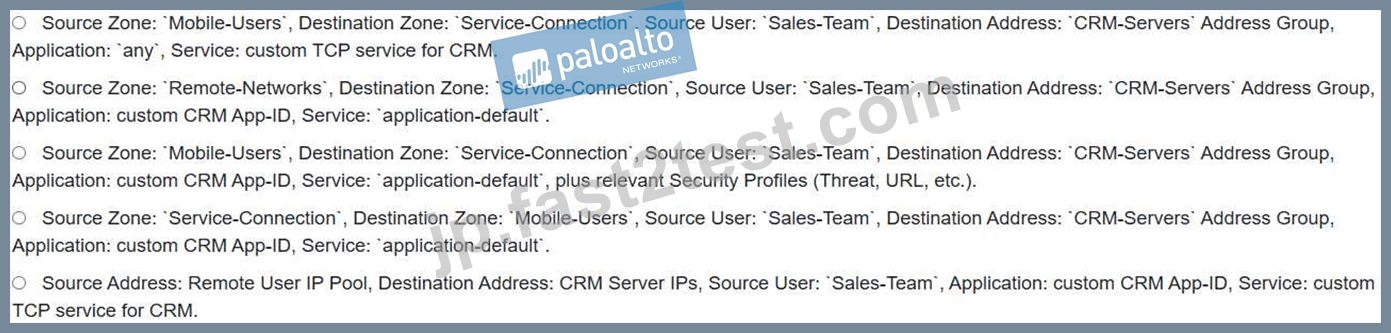
- A. Option A
- B. Option C
- C. Option E
- D. Option D
- E. Option B
正解:B
解説:
Creating a granular security policy rule involves specifying the source, destination, user, application, and service, along with security profiles. - Source Zone: For remote users connected via GlobalProtect, the source zone is typically 'Mobile-Users'. - Destination Zone: Internal data center resources accessed via Service Connections reside in the 'Service-Connection' zone. - Source User: The policy must match the specific user group, 'Sales-Team' , identified via User-ID. - Destination Address: The target is the group of CRM servers, represented by the 'CRM-Servers' Address Group. - Application: While the service (port) is known, using a custom CRM App-ID (which can be defined for applications on non-standard ports) is the best practice for application-aware policy. Once the application is identified by App-ID, setting the Service to 'application-default' allows the firewall to use the standard ports defined for that App-ID. - Service: If using a custom App-ID, set to application-default. If App-ID isn't used or needs the port defined explicitly alongside 'any' App-ID, you'd use the custom TCP service. - Security Profiles: Applying Threat Prevention and other Content-ID profiles is essential for deep inspection. - Option A: Uses 'Application: any' and specifies the service explicitly. While functional for forwarding, it lacks the application awareness provided by a custom App-ID. - Option B: Uses the correct source zone, user, destination, and App-ID, but the source zone 'Remote-Networks' is typically for site-to-site VPNs, not mobile users. - Option C (Correct): Uses the correct source zone (Mobile-Users), destination zone ('Service-Connection'), source user ( ' Sales-Team'), destination address group CCRM-Servers'), the appropriate method for application identification (custom CRM App-ID with application-default' service), and includes the crucial step of applying Security Profiles for inspection. - Option D: Reverses the source and destination zones. - Option E: Uses IP addresses instead of zones (less scalable) and mixes App-ID with explicit service (typically either use App-ID with 'application-default' or use 'any' App-ID with explicit service, although using explicit service alongside App-ID is possible but less common when 'application-default' works).
質問 # 122
From a customer's perspective, which aspect of managing security posture and feature availability in Prisma Access is directly influenced by the underlying software version running on the security processing nodes?
- A. The available security features, policy options, and supported protocols.
- B. The performance capacity (throughput, sessions/second) of the assigned bandwidth.
- C. The geographic location of the service connection to the data center.
- D. The specific signature content in dynamic updates (Threat, App-ID).
- E. The number of users concurrently connected via GlobalProtect.
正解:A
解説:
The software version determines the fundamental capabilities of the platform. - Option A: Dynamic updates provide the latest intelligence but the types of signatures and updates available are determined by the software version. - Option B (Correct): Just like with PAN-OS on self-managed firewalls, major software version upgrades in Prisma Access unlock new features, introduce new policy options, add support for new protocols or decryption standards, and may include performance optimizations or bug fixes to existing features. The software version dictates the capabilities available to the customer. - Option C: Performance capacity is primarily determined by the allocated bandwidth and the underlying hardware/virtual resources provisioned by Palo Alto Networks, not the software version itself. - Option D: Geographic location is a deployment choice. - Option E: The number of users is a factor managed by licensing and bandwidth allocation, not directly by the underlying software version itself.
質問 # 123
An organization manages its Palo Alto Networks firewalls using Panoram
a. They want to ensure consistent security enforcement across all managed devices by using shared security profiles configured in Panorama. They receive a report indicating that a specific Anti-Spyware profile attached to a critical Security Policy rule is configured to 'Alert' instead of 'Block' for medium and high severity signatures. How would an administrator typically locate and modify this shared Anti-Spyware profile using Panorama, and what is the impact of the change after committing?
- A. Locate the Anti-Spyware profile under Panorama > Objects > Security Profiles > Anti-Spyware, modify the actions for medium/high severity signatures to 'Block', and push the changes from Panorama to the relevant Device Groups and firewalls.
- B. The change only affects new policies created after the modification; existing policies retain the old profile settings.
- C. Modifying a shared profile in Panorama requires a complete reboot of all managed firewalls for the changes to take effect.
- D. Locate the Anti-Spyware profile under Panorama > Policies > Security, modify the actions for medium/high severity signatures to 'Block', and commit the changes to Panorama, which automatically pushes to managed devices.
- E. Access each individual firewall's web interface, locate the Anti-Spyware profile under Objects > Security Profiles, modify the actions, and commit the change on each firewall.
正解:A
解説:
Shared security profiles in Panorama are managed under the 'Objects' tab, and changes are pushed to managed firewalls. - Option A: Security policies are under Policies, but security profiles are typically under Objects. - Option B (Correct): Security profiles are defined as reusable objects under Panorama > Objects > Security Profiles. Modifying a shared profile here changes the definition for all policies and Device Groups that reference this shared profile. After making the modification, the administrator must 'Push' the configuration from Panorama to the specific Device Groups or individual firewalls that use this profile. The change takes effect on the firewalls after a successful push and commit on the firewalls. - Option C: This describes managing local profiles, which defeats the purpose of centralized management and consistency provided by Panorama shared profiles. - Option D: Modifying a shared profile updates its definition. Any policy rule that references that shared profile will use the new definition after the configuration is pushed and committed. Existing policies using that profile are updated. - Option E: Configuration changes pushed from Panorama require a commit on the firewalls, but not a reboot (unless the change impacts fundamental network settings that require it, which profile changes typically don't).
質問 # 124
An administrator is reviewing Data Filtering logs and observes a large number of 'alert' actions triggered for sensitive data patterns being detected in traffic to a sanctioned cloud storage service. They want to understand if the sensitive data was actually uploaded successfully despite the alert. Which other log type is essential to correlate with the Data Filtering logs to confirm if the upload session was allowed by the security policy?
- A. Threat logs
- B. URL Filtering logs
- C. System logs
- D. Traffic logs
- E. Decryption logs
正解:D
解説:
Data Filtering logs show that a sensitive data match occurred and the action taken by the Data Filtering profile (alert or block). To know if the overall session that carried this data was allowed or denied by the firewall's security policy, you need to check the Traffic logs. - Option A: Threat logs are for malware/exploits. - Option B: System logs are for firewall health. - Option C (Correct): Traffic logs record every session and the action taken by the Security Policy rule (allow, deny, drop, reset). Correlating the session ID from the Data Filtering log with the Traffic log entry for the same session will show if the session was ultimately allowed to complete, indicating a successful upload despite the DLP alert. - Option D: Decryption logs confirm if the session was decrypted, necessary for DLP, but not whether the session was allowed by security policy. - Option E: URL Filtering logs track web access actions.
質問 # 125
......
SecOps-GeneralistのPDFで合格させるスゴ問題集でSecOps-Generalist最新のリアル試験問題:https://jp.fast2test.com/SecOps-Generalist-premium-file.html
有効なSecOps-Generalistテスト解答SecOps-Generalist試験PDF:https://drive.google.com/open?id=1PtkutlT_Q-per5AYX-2LAXT1stWMFA7F