

2026年最新のKCNA問題集レビュー専門クイズ学習材料
KCNAテスト準備トレーニング練習試験問題 練習テスト
質問 # 26
You are implementing a continuous integration and continuous deployment (CI/CD) pipeline for a cloud native application running in Kubernetes. Which of the following tools can be used for building, testing, and deploying the application to the cluster?
- A. GitHub Actions
- B. GitLab CI/CD
- C. Jenkins
- D. Travis Cl
- E. CircleCl
正解:A、B、C、D、E
解説:
All of the listed tools are widely used for CI/CD pipelines and can be integrated with Kubernetes. Each tool has its own strengths and weaknesses depending on your specific needs. Here's a brief overview: Jenkins: Open-source, highly customizable, and supports a wide range of plugins. CircleCl: Cloud-based, user-friendly, and well-suited for smaller teams and projects. Travis Cl: Also cloud-based, popular for open-source projects and known for its simple setup. GitHub Actions: Native to GitHub, allows you to build, test, and deploy directly within your repository. GitLab CI/CD: Integrated with GitLab, provides a complete CI/CD solution with features for building, testing, and deploying applications.
質問 # 27
You have a Kubernetes cluster with two worker nodes. One node has 8 CPU cores and 16GB RAM, while the other has 4 CPU cores and 8GB RAM. You deploy a pod with resource requests of 2 CPU cores and 4GB RAM. Where is this pod most likely to be scheduled?
- A. The node with the highest available CPU capacity.
- B. Either node, as Kubernetes will randomly choose.
- C. The node with 4 CPU cores and 8GB RAM.
- D. The node with the highest available memory capacity.
- E. The node with 8 CPU cores and 16GB RAM.
正解:E
解説:
Kubernetes will try to schedule pods on nodes that have enough resources to meet the pod's requests. In this case, both nodes have enough resources, but the node with 8 CPU cores and 16GB RAM has more available resources, making it the more likely candidate for the pod to be scheduled on.
質問 # 28
What are the two major components of service mesh?
- A. Master plane and User plane
- B. Control plane and Data plane
- C. Master plane and Data plane
- D. None of the options
- E. Controller plane and User plane
正解:B
解説:
https://istio.io/latest/about/service-mesh/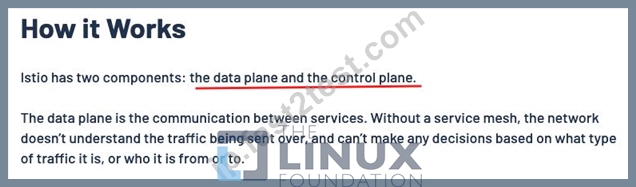
質問 # 29
Which of the following is an example of vertical scaling?
- A. Adding more replica pods to a deployment
- B. Adding more resources (memory and/or cpu) to a kubernetes node
- C. Adding more nodes to kubernetes cluster
- D. Using cluster autoscaler
正解:B
解説:
https://kubernetes.io/docs/tasks/run-application/horizontal-pod-autoscale/
質問 # 30
Which of the following is not the Kubernetes AutoScaling Strategy?
- A. Horizontal Pod Autoscaler
- B. Cluster Autoscaler
- C. Vertical Pod Autoscaler
- D. Load Balancing AutoScaler
正解:D
解説:
https://learnk8s.io/kubernetes-autoscaling-strategies
質問 # 31
Your organization uses multiple cloud providers and wants to ensure that your applications can run seamlessly across different environments. What open standard would be most beneficial for this scenario?
- A. Open Policy Agent (OPA)
- B. CloudEvents
- C. Kubernetes Ingress
- D. open Service Mesh (OSM)
- E. Kubernetes Resource Quotas
正解:B
解説:
CloudEvents is an open standard for eventing, enabling applications to communicate events across different cloud providers and platforms. This helps ensure portability and interoperability, allowing your applications to run consistently across multiple environments without tight coupling to specific cloud services.
質問 # 32
You have a Kubernetes cluster with a HorizontalPodAutoscaler (HPA) configured for your application. The HPA is set to scale the application based on CPU utilization. The application suddenly experiences a surge in traffic, causing high CPU usage. How does the HPA respond to this scenario?
- A. The HPA scales up the application by increasing the resource requests for existing Pods.
- B. The HPA scales up the application only if CPU utilization exceeds a predefined threshold.
- C. The HPA immediately scales up the application by creating new Pods.
- D. The HPA scales up the application after a configurable delay to avoid over-provisioning.
- E. The HPA only scales down the application when CPU utilization drops below a certain threshold.
正解:B
解説:
The HPA typically has a defined threshold (e.g., 80% CPU utilization) and a scaling policy (e.g., add one Pod if CPU exceeds the threshold). The HPA won't immediately scale up upon a traffic surge; it will wait for the CPU utilization to surpass the specified threshold before triggering the scaling action.
質問 # 33
You're running a web application in Kubernetes that experiences occasional spikes in traffic. You want to scale your application horizontally to handle these spikes automatically. What Kubernetes resource should you utilize to achieve this?
- A. Deployment
- B. StatefulSet
- C. Service
- D. HorizontalPodAutoscaler (HPA)
- E. DaemonSet
正解:D
解説:
A HonzontalPodAutoscaler (HPA) is the primary resource in Kubernetes for automatically scaling Pods based on resource utilization (CPU, memory, etc.) or custom metrics. Deployments, StatefulSets, and DaemonSets define the deployment and management of Pods, while Services handle load balancing and access to the application.
質問 # 34
Your organization is migrating a monolithic application to a serverless architecture on Google Cloud Platform. Which Google Cloud service would be the most suitable for running your application's backend logic?
- A. Google Cloud SQL
- B. Google Cloud Functions
- C. Google App Engine
- D. Google Cloud Storage
- E. Google Kubernetes Engine (GKE)
正解:B
解説:
Google Cloud Functions is the ideal choice for running backend logic in a serverless environment on Google Cloud. It offers a fully managed serverless execution environment for event-driven code. App Engine (A) is more suited for web applications. GKE (B) is a container orchestration service. Cloud Storage (D) is for data storage, and Cloud SQL (E) is for relational databases.
質問 # 35
You are setting up a Kubernetes cluster with a large number of pods. You want to optimize the network communication between these pods for high performance and minimal latency. Which Kubernetes networking option would you consider for this scenario?
- A. Weave Net
- B. Canal
- C. Calico
- D. Flannel
- E. kube-proxy
正解:A、C
解説:
Calico and Weave Net are known for their performance and scalability in Kubernetes environments. Calico provides efficient routing and optimized network communication, making it suitable for large-scale deployments. Weave Net is a popular choice for its simplicity scalability, and performance in handling heavy network traffic. While Flannel and Canal are also Kubernetes networking solutions, they may not be as optimized for large-scale deployments as Calico and Weave Net
質問 # 36
In distributed system tracing, is the term used to refer to a request as it passes through a single com-ponent of the distributed system?
- A. Span
- B. Bucket
- C. Trace
- D. Log
正解:A
解説:
https://www.splunk.com/en_us/data-insider/what-is-distributed-tracing.html
質問 # 37
You are running a web application in Kubernetes. The application uses a database that is accessed by multiple Pods. You want to ensure that the database connection details are securely stored and accessed by the Pods. Which Kubernetes feature would you use for this purpose?
- A. PersistentVolumeClaim
- B. ConfigMap
- C. Namespace
- D. Service
- E. Secret
正解:E
解説:
Secrets are Kubernetes resources that allow you to store sensitive information, such as passwords, API keys, and certificates. You can then mount Secrets into Pods, allowing them to securely access the information they need without exposing it in plain text.
質問 # 38
How should folks new to the cloud native ecosystem, go about learning the different aspects of the ecosystem?
- A. by reading the Kubernetes documentation
- B. by looking at the cloud native landscape
- C. by signing up the CNCF slack
- D. by looking at the cloud native trail-map
正解:D
解説:
https://github.com/cncf/landscape#trail-map
質問 # 39
You are developing a microservices application where each service requires a specific configuration. Which Kubernetes feature best addresses this need for service-specific configuration?
- A. Persistent Volumes
- B. Namespaces
- C. ConfigMaps
- D. Secrets
- E. Deployments
正解:C
解説:
ConfigMaps allow you to store key-value pairs of configuration data, which can be easily mounted as environment variables or files within your containers. This is ideal for handling service-specific configurations.
質問 # 40
Consider the following Kubernetes YAML file representing a deployment:
What is the primary benefit of using a GitOps approach to manage this deployment compared to traditional methods?
- A. GitOps provides faster deployment times by eliminating the need for manual interventions.
- B. GitOps enhances security by preventing unauthorized changes to the Kubernetes cluster.
- C. GitOps simplifies the process of managing complex Kubernetes deployments by providing a centralized repository for configuration.
- D. GitOps automates the deployment process, eliminating the need for human intervention.
- E. GitOps enables easy rollbacks to previous deployments by leveraging the versioning capabilities of Git.
正解:E
解説:
GitOps leverages Git's version control system, providing a history of changes to your cluster's configuration. This enables easy rollbacks to previous deployments by simply reverting to a specific commit in the Git repository, making it easier to recover from errors or unwanted changes.
質問 # 41
What is a benefits of Kubernetes federation?
- A. Avoids scalability limits on pods and nodes
- B. Creates highly available clusters in different regions
- C. Low latency
正解:A、B、C
質問 # 42
What are the key differences between a PersistentVolume (PV) and a PersistentVolumeClaim (PVC) in Kubernetes?
- A. PV is a persistent storage resource defined in Kubernetes while PVC is a request for a PV by a pod or application.
- B. PVC is a resource that can be shared by multiple pods, while PV is always associated with a single pod
- C. PV is a request for storage, while PVC represents the actual storage provisioned.
- D. PVC is a resource that can be shared by multiple pods, while PV is always associated with a single pod
- E. PV represents a request for storage, while PVC represents the actual storage provisioned.
正解:A
解説:
PVs are persistent storage resources defined in Kubernetes that can be used to provision storage to pods. PVCs are requests for a PV by a pod or application, specifying the required storage size, access modes, and other attributes. PVs can be shared among multiple pods, but each pod needs a PVC to access the PV.
質問 # 43
What do GitOps tools do in kubernetes?
- A. They manage the source code of kubernetes itself
- B. They allow us to make changes to a kubernetes cluster using a Git repository
- C. They allow us to store software code in Git
- D. They allows us to store container images in repositories
正解:B
解説:
https://fluxcd.io/docs/components/
質問 # 44
Which of the following is an advantage a cloud-native microservices application has over monolithic applications?
- A. Cloud-native microservice applications tend to be easier to troubleshoot.
- B. Cloud-native microservice applications tend to be easier to scale and perform updates on.
- C. Cloud-native microservices applications tend to be faster and more responsive than monolithic applications.
正解:B
解説:
Cloud-native applications tend to be microservice base, they have individual services that can be independently scaled, updated and rolled back. This makes scaling and update operations simpler and less risky.
質問 # 45
You have a Kubernetes cluster with a custom network plugin that provides advanced networking capabilities. What needs to be considered when configuring this custom network plugin?
- A. Ensure that the custom plugin adheres to the Kubernetes CNI (Container Network Interface) specification.
- B. Configure the plugin to support Kubernetes service discovery and load balancing.
- C. Test the plugin thoroughly with your applications to ensure compatibility and performance.
- D. Deploy the plugin as a DaemonSet on each Kubernetes node.
- E. Integrate the plugin with the Kubernetes API server to manage network resources.
正解:A、B、C、D、E
解説:
All of the options are important considerations when configuring a custom network plugin in Kubernetes- - A Adherence to the CNI specification ensures interoperability with Kubernetes and other CNI plugins- - B: Support for service discovery and load balancing is crucial for seamless integration with Kubernetes services. - C: Integration with the Kubernetes API server allows the plugin to be managed and controlled by Kubernetes- - D Deploying the plugin as a DaemonSet ensures its availability and consistent behavior across all nodes. - E Thorough testing is essential to guarantee compatibility with your applications and the desired performance characteristics.
質問 # 46
What do you call the pattern where you add a second container to the pod to collect logs infor-mation?
- A. Cluster level logging
- B. Sidecar container logging
- C. Node level logging
- D. Application level logging
正解:B
解説:
https://kubernetes.io/docs/concepts/cluster-administration/logging/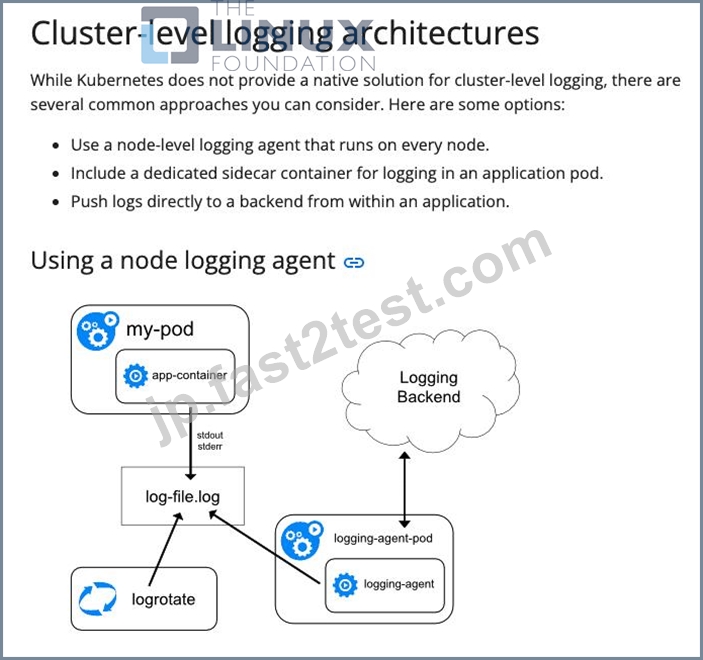
質問 # 47
You are using a Kubernetes deployment to run a web application. You want to roll out a new version of the application with minimal downtime. Which strategy can be used to achieve this?
- A. BlueGreen
- B. RollingUpdate
- C. Canary
- D. Immutable
- E. Recreate
正解:A、B、C
解説:
RollingUpdate, BlueGreen, and Canary are all strategies that can be used to roll out new application versions with minimal downtime. RollingUpdate updates Pods one by one, ensuring that there are always healthy Pods running. BlueGreen creates two separate environments, one for the old version and one for the new version, and then switches traffic over to the new environment. Canary gradually rolls out the new version to a small subset of users before making it available to everyone. Option 'A' (Recreate) would completely stop the old Pods before creating new ones, which could lead to downtime. Option 'E' (Immutable) is not a deployment strategy for rolling out updates.
質問 # 48
Which component of the Kubernetes architecture is responsible for scheduling Pods to nodes and ensuring that they are running as intended?
- A. etcd
- B. kube-apiserver
- C. kube-controller-manager
- D. kube-scheduler
- E. kubelet
正解:D
解説:
The kube-scheduler is the component responsible for scheduling Pods to nodes. It takes into account resource availability node affinity, and other factors to ensure optimal resource utilization and application performance.
質問 # 49
What is the purpose of the "securityContext" field in a pod specification? Choose all that apply.
- A. To specify the network namespace that the pod should be created in.
- B. To control access to the Kubernetes API server.
- C. To define the user ID and group ID for the containers within the pod.
- D. To define the security context of the pods, such as SELinux and AppArmor.
- E. To configure the resource limits for the containers within the pod.
正解:C、D
解説:
The "securityContext" field in a pod specification is used to define the security context of the containers within the pod. This includes settings related to user ID and group ID, SELinux and AppArmor profiles, and other security-related options. It does not control access to the Kubernetes API server, configure resource limits, or specify the network namespace.
質問 # 50
Which control plane component is responsible for scheduling pods?
- A. kube scheduler
- B. kube api-server
- C. kubelet
- D. kube-proxy
正解:A
解説:
https://kubernetes.io/docs/concepts/overview/components/
質問 # 51
......
試験問題解答ブレーン問題集でKCNA試験問題集PDF問題:https://jp.fast2test.com/KCNA-premium-file.html
KCNA試験問題集、KCNA練習テスト問題:https://drive.google.com/open?id=1wb_yE-FPuF0qQum2Vik0onIcL8Y4uWhc