

2026年最新の実際のFast2test Workday-Pro-Time-Tracking問題集PDFで100%合格率を保証します
無料Workday Workday-Pro-Time-Tracking試験問題と解答
Workday Workday-Pro-Time-Tracking 認定試験の出題範囲:
| トピック | 出題範囲 |
|---|---|
| トピック 1 |
|
| トピック 2 |
|
| トピック 3 |
|
| トピック 4 |
|
| トピック 5 |
|
質問 # 20
What report should you use to check if a worker is eligible for more than one time entry template at a given time?
- A. All Time Entry Templates
- B. View Worker's Time Eligibility
- C. All Time Approval Templates
- D. Audit - Workers with Multiple Time Entry Templates
正解:D
解説:
The correct answer is C. Audit - Workers with Multiple Time Entry Templates .
In Workday Time Tracking, a worker should normally be eligible for only one active time entry template at a time. The time entry template controls how the worker records time, such as hours versus in/out entry, required fields, worktags, and related entry behavior. If a worker becomes eligible for more than one template simultaneously, it can create inconsistent time entry behavior and configuration conflicts. To detect this kind of setup issue, Workday provides a dedicated audit report: Audit - Workers with Multiple Time Entry Templates .
This report is specifically designed to identify workers whose eligibility rules cause overlap across templates.
That makes it the best tool for administrators who are validating setup and trying to prevent template assignment conflicts before they affect time entry.
Option A , All Time Entry Templates , lists templates but does not specifically identify workers with overlapping eligibility. Option B , All Time Approval Templates , relates to approval routing, not time entry template eligibility. Option D , View Worker's Time Eligibility , can help review an individual worker's eligibility setup, but it is not the primary audit report used to systematically find workers with multiple time entry templates at the same time.
So the most accurate and purpose-built report is C .
質問 # 21
You have configured a Time Calculation Tag to tag all hours worked on the seventh consecutive day.
Where will these hours display in the Worker's Time Entry Calendar?
- A. On the Calculated tab in the Time Block in the Worker's Time Entry Calendar on the day the hours were worked.
- B. On the top line of the Time Block in the Worker's Time Entry Calendar on the day the hours were worked.
- C. On the day's shift in the Worker's Work Schedule Calendar.
- D. In the Calculation Group Snapshots for the worker on the View Worker's Time Eligibility report.
正解:A
解説:
The correct answer is B. On the Calculated tab in the Time Block in the Worker's Time Entry Calendar on the day the hours were worked .
In Workday Time Tracking, a Time Calculation Tag is part of the calculation framework used to identify or classify time after Workday evaluates the entered hours through configured calculation logic. When a rule tags hours worked on the seventh consecutive day , that result is not treated as the original entered time itself. Instead, it is displayed as a calculated result tied to the time block for the relevant date.
That is why these tagged hours appear on the Calculated tab of the worker's time block. The entered line remains the source time entry, while the calculated section shows the results produced by Workday's time calculations, such as tagged hours, overtime, premiums, or other rule-based outcomes.
Option D is incorrect because the top line of the time block is generally where the worker's entered time appears, not the detailed calculation-tag output. Option A is incorrect because the Work Schedule Calendar reflects planned schedule information, not calculated time-tag results. Option C is incorrect because View Worker's Time Eligibility is used to review assigned time tracking components, not to display daily calculated tagged hours.
So the correct display location is the Calculated tab in the time block.
質問 # 22
What report do you run to ensure that a period schedule is assigned to a worker?
- A. Audit - Workers with Multiple Time Period Schedules
- B. View Worker's Time Eligibility
- C. View Period Schedule
- D. Time Entry Period Schedule Review
正解:B
解説:
The correct answer is D. View Worker's Time Eligibility .
In Workday Time Tracking, when you want to confirm whether a specific worker has been assigned a period schedule , the most direct report is View Worker's Time Eligibility . This report is used to review which Time Tracking components a worker is currently eligible for and receiving, including items such as time entry templates, approval templates, and period schedules . Since the question is focused on verifying assignment to a worker , this worker-level eligibility view is the most appropriate choice.
The other options do not fit the requirement as well. Audit - Workers with Multiple Time Period Schedules is an exception report used to identify workers who have more than one schedule, not to simply confirm that a worker has one assigned. View Period Schedule lets you inspect the schedule definition itself, but it is not the best worker-specific confirmation tool. Time Entry Period Schedule Review may sound related, but it is not the standard report used to validate a worker's eligibility-based assignment in the same direct way.
So, if your goal is to ensure that a particular worker is assigned the correct period schedule, the correct report is View Worker's Time Eligibility .
質問 # 23
Where can you configure daily and weekly totals for a worker's time entry calendar?
- A. Time entry code
- B. Time calculation
- C. Time entry template
- D. Time calculation tag
正解:B
解説:
The correct answer is B. Time calculation . In Workday Time Tracking, daily and weekly totals on a worker's time entry calendar are driven through the Time Calculation framework. Time calculations are used to evaluate entered time and produce results such as totals, overtime, premiums, exceptions, and other rule- based outcomes. When Workday needs to total time across a day or across a week, that logic is configured in a time calculation because calculations define how time is interpreted, accumulated, and processed.
The other options do not control this type of totaling behavior. A time calculation tag is mainly used to organize or identify calculations, not to perform the actual totaling logic. A time entry code identifies the type of time being entered, such as regular hours, training, or on-call time, but it does not define calendar total behavior. A time entry template helps control the layout or default structure for time entry, but it is not where daily or weekly total rules are configured.
So, if the question asks specifically where Workday configures the totals shown for a worker's calendar, the best and correct choice is Time calculation .
質問 # 24
Refer to the following scenario to answer the question below.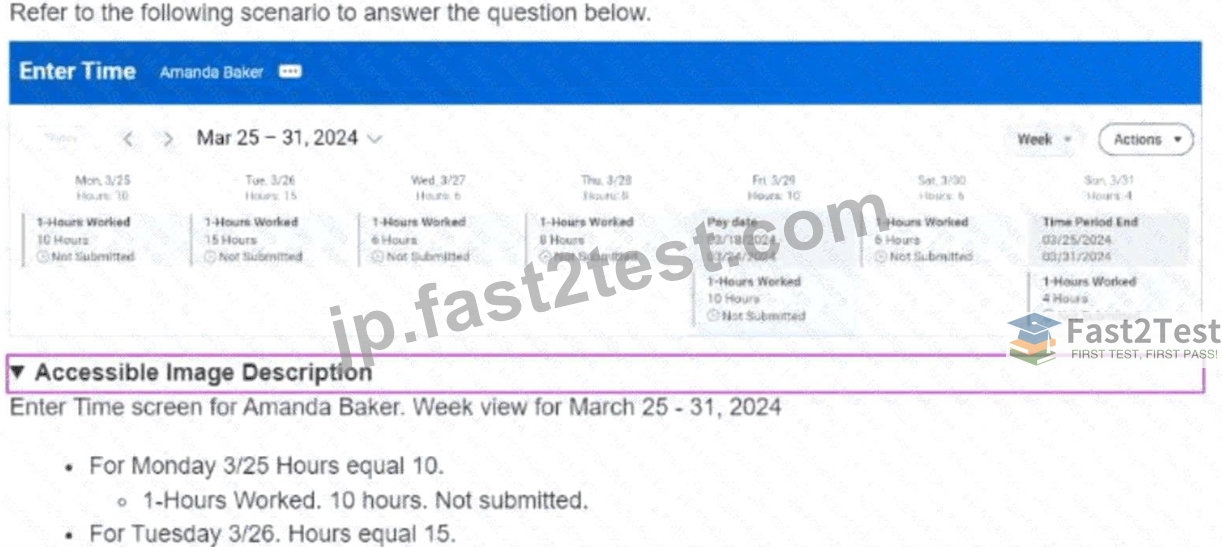
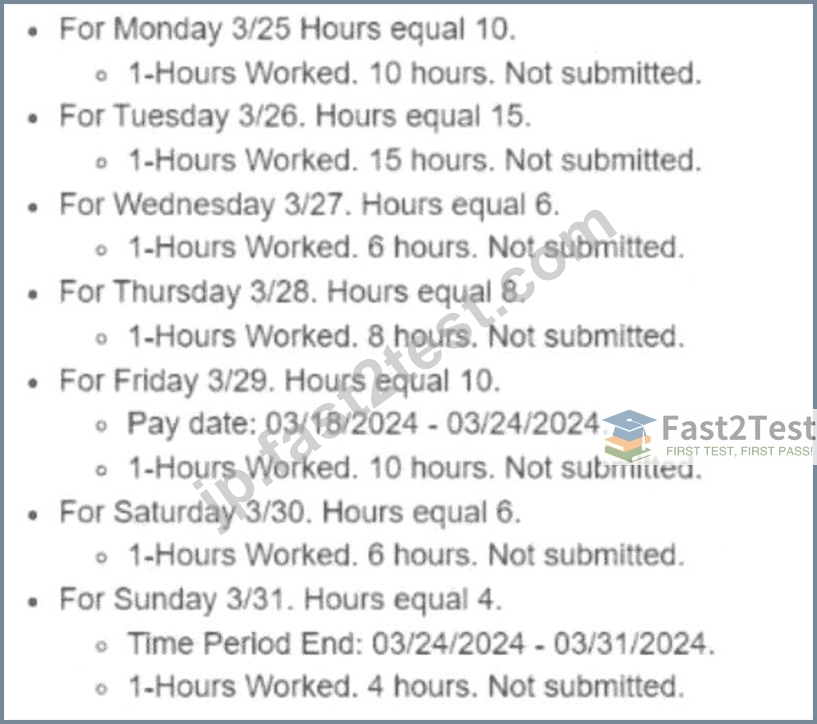
Amanda Baker is eligible for the following calculations: Daily OT > 8 regular hours in a day, Daily double time > 12 regular hours in a day, Weekly OT > 40 regular hours in a week.
How many time calculation tags are assigned on the calculated tab for Tuesday?
- A. 0
- B. 1
- C. 2
- D. 3
正解:D
解説:
The correct answer is C. 3 . On Tuesday , Amanda Baker reported 15 hours . Based on the rules provided, Workday Time Tracking would evaluate those 15 hours against the applicable daily and weekly thresholds.
The first 8 hours remain regular hours . Since she worked more than 8 hours in the day, the next block of hours qualifies for daily overtime . Because she also exceeded 12 hours in the same day , the hours above
12 qualify for daily double time .
That means Tuesday's calculated results would typically be split into three calculation tag categories: Regular
, Daily Overtime , and Daily Double Time . This produces a total of 3 time calculation tags on the calculated tab for that day.
The weekly overtime rule does not add a fourth tag for Tuesday. Weekly overtime applies only after total regular hours for the week exceed 40 . By the end of Tuesday, Amanda has worked 10 hours on Monday +
15 hours on Tuesday = 25 total hours , which is still below the weekly 40-hour threshold. Therefore, weekly overtime has not yet been triggered on Tuesday.
So the correct count of calculation tags assigned for Tuesday is 3 .
質問 # 25
What security group assignment does Workday use to run the Mass Operations Management (MOM) function?
- A. Manager
- B. Payroll Partner
- C. Time Tracking Administrator
- D. Business Process Administrator
正解:C
解説:
The correct answer is D. Time Tracking Administrator .
In Workday Time Tracking, the Mass Operations Management (MOM) function is used for administrative actions that affect time tracking data in bulk. Because this is a specialized time administration capability, Workday assigns access to this function through the Time Tracking Administrator security role. This role is intended for users who manage time tracking setup, monitor processing, perform corrections, and run administrative operations across groups of workers or time periods.
Mass operations can have broad impact, so Workday restricts them to a role specifically aligned with time administration responsibilities. That is why the MOM function is not typically assigned to more general roles such as Manager or Payroll Partner . Managers are focused on supervising workers and approving time, while Payroll Partners are responsible for payroll-related processes rather than direct time administration tools. Business Process Administrator handles business process maintenance and oversight, but MOM in this context is tied specifically to Time Tracking administration.
Since the question asks which security group assignment Workday uses to run MOM in the Time Tracking area, the most accurate answer is Time Tracking Administrator . This role provides the correct level of access and responsibility for performing large-scale time tracking administrative operations safely and appropriately.
質問 # 26
A worker's Work Schedule Calendar has a Day Breaker of 2:00 AM (current day from previous day). They report regular hours from 8:00 PM, April 05 to 4:00 AM, April 06.
How will the calculated hours show on the time block?
- A. Six regular hours on April 05 and two regular hours on April 06.
- B. Two regular hours on April 05 and six regular hours on April 06.
- C. Four regular hours on April 05 and four regular hours on April 06.
- D. Eight regular hours on April 05 and no regular hours on April 06.
正解:A
解説:
The correct answer is D. Six regular hours on April 05 and two regular hours on April 06 .
In Workday Time Tracking, a Day Breaker determines when one workday ends and the next workday begins for time calculation purposes. When the Day Breaker is set to 2:00 AM , any time worked before 2:00 AM is treated as belonging to the previous day , and any time worked at or after 2:00 AM belongs to the current day .
In this example, the worker enters time from 8:00 PM on April 05 to 4:00 AM on April 06 , which equals 8 total hours . These hours split as follows:
* 8:00 PM to 12:00 AM = 4 hours on April 05
* 12:00 AM to 2:00 AM = 2 hours, but because of the 2:00 AM Day Breaker, these hours still belong to April 05
* 2:00 AM to 4:00 AM = 2 hours that belong to April 06
That produces:
* 6 regular hours on April 05
* 2 regular hours on April 06
The key concept is that Workday does not simply split time at midnight when a Day Breaker is defined.
Instead, it uses the configured Day Breaker to assign hours to the proper workday for scheduling, calculations, and reporting.
質問 # 27
Refer to the following scenario to answer the question below.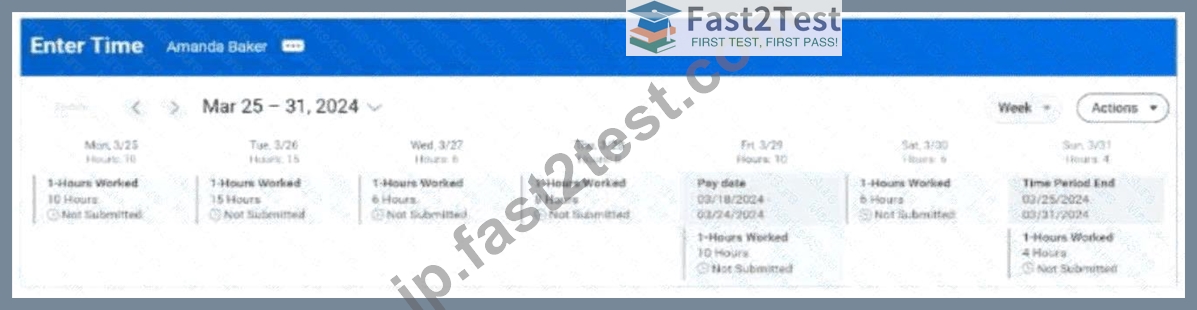
Amanda Baker is eligible for the following calculations: Daily OT > 8 regular hours in a day, Daily double time > 12 regular hours in a day, Weekly OT > 40 regular hours in a week.
What are the calculated hours for Friday?
- A. 10 Weekly OT
- B. 10 Regular
- C. 8 Regular and 2 Daily OT
- D. 2 Daily OT and 8 Weekly OT
正解:C
解説:
The correct answer is C. 8 Regular and 2 Daily OT . In Workday Time Tracking, daily calculations are evaluated based on the hours entered for that specific day, while weekly overtime is applied only after total eligible regular hours for the week exceed the weekly threshold.
Let us total Amanda's regular hours before Friday. On Monday , she worked 10 hours, which results in 8 Regular + 2 Daily OT . On Tuesday , she worked 15 hours, which results in 8 Regular + 4 Daily OT + 3 Daily Double Time . On Wednesday , she worked 6 Regular hours. On Thursday , she worked 8 Regular hours. That gives her a total of 30 regular hours through Thursday.
On Friday , Amanda worked 10 hours . Applying the daily overtime rule, the first 8 hours are regular and the remaining 2 hours become Daily OT . At that point, her total regular hours for the week become 38 (30 +
8), which is still below the weekly overtime threshold of 40 . Because weekly overtime has not yet been reached on Friday, none of Friday's hours convert to Weekly OT.
Therefore, Friday's calculated hours are 8 Regular and 2 Daily OT .
質問 # 28
Which report should you run to ensure a worker only has one period schedule?
- A. Audit - Workers with Multiple Time Period Schedules
- B. View Period Schedule
- C. View Work Schedule Calendar
- D. View Worker's Time Eligibility
正解:A
解説:
The correct answer is D. Audit - Workers with Multiple Time Period Schedules .
In Workday Time Tracking, a worker should generally have only one active time period schedule so that time entry, approvals, period close, and downstream payroll processing function correctly. When a worker is assigned to more than one time period schedule, it can create confusion around which period controls their time entry deadlines, submission windows, and approval timing. Because this is a setup and data integrity issue, Workday provides a specific audit report to identify workers who have this problem.
The report Audit - Workers with Multiple Time Period Schedules is designed exactly for this purpose. It helps administrators quickly find workers with conflicting schedule assignments so corrective action can be taken. This makes it the best report to run when validating time tracking configuration and ensuring clean administrative setup.
The other options are not intended for this audit purpose. View Work Schedule Calendar shows schedule- related calendar details, not duplicate period schedule assignments. View Period Schedule displays the schedule itself, but not necessarily workers with multiple assignments. View Worker's Time Eligibility is used to review time tracking eligibility rules and related setup, not to detect duplicate period schedules.
質問 # 29
You need to count all hours in a week of system-generated time blocks for breaks.
What business object will you use?
- A. Time Block
- B. Time Week
- C. Time Day
- D. Worker
正解:B
解説:
The correct answer is B. Time Week .
In Workday Time Tracking, the business object you choose depends on the level at which the calculation needs to evaluate time . Since the requirement is to count all hours in a week for system-generated break time blocks, the calculation must operate at the weekly level , which makes Time Week the appropriate business object. Time Week is used when Workday needs to total, compare, or evaluate hours across an entire workweek rather than looking at only one block or one day at a time.
This is especially important for time calculations involving accumulated weekly values, such as total break hours, weekly overtime thresholds, or weekly premium eligibility. Because the requirement explicitly says all hours in a week , Workday must evaluate the data in a weekly context, not as isolated entries.
The other options are not correct for this scenario. Time Block is too granular because it evaluates individual entries or blocks of time rather than the total for the week. Time Day would only support daily accumulation, not a full weekly count. Worker is too broad and is typically used for eligibility or worker-level attributes rather than time aggregation logic.
So, for counting break-related system-generated time block hours across a full week, the correct business object is Time Week
質問 # 30
Refer to the following scenario to answer the question below.
You have received a requirement to create a set of Time Tracking Components for workers who have the following attributes:
* Time Type = Salary
* Country = United States
* Supervisory Organization = Facilities Group
A worker that you are testing is already assigned to a template. During testing, this worker, who meets all of the newly defined criteria, is not assigned to the new Time Entry Template.
How do you troubleshoot this issue?
- A. Run the All Time Entry Templates report to confirm that there are overlapping assignments.
- B. Run the View Worker Time Eligibility by Organization to confirm that there are overlapping assignments.
- C. Run the Audit - Workers with Multiple Time Entry Templates report to confirm that there are overlapping assignments.
- D. Run the Audit - Workers with Multiple Work Schedule Calendars to confirm that there are overlapping assignments.
正解:C
解説:
The correct answer is C. Run the Audit - Workers with Multiple Time Entry Templates report to confirm that there are overlapping assignments .
In Workday Time Tracking, a worker should generally be eligible for only one active time entry template at a time . If a worker already has an existing template assignment and also meets the criteria for a newly created template, the most common issue is overlapping eligibility between templates. When this happens, Workday administrators need an audit tool that specifically identifies workers who match more than one template at the same time.
The Audit - Workers with Multiple Time Entry Templates report is built for exactly this troubleshooting scenario. It helps confirm whether the worker is being picked up by multiple eligibility rules and whether an overlap is preventing the expected result or creating assignment ambiguity. This makes it the most accurate report to run when validating time entry template setup.
Option A only lists templates and does not directly expose worker-level overlap issues. Option B focuses on work schedule calendars , which is a different setup area and not related to time entry template conflicts.
Option D may provide useful eligibility information, but it is not the primary audit report used to detect overlapping template assignments.
Therefore, the best troubleshooting step is C .
質問 # 31
Refer to the following scenario to answer the question below.
You are reviewing time for a worker in California. The worker has reported hours for the seventh consecutive day and the hours are calculating as configured. This week the worker reported 11 hours on the seventh consecutive day worked. This worker is eligible for double time on all hours worked over 8 on the seventh consecutive day; however, all 11 hours are tagged as seventh consecutive day hours.
While reviewing the Seventh Consecutive Day Double Time calculation, you notice there are two time calculation tags sharing the same row in the grid.
What does this signify?
- A. An AND condition is applied to the time calculation tags. Only hours that contain both calculation tags will be counted towards the 8 hour threshold.
- B. If the SUM of hours worked with either of the two time calculation tags equals or exceeds the number of hours in the criteria, then the time calculation will be triggered.
- C. If the SUM of hours worked with either of the two time calculation tags equals but does not exceed the number of hours in the criteria, then the time calculation will be triggered.
- D. An OR condition is applied to the time calculation tags. Hours that contain either of the calculation tags will be counted towards the 8 hour threshold.
正解:D
解説:
The correct answer is B. An OR condition is applied to the time calculation tags. Hours that contain either of the calculation tags will be counted towards the 8 hour threshold.
In Workday Time Tracking, when multiple time calculation tags appear on the same row in the tag grid, Workday interprets them with OR logic . That means time containing either of those tags is eligible to be included in the evaluation. By contrast, tags placed on separate rows are generally used to build more restrictive logic combinations.
In this scenario, the worker reported 11 hours on the seventh consecutive day , and the business rule should apply double time only to hours over 8 . If two tags are sharing the same row, Workday is counting hours with either tag toward the threshold. That setup can broaden the hours being evaluated and explains why all
11 hours may continue to be included under the seventh-consecutive-day logic rather than splitting correctly after 8 hours.
Option A is incorrect because same-row tags do not represent AND logic. Options C and D describe threshold behavior but do not answer the actual meaning of tags sharing the same row. The key configuration takeaway is that same row = OR condition in the calculation tag grid.
Therefore, the correct answer is B .
質問 # 32
You have configured a Time Calculation that tags all hours reported on either Saturday or Sunday as Weekend Premium hours. A second time calculation tags all hours worked over 8 hours on Saturday or Sunday as double time.
What task do you use to verify that these two time calculations are prioritized correctly?
- A. Maintain Time Accumulator Threshold Rule Priorities
- B. Maintain Time Calculation Priorities
- C. Maintain Time Calculation Tags
- D. View Time Calculation Group
正解:B
解説:
The correct answer is D. Maintain Time Calculation Priorities .
In Workday Time Tracking, when multiple time calculations interact with each other, the order of execution is extremely important. In this example, one calculation tags all Saturday and Sunday hours as Weekend Premium , while another tags hours over 8 on those same days as double time . Since both calculations may evaluate the same time, you must confirm that they run in the correct sequence so the desired tags are applied properly and downstream results are accurate.
The task used specifically to review and manage the execution order of time calculations is Maintain Time Calculation Priorities . This is where Workday administrators verify whether one calculation runs before or after another based on its configured priority value. If the priorities are incorrect, calculations may not tag or replace hours as expected.
The other options are not the correct tool for this purpose. View Time Calculation Group helps review grouped calculations, but not the priority maintenance itself. Maintain Time Calculation Tags is used for tag configuration, not sequencing. Maintain Time Accumulator Threshold Rule Priorities applies to threshold rule priorities, which is a different configuration area and not the general task for validating calculation order between standard time calculations.
Therefore, the correct task is Maintain Time Calculation Priorities .
質問 # 33
Refer to the following scenario to answer the question below.
You have received a requirement to create a set of Time Tracking Components for workers who have the following attributes:
* Time Type = Salary
* Country = United States
* Supervisory Organization = Facilities Group
You want to create a single Time Tracking Eligibility Rule for all new configuration components.
What business object must you use when selecting fields for the conditions?
- A. Compensation
- B. Organization
- C. Worker
- D. Position
正解:C
解説:
The correct answer is D. Worker .
In Workday Time Tracking, Time Tracking Eligibility Rules are built by selecting a business object and then defining condition rules based on fields available from that object and its related fields. In this scenario, the eligibility criteria include attributes such as Time Type , Country , and Supervisory Organization . These are evaluated in the context of the worker record , because the rule is determining which workers should receive the new Time Tracking components.
The Worker business object is the correct choice because it serves as the central object for worker-specific eligibility evaluation and allows access to related worker attributes, including employment and organizational data. This makes it possible to create one rule that consistently evaluates all three conditions together for a worker population.
The other options are too narrow. Compensation focuses on pay-related data, Position centers on the job position, and Organization focuses on organizational structures. Although some of the required values may relate to those areas, the eligibility rule itself must evaluate them from the perspective of the worker who is being assigned the Time Tracking setup.
That is why the appropriate business object for this rule is Worker .
質問 # 34
Refer to the following scenario to answer the question below.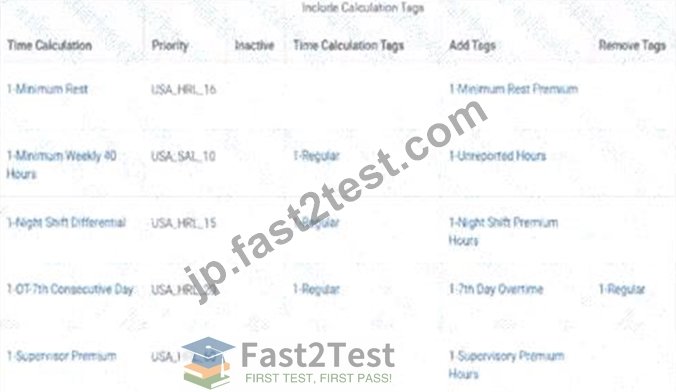
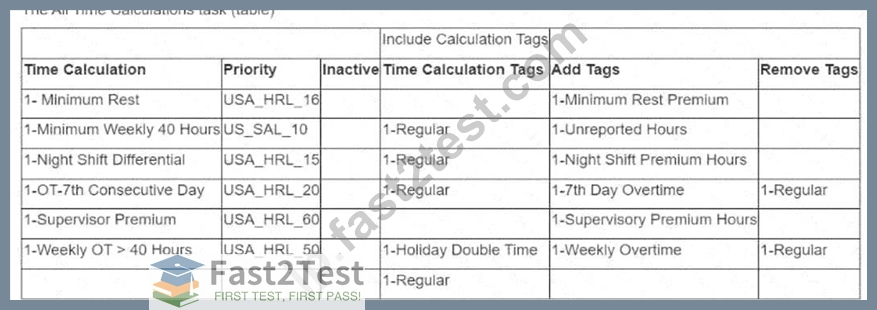
The All Time Calculations task shows the following calculations and priorities: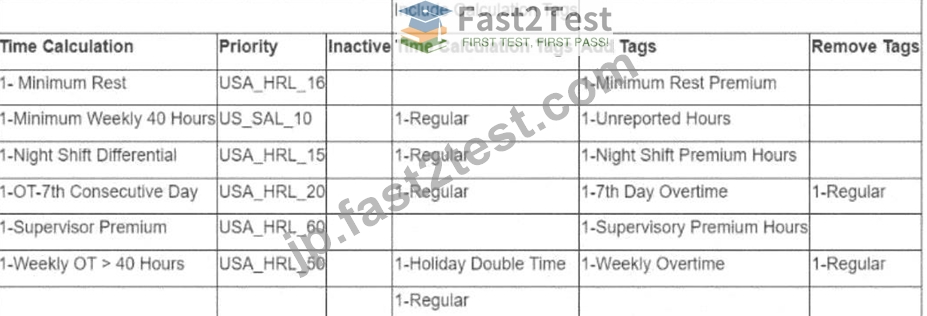
What is the appropriate priority for the time calculation that creates the 1-Holiday Double Time tag for hourly workers?
- A. USA_HRL_40
- B. USA_HRL_55
- C. USA_SAL_10
- D. USA_HRL_45
正解:A
解説:
The correct answer is B. USA_HRL_40 .
In Workday Time Tracking, time calculation priorities control the sequence in which calculations run . Lower priority numbers run first, and higher numbers run later. The calculation Weekly OT > 40 Hours has priority USA_HRL_50 and explicitly includes the tag "1-Holiday Double Time." This means the system expects the Holiday Double Time tag to already exist before the Weekly OT calculation executes .
Therefore, the calculation that generates the 1-Holiday Double Time tag must run before priority 50 so that the Weekly OT calculation can recognize those tagged hours when it evaluates overtime eligibility.
Looking at the options:
* USA_SAL_10 is used for salaried logic and not appropriate for hourly worker calculations.
* USA_HRL_55 would run after Weekly OT > 40 Hours, which is incorrect.
* USA_HRL_45 would run before 50, but the standard Workday configuration typically places holiday or premium tagging calculations earlier in the sequence so downstream overtime rules can reference them consistently.
Thus USA_HRL_40 is the most appropriate priority because it executes before Weekly OT > 40 Hours (USA_HRL_50) while still allowing earlier calculations such as Night Shift or other hourly rules to run first if needed.
This ensures that Holiday Double Time hours are correctly tagged before weekly overtime calculations evaluate total hours and remove or replace the Regular tag where necessary.
質問 # 35
Refer to the following scenario to answer the question below.
You are reviewing time for a worker in California. The worker has reported hours for the seventh consecutive day and the hours are calculating as configured. This week the worker reported 11 hours on the seventh consecutive day worked. This worker is eligible for double-time on all hours worked over 8 on the seventh consecutive day; however, all 11 hours are tagged as seventh consecutive day hours.
You have created and assigned the Seventh Consecutive Day Double Time time calculation to a time calculation group.
Where on the Seventh Consecutive Day Double Time calculation do you find the hours that count toward seventh consecutive day double time?
- A. Remove Tags field
- B. Time Calculation Group grid
- C. Add Tags field
- D. Include Calculation Tags grid
正解:D
解説:
The correct answer is A. Include Calculation Tags grid .
In Workday Time Tracking, the Include Calculation Tags section determines which hours are evaluated by a specific time calculation. For a rule such as Seventh Consecutive Day Double Time , Workday looks at the hours that already carry certain calculation tags and uses those tagged hours to determine whether the threshold for double time has been reached. In other words, the hours that count toward the seventh consecutive day double-time rule are identified in the Include Calculation Tags grid .
This is different from the Add Tags field, which defines the result of the calculation by specifying the tag that will be added after the criteria are met. The Remove Tags field controls which tags should be removed once the calculation applies. The Time Calculation Group grid is not where the hours are identified; it simply groups related calculations for worker eligibility and execution.
In this scenario, if all 11 hours remain tagged as seventh consecutive day hours instead of splitting after 8 hours, reviewing the Include Calculation Tags grid is essential because it shows exactly which tagged hours Workday is counting toward the threshold. That is the configuration area that determines the hours considered for the seventh consecutive day double-time calculation.
Therefore, the correct answer is A .
質問 # 36
US full-time workers earn overtime for over 40 hours reported in a week. California full-time workers have daily overtime requirements for hours greater than 8 and double time greater than 12 hours, as well as overtime and double time for seven consecutive days worked.
A time calculation group is created for US full-time workers and a new time calculation group has been created for California full-time workers.
How do you assign the new calculation group to the California full-time workers?
- A. Create a new time calculation group with only the seventh consecutive day time calculation. Assign it to all California full-time workers.
- B. Assign an eligibility rule to the new time calculation group and make only the California full-time workers eligible.
- C. Assign an eligibility rule to the new time calculation group and make all US full-time workers eligible.
- D. Create a new time calculation group to include California and US overtime calculations and make all US full-time workers eligible.
正解:B
解説:
The correct answer is B. Assign an eligibility rule to the new time calculation group and make only the California full-time workers eligible.
In Workday Time Tracking, Time Calculation Groups are used to bundle multiple time calculations together so that a specific population of workers receives the appropriate rules. Eligibility for these groups is controlled through Time Tracking Eligibility Rules , which determine which workers should receive a particular configuration.
In this scenario, US full-time workers already have a calculation group that handles weekly overtime after 40 hours . California workers, however, have additional legal requirements , including daily overtime after 8 hours, double time after 12 hours, and overtime rules related to consecutive days worked. Because these rules apply only to California workers, they must be placed in a separate time calculation group and assigned only to that population.
The correct approach is to configure an eligibility rule that identifies California full-time workers (for example using worker location, country/state, or supervisory organization attributes) and attach that rule to the new California time calculation group.
The other options are incorrect because they either apply the California rules to all US workers or fail to include the full set of required calculations. Therefore, using a specific eligibility rule for California full- time workers is the correct configuration approach.
質問 # 37
......
検証済みWorkday-Pro-Time-Tracking問題集と解答で最新Workday-Pro-Time-Trackingをダウンロード:https://jp.fast2test.com/Workday-Pro-Time-Tracking-premium-file.html