

2026年最新の実際に出るNetSec-Analyst問題集には試験のコツがあるPDF試験材料
心強いNetSec-AnalystPDF問題集はNetSec-Analyst問題
Palo Alto Networks NetSec-Analyst 認定試験の出題範囲:
| トピック | 出題範囲 |
|---|---|
| トピック 1 |
|
| トピック 2 |
|
| トピック 3 |
|
| トピック 4 |
|
質問 # 139
Which URL Filtering profile action would you set to allow users the option to access a site only if they provide a URL admin password?
- A. authorization
- B. continue
- C. override
- D. authentication
正解:A
解説:
Explanation/Reference:
https://docs.paloaltonetworks.com/pan-os/8-1/pan-os-admin/url-filtering/url-filtering-concepts/url- filteringprofile-actions.html
質問 # 140
A Security Administrator is configuring a Palo Alto Networks firewall to block access to known malicious IP addresses. The threat intelligence feed updates hourly and contains thousands of entries. Which External Dynamic List (EDL) type is most appropriate for this scenario to ensure the firewall efficiently processes and applies the updates?
- A. IP Address (IPv4/lPv6)
- B. Domain
- C. Pre-defined EDL (e.g., Palo Alto Networks' Threat Prevention feeds)
- D. URL
- E. Custom Application
正解:A
解説:
For blocking known malicious IP addresses, an 'IP Address (IPv4/lPv6)' EDL is the most direct and efficient type. While Palo Alto Networks' pre-defined feeds are also IP-based and often used, the question specifically asks for the most appropriate type when the administrator is configuring a feed with thousands of entries, implying a custom or third-party feed. Domain and URL lists are for FQDNs and URLs, respectively, not raw IP addresses. Custom Application is irrelevant here.
質問 # 141
Given the Cyber-Attack Lifecycle diagram, identify the stage in which the attacker can initiate malicious code against a targeted machine.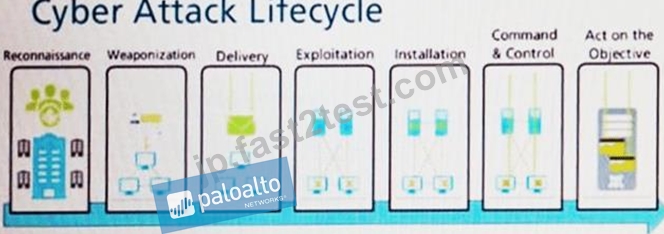
- A. Installation
- B. Exploitation
- C. Act on Objective
- D. Reconnaissance
正解:B
質問 # 142
Given the cyber-attack lifecycle diagram identify the stage in which the attacker can run malicious code against a vulnerability in a targeted machine.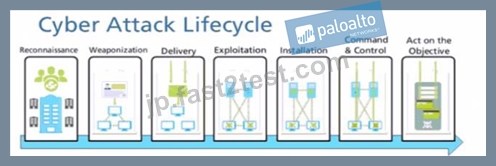
- A. Installation
- B. Exploitation
- C. Reconnaissance
- D. Act on the Objective
正解:B
質問 # 143
A critical application behind a Palo Alto Networks firewall intermittently loses connectivity. Packet captures on the firewall show SYN packets from the client reaching the firewall, but no SYN-ACK is returned. The firewall's session browser shows sessions in a 'DOWN' state for this traffic. The security policy rule permitting this traffic has 'Service: application-default' and 'Application: '. The security logs show 'Permit' actions, but the session never establishes. Which of the following is the MOST PROBABLE cause?
- A. The firewall's TCP session setup timeout is too aggressive for the application's response time.
- B. Asymmetric routing causing the return traffic to bypass the firewall.
- C. A fragmented packet from the client is being dropped due to a max-fragment-size setting, preventing session setup.
- D. A conflicting security policy rule with a more specific match is denying the traffic, but due to session state, initial logs show 'Permit'.
- E. The server hosting the application is not responding to SYN requests due to being overloaded or misconfigured.
正解:B
解説:
This is a classic symptom of asymmetric routing. If the client sends a SYN packet through the firewall, the firewall creates a session table entry. If the server's SYN-ACK (or subsequent return traffic) takes a different path and bypasses the firewall, the firewall will not see the complete three-way handshake for the initial session setup, leading to 'DOWN' sessions and no SYN-ACK being returned through the firewall. Options B, C, D, and E are plausible issues but do not fit the specific combination of 'SYN reaches firewall, no SYN-ACK returned, session DOWN, logs show Permit' as well as asymmetric routing. A server not responding (B) would show 'age-out' or similar in session state, not necessarily 'DOWN' for an unestablished session if the SYN-ACK isn't seen by the firewall. Frag packets (C) would typically be dropped by the firewall with a specific log entry if they were the issue. Timeout (D) would eventually age out the session, but not necessarily prevent the SYN-ACK from being returned through the firewall if it arrived. Conflicting rules (E) would usually show a deny in the logs, not a permit.
質問 # 144
Which profile should be used to obtain a verdict regarding analyzed files?
- A. Advanced threat prevention
- B. Content-ID
- C. WildFire analysis
- D. Vulnerability profile
正解:C
解説:
* A profile is a set of rules or settings that defines how the firewall performs a specific function, such as detecting and preventing threats, filtering URLs, or decrypting traffic1.
* There are different types of profiles that can be applied to different types of traffic or scenarios, such as Antivirus, Anti-Spyware, Vulnerability Protection, URL Filtering, File Blocking, Data Filtering, Decryption, or WildFire Analysis1.
* The WildFire Analysis profile is a profile that enables the firewall to submit unknown files or email links to the cloud-based WildFire service for analysis and verdict determination2. WildFire is the industry's most advanced analysis and prevention engine for highly evasive zero-day exploits and malware3. WildFire uses a variety of malware detection techniques, such as static analysis, dynamic analysis, machine learning, and intelligent run-time memory analysis, to identify and protect against unknown threats34.
* The Vulnerability Protection profile is a profile that protects the network from exploits that target known software vulnerabilities. It allows the administrator to configure the actions and log settings for each vulnerability severity level, such as critical, high, medium, low, or informational5.
* Content-ID is not a profile, but a feature of the firewall that performs multiple functions to identify and control applications, users, content, and threats on the network. Content-ID consists of four components: App-ID, User-ID, Content Inspection, and Threat Prevention.
* Advanced Threat Prevention is not a profile, but a term that refers to the comprehensive approach of Palo Alto Networks to prevent sophisticated and unknown threats. Advanced Threat Prevention includes WildFire, but also other products and services, such as DNS Security, Cortex XDR, Cortex XSOAR, and AutoFocus.
Therefore, the profile that should be used to obtain a verdict regarding analyzed files is the WildFire Analysis profile.
References:
1: Security Profiles - Palo Alto Networks 2: WildFire Analysis Profile - Palo Alto Networks 3: WildFire - Palo Alto Networks 4: Advanced Wildfire as an ICAP Alternative | Palo Alto Networks 5: Vulnerability Protection Profile - Palo Alto Networks : [Content-ID - Palo Alto Networks] : [Advanced Threat Prevention - Palo Alto Networks]
質問 # 145
An organization is migrating its data center to a hybrid cloud model. They use Palo Alto Networks Panorama to manage firewalls both on-premise and in multiple public clouds. A critical requirement is to ensure consistent security posture across all environments while allowing for cloud-specific network configurations (e.g., VPC routing, security groups). They also need to automate the onboarding of new cloud firewalls and configuration of their network interfaces based on cloud metadat a. Which set of Panorama features and external integrations offers the best solution?
- A. Utilize Panorama's API to push entire firewall configurations, including network interfaces, to cloud firewalls after manual deployment. Manage security policies through 'Local Configuration' on each cloud firewall.
- B. Use a single, flat Device Group for all firewalls and manually configure network interfaces and routing on each cloud firewall after deployment. Global policies are then pushed from Panorama.
- C. Employ Template Stacks for network configuration (with common and cloud-specific templates) and Device Groups for security policies. Integrate with cloud orchestration tools (Terraform/CloudFormation) to provision firewalls and use their user-data/bootstrap mechanisms to auto-register firewalls with Panorama, leveraging cloud metadata to apply appropriate templates and variables dynamically.
- D. Export a master configuration from an on-premise firewall and import it into all cloud firewalls. Use Panorama solely for logging and reporting, not for configuration management in the cloud.
- E. Configure 'Shared' security policies on Panorama for all common rules and rely on 'Policy Based Forwarding' for cloud-specific routing. Network interfaces are configured directly on the cloud firewalls via their cloud console.
正解:C
解説:
Option B offers the most comprehensive and automated solution for a hybrid cloud environment: Template Stacks: These are perfect for managing network-specific configurations. You can have a base template (e.g., for logging, management interfaces) and then cloud- specific templates within the stack for AWS, Azure, GCP, or even different VPCs/VNETs. This allows for consistent network configuration practices while accommodating environmental differences. Device Groups: Used for organizing and applying security policies. Common policies can be defined at higher-level device groups and more specific policies at lower-level groups. Cloud Orchestration Tools (Terraform/CloudFormation): These tools are essential for provisioning cloud firewalls. They can embed bootstrap configurations (e.g., user- data scripts) that instruct the firewall to automatically register with Panorama. This streamlines the onboarding process. User-data/Bootstrap & Cloud Metadata: The initial firewall bootstrap can pass cloud metadata (e.g., instance tags for environment, region) to Panorama during registration. Panorama can then use this metadata to dynamically assign the firewall to the correct Template Stack and Device Group, ensuring it receives the right network and security policies automatically. Dynamic Variables: Variables within templates can be populated based on cloud metadata or Panorama's auto-registration rules, allowing for highly dynamic network configurations (e.g., interface IPs, gateway IPs) without hardcoding. This approach ensures centralized management, consistency, and automation across diverse environments. Options A, C, D, and E are either too manual, lack automation, or deviate from Panorama's intended use for centralized management in such complex scenarios.
質問 # 146
An organization is deploying a new custom application that runs over QUIC (Quick UDP Internet Connections) protocol, primarily for performance reasons. The firewall team needs to create a security policy to allow this application while ensuring it adheres to content inspection requirements, including SSL decryption. Currently, the firewall's default settings block unknown UDP traffic. Which configuration steps are necessary for the Palo Alto Networks firewall to successfully identify, decrypt, and apply content-ID to this QUIC application?
- A. QUIC traffic uses a different handshaking mechanism than traditional SSL/TLS over TCP, making direct SSL decryption challenging for the firewall's standard SSL Proxy. The best approach is to use an Application Override for the QUIC traffic to identify it, then apply a specific Content-ID profile that bypasses SSL decryption but focuses on other threat prevention aspects. A Security Policy rule allowing this traffic is also needed.
- B. Upgrade the PAN-OS to the latest version which has native support for QUIC decryption. Then, create a Security Policy rule allowing the 'quic' application and apply an SSL Decryption Profile along with Content-ID profiles. If the application is custom, a Custom App-ID might still be required.
- C. QUIC traffic, by its nature, integrates encryption directly at the transport layer. While a custom App-ID can identify it (if supported by signatures or application override), standard SSL decryption profiles designed for TCP-based SSL/TLS will not function directly on QUIC. A Security Policy rule allowing the custom App-Ld (or the 'quic' App-ID if recognized by the firewall) with appropriate Content-ID profiles (Antivirus, Anti-Spyware, WildFire) is required, but explicit SSL Decryption is generally not applied in the same manner as TCP.
- D. QUIC is UDP-based; therefore, SSL decryption is not applicable. Create a Custom Application for QUIC traffic specifying UDP port. Create a Security Policy rule allowing this custom application. Apply relevant Content-ID profiles without SSL decryption.
- E. Create a Custom Application for QUIC traffic specifying UDP port. Create a Security Policy rule allowing this custom application. Configure an SSL Decryption Policy for this traffic. Apply relevant Content-ID profiles.
正解:C
解説:
Option D correctly identifies the challenge with QUIC. QUIC (HTTP/3) integrates TLS 1.3 directly into the UDP transport layer, making it fundamentally different from how traditional SSL/TLS (over TCP) is decrypted by firewalls. Standard SSL decryption profiles are designed for TCP sessions and will not directly decrypt QUIC. While Palo Alto Networks continues to enhance its App-ID and threat prevention for QUIC, explicit SSL decryption as applied to TCP-based traffic is not typically done in the same manner. The firewall will primarily rely on App-Ld for identification and then apply other Content-ID profiles like Antivirus, Anti-Spyware, and WildFire based on the identified application. Option E implies a direct native decryption feature which, while evolving, isn't the standard approach for custom QUIC apps in the same way as TCP SSL. Options A and C are incorrect in assuming standard SSL decryption or application override for decryption functionality will work directly. Option B is partially correct in stating SSL decryption is not applicable, but then implies standard content-ID would just work without acknowledging the encryption.
質問 # 147
A network security analyst is investigating erratic packet forwarding behavior on a Palo Alto Networks firewall running advanced threat prevention services. Some legitimate traffic flows are experiencing severe latency or being dropped, while others are processed normally. The firewall's data plane CPU utilization is consistently low, and traffic logs show no explicit denies, but session end reasons indicate 'aged-out' or 'session-limit'. A 'debug dataplane packet-diag' output for an affected flow shows the packet reaching the 'flow_lookup' stage but then appears to get stuck or re-evaluated endlessly without being forwarded. Which of the following is the most obscure and difficult to diagnose misconfiguration or state that could cause this behavior?
- A. An excessive number of active sessions, hitting the firewall's session limit per flow or per security zone, causing new legitimate sessions to be dropped.
- B. The firewall's Content-ID engine is stuck in a pattern matching loop due to a malicious or malformed payload, consuming excessive resources for specific flows.
- C. A fragmented packet reassembly issue, where out-of-order or missing fragments are preventing the firewall from correctly identifying the application or threat, leading to session aging/timeout.
- D. A subtle misconfiguration in a 'policy-based fomarding' rule, where an implicit 'any' match condition is inadvertently matching and forwarding traffic to an incorrect or non-existent next-hop, leading to blackholing or routing loops.
- E. A misconfigured custom application signature (App-ID) is causing a continuous re-evaluation loop, preventing the session from establishing or being correctly identified.
正解:E
解説:
The key here is 'packet reaching the 'flow_lookup' stage but then appears to get stuck or re-evaluated endlessly without being forwarded.' This symptom, combined with 'aged-out' or 'session-limit' without explicit denies and low data plane CPU, strongly points to an issue with how the firewall is classifying the session at the very early stages. A misconfigured custom App-ID signature (A) can create a scenario where the firewall keeps re-evaluating the flow against a complex or faulty pattern, never successfully classifying it. This prevents the session from moving past the initial lookup phase, leading to timeouts Caged-out') or hitting internal session limits if multiple re-evaluations create new ephemeral internal 'sessions'. Options B, C, D are common but usually have different diagnostic indicators (high resource usage, explicit drops, or different session end reasons). Option E would typically manifest as routing issues or blackholing but wouldn't typically cause the 'stuck at flow_lookup' symptom unless it somehow triggered a continuous re-evaluation of the flow table. A faulty custom App-ID is notoriously difficult to debug as it resides deep within the packet processing pipeline.
質問 # 148
Match the Cyber-Attack Lifecycle stage to its correct description.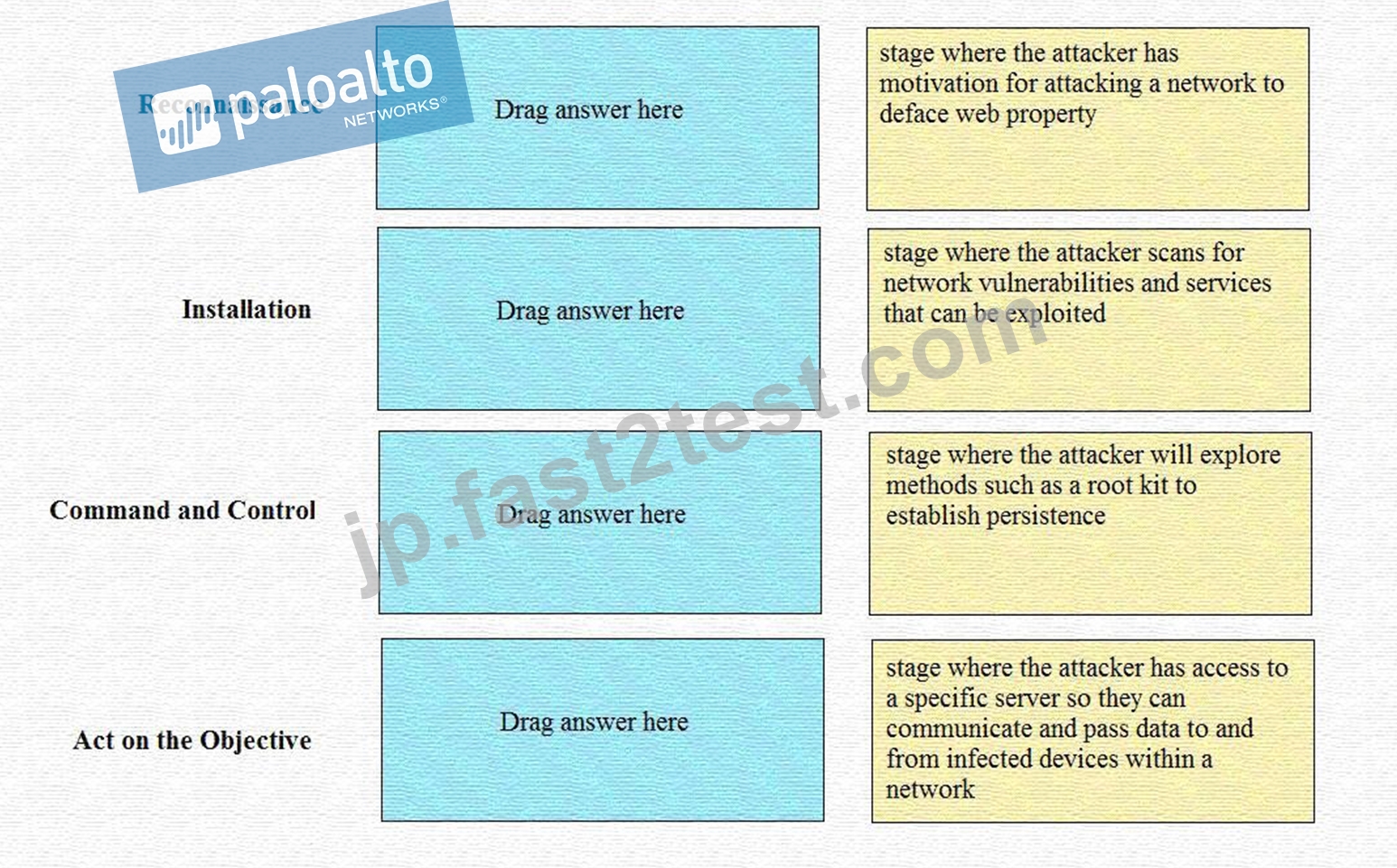
正解:
解説: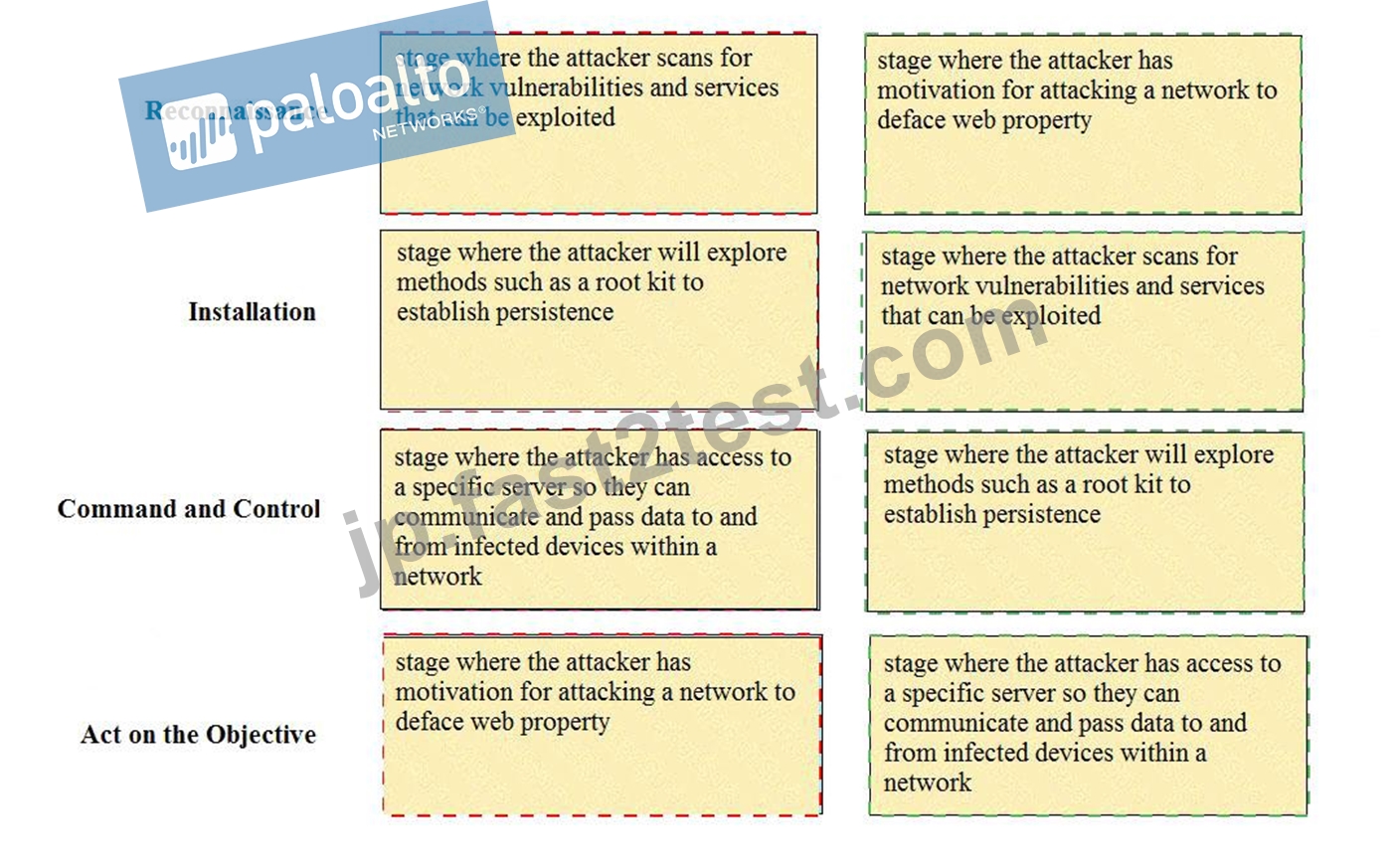
Explanation:
Reconnaissance - stage where the attacker scans for network vulnerabilities and services that can be exploited.
Installation - stage where the attacker will explore methods such as a root kit to establish persistence Command and Control - stage where the attacker has access to a specific server so they can communicate and pass data to and from infected devices within a network.
Act on the Objective - stage where an attacker has motivation for attacking a network to deface web property
質問 # 149
What is the purpose of the automated commit recovery feature?
- A. It reverts the firewall configuration if the firewall recognizes a loss of connectivity to Panorama after the change.
- B. It causes HA synchronization to occur automatically between the HA peers after a push from Panorama.
- C. It generates a config log after the Panorama configuration successfully reverts to the last running configuration.
- D. It reverts the Panorama configuration.
正解:A
質問 # 150
An organization relies heavily on an internal application that utilizes mutual TLS (mTLS) for secure communication between various microservices. The security team wants to gain visibility into this internal mTLS traffic using a Palo Alto Networks firewall. Implementing standard SSL Inbound Inspection has failed, as it breaks the mTLS handshake. What is the most granular and effective approach to inspect this traffic while preserving the integrity of the mTLS connection, or if preservation is impossible, what is the best alternative for visibility?
- A. For true mTLS decryption, packet capture and offline analysis are often required, as inline decryption by a firewall breaks the mutual authentication. The firewall should be configured for 'No Decryption' for this specific traffic, and alternative logging (e.g., application logs, NetFlow) used for metadata.
- B. Utilize 'SSL Decryption Excluding Server Certificates' by importing only the server certificates (not private keys) of the microservices into a decryption profile, allowing inspection up to the certificate exchange phase.
- C. Apply a 'No Decryption' policy for the mTLS traffic and rely on endpoint security for visibility.
- D. Configure SSL Forward Proxy decryption with the firewall's root CA distributed to all microservices.
- E. Implement SSL Inbound Inspection, but manually import both server and client certificates and private keys for all communicating microservices onto the firewall for re-signing.
正解:A
解説:
This is a very tough scenario because mTLS fundamentally relies on both client and server authenticating each other's certificates. An inline device like a firewall, acting as a man-in-the-middle for decryption, will inevitably break the client's ability to validate the server's original certificate and the server's ability to validate the original client certificate. The firewall cannot genuinely present the client's original certificate to the server, nor the server's original certificate to the client, while performing full decryption. While SSL Inbound Inspection (Option C) can decrypt server-authenticated TLS if you have the server's private key, it cannot flawlessly manage mutual authentication for arbitrary clients and servers in an inline fashion without compromising the mTLS chain. Therefore, for true mTLS, inline decryption is usually not feasible without breaking the mTLS trust. The most realistic approach is to exclude this traffic from decryption and seek alternative visibility methods. Options A, C, and D will almost certainly break the mTLS handshake. Option B is partial; Option E provides the best practical advice for such complex scenarios.
質問 # 151
Which path in PAN-OS 10.0 displays the list of port-based security policy rules?
- A. Policies> Security> Rule Usage> Port only specified
- B. Policies> Security> Rule Usage> Port-based Rules
- C. Policies> Security> Rule Usage> No App Specified
- D. Policies> Security> Rule Usage> Unused Apps
正解:C
解説:
https://docs.paloaltonetworks.com/pan-os/9-0/pan-os-admin/app-id/security-policy-rule-optimization/migrate-port-based-to-app-id-based-security-policy-rules.html
質問 # 152
A SaaS provider uses a Palo Alto Networks firewall to protect its multi-tenant application infrastructure. They frequently observe a pattern where seemingly legitimate client IPs initiate a large number of TCP connections, perform a few benign operations, and then abruptly close the connections, repeating this cycle rapidly. This behavior, while not strictly a SYN flood, exhausts connection tracking resources and impacts performance. The security team wants to implement a DoS profile that specifically targets this 'rapid connection churn' without blocking legitimate clients who might occasionally reconnect quickly. Which of the following DoS protection profile parameters and 'group-by' settings would be most effective, and why?
- A. Activate 'SYN Cookies' for all incoming TCP traffic with a very low 'Alarm Rate' to quickly challenge any suspicious connection attempts.
- B. Implement 'Packet Based Attack Protection' for 'TCP Flood' with a high 'Per-Packet Rate' and 'Action: Drop', grouped by 'none' to catch global anomalies.
- C. Configure 'Max Concurrent Sessions' with a low threshold (e.g., 50) and 'Action: Block', grouped by 'destination-ip', to limit the impact on individual application instances.
- D. Enable 'Session Rate' protection with a 'group-by: source-ip' and a moderate 'activation-rate' (e.g., 20 sessions/second). Set 'Action: Protect' to initially apply rate limiting or challenge for excessive new sessions from a single source.
- E. Utilize 'Session Based Attack Protection' with 'Session Rate' thresholds, specifically on 'new sessions', with a 'group-by: source-ip'. For the 'Action', choose 'Protect' to potentially apply a rate limit or a more subtle challenge, rather than an immediate block, allowing legitimate quick re-connects.
正解:E
解説:
The problem describes 'rapid connection churn' from seemingly legitimate IPs, which exhausts connection resources. This is best addressed by controlling the rate at which new sessions are established. 1. Session Rate: This parameter specifically tracks the rate of new session creations. This is superior to 'Max Concurrent Sessions' (which tracks open sessions) or 'TCP Flood' (which targets SYN packets before session establishment). 2. Group-by: source-ip: This ensures that the rate limit is applied to individual attacking clients, allowing legitimate clients to burst if their individual rate remains within limits. 3. Action: Protect: This is crucial for 'tough' scenarios. 'Protect' offers more nuanced responses than immediate 'Block' or 'Drop'. For session-based attacks, 'Protect' can mean delaying session establishment, rate-limiting future sessions from that source, or applying a challenge. This avoids blocking legitimate users who rapidly reconnect but don't sustain the high rate over a long period. 'Syn-Cookies' (C) are for raw SYN floods, not established-then-closed sessions. Options A and D are less precise for this specific attack pattern.
質問 # 153
An administrator is reviewing the Security policy rules shown in the screenshot below.
Which statement is correct about the information displayed?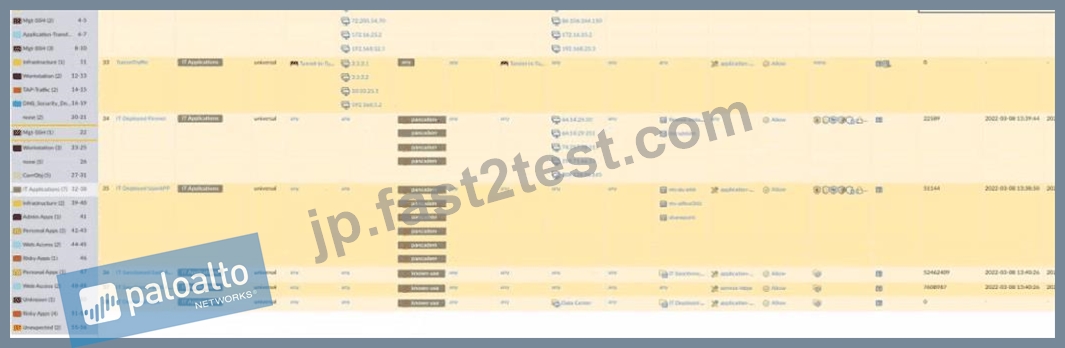
- A. There are seven Security policy rules on this firewall.
- B. Eleven rules use the "Infrastructure* tag.
- C. Highlight Unused Rules is checked.
- D. The view Rulebase as Groups is checked.
正解:D
質問 # 154
An administrator wishes to follow best practices for logging traffic that traverses the firewall Which log setting is correct?
- A. Disable all logging
- B. Enable Log at Session End
- C. Enable Log at both Session Start and End
- D. Enable Log at Session Start
正解:B
解説:
Explanation:
Explanation/Reference:
Reference:
https://knowledgebase.paloaltonetworks.com/KCSArticleDetail?id=kA10g000000Clt5CAC
質問 # 155
A company is experiencing performance issues with their cloud-based CRM application (e.g., Salesforce), which uses App-ID: salesforce-base. Users in remote branches report slow response times, even though their internet links appear healthy. Investigation reveals occasional transient packet loss spikes and latency jitter affecting the application's performance. The network team wants to implement an SD-WAN policy that proactively steers Salesforce traffic away from paths experiencing degradation, even if the degradation is intermittent and temporary. Which of the following is the most appropriate configuration?
- A. Utilize a standard static route for Salesforce traffic to a primary internet link. Implement BFD (Bidirectional Forwarding Detection) on the link to rapidly detect failures and switch to a pre-configured backup static route.
- B. Define an SD-WAN policy for Salesforce. Use 'Dynamic Path Selection' with an SLA profile that monitors latency, jitter, and packet loss. Set the 'Path Selection Type' to 'Best Path' and configure multiple preferred paths. The system will continuously evaluate paths and select the one currently meeting the SLA.
- C. Implement QOS policies on the WAN interfaces to prioritize Salesforce traffic. Configure a separate security policy for Salesforce to always use the most direct internet link, bypassing SD-WAN intelligence.
- D. Configure health checks on all internet-facing interfaces. If any interface experiences degradation, manually disable that interface in the network configuration to force traffic to other links.
- E. Create an SLA profile for Salesforce with strict thresholds for latency and packet loss. Configure a PBF rule for Salesforce traffic, and within the PBF, specify a primary path and a secondary path. The PBF will automatically failover if the primary path violates the SL
正解:B
解説:
Option B is the correct approach. Palo Alto Networks SD-WAN's 'Dynamic Path Selection' (DPS) with 'Best Path' selection, coupled with a properly defined SLA profile monitoring latency, jitter, and packet loss, is designed precisely for scenarios where applications need to proactively steer away from degrading paths. The system constantly monitors path quality against the SLA and dynamically selects the best available path, ensuring optimal application performance even with intermittent network issues.
質問 # 156
An organization is migrating its internal certificate authority (CA) infrastructure. They have existing SSL Inbound Inspection policies on a Palo Alto Networks firewall that utilize certificates and private keys from the old CA. The new CA will issue new certificates for internal servers. What is the most operationally efficient and secure way to transition the decryption policies to use the new certificates without service interruption, assuming a phased migration of servers?
- A. Import the new server certificates and private keys into separate 'Certificate Profiles' on the firewall. Then, modify the existing 'Decryption Profiles' to allow selecting multiple 'Certificate Profiles' or dynamically choosing the correct one based on the server certificate presented.
- B. Create entirely new Decryption Policies and Decryption Profiles for each server using the new certificates, and then disable the old policies/profiles once all servers are migrated.
- C. Import the new server certificates and private keys into new 'Server Certificate' objects. Create new 'Decryption Profiles' that reference these new certificates. Modify existing 'Decryption Policies' to include duplicate rules one for the old certificate profile and one for the new, using source/destination IP addresses to differentiate phased servers. Once all servers migrate, remove the old rules and profiles.
- D. Export the new server certificates and private keys from the new CA, import them directly into the existing decryption profiles, overwriting the old certificates.
- E. Configure the Palo Alto Networks firewall to act as a subordinate CA to the new internal CA, then generate new decryption certificates directly on the firewall for all relevant servers.
正解:C
解説:
This scenario requires a phased approach to avoid service disruption. Option E is the most operationally efficient and secure method. You cannot simply overwrite certificates (Option A) without causing an outage for servers still using the old certs. Creating entirely new policies and profiles (Option B) is less efficient and harder to manage during a phased rollout. Palo Alto Networks firewalls do not dynamically choose certificate profiles based on presented server certificates within a single decryption profile (Option C). Option D is more about the firewall's own CA capabilities, not for managing existing server certificates for inbound inspection during migration. The correct approach (Option E) involves: 1) Importing the new certificates as distinct 'Server Certificate' objects. 2) Creating new 'Decryption Profiles' that reference these new certificates. 3) Modifying the existing decryption policies. Instead of duplicating the entire policy, you can modify the rule that applies to these servers. You'd typically use source or destination IP addresses (or even a specific custom URL category if the servers have distinct FQDNs) to target the servers as they migrate. For instance, if Server A has migrated to the new cert, its traffic hits a rule referencing the new profile; if Server B is still on the old cert, its traffic hits a rule referencing the old profile. Once all servers in a group have migrated, the rule for the old certificate profile can be removed. This maintains continuous decryption throughout the transition.
質問 # 157
A Palo Alto Networks firewall is configured with an External Dynamic List of type 'URL' for blocking known malicious URLs. The list is extensive, containing millions of entries. The security team notices a significant increase in firewall management plane CPU utilization and occasional delays in policy commit operations after implementing this large EDL. Which two adjustments or considerations are most critical to mitigate these performance impacts without compromising security efficacy?
- A. Ensure the EDL source server is highly available and responsive to minimize timeout errors.
- B. Consider upgrading the firewall model to one with higher management plane resources and more memory.
- C. Reduce the EDL's 'Repeat' refresh interval to a longer duration (e.g., from hourly to daily).
- D. Split the single large EDL into multiple smaller EDLs based on threat categories or geography.
- E. Utilize a dedicated log collector or Panorama appliance to offload EDL processing.
正解:B、C
解説:
Handling extremely large EDLs can significantly impact firewall performance, especially the management plane. Option A (Correct): Reducing the refresh frequency is a primary mitigation. Each refresh involves downloading, parsing, and committing the EDL entries, which are CPU-intensive operations on the management plane. Fewer refreshes mean less overhead. Option E (Correct): For 'millions of entries,' the current firewall model might simply be undersized. Larger EDLs consume more memory and require more CPU cycles for processing and lookup, directly impacting management plane performance. Upgrading to a model with more resources is a direct solution. Option B is important for successful updates, but it doesn't directly address the firewall's internal processing burden once the file is downloaded. Option C might help organize but doesn't fundamentally reduce the total number of entries the firewall has to process or store. The aggregate impact remains. Option D (log collector/Panorama) is for log processing and centralized management; it does not offload the firewall's internal EDL processing.
質問 # 158
An organization is migrating its cloud applications from a public internet connection to a dedicated AWS Direct Connect link through a Palo Alto Networks firewall. To achieve this, all traffic to AWS public IP ranges (e.g., EC2, S3) from the internal network must be forwarded over the Direct Connect interface (ethernet1/3) with a specific next-hop router. Other internet-bound traffic should continue using the primary internet uplink (ethernet1/1 ). Which of the following PBF actions are critical to ensure that if the Direct Connect link fails, the AWS-bound traffic automatically fails over to the primary internet uplink without manual intervention?
- A. Configure a PBF rule with 'Action: Forward', 'Egress Interface: ethernet1/3', 'Next Hop: AWS Router_IP', and then create a second PBF rule with a higher priority for the same AWS destinations pointing to ethernet1/1 , which will only activate manually.
- B. Create a PBF rule with 'Action: Forward', 'Egress Interface: ethernet1/3', 'Next Hop: AWS_Router_IP', and specify 'Fall back to: Yes' with the primary internet uplink's virtual router and next-hop.
- C. Configure a PBF rule with 'Action: Forward', 'Egress Interface: ethernet1/3', 'Next Hop: AWS_Router_IP', and enable 'Monitor Link Group' for ethernet1/3 to trigger a route removal.
- D. Implement an ECMP route for the AWS public IP ranges, distributing traffic between ethernet1/3 and ethernet1/1 based on load.
- E. Set up a static route for the AWS ranges with ethernet1/3 as the next hop, and configure BIDirectional Forwarding Detection (BFD) on the Direct Connect interface.
正解:B
解説:
Palo Alto Networks PBF rules have a built-in 'Fall back to' option specifically for high availability. When configured, if the primary egress interface or next-hop specified in the PBF rule becomes unreachable (based on link monitoring or ARP/Ping monitoring), the traffic matching that rule will automatically fall back to the specified alternative forwarding method (e.g., default route, specific virtual router, or specific next hop). Option A describes link monitoring but not the automatic fallback PBF feature. Option C is for load balancing, not active-passive failover in this context. Option D requires manual intervention and doesn't leverage the PBF fallback mechanism. Option E describes general routing failover, but PBF provides a more granular, policy-based failover specific to the steered traffic.
質問 # 159
......
結果を保証するには最新2026年03月無料:https://jp.fast2test.com/NetSec-Analyst-premium-file.html
正真正銘のNetSec-Analyst問題集で無料PDF問題で合格させる:https://drive.google.com/open?id=1zBI-ECkjFQF4rnnNjhtNVCHknlYTtctT