

[2025年07月09日] MuleSoft-Integration-Architect-Iテストエンジンお試しセット、MuleSoft-Integration-Architect-I問題集PDF
最新のSalesforce MuleSoft-Integration-Architect-IのPDFと問題集で(2025)無料試験問題解答
質問 # 20
An API implementation is being developed to expose data from a production database via HTTP requests. The API implementation executes a database SELECT statement that is dynamically created based upon data received from each incoming HTTP request. The developers are planning to use various types of testing to make sure the Mule application works as expected, can handle specific workloads, and behaves correctly from an API consumer perspective. What type of testing would typically mock the results from each SELECT statement rather than actually execute it in the production database?
- A. Integration testing
- B. Functional testing (black box)
- C. Performance testing
- D. Unit testing (white box)
正解:D
解説:
In Unit testing instead of using actual backends, stubs are used for the backend services. This ensures that developers are not blocked and have no dependency on other systems.
In Unit testing instead of using actual backends, stubs are used for the backend services. This ensures that developers are not blocked and have no dependency on other systems.
Below are the typical characteristics of unit testing.
-- Unit tests do not require deployment into any special environment, such as a staging environment
-- Unit tests san be run from within an embedded Mule runtime
-- Unit tests can/should be implemented using MUnit
-- For read-only interactions to any dependencies (such as other APIs): allowed to invoke production endpoints
-- For write interactions: developers must implement mocks using MUnit
-- Require knowledge of the implementation details of the API implementation under test
質問 # 21
A stock broking company makes use of CloudHub VPC to deploy Mule applications. Mule application needs to connect to a database application in the customers on-premises corporate data center and also to a Kafka cluster running in AWS VPC.
How is access enabled for the API to connect to the database application and Kafka cluster securely?
- A. Setup VPC peering with the customers onto my service corporate data center and Anypoint VPN to AWS VPC
- B. Set up a transit gateway to the customers on-premises corporate datacenter to AWS VPC
- C. Setup AnyPoint VPN to the customer's on-premise corporate data
center and VPC peering with AWS VPC - D. Setup VPC peering with AWS VPC and the customers devices corporate data center
正解:C
質問 # 22
An organization's IT team must secure all of the internal APIs within an integration solution by using an API proxy to apply required authentication and authorization policies.
Which integration technology, when used for its intended purpose, should the team choose to meet these requirements if all other relevant factors are equal?
- A. Electronic Data Interchange (EDI)
- B. Robotic Process Automation (RPA)
- C. API Management (APIM)
- D. Integration Platform-as-a-service (PaaS)
正解:C
解説:
To secure all internal APIs within an integration solution by using an API proxy to apply required authentication and authorization policies, the organization should use API Management (APIM). APIM provides a comprehensive platform to manage, secure, and analyze APIs. It allows the IT team to create API proxies, enforce security policies, control access through authentication and authorization mechanisms, and monitor API usage.
Using APIM for this purpose ensures that internal APIs are protected with standardized security policies, facilitating centralized management and governance of API traffic. This approach is specifically designed for managing APIs and their security, making it the most suitable choice among the options provided.
References
* MuleSoft Documentation on API Management
* Best Practices for API Security and Governance
質問 # 23
What best describes the Fully Qualified Domain Names (FQDNs), also known as DNS entries, created when a Mule application is deployed to the CloudHub Shared Worker Cloud?
- A. The FQDNs are determined by the application name, but can be modified by an administrator after deployment
- B. The FQDNs are determined by both the application name and the region
- C. The FQDNs are determined by the application name chosen, IRRESPECTIVE of the region
- D. A fixed number of FQDNs are created, IRRESPECTIVE of the environment and VPC design
正解:B
解説:
Every Mule application deployed to CloudHub receives a DNS entry pointing to the CloudHub. The DNS entry is a CNAME for the CloudHub Shared Load Balancer in the region to which the Mule application is deployed. When we deploy the application on CloudHub, we get a generic url to access the endpoints.
Generic URL looks as below:
<application-name>.<region>.cloudhub.io <application-name> is the deployed application name which is unique across all the MuleSoft clients. <region> is the region name in which an application is deployed.
The
public CloudHub (shared) load balancer already redirects these requests, where myApp is the name of the Mule application deployment to CloudHub: HTTP requests to http://myApp.
<region>.cloudhub.io redirects to
http://mule-worker-myApp.<region>.cloudhub.io:8081
HTTPS traffic to https://myApp.<region>.cloudhub.io redirects to
https://mule-worker-myApp.<region>.cloudhub.io:8082
質問 # 24
Which key DevOps practice and associated Anypoint Platform component should a MuteSoft integration team adopt to improve delivery quality?
- A. Passive monitoring with Anypoint Monitoring
- B. A Continuous design with API Designer
- C. Manual testing with Anypoint Studio
- D. Automated testing with MUnit
正解:D
解説:
To improve delivery quality, a MuleSoft integration team should adopt automated testing with MUnit. MUnit is MuleSoft's testing framework that allows developers to create, design, and run unit and integration tests on their Mule applications. Automated testing with MUnit ensures that each part of the Mule application is tested for correctness and performance, catching issues early in the development cycle. This practice leads to higher quality code, reduced defects, and more reliable integrations.
Other practices mentioned, such as continuous design with API Designer and passive monitoring with Anypoint Monitoring, are important but do not directly address the need for rigorous and automated testing to ensure quality.
References
* MuleSoft Documentation on MUnit
* Best Practices for Automated Testing with MUnit
質問 # 25
An organization is in the process of building automated deployments using a CI/CD process. As a part of automated deployments, it wants to apply policies to API Instances.
What tool can the organization use to promote and deploy API Manager policies?
- A. Anypoint CLI
- B. Runtime Manager agent
- C. MUnit Maven plugin
- D. Mule Maven plugin
正解:A
質問 # 26
An organization is designing multiple new applications to run on CloudHub in a single Anypoint VPC and that must share data using a common persistent Anypoint object store V2 (OSv2).
Which design gives these mule applications access to the same object store instance?
- A. An Anypoint MQ connector configured to directly access the persistent object store
- B. The object store V2 rest API configured to access the persistent object store
- C. Object store V2 can be shared across cloudhub applications with the configured osv2 connector
- D. AVM connector configured to directly access the persistence queue of the persistent object store
正解:C
解説:
Object Store v2 (OSv2) in MuleSoft allows multiple applications within the same Anypoint Virtual Private Cloud (VPC) to share data. To achieve this, the OSv2 connector must be configured in each application to access the common persistent object store instance. This configuration enables the applications to read from and write to the same object store, facilitating data sharing. Object Store v2 is designed to be persistent and reliable, making it suitable for scenarios where data needs to be retained and shared across multiple applications.
References:
* MuleSoft Documentation on Object Store v2
質問 # 27
An organization has chosen Mulesoft for their integration and API platform.
According to the Mulesoft catalyst framework, what would an integration architect do to create achievement goals as part of their business outcomes?
- A. build and publish foundational assets
- B. evangelize API's
- C. Measure the impact of the centre for enablement
- D. agree upon KPI's and help develop and overall success plan
正解:D
質問 # 28
When designing an upstream API and its implementation, the development team has been advised to not set timeouts when invoking downstream API. Because the downstream API has no SLA that can be relied upon. This is the only donwstream API dependency of that upstream API. Assume the downstream API runs uninterrupted without crashing. What is the impact of this advice?
- A. An SLA for the upstream API CANNOT be provided.
- B. A load-dependent timeout of less than 1000 ms will be applied by the Mule runtime in which the downstream API implementation executes.
- C. A default timeout of 500 ms will automatically be applied by the Mule runtime in which the upstream API implementation executes.
- D. The invocation of the downstream API will run to completion without timing out.
正解:A
解説:
An SLA for the upstream API CANNOT be provided.
質問 # 29
A trading company handles millions of requests a day. Due to nature of its business, it requires excellent performance and reliability within its application.
For this purpose, company uses a number of event-based API's hosted on various mule clusters that communicate across a shared message queue sitting within its network.
Which method should be used to meet the company's requirement for its system?
- A. JMS manual acknowledgements with a reliability pattern
- B. JMS transactions
- C. VM queues with reliability pattern
- D. XA transactions and XA connected components
正解:B
解説:
For handling millions of requests per day with high performance and reliability, JMS (Java Message Service) transactions are the most suitable method. JMS transactions ensure that messages are processed reliably and can be rolled back in case of failures, providing transactional integrity. This is crucial for a trading company where reliable message processing is critical.
Using JMS transactions within Mule clusters allows for the decoupling of message producers and consumers, improving scalability and fault tolerance. JMS provides built-in mechanisms for handling transactional messaging, ensuring that messages are processed once and only once, even in the event of system failures.
References:
* MuleSoft Documentation on JMS
質問 # 30
What limits if a particular Anypoint Platform user can discover an asset in Anypoint Exchange?
- A. The type of the asset in Anypoint Exchange
- B. Design Center and RAML were both used to create the asset
- C. The existence of a public Anypoint Exchange portal to which the asset has been published
- D. The business groups to which the user belongs
正解:D
解説:
* "The existence of a public Anypoint Exchange portal to which the asset has been published" - question does not mention anything about the public portal. Beside the public portal is open to the internet, to anyone. * If you cannot find an asset in the current business group scopes, search in other scopes. In the left navigation bar click All assets (assets provided by MuleSoft and your own master organization), Provided by MuleSoft, or a business group scope. User belonging to one Business Group can see assets related to his group only Reference: https://docs.mulesoft.com/exchange/to-find-info https://docs.mulesoft.com/exchange/asset-details Correct answer is The business groups to which the user belongs
質問 # 31
A manufacturing company plans to deploy Mule applications to its own
Azure Kubernetes service infrastructure.The organization wants to make
the Mule applications more available and robust by deploying each Mule
application to an isolated Mule runtime in a Docker container while
managing all the Mule applications from the MuleSoft-hosted control plane.
What choice of runtime plane meets these organizational requirements?
- A. Anypoint Runtime Fabric
- B. Customer-hosted self-provisioned runtime plane
- C. CloudHub 2.0
- D. Anypoint Service Mesh
正解:A
解説:
Anypoint Runtime Fabric is the appropriate choice for deploying Mule applications in an isolated Mule runtime within Docker containers on an Azure Kubernetes Service (AKS) infrastructure. This solution provides a containerized and orchestrated environment managed from the MuleSoft-hosted control plane. It enhances the availability, scalability, and robustness of Mule applications by allowing fine-grained control over deployments and providing built-in support for high availability and fault tolerance.
References:
* Anypoint Runtime Fabric Overview
* Deploying Mule Applications to Kubernetes
質問 # 32
An organization needs to enable access to their customer data from both a mobile app and a web application, which each need access to common fields as well as certain unique fields. The data is available partially in a database and partially in a 3rd-party CRM system. What APIs should be created to best fit these design requirements?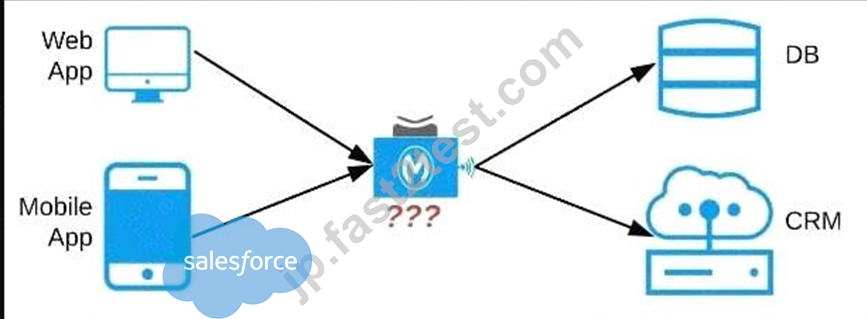
- A. Separate Experience APIs for the mobile and web app, but a common Process API that invokes separate System APIs created for the database and CRM system
- B. One set of APIs (Experience API, Process API, and System API) for the web app, and another set for the mobile app.
- C. A common Experience API used by both the web and mobile apps, but separate Process APIs for the web and mobile apps that interact with the database and the CRM System.
- D. A Process API that contains the data required by both the web and mobile apps, allowing these applications to invoke it directly and access the data they need thereby providing the flexibility to add more fields in the future without needing API changes.
正解:A
解説:
Lets analyze the situation in regards to the different options available Option : A common Experience API but separate Process APIs Analysis : This solution will not work because having common experience layer will not help the purpose as mobile and web applications will have different set of requirements which cannot be fulfilled by single experience layer API Option : Common Process API Analysis : This solution will not work because creating a common process API will impose limitations in terms of flexibility to customize API;s as per the requirements of different applications. It is not a recommended approach.
Option : Separate set of API's for both the applications Analysis : This goes against the principle of Anypoint API-led connectivity approach which promotes creating reusable assets. This solution may work but this is not efficient solution and creates duplicity of code.
Hence the correct answer is: Separate Experience APIs for the mobile and web app, but a common Process API that invokes separate System APIs created for the database and CRM system A screenshot of a computer Description automatically generated with low confidence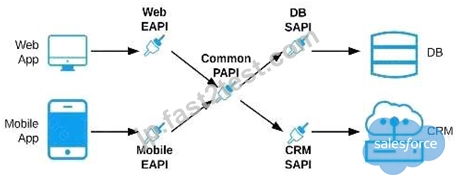
Lets analyze the situation in regards to the different options available Option : A common Experience API but separate Process APIs Analysis : This solution will not work because having common experience layer will not help the purpose as mobile and web applications will have different set of requirements which cannot be fulfilled by single experience layer API Option : Common Process API Analysis : This solution will not work because creating a common process API will impose limitations in terms of flexibility to customize API;s as per the requirements of different applications. It is not a recommended approach.
Option : Separate set of API's for both the applications Analysis : This goes against the principle of Anypoint API-led connectivity approach which promotes creating reusable assets. This solution may work but this is not efficient solution and creates duplicity of code.
Hence the correct answer is: Separate Experience APIs for the mobile and web app, but a common Process API that invokes separate System APIs created for the database and CRM system Diagram Description automatically generated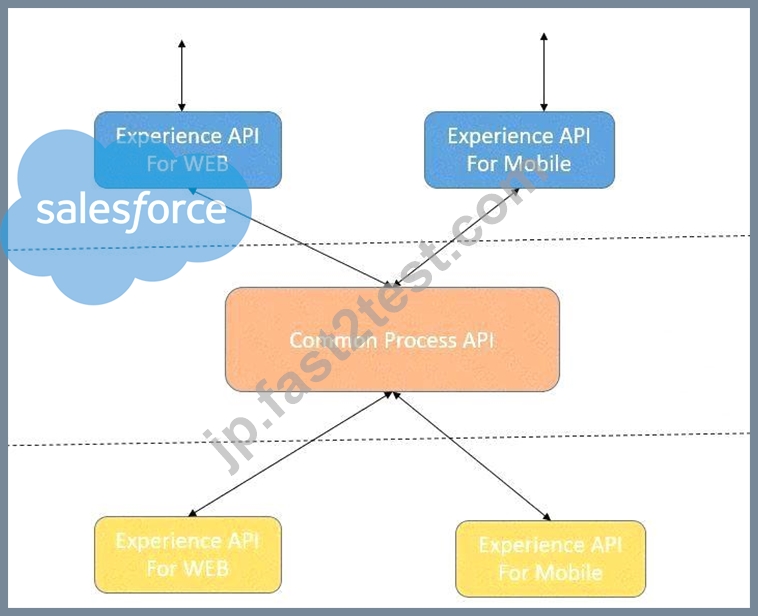
質問 # 33
A company is designing a mule application to consume batch data from a partner's ftps server The data files have been compressed and then digitally signed using PGP.
What inputs are required for the application to securely consumed these files?
- A. TLS context trust or containing a public certificate for the ftps server The FTP username and password The PGP public key of the partner
- B. ATLS context Key Store requiring the private key and certificate for the company PGP public key of partner PGP private key for the company
- C. The PGP public key of the partner
The PGP private key for the company
The FTP username and password - D. ATLS context first store containing a public certificate for partner ftps server and the PGP public key of the partner TLS contact Key Store containing the FTP credentials
正解:C
解説:
To securely consume compressed and digitally signed files from a partner's FTPS server, the following inputs are required:
* PGP Public Key of the Partner:
* Purpose: Used to verify the digital signature of the files received from the partner. This ensures that the files were indeed sent by the partner and have not been tampered with.
* Implementation: Import the partner's PGP public key into the Mule application.
* PGP Private Key for the Company:
* Purpose: Used to decrypt the files that were encrypted by the partner using the company's public key. This ensures that only the intended recipient (the company) can access the contents of the files.
* Implementation: Configure the Mule application to use the company's PGP private key for decryption.
* FTP Username and Password:
* Purpose: Used to authenticate and establish a connection to the partner's FTPS server. The credentials ensure that only authorized users can access the server.
* Implementation: Provide the FTP credentials in the Mule application's FTPS connector configuration.
By using these inputs, the Mule application can securely connect to the FTPS server, verify the integrity and authenticity of the files using PGP, and decrypt the contents for further processing.
References
* MuleSoft FTPS Connector
* MuleSoft PGP Module
質問 # 34
A company is implementing a new Mule application that supports a set of critical functions driven by a rest API enabled, claims payment rules engine hosted on oracle ERP. As designed the mule application requires many data transformation operations as it performs its batch processing logic.
The company wants to leverage and reuse as many of its existing java-based capabilities (classes, objects, data model etc.) as possible What approach should be considered when implementing required data mappings and transformations between Mule application and Oracle ERP in the new Mule application?
- A. Invoke any of the appropriate Java methods directly, create metadata RAML classes and then perform required transformations via Dataweave
- B. Transform by calling any suitable Java class from Dataweave
- C. From the mule application, transform via theXSLT model
- D. Create a new metadata RAML classes in Mule from the appropriate Java objects and then perform transformations via Dataweave
正解:B
質問 # 35
One of the backend systems involved by the API implementation enforces rate limits on the number of request a particle client can make.
Both the back-end system and API implementation are deployed to several non-production environments including the staging environment and to a particular production environment. Rate limiting of the back-end system applies to all non-production environments.
The production environment however does not have any rate limiting.
What is the cost-effective approach to conduct performance test of the API implementation in the non- production staging environment?
- A. Including logic within the API implementation that bypasses in locations of the back-end system in the staging environment and invoke a Mocking service that replicates typical back-end system responses Then conduct performance test using this API implementation
- B. Create a Mocking service that replicates the back-end system's production performance characteristics Then configure the API implementation to use the mocking service and conduct the performance test
- C. Use MUnit to simulate standard responses from the back-end system.
Then conduct performance test to identify other bottlenecks in the system - D. Conduct scaled-down performance tests in the staging environment against rate-limiting back-end system. Then upscale performance results to full production scale
正解:B
解説:
To conduct performance testing in a non-production environment where rate limits are enforced, the most cost-effective approach is:
C: Create a Mocking service that replicates the back-end system's production performance characteristics. Then configure the API implementation to use the mocking service and conduct the performance test.
* Mocking Service: Develop a mock service that emulates the performance characteristics of the production back-end system. This service should mimic the response times, data formats, and any relevant behavior of the actual back-end system without imposing rate limits.
* Configuration: Modify the API implementation to route requests to the mocking service instead of the actual back-end system. This ensures that the performance tests are not impacted by the rate limits imposed in the non-production environment.
* Performance Testing: Conduct the performance tests using the API implementation configured with the mocking service. This approach allows you to assess the performance under expected production load conditions without being constrained by non-production rate limits.
This method ensures that performance testing is accurate and reflective of the production environment without additional costs or constraints due to rate limiting in staging environments.
References:
* MuleSoft Documentation: Mocking Services
* MuleSoft Documentation: Performance Testing
質問 # 36
An organization is migrating all its Mule applications to Runtime Fabric (RTF). None of the Mule applications use Mule domain projects.
Currently, all the Mule applications have been manually deployed to a server group among several customer hosted Mule runtimes.
Port conflicts between these Mule application deployments are currently managed by the DevOps team who carefully manage Mule application properties files.
When the Mule applications are migrated from the current customer-hosted server group to Runtime Fabric (RTF), fo the Mule applications need to be rewritten and what DevOps port configuration responsibilities change or stay the same?
- A. Yes, the Mule applications Must be rewritten
DevOps Must Still Manage port conflicts. - B. Yes, the Mule applications Must be rewritten
DevOps No Longer needs to manage port conflicts between the Mule applications - C. NO, the Mule applications do NO need to be rewritten
DevOps NO LONGER needs to manage port conflicts between the Mule applications. - D. NO, The Mule applications do NOT need to be rewritten
DevOps MUST STILL manage port conflicts
正解:D
解説:
* Anypoint Runtime Fabric is a container service that automates the deployment and orchestration of your Mule applications and gateways.
* Runtime Fabric runs on customer-managed infrastructure on AWS, Azure, virtual machines (VMs) or bare- metal servers.
* As none of the Mule applications use Mule domain projects. applications are not required to be rewritten.
Also when applications are deployed on RTF, by default ingress is allowed only on 8081.
* Hence port conflicts are not required to be managed by DevOps team
質問 # 37
An organization is designing an integration solution to replicate financial transaction data from a legacy system into a data warehouse (DWH).
The DWH must contain a daily snapshot of financial transactions, to be delivered as a CSV file. Daily transaction volume exceeds tens of millions of records, with significant spikes in volume during popular shopping periods.
What is the most appropriate integration style for an integration solution that meets the organization's current requirements?
- A. Event-driven architecture
- B. API-led connectivity
- C. Microservice architecture
- D. Batch-triggered ETL
正解:D
解説:
Correct answer is Batch-triggered ETL Within a Mule application, batch processing provides a construct for asynchronously processing larger-than-memory data sets that are split into individual records. Batch jobs allow for the description of a reliable process that automatically splits up source data and stores it into persistent queues, which makes it possible to process large data sets while providing reliability. In the event that the application is redeployed or Mule crashes, the job execution is able to resume at the point it stopped.
質問 # 38
A retailer is designing a data exchange interface to be used by its suppliers. The interface must support secure communication over the public internet. The interface must also work with a wide variety of programming languages and IT systems used by suppliers.
What are suitable interface technologies for this data exchange that are secure, cross-platform, and internet friendly, assuming that Anypoint Connectors exist for these interface technologies?
- A. SOAP over HTTPS HOP over TLS gRPC over HTTPS
- B. CSV over FTP YAML over TLS JSON over HTTPS
- C. XML over ActiveMQ XML over SFTP XML/REST over HTTPS
- D. EDJFACT XML over SFTP JSON/REST over HTTPS
正解:C
解説:
* As per definition of API by Mulesoft , it is Application Programming Interface using HTTP-based protocols. Non-HTTP-based programmatic interfaces are not APIs.
* HTTP-based programmatic interfaces are APIs even if they don't use REST or JSON. Hence implementation based on Java RMI, CORBA/IIOP, raw TCP/IP interfaces are not API's as they are not using HTTP.
* One more thing to note is FTP was not built to be secure. It is generally considered to be an insecure protocol because it relies on clear-text usernames and passwords for authentication and does not use encryption.
* Data sent via FTP is vulnerable to sniffing, spoofing, and brute force attacks, among other basic attack methods.
Considering the above points only correct option is
-XML over ActiveMQ
- XML over SFTP
- XML/REST over HTTPS
質問 # 39
How does timeout attribute help inform design decisions while using JMS connector listening for incoming messages in an extended architecture (XA) transaction?
- A. The timeout defines the time that is allowed to pass without the transaction ending explicitly and after the timeout expires, the transaction rolls back
- B. The timeout specifies the time allowed to pass between receiving JMS messages on the same JMS connection and then after the timeout new JMS connection is established
- C. The time allowed to pass between committing the transaction and the completion of the mule flow and then after the timeout flow processing triggers an error
- D. After the timeout is exceeded, stale JMS consumer threads are destroyed and new threads are created
正解:A
解説:
* Timeout Attribute:
* The timeout attribute in the JMS connector specifies the maximum time allowed for a transaction to be completed. If the transaction does not complete within this specified time, it will be considered a timeout.
* Transaction Management:
* In the context of an Extended Architecture (XA) transaction, this timeout ensures that if the transaction is not explicitly ended within the defined time, the transaction is rolled back to maintain data consistency.
* Implications of Timeout:
* If the timeout is exceeded, the JMS message processing is considered unsuccessful, and all operations within the transaction are undone, which helps in avoiding partial updates and maintaining a reliable state.
References:
* MuleSoft Documentation on JMS Connector
* Understanding XA Transactions
質問 # 40
According to the National Institute of Standards and Technology (NIST), which cloud computing deployment model describes a composition of two or more distinct clouds that support data and application portability?
- A. Community cloud
- B. Public cloud
- C. Hybrid cloud 4
- D. Private cloud
正解:C
質問 # 41
......
あなたを合格させるSalesforce MuleSoft MuleSoft-Integration-Architect-I試験問題集で2025年07月09日には275問あります:https://jp.fast2test.com/MuleSoft-Integration-Architect-I-premium-file.html
MuleSoft-Integration-Architect-I無料試験学習ガイド!(更新された275問あります):https://drive.google.com/open?id=1vcN6aLzkxweWwqcOOWzgmdXUQ9dtSl_m