

[2025年04月15日] 有効なDatabricks-Machine-Learning-Associateテスト解答とDatabricks Databricks-Machine-Learning-Associate試験PDF問題を試そう
実際に出るDatabricks-Machine-Learning-Associate試験問題集には正確で更新された問題
質問 # 21
Which of the following describes the relationship between native Spark DataFrames and pandas API on Spark DataFrames?
- A. pandas API on Spark DataFrames are made up of Spark DataFrames and additional metadata
- B. pandas API on Spark DataFrames are less mutable versions of Spark DataFrames
- C. pandas API on Spark DataFrames are single-node versions of Spark DataFrames with additional metadata
- D. pandas API on Spark DataFrames are more performant than Spark DataFrames
正解:A
解説:
The pandas API on Spark DataFrames are made up of Spark DataFrames with additional metadata. The pandas API on Spark aims to provide the pandas-like experience with the scalability and distributed nature of Spark. It allows users to work with pandas functions on large datasets by leveraging Spark's underlying capabilities.
Reference:
Databricks documentation on pandas API on Spark: pandas API on Spark
質問 # 22
The implementation of linear regression in Spark ML first attempts to solve the linear regression problem using matrix decomposition, but this method does not scale well to large datasets with a large number of variables.
Which of the following approaches does Spark ML use to distribute the training of a linear regression model for large data?
- A. Singular value decomposition
- B. Logistic regression
- C. Least-squares method
- D. Spark ML cannot distribute linear regression training
- E. Iterative optimization
正解:E
質問 # 23
A data scientist has written a data cleaning notebook that utilizes the pandas library, but their colleague has suggested that they refactor their notebook to scale with big data.
Which of the following approaches can the data scientist take to spend the least amount of time refactoring their notebook to scale with big data?
- A. They can refactor their notebook to utilize the pandas API on Spark.
- B. They can refactor their notebook to use the PySpark DataFrame API.
- C. They can refactor their notebook to use Spark SQL.
- D. They can refactor their notebook to process the data in parallel.
- E. They can refactor their notebook to use the Scala Dataset API.
正解:A
解説:
The data scientist can refactor their notebook to utilize the pandas API on Spark (now known as pandas on Spark, formerly Koalas). This allows for the least amount of changes to the existing pandas-based code while scaling to handle big data using Spark's distributed computing capabilities. pandas on Spark provides a similar API to pandas, making the transition smoother and faster compared to completely rewriting the code to use PySpark DataFrame API, Scala Dataset API, or Spark SQL.
Reference:
Databricks documentation on pandas API on Spark (formerly Koalas).
質問 # 24
A data scientist has replaced missing values in their feature set with each respective feature variable's median value. A colleague suggests that the data scientist is throwing away valuable information by doing this.
Which of the following approaches can they take to include as much information as possible in the feature set?
- A. Create a binary feature variable for each feature that contained missing values indicating whether each row's value has been imputed
- B. Remove all feature variables that originally contained missing values from the feature set
- C. Refrain from imputing the missing values in favor of letting the machine learning algorithm determine how to handle them
- D. Impute the missing values using each respective feature variable's mean value instead of the median value
- E. Create a constant feature variable for each feature that contained missing values indicating the percentage of rows from the feature that was originally missing
正解:A
解説:
By creating a binary feature variable for each feature with missing values to indicate whether a value has been imputed, the data scientist can preserve information about the original state of the data. This approach maintains the integrity of the dataset by marking which values are original and which are synthetic (imputed). Here are the steps to implement this approach:
Identify Missing Values: Determine which features contain missing values.
Impute Missing Values: Continue with median imputation or choose another method (mean, mode, regression, etc.) to fill missing values.
Create Indicator Variables: For each feature that had missing values, add a new binary feature. This feature should be '1' if the original value was missing and imputed, and '0' otherwise.
Data Integration: Integrate these new binary features into the existing dataset. This maintains a record of where data imputation occurred, allowing models to potentially weight these observations differently.
Model Adjustment: Adjust machine learning models to account for these new features, which might involve considering interactions between these binary indicators and other features.
Reference
"Feature Engineering for Machine Learning" by Alice Zheng and Amanda Casari (O'Reilly Media, 2018), especially the sections on handling missing data.
Scikit-learn documentation on imputing missing values: https://scikit-learn.org/stable/modules/impute.html
質問 # 25
A machine learning engineer is trying to scale a machine learning pipeline by distributing its feature engineering process.
Which of the following feature engineering tasks will be the least efficient to distribute?
- A. One-hot encoding categorical features
- B. Imputing missing feature values with the true median
- C. Imputing missing feature values with the mean
- D. Creating binary indicator features for missing values
- E. Target encoding categorical features
正解:B
解説:
Among the options listed, calculating the true median for imputing missing feature values is the least efficient to distribute. This is because the true median requires knowledge of the entire data distribution, which can be computationally expensive in a distributed environment. Unlike mean or mode, finding the median requires sorting the data or maintaining a full distribution, which is more intensive and often requires shuffling the data across partitions.
Reference
Challenges in parallel processing and distributed computing for data aggregation like median calculation: https://www.apache.org
質問 # 26
A data scientist has produced three new models for a single machine learning problem. In the past, the solution used just one model. All four models have nearly the same prediction latency, but a machine learning engineer suggests that the new solution will be less time efficient during inference.
In which situation will the machine learning engineer be correct?
- A. When the new solution's models have an average size that is larger than the size of the original model
- B. When the new solution requires the use of fewer feature variables than the original model
- C. When the new solution requires that each model computes a prediction for every record
- D. When the new solution requires if-else logic determining which model to use to compute each prediction
- E. When the new solution's models have an average latency that is larger than the size of the original model
正解:C
解説:
If the new solution requires that each of the three models computes a prediction for every record, the time efficiency during inference will be reduced. This is because the inference process now involves running multiple models instead of a single model, thereby increasing the overall computation time for each record.
In scenarios where inference must be done by multiple models for each record, the latency accumulates, making the process less time efficient compared to using a single model.
Reference:
Model Ensemble Techniques
質問 # 27
The implementation of linear regression in Spark ML first attempts to solve the linear regression problem using matrix decomposition, but this method does not scale well to large datasets with a large number of variables.
Which of the following approaches does Spark ML use to distribute the training of a linear regression model for large data?
- A. Singular value decomposition
- B. Logistic regression
- C. Least-squares method
- D. Iterative optimization
正解:D
解説:
For large datasets, Spark ML uses iterative optimization methods to distribute the training of a linear regression model. Specifically, Spark MLlib employs techniques like Stochastic Gradient Descent (SGD) and Limited-memory Broyden-Fletcher-Goldfarb-Shanno (L-BFGS) optimization to iteratively update the model parameters. These methods are well-suited for distributed computing environments because they can handle large-scale data efficiently by processing mini-batches of data and updating the model incrementally.
Reference:
Databricks documentation on linear regression: Linear Regression in Spark ML
質問 # 28
A data scientist wants to use Spark ML to one-hot encode the categorical features in their PySpark DataFrame features_df. A list of the names of the string columns is assigned to the input_columns variable.
They have developed this code block to accomplish this task: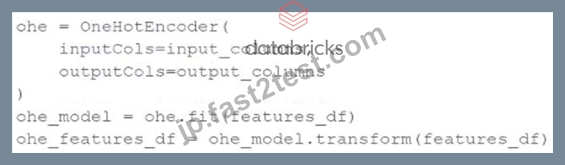
The code block is returning an error.
Which of the following adjustments does the data scientist need to make to accomplish this task?
- A. They need to use VectorAssembler prior to one-hot encoding the features.
- B. They need to use Stringlndexer prior to one-hot encodinq the features.
- C. They need to remove the line with the fit operation.
- D. They need to specify the method parameter to the OneHotEncoder.
正解:B
解説:
The OneHotEncoder in Spark ML requires numerical indices as inputs rather than string labels. Therefore, you need to first convert the string columns to numerical indices using StringIndexer. After that, you can apply OneHotEncoder to these indices.
Corrected code:
from pyspark.ml.feature import StringIndexer, OneHotEncoder # Convert string column to index indexers = [StringIndexer(inputCol=col, outputCol=col+"_index") for col in input_columns] indexer_model = Pipeline(stages=indexers).fit(features_df) indexed_features_df = indexer_model.transform(features_df) # One-hot encode the indexed columns ohe = OneHotEncoder(inputCols=[col+"_index" for col in input_columns], outputCols=output_columns) ohe_model = ohe.fit(indexed_features_df) ohe_features_df = ohe_model.transform(indexed_features_df) Reference:
PySpark ML Documentation
質問 # 29
A machine learning engineer wants to parallelize the inference of group-specific models using the Pandas Function API. They have developed the apply_model function that will look up and load the correct model for each group, and they want to apply it to each group of DataFrame df.
They have written the following incomplete code block:
Which piece of code can be used to fill in the above blank to complete the task?
- A. groupedApplyInPandas
- B. applyInPandas
- C. mapInPandas
- D. predict
正解:B
解説:
To parallelize the inference of group-specific models using the Pandas Function API in PySpark, you can use the applyInPandas function. This function allows you to apply a Python function on each group of a DataFrame and return a DataFrame, leveraging the power of pandas UDFs (user-defined functions) for better performance.
prediction_df = ( df.groupby("device_id") .applyInPandas(apply_model, schema=apply_return_schema) ) In this code:
groupby("device_id"): Groups the DataFrame by the "device_id" column.
applyInPandas(apply_model, schema=apply_return_schema): Applies the apply_model function to each group and specifies the schema of the return DataFrame.
Reference:
PySpark Pandas UDFs Documentation
質問 # 30
A machine learning engineer is trying to scale a machine learning pipeline pipeline that contains multiple feature engineering stages and a modeling stage. As part of the cross-validation process, they are using the following code block: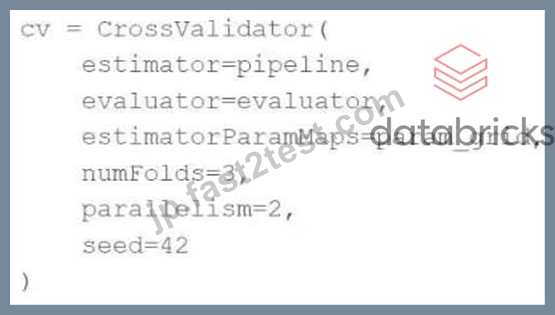
A colleague suggests that the code block can be changed to speed up the tuning process by passing the model object to the estimator parameter and then placing the updated cv object as the final stage of the pipeline in place of the original model.
Which of the following is a negative consequence of the approach suggested by the colleague?
- A. The model will be refit one more per cross-validation fold
- B. The cross-validation process will no longer be
- C. The model will take longer to train for each unique combination of hvperparameter values
- D. The cross-validation process will no longer be reproducible
- E. The feature engineering stages will be computed using validation data
正解:E
解説:
If the model object is passed to the estimator parameter of CrossValidator and the cross-validation object itself is placed as a stage in the pipeline, the feature engineering stages within the pipeline would be applied separately to each training and validation fold during cross-validation. This leads to a significant issue: the feature engineering stages would be computed using validation data, thereby leaking information from the validation set into the training process. This would potentially invalidate the cross-validation results by giving an overly optimistic performance estimate.
Reference:
Cross-validation and Pipeline Integration in MLlib (Avoiding Data Leakage in Pipelines).
質問 # 31
A data scientist wants to efficiently tune the hyperparameters of a scikit-learn model. They elect to use the Hyperopt library's fmin operation to facilitate this process. Unfortunately, the final model is not very accurate. The data scientist suspects that there is an issue with the objective_function being passed as an argument to fmin.
They use the following code block to create the objective_function: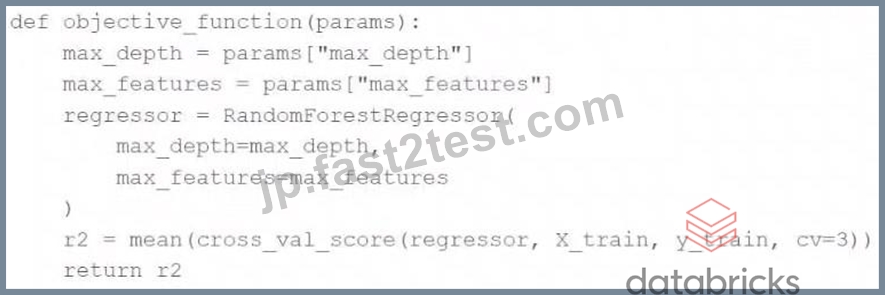
Which of the following changes does the data scientist need to make to their objective_function in order to produce a more accurate model?
- A. Add a random_state argument to the RandomForestRegressor operation
- B. Add test set validation process
- C. Replace the fmin operation with the fmax operation
- D. Replace the r2 return value with -r2
- E. Remove the mean operation that is wrapping the cross_val_score operation
正解:D
解説:
When using the Hyperopt library with fmin, the goal is to find the minimum of the objective function. Since you are using cross_val_score to calculate the R2 score which is a measure of the proportion of the variance for a dependent variable that's explained by an independent variable(s) in a regression model, higher values are better. However, fmin seeks to minimize the objective function, so to align with fmin's goal, you should return the negative of the R2 score (-r2). This way, by minimizing the negative R2, fmin is effectively maximizing the R2 score, which can lead to a more accurate model.
Reference
Hyperopt Documentation: http://hyperopt.github.io/hyperopt/
Scikit-Learn documentation on model evaluation: https://scikit-learn.org/stable/modules/model_evaluation.html
質問 # 32
A data scientist learned during their training to always use 5-fold cross-validation in their model development workflow. A colleague suggests that there are cases where a train-validation split could be preferred over k-fold cross-validation when k > 2.
Which of the following describes a potential benefit of using a train-validation split over k-fold cross-validation in this scenario?
- A. Fewer models need to be trained when using a train-validation split
- B. Fewer hyperparameter values need to be tested when using a train-validation split
- C. A holdout set is not necessary when using a train-validation split
- D. Bias is avoidable when using a train-validation split
- E. Reproducibility is achievable when using a train-validation split
正解:A
解説:
A train-validation split is often preferred over k-fold cross-validation (with k > 2) when computational efficiency is a concern. With a train-validation split, only two models (one on the training set and one on the validation set) are trained, whereas k-fold cross-validation requires training k models (one for each fold).
This reduction in the number of models trained can save significant computational resources and time, especially when dealing with large datasets or complex models.
Reference:
Model Evaluation with Train-Test Split
質問 # 33
A data scientist wants to use Spark ML to impute missing values in their PySpark DataFrame features_df. They want to replace missing values in all numeric columns in features_df with each respective numeric column's median value.
They have developed the following code block to accomplish this task: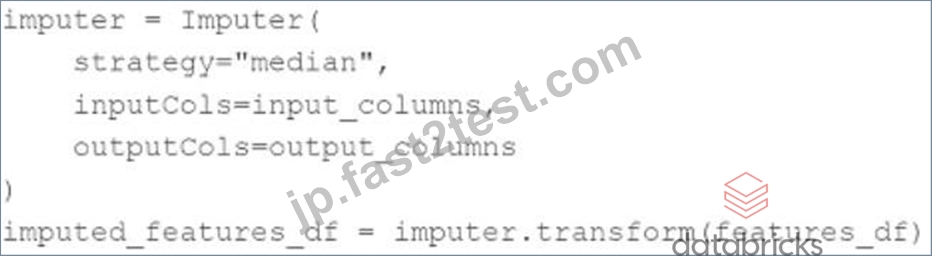
The code block is not accomplishing the task.
Which reasons describes why the code block is not accomplishing the imputation task?
- A. The inputCols and outputCols need to be exactly the same.
- B. It does not fit the imputer on the data to create an ImputerModel.
- C. It does not impute both the training and test data sets.
- D. The fit method needs to be called instead of transform.
正解:B
解説:
In the provided code block, the Imputer object is created but not fitted on the data to generate an ImputerModel. The transform method is being called directly on the Imputer object, which does not yet contain the fitted median values needed for imputation. The correct approach is to fit the imputer on the dataset first.
Corrected code:
imputer = Imputer( strategy="median", inputCols=input_columns, outputCols=output_columns ) imputer_model = imputer.fit(features_df) # Fit the imputer to the data imputed_features_df = imputer_model.transform(features_df) # Transform the data using the fitted imputer Reference:
PySpark ML Documentation
質問 # 34
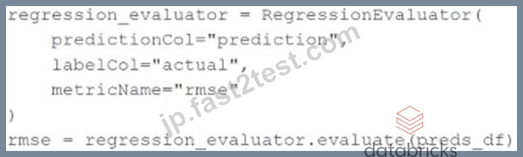
A data scientist has developed a linear regression model using Spark ML and computed the predictions in a Spark DataFrame preds_df with the following schema:
prediction DOUBLE
actual DOUBLE
Which of the following code blocks can be used to compute the root mean-squared-error of the model according to the data in preds_df and assign it to the rmse variable?
- A.
- B.
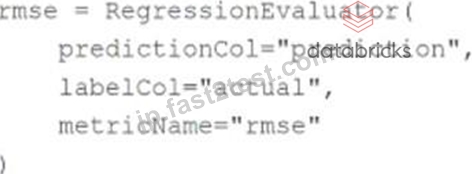
- C.
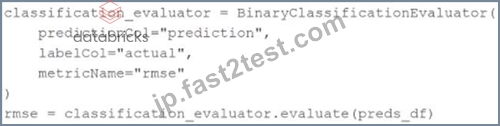
- D.
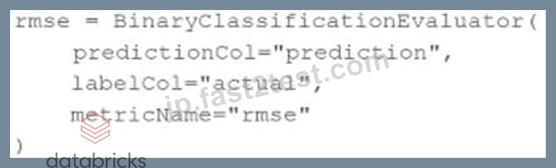
正解:A
解説:
To compute the root mean-squared-error (RMSE) of a linear regression model using Spark ML, the RegressionEvaluator class is used. The RegressionEvaluator is specifically designed for regression tasks and can calculate various metrics, including RMSE, based on the columns containing predictions and actual values.
The correct code block to compute RMSE from the preds_df DataFrame is:
regression_evaluator = RegressionEvaluator( predictionCol="prediction", labelCol="actual", metricName="rmse" ) rmse = regression_evaluator.evaluate(preds_df) This code creates an instance of RegressionEvaluator, specifying the prediction and label columns, as well as the metric to be computed ("rmse"). It then evaluates the predictions in preds_df and assigns the resulting RMSE value to the rmse variable.
Options A and B incorrectly use BinaryClassificationEvaluator, which is not suitable for regression tasks. Option D also incorrectly uses BinaryClassificationEvaluator.
Reference:
PySpark ML Documentation
質問 # 35
A machine learning engineer would like to develop a linear regression model with Spark ML to predict the price of a hotel room. They are using the Spark DataFrame train_df to train the model.
The Spark DataFrame train_df has the following schema: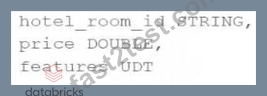
The machine learning engineer shares the following code block:
Which of the following changes does the machine learning engineer need to make to complete the task?
- A. They need to split the features column out into one column for each feature
- B. They do not need to make any changes
- C. They need to utilize a Pipeline to fit the model
- D. They need to call the transform method on train df
- E. They need to convert the features column to be a vector
正解:E
解説:
In Spark ML, the linear regression model expects the feature column to be a vector type. However, if the features column in the DataFrame train_df is not already in this format (such as being a column of type UDT or a non-vectorized type), the engineer needs to convert it to a vector column using a transformer like VectorAssembler. This is a critical step in preparing the data for modeling as Spark ML models require input features to be combined into a single vector column.
Reference
Spark MLlib documentation for LinearRegression: https://spark.apache.org/docs/latest/ml-classification-regression.html#linear-regression
質問 # 36
In which of the following situations is it preferable to impute missing feature values with their median value over the mean value?
- A. When the features are of the categorical type
- B. When the features contain no outliers
- C. When the features are of the boolean type
- D. When the features contain no missing no values
- E. When the features contain a lot of extreme outliers
正解:E
解説:
Imputing missing values with the median is often preferred over the mean in scenarios where the data contains a lot of extreme outliers. The median is a more robust measure of central tendency in such cases, as it is not as heavily influenced by outliers as the mean. Using the median ensures that the imputed values are more representative of the typical data point, thus preserving the integrity of the dataset's distribution. The other options are not specifically relevant to the question of handling outliers in numerical data.
Reference:
Data Imputation Techniques (Dealing with Outliers).
質問 # 37
A data scientist is attempting to tune a logistic regression model logistic using scikit-learn. They want to specify a search space for two hyperparameters and let the tuning process randomly select values for each evaluation.
They attempt to run the following code block, but it does not accomplish the desired task:
Which of the following changes can the data scientist make to accomplish the task?
- A. Replace the GridSearchCV operation with ParameterGrid
- B. Replace the GridSearchCV operation with RandomizedSearchCV
- C. Replace the random_state=0 argument with random_state=1
- D. Replace the penalty= ['12', '11'] argument with penalty=uniform ('12', '11')
- E. Replace the GridSearchCV operation with cross_validate
正解:B
解説:
The user wants to specify a search space for hyperparameters and let the tuning process randomly select values. GridSearchCV systematically tries every combination of the provided hyperparameter values, which can be computationally expensive and time-consuming. RandomizedSearchCV, on the other hand, samples hyperparameters from a distribution for a fixed number of iterations. This approach is usually faster and still can find very good parameters, especially when the search space is large or includes distributions.
Reference
Scikit-Learn documentation on hyperparameter tuning: https://scikit-learn.org/stable/modules/grid_search.html#randomized-parameter-optimization
質問 # 38
A data scientist wants to parallelize the training of trees in a gradient boosted tree to speed up the training process. A colleague suggests that parallelizing a boosted tree algorithm can be difficult.
Which of the following describes why?
- A. Gradient boosting is not a linear algebra-based algorithm which is required for parallelization
- B. Gradient boosting is an iterative algorithm that requires information from the previous iteration to perform the next step.
- C. Gradient boosting requires access to all data at once which cannot happen during parallelization.
- D. Gradient boosting calculates gradients in evaluation metrics using all cores which prevents parallelization.
正解:B
解説:
Gradient boosting is fundamentally an iterative algorithm where each new tree is built based on the errors of the previous ones. This sequential dependency makes it difficult to parallelize the training of trees in gradient boosting, as each step relies on the results from the preceding step. Parallelization in this context would undermine the core methodology of the algorithm, which depends on sequentially improving the model's performance with each iteration.
Reference:
Machine Learning Algorithms (Challenges with Parallelizing Gradient Boosting).
Gradient boosting is an ensemble learning technique that builds models in a sequential manner. Each new model corrects the errors made by the previous ones. This sequential dependency means that each iteration requires the results of the previous iteration to make corrections. Here is a step-by-step explanation of why this makes parallelization challenging:
Sequential Nature: Gradient boosting builds one tree at a time. Each tree is trained to correct the residual errors of the previous trees. This requires the model to complete one iteration before starting the next.
Dependence on Previous Iterations: The gradient calculation at each step depends on the predictions made by the previous models. Therefore, the model must wait until the previous tree has been fully trained and evaluated before starting to train the next tree.
Difficulty in Parallelization: Because of this dependency, it is challenging to parallelize the training process. Unlike algorithms that process data independently in each step (e.g., random forests), gradient boosting cannot easily distribute the work across multiple processors or cores for simultaneous execution.
This iterative and dependent nature of the gradient boosting process makes it difficult to parallelize effectively.
Reference
Gradient Boosting Machine Learning Algorithm
Understanding Gradient Boosting Machines
質問 # 39
Which of the following statements describes a Spark ML estimator?
- A. An estimator is a trained ML model which turns a DataFrame with features into a DataFrame with predictions
- B. An estimator is an alqorithm which can be fit on a DataFrame to produce a Transformer
- C. An estimator is an evaluation tool to assess to the quality of a model
- D. An estimator is a hyperparameter arid that can be used to train a model
- E. An estimator chains multiple alqorithms toqether to specify an ML workflow
正解:B
解説:
In the context of Spark MLlib, an estimator refers to an algorithm which can be "fit" on a DataFrame to produce a model (referred to as a Transformer), which can then be used to transform one DataFrame into another, typically adding predictions or model scores. This is a fundamental concept in machine learning pipelines in Spark, where the workflow includes fitting estimators to data to produce transformers.
Reference
Spark MLlib Documentation: https://spark.apache.org/docs/latest/ml-pipeline.html#estimators
質問 # 40
A data scientist uses 3-fold cross-validation and the following hyperparameter grid when optimizing model hyperparameters via grid search for a classification problem:
* Hyperparameter 1: [2, 5, 10]
* Hyperparameter 2: [50, 100]
Which of the following represents the number of machine learning models that can be trained in parallel during this process?
- A. 0
- B. 1
- C. 2
- D. 3
正解:C
解説:
To determine the number of machine learning models that can be trained in parallel, we need to calculate the total number of combinations of hyperparameters. The given hyperparameter grid includes:
Hyperparameter 1: [2, 5, 10] (3 values)
Hyperparameter 2: [50, 100] (2 values)
The total number of combinations is the product of the number of values for each hyperparameter: 3 (values of Hyperparameter 1)×2 (values of Hyperparameter 2)=63 (values of Hyperparameter 1)×2 (values of Hyperparameter 2)=6 With 3-fold cross-validation, each combination of hyperparameters will be evaluated 3 times. Thus, the total number of models trained will be: 6 (combinations)×3 (folds)=186 (combinations)×3 (folds)=18 However, the number of models that can be trained in parallel is equal to the number of hyperparameter combinations, not the total number of models considering cross-validation. Therefore, 6 models can be trained in parallel.
Reference:
Databricks documentation on hyperparameter tuning: Hyperparameter Tuning
質問 # 41
A data scientist has defined a Pandas UDF function predict to parallelize the inference process for a single-node model: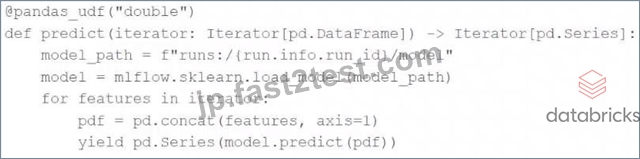
They have written the following incomplete code block to use predict to score each record of Spark DataFrame spark_df: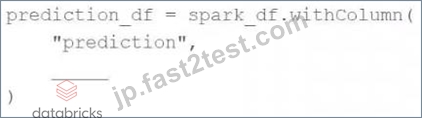
Which of the following lines of code can be used to complete the code block to successfully complete the task?
- A. predict(spark_df.columns)
- B. mapInPandas(predict)
- C. mapInPandas(predict(spark_df.columns))
- D. predict(*spark_df.columns)
- E. predict(Iterator(spark_df))
正解:B
解説:
To apply the Pandas UDF predict to each record of a Spark DataFrame, you use the mapInPandas method. This method allows the Pandas UDF to operate on partitions of the DataFrame as pandas DataFrames, applying the specified function (predict in this case) to each partition. The correct code completion to execute this is simply mapInPandas(predict), which specifies the UDF to use without additional arguments or incorrect function calls.
Reference:
PySpark DataFrame documentation (Using mapInPandas with UDFs).
質問 # 42
A team is developing guidelines on when to use various evaluation metrics for classification problems. The team needs to provide input on when to use the F1 score over accuracy.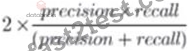
Which of the following suggestions should the team include in their guidelines?
- A. The F1 score should be utilized over accuracy when identifying true positives and true negatives are equally important to the business problem.
- B. The F1 score should be utilized over accuracy when there is significant imbalance between positive and negative classes and avoiding false negatives is a priority.
- C. The F1 score should be utilized over accuracy when the number of actual positive cases is identical to the number of actual negative cases.
- D. The F1 score should be utilized over accuracy when there are greater than two classes in the target variable.
正解:B
解説:
The F1 score is the harmonic mean of precision and recall and is particularly useful in situations where there is a significant imbalance between positive and negative classes. When there is a class imbalance, accuracy can be misleading because a model can achieve high accuracy by simply predicting the majority class. The F1 score, however, provides a better measure of the test's accuracy in terms of both false positives and false negatives.
Specifically, the F1 score should be used over accuracy when:
There is a significant imbalance between positive and negative classes.
Avoiding false negatives is a priority, meaning recall (the ability to detect all positive instances) is crucial.
In this scenario, the F1 score balances both precision (the ability to avoid false positives) and recall, providing a more meaningful measure of a model's performance under these conditions.
Reference:
Databricks documentation on classification metrics: Classification Metrics
質問 # 43
......
Databricks Databricks-Machine-Learning-Associate 認定試験の出題範囲:
| トピック | 出題範囲 |
|---|---|
| トピック 1 |
|
| トピック 2 |
|
| トピック 3 |
|
| トピック 4 |
|
Databricks-Machine-Learning-Associate試験問題集でPDF問題とテストエンジン:https://jp.fast2test.com/Databricks-Machine-Learning-Associate-premium-file.html