

[2025年04月] 更新されたのはCisco CCST-Networking日本語問題集PDFオンラインエンジン
CCST-Networking日本語.PDFで問題解答PDFサンプル問題は信頼され続ける
質問 # 19
Wi-Fi ネットワークの仕様はどの規格に含まれていますか?
- A. IEEE 802.3
- B. LTE
- C. GSM
- D. EIA/TIA 568A
- E. IEEE 802.11
正解:E
解説:
The IEEE 802.11 standard contains the specifications for Wi-Fi networks. It is a set of media access control (MAC) and physical layer (PHY) specifications for implementing wireless local area network (WLAN) computer communication in various frequencies, including but not limited to 2.4 GHz, 5 GHz, and 6 GHz1.
This standard is maintained by the Institute of Electrical and Electronics Engineers (IEEE) and is commonly referred to as Wi-Fi. The standard has evolved over time to include several amendments that improve speed, range, and reliability of wireless networks.
References :=
*The Most Common Wi-Fi Standards and Types, Explained
*802.11 Standards Explained: 802.11ax, 802.11ac, 802.11b/g/n, 802.11a
*Wi-Fi Standards Explained - GeeksforGeeks
質問 # 20
サポート チケットを最初に作成するときに含めるべき 2 つの情報はどれですか? (2 つ選択してください)
- A. ネットワークに接続されているコンピュータの詳細
- B. 障害が発生したときの条件の説明
- C. 障害を解決するために実行されたアクション
- D. 障害の詳細な説明
- E. トップダウンの障害検出手順の説明
正解:B、D
解説:
* Statement A: "A detailed description of the fault." This is essential for support staff to understand the nature of the problem and begin troubleshooting effectively.
* Statement C: "A description of the conditions when the fault occurs." This helps in reproducing the issue and identifying patterns that might indicate the cause of the fault.
* Statement B: "Details about the computers connected to the network." While useful, this is not as immediately critical as understanding the fault itself and the conditions under which it occurs.
* Statement D: "The actions taken to resolve the fault." This is important but typically follows the initial report.
* Statement E: "The description of the top-down fault-finding procedure." This is more of a troubleshooting methodology than information typically included in an initial support ticket.
References:
* Best Practices for Submitting Support Tickets: Support Ticket Guidelines
質問 # 21
レイヤー 2 スイッチの管理 VLAN インターフェイスに IP アドレスを割り当てる目的は何ですか?
- A. TelnetまたはSSH経由でスイッチのCLIにアクセスできるようにする
- B. スイッチが接続されたデバイスのデフォルトゲートウェイとして機能するようにする
- C. スイッチがネットワーク内の他のスイッチにDHCPサービスを提供できるようにする
- D. スイッチが接続されたデバイスのURLを解決できるようにするには
正解:A
解説:
The primary purpose of assigning an IP address to the management VLAN interface on a Layer 2 switch is to facilitate remote management of the switch. By configuring an IP address on the management VLAN, network administrators can access the switch's Command Line Interface (CLI) remotely using protocols such as Telnet or Secure Shell (SSH). This allows for convenient configuration changes, monitoring, and troubleshooting without needing physical access to the switch1.
References :=
*Understanding the Management VLAN
*Cisco - VLAN Configuration Guide
*Remote Management of Switches
Assigning an IP address to the management VLAN interface (often the VLAN 1 interface by default) on a Layer 2 switch allows network administrators to remotely manage the switch using protocols such as Telnet or SSH. This IP address does not affect the switch's ability to route traffic between VLANs but provides a means to access and configure the switch through its Command Line Interface (CLI).
*A: The switch does not act as a default gateway; this is typically a function of a Layer 3 device like a router.
*B: The switch does not resolve URLs; this is typically a function of DNS servers.
*C: The switch can relay DHCP requests but does not typically provide DHCP services itself; this is usually done by a dedicated DHCP server or router.
Thus, the correct answer is D. To enable access to the CLI on the switch through Telnet or SSH.
References :=
*Cisco VLAN Management Overview
*Cisco Catalyst Switch Management
質問 # 22
ネットワーク上のすべてのユーザーがアクセスできるファイルを保存したい。
どのエンドポイントデバイスが必要ですか?
- A. ハブ
- B. サーバー
- C. アクセスポイント
- D. スイッチ
正解:B
解説:
To store files that will be accessible by every user on a network, you would need aserver. A server is a computer system that provides data to other computers. It can serve data to systems on a local network (LAN) or a wide network (WAN) over the internet.In this context, a file server would be set up to store and manage files, allowing users on the network to access them from their own devices1.
References:=
* What is a Server?
* Understanding Servers and Their Functions
A server is a computer designed to process requests and deliver data to other computers over a local network or the internet. In this case, to store files that will be accessible by every user on the network, a file server is the appropriate endpoint device. It provides a centralized location for storing and managing files, allowing users to access and share files easily.
* A. Access point: Provides wireless connectivity to a network.
* C. Hub: A basic networking device that connects multiple Ethernet devices together, making them act as a single network segment.
* D. Switch: A networking device that connects devices on a computer network by using packet switching to forward data to the destination device.
Thus, the correct answer is B. Server.
References:=
* File Server Overview (Cisco)
* Server Roles in Networking (Cisco)
質問 # 23
小規模オフィスのコンピューターは companypro.net にアクセスできません。コンピューターの 1 台で ipconfig コマンドを実行します。結果は図に示されています。
ルーターにアクセスできるかどうかを確認する必要があります。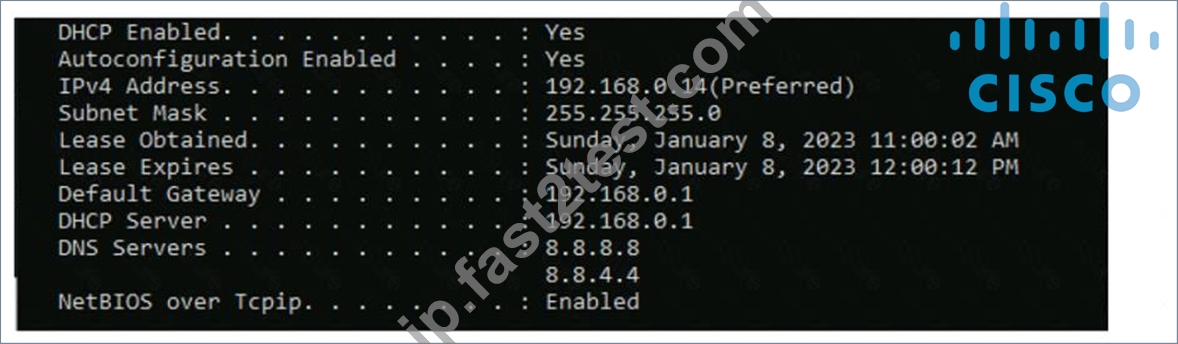
どのコマンドを使用すればよいですか? 各ドロップダウン リストから正しいオプションを選択してコマンドを完了します。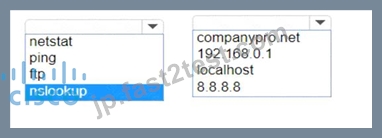
正解:
解説: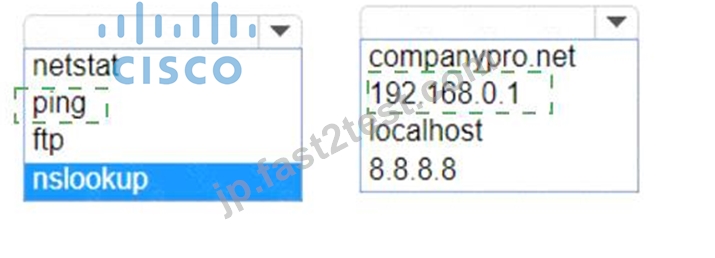
Explanation:
To determine if you can reach the router, you should use thepingcommand followed by the IP address of the router. Thepingcommand is a network utility used to test the reachability of a host on an Internet Protocol (IP) network and to measure the round-trip time for messages sent from the originating host to a destination computer.
The Default Gateway in theipconfigresults is typically the router's IP address in a home or small office network. In this case, the Default Gateway is192.168.0.1, which is the address you would ping to check connectivity to the router.
References:=
* How to Use the Ping Command
* Testing Network Connectivity with the Ping Command
To determine if you can reach the router, you should use thepingcommand with the IP address of the router.
* Command:ping
* Target:192.168.0.1
So, the completed command is:
* ping 192.168.0.1
Step by Step Comprehensive and Detailed Explanation:
* ping: The ping command sends ICMP Echo Request messages to the target IP address and waits for an Echo Reply. It is commonly used to test the reachability of a network device.
* 192.168.0.1: This is the IP address of the default gateway (the router) as shown in theipconfigoutput.
Pinging this address will help determine if the computer can communicate with the router.
References:
* Using the ping Command: ping Command Guide
質問 # 24
ホストには IP アドレス 172.16.100.25 とサブネット マスク 255.255.252.0 が割り当てられます。
このアドレスの CIDR 表記は何ですか?
- A. 172.16.100.25 /22
- B. 172.16.100.25 /20
- C. 172.16.100.25 /23
- D. 172.16.100.25 /21
正解:A
解説:
The CIDR (Classless Inter-Domain Routing) notation for the subnet mask 255.255.252.0 is /22. This notation indicates that the first 22 bits of the IP address are used for network identification, and the remaining bits are used for host addresses within the network1.
References :=
*Subnet Cheat Sheet - 24 Subnet Mask, 30, 26, 27, 29, and other IP Address CIDR Network References
*Subnet Mask to CIDR Notation: The given subnet mask is 255.255.252.0. To convert this to CIDR notation:
*Convert the subnet mask to binary: 11111111.11111111.11111100.00000000
*Count the number of consecutive 1s in the binary form: There are 22 ones.
*Therefore, the CIDR notation is /22.
References:
*Understanding Subnetting and CIDR: Cisco CIDR Guide
質問 # 25
UDP セグメントのヘッダーにはどのような情報が含まれていますか?
- A. シーケンス番号
- B. MAC アドレス
- C. ポート番号
- D. IPアドレス
正解:C
解説:
The header of a UDP (User Datagram Protocol) segment includesport numbers. Specifically, it contains the source port number and the destination port number, which are used to identify the sending and receiving applications. UDP headers do not include IP addresses or MAC addresses, as those are part of the IP and Ethernet frame headers, respectively.Additionally, UDP does not use sequence numbers, which are a feature of TCP (Transmission Control Protocol) for ensuring reliable delivery of data segments1.
References:=
* Segmentation Explained with TCP and UDP Header
* User Datagram Protocol (UDP) - GeeksforGeeks
* Which three fields are used in a UDP segment header
* UDP Header: The header of a UDP segment includes the following key fields:
* Source Port: The port number of the sending application.
* Destination Port: The port number of the receiving application.
* Length: The length of the UDP header and data.
* Checksum: Used for error-checking the header and data.
* IP Addresses: These are included in the IP header, not the UDP header.
* Sequence Numbers: These are part of the TCP header, not UDP.
* MAC Addresses: These are part of the Ethernet frame header and are not included in the UDP header.
References:
* RFC 768 - User Datagram Protocol: RFC 768
* Cisco Guide on UDP: Cisco UDP Guide
質問 # 26
サポート技術者が Cisco スイッチの前面パネルを調べたところ、最初の 4 つのポートに 4 本のイーサネット ケーブルが接続されていることがわかりました。ポート 1、2、3 には緑色の LED が付いています。ポート 4 には緑色の点滅ライトが付いています。
ポート4の状態はどうですか?
- A. リンクは稼働していますが、安定していません。
- B. リンクはアップしていますが、アクティビティはありません。
- C. リンクはアップしておりアクティブです。
- D. ケーブルに障害があるものの、リンクは稼働しています。
正解:C
解説:
On a Cisco switch, a port with a blinking green LED typically indicates that the port is up (active) and is currently transmitting or receiving data. This is a normal state indicating active traffic on the port.
*A. Link is up with cable malfunctions: Usually indicated by an amber or blinking amber light.
*B. Link is up and not stable: Not typically indicated by a green blinking light.
*D. Link is up and there is no activity: Would be indicated by a solid green light withoutblinking.
Thus, the correct answer is C. Link is up and active.
References :=
*Cisco Switch LED Indicators
*Cisco Ethernet Switch LED Patterns
質問 # 27
ユーザーのコンピューター上のアプリでデータのダウンロードに問題が発生しています。アプリはデータのダウンロードに次の URL を使用します。
https://www.companypro.net:7100/api
その URL との間で送受信されるパケットをキャプチャするには、Wireshark を使用する必要があります。
結果をフィルタリングするためにどの Wireshark フィルタ オプションを使用しますか? 各ドロップダウン リストから正しいオプションを選択してコマンドを完了します。
注意: 正しい選択ごとに部分的なポイントが付与されます。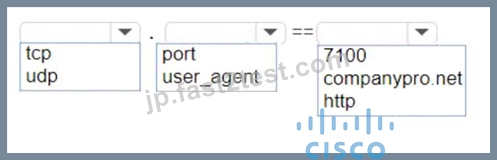
正解:
解説: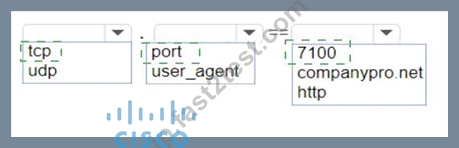
Explanation:
To capture packets sent to and received from the URLhttps://www.companypro.net:7100/apiusing Wireshark, you would use the following filter options:
* Protocol:tcp
* Filter Type:port
* Port Number:7100
This filter setup in Wireshark will display all TCP packets that are sent to or received from port 7100, which is the port specified in the URL for the API service. Since HTTPS typically uses TCP as the transport layer protocol, filtering by TCP and the specific port number will help isolate the relevant packets for troubleshooting the app's data download issues.
* cp: The app is using HTTPS, which relies on the TCP protocol for communication.
* port: The specific port number used by the application, which in this case is 7100.
* 7100: This is the port specified in the URL (https://www.companypro.net:7100/api).
This filter will capture all TCP traffic on port 7100, allowing you to analyze the packets related to the application's data download.
References:
* Wireshark Filters: Wireshark Display Filters
質問 # 28
ユーザーから、会社の Web サイトが利用できないという報告がありました。ヘルプ デスクの技術者は、tracert コマンドを発行して、Web サイトをホストしているサーバーがネットワーク経由でアクセス可能かどうかを判断します。コマンドの出力は次のようになります。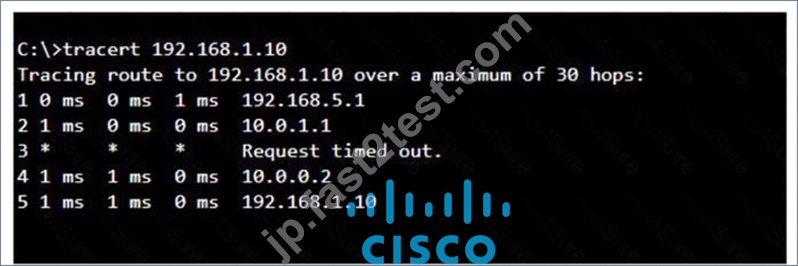
コマンド出力から何がわかりますか?
- A. アドレス 192.168.1.10 のサーバーはネットワーク経由でアクセスできます。
- B. サーバー アドレス 192.168.1.10 は、ホップ 3 のルーターのファイアウォールによってブロックされています。
- C. ホップ 3 のルータは、IP アドレス 192.168.1.10 にパケットを転送していません。
- D. 192.168.1.10 の Web サーバーへの要求が遅延し、タイムアウトになりました。
正解:A
解説:
The tracert command output shows the path taken to reach the destination IP address, 192.168.1.10. The command output indicates:
*Hops 1 and 2 are successfully reached.
*Hop 3 times out, meaning the router at hop 3 did not respond to the tracert request. However, this does not necessarily indicate a problem with forwarding packets, as some routers may be configured to block or not respond to ICMP requests.
*Hops 4 and 5 are successfully reached, with hop 5 being the destination IP 192.168.1.10, indicating that the server is reachable.
Thus, the correct answer is C. The server with the address 192.168.1.10 is reachable over the network.
References :=
*Cisco Traceroute Command
*Understanding Traceroute
The tracert command output indicates that the server with the address 192.168.1.10 is reachable over the network. The asterisk (*) at hop 3 suggests that the probe sent to that hop did not return a response, which could be due to a variety of reasons such as a firewall blocking ICMP packets or the router at that hop being configured not to respond to ICMP requests. However, since the subsequent hops (4 and 5) are showing response times, it means that the packets are indeed getting through and the server is reachable12.
References :=
*How to Use Traceroute Command to Read Its Results
*How to Use the Tracert Command in Windows
質問 # 29
各クラウド コンピューティング サービス モデルを左側のリストから右側の正しい例に移動します。注: 正解ごとに部分的なポイントが付与されます。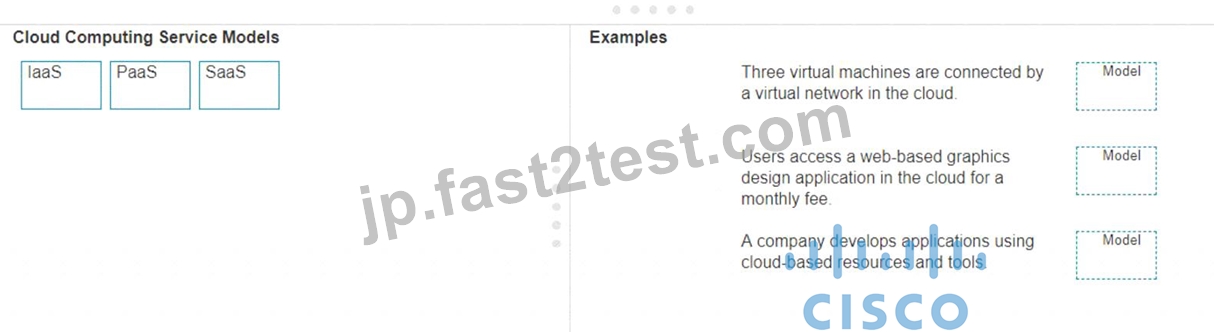
正解:
解説: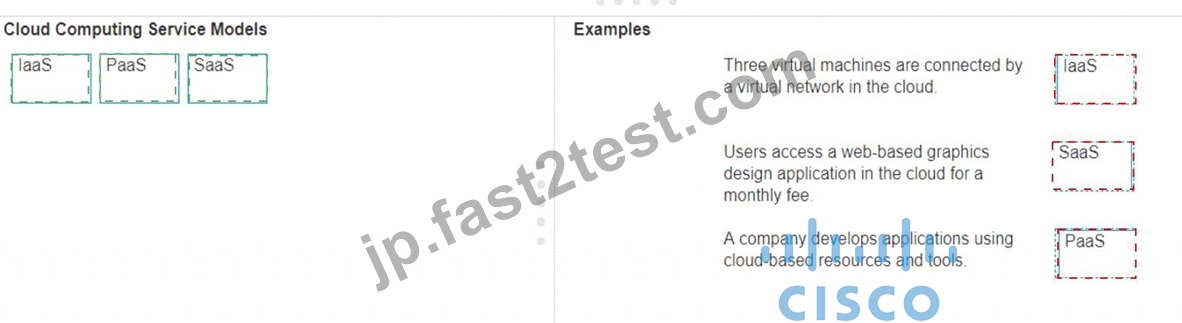
Explanation:
* Three virtual machines are connected by a virtual network in the cloud.
* Model: IaaS (Infrastructure as a Service)
* Explanation: IaaS provides virtualized computing resources over the internet, including virtual machines, storage, and networks.
* Users access a web-based graphics design application in the cloud for a monthly fee.
* Model: SaaS (Software as a Service)
* Explanation: SaaS delivers software applications over the internet, typically on a subscription basis, accessible via a web browser.
* A company develops applications using cloud-based resources and tools.
* Model: PaaS (Platform as a Service)
* Explanation: PaaS provides a platform allowing customers to develop, run, and manage applications without dealing with the infrastructure.
* IaaS (Infrastructure as a Service): Provides virtualized hardware resources that customers can use to build their own computing environments.
* PaaS (Platform as a Service): Offers a platform with tools and services to develop, test, and deploy applications.
* SaaS (Software as a Service): Delivers fully functional applications over the internet that users can access and use without managing the underlying infrastructure.
References:
* Cloud Service Models: Understanding IaaS, PaaS, SaaS
* NIST Definition of Cloud Computing:NIST Cloud Computing
質問 # 30
次の図は Cisco PoE スイッチを示しています。IP 電話にデータ接続と電源の両方を提供するポートのタイプはどれですか。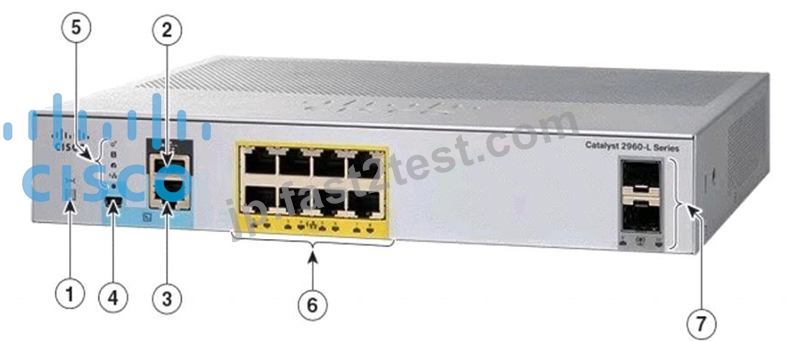
- A. 番号3と4で識別されるポート
- B. 番号2で識別されるポート
- C. 番号6で識別されるポート
- D. 番号7で識別されるポート
正解:C
解説:
In the provided image of the Cisco PoE switch, the ports identified with number 6 are the standard RJ-45 Ethernet ports typically found on switches that provide both data connectivity and Power over Ethernet (PoE).
PoE ports are designed to supply power to devices such as IP phones, wireless access points, and other PoE-enabled devices directly through the Ethernet cable.
Ports:
*2: Console port (for management and configuration)
*3 and 4: Specific function ports (often for management)
*6: RJ-45 Ethernet ports (capable of providing PoE)
*7: SFP ports (for fiber connections, typically do not provide PoE)
Thus, the correct answer is C. Ports identified with number 6.
References :=
*Cisco Catalyst 2960-L Series Switches Data Sheet
*Cisco PoE Overview
質問 # 31
各プロトコルを左側のリストから右側の正しい TCP/IP モデル レイヤーに移動します。
注意: 正解ごとに部分的な得点が与えられます。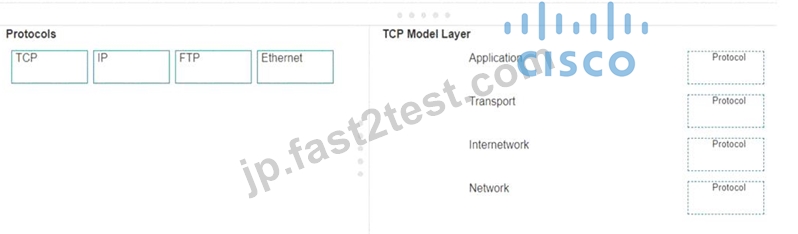
正解:
解説: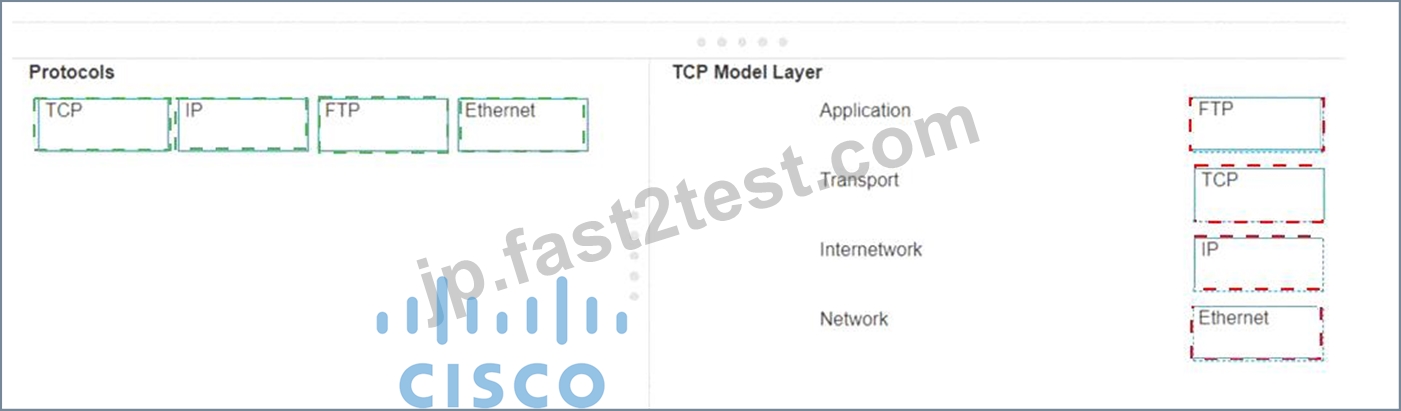
Explanation:
Here's how each protocol aligns with the correct TCP/IP model layer:
* TCP (Transmission Control Protocol): This protocol belongs to theTransportlayer, which is responsible for providing communication between applications on different hosts1.
* IP (Internet Protocol): IP is part of theInternetworklayer, which is tasked with routing packets across network boundaries to their destination1.
* FTP (File Transfer Protocol): FTP operates at theApplicationlayer, which supports application and end-user processes.It is used for transferring files over the network1.
* Ethernet: While not a protocol within the TCP/IP stack, Ethernet is associated with theNetwork Interfacelayer, which corresponds to the link layer of the TCP/IP model and is responsible for the physical transmission of data1.
The TCP/IP model layers are designed to work collaboratively to transmit data from one layer to another, with each layer having specific protocols that perform functions necessary for the data transmission process1.
* TCP:
* TCP Model Layer: Transport
* Explanation: The Transport layer is responsible for end-to-end communication and error handling. TCP (Transmission Control Protocol) operates at this layer to provide reliable, ordered, and error-checked delivery of data.
* IP:
* TCP Model Layer: Internetwork
* Explanation: The Internetwork layer, also known as the Internet layer, is responsible for logical addressing and routing. IP (Internet Protocol) operates at this layer to route packets across networks.
* FTP:
* TCP Model Layer: Application
* Explanation: The Application layer provides network services to applications. FTP (File Transfer Protocol) operates at this layer to transfer files between computers over a network.
* Ethernet:
* TCP Model Layer: Network
* Explanation: The Network layer, also known as the Link layer in the TCP/IP model, is responsible for physical addressing and access to the physical medium. Ethernet operates at this layer to provide the physical and data link functions.
* Transport Layer: This layer is responsible for providing communication services directly to the application processes running on different hosts. TCP is a core protocol in this layer.
* Internetwork Layer: This layer is responsible for logical addressing, routing, and packet forwarding.
IP is the primary protocol for this layer.
* Application Layer: This layer interfaces directly with application processes and provides common network services. FTP is an example of a protocol operating in this layer.
* Network Layer: In the TCP/IP model, this layer includes both the data link and physical layers of the OSI model. Ethernet is a protocol used in this layer to define network standards and communication protocols at the data link and physical levels.
References:
* TCP/IP Model Overview: Cisco TCP/IP Model
* Understanding the TCP/IP Model: TCP/IP Layers
質問 # 32
地元の会社では、2 つの新しい建物に 2 つのネットワークが必要です。これらのネットワークで使用するアドレスは、プライベート ネットワークの範囲内である必要があります。
会社が使用すべき 2 つのアドレス範囲はどれですか? (2 つ選択してください)
注意: 正しい選択ごとに部分的なポイントが付与されます。
- A. 192.168.0.0 から 192.168.255.255
- B. 11.0.0.0 から 11.255.255.255
- C. 192.16.0.0 から 192.16.255.255
- D. 172.16.0.0 から 172.31.255.255
正解:A、D
解説:
The private IP address ranges that are set aside specifically for use within private networks and not routable on the internet are as follows:
* Class A: 10.0.0.0 to 10.255.255.255
* Class B: 172.16.0.0 to 172.31.255.255
* Class C: 192.168.0.0 to 192.168.255.255
These ranges are defined by the Internet Assigned Numbers Authority (IANA) and are used for local communications within a private network123.
Given the options: A.172.16.0.0 to 172.31.255.255falls within the Class B private range. B.192.16.0.0 to
192.16.255.255is not a recognized private IP range. C.11.0.0.0 to 11.255.255.255is not a recognized private IP range. D.192.168.0.0 to 192.168.255.255falls within the Class C private range.
Therefore, the correct selections that the company should use for their private networks areAandD.
References:=
* Reserved IP addresses on Wikipedia
* Private IP Addresses in Networking - GeeksforGeeks
* Understanding Private IP Ranges, Uses, Benefits, and Warnings
質問 # 33
帯域幅とスループットに関する各ステートメントについて、True または False を選択します。
注意: 正しい選択ごとに部分的なポイントが付与されます。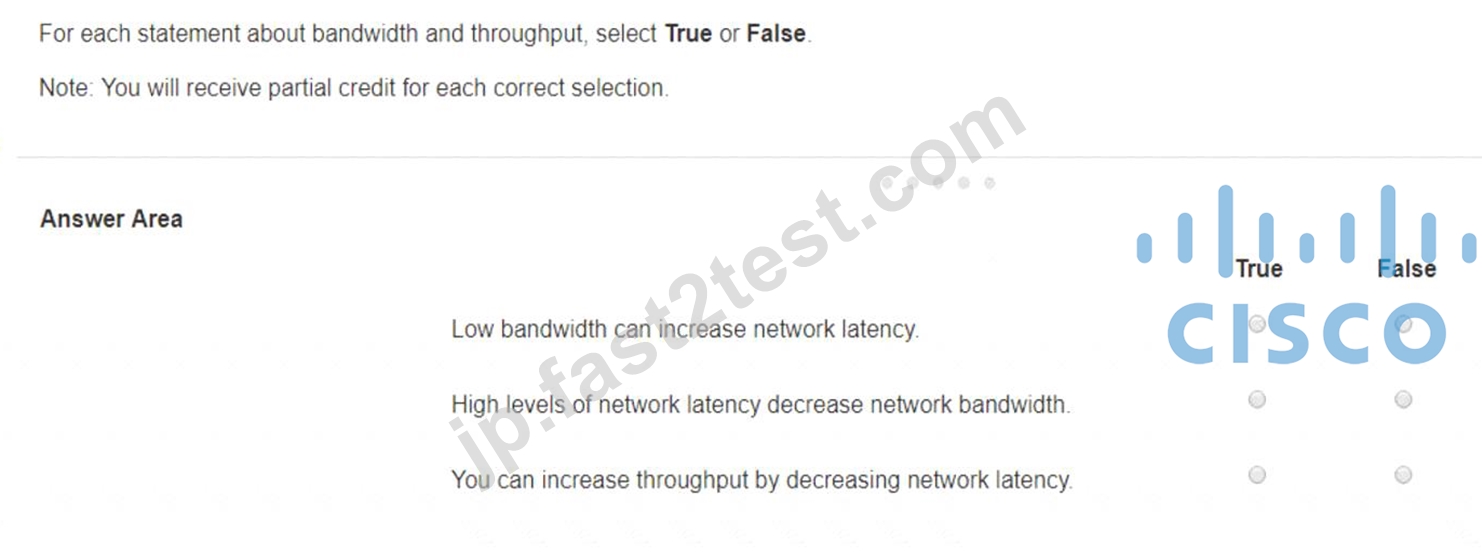
正解:
解説: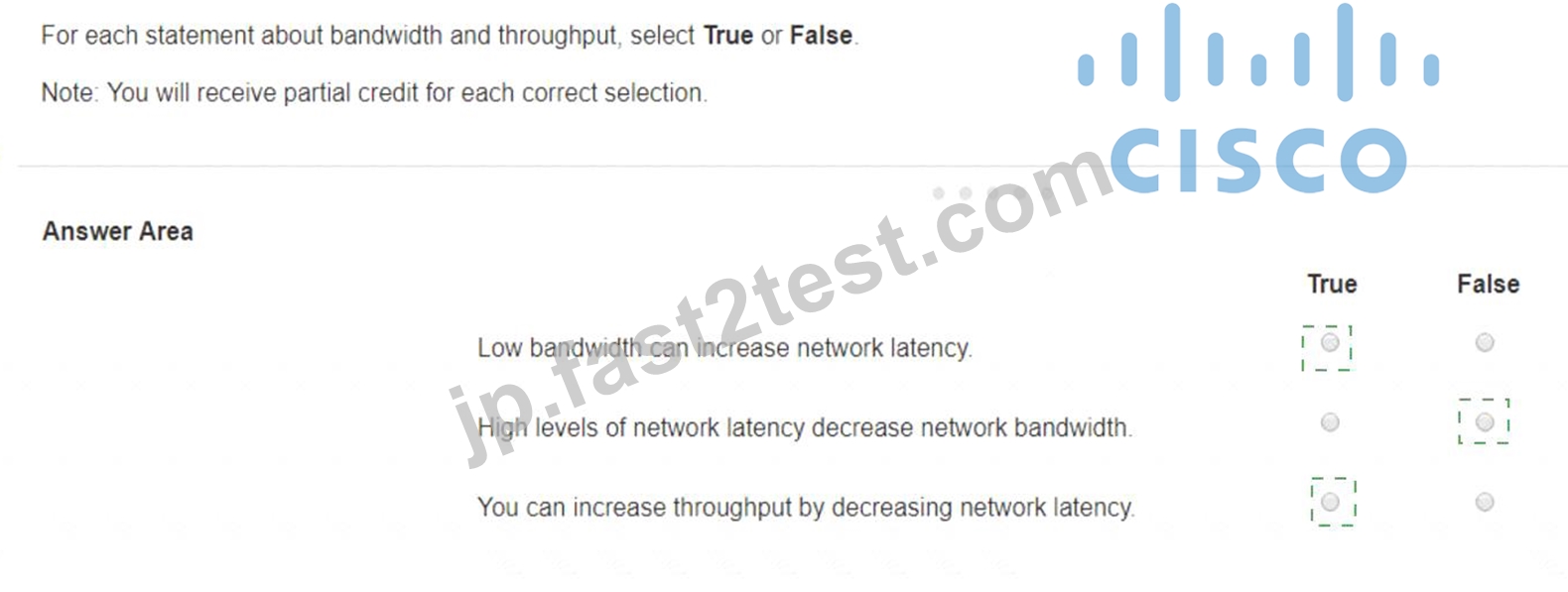
Explanation:
* Statement 1: Low bandwidth can increase network latency.
* True: Low bandwidth can result in increased network latency because the network may become congested, leading to delays in data transmission.
* Statement 2: High levels of network latency decrease network bandwidth.
* False: High levels of network latency do not decrease the available network bandwidth, but they do affect the perceived performance and throughput of the network.
* Statement 3: You can increase throughput by decreasing network latency.
* True: Decreasing network latency can increase throughput because data can be transmitted more quickly and efficiently without delays.
* Bandwidth vs. Latency: Bandwidth refers to the maximum rate at which data can be transferred over a network path. Latency is the time it takes for a data packet to travel from the source to the destination.
* Low bandwidth can cause network congestion, which can increase latency as packets wait to be transmitted.
* High latency does not reduce the actual bandwidth but can affect the overall performance and efficiency of data transmission.
* Reducing latency can lead to higher throughput because the network can handle more data in a given period without delays.
References:
* Network Performance Metrics: Cisco Network Performance
* Understanding Bandwidth and Latency: Bandwidth vs. Latency
質問 # 34
IPv6 アドレス 2001 :0db8:0000:0016:0000:001b: 2000:0056 の最も圧縮された有効な形式は何ですか?
- A. 2001:db8: : 16: : 1b: 2000: 56
- B. 2001:db8: 16: :1b:2:56
- C. 2001:db8: 0:16: :1b: 2000:56
- D. 2001:db8: : 16: : 1b:2:56
正解:C
解説:
IPv6 addresses can be compressed by removing leading zeros and replacing consecutive groups of zeros with a double colon (::). Here's how to compress the address 2001:0db8:0000:0016:0000:001b:2000:0056:
* Remove leading zeros from each segment:
* 2001:db8:0000:0016:0000:001b:2000:0056 becomes 2001:db8:0:16:0:1b:2000:56
* Replace the longest sequence of consecutive zeros with a double colon (::). In this case, the two consecutive zeros between the 16 and 1b:
* 2001:db8:0:16::1b:2000:56
Thus, the most compressed valid format of the IPv6 address is 2001:db8:0:16::1b:2000:56.
References:=
* Cisco Learning Network
* IPv6 Addressing (Cisco)
質問 # 35
次の出力を調べます。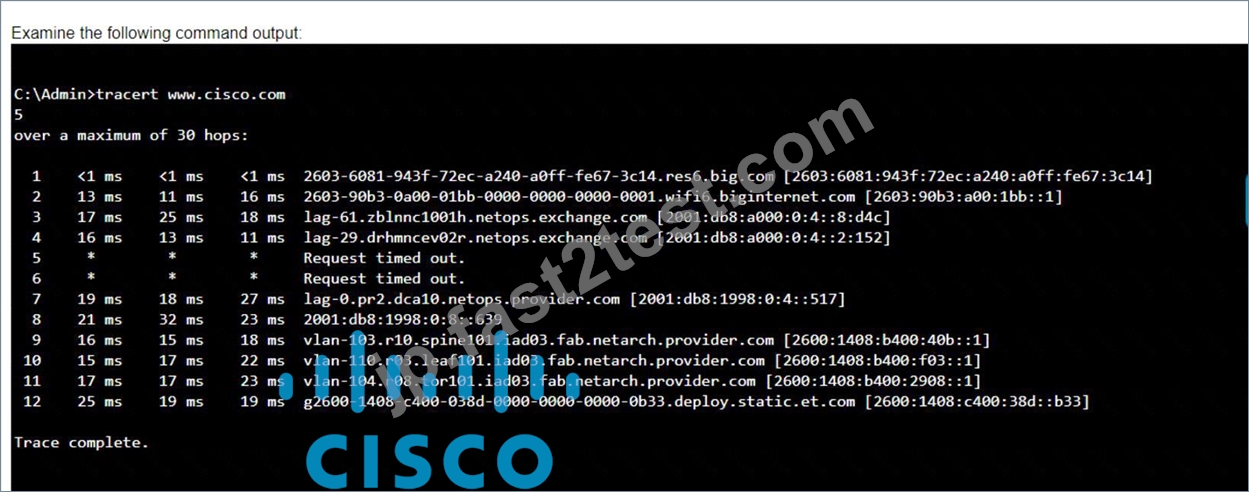
tracert コマンドの出力から、どの 2 つの結論を導き出すことができますか? (2 つ選択してください) 注: 正解ごとに部分的なポイントが付与されます。
- A. 4 回目のホップ後にトレースが失敗しました。
- B. トレースは www.cisco.com サーバーに正常に到達しました。
- C. トレース送信デバイスの IPv6 アドレスは 2600:1408:c400:38d :: b33 です。
- D. www.cisco.com サーバに関連付けられている IPv6 アドレスは 2600:1408: c400: 38d: : b33 です。
- E. ホップ 5 と 6 のルータはオフラインです。
正解:B、D
解説:
*Statement A: "The trace successfully reached the www.cisco.com server." This is true as indicated by the
"Trace complete" message at the end, showing that the trace has reached its destination.
*Statement C: "The IPv6 address associated with the www.cisco.com server is 2600:1408:c400:38d::b33." This is true because the final hop in the trace, which is the destination, has this IPv6 address.
*Statement B: "The trace failed after the fourth hop." This is incorrect as the trace continues beyond the fourth hop, despite some intermediate timeouts.
*Statement D: "The routers at hops 5 and 6 are offline." This is not necessarily true. The routers might be configured to not respond to traceroute requests.
*Statement E: "The device sending the trace has IPv6 address 2600:1408:c400:38d::b33." This is incorrect; this address belongs to the destination server, not the sender.
References:
*Understanding Traceroute: Traceroute Guide
質問 # 36
......
Cisco CCST-Networking日本語問題集PDFのベストを目指すなら問題集を使おう 目指そう高得点:https://jp.fast2test.com/CCST-Networking-JPN-premium-file.html