

2025年01月 Microsoft AZ-400認定リアル2025年最新の模擬試験合格させます
AZ-400試験問題と有効なAZ-400問題集でPDF
AZ-400認定試験は、Azure DevOpsソリューションでのバージョン管理、構成管理、ビルド、リリース、およびテストのためのDevOpsプラクティスを設計および実装する能力を測定します。本試験は、継続的インテグレーションおよび継続的デリバリー(CI / CD)パイプライン、インフラストラクチャのコード(IaC)、モニタリング、およびフィードバックシステムの知識も試験します。
Microsoft AZ-400(Microsoft DevOps ソリューションの設計と実装)認定試験は、Microsoft のテクノロジーを使用して DevOps プラクティスを開発および実装したいプロフェッショナルを対象としています。この試験は、ビルドインフラストラクチャの管理、継続的な統合および配信の実装、リリース管理およびモニタリングの設定能力を測定します。また、Azure、Visual Studio、Microsoft Teams などの Microsoft テクノロジーを統合する能力も評価されます。
質問 # 206
You need to configure access to Azure DevOps Agent pools to meet the forwarding requirements:
* Use a project agent pool when authoring build release pipelines.
* View the agent pool and agents of the organization.
* Use the principle of least privilege.
Which role memberships are required for the Azure 0e%Oos organization and the project? To answer, drag the appropriate role membership to the correct targets. Each role membership may be used once, more than once, or not at all. You may need to drag the split bar between panes or scroll to content NOTE: Each correct selection is worth one point.
正解:
解説:
References: https://docs.microsoft.com/en-us/azure/devops/pipelines/agents/pools-queues
質問 # 207
You have an Azure Repos repository named repo1.
You need to clone repo1. The solution must clone only a directory named src/web.
How should you complete the script? To answer, drag the appropriate values to the correct targets,Each value may be used once, more than once, or not at all. You may need to drag the spirt bar between panes or scroll to view content.
NOTE: Each correct selection is worth one point
正解:
解説:
質問 # 208
You need to ensure that the https://contoso.com/statushook webhook is called every time a repository named az40010480345acr1 receives a new version of an image named dotnetapp.
To complete this task, sign in to the Microsoft Azure portal.
正解:
解説:
See solution below.
Explanation:
* Sign in to the Azure portal.
* Navigate to the container registry az40010480345acr1.
* Under Services, select Webhooks.
* Select the existing webhook https://contoso.com/statushook, and double-click on it to get its properties.
* For Trigger actions select image push
Example web hook:
Reference:
https://docs.microsoft.com/en-us/azure/container-registry/container-registry-webhook
質問 # 209
You have a GitHub organization that contains three users named User 1. User2. and User3. You have a project that contains a repository named repo1. You need to configure permissions for repo1. The solution must meet the following requirements:
* Ensure that User 1 can actively push to repo1.
* Ensure that Usef2 can manage issues and pull requests for repo1.
* Ensure that User3 can manage repo1.
* Prevent User3 from accessing sensitive data in repo1.
Which role should you assign to each use?
正解:
解説:
質問 # 210
You have an Azure subscription that uses Azure Monitor and contains a Log Analytics workspace.
You have an encryption key.
You need to configure Azure Monitor to use the key to encrypt log data
正解:
解説:
1 - Create an Azure key vault and store the key.
2 - Configure the key vault properties for the cluster.
3 - Grant the system-assigned managed identity Key permission for the key vault.
4 - Create an Azure Monitor Logs dedicated cluster that has a system-assigned managed identity.
5 - Link the log Analytics workspace to the cluster.
質問 # 211
You need to configure authentication for App1. The solution must support the planned changes.
Which three actions should you perform in sequence? To answer, move all actions from the list of actions to the answer area and arrange them in the correct order.
正解:
解説:
Explanation:
Graphical user interface, text, application Description automatically generated
Woodgrove Bank plans to implement the following changes to the identity environment:
Configure App1 to use a service principal.
Reference:
https://docs.microsoft.com/en-us/azure/active-directory/develop/howto-create-service-principal-portal
質問 # 212
You need to recommend project metrics for dashboards in Azure DevOps.
Which chart widgets should you recommend for each metric? To answer, drag the appropriate chart widgets to the correct metrics. Each chart widget may be used once, more than once, or not at all. You may need to drag the split bar between panes or scroll to view content.
NOTE: Each correct selection is worth one point.
正解:
解説:
Explanation:
Box 1: Lead time
Lead time measures the total time elapsed from the creation of work items to their completion.
Box 2: Cycle time
Cycle time measures the time it takes for your team to complete work items once they begin actively working on them.
Box 3: Burndown
Burndown charts focus on remaining work within a specific time period.
Incorrect Answers:
References:
https://docs.microsoft.com/en-us/azure/devops/report/dashboards/velocity-guidance?view=vsts
https://docs.microsoft.com/en-us/azure/devops/report/dashboards/cycle-time-and-lead-time?view=vsts
https://docs.microsoft.com/en-us/azure/devops/report/dashboards/configure-burndown-burnup-widgets?view=vsts
質問 # 213
You have a virtual machine that runs Windows Server 2019 and is managed by using Desired State Configuration (DSC).
You have the following DSC configuration.
You have the following Local Configuration Manager (LCM) configuration.
For each of the following statements, select Yes if the statement is true. Otherwise, select No.
NOTE: Each correct selection is worth one point.
正解:
解説:
質問 # 214
You have an Azure Kubernetes Service (AKSJ pod that hosts an app named App1.
You need to configure the AKS container to restart automatically if the container stops responding. The solution must check the status of App1 once every three seconds.
How should you complete the deployment? To answer, drag the appropriate values to the correct targets. Each value may be used once, more than once, or not at all. You may need to drag the split bar between panes or scroll to view content NOTE: Each correct selection is worth one point.
正解:
解説:
Explanation:
質問 # 215
You need to configure access to Azure DevOps Agent pools to meet the forwarding requirements:
* Use a project agent pool when authoring build release pipelines.
* View the agent pool and agents of the organization.
* Use the principle of least privilege.
Which role memberships are required for the Azure 0e%Oos organization and the project? To answer, drag the appropriate role membership to the correct targets. Each role membership may be used once, more than once, or not at all. You may need to drag the split bar between panes or scroll to content NOTE: Each correct selection is worth one point.
正解:
解説:
Explanation:
project level role: UserOrganization level role: Reader
References: https://docs.microsoft.com/en-us/azure/devops/pipelines/agents/pools-queues
質問 # 216
To resolve the current technical issue, what should you do to the Register-AzureRmAutomationDscNode command?
- A. Replace the Register-AzureRmAutomationDscNode cmdlet with
Register-AzureRmAutomationScheduledRunbook - B. Add the AllowModuleOverwrite parameter.
- C. Change the value of the ConfigurationMode parameter.
- D. Add the DefaultProfile parameter.
正解:C
解説:
Explanation
Change the ConfigurationMode parameter from ApplyOnly to ApplyAndAutocorrect.
The Register-AzureRmAutomationDscNode cmdlet registers an Azure virtual machine as an APS Desired State Configuration (DSC) node in an Azure Automation account.
Scenario: Current Technical Issue
The test servers are configured correctly when first deployed, but they experience configuration drift over time. Azure Automation State Configuration fails to correct the configurations.
Azure Automation State Configuration nodes are registered by using the following command.
References:
https://docs.microsoft.com/en-us/powershell/module/azurerm.automation/register-azurermautomationdscnode?vi
質問 # 217
You need to implement Project6.
Which three actions should you perform in sequence? To answer, move the appropriate actions from the list of actions to the answer area and arrange them m the correct order.
正解:
解説:
Explanation
Scenario: Implement Project3, Project5, Project6, and Project7 based on the planned changes
Step 1: Open the release pipeline editor.
In the Releases tab of Azure Pipelines, select your release pipeline and choose Edit to open the pipeline editor.
Step 2: Enable Gates.
Choose the pre-deployment conditions icon for the Production stage to open the conditions panel. Enable gates by using the switch control in the Gates section.
Step 3: Add Query Work items.
Choose + Add and select the Query Work Items gate.
Configure the gate by selecting an existing work item query.
Note: A case for release gate is:
Incident and issues management. Ensure the required status for work items, incidents, and issues. For example, ensure deployment occurs only if no priority zero bugs exist, and validation that there are no active incidents takes place after deployment.
References:
https://docs.microsoft.com/en-us/azure/devops/pipelines/release/deploy-using-approvals?view=azure-devops#co
Topic 3, Woodgrove bank
This is a case study. Case studies are not timed separately. You can use as much exam time as you would like to complete each case. However, there may be additional case studies and sections on this exam. You must manage your time to ensure that you are able to complete all questions included on this exam in the time provided.
To answer the questions included in a case study, you will need to reference information that is provided in the case study. Case studies might contain exhibits and other resources that provide more information about the scenario that is described in the case study. Each question is independent of the other questions in this case study.
At the end of this case study, a review screen will appear. This screen allows you to review your answers and to make changes before you move to the next section of the exam. After you begin a new section, you cannot return to this section.
To start the case study
To display the first question in this case study, click the button. Use the buttons in the left pane to explore the content of the case study before you answer the questions. Clicking these buttons displays information such as business requirements, existing environment, and problem statements. If the case study has an All Information tab, note that the information displayed is identical to the information displayed on the subsequent tabs. When you are ready to answer a question, click the button to return to the question.
Overview
General Overview
Woodgrove Bank is a financial services company that has a main office in the United Kingdom.
Technical Requirements and Planned Changes
Planned Changes
Woodgrove Bank plans to implement the following project management changes:
* Implement Azure DevOps for project tracking.
* Centralize source code control in private GitHub repositories.
* Implement Azure Pipelines for build pipelines and release pipelines.
Woodgrove Bank plans to implement the following changes to the identity environment:
* Deploy an Azure AD tenant named woodgrovebank.com.
* Sync the Active Directory domain to Azure AD.
* Configure App1 to use a service principal.
* Integrate GitHub with Azure AD.
Woodgrove Bank plans to implement the following changes to the core apps:
* Migrate App1 to ASP.NET Core.
* Integrate Azure Pipelines and the third-party build tool used to develop App2.
Woodgrove Bank plans to implement the following changes to the DevOps environment:
* Deploy App1 to Azure App Service.
* Implement source control for the DB1 schema.
* Migrate all the source code from TFS1 to GitHub.
* Deploy App2 to an Azure virtual machine named VM1.
* Merge the POC branch into the GitHub default branch.
* Implement an Azure DevOps dashboard for stakeholders to monitor development progress.
Technical Requirements
Woodgrove Bank identifies the following technical requirements:
* The initial databases for new environments must contain both schema and reference data.
* An Azure Monitor alert for VM1 must be configured to meet the following requirements:
* Be triggered when average CPU usage exceeds 80 percent for 15 minutes.
* Calculate CPU usage averages once every minute.
* The commit history of the POC branch must replace the history of the default branch.
* The Azure DevOps dashboard must display the metrics shown in the following table.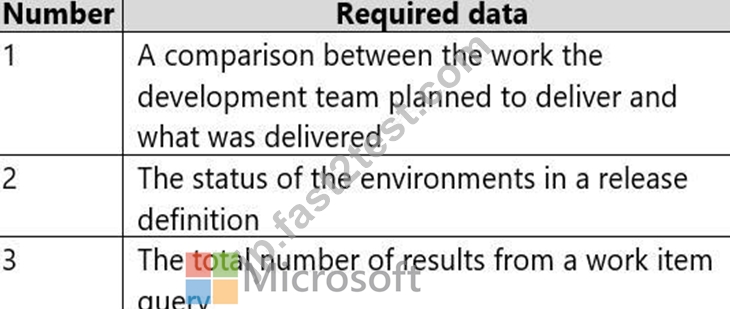
* Access to Azure DevOps must be restricted to specific IP addresses.
* Page load times for App1 must be captured and monitored.
* Administrative effort must be minimized.
質問 # 218
You use Get for source control.
You delete a file, commit the changes, and continue to work.
You need to recover the deleted file.
Which three commands should you run in sequence? To answer, move the appropriate commands from the list of commands to the answer area and arrange them in the correct order.
正解:
解説:
Explanation
質問 # 219
You have a Microsoft ASP.NET Core web app in Azure that is accessed worldwide.
You need to run a URL ping test once every five minutes and create an alert when the web app is unavailable from specific Azure regions. The solution must minimize development time.
What should you do?
- A. Create an Azure Application Insights availability test and alert.
- B. Create an Azure Monitor Availability metric and alert
- C. Write an Azure function and deploy the function to the specific regions.
- D. Create an Azure Service Health alert for the specific regions.
正解:A
解説:
There are three types of Application Insights availability tests:
* URL ping test: a simple test that you can create in the Azure portal.
* Multi-step web test
* Custom Track Availability Tests
Note: After you've deployed your web app/website, you can set up recurring tests to monitor availability and responsiveness. Azure Application Insights sends web requests to your application at regular intervals from points around the world. It can alert you if your application isn't responding, or if it responds too slowly.
You can set up availability tests for any HTTP or HTTPS endpoint that is accessible from the public internet. You don't have to make any changes to the website you're testing. In fact, it doesn't even have to be a site you own. You can test the availability of a REST API that your service depends on.
Reference:
https://docs.microsoft.com/en-us/azure/azure-monitor/app/monitor-web-app-availability#create-a-url-ping-test
質問 # 220
You have a web app that connects to an Azure SQL Database named db1.
You need to configure db1 to send Query Store runtime statistics to Azure Log Analytics.
To complete this task, sign in to the Microsoft Azure portal.
正解:
解説:
See explanation below
Explanation:
To enable streaming of diagnostic telemetry for a single or a pooled database, follow these steps:
1. Go to Azure SQL database resource.
2. Select Diagnostics settings.
3. Select Turn on diagnostics if no previous settings exist, or select Edit setting to edit a previous setting. You can create up to three parallel connections to stream diagnostic telemetry.
4. Select Add diagnostic setting to configure parallel streaming of diagnostics data to multiple resources.
5. Enter a setting name for your own reference.
6. Select a destination resource for the streaming diagnostics data: Archive to storage account, Stream to an event hub, or Send to Log Analytics.
7. For the standard, event-based monitoring experience, select the following check boxes for database diagnostics log telemetry: Query Store Runtime Statistics
8. For an advanced, one-minute-based monitoring experience, select the check box for Basic metrics.
9. Select Save.
Reference:
https://docs.microsoft.com/en-us/azure/azure-sql/database/metrics-diagnostic-telemetry-logging-streaming-expor
質問 # 221
Your company has two virtual machines that run Linux in a third-party public cloud.
You plan to use the company's Azure Automation State Configuration implementation to manage the two virtual machines and detect configuration drift.
You need to onboard the Linux virtual machines.
You install PowerShell Desired State Configuration (DSC) on the virtual machines, and then run register.py.
Which three actions should you perform next in sequence? To answer, move the actions from the list of actions to the answer area and arrange them in the correct order.
正解:
解説:
1 - Create a DSC metaconfiguration
2 - Copy the metaconfiguration to the virtual machines.
3 - Add the virtual machines as DSC nodes in Azure Automation.
質問 # 222
You plan to deploy a runbook that willcreate Azure AD user accounts.
You need to ensure that runbooks can run the Azure PowerShell cmdlets for Azure Active Directory.
To complete this task, sign in to the Microsoft Azure portal.
正解:
解説:
See solution below.
Explanation
AzureAutomation now ships with the Azure PowerShell module of version 0.8.6, which introduced the ability to non-interactively authenticate to Azure using OrgId (Azure Active Directory user) credential-based authentication. Using the steps below, you can set upAzure Automation to talk to Azure using this authentication type.
Step 1: Find the Azure Active Directory associated with the Azure subscription to manage:
1. Log in to the Azure portal as the service administrator for the Azure subscription you want to manage using Azure Automation. You can find this user by logging in to the Azure portal as any user with access to this Azure subscription, then clicking Settings, then Administrators.
2. Note the name of the directory associated with the Azure subscription you want to manage. You can find this directory by clicking Settings, then Subscriptions.
Step 2: Create an Azure Active Directory user in the directory associated with the Azure subscription to manage:
You can skip this step if you already have an Azure Active Directory user in this directory. and plan to use this OrgId to manage Azure.
1. In the Azure portal click on Active Directory service.
2. Click the directory name that is associated with this Azure subscription.
3. Click on theUsers tab and then click the Add User button.
4. For type of user, select "New user in your organization." Enter a username for the user to create.
5. Fill out the user's profile. For role, pick "User." Don't enable multi-factor authentication. Multi-factor accounts cannot be used with Azure Automation.
6. Click Create.
7. Jot down the full username (including part after @ symbol) and temporary password.
Step 3: Allow this Azure Active Directory user to manage this Azure subscription.
1. Click on Settings(bottom Azure tab under StorSimple)
2. Click Administrators
3. Click the Add button. Type the full user name (including part after @ symbol) of the Azure Active Directory user you want to set up to manage Azure. For subscriptions, choose the Azure subscriptions you want this user to be able to manage. Click the check mark.
Step 4: Configure Azure Automation to use this Azure Active Directory user to manage this Azure subscription Create an Azure Automation credential asset containing the username and password of the Azure Active Directory user that you have just created. You can create a credential asset in Azure Automation by clicking into an Automation Account and then clicking the Assets tab, then the Add Setting button.
Note: Once you have set up the Azure Active Directory credential in Azure and Azure Automation, you can now manage Azure from Azure Automation runbooks using this credential.
References:
https://azure.microsoft.com/sv-se/blog/azure-automation-authenticating-to-azure-using-azure-active-directory/
質問 # 223
You use Semantic Versioning (Sem Ver) as a dependency versioning strategy.
You perform changes to code as shown in the following table.
Which part of the version should you increment for each change? To answer, drag the appropriate parts to the correct changes. Each part may be used once, more than once, or not at all. You may need to drag the split bar between panes or scroll to view content.
NOTE: Each correct selection is worth one point.
正解:
解説:
質問 # 224
You need to ensure that an Azure web app named az400-9940427-main supports rolling upgrades. The solution must ensure that only 10 percent of users who connect to az400-9940427-main use update versions of the app.
The solution must minimize administrative effort.
To complete this task, sign in to the Microsoft Azure portal.
正解:
解説:
Set up staging environments in Azure App Service
1. Open Microsoft Azure Portal
2. Log into your Azure account, select your app's resource page, in the left pane, select Deployment slots > Add Slot.
3. In the Add a slot dialog box, give the slot a name, and select whether to clone an app configuration from another deployment slot. Select Add to continue.
4. After the slot is added, select Close to close the dialog box. The new slot is now shown on the Deployment slots page. By default, Traffic % is set to 0 for the new slot, with all customer traffic routed to the production slot.
5. Select the new deployment slot to open that slot's resource page.
6. Change TRAFFIC % to 10
References:
https://docs.microsoft.com/en-us/azure/app-service/deploy-staging-slots
質問 # 225
You have several Azure virtual machines that run Windows Server 2019.
You need to identify the distinct event IDs of each virtual machine as shown in the following table.
How should you complete the Azure Monitor query? To answer, drag the appropriate values to the correct locations. Each value may be used once, more than once, or not at all. You may need to drag the split bar between panes or scroll to view content.
正解:
解説:
Reference:
https://docs.microsoft.com/en-us/azure/azure-monitor/log-query/advanced-aggregations
質問 # 226
Your company uses a Git source-code repository.
You plan to implement GitFlow as a workflow strategy.
You need to identify which branch types are used for production code and preproduction code in the strategy.
Which branch type should you identify for each code type? To answer, select the appropriate options in the answer area.
NOTE: Each correct selection is worth one point.
正解:
解説:
Reference:
https://medium.com/@patrickporto/4-branching-workflows-for-git-30d0aaee7bf
質問 # 227
You have an Azure DevOps release pipeline as shown in the following exhibit.
You need to complete the pipeline to configure OWASP ZAP for security testing.
Which five Azure CLI tasks should you add in sequence? To answer, move the tasks from the list of tasks to the answer area and arrange them in the correct order.
正解:
解説:
1 - Call the Baseline Scan
2 - Download the file
3 - Convert Report Format
4 - Publish Test Results
5 - Destroy OWASP Container
Reference:
https://devblogs.microsoft.com/premier-developer/azure-devops-pipelines-leveraging-owasp-zap-in-the-release-pipeline/
質問 # 228
You need to implement the code flow strategy for Project2 in Azure DevOps.
Which three actions should you perform in sequence? To answer, move the appropriate actions from the list of actions to the answer area and arrange in the correct order.
正解:
解説:
Explanation
Step 1: Create a repository
A Git repository, or repo, is a folder that you've told Git to help you track file changes in. You can have any number of repos on your computer, each stored in their own folder.
Step 2: Create a branch
Branch policies help teams protect their important branches of development. Policies enforce your team's code quality and change management standards.
Step 3: Add a build validation policy
When a build validation policy is enabled, a new build is queued when a new pull request is created or when changes are pushed to an existing pull request targeting this branch. The build policy then evaluates the results of the build to determine whether the pull request can be completed.
Scenario:
Implement a code flow strategy for Project2 that will:
Enable Team2 to submit pull requests for Project2.
Enable Team2 to work independently on changes to a copy of Project2.
Ensure that any intermediary changes performed by Team2 on a copy of Project2 will be subject to the same restrictions as the ones defined in the build policy of Project2.
References: https://docs.microsoft.com/en-us/azure/devops/repos/git/manage-your-branches
質問 # 229
You have a protect in Azure DevOps.
You need to associate an automated test to a test case.
Which three actions should you perform in sequence? To answer, move the appropriate actions from the list of actions to the answer area and arrange them in the correct order.
正解:
解説:
1 - Create a test project.
2 - Check in a project to the Azure DevOps repository.
3 - Add the automated test tot a build pipeline.
Reference:
https://docs.microsoft.com/en-us/azure/devops/test/associate-automated-test-with-test-case
質問 # 230
Your company uses the following resources:
* Windows Server 2019 container images hosted in an Azure Container Registry
* Azure virtual machines that run the latest version of Ubuntu An Azure
* Log Analytics workspace Azure Active Directory (Azure AD)
* An Azure key vault
For which two resources can you receive vulnerability assessments in Azure Security Center? Each correct answer presents part of the solution.
- A. the Azure virtual machines that run the latest version of Ubuntu
- B. Azure Active Directory (Azure AD)
- C. the Windows Server 2019 container images hosted in the Azure Container Registry
- D. the Azure key vault
- E. the Azure Log Analytics workspace
正解:B、D
解説:
Explanation
https://docs.microsoft.com/en-us/azure/security-center/features-paas
https://docs.microsoft.com/en-us/azure/security-center/container-security
質問 # 231
......
試験は40~60の選択式・複数回答式問題から構成され、2時間以内に解答する必要があります。試験料は165ドルで、Microsoft認定プロフェッショナル(MCP)には15%の割引が適用されます。試験の合格点は1000点中700点です。
AZ-400問題集を無料PDFゲットせよ最近更新された問題:https://jp.fast2test.com/AZ-400-premium-file.html
AZ-400ブレーン問題集で学習ガイドには試験合格するための秘訣:https://drive.google.com/open?id=18BDnZd-26XUfMrTFDz2CVqY9hVv8V6b-