

[2025年最新] 高合格率な最新無料HPE7-A08試験問題集アンサーを使おう
HPE7-A08知能問題集PDF!HP HPE7-A08試験問セット
HP HPE7-A08 認定試験の出題範囲:
| トピック | 出題範囲 |
|---|---|
| トピック 1 |
|
| トピック 2 |
|
| トピック 3 |
|
| トピック 4 |
|
質問 # 19
You are deploying a pair of VSX switches parallel to some existing HPE Comware switches. You would like to configure a common first-hop redundancy protocol as part of your migration strategy. Which of these would be suitable?
- A. Active Forwarding
- B. HSRP
- C. Active Gateway
- D. VRRP
正解:D
解説:
When deploying HPE Aruba VSX switches parallel to existing HPE Comware switches, choosing a first-hop redundancy protocol compatible with both platforms is essential. VRRP (Virtual Router Redundancy Protocol) is widely supported across multiple vendors and is suitable for multi-vendor environments.
HSRP is Cisco proprietary and not supported on Aruba Comware or CX.
Active Forwarding and Active Gateway are Aruba VSX internal mechanisms, not standard first-hop redundancy protocols.
VRRP provides seamless failover and is supported in Comware and Aruba CX platforms.
Thus, VRRP is the suitable choice.
References:
HPE Aruba VSX Configuration Guide
Aruba Comware and CX Interoperability Documentation
VRRP RFC and Aruba Deployment Guides
質問 # 20
What must an OSPF router do when it receives a link state update?
- A. It must run the shortest path first algorithm.
- B. It must participate in a new election for the Designated Router and Backup DR.
- C. It must initiate a graceful restart timer.
- D. It must re-establish adjacency with its Designated Router and Backup DR.
正解:A
質問 # 21
Which protocol is essential for preventing loops in Layer 2 networks?
Response:
- A. VRRP
- B. OSPF
- C. RIP
- D. STP
正解:D
質問 # 22
Which command is used to configure a VLAN on an Aruba switch via CLI?
Response:
- A. create vlan 10
- B. switchport vlan 10
- C. set vlan 10
- D. vlan 10
正解:D
質問 # 23
Which network design principle improves efficiency by logically grouping devices?
Response:
- A. Scalability
- B. Segmentation
- C. Convergence
- D. Redundancy
正解:B
質問 # 24
What is the main advantage of implementing stacking in HPE Aruba switches?
Response:
- A. Centralized management
- B. Increased bandwidth
- C. Enhanced security
- D. Faster switching speeds
正解:A
質問 # 25
Examine the AOS-CS switch output: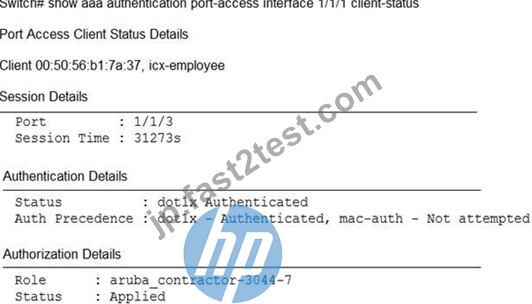
Based on this output, what is correct?
- A. Only 802.1X authentication is configured on the port
- B. 802.1X authentication was successful, but MAC authentication is yet to start
- C. 802.1X authentication occurred and downloadable user roles are deployed
- D. A local user role was deployed using a ClearPass solution
正解:C
解説:
The role 'aruba_contractor-3044-7' is the exact correct format for a DUR.
質問 # 26
An administrator is managing a VSX pair of AOS-CX switches. An administrator configures the following on the primary AOS-CX switch:
- A. The VLAN is only created on the secondary switch.
- B. The operation is not allowed by the switch and a CLI error is displayed
- C. The VLAN is created on both the primary and secondary switches
- D. The primary switch will erase VLAN 200 from the VSX pair
正解:C
質問 # 27
A user reports slow access to a cloud application. The switch shows normal CPU utilization. What should be checked next?
- A. VLAN assignments
- B. End-to-end latency
- C. QoS policies
- D. STP configuration
正解:B
質問 # 28
A network administrator is tasked to set up BGP in the company's network. The administrator is defining an eBGP peering between an AOS-CX switch and a directly-connected service provider.
The administrator has configured the following on the AOS-CX switch: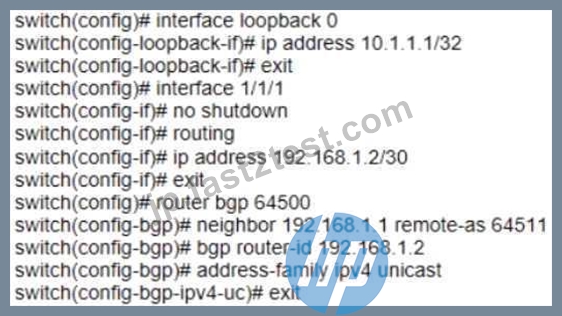
However, when using the "show bgp all summary" command, the state does not display
"Established" for the eBGP peer. What must the administrator configure to fix this issue?
- A. router bgp 64500 enable
- B. router bgp 64500 address-family ipv4 unicast neighbor 192.168.1.1 activate
- C. router bgp 64500 neighbor 192.168.1.1 update-source loopback0
- D. router bgp 64500 neighbor 192.168.1.1 ebgp-multihop
正解:B
質問 # 29
A company has just purchased AOS-CX switches. The company has a free and open-source AAA solution. The company wants to implement access control on the Ethernet ports of the AOS- CX switches.
Which security features can the company implement given the equipment that they are using?
- A. Device fingerprinting
- B. Local user roles
- C. Downloadable user roles
- D. Port-based tunneling
正解:B
解説:
You need use 3rd party AAA server. DUR is use for CLeapass.
質問 # 30
Examine the following AOS-CX configuration: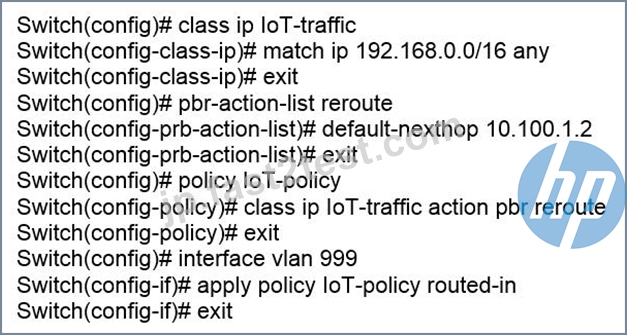
Based on this configuration, which statement is correct regarding IoT traffic?
- A. All routes are ignored in the routing table for IoT traffic, which is routed to 10.100.1.2
- B. If 10.100.1.2 is not reachable, the IoT traffic will be automatically dropped by the switch
- C. If a specific route is not available in the routing table, the traffic will be routed to 10.100.1.2
- D. The next hop of 10.100.1.2 can be one or more hops away from the AOS-CX switch
正解:C
解説:
default-nexthop
Sets the next hop for routing the packet when there is no explicit route for its destination.
質問 # 31
What should you configure for an interface connected to a device you cannot trust to assign DSCP markings?
(Select two.)
- A. Apply a dscp-map to the interface to assign a Local Priority value
- B. Apply a classifier-based policy to the interface to assign a Local Priority value
- C. Configure "qos trust none"
- D. Configure "qos trust cos"
- E. Configure Weighted Fair Queuing
正解:B、C
解説:
For an interface connected to an untrusted device regarding DSCP markings, the recommended configurations are:
Apply a classifier-based policy to assign a Local Priority value (Option B). This overrides or marks traffic based on predefined criteria.
Configure qos trust none (Option E) to disable trusting DSCP or CoS markings from the device, preventing manipulation of QoS.
Trusting CoS (Option A) is incorrect because the device is untrusted.
DSCP maps and Weighted Fair Queuing (Options C and D) are additional QoS features but do not specifically address untrusted markings.
References:
ArubaOS-CX QoS Configuration Guide
HPE Aruba Networking QoS Best Practices
Aruba CX Trust Model Documentation
質問 # 32
Examine the following ACL rule policies:
* Permit traffic from 10.2.2.1 through 10.2.2.30 to anywhere
* Permit traffic from 10.2.2.40 through 10.2.2.55 to anywhere
* Deny all others
Based on this policy, place the following ACL rule statements in the correct order to accomplish the above filtering policy.
- A. deny ip 10.2.2.31 255.255.255.255 any
permit ip 10.2.2.40 255.255.255.248 any
deny ip 10.2.2.32 255.255.255.224 any
permit ip 10.2.2.48 255.255.255.248 any
permit ip 10.2.2.0 255.255.255.192 any - B. deny ip 10.2.2.31 255.255.255.255 any
deny ip 10.2.2.32 255.255.255.224 any
permit ip 10.2.2.40 255.255.255.248 any
permit ip 10.2.2.48 255.255.255.248 any
permit ip 10.2.2.0 255.255.255.192 any - C. deny ip 10.2.2.31 255.255.255.255 any
permit ip 10.2.2.40 255.255.255.248 any
permit ip 10.2.2.48 255.255.255.248 any
deny ip 10.2.2.32 255.255.255.224 any
permit ip 10.2.2.0 255.255.255.192 any - D. permit ip 10.2.2.40 255.255.255.248 any
permit ip 10.2.2.48 255.255.255.248 any
permit ip 10.2.2.0 255.255.255.192 any
deny ip 10.2.2.31 255.255.255.255 any
deny ip 10.2.2.32 255.255.255.224 any
正解:C
質問 # 33
You have applied the following OSPF configuration but are seeing the output from the command below.
What is the reason for this?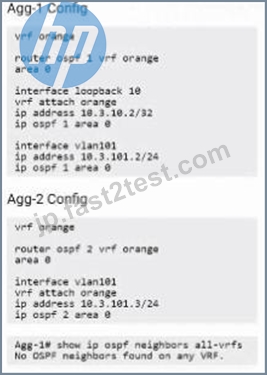
- A. A Layer-3 interface has not been associated with a VRF
- B. A different OSPF process ID is used on each switch
- C. A loopback interface hasn't been configured on Agg-2
- D. OSPF interfaces are passive by default
正解:A
解説:
The question concerns an OSPF configuration where the interface does not come up as expected.
Common reasons for no OSPF adjacency or interface participation include:
Interfaces being passive (no adjacency formed)
Mismatched OSPF process IDs
Missing loopback interfaces (for router ID)
Layer-3 interfaces not associated with VRFs when VRFs are configured
Option D (a Layer-3 interface has not been associated with a VRF) is the root cause because in Aruba CX switches, when VRF is configured, all Layer-3 interfaces that participate in OSPF must be associated with the correct VRF instance to establish adjacency and participate correctly.
If an interface is not part of the VRF configured for OSPF, it will not appear in the OSPF interface list or form neighbors.
References:
ArubaOS-CX VRF and OSPF configuration guides
OSPF troubleshooting guides on Aruba CX switches
Aruba Network Design Best Practices documents
質問 # 34
Your customer has an existing gateway cluster that they are using to tunnel traffic from APs and would like to configure the same for their CX switches. Which tunneling option should you recommend?
- A. UBT
- B. VNBT
- C. IPSec
- D. GRE
正解:A
解説:
The customer wants to tunnel traffic from APs through CX switches, similar to what they currently do with a gateway cluster. Aruba's User-Based Tunneling (UBT) is designed specifically for this use case. UBT allows traffic from wireless and wired clients to be tunneled to a centralized gateway or controller for policy enforcement and traffic inspection.
IPSec and GRE are general tunneling protocols but not Aruba's recommended solution for AP traffic.
VNBT relates to colorless ports and dynamic segmentation, not tunneling client traffic.
Thus, UBT is the correct tunneling solution for AP traffic through CX switches.
References:
Aruba User-Based Tunneling Whitepaper
ArubaOS-CX Wireless Integration Guide
HPE Aruba Networking Solutions for Campus Networks
質問 # 35
Which features are part of Aruba Central?
(Select two.)
Response:
- A. SD-WAN integration
- B. Switch configuration
- C. Intrusion Prevention
- D. VLAN monitoring
正解:A、B
質問 # 36
......
HP HPE7-A08問題集PDFを使ってベストオプションを目指そう:https://jp.fast2test.com/HPE7-A08-premium-file.html
2025年最新のHPE7-A08サンプル問題は頼もしいHPE7-A08テストエンジン:https://drive.google.com/open?id=1-SboRg8vCYNCrJBMb9cBQp6GUmiXRg7w