

[2025年更新]早速ゲットしてトップランクのISTQB CT-AI試験問題集
パスする秘訣はCT-AIをゲットして認証された試験エンジンPDF
ISTQB CT-AI 認定試験の出題範囲:
| トピック | 出題範囲 |
|---|---|
| トピック 1 |
|
| トピック 2 |
|
| トピック 3 |
|
| トピック 4 |
|
| トピック 5 |
|
| トピック 6 |
|
| トピック 7 |
|
| トピック 8 |
|
| トピック 9 |
|
質問 # 19
Which ONE of the following options is the MOST APPROPRIATE stage of the ML workflow to set model and algorithm hyperparameters?
SELECT ONE OPTION
- A. Data testing
- B. Tuning the model
- C. Deploying the model
- D. Evaluating the model
正解:B
解説:
Setting model and algorithm hyperparameters is an essential step in the machine learning workflow, primarily occurring during the tuning phase.
Evaluating the model (A): This stage involves assessing the model's performance using metrics and does not typically include the setting of hyperparameters.
Deploying the model (B): Deployment is the stage where the model is put into production and used in real-world applications. Hyperparameters should already be set before this stage.
Tuning the model (C): This is the correct stage where hyperparameters are set. Tuning involves adjusting the hyperparameters to optimize the model's performance.
Data testing (D): Data testing involves ensuring the quality and integrity of the data used for training and testing the model. It does not include setting hyperparameters.
Hence, the most appropriate stage of the ML workflow to set model and algorithm hyperparameters is C. Tuning the model.
Reference:
ISTQB CT-AI Syllabus Section 3.2 on the ML Workflow outlines the different stages of the ML process, including the tuning phase where hyperparameters are set.
Sample Exam Questions document, Question #31 specifically addresses the stage in the ML workflow where hyperparameters are configured.
質問 # 20
A ML engineer is trying to determine the correctness of the new open-source implementation *X", of a supervised regression algorithm implementation. R-Square is one of the functional performance metrics used to determine the quality of the model.
Which ONE of the following would be an APPROPRIATE strategy to achieve this goal?
SELECT ONE OPTION
- A. Drop 10% of the rows randomly and create another model and compare the R-Square scores of both the models.
- B. Compare the R-Square score of the model obtained using two different implementations that utilize two different programming languages while using the same algorithm and the same training and testing data.
- C. Train various models by changing the order of input features and verify that the R-Square score of these models vary significantly.
- D. Add 10% of the rows randomly and create another model and compare the R-Square scores of both the model.
正解:B
解説:
A . Add 10% of the rows randomly and create another model and compare the R-Square scores of both the models.
Adding more data to the training set can affect the R-Square score, but it does not directly verify the correctness of the implementation.
B . Train various models by changing the order of input features and verify that the R-Square score of these models vary significantly.
Changing the order of input features should not significantly affect the R-Square score if the implementation is correct, but this approach is more about testing model robustness rather than correctness of the implementation.
C . Compare the R-Square score of the model obtained using two different implementations that utilize two different programming languages while using the same algorithm and the same training and testing data.
This approach directly compares the performance of two implementations of the same algorithm. If both implementations produce similar R-Square scores on the same training and testing data, it suggests that the new implementation "X" is correct.
D . Drop 10% of the rows randomly and create another model and compare the R-Square scores of both the models.
Dropping data can lead to variations in the R-Square score but does not directly verify the correctness of the implementation.
Therefore, option C is the most appropriate strategy because it directly compares the performance of the new implementation "X" with another implementation using the same algorithm and datasets, which helps in verifying the correctness of the implementation.
質問 # 21
Which ONE of the following combinations of Training, Validation, Testing data is used during the process of learning/creating the model?
SELECT ONE OPTION
- A. Training data * test data
- B. Training data - validation data
- C. Validation data - test data
- D. Training data - validation data - test data
正解:D
解説:
The process of developing a machine learning model typically involves the use of three types of datasets:
Training Data: This is used to train the model, i.e., to learn the patterns and relationships in the data.
Validation Data: This is used to tune the model's hyperparameters and to prevent overfitting during the training process.
Test Data: This is used to evaluate the final model's performance and to estimate how it will perform on unseen data.
Let's analyze each option:
A . Training data - validation data - test data
This option correctly includes all three types of datasets used in the process of creating and validating a model. The training data is used for learning, validation data for tuning, and test data for final evaluation.
B . Training data - validation data
This option misses the test data, which is crucial for evaluating the model's performance on unseen data after the training and validation phases.
C . Training data - test data
This option misses the validation data, which is important for tuning the model and preventing overfitting during training.
D . Validation data - test data
This option misses the training data, which is essential for the initial learning phase of the model.
Therefore, the correct answer is A because it includes all necessary datasets used during the process of learning and creating the model: training, validation, and test data.
質問 # 22
Which ONE of the following describes a situation of back-to-back testing the LEAST?
SELECT ONE OPTION
- A. Comparison of the results of a home-grown neural network model ML model with results in a neural network model implemented in a standard implementation (for example Pytorch) for same data
- B. Comparison of the results of the current neural network ML model on the current data set with a slightly modified data set.
- C. Comparison of the results of a neural network ML model with a current decision tree ML model for the same data.
- D. Comparison of the results of a current neural network model ML model implemented in platform A (for example Pytorch) with a similar neural network model ML model implemented in platform B (for example Tensorflow), for the same data.
正解:C
解説:
Back-to-back testing is a method where the same set of tests are run on multiple implementations of the system to compare their outputs. This type of testing is typically used to ensure consistency and correctness by comparing the outputs of different implementations under identical conditions. Let's analyze the options given:
A . Comparison of the results of a current neural network model ML model implemented in platform A (for example Pytorch) with a similar neural network model ML model implemented in platform B (for example Tensorflow), for the same data.
This option describes a scenario where two different implementations of the same type of model are being compared using the same dataset. This is a typical back-to-back testing situation.
B . Comparison of the results of a home-grown neural network model ML model with results in a neural network model implemented in a standard implementation (for example Pytorch) for the same data.
This option involves comparing a custom implementation with a standard implementation, which is also a typical back-to-back testing scenario to validate the custom model against a known benchmark.
C . Comparison of the results of a neural network ML model with a current decision tree ML model for the same data.
This option involves comparing two different types of models (a neural network and a decision tree). This is not a typical scenario for back-to-back testing because the models are inherently different and would not be expected to produce identical results even on the same data.
D . Comparison of the results of the current neural network ML model on the current data set with a slightly modified data set.
This option involves comparing the outputs of the same model on slightly different datasets. This could be seen as a form of robustness testing or sensitivity analysis, but not typical back-to-back testing as it doesn't involve comparing multiple implementations.
Based on this analysis, option C is the one that describes a situation of back-to-back testing the least because it compares two fundamentally different models, which is not the intent of back-to-back testing.
質問 # 23
Upon testing a model used to detect rotten tomatoes, the following data was observed by the test engineer, based on certain number of tomato images.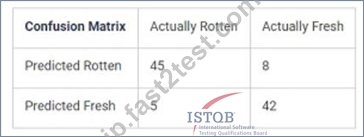
For this confusion matrix which combinations of values of accuracy, recall, and specificity respectively is CORRECT?
SELECT ONE OPTION
- A. 0.84.1,0.9
- B. 0.87.0.9. 0.84
- C. 1,0.87,0.84
- D. 1,0.9, 0.8
正解:B
解説:
To calculate the accuracy, recall, and specificity from the confusion matrix provided, we use the following formulas:
Confusion Matrix:
Actually Rotten: 45 (True Positive), 8 (False Positive)
Actually Fresh: 5 (False Negative), 42 (True Negative)
Accuracy:
Accuracy is the proportion of true results (both true positives and true negatives) in the total population.
Formula: Accuracy=TP+TNTP+TN+FP+FN\text{Accuracy} = \frac{TP + TN}{TP + TN + FP + FN}Accuracy=TP+TN+FP+FNTP+TN Calculation: Accuracy=45+4245+42+8+5=87100=0.87\text{Accuracy} = \frac{45 + 42}{45 + 42 + 8 + 5} = \frac{87}{100} = 0.87Accuracy=45+42+8+545+42=10087=0.87 Recall (Sensitivity):
Recall is the proportion of true positive results in the total actual positives.
Formula: Recall=TPTP+FN\text{Recall} = \frac{TP}{TP + FN}Recall=TP+FNTP Calculation: Recall=4545+5=4550=0.9\text{Recall} = \frac{45}{45 + 5} = \frac{45}{50} = 0.9Recall=45+545=5045=0.9 Specificity:
Specificity is the proportion of true negative results in the total actual negatives.
Formula: Specificity=TNTN+FP\text{Specificity} = \frac{TN}{TN + FP}Specificity=TN+FPTN Calculation: Specificity=4242+8=4250=0.84\text{Specificity} = \frac{42}{42 + 8} = \frac{42}{50} = 0.84Specificity=42+842=5042=0.84 Therefore, the correct combinations of accuracy, recall, and specificity are 0.87, 0.9, and 0.84 respectively.
Reference:
ISTQB CT-AI Syllabus, Section 5.1, Confusion Matrix, provides detailed formulas and explanations for calculating various metrics including accuracy, recall, and specificity.
"ML Functional Performance Metrics" (ISTQB CT-AI Syllabus, Section 5).
質問 # 24
Data used for an object detection ML system was found to have been labelled incorrectly in many cases.
Which ONE of the following options is most likely the reason for this problem?
SELECT ONE OPTION
- A. Accuracy issues
- B. Security issues
- C. Bias issues
- D. Privacy issues
正解:A
解説:
The question refers to a problem where data used for an object detection ML system was labelled incorrectly. This issue is most closely related to "accuracy issues." Here's a detailed explanation:
Accuracy Issues: The primary goal of labeling data in machine learning is to ensure that the model can accurately learn and make predictions based on the given labels. Incorrectly labeled data directly impacts the model's accuracy, leading to poor performance because the model learns incorrect patterns.
Why Not Other Options:
Security Issues: This pertains to data breaches or unauthorized access, which is not relevant to the problem of incorrect data labeling.
Privacy Issues: This concerns the protection of personal data and is not related to the accuracy of data labeling.
Bias Issues: While bias in data can affect model performance, it specifically refers to systematic errors or prejudices in the data rather than outright incorrect labeling.
質問 # 25
Which ONE of the following options is an example that BEST describes a system with Al-based autonomous functions?
SELECT ONE OPTION
- A. A fully automated manufacturing plant that uses no software.
- B. A system that utilizes a tool like Selenium.
- C. A system that utilizes human beings for all important decisions.
- D. A system that is fully able to respond to its environment.
正解:D
解説:
* AI-Based Autonomous Functions: An AI-based autonomous system is one that can respond to its environment without human intervention. The other options either involve human decisions or do not use AI at all.
* Reference: ISTQB_CT-AI_Syllabus_v1.0, Sections on Autonomy and Testing Autonomous AI-Based Systems.
質問 # 26
A software component uses machine learning to recognize the digits from a scan of handwritten numbers. In the scenario above, which type of Machine Learning (ML) is this an example of?
SELECT ONE OPTION
- A. Regression
- B. Classification
- C. Clustering
- D. Reinforcement learning
正解:B
解説:
Recognizing digits from a scan of handwritten numbers using machine learning is an example of classification. Here's a breakdown:
Classification: This type of machine learning involves categorizing input data into predefined classes. In this scenario, the input data (handwritten digits) are classified into one of the 10 digit classes (0-9).
Why Not Other Options:
Reinforcement Learning: This involves learning by interacting with an environment to achieve a goal, which does not fit the problem of recognizing digits.
Regression: This is used for predicting continuous values, not discrete categories like digit recognition.
Clustering: This involves grouping similar data points together without predefined classes, which is not the case here.
質問 # 27
Which of the following is THE LEAST appropriate tests to be performed for testing a feature related to autonomy?
SELECT ONE OPTION
- A. Test for human handover to give rest to the system.
- B. Test for human handover when it should actually not be relinquishing control.
- C. Test for human handover requiring mandatory relinquishing control.
- D. Test for human handover after a given time interval.
正解:B
解説:
* Testing Autonomy: Testing for human handover when it should not be relinquishing control is the least appropriate because it contradicts the very definition of autonomous systems. The other tests are relevant to ensuring smooth operation and transitions between human and AI control.
* Reference: ISTQB_CT-AI_Syllabus_v1.0, Sections on Testing Autonomous AI-Based Systems and Testing for Human-AI Interaction.
質問 # 28
"Splendid Healthcare" has started developing a cancer detection system based on ML. The type of cancer they plan on detecting has 2% prevalence rate in the population of a particular geography. It is required that the model performs well for both normal and cancer patients.
Which ONE of the following combinations requires MAXIMIZATION?
SELECT ONE OPTION
- A. Maximize recall and precision
- B. Maximize specificity number of classes
- C. Maximize precision and accuracy
- D. Maximize accuracy and recall
正解:A
解説:
Prevalence Rate and Model Performance:
The cancer detection system being developed by "Splendid Healthcare" needs to account for the fact that the type of cancer has a 2% prevalence rate in the population. This indicates that the dataset is highly imbalanced with far fewer positive (cancer) cases compared to negative (normal) cases.
Importance of Recall:
Recall, also known as sensitivity or true positive rate, measures the proportion of actual positive cases that are correctly identified by the model. In medical diagnosis, especially cancer detection, recall is critical because missing a positive case (false negative) could have severe consequences for the patient. Therefore, maximizing recall ensures that most, if not all, cancer cases are detected.
Importance of Precision:
Precision measures the proportion of predicted positive cases that are actually positive. High precision reduces the number of false positives, meaning fewer people will be incorrectly diagnosed with cancer. This is also important to avoid unnecessary anxiety and further invasive testing for those who do not have the disease.
Balancing Recall and Precision:
In scenarios where both false negatives and false positives have significant consequences, it is crucial to balance recall and precision. This balance ensures that the model is not only good at detecting positive cases but also accurate in its predictions, reducing both types of errors.
Accuracy and Specificity:
While accuracy (the proportion of total correct predictions) is important, it can be misleading in imbalanced datasets. In this case, high accuracy could simply result from the model predicting the majority class (normal) correctly. Specificity (true negative rate) is also important, but for a cancer detection system, recall and precision take precedence to ensure positive cases are correctly and accurately identified.
Conclusion:
Therefore, for a cancer detection system with a low prevalence rate, maximizing both recall and precision is crucial to ensure effective and accurate detection of cancer cases.
質問 # 29
Which ONE of the following approaches to labelling requires the least time and effort?
SELECT ONE OPTION
- A. Internal
- B. Al-Assisted
- C. Pre-labeled dataset
- D. Outsourced
正解:C
解説:
* Labelling Approaches: Among the options provided, pre-labeled datasets require the least time and effort because the data has already been labeled, eliminating the need for further manual or automated labeling efforts.
* Reference: ISTQB_CT-AI_Syllabus_v1.0, Section 4.5 Data Labelling for Supervised Learning, which discusses various approaches to data labeling, including pre-labeled datasets, and their associated time and effort requirements.
質問 # 30
"AllerEgo" is a product that uses sell-learning to predict the behavior of a pilot under combat situation for a variety of terrains and enemy aircraft formations. Post training the model was exposed to the real- world data and the model was found to be behaving poorly. A lot of data quality tests had been performed on the data to bring it into a shape fit for training and testing.
Which ONE of the following options is least likely to describes the possible reason for the fall in the performance, especially when considering the self-learning nature of the Al system?
SELECT ONE OPTION
The difficulty of defining criteria for improvement before the model can be accepted.
The fast pace of change did not allow sufficient time for testing.
The unknown nature and insufficient specification of the operating environment might have caused the poor performance.
There was an algorithmic bias in the Al system.
- A. The difficulty of defining criteria for improvement before the model can be accepted.
Defining criteria for improvement is a challenge in the acceptance of AI models, but it is not directly related to the performance drop in real-world scenarios. It relates more to the evaluation and deployment phase rather than affecting the model's real-time performance post-deployment. - B. The unknown nature and insufficient specification of the operating environment might have caused the poor performance.
This is highly likely to affect performance. Self-learning AI systems require detailed specifications of the operating environment to adapt and learn effectively. If the environment is insufficiently specified, the model may fail to perform accurately in real-world scenarios. - C. There was an algorithmic bias in the AI system.Algorithmic bias can significantly impact the performance of AI systems. If the model has biases, it will not perform well across different scenarios and data distributions.
- D. The fast pace of change did not allow sufficient time for testing.
This can significantly affect the model's performance. If the system is self-learning, it needs to adapt quickly, and insufficient testing time can lead to incomplete learning and poor performance.
正解:A
解説:
Given the context of the self-learning nature and the need for real-time adaptability, option A is least likely to describe the fall in performance because it deals with acceptance criteria rather than real-time performance issues.
質問 # 31
The activation value output for a neuron in a neural network is obtained by applying computation to the neuron.
Which ONE of the following options BEST describes the inputs used to compute the activation value?
SELECT ONE OPTION
- A. Activation values of neurons in the previous layer, and weights assigned to the connections between the neurons.
- B. Individual bias at the neuron level, and activation values of neurons in the previous layer.
- C. Individual bias at the neuron level, activation values of neurons in the previous layer, and weights assigned to the connections between the neurons.
- D. Individual bias at the neuron level, and weights assigned to the connections between the neurons.
正解:C
解説:
In a neural network, the activation value of a neuron is determined by a combination of inputs from the previous layer, the weights of the connections, and the bias at the neuron level. Here's a detailed breakdown:
Inputs for Activation Value:
Activation Values of Neurons in the Previous Layer: These are the outputs from neurons in the preceding layer that serve as inputs to the current neuron.
Weights Assigned to the Connections: Each connection between neurons has an associated weight, which determines the strength and direction of the input signal.
Individual Bias at the Neuron Level: Each neuron has a bias value that adjusts the input sum, allowing the activation function to be shifted.
Calculation:
The activation value is computed by summing the weighted inputs from the previous layer and adding the bias.
Formula: z=∑(wiai)+bz = \sum (w_i \cdot a_i) + bz=∑(wiai)+b, where wiw_iwi are the weights, aia_iai are the activation values from the previous layer, and bbb is the bias.
The activation function (e.g., sigmoid, ReLU) is then applied to this sum to get the final activation value.
Why Option A is Correct:
Option A correctly identifies all components involved in computing the activation value: the individual bias, the activation values of the previous layer, and the weights of the connections.
Eliminating Other Options:
B . Activation values of neurons in the previous layer, and weights assigned to the connections between the neurons: This option misses the bias, which is crucial.
C . Individual bias at the neuron level, and weights assigned to the connections between the neurons: This option misses the activation values from the previous layer.
D . Individual bias at the neuron level, and activation values of neurons in the previous layer: This option misses the weights, which are essential.
Reference:
ISTQB CT-AI Syllabus, Section 6.1, Neural Networks, discusses the components and functioning of neurons in a neural network.
"Neural Network Activation Functions" (ISTQB CT-AI Syllabus, Section 6.1.1).
質問 # 32
Which ONE of the following options does NOT describe a challenge for acquiring test data in ML systems?
SELECT ONE OPTION
- A. Nature of data constantly changes with lime.
- B. Compliance needs require proper care to be taken of input personal data.
- C. Data for the use case is being generated at a fast pace.
- D. Test data being sourced from public sources.
正解:C
解説:
* Challenges for Acquiring Test Data in ML Systems: Compliance needs, the changing nature of data over time, and sourcing data from public sources are significant challenges. Data being generated quickly is generally not a challenge; it can actually be beneficial as it provides more data for training and testing.
* Reference: ISTQB_CT-AI_Syllabus_v1.0, Sections on Data Preparation and Data Quality Issues.
質問 # 33
Which ONE of the following options does NOT describe an Al technology related characteristic which differentiates Al test environments from other test environments?
SELECT ONE OPTION
- A. The challenge of mimicking undefined scenarios generated due to self-learning
- B. Challenges resulting from low accuracy of the models.
- C. Challenges in the creation of scenarios of human handover for autonomous systems.
- D. The challenge of providing explainability to the decisions made by the system.
正解:C
解説:
AI test environments have several unique characteristics that differentiate them from traditional test environments. Let's evaluate each option:
A . Challenges resulting from low accuracy of the models.
Low accuracy is a common challenge in AI systems, especially during initial development and training phases. Ensuring the model performs accurately in varied and unpredictable scenarios is a critical aspect of AI testing.
B . The challenge of mimicking undefined scenarios generated due to self-learning.
AI systems, particularly those that involve machine learning, can generate undefined or unexpected scenarios due to their self-learning capabilities. Mimicking and testing these scenarios is a unique challenge in AI environments.
C . The challenge of providing explainability to the decisions made by the system.
Explainability, or the ability to understand and articulate how an AI system arrives at its decisions, is a significant and unique challenge in AI testing. This is crucial for trust and transparency in AI systems.
D . Challenges in the creation of scenarios of human handover for autonomous systems.
While important, the creation of scenarios for human handover in autonomous systems is not a characteristic unique to AI test environments. It is more related to the operational and deployment challenges of autonomous systems rather than the intrinsic technology-related characteristics of AI .
Given the above points, option D is the correct answer because it describes a challenge related to operational deployment rather than a technology-related characteristic unique to AI test environments.
質問 # 34
An image classification system is being trained for classifying faces of humans. The distribution of the data is 70% ethnicity A and 30% for ethnicities B, C and D. Based ONLY on the above information, which of the following options BEST describes the situation of this image classification system?
SELECT ONE OPTION
- A. This is an example of expert system bias.
- B. This is an example of sample bias.
- C. This is an example of algorithmic bias.
- D. This is an example of hyperparameter bias.
正解:B
解説:
A . This is an example of expert system bias.
Expert system bias refers to bias introduced by the rules or logic defined by experts in the system, not by the data distribution.
B . This is an example of sample bias.
Sample bias occurs when the training data is not representative of the overall population that the model will encounter in practice. In this case, the over-representation of ethnicity A (70%) compared to B, C, and D (30%) creates a sample bias, as the model may become biased towards better performance on ethnicity A.
C . This is an example of hyperparameter bias.
Hyperparameter bias relates to the settings and configurations used during the training process, not the data distribution itself.
D . This is an example of algorithmic bias.
Algorithmic bias refers to biases introduced by the algorithmic processes and decision-making rules, not directly by the distribution of training data.
Based on the provided information, option B (sample bias) best describes the situation because the training data is skewed towards ethnicity A, potentially leading to biased model performance.
質問 # 35
......
CT-AI試験問題は練習は2025年最新の40問題:https://jp.fast2test.com/CT-AI-premium-file.html
CT-AI試験問題集パスと最新テスト問題集:https://drive.google.com/open?id=1FG6hb4FLQKY-GF-zYeV4tdJmURM_hZsR