

[2024年12月07日] 合格させるSAP C_ABAPD_2309試験情報と無料練習テスト
C_ABAPD_2309試験問題集PDF更新された問題集にはFast2test試験合格保証付き
SAP C_ABAPD_2309 認定試験の出題範囲:
| トピック | 出題範囲 |
|---|---|
| トピック 1 |
|
| トピック 2 |
|
| トピック 3 |
|
質問 # 35
Which field is defined incorrectly?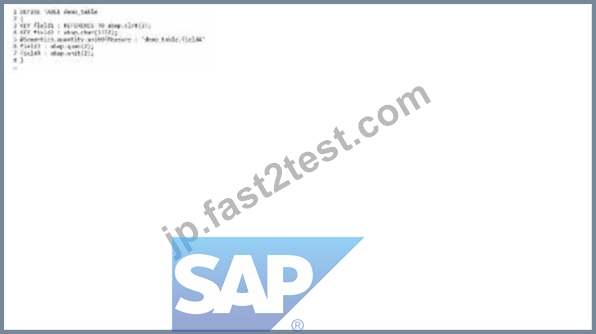
- A. field4
- B. field2
- C. field3
- D. field1
正解:A
解説:
Explanation
The field4 is defined incorrectly in the ABAP code snippet. The reason is that the data type c (character) cannot have a decimal places specification. The decimal places specification is only valid for the data types p (packed number) and f (floating point number)1. Therefore, the field4 definition should either omit the decimal places specification or change the data type to p or f.
References: 1: Data Types and Data Objects - ABAP Keyword Documentation - SAP Online Help
質問 # 36
In ABAP SQL, which of the following retrieves the association field_Airline-Name of a CDS view?
- A. "_Airline Name
- B. @_Airline-Name
- C. /_Airline Name
- D. \_Airline-Name
正解:B
解説:
Explanation
In ABAP SQL, the syntax to retrieve the association field of a CDS view is to use the @ sign followed by the association name and the field name, separated by a period sign (.). For example, to retrieve the association field _Airline-Name of a CDS view, the syntax is @_Airline.Name. This syntax allows the access to the fields of the target data source of the association without explicitly joining the data sources1. The other options are incorrect because they use the wrong symbols or formats to access the association field.
References: 1: Path Expressions - ABAP Keyword Documentation
質問 # 37
For what kind of applications would you consider using on-stack developer extensions? Note: There are 2 correct answers to this question.
- A. Applications that provide APIs for side by side SAP BTP apps
- B. Applications that integrate data from several different systems
- C. Applications that access SAP S/4HANA data using complex SQL
- D. Applications that run separate from SAP S/4HANA
正解:A、C
解説:
Explanation
On-stack developer extensibility is a type of extensibility that allows you to create development projects directly on the SAP S/4HANA Cloud technology stack. It gives you the opportunity to develop cloud-ready and upgrade-stable custom ABAP applications and services inside the SAP S/4HANA Cloud, public edition system. You can use the ABAP Development Tools in Eclipse to create and deploy your on-stack extensions.
On-stack developer extensibility is suitable for the following kinds of applications:
Applications that provide APIs for side by side SAP BTP apps. On-stack developer extensibility allows you to create OData services or RESTful APIs based on CDS view entities or projection views. These services or APIs can expose SAP S/4HANA data and logic to other applications that run on the SAP Business Technology Platform (SAP BTP) or other platforms. This way, you can create a loosely coupled integration between your SAP S/4HANA system and your side by side SAP BTP apps.
Applications that access SAP S/4HANA data using complex SQL. On-stack developer extensibility allows you to use ABAP SQL to access SAP S/4HANA data using complex queries, such as joins, aggregations, filters, parameters, and code pushdown techniques. You can also use ABAP SQL to perform data manipulation operations, such as insert, update, delete, and upsert. This way, you can create applications that require advanced data processing and analysis on SAP S/4HANA data.
The other kinds of applications are not suitable for on-stack developer extensibility, as they have different requirements and challenges. These kinds of applications are:
Applications that integrate data from several different systems. On-stack developer extensibility is not meant for creating applications that integrate data from multiple sources, such as other SAP systems, third-party systems, or cloud services. This is because on-stack developer extensibility does not support remote access or data replication, and it may cause performance or security issues. For this kind of applications, you should use side by side extensibility, which allows you to create applications that run on the SAP BTP and communicate with the SAP S/4HANA system via public APIs or events.
Applications that run separate from SAP S/4HANA. On-stack developer extensibility is not meant for creating applications that run independently from the SAP S/4HANA system, such as standalone apps, microservices, or web apps. This is because on-stack developer extensibility requires a tight coupling with the SAP S/4HANA system, and it may limit the scalability, flexibility, and portability of the applications. For this kind of applications, you should use side by side extensibility, which allows you to create applications that run on the SAP BTP and leverage the cloud-native features and services of the platform.
References: Developer Extensibility in SAP S/4HANA Cloud ABAP Environment, SAP S/4HANA Extensibility - Simplified Guide for Beginners
質問 # 38
In this nested join below in which way is the join evaluated?
- A. From the bottom to the top in the order of the on conditions:
1.
a is joined with b
2.
b is joined with c - B. From the right to the left in the order of the tables:
1.
b is joined with c.
2.
b is joined with a. - C. From the left to the right in the order of the tables:
1.
a is joined with b
2.
b is joined with c - D. From the top to the bottom in the order of the on conditions
1.
b is joined with c
2.
a is joined with b
正解:D
解説:
Explanation
The nested join is evaluated from the top to the bottom in the order of the ON conditions. This means that the join expression is formed by assigning each ON condition to the directly preceding JOIN from left to right.
The join expression can be parenthesized implicitly or explicitly to show the order of evaluation. In this case, the implicit parentheses are as follows:
SELECT * FROM (a INNER JOIN (b INNER JOIN c ON b~c = c~c) ON a~b = b~b) This means that the first join expression is b INNER JOIN c ON b~c = c~c, which joins the columns of tables b and c based on the condition that b~c equals c~c. The second join expression is a INNER JOIN (b INNER JOIN c ON b~c = c~c) ON a~b = b~b, which joins the columns of table a and the result of the first join expression based on the condition that a~b equals b~b. The final result set contains all combinations of rows from tables a, b, and c that satisfy both join conditions.
References: 1: SELECT, FROM JOIN - ABAP Keyword Documentation - SAP Online Help
質問 # 39 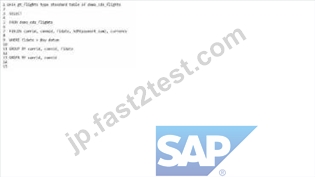
To adhere to the most recent ABAP SQL syntax conventions from SAP, on which line must you insert the
"INTO TABLE @gt flights" clause to complete the SQL statement?
- A. #8
- B. #15
- C. #4
- D. #6
正解:C
解説:
Explanation
To adhere to the most recent ABAP SQL syntax conventions from SAP, you must insert the "INTO TABLE
@gt flights" clause on line #4 to complete the SQL statement. This is because the INTO or APPENDING clause should be specified immediately after the SELECT clause, according to the ABAP SQL syntax conventions1. The INTO or APPENDING clause defines the data object to which the results set of the SELECT statement is assigned. The data object can be an internal table, a work area, or an inline declaration.
In this case, the data object is an internal table named gt_flights, which is created using the inline declaration operator @DATA. The inline declaration operator allows you to declare and create a data object in the same statement where it is used, without the need for a separate DATA statement2.
The other lines are not suitable for inserting the "INTO TABLE @gt flights" clause, as they would violate the ABAP SQL syntax conventions or cause syntax errors. These lines are:
#6: This line is not suitable for inserting the "INTO TABLE @gt flights" clause, as it would cause a syntax error. This is because the FROM clause must be specified before the INTO or APPENDING clause, according to the ABAP SQL syntax conventions1. The FROM clause defines the data sources from which the data is read, such as database tables, CDS view entities, or CDS DDIC-based views. In this case, the data source is the database table flights.
#8: This line is not suitable for inserting the "INTO TABLE @gt flights" clause, as it would cause a syntax error. This is because the ORDER BY clause must be specified after the INTO or APPENDING clause, according to the ABAP SQL syntax conventions1. The ORDER BY clause defines the sort order of the results set of the SELECT statement. In this case, the results set is sorted by the fields carrid, connid, and fltime.
#15: This line is not suitable for inserting the "INTO TABLE @gt flights" clause, as it would violate the ABAP SQL syntax conventions. This is because the INTO or APPENDING clause should be specified as close as possible to the SELECT clause, according to the ABAP SQL syntax conventions1. The INTO or APPENDING clause should not be separated from the SELECT clause by other clauses, such as the WHERE clause, the GROUP BY clause, the HAVING clause, the UNION clause, or the ORDER BY clause. This is to improve the readability and maintainability of the ABAP SQL statement.
References: SELECT - ABAP Keyword Documentation, Inline Declarations - ABAP Keyword Documentation
質問 # 40 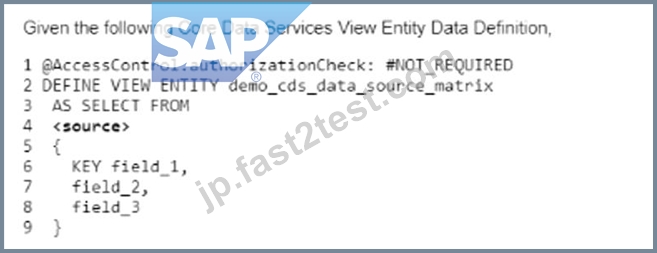
Which of the following types are permitted to be used for <source> on line #4? Note: There are 2 correct answers to this question.
- A. A CDS DDIC-based view
- B. An external view from the ABAP Dictionary
- C. A database table from the ABAP Dictionary
- D. A database view from the ABAP Dictionary
正解:A、C
解説:
The <source> clause in the CDS View Entity Data Definition can be used to specify the data source for the view entity. The <source> clause can accept different types of data sources, depending on the type of the view entity1.
* A database table from the ABAP Dictionary: This is a valid type of data source for a CDS View Entity Data Definition. A database table from the ABAP Dictionary is a table that is defined in the ABAP Dictionary using the keyword TABLE or TABLE OF. The name of the database table must be unique within its namespace and must not contain any special characters2.
* A CDS DDIC-based view: This is also a valid type of data source for a CDS View Entity Data Definition. A CDS DDIC-based view is a view that is defined in the Core Data Services using the keyword DEFINE VIEW ENTITY. The name of the CDS DDIC-based view must be unique within its namespace and must not contain any special characters3.
You cannot do any of the following:
* An external view from the ABAP Dictionary: This is not a valid type of data source for a CDS View Entity Data Definition. An external view from the ABAP Dictionary is a view that is defined in an
* external application using any language supported by SAP, such as SQL, PL/SQL, or Java. The name of the external view must be unique within its namespace and must not contain any special characters4.
* A database view from the ABAP Dictionary: This is not a valid type of data source for a CDS View Entity Data Definition. A database view from the ABAP Dictionary is a view that is defined in an external application using any language supported by SAP, such as SQL, PL/SQL, or Java. The name of the database view must be unique within its namespace and must not contain any special characters4.
References: 1: CDS DDL - DEFINE VIEW ENTITY - ABAP Keyword Documentation - SAP Online Help 2:
ABAP Dictionary Tables - SAP Online Help 3: CDS DDL - DEFINE VIEW ENTITY - ABAP Keyword Documentation - SAP Online Help 4: ABAP Dictionary Views - SAP Online Help
質問 # 41
What are some of the reasons that Core Data Services are preferable to the classical approach to data modeling? Note: There are 2 correct answers to this question.
- A. They transfer computational results to the application server.
- B. They compute results on the application server.
- C. They avoid data transfer completely.
- D. They implement code pushdown.
正解:A、D
解説:
Explanation
Core Data Services (CDS) are preferable to the classical approach to data modeling for several reasons, but two of them are:
They implement code pushdown. Code pushdown is the principle of moving data-intensive logic from the application server to the database server, where the data resides. This reduces the data transfer between the application server and the database server, which improves the performance and scalability of the application. CDS enable code pushdown by allowing the definition of semantic data models and business logic in the database layer, using SQL and SQL-based expressions1.
They transfer computational results to the application server. CDS allow the application server to access the data and the logic defined in the database layer by using Open SQL statements. Open SQL is a standardized and simplified subset of SQL that can be used across different database platforms. Open SQL statements are translated into native SQL statements by the ABAP runtime environment and executed on the database server. The results of the computation are then transferred to the application server, where they can be further processed or displayed2.
References: 1: ABAP - Core Data Services (ABAP CDS) - ABAP Keyword Documentation 2: Open SQL - ABAP Keyword Documentation
質問 # 42 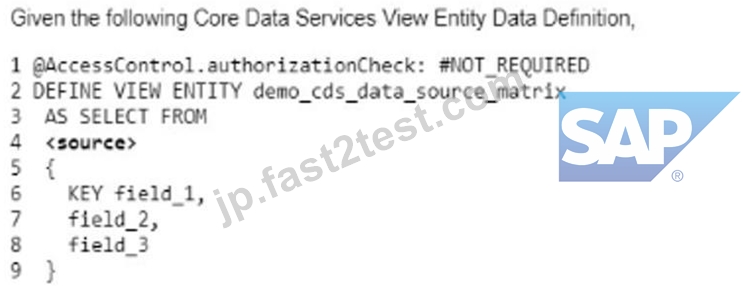
Which of the following types are permitted to be used for <source> on line #4? Note: There are 2 correct answers to this question.
- A. A CDS DDIC-based view
- B. An external view from the ABAP Dictionary
- C. A database table from the ABAP Dictionary
- D. A database view from the ABAP Dictionary
正解:A、C
解説:
Explanation
The <source> clause in the CDS View Entity Data Definition can be used to specify the data source for the view entity. The <source> clause can accept different types of data sources, depending on the type of the view entity1.
A database table from the ABAP Dictionary: This is a valid type of data source for a CDS View Entity Data Definition. A database table from the ABAP Dictionary is a table that is defined in the ABAP Dictionary using the keyword TABLE or TABLE OF. The name of the database table must be unique within its namespace and must not contain any special characters2.
A CDS DDIC-based view: This is also a valid type of data source for a CDS View Entity Data Definition. A CDS DDIC-based view is a view that is defined in the Core Data Services using the keyword DEFINE VIEW ENTITY. The name of the CDS DDIC-based view must be unique within its namespace and must not contain any special characters3.
You cannot do any of the following:
An external view from the ABAP Dictionary: This is not a valid type of data source for a CDS View Entity Data Definition. An external view from the ABAP Dictionary is a view that is defined in an external application using any language supported by SAP, such as SQL, PL/SQL, or Java. The name of the external view must be unique within its namespace and must not contain any special characters4.
A database view from the ABAP Dictionary: This is not a valid type of data source for a CDS View Entity Data Definition. A database view from the ABAP Dictionary is a view that is defined in an external application using any language supported by SAP, such as SQL, PL/SQL, or Java. The name of the database view must be unique within its namespace and must not contain any special characters4.
References: 1: CDS DDL - DEFINE VIEW ENTITY - ABAP Keyword Documentation - SAP Online Help 2:
ABAP Dictionary Tables - SAP Online Help 3: CDS DDL - DEFINE VIEW ENTITY - ABAP Keyword Documentation - SAP Online Help 4: ABAP Dictionary Views - SAP Online Help
質問 # 43
When processing an internal table with the statement LOOP AT itab... ENDLOOP, what system variable contains the current row number?
- A. sy-subrc
- B. sy-index
- C. sy-tabix
- D. sy-linno
正解:C
解説:
When processing an internal table with the statement LOOP AT itab... ENDLOOP, the system variable that contains the current row number is sy-tabix. The sy-tabix variable is a predefined field of the system structure sy that holds the index or the row number of the current line in an internal table loop. The sy-tabix variable is initialized with the value 1 for the first loop pass and is incremented by 1 for each subsequent loop pass. The sy-tabix variable can be used to access or modify the current line of the internal table using the index access12.
References: 1: LOOP AT itab - ABAP Keyword Documentation - SAP Online Help 2: System Fields - ABAP Keyword Documentation - SAP Online Help
質問 # 44 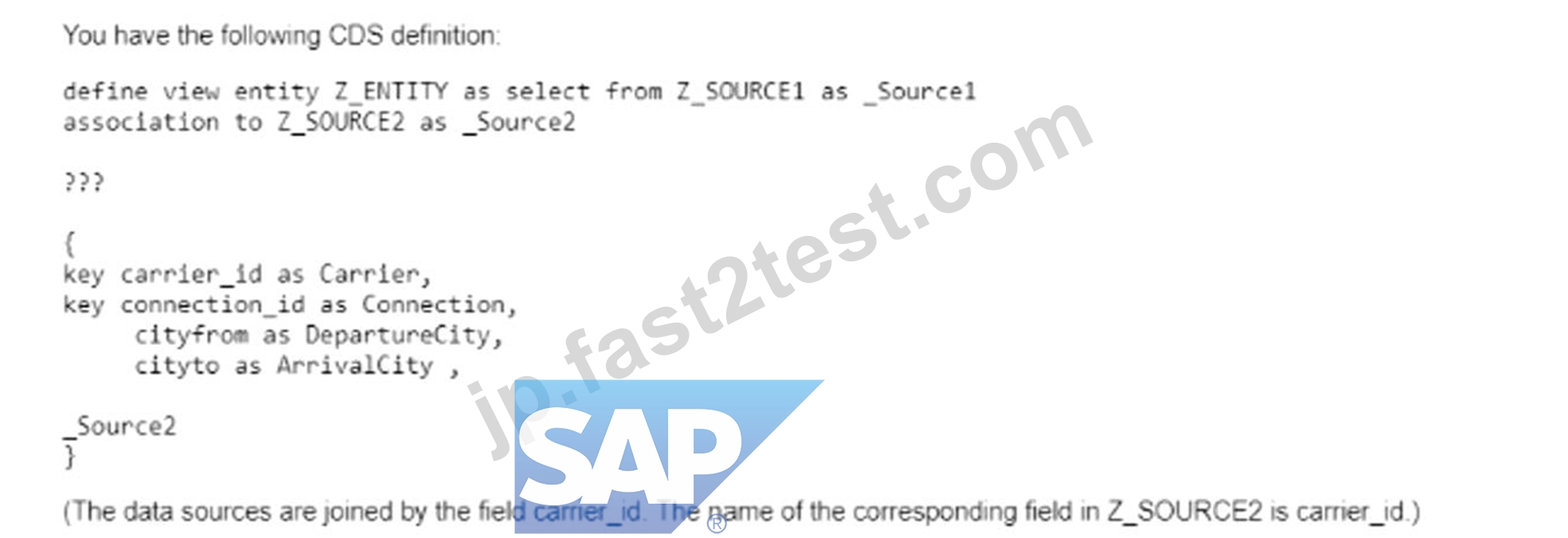
Which of the following ON conditions must you insert in place of "???"?
- A. ON Z_Sourcel.camer_id = 7_Source2 carrier_id
- B. ON Sprojection.carrier_id=Z_Source2.carrier_id
- C. ON Sprojection Camer=Source2 carrier_id
- D. ON Sprojection. Carrier Source2.carrier
正解:B
解説:
Explanation
The correct ON condition that must be inserted in place of "???" is:
ON Sprojection.carrier_id=Z_Source2.carrier_id
This ON condition specifies the join condition between the CDS view Sprojection and the database table Z_Source2. The join condition is based on the field carrier_id, which is the primary key of both the CDS view and the database table. The ON condition ensures that only the records that have the same value for the carrier_id field are joined together1.
The other options are not valid ON conditions, because:
A: ON Z_Sourcel.camer_id = 7_Source2 carrier_id is not valid because Z_Sourcel and 7_Source2 are not valid data sources in the given code. There is no CDS view or database table named Z_Sourcel or
7_Source2. The correct names are Z_Source1 and Z_Source2. Moreover, the field camer_id is not a valid field in the given code. There is no field named camer_id in any of the data sources. The correct name is carrier_id.
B: ON Sprojection Camer=Source2 carrier_id is not valid because Sprojection and Source2 are not valid data sources in the given code. There is no CDS view or database table named Sprojection or Source2.
The correct names are Sprojection and Z_Source2. Moreover, the field Camer is not a valid field in the given code. There is no field named Camer in any of the data sources. The correct name is carrier_id. Furthermore, the ON condition is missing the dot (.) operator between the data source name and the field name, which is required to access the fields of the data source1.
C: ON Sprojection. Carrier Source2.carrier is not valid because Carrier and carrier are not valid fields in the given code. There is no field named Carrier or carrier in any of the data sources. The correct name is carrier_id. Moreover, the ON condition is missing the dot (.) operator between the data source name and the field name, which is required to access the fields of the data source1.
References: 1: ON Condition - ABAP Keyword Documentation
質問 # 45
Which ABAP SQL clause allows the use of inline declarations?
- A. INTO
- B. INTO CORRESPONDING FIELDS OF
- C. FROM
- D. FIELDS
正解:A
解説:
The ABAP SQL clause that allows the use of inline declarations is the INTO clause. The INTO clause is used to specify the target variable or field symbol where the result of the SQL query is stored. The INTO clause can use inline declarations to declare the target variable or field symbol at the same position where it is used, without using a separate DATA or FIELD-SYMBOLS statement. The inline declaration is performed using the DATA or @DATA operators in the declaration expression12. For example:
The following code snippet uses the INTO clause with an inline declaration to declare a local variable itab and store the result of the SELECT query into it:
SELECT * FROM scarr INTO TABLE @DATA (itab).
The following code snippet uses the INTO clause with an inline declaration to declare a field symbol <fs> and store the result of the SELECT query into it:
SELECT SINGLE * FROM scarr INTO @<fs>.
You cannot do any of the following:
FROM: The FROM clause is used to specify the data source of the SQL query, such as a table, a view, or a join expression. The FROM clause does not allow the use of inline declarations12.
INTO CORRESPONDING FIELDS OF: The INTO CORRESPONDING FIELDS OF clause is used to specify the target structure or table where the result of the SQL query is stored. The INTO CORRESPONDING FIELDS OF clause does not allow the use of inline declarations. The target structure or table must be declared beforehand using a DATA or FIELD-SYMBOLS statement12.
FIELDS: The FIELDS clause is used to specify the columns or expressions that are selected from the data source of the SQL query. The FIELDS clause does not allow the use of inline declarations. The FIELDS clause must be followed by an INTO clause that specifies the target variable or field symbol where the result is stored12.
質問 # 46
Which of the following string functions are predicate functions? Note: There are 2 correct answers to this question.
- A. find_any_not_of()
- B. count_any_of()
- C. contains_any_of()
- D. matchesQ
正解:C、D
解説:
Explanation
String functions are expressions that can be used to manipulate character-like data in ABAP. String functions can be either predicate functions or non-predicate functions. Predicate functions are string functions that return a truth value (true or false) for a condition of the argument text. Non-predicate functions are string functions that return a character-like result for an operation on the argument text1.
The following string functions are predicate functions:
B). contains_any_of(): This function returns true if the argument text contains at least one of the characters specified in the character set. For example, the following expression returns true, because the text 'ABAP' contains at least one of the characters 'A', 'B', or 'C':
contains_any_of( val = 'ABAP' set = 'ABC' ).
D). matches(): This function returns true if the argument text matches the pattern specified in the regular expression. For example, the following expression returns true, because the text 'ABAP' matches the pattern that consists of four uppercase letters:
matches( val = 'ABAP' regex = '[A-Z]{4}' ).
The following string functions are not predicate functions, because they return a character-like result, not a truth value:
A). find_any_not_of(): This function returns the position of the first character in the argument text that is not contained in the character set. If no such character is found, the function returns 0. For example, the following expression returns 3, because the third character of the text 'ABAP' is not contained in the character set 'ABC':
find_any_not_of( val = 'ABAP' set = 'ABC' ).
C). count_any_of(): This function returns the number of characters in the argument text that are contained in the character set. For example, the following expression returns 2, because there are two characters in the text 'ABAP' that are contained in the character set 'ABC':
count_any_of( val = 'ABAP' set = 'ABC' ).
References: 1: String Functions - ABAP Keyword Documentation
質問 # 47
In what order are objects created to generate a RESTful Application Programming application?
- A. C B A B
- B. A D C B
- C. Data model view 2
- D. B D C A
- E. Service binding Projection view 4
- F. Database table 1
- G. D A B C
- H. Service definition 3
正解:H
解説:
The order in which objects are created to generate a RESTful Application Programming application is A, D, C, B. This means that the following steps are followed:
* First, a database table is created to store the data for the application. A database table is a CDS DDIC-based view that defines a join or union of database tables. A database table has an SQL view attached and can be accessed by Open SQL or native SQL.
* Second, a data model view is created to define a data model based on the database table or other CDS view entities. A data model view is a CDS view entity that can have associations, aggregations, filters, parameters, and annotations. A data model view can also define the behavior definition and implementation for the business object.
* Third, a service definition is created to define the service interface for the application. A service definition is a CDS view entity that defines a projection on a data model view or another service definition. A service definition can also define service metadata, such as service name, version, description, and annotations.
* Fourth, a service binding is created to define the service binding for the application. A service binding is a CDS view entity that defines a projection on a service definition. A service binding can also define the service protocol, such as OData V2, OData V4, or REST, and the service URL.
References: CDS Data Model Views - ABAP Keyword Documentation, CDS Service Definitions - ABAP Keyword Documentation, CDS Service Bindings - ABAP Keyword Documentation, CDS Projection Views - ABAP Keyword Documentation
質問 # 48
Which of the following string functions are predicate functions? Note: There are 2 correct answers to this question.
- A. find_any_not_of()
- B. count_any_of()
- C. contains_any_of()
- D. matchesQ
正解:C、D
解説:
String functions are expressions that can be used to manipulate character-like data in ABAP. String functions can be either predicate functions or non-predicate functions. Predicate functions are string functions that return a truth value (true or false) for a condition of the argument text. Non-predicate functions are string functions that return a character-like result for an operation on the argument text1.
The following string functions are predicate functions:
* B. contains_any_of(): This function returns true if the argument text contains at least one of the characters specified in the character set. For example, the following expression returns true, because the text 'ABAP' contains at least one of the characters 'A', 'B', or 'C':
contains_any_of( val = 'ABAP' set = 'ABC' ).
* D. matches(): This function returns true if the argument text matches the pattern specified in the regular expression. For example, the following expression returns true, because the text 'ABAP' matches the pattern that consists of four uppercase letters:
matches( val = 'ABAP' regex = '[A-Z]{4}' ).
The following string functions are not predicate functions, because they return a character-like result, not a truth value:
* A. find_any_not_of(): This function returns the position of the first character in the argument text that is not contained in the character set. If no such character is found, the function returns 0. For example, the following expression returns 3, because the third character of the text 'ABAP' is not contained in the character set 'ABC':
find_any_not_of( val = 'ABAP' set = 'ABC' ).
* C. count_any_of(): This function returns the number of characters in the argument text that are contained in the character set. For example, the following expression returns 2, because there are two characters in the text 'ABAP' that are contained in the character set 'ABC':
count_any_of( val = 'ABAP' set = 'ABC' ).
References: 1: String Functions - ABAP Keyword Documentation
質問 # 49 
To adhere to the most recent ABAP SQL syntax conventions from SAP, on which line must you insert the
"INTO TABLE @gt flights" clause to complete the SQL statement?
- A. #8
- B. #15
- C. #4
- D. #6
正解:C
解説:
To adhere to the most recent ABAP SQL syntax conventions from SAP, you must insert the "INTO TABLE
@gt flights" clause on line #4 to complete the SQL statement. This is because the INTO or APPENDING clause should be specified immediately after the SELECT clause, according to the ABAP SQL syntax conventions1. The INTO or APPENDING clause defines the data object to which the results set of the SELECT statement is assigned. The data object can be an internal table, a work area, or an inline declaration.
In this case, the data object is an internal table named gt_flights, which is created using the inline declaration operator @DATA. The inline declaration operator allows you to declare and create a data object in the same statement where it is used, without the need for a separate DATA statement2.
The other lines are not suitable for inserting the "INTO TABLE @gt flights" clause, as they would violate the ABAP SQL syntax conventions or cause syntax errors. These lines are:
* #6: This line is not suitable for inserting the "INTO TABLE @gt flights" clause, as it would cause a syntax error. This is because the FROM clause must be specified before the INTO or APPENDING clause, according to the ABAP SQL syntax conventions1. The FROM clause defines the data sources from which the data is read, such as database tables, CDS view entities, or CDS DDIC-based views. In this case, the data source is the database table flights.
* #8: This line is not suitable for inserting the "INTO TABLE @gt flights" clause, as it would cause a syntax error. This is because the ORDER BY clause must be specified after the INTO or APPENDING clause, according to the ABAP SQL syntax conventions1. The ORDER BY clause defines the sort order of the results set of the SELECT statement. In this case, the results set is sorted by the fields carrid, connid, and fltime.
* #15: This line is not suitable for inserting the "INTO TABLE @gt flights" clause, as it would violate the ABAP SQL syntax conventions. This is because the INTO or APPENDING clause should be specified as close as possible to the SELECT clause, according to the ABAP SQL syntax conventions1. The INTO or APPENDING clause should not be separated from the SELECT clause by other clauses, such as the WHERE clause, the GROUP BY clause, the HAVING clause, the UNION clause, or the ORDER BY clause. This is to improve the readability and maintainability of the ABAP SQL statement.
References: SELECT - ABAP Keyword Documentation, Inline Declarations - ABAP Keyword Documentation
質問 # 50
Image:
In the following ABAP SQL code, what are valid case distinctions? Note: There are 2 correct answers to this question.
- A.
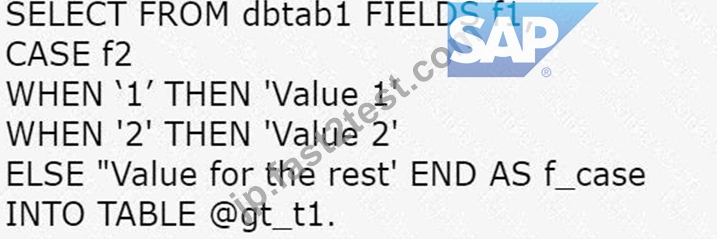
- B.

- C.

正解:A、B
質問 # 51
In class ZCL_CLASS_A, you use the statement DATA var TYPE ***
What may stand in place of ***? Note: There are 2 correct answers to this question.
- A. The name of a type defined privately in another class
- B. The name of a data element from the ABAP Dictionary
- C. The name of a type defined privately in class ZCL_CLASS_A
- D. The name of a domain from the ABAP Dictionary
正解:B、D
解説:
In class ZCL_CLASS_A, you use the statement DATA var TYPE *** to declare a data object named var with a data type specified by ***. The data type can be any of the following1:
* A predefined ABAP type, such as i, f, c, string, xstring, and so on.
* A data element from the ABAP Dictionary, such as matnr, carrid, bukrs, and so on. A data element defines the semantic and technical attributes of a data field, such as the domain, the length, the data type, the description, and the value range2.
* A domain from the ABAP Dictionary, such as matnr_d, carrid_d, bukrs_d, and so on. A domain defines the technical attributes of a data field, such as the data type, the length, the output length, the number of decimal places, and the value range3.
* A type defined globally in a class, an interface, or a type pool, such as zcl_class_b=>type_a, zif_interface_c=>type_b, ztype_pool_d=>type_c, and so on. A global type is a type that is defined in a global repository object and can be used in any program or class4.
* A type defined locally in the current class, such as type_a, type_b, type_c, and so on. A local type is a type that is defined in the declaration part of a class and can only be used within the class5.
Therefore, the possible values for *** are B. the name of a data element from the ABAP Dictionary and D. the name of a domain from the ABAP Dictionary. The other options are not valid because:
* A. The name of a type defined privately in class ZCL_CLASS_A is a local type and cannot be used with the DATA statement. A local type can only be used with the TYPES statement5.
* C. The name of a type defined privately in another class is a private type and cannot be accessed from outside the class. A private type can only be used within the class that defines it.
References: 1: DATA - ABAP Keyword Documentation 2: Data Elements - ABAP Dictionary - SAP Online Help 3: Domains - ABAP Dictionary - SAP Online Help 4: Global Types - ABAP Keyword Documentation 5:
Local Types - ABAP Keyword Documentation : Private Types - ABAP Keyword Documentation
質問 # 52
You have two internal tables itab1 and itab2.What is true for using the expression itab1 = corresponding #( itab2 )? Note: There are 2 correct answers to this question.
- A. itab1 and itab2 must have the same data type.
- B. itab1 and itab2 must have at least one field name in common.
- C. Fields with the same name but with different types may be copied from itab2 to itab1.
- D. Fields with the same name and the same type will be copied from itab2 to itab1.
正解:B、D
解説:
Explanation
The expression itab1 = corresponding #( itab2 ) is a constructor expression with the component operator CORRESPONDING that assigns the contents of the internal table itab2 to the internal table itab1. The following statements are true for using this expression:
B: itab1 and itab2 must have at least one field name in common. This is because the component operator CORRESPONDING assigns the identically named columns of itab2 to the identically named columns of itab1 by default, according to the rules of MOVE-CORRESPONDING for internal tables. If itab1 and itab2 do not have any field name in common, the expression will not assign any value to itab1 and it will remain initial or unchanged1 C: Fields with the same name and the same type will be copied from itab2 to itab1. This is because the component operator CORRESPONDING assigns the identically named columns of itab2 to the identically named columns of itab1 by default, according to the rules of MOVE-CORRESPONDING for internal tables. If the columns have the same name but different types, the assignment will try to perform a conversion between the types, which may result in a loss of precision, a truncation, or a runtime error, depending on the types involved1 The following statements are false for using this expression:
A: Fields with the same name but with different types may be copied from itab2 to itab1. This is not true, as explained in statement C. The assignment will try to perform a conversion between the types, which may result in a loss of precision, a truncation, or a runtime error, depending on the types involved1 D: itab1 and itab2 must have the same data type. This is not true, as the component operator CORRESPONDING can assign the contents of an internal table of one type to another internal table of a different type, as long as theyhave at least one field name in common. The target type of the expression is determined by the left-hand side of the assignment, which is itab1 in this case. The expression will create an internal table of the same type as itab1 and assign it to itab11 References: CORRESPONDING - Component Operator - ABAP Keyword Documentation
質問 # 53
Given the following code in an SAP S/4HANA Cloud private edition tenant: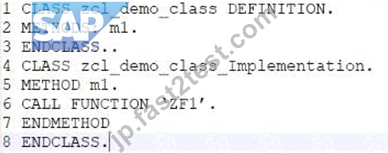
The class zcl_demo_class is in a software component with the language version set to "ABAP Cloud". The function module ZF1' is in a different software component with the language version set to "Standard ABAP".
Both the class and function module are customer created.
Regarding line #6, which of the following are valid statements? Note: There are 2 correct answers to this question.
- A. ZF1" can be called if a wrapper is created for it but the wrapper itself is not released for cloud development.
- B. "ZF1" can be called whether it is released or not for cloud development
- C. 'ZF1' can be called if a wrapper is created for it and the wrapper itself is released for cloud development.
- D. ZF1' can be called only if it is released for cloud development.
正解:C、D
解説:
Explanation
The ABAP Cloud Development Model requires that only public SAP APIs and extension points are used to access SAP functionality and data. These APIs and extension points are released by SAP and documented in the SAP API BusinessHub1. Customer-created function modules are not part of the public SAP APIs and are not released for cloud development. Therefore, calling a function module directly from an ABAP Cloud class is not allowed and will result in a syntax error. However, there are two possible ways to call a function module indirectly from an ABAP Cloud class:
Create a wrapper class or interface for the function module and release it for cloud development. A wrapper is a class or interface that encapsulates the function module and exposes its functionality through public methods or attributes. The wrapper must be created in a software component with the language version set to "Standard ABAP" and must be marked as released for cloud development using the annotation @EndUserText.label. The wrapper can then be called from an ABAP Cloud class using the public methods or attributes2.
Use the ABAP Cloud Connector to call the function module as a remote function call (RFC) from an ABAP Cloud class. The ABAP Cloud Connector is a service that enables the secure and reliable communication between SAP BTP, ABAP environment and on-premise systems. The function module must be exposed as an RFC-enabled function module in the on-premise system and must be registered in the ABAP Cloud Connector. The ABAP Cloud class can then use the class cl_rfc_destination_service to get the destination name and the class cl_abap_system to create a proxy object for the function module. The proxy object can then be used to call the function module3.
References: 1: SAP API Business Hub 2: Creating an ABAP Cloud Project | SAP Help Portal 3: Calling Remote Function Modules | SAP Help Portal
質問 # 54
Which function call returns 0?
- A. Count (val - 'ABAP ABAP abap' sub - 'AB' )
- B. find_any_of (val = "ABAP ABAP abap' sub = "AB")
- C. Count_any_of ( val - 'ABAP ABAP abap' sub "AB" )
- D. find_any_not_of( val 'ABAP ABAP abap' sub = 'AB')
正解:D
解説:
The function find_any_not_of returns the position of the first character in the string val that is not contained in the string sub. If no such character is found, the function returns 0. In this case, the string val contains only the characters A, B, and a, which are all contained in the string sub, so the function returns 0. The other functions return positive values, as follows:
Count_any_of returns the number of occurrences of any character in the string sub within the string val. In this case, it returns 8, since there are 8 A's and B's in val.
Count returns the number of occurrences of the string sub within the string val. In this case, it returns 2, since there are 2 AB's in val.
find_any_of returns the position of the first character in the string val that is contained in the string sub. In this case, it returns 1, since the first character A is in sub. Reference: String Functions - ABAP Keyword Documentation, Examples of String Functions - ABAP Keyword Documentation
質問 # 55
What RESTful Application Programming object contains only the fields required for a particular app?
- A. Metadata extension
- B. Data model view
- C. Database view
- D. Projection View
正解:D
解説:
A projection view is a RESTful Application Programming object that contains only the fields required for a particular app. A projection view is a CDS view entity that defines a projection on an existing CDS view entity or CDS DDIC-based view. A projection view exposes a subset of the elements of the projected entity, which are relevant for a specific business service. A projection view can also define aliases, virtual elements, and annotations for the projected elements. A projection view is the top-most layer of a CDS data model and prepares data for a particular use case. A projection view can have different provider contracts depending on the type of service it supports, such as transactional query, analytical query, or transactional interface.
A database view is a CDS DDIC-based view that defines a join or union of database tables. A database view has an SQL view attached and can be accessed by Open SQL or native SQL. A database view can be used as a projected entity for a projection view, but it does not contain only the fields required for a particular app.
A metadata extension is a RESTful Application Programming object that defines additional annotations for a CDS view entity or a projection view. A metadata extension can be used to enhance the metadata of a CDS data model without changing the original definition. A metadata extension does not contain any fields, but only annotations.
A data model view is a CDS view entity that defines a data model based on database tables or other CDS view entities. A data model view can have associations, aggregations, filters, parameters, and annotations. A data model view can be used as a projected entity for a projection view, but it does not contain only the fields required for a particular app.
References: CDS Projection Views - ABAP Keyword Documentation, CDS Projection Views in ABAP CDS:
What's Your Flavor, Business Object Projection - ABAP Keyword Documentation
質問 # 56
When does SAP recommend to use a sorted or a hashed table respectively? Note: There are 2 correct answers to this question.
- A. A sorted table, when you read a subset in a loop and specify a part of the key from the left ^ without gaps.
- B. A hashed table, when you read a subset in a loop and specify a part of the key from the left without gaps.
- C. A hashed table, when you read a single record and specify the complete key.
- D. A sorted table, when you read a single record and specify non key fields.
正解:B、C
質問 # 57
When processing a loop with the statement DO... ENDDO, what system variable contains the implicit loop counter?
- A. sy-labix
- B. sy-subrc
- C. sy-linno
- D. sy-index
正解:D
解説:
When processing a loop with the statement DO... ENDDO, the system variable that contains the implicit loop counter is sy-index. The loop counter is a numeric value that indicates how many times the loop has been executed. The loop counter is initialized to 1 before the first execution of the loop and is incremented by 1 after each execution. The loop counter can be used to control the number of loop iterations or to access the loop elements by index. The loop counter can also be accessed or modified within the loop body, but this is not recommended as it may cause unexpected results or errors1.
For example, the following code snippet uses the loop counter sy-index to display the numbers from 1 to 10:
DO 10 TIMES. WRITE: / sy-index. ENDDO.
The output of this code is:
1 2 3 4 5 6 7 8 9 10
References: 1: DO - ABAP Keyword Documentation
質問 # 58
For what kind of applications would you consider using on-stack developer extensions? Note: There are 2 correct answers to this question.
- A. Applications that provide APIs for side by side SAP BTP apps
- B. Applications that integrate data from several different systems
- C. Applications that access SAP S/4HANA data using complex SQL
- D. Applications that run separate from SAP S/4HANA
正解:A、C
解説:
On-stack developer extensibility is a type of extensibility that allows you to create development projects directly on the SAP S/4HANA Cloud technology stack. It gives you the opportunity to develop cloud-ready and upgrade-stable custom ABAP applications and services inside the SAP S/4HANA Cloud, public edition system. You can use the ABAP Development Tools in Eclipse to create and deploy your on-stack extensions. On-stack developer extensibility is suitable for the following kinds of applications:
Applications that provide APIs for side by side SAP BTP apps. On-stack developer extensibility allows you to create OData services or RESTful APIs based on CDS view entities or projection views. These services or APIs can expose SAP S/4HANA data and logic to other applications that run on the SAP Business Technology Platform (SAP BTP) or other platforms. This way, you can create a loosely coupled integration between your SAP S/4HANA system and your side by side SAP BTP apps.
Applications that access SAP S/4HANA data using complex SQL. On-stack developer extensibility allows you to use ABAP SQL to access SAP S/4HANA data using complex queries, such as joins, aggregations, filters, parameters, and code pushdown techniques. You can also use ABAP SQL to perform data manipulation operations, such as insert, update, delete, and upsert. This way, you can create applications that require advanced data processing and analysis on SAP S/4HANA data.
The other kinds of applications are not suitable for on-stack developer extensibility, as they have different requirements and challenges. These kinds of applications are:
Applications that integrate data from several different systems. On-stack developer extensibility is not meant for creating applications that integrate data from multiple sources, such as other SAP systems, third-party systems, or cloud services. This is because on-stack developer extensibility does not support remote access or data replication, and it may cause performance or security issues. For this kind of applications, you should use side by side extensibility, which allows you to create applications that run on the SAP BTP and communicate with the SAP S/4HANA system via public APIs or events.
Applications that run separate from SAP S/4HANA. On-stack developer extensibility is not meant for creating applications that run independently from the SAP S/4HANA system, such as standalone apps, microservices, or web apps. This is because on-stack developer extensibility requires a tight coupling with the SAP S/4HANA system, and it may limit the scalability, flexibility, and portability of the applications. For this kind of applications, you should use side by side extensibility, which allows you to create applications that run on the SAP BTP and leverage the cloud-native features and services of the platform.
質問 # 59
Which of the following results in faster access to internal tables? Note: There are 3 correct answers to this question.
- A. In a sorted internal table, specifying the primary key partially from the left without gaps.
- B. In a hashed internal table, specifying the primary key partially from the left without gaps.
- C. In a sorted internal table, specifying the primary key completely.
- D. In a standard internal table, specifying the primary key partially from the left without gaps.
- E. In a hashed internal table, specifying the primary key completely.
正解:B、C、E
解説:
The access to internal tables can be optimized by using the appropriate table type and specifying the table key.
The table key is a set of fields that uniquely identifies a row in the table and determines the sorting order of the table. The table key can be either the primary key or a secondary key. The primary key is defined by the table type and the table definition, while the secondary key is defined by the user using the KEY statement1.
The following results in faster access to internal tables:
* B. In a sorted internal table, specifying the primary key completely. A sorted internal table is a table type that maintains a predefined sorting order, which is defined by the primary key in the table definition. The primary key can be either unique or non-unique. A sorted internal table can be accessed
* using the primary key or the table index. The access using the primary key is faster than the access using the table index, because the system can use a binary search algorithm to find the row. However, the primary key must be specified completely, meaning that all the fields of the primary key must be given in the correct order and without gaps2.
* D. In a hashed internal table, specifying the primary key partially from the left without gaps. A hashed internal table is a table type that does not have a predefined sorting order, but uses a hash algorithm to store and access the rows. The primary key of a hashed internal table must be unique and cannot be changed. A hashed internal table can only be accessed using the primary key, not the table index. The access using the primary key is very fast, because the system can directly calculate the position of the row using the hash algorithm. The primary key can be specified partially from the left without gaps, meaning that some of the fields of the primary key can be omitted, as long as they are the rightmost fields and there are no gaps between the specified fields.
* E. In a hashed internal table, specifying the primary key completely. A hashed internal table is a table type that does not have a predefined sorting order, but uses a hash algorithm to store and access the rows. The primary key of a hashed internal table must be unique and cannot be changed. A hashed internal table can only be accessed using the primary key, not the table index. The access using the primary key is very fast, because the system can directly calculate the position of the row using the hash algorithm. The primary key can be specified completely, meaning that all the fields of the primary key must be given in the correct order.
The following do not result in faster access to internal tables, because:
* A. In a sorted internal table, specifying the primary key partially from the left without gaps. A sorted internal table is a table type that maintains a predefined sorting order, which is defined by the primary key in the table definition. The primary key can be either unique or non-unique. A sorted internal table can be accessed using the primary key or the table index. The access using the primary key is faster than the access using the table index, because the system can use a binary search algorithm to find the row.
However, the primary key must be specified completely, meaning that all the fields of the primary key must be given in the correct order and without gaps. If the primary key is specified partially from the left without gaps, the system cannot use the binary search algorithm and has to perform a linear search, which is slower2.
* C. In a standard internal table, specifying the primary key partially from the left without gaps. A standard internal table is a table type that does not have a predefined sorting order, but uses a sequential storage and access of the rows. The primary key of a standard internal table is the standard key, which consists of all the fields of the table row in the order in which they are defined. A standard internal table can be accessed using the primary key or the table index. The access using the primary key is slower than the access using the table index, because the system has to perform a linear search to find the row.
The primary key can be specified partially from the left without gaps, but this does not improve the access speed, because the system still has to perform a linear search.
References: 1: Internal Tables - Overview - ABAP Keyword Documentation 2: Sorted Tables - ABAP Keyword Documentation : Hashed Tables - ABAP Keyword Documentation : Standard Tables - ABAP Keyword Documentation
質問 # 60
......
あなたを合格させるSAP試験にはC_ABAPD_2309試験問題集:https://jp.fast2test.com/C_ABAPD_2309-premium-file.html