

[2024年10月13日] 有効なSalesforce-MuleSoft-Developer-IIテスト解答とSalesforce Salesforce-MuleSoft-Developer-II試験PDF問題を試そう
実際に出るSalesforce-MuleSoft-Developer-II試験問題集には正確で更新された問題
質問 # 19
The Center for Enablement team published a common application as a reusable module to the central Nexus repository.
How can the common application be included in all API implementations?
- A. Add a Maven dependency in the PCM file with multiple-plugin as <classifier>
- B. Download the common application from Naxus and copy it to the src/main/resources folder in the API
- C. Copy the common application's source XML file and out it in a new flow file in the src/main/mule folder
- D. Add a Maven dependency in the POM file with jar as <classifier>
正解:D
解説:
To include a common application as a reusable module in all API implementations, the developer should add a Maven dependency in the POM file with jar as <classifier>. This way, the developer can reuse Mule code from another application by packaging it as a JAR file and adding it as a dependency in the POM file of the API implementation. The classifier element specifies that it is a JAR file. Reference: https://docs.mulesoft.com/mule-runtime/4.3/mmp-concept#add-a-maven-dependency-to-the-pom-file
質問 # 20
Mule application A is deployed to CloudHub and is using Object Store v2. Mute application B is also deployed to CloudHub.
Which approach can Mule application B use to remove values from Mule application A'S Object Store?
- A. Object Store v2 REST API
- B. CloudHub REST API
- C. Object Store Connector
- D. CloudHub Connector
正解:A
解説:
To remove values from Mule application A's Object Store v2, Mule application B can use Object Store v2 REST API. This API allows performing operations on Object Store v2 resources using HTTP methods, such as GET, POST, PUT, and DELETE. Mule application B can use the DELETE method to remove values from Mule application A's Object Store v2 by specifying the object store ID and the key of the value to delete. Reference: https://docs.mulesoft.com/object-store/osv2-apis
質問 # 21
The flow is invoicing a target API. The API's protocol is HTTPS. The TLS configuration in the HTTP Request Configuration global element is set to None. A web client submits a request to http:localhost:8081/vehicles.
If the certificate of the target API is signed by a certificate authority (CA), what is true about the HTTP Request operation when the flow executes?
- A. The HTTP Request operation will always fail regardless of the CA
- B. The HTTP Request operation will succeed if the CA'S certificate is present in the JRE's default keystore
- C. The HTTP Request operation will succeed if the CA's certificate is present in the JRE's default truststore.
- D. The HTTP Request operation will always succeed regardless of the CA
正解:C
解説:
The HTTP Request operation will use the default truststore of the JRE to validate the certificate of the target API. If the CA's certificate is present in the truststore, the operation will succeed. Otherwise, it will fail with a handshake exception. Reference: https://docs.mulesoft.com/mule-runtime/4.3/tls-configuration#tls-default
質問 # 22
A heathcare customer wants to use hospital system data, which includes code that was developed using legacy tools and methods. The customer has created reusable Java libraries in order to read the data from the system.
What is the most effective way to develop an API retrieve the data from the hospital system?
- A. Include the libraries writes deploying the code into the runtime
- B. Refer to JAR files in the code
- C. Create the Java code in your project and invoice the data from the code
- D. Install libraries in a local repository and refer to it in the pm.xml file
正解:D
解説:
To develop an API that retrieves data from a hospital system using reusable Java libraries, the developer should install libraries in a local repository and refer to it in the pom.xml file. This way, the developer can use Maven to manage dependencies and invoke Java code from Mule applications using Java Module operations. Reference: https://docs.mulesoft.com/mule-runtime/4.3/java-module-reference#add-the-java-module-to-your-project https://docs.mulesoft.com/mule-runtime/4.3/java-module-reference#invoke-java-code
質問 # 23
Which statement is true when using XML SDK for creating custom message processors?
- A. Operations can be reused in recursive calls
- B. An XML SDK provides both inbound and outbound operations
- C. Properties are fields defined by an end user of the XML SDK component and serve as a global configuration for the entire Mule project in which they are used
- D. All operations are public
正解:C
解説:
When using XML SDK for creating custom message processors, all operations are public by default and can be used by any Mule application that imports them. There is no way to make an operation private or protected in XML SDK. Reference: https://docs.mulesoft.com/mule-sdk/1.1/xml-sdk#operations
質問 # 24
Refer to the exhibit.
What action must be performed to log all the errors raised by the VM Connector?
- A. Nothing, as error-level events are automatically logged
- B. Add <AsyncLOgger name='orgroute.extensions vm' level=ERROR'/> inside the Appenders tag
- C. Configure <Logger level-'ERROR'/> inside the VM Connector configuration
- D. Add <AsyncLOgger name='orgroute.extensions vm' level=ERROR'I> inside the Logger tag
正解:B
解説:
To log all the errors raised by the VM Connector, the developer needs to add an async logger with the name 'org.mule.extension.vm' and the level 'ERROR' inside the appenders tag of the log4j2.xml file. This will enable logging all error-level events generated by the VM Connector to the console appender. Reference: https://docs.mulesoft.com/mule-runtime/4.3/logging-in-mule#configuring-custom-logging-settings
質問 # 25
Which plugin or dependency is required to unit test modules created with XML SDK?
- A. MUnit Maven plugin
- B. MUnit Extensions Maven plugin
- C. XMLUnit
- D. Junit
正解:B
解説:
To unit test modules created with XML SDK, the developer needs to use the MUnit Extensions Maven plugin. This plugin allows testing XML SDK modules using MUnit by adding a dependency to the module under test and using a custom processor tag to invoke it. Reference: https://docs.mulesoft.com/mule-sdk/1.1/xml-sdk#testing
質問 # 26
Refer to the exhibits.
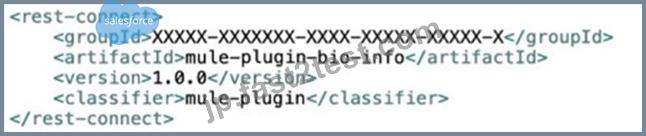
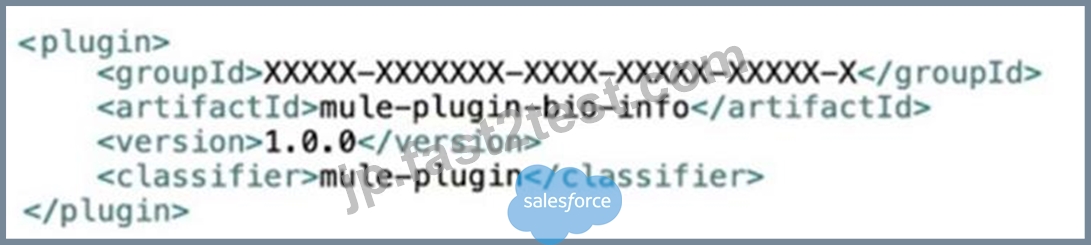
Bioinfo System API is implemented and published to Anypoint Exchange. A developer wants to invoke this API using its REST Connector.
What should be added to the POM?
- A.

- B.

- C.
- D.
- E.

正解:D
解説:
To invoke Bioinfo System API using its REST Connector, option E should be added to the pom.xml file. This option adds a dependency for Bioinfo System API REST Connector with its group ID, artifact ID, version, classifier, and type. The classifier specifies that it is a REST Connector (raml-client), and the type specifies that it is a Mule plugin (mule-plugin). Reference: https://docs.mulesoft.com/apikit/4.x/apikit-4-generate-from-rest-api-task#add-the-api-dependency-to-the-pom-file
質問 # 27
A developer is working on a project that requires encrypting all data before sending it to a backend application. To accomplish this, the developer will use PGP encryption in the Mule 4 Cryptography module.
What is required to encrypt the data before sending it to the backend application?
- A. The application needs to both the private and public keys to encrypt the data
- B. The application needs to configure HTTPS TLS context information to encrypt the data
- C. The application needs the private key from the backend service to encrypt the data
- D. The application needs the public key from the backend service to encrypt the data
正解:D
解説:
To encrypt the data before sending it to the backend application using PGP encryption, the application needs the public key from the backend service. PGP encryption uses a public-key cryptography system, which means that each party has a pair of keys: a public key and a private key. The public key is used to encrypt data, and the private key is used to decrypt data. Therefore, to encrypt data for a specific recipient (the backend service), the application needs to use the recipient's public key. The recipient can then use its own private key to decrypt the data. Reference: https://docs.mulesoft.com/mule-runtime/4.3/cryptography-pgp
質問 # 28
When a client and server are exchanging messages during the mTLS handshake, what is being agreed on during the cipher suite exchange?
- A. The TLS version
- B. An encryption algorithm
- C. A protocol
- D. The Public key format
正解:B
解説:
A cipher suite is a set of cryptographic algorithms that are used to secure the communication between a client and a server. A cipher suite consists of four components: a key exchange algorithm, an authentication algorithm, an encryption algorithm, and a message authentication code (MAC) algorithm. During the cipher suite exchange, the client and the server agree on which encryption algorithm to use for encrypting and decrypting the data. Reference: https://docs.mulesoft.com/mule-runtime/4.3/tls-configuration#cipher-suites
質問 # 29
A Flight Management System publishes gate change notification events whenever a flight's arrival gate changes. Other systems, including Baggage Handler System. Inflight Catering System and Passenger Notifications System, must each asynchronously receive the same gate change notification to process the event according.
Which configuration is required in Anypoint MQ to achieve this publish/subscribe model?
- A. Publish the gate change notification to an Anypoint MQ exchanhe.
Create different Anypoint MQ queues meant for each of the other subscribing systems.Bind the exchange with each of the queues. - B. Publish the gate change notification to an Anypoint MQ queue.
Create different anypoint MQ exchange meant for each of the other subscribing systems Bind the queue with each of the exchanges - C. Publish each client subscribe directly to the exchange.
Have each client subscribe directly to the queue. - D. Publish the gate change notification to an Anypoint MC queue
Have each client subscribe directly to the queue
正解:A
解説:
To achieve a publish/subscribe model using Anypoint MQ, where each system receives the same gate change notification event, the developer should publish the gate change notification to an Anypoint MQ exchange, create different Anypoint MQ queues meant for each of the other subscribing systems, and bind the exchange with each of the queues. An exchange is a message routing agent that can send messages to different queues based on predefined criteria. By binding an exchange with multiple queues, each queue receives a copy of every message sent to that exchange. Therefore, each system can subscribe to its own queue and receive every gate change notification event. Reference: https://docs.mulesoft.com/anypoint-mq/3.x/anypoint-mq-exchanges
質問 # 30
A healthcare portal needs to validate the token that it sends to a Mule API. The developer plans to implement a custom policy using the HTTP Policy Transform Extension to match the token received in the header from the heathcare portal.
Which files does the developer need to create in order to package the custom policy?
- A. JSON properties file, XML template file
- B. JSON properties file, YAML configuration file
- C. Deployable ZIP file, YAML configuration file
- D. XML template file, YAML configuration file
正解:D
解説:
To package a custom policy using the HTTP Policy Transform Extension, the developer needs to create an XML template file and a YAML configuration file. The XML template file defines the policy logic using Mule components and placeholders for user-defined properties. The YAML configuration file defines the metadata of the policy, such as its name, description, category, parameters, and dependencies. Reference: https://docs.mulesoft.com/api-manager/2.x/http-policy-transform#packaging-the-policy
質問 # 31
A Mule application contain two policies Policy A and Policy A has order1, and Policy B has order 2. Policy A Policy B, and a flow are defined by he configuration below.
When a HTTP request arrives at the Mule application's endpoint, what will be the execution order?
- A. F1, B1, A1, A2, B2
- B. A1, B1, F1, B2, A2
- C. B1, A1, F1, A2, B2
- D. F1, A1, B1, B2, A2
正解:B
解説:
Based on the configuration below, when a HTTP request arrives at the Mule application's endpoint, the execution order will be A1, B1, F1, B2, A2. This is because policies are executed before and after the API implementation flow according to their order attribute. Policy A has order 1, which means it is executed first before Policy B, which has order 2. The flow is executed after both policies are executed before the flow. Then, Policy B is executed after the flow before Policy A is executed after the flow. Reference: https://docs.mulesoft.com/api-manager/2.x/policies-policy-order
質問 # 32
A Mule implementation uses a HTTP Request within an Unit Successful scope to connect to an API.
How should a permanent error response like HTTP:UNAUTHORIZED be handle inside Until Successful to reduce latency?
- A. Put the HTTP Request inside a try scope in Unit Successful.
In the error handler, use On Error Propagate to catch permanent errors like HTTP UNAUTHORIZED. - B. In Until Successful configuration, set the retry count to 1 for error type HTTP: UNAUTHORIZED.
- C. Put the HTTP Request inside a try scope in Unit Successful.
In the error handler, use On Error Continue to catch permanent errors like HTTP UNAUTHORIZED. - D. Configure retrying until a MULERETRY_EXHAUSTED error is raised or the API responds back with a successful response.
正解:C
解説:
To handle a permanent error response like HTTP:UNAUTHORIZED inside Until Successful, the developer should put the HTTP Request inside a try scope in Unit Successful, and use On Error Continue to catch permanent errors like HTTP UNAUTHORIZED in the error handler. This way, the developer can avoid retrying requests that will always fail due to a permanent error, and reduce latency. On Error Continue allows the flow to continue processing after handling the error. Reference: https://docs.mulesoft.com/mule-runtime/4.3/until-successful-scope https://docs.mulesoft.com/mule-runtime/4.3/on-error-continue-concept
質問 # 33
A Mule application defines as SSL/TLS keystore properly 'tis,keystore.keyPassword'' as secure.
How can this property be referenced to access its value within the application?
- A. p{secure::tiskeystore,keyPassowrd}
- B. ${secure::tiskeystore,keyPassowrd}
- C. ${secure::tiskeystore,keyPassowrd}
- D. #{secure::tiskeystore,keyPassowrd}
正解:B
解説:
secure::tiskeystore,keyPassowrd∗∗ShortExplanationofCorrectAnswerOnly:Toreferenceasecurepropertyvaluewithintheapplication,thedeveloperneedstousethesyntax{secure::}. In this case, the property name is tiskeystore,keyPassword, so the correct syntax is ${secure::tiskeystore,keyPassowrd}. Reference: https://docs.mulesoft.com/mule-runtime/4.3/secure-configuration-properties#referencing-secure-properties
質問 # 34
Refer to the exhibit.
Based on the code snippet, schema,json file, and payload below, what is the outcome of the given code snippet when a request is sent with the payload?
- A. The Mule flow will execute successfully with status code 200m and a response will display the message '' Age in years which must equal to or greater than zero.''
- B. The Mule flow will execute successfully with status code 204
- C. The Mule flow will execute successfully with status code 200, and the response will be the JSON sent in request
- D. The Mule flow will throw the exception 'JSON:SCHEMA_NOT_HONOURED
正解:D
解説:
Based on the code snippet, schema.json file, and payload below, the outcome of the given code snippet when a request is sent with the payload is that the Mule flow will throw the exception 'JSON:SCHEMA_NOT_HONOURED'. This is because the payload does not conform to the schema.json file, which specifies that age must be a number greater than or equal to zero. The payload has age as a string with a negative value, which violates the schema. Therefore, the validate-schema operation throws an error with type 'JSON:SCHEMA_NOT_HONOURED'. Reference: https://docs.mulesoft.com/json-module/1.1/json-validate-schema
質問 # 35
Which configurations are required for HTTP Listener to enable mTLS authentication?
- A. Set an appropriate keystore and truststore configuration for the listener
- B. Set an appropriate keystore configuration and use persistent connections for the listener
- C. Set an appropriate truststore configuration and reconnection strategy for the listener
- D. Set an appropriate reconnection strategy and use persistent connections for the listener
正解:A
解説:
To enable mTLS authentication for HTTP Listener, the developer needs to set an appropriate keystore and truststore configuration for the listener. The keystore contains the certificate and private key of the Mule application that are used to prove its identity to clients. The truststore contains the certificates of trusted clients that are allowed to access the Mule application. Reference: https://docs.mulesoft.com/mule-runtime/4.3/tls-configuration#mutual-authentication
質問 # 36
What is the MuleSoft recommended method to encrypt sensitive property data?
- A. The encryption key should be different for each environment and the sensitive data should be the same for all environments
- B. The encryption key and sensitive data should be different for each environment
- C. The encryption key should be identical for all environments and the sensitive data should be different for each environment
- D. The encryption key should be identical for all environments
正解:B
解説:
The MuleSoft recommended method to encrypt sensitive property data is to use the Secure Properties Tool that comes with Anypoint Studio. This tool allows encrypting properties files with a secret key and then decrypting them at runtime using the same key. The encryption key and sensitive data should be different for each environment to ensure security and avoid accidental exposure of sensitive data. Reference: https://docs.mulesoft.com/mule-runtime/4.3/secure-configuration-properties
質問 # 37
An organization uses CloudHub to deploy all of its applications.
How can a common-global-handler flow be configured so that it can be reused across all of the organization's deployed applications?
- A. Create a common-global-error-handler flow in all Mule Applications Refer to it flow-ref wherever needed.
- B. Create a Mule plugin project
Create a common-global-error-handler flow inside the plugin project.
Use this plugin as a dependency in all Mute applications.
Import that configuration file in Mute applications. - C. Create a Mule Plugin project
正解:C
解説:
Create a common-global-error-handler flow inside the plugin project.
Use this plugin as a dependency in all Mule applications
D.
Create a Mule daman project.
Create a common-global-error-handler flow inside the domain project.
Use this domain project as a dependency.
Explanation:
To configure a common-global-handler flow that can be reused across all of the organization's deployed applications, the developer should create a Mule Plugin project, create a common-global-error-handler flow inside the plugin project, and use this plugin as a dependency in all Mule applications. This way, the developer can import the common-global-error-handler flow in any application that needs it and avoid duplicating the error handling logic. Reference: https://docs.mulesoft.com/mule-runtime/4.3/error-handling#global-error-handler
質問 # 38
Refer to the exhibit.
What required changes can be made to give a partial successful response in case the United Airlines API returns with a timeout?
- A. Add Flow Reference components inside a Try scope
Set the payload to a default value '' inside the error handler using the On Error Propagate scope - B. Add a Scatter-Gather component inside a Try scope.
Set the payload to a default value 'Error'' inside the error handler using the On Error Continue scope. - C. Add Flow Reference components inside a Try scope.
Set the payload to a default value'' insider the error handler using the ON Error Continue scope - D. Add a Scatter-gather component inside a Try scope.
Set the payload to a default value 'Error' inside the error handler using the On Error Propagate scope.
正解:B
解説:
To give a partial successful response in case the United Airlines API returns with a timeout, the developer should add a Scatter-Gather component inside a Try scope, and set the payload to a default value 'Error' inside the error handler using the On Error Continue scope. A Scatter-Gather component allows sending multiple requests concurrently and aggregating the responses into an array. A Try scope allows handling errors that occur within it using an error handler. An On Error Continue scope allows continuing the flow execution after handling an error. Therefore, by using these components, the developer can send requests to both APIs in parallel, handle any timeout errors from United Airlines API, and return a partial response with a default value for that API. Reference: https://docs.mulesoft.com/mule-runtime/4.3/scatter-gather-concept https://docs.mulesoft.com/mule-runtime/4.3/try-scope-concept https://docs.mulesoft.com/mule-runtime/4.3/on-error-continue-concept
質問 # 39
Refer to the exhibit.
The flow name is ''implementation'' with code for the MUnit test case.
When the MUnit test case is executed, what is the expected result?
- A. The test throws an error and does not start
- B. The test case fails with an assertion error
- C. The test case fails with an unexpected error type
- D. The test case passes
正解:B
解説:
Based on the code snippet and MUnit test case below, when the MUnit test case is executed, the expected result is that the test case fails with an assertion error. This is because the assert-equals processor compares two values for equality, and fails if they are not equal. In this case, the expected value is 'Hello World', but the actual value returned by the implementation flow is 'Hello Mule'. Therefore, the assertion fails and an error is thrown. Reference: https://docs.mulesoft.com/munit/2.3/assert-equals-processor
質問 # 40
A new Mule project has been created in Anypoint Studio with the default settings.
Which file inside the Mule project must be modified before using Maven to successfully deploy the application?
- A. Mule.artificact.json
- B. Pom.xml
- C. Config.yaml
- D. Settings.xml
正解:B
解説:
To use Maven to successfully deploy the application, the developer needs to modify the pom.xml file inside the Mule project. The pom.xml file contains the configuration and dependencies of the Mule application, as well as the deployment information such as the CloudHub region, environment, and worker size. The developer needs to specify these properties in the pom.xml file before using Maven to deploy the application. Reference: https://docs.mulesoft.com/mule-runtime/4.3/mmp-concept#application-deployment-descriptor
質問 # 41
Refer to the exhibit.
A Mute Object Store is configured with an entry TTL of one second and an expiration interval of 30 seconds.
What is the result of the flow if processing between os'store and os:retrieve takes 10 seconds?
- A. testPayload
- B. nullPayload
- C. OS:KEY_NOT_FOUND
- D. originalPayload
正解:B
解説:
The result of the flow is nullPayload if processing between os:store and os:retrieve takes 10 seconds. This is because the entry TTL of the object store is one second, which means that any stored value expires after one second and is removed from the object store. The expiration interval of 30 seconds only determines how often the object store checks for expired values, but it does not affect the TTL. Therefore, when os:retrieve tries to get the value after 10 seconds, it returns nullPayload because the value has already expired and been removed. Reference: https://docs.mulesoft.com/object-store/osv2-faq#how-does-the-time-to-live-work
質問 # 42
An API has been built to enable scheduling email provider. The front-end system does very little data entry validation, and problems have started to appear in the email that go to patients. A validate-customer'' flow is added validate the data.
What is he expected behavior of the 'validate-customer'' flow?
- A. If the email address is invalid, processing continues to see if the appointment data and customer name are also invalid
- B. If only the email address Is invalid a VALIDATION.INVALID_EMAIL error is raised
- C. If all of the values are invalid the last validation error is raised:SCHEDULE:INVALID_CUSTOMER_NAME
- D. If the appointment date and customer name are invalid, a SCHEDULE:INVALID_APPOINTMENT_DATE error is raised
正解:B
解説:
The validate-customer flow uses an until-successful scope to validate each field of the customer data. The until-successful scope executes its processors until they succeed or exhausts the maximum number of retries. If any processor fails, it raises an error and stops executing the remaining processors. Therefore, if only the email address is invalid, a VALIDATION.INVALID_EMAIL error is raised and the validation of appointment date and customer name is skipped. Reference: https://docs.mulesoft.com/mule-runtime/4.3/until-successful-scope
質問 # 43
......
Salesforce-MuleSoft-Developer-II試験問題集でPDF問題とテストエンジン:https://jp.fast2test.com/Salesforce-MuleSoft-Developer-II-premium-file.html